Best B2B Data Platforms in 2026: A Buyer's Comparison Guide
A neutral, hands-on comparison of the best B2B data platforms in 2026 — accuracy, coverage, pricing, and compliance — so you pick the right contact data stack without overpaying.
Picking a B2B data platform is really a bet on two numbers: how often the contact record is right, and how much you pay for the times it's wrong. Everything else — UI, integrations, "intent signals" — sits on top of those two numbers. This guide compares the best B2B data platforms in 2026 on the things that actually move pipeline, and tells you which fits which team.
TL;DR#
- No single platform wins for everyone. ZoomInfo leads on enterprise breadth, Cognism on EU/phone compliance, Apollo on all-in-one value, and Tomba on accuracy-per-dollar for email-led teams.
- Accuracy beats database size. A 100M-record database with a 70% hit rate wastes more of your SDRs' time than a focused database that verifies before it bills you.
- Watch the pricing model, not the sticker price. Per-seat platforms punish small teams; credit-based and API tools scale down cleanly.
- Compliance is a feature now. GDPR, CCPA, and phone-DNC handling separate the serious vendors from the scrapers.
- Most teams overbuy. Start with verified email + domain search, add intent and phone only when a clear use case demands it.
What is a B2B data platform?#
A B2B data platform is a tool that turns a name, a company, or a domain into a usable, accurate contact record — work email, phone, title, company firmographics — and keeps that record fresh. Think of it as the difference between a phone book and a concierge: the phone book lists everyone once and rots immediately; the concierge confirms the person still works there before handing you the number.
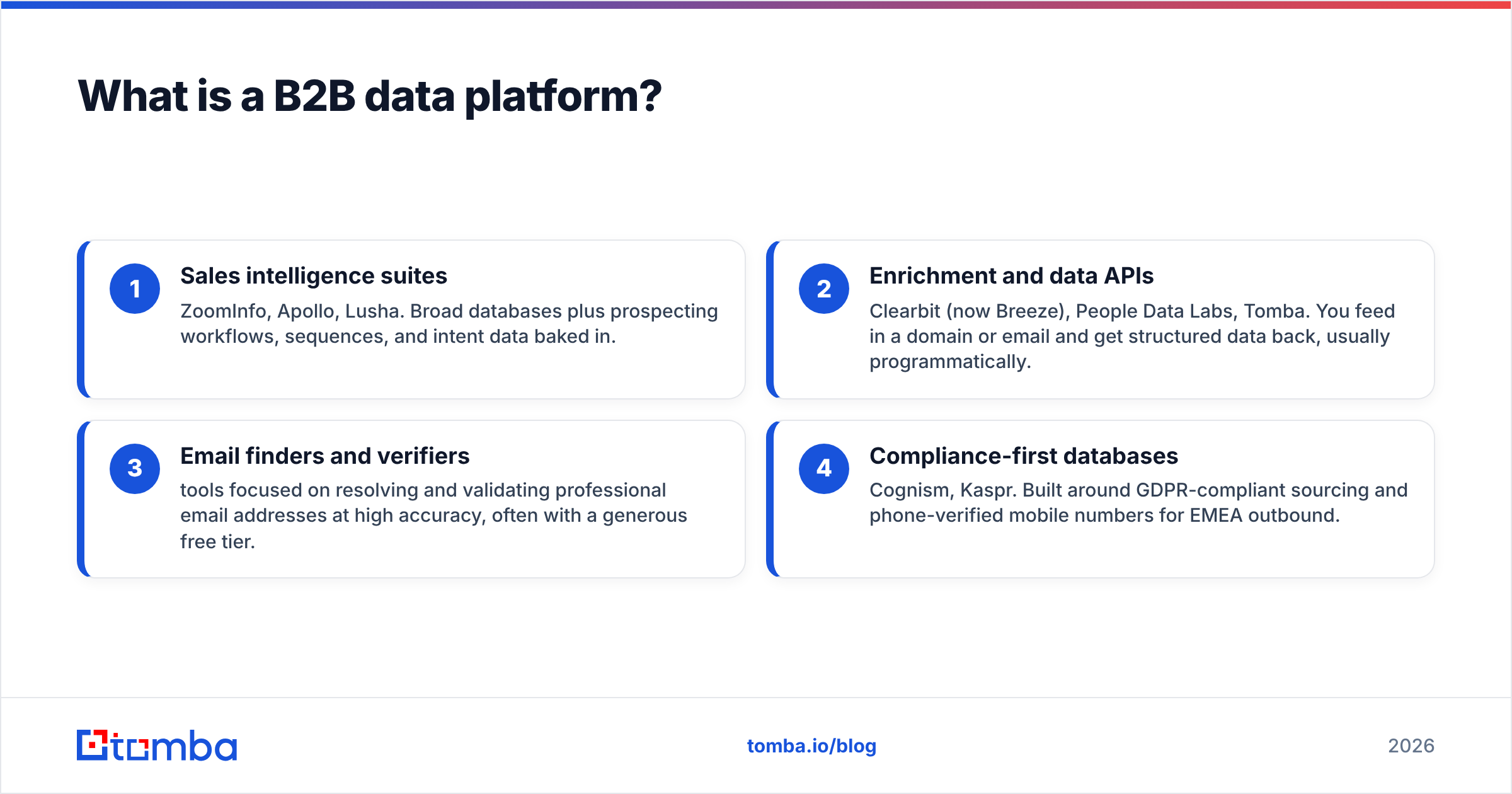
These platforms cluster into a few overlapping categories:
- Sales intelligence suites — ZoomInfo, Apollo, Lusha. Broad databases plus prospecting workflows, sequences, and intent data baked in.
- Enrichment and data APIs — Clearbit (now Breeze), People Data Labs, Tomba. You feed in a domain or email and get structured data back, usually programmatically.
- Email finders and verifiers — tools focused on resolving and validating professional email addresses at high accuracy, often with a generous free tier.
- Compliance-first databases — Cognism, Kaspr. Built around GDPR-compliant sourcing and phone-verified mobile numbers for EMEA outbound.
Most teams end up using two: one broad source of records and one accuracy layer that verifies before contact data hits the CRM. If you want the vocabulary straight, Tomba's B2B glossary defines the terms vendors love to blur.

How should you evaluate the best B2B data platforms?#
Score every vendor on six axes. Demos hide the weak ones, so ask for proof on each.
- Accuracy / bounce rate — What percent of emails are deliverable? Anything under 95% deliverable will quietly torch your sender reputation.
- Coverage — Does it actually have your ICP? Great US coverage is useless if you sell into Germany.
- Freshness — How often are records re-verified? Job changes break ~30% of B2B contact data per year.
- Compliance — GDPR/CCPA sourcing, opt-out handling, phone DNC scrubbing.
- Pricing model — Per seat, per credit, or per API call. This decides whether the tool scales with you or against you.
- Integrations — Native CRM sync (HubSpot, Salesforce, Pipedrive) or are you living in CSV exports?
A practical test: pull 100 known-good contacts you can verify yourself, run them through each platform's trial, and measure the real hit rate. Vendors quote lab numbers; your list tells the truth. If you want to validate the output independently, run the results through an email verifier before you trust a single quoted accuracy figure.
Which are the best B2B data platforms in 2026?#
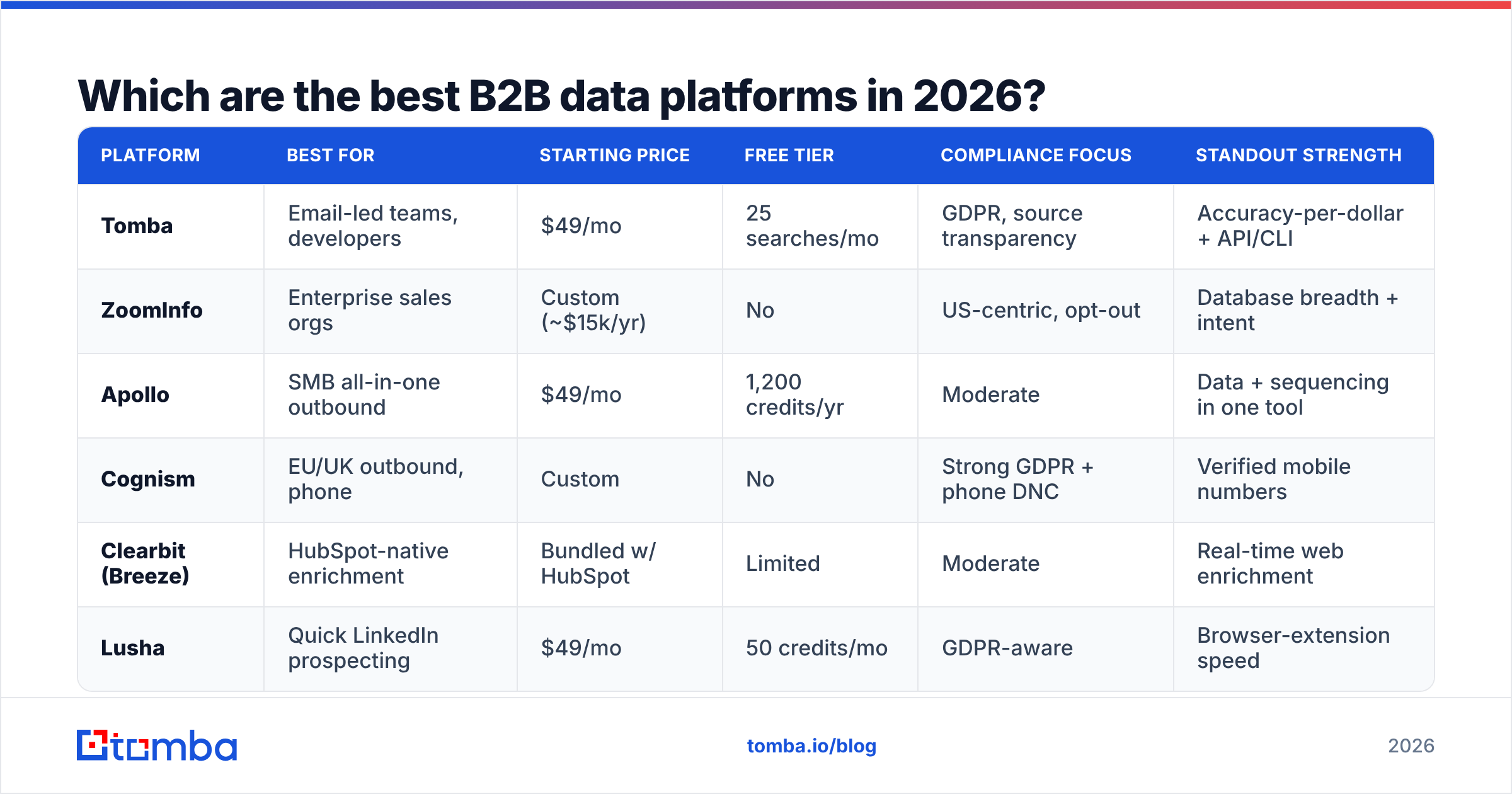
Here's the head-to-head. Prices are entry/published tiers as of 2026; enterprise quotes vary widely, so treat the sticker as a floor.
| Platform | Best for | Starting price | Free tier | Compliance focus | Standout strength |
|---|---|---|---|---|---|
| Tomba | Email-led teams, developers | $49/mo | 25 searches/mo | GDPR, source transparency | Accuracy-per-dollar + API/CLI |
| ZoomInfo | Enterprise sales orgs | Custom (~$15k/yr) | No | US-centric, opt-out | Database breadth + intent |
| Apollo | SMB all-in-one outbound | $49/mo | 1,200 credits/yr | Moderate | Data + sequencing in one tool |
| Cognism | EU/UK outbound, phone | Custom | No | Strong GDPR + phone DNC | Verified mobile numbers |
| Clearbit (Breeze) | HubSpot-native enrichment | Bundled w/ HubSpot | Limited | Moderate | Real-time web enrichment |
| Lusha | Quick LinkedIn prospecting | $49/mo | 50 credits/mo | GDPR-aware | Browser-extension speed |
A few honest reads on this table:
- ZoomInfo is still the broadest database, and for a 200-rep enterprise org that depth justifies the price. For a 5-person team it's overkill you'll resent at renewal.
- Apollo is the value pick when you want database, enrichment, and sequencing under one login — but accuracy on niche or non-US segments is inconsistent.
- Cognism earns its keep specifically for EMEA phone outbound, where its phone-verified "Diamond Data" and DNC scrubbing are genuinely ahead.
- Clearbit makes the most sense if you already live inside HubSpot, since it's now part of that ecosystem.
- Tomba wins on a narrower but common need: getting accurate, verified emails by domain or name at a price small and mid teams can actually sustain, with a real Tomba API and CLI for teams that want to build instead of click.
For deeper category-specific swaps, Tomba keeps alternative breakdowns like the Apollo alternative and Clearbit alternative pages — useful when you're pricing a like-for-like switch.
Is a bigger database better than a more accurate one?#
No — accuracy wins, and the math is brutal once you run it. Database size is a vanity metric; deliverable, current records are the asset.
Say two platforms both quote "100M+ contacts." Platform A delivers an 88% valid-email rate; Platform B delivers 97%. On a 5,000-contact campaign that's 600 extra bounces from Platform A. Those bounces don't just waste sends — they signal mailbox providers that you're a sloppy sender, which drags down inbox placement for the good addresses too. One bad data source can poison an otherwise healthy domain's email deliverability.
This is why the verify-before-you-trust workflow matters more than raw counts. A focused tool that confirms deliverability — including handling tricky catch-all domains — protects the asset you can't easily rebuild: your sending reputation. Independent review sites like G2 are useful here because they surface real bounce-rate complaints the vendor decks omit.
How much should you actually pay for B2B data?#
Match the pricing model to your motion, not the other way around. The three models behave very differently as you scale.
- Per-seat (ZoomInfo, Cognism): predictable for big teams, painful for small ones. You pay for access whether a rep pulls 10 or 10,000 records. Best when every seat is a full-time prospector.
- Per-credit (Apollo, Lusha, Tomba): you pay for what you consume. Scales down cleanly, which is why it suits SMBs and seasonal campaigns. Watch for credits that expire monthly.
- Per API call (Tomba, People Data Labs, Clearbit): ideal when enrichment runs inside your product or RevOps pipeline rather than a UI. Costs track usage almost perfectly.
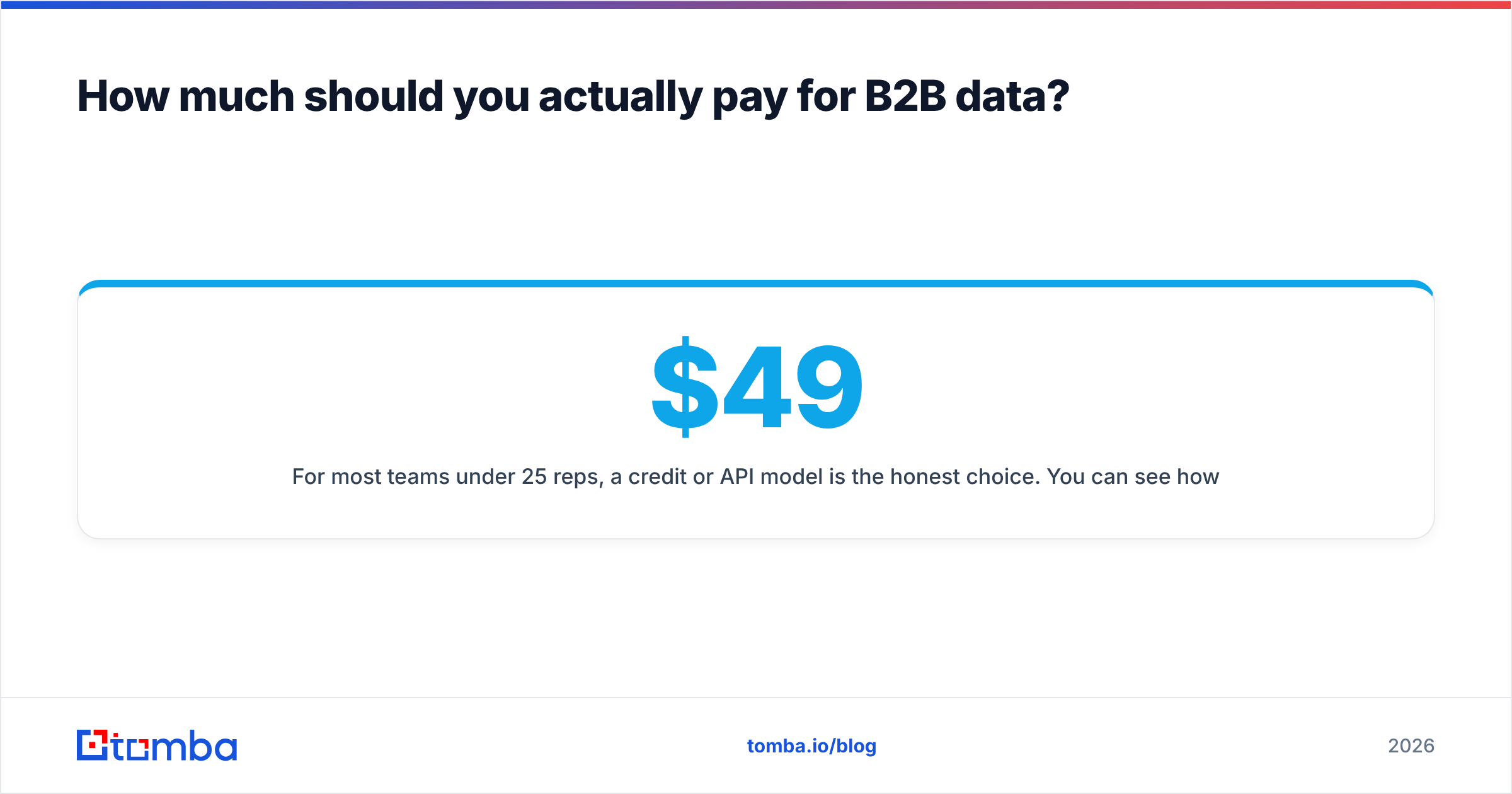
For most teams under 25 reps, a credit or API model is the honest choice. You can see how a transparent credit ladder looks on Tomba pricing: a free tier at 25 searches, Starter at $49/mo, Growth at $99/mo, and Pro at $249/mo, with enterprise quoted separately. The point isn't that cheaper is better — it's that you shouldn't pay enterprise per-seat rates to solve a 3,000-email-a-month problem.
A quick gut-check before any contract: divide annual cost by the number of verified, deliverable contacts you'll realistically use. That cost-per-good-record number is the only price comparison that means anything across vendors with different models.
What about compliance and data sourcing?#
Treat compliance as a hard filter, not a nice-to-have — a cheap record sourced illegally is the most expensive line item you'll ever buy. Regulators have made B2B contact data a genuine liability surface.
The questions that separate serious vendors:
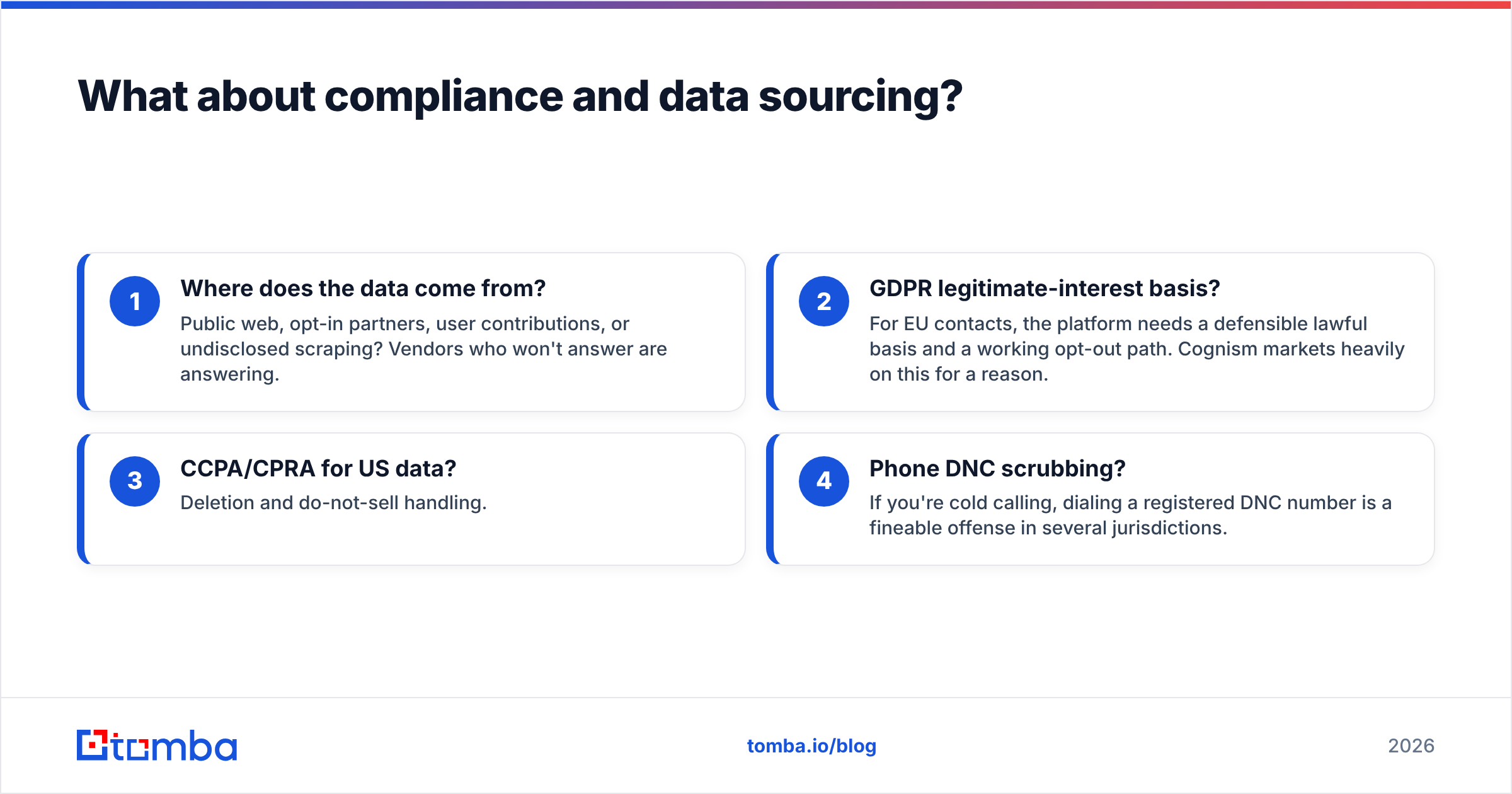
- Where does the data come from? Public web, opt-in partners, user contributions, or undisclosed scraping? Vendors who won't answer are answering.
- GDPR legitimate-interest basis? For EU contacts, the platform needs a defensible lawful basis and a working opt-out path. Cognism markets heavily on this for a reason.
- CCPA/CPRA for US data? Deletion and do-not-sell handling.
- Phone DNC scrubbing? If you're cold calling, dialing a registered DNC number is a fineable offense in several jurisdictions.
The EDPB guidance is the authoritative reference for the EU side; don't rely on a sales rep's summary of it. Tomba publishes where its data comes from precisely because source transparency is now part of the buying decision, not an afterthought.
Which platform fits which team?#
Conclusion first, then the reasoning:
- Enterprise sales org, US-heavy, big budget → ZoomInfo. You'll use the breadth and intent, and the per-seat cost is rounding error at your scale.
- EMEA outbound with heavy cold calling → Cognism. Phone-verified mobiles and DNC compliance are worth the premium where it matters most.
- SMB wanting one tool for data + sending → Apollo. Good enough data plus built-in sequencing beats stitching two tools together at that size.
- Already all-in on HubSpot → Clearbit/Breeze. Native enrichment with no new vendor to manage.
- Email-led outbound, developers, or accuracy-per-dollar buyers → Tomba. Verified emails by name or domain, a clean API/CLI, bulk lead generation, and a free tier to test the real hit rate before paying.
If your core need is "turn a list of companies into accurate, deliverable contacts without setting money on fire," start narrow. You can always layer intent and phone data on later when a specific play demands it.
Common mistakes when choosing a B2B data platform#
- Buying for the demo dataset. Reps demo on clean, US, mid-market records. Test on your ICP.
- Ignoring the renewal. Per-seat platforms ratchet up at renewal. Model year two, not year one.
- Skipping verification. Even good databases decay. Always run a final email verification pass before a campaign.
- Overbuying intent. Intent data is powerful for the teams that operationalize it and shelfware for everyone else.
- No bounce SLA. Get the deliverable-rate guarantee in writing, or assume it's marketing.
The bottom line#
The best B2B data platform in 2026 is the one whose accuracy, compliance, and pricing model match how your team actually sells — not the one with the biggest logo or the longest feature list. Score vendors on the six axes, run a real-list trial, and divide by cost-per-deliverable-record before you sign anything.
If your motion is email-led and you want high-accuracy contacts without enterprise per-seat pricing, start with the Tomba Email Finder. Find professional emails by name, domain, or company, verify them before they hit your CRM, and test the whole thing on the free tier (25 searches a month) before you spend a dollar. Pull 100 of your real target contacts through it this afternoon — the hit rate will tell you more than any vendor deck.
// get started
Find, verify and enrich your first contacts today
Start on the free plan with 25 searches a month, then scale when your team is ready.
Free plan · No credit card required · GDPR & CCPA
// about the author