Best Bulk Email Software in 2026: Top 9 Tools Compared
Choosing the best bulk email software in 2026? Compare 9 top platforms on price, deliverability, list size, and automation — plus the one step most teams skip.
Picking bulk email software feels like picking a car: every vendor swears theirs is the fastest, but the thing that actually gets you to the destination is the fuel — your list. Send to a clean, verified list and almost any platform performs. Send to garbage and the best tool on earth lands you in spam.
This guide ranks the best bulk email software for 2026 across the three jobs people actually buy it for: cold outreach, marketing newsletters, and transactional sends. We compare real pricing, deliverability features, and where each tool quietly falls short.
TL;DR#
- Best for cold outreach: Instantly and Smartlead — built-in warmup, inbox rotation, unlimited sending accounts.
- Best for newsletters/marketing: Mailchimp and Brevo — drag-and-drop builders, automation, and audience segmentation.
- Best for developers/transactional: Amazon SES and SendGrid — cheap, API-first, near-infinite scale.
- The step everyone skips: verifying your list before you send. A 30% bounce rate will tank deliverability on any platform.
- Tomba's role: it isn't a sender — it's how you build and clean the list that the sender depends on.

What is bulk email software?#
Bulk email software sends large volumes of email — hundreds to millions of messages — from a single campaign or API call, with tooling to manage lists, personalize content, throttle sends, and track opens, clicks, and bounces.
It splits into three categories, and confusing them is the most common (and expensive) mistake buyers make:
- Cold outreach platforms — built for sales teams emailing people who haven't opted in. They prioritize deliverability tricks: mailbox warmup, inbox rotation across dozens of sending accounts, and spintax. Examples: Instantly, Smartlead, Saleshandy.
- Marketing / newsletter platforms — built for opted-in audiences. They prioritize design, segmentation, and automation flows. Examples: Mailchimp, Brevo, Klaviyo.
- Transactional / API senders — built for receipts, password resets, and high-volume programmatic mail. They prioritize raw throughput and uptime. Examples: Amazon SES, SendGrid, Postmark.
A newsletter tool used for cold outreach will get your account banned. A cold-email tool used for a 500k newsletter will cost a fortune and lack the design tools. Match the category to the job first, then compare within it.
Which is the best bulk email software in 2026?#
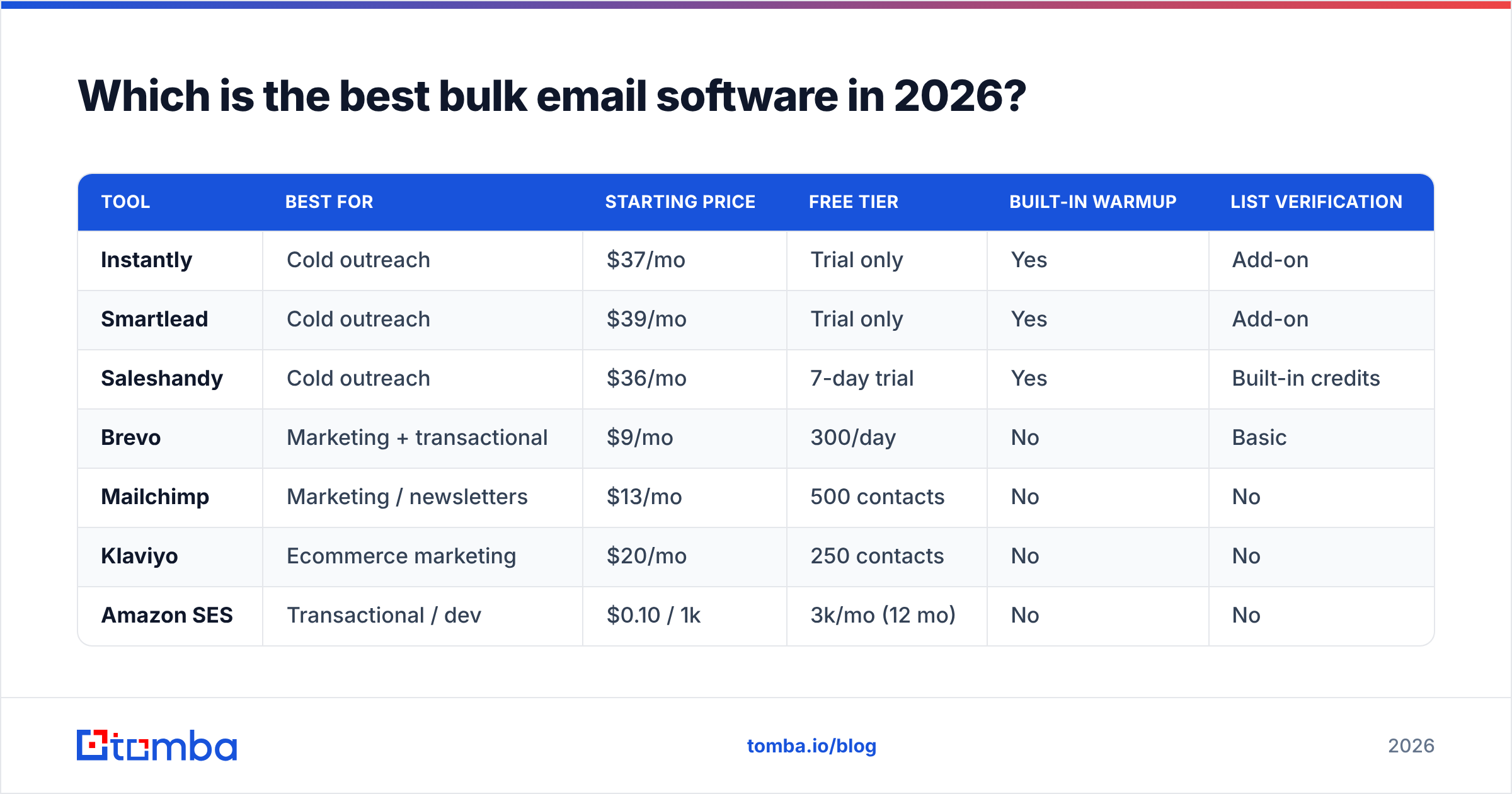
Here's the head-to-head on the attributes that matter. Prices are entry-paid tiers as of 2026 and shift often — always confirm on the vendor's own page.
| Tool | Best for | Starting price | Free tier | Built-in warmup | List verification |
|---|---|---|---|---|---|
| Instantly | Cold outreach | $37/mo | Trial only | Yes | Add-on |
| Smartlead | Cold outreach | $39/mo | Trial only | Yes | Add-on |
| Saleshandy | Cold outreach | $36/mo | 7-day trial | Yes | Built-in credits |
| Brevo | Marketing + transactional | $9/mo | 300/day | No | Basic |
| Mailchimp | Marketing / newsletters | $13/mo | 500 contacts | No | No |
| Klaviyo | Ecommerce marketing | $20/mo | 250 contacts | No | No |
| Amazon SES | Transactional / dev | $0.10 / 1k | 3k/mo (12 mo) | No | No |
| SendGrid | Transactional + marketing | $19.95/mo | 100/day | No | No |
| MailerLite | Newsletters / creators | $9/mo | 1k subscribers | No | No |
A few honest takeaways from this table:
- Cold-outreach tools bundle warmup; marketing tools don't — because marketing tools assume you already have permission and a warm domain.
- Transactional senders win on raw cost ($0.10 per 1,000 with SES is unbeatable), but you get no campaign UI, no list management, and no segmentation.
- Almost none verify your list for you. That gap is exactly where bounce rates come from, and it's the single biggest lever on deliverability.
How do you choose between cold email and newsletter tools?#
Start with one question: did these people ask to hear from you?
If yes, you want a marketing platform. Opted-in audiences forgive imperfect lists, and the design and automation tooling in Mailchimp or Brevo will do more for revenue than warmup ever could.
If no — you're prospecting — you need a cold-outreach platform with warmup and inbox rotation, and you need ruthless list hygiene. Cold sending is where deliverability dies, because you're contacting strangers whose mailbox providers have never seen your domain.
Use this quick decision framework:
- Audience opted in + needs design → Mailchimp, Brevo, MailerLite
- Ecommerce with purchase data → Klaviyo
- Cold B2B prospecting at scale → Instantly, Smartlead, Saleshandy
- Receipts, alerts, app email → Amazon SES, Postmark, SendGrid
- High volume + tight budget + dev team → Amazon SES
No matter which row you land on, the input is the same: a list of real, deliverable addresses. That's a data problem, not a sending problem — and it's solved upstream with an email verifier before a single message goes out.
Why does deliverability matter more than the tool?#
Because mailbox providers grade you, not your software. Gmail and Outlook score your sender reputation based on bounce rate, spam complaints, and engagement. A pristine reputation gets you to the inbox on a cheap tool; a trashed one buries you in spam on the most expensive one.
The mechanics are worth understanding. When you send to invalid addresses, they bounce. A high bounce rate signals to providers that you don't maintain your list — a classic spammer behavior — so they start filtering you. This is why email deliverability is downstream of list quality, not features.
Three foundations carry more weight than any platform choice:
- Authentication — SPF, DKIM, and DMARC records prove you are who you claim. Missing records is an instant credibility hit. Check yours with a free SPF checker.
- List hygiene — verify before you send. Remove invalids, role accounts, and risky catch-alls.
- Warmup and pacing — ramp volume gradually on new domains instead of blasting from cold.

According to deliverability research published by vendors like Mailchimp and industry reviews on G2, engagement-based filtering now dominates inbox placement decisions — meaning sending to people who actually open your mail matters more than ever. You can't get engagement from addresses that don't exist.
What features should the best bulk email software have?#
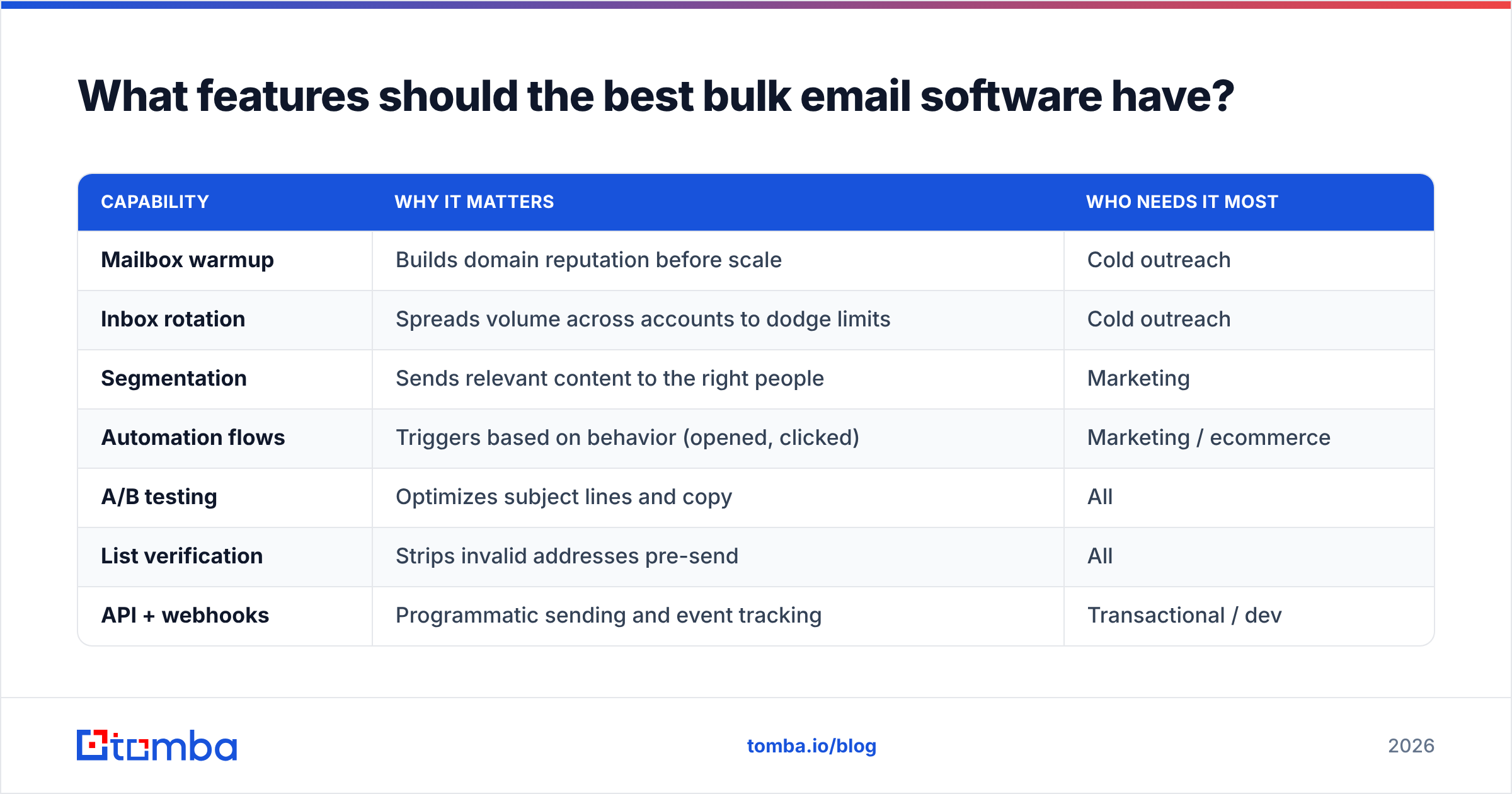
Beyond send volume, weigh these capabilities. The ones that move the needle are not the ones vendors put on billboards.
| Capability | Why it matters | Who needs it most |
|---|---|---|
| Mailbox warmup | Builds domain reputation before scale | Cold outreach |
| Inbox rotation | Spreads volume across accounts to dodge limits | Cold outreach |
| Segmentation | Sends relevant content to the right people | Marketing |
| Automation flows | Triggers based on behavior (opened, clicked) | Marketing / ecommerce |
| A/B testing | Optimizes subject lines and copy | All |
| List verification | Strips invalid addresses pre-send | All |
| API + webhooks | Programmatic sending and event tracking | Transactional / dev |
| Analytics depth | Opens, clicks, replies, revenue attribution | All |
Notice that list verification appears for "all." It's the one feature that improves results regardless of category, yet it's the one most platforms treat as an afterthought or paid add-on. That's the structural gap to plan around: assume your sending tool won't clean your list well, and handle hygiene with a dedicated tool.
If you're running cold outreach specifically, pair your sender with strong subject lines — a free subject line generator helps — and keep a close eye on your response rate as the real signal of campaign health.
How much does bulk email software cost?#
Pricing models vary wildly, which makes apples-to-apples comparison hard. There are three common structures:
- Per-contact (Mailchimp, Klaviyo) — you pay for your audience size whether you email them or not. Costs balloon as your list grows.
- Per-send / per-volume (Amazon SES, SendGrid) — you pay per email delivered. Cheapest at scale, but no list management included.
- Per-sending-account or flat (Instantly, Smartlead) — you pay for seats, sending mailboxes, or active leads. Predictable for outreach teams.
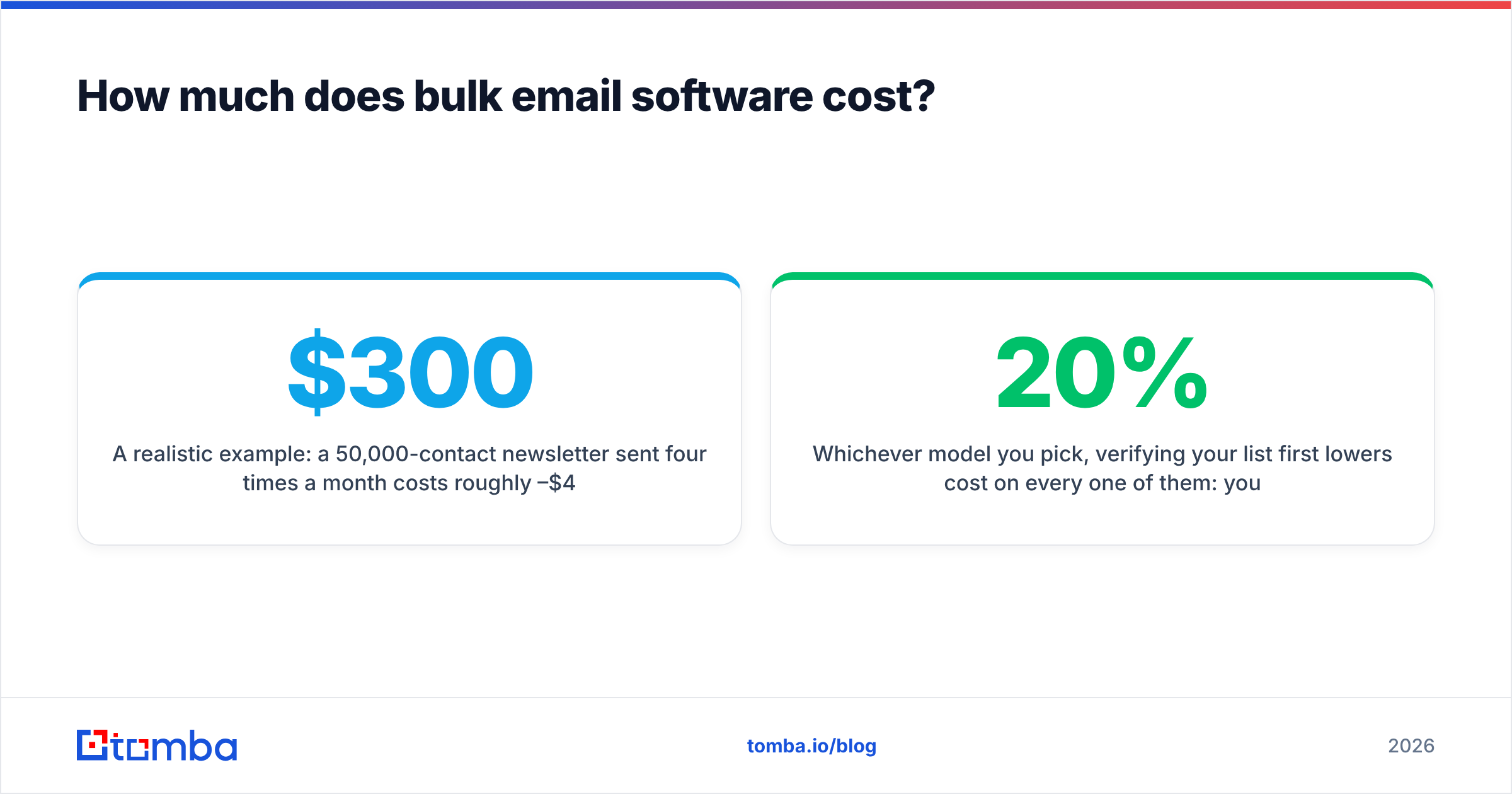
A realistic example: a 50,000-contact newsletter sent four times a month costs roughly $300–$400/mo on a per-contact marketing platform, but under $25/mo on Amazon SES — if you're willing to build the campaign tooling yourself. The "cheap" option has a hidden engineering cost; the "expensive" option bundles convenience.
Whichever model you pick, verifying your list first lowers cost on every one of them: you stop paying to store, send to, or warm up addresses that were never going to convert. On per-contact plans especially, removing 20% dead weight is a direct 20% discount.
Where does Tomba fit in a bulk email stack?#
Tomba isn't a bulk sender — and that's the point. It sits one step upstream, building and cleaning the list every sender depends on. Think of it as the fuel refinery feeding whichever engine you chose above.
Here's the typical workflow:
- Find prospects — use the email finder or domain search to build a targeted list of verified business contacts.
- Clean the list — run it through the bulk email finder and verifier to strip invalids, role accounts, and risky catch-alls before they bounce.
- Export to your sender — push clean contacts into Instantly, Mailchimp, Brevo, or whatever you picked, via native integrations or the Tomba API.
- Send and monitor — let your bulk tool do what it's good at, on a list that won't sink your reputation.
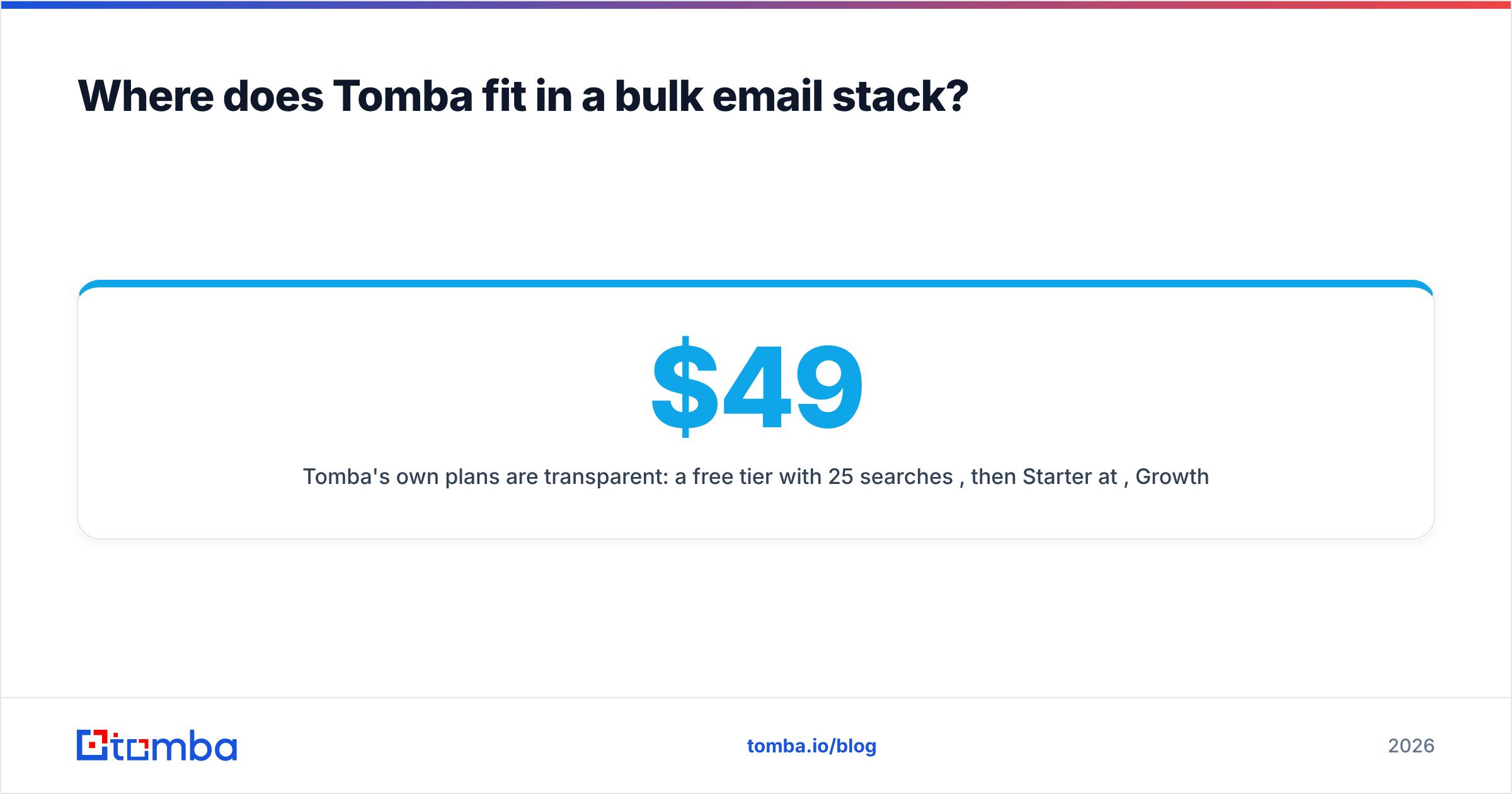
Tomba's own plans are transparent: a free tier with 25 searches/mo, then Starter at $49/mo, Growth at $99/mo, and Pro at $249/mo — see full Tomba pricing for verification credit allowances. Compared to bolting a weak verification add-on onto a sending tool, a dedicated data layer consistently produces cleaner lists and lower bounce rates.
Is free bulk email software worth it?#
For low volume and learning, yes. Brevo's 300 emails/day, Mailchimp's 500-contact free plan, and Amazon SES's 12-month free tier are genuinely useful for getting started or running a small newsletter.
But "free" rarely covers list verification, advanced automation, or the sending volume a real campaign needs. The trap is scaling on a free tool with an unverified list — you'll hit deliverability problems right as your audience grows, exactly when it hurts most. Free senders are fine; free list hygiene usually isn't, because the cheap verification tools cut corners on catch-all detection and SMTP checks.
A pragmatic starter stack for 2026: a free or low-cost sender (Brevo or MailerLite) plus a real verification layer. That combination beats an expensive all-in-one with a dirty list every time.
The bottom line#
The "best" bulk email software depends entirely on your job: Instantly or Smartlead for cold outreach, Mailchimp or Brevo for newsletters, Amazon SES or SendGrid for transactional. But the tool is the engine, not the fuel. Every platform above performs well on a clean list and poorly on a dirty one.
Before you commit to any sender, fix the input. Build a targeted, verified contact list with the Tomba Email Finder — find professional email addresses by domain, name, or company, then verify them in bulk so your bounce rate stays low and your sender reputation stays intact. Start free with 25 searches, and let your bulk email software do its job on a list that's actually deliverable.
// get started
Find, verify and enrich your first contacts today
Start on the free plan with 25 searches a month, then scale when your team is ready.
Free plan · No credit card required · GDPR & CCPA
// about the author