Best Business Contact Database in 2026: Top 9 Compared
Not all B2B data is equal. See how the best business contact database providers stack up on accuracy, coverage, compliance, and price — and how to pick the right one for your team in 2026.
A business contact database is only as good as the day it was built — and most go stale faster than the teams using them realize. If you are buying one in 2026, the question is not "who has the most records," it's "whose records are still true this quarter, and at what price." This guide compares the nine providers that matter, with concrete numbers instead of marketing claims.
TL;DR#
- The best business contact database for you depends on three variables: data freshness, coverage in your target region, and how you pay (seats vs. credits vs. volume).
- ZoomInfo and Cognism win on enterprise depth and compliance; Apollo and Lusha win on price-to-value for SMBs; Tomba wins when you need verified emails on demand without a per-seat contract.
- Bounce rate is the only honest accuracy metric. Demand a real-time verification step — a database that doesn't re-check at export will quietly burn your sender reputation.
- Credit-based tools (Tomba, Apollo) beat seat-based licenses for teams under 10 reps who prospect in bursts.
- Always pair any database with an email verifier before you send. Static records decay 22–30% per year.
What is a business contact database?#
A business contact database is a structured collection of B2B records — names, job titles, company affiliations, professional emails, phone numbers, and firmographics — that sales and marketing teams use to find and reach decision-makers. Think of it as a phone book that rebuilds itself: people change jobs, companies get acquired, and domains get retired, so the database has to keep re-validating what it stores or it rots.
The good ones do four things well:
- Collect broadly — from public web pages, business filings, opt-in networks, and partner contributions.
- Verify continuously — re-checking emails and phones against live signals, not just at the moment of capture.
- Enrich — attaching firmographic and technographic context (company size, tech stack, funding) to each record.
- Stay compliant — honoring GDPR, CCPA, and similar regimes with a lawful basis and a documented opt-out path.
Miss any one of those and you don't have a database — you have a liability with a CSV export button.

Why does data accuracy matter more than database size?#
Because you email the records, not the count. A vendor advertising "275 million contacts" is meaningless if 30% of the emails in your slice bounce. Every hard bounce above roughly 2% tells inbox providers your list is dirty, and your sender reputation drops for everyone you email afterward — including the valid addresses.
Here is the math that vendors don't put on the pricing page: B2B data decays at about 22–30% per year as people switch jobs. That means a database refreshed annually is, on average, ~15% wrong on any given day. The only providers worth paying for are the ones that re-verify at the moment of export, not the ones that verified at the moment of collection.
This is why a smaller, continuously verified database often outperforms a massive static one. When you pull a record, you want it checked against live mail servers that day. Tomba's approach — verifying emails through SMTP and catch-all logic at request time — is built around this principle, and it's the difference between a 1% and a 9% bounce rate. You can read how the underlying data sources are assembled and scored if you want the methodology.
Which is the best business contact database in 2026?#
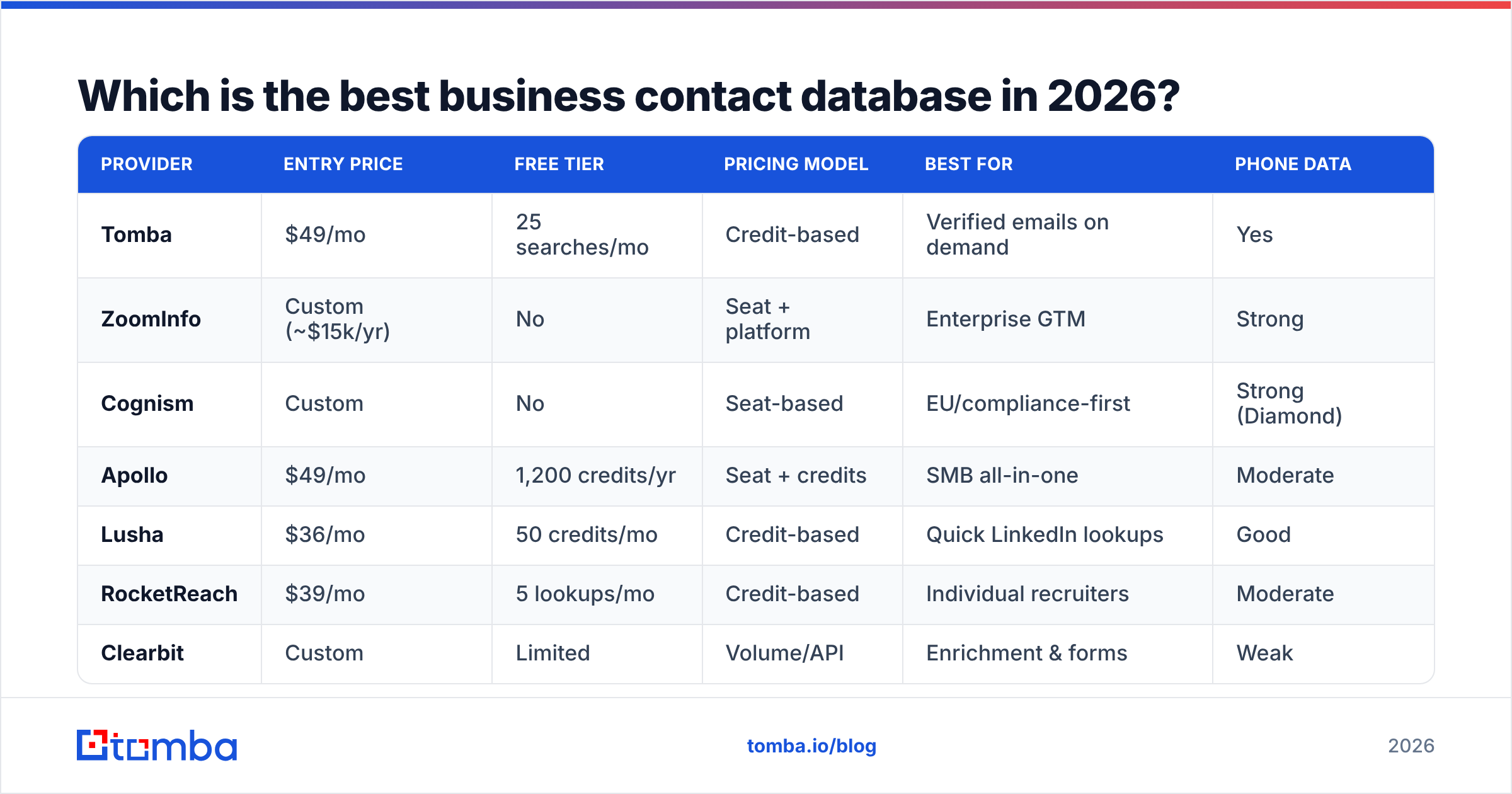
There is no single winner — there's a best fit per team size, region, and workflow. Below is a head-to-head on the attributes that actually change your results. Pricing reflects publicly listed entry plans as of 2026; enterprise tiers are quote-based.
| Provider | Entry price | Free tier | Pricing model | Best for | Phone data |
|---|---|---|---|---|---|
| Tomba | $49/mo | 25 searches/mo | Credit-based | Verified emails on demand | Yes |
| ZoomInfo | Custom (~$15k/yr) | No | Seat + platform | Enterprise GTM | Strong |
| Cognism | Custom | No | Seat-based | EU/compliance-first | Strong (Diamond) |
| Apollo | $49/mo | 1,200 credits/yr | Seat + credits | SMB all-in-one | Moderate |
| Lusha | $36/mo | 50 credits/mo | Credit-based | Quick LinkedIn lookups | Good |
| RocketReach | $39/mo | 5 lookups/mo | Credit-based | Individual recruiters | Moderate |
| Clearbit | Custom | Limited | Volume/API | Enrichment & forms | Weak |
| Seamless.AI | Custom | Limited trial | Seat-based | High-volume outbound | Moderate |
| Hunter | $49/mo | 25 searches/mo | Credit-based | Domain-level email finding | No |
A few honest takeaways from the table:
- If you need depth and have budget, ZoomInfo and Cognism are the category leaders — but you're signing an annual contract measured in five figures, and you pay per seat whether reps use it or not. Compare them on G2 before committing.
- If you want all-in-one at SMB price, Apollo bundles a database, sequencer, and dialer. The trade-off is that data accuracy outside North America is inconsistent.
- If you mostly need verified emails by domain or name, a focused email finder like Tomba or Hunter is cheaper and faster than a full platform you'll under-use.
How is Tomba different from ZoomInfo and Apollo?#
Tomba is a focused email-and-enrichment engine, not a full sales-engagement suite — and for many teams that's the point. ZoomInfo and Apollo sell you a platform; Tomba sells you accurate contact data you can drop into the tools you already own.
The practical differences:
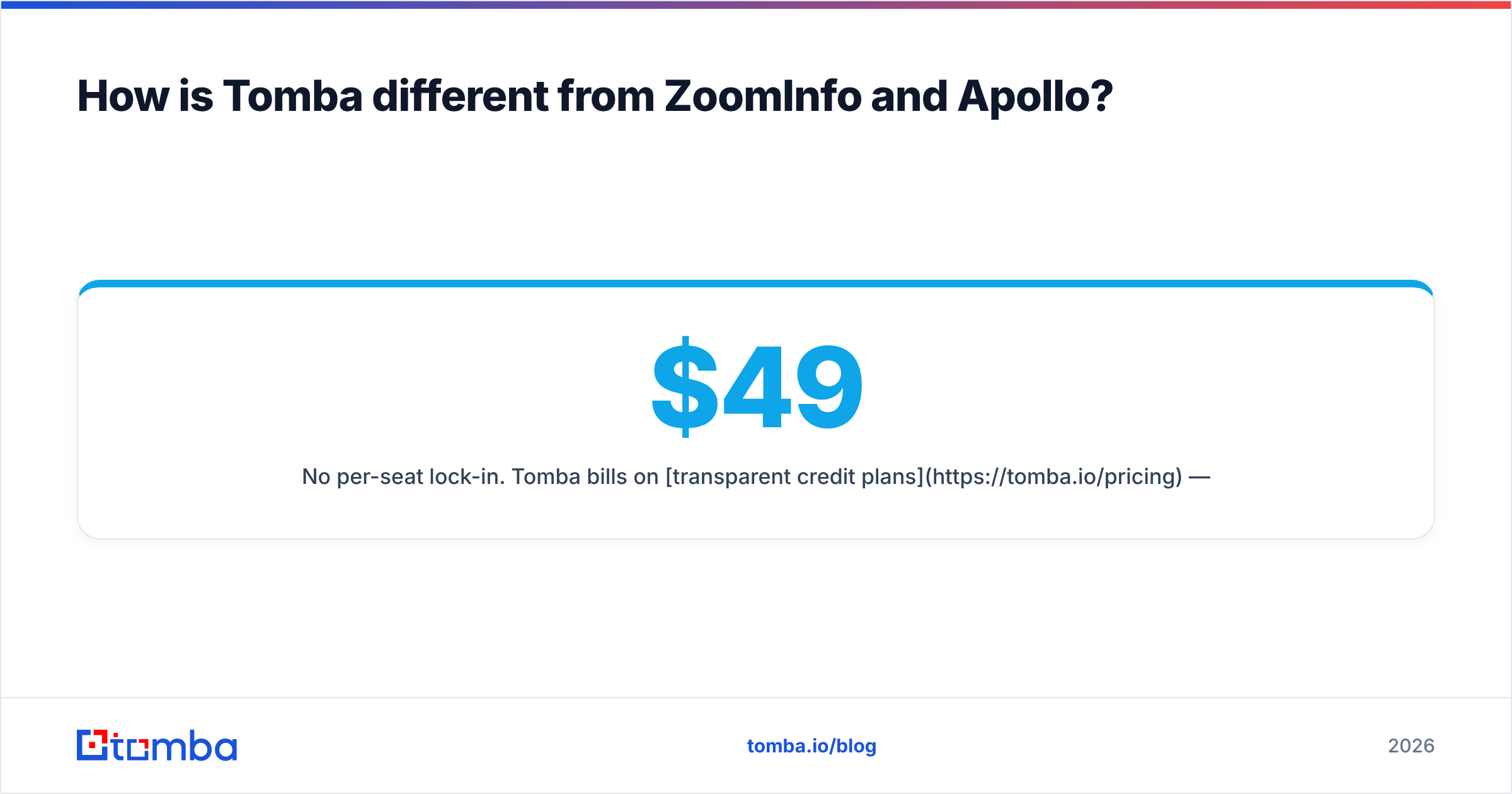
- No per-seat lock-in. Tomba bills on transparent credit plans — Free (25 searches/mo), Starter $49/mo, Growth $99/mo, Pro $249/mo, Enterprise custom. A five-person team isn't forced into five enterprise seats.
- Verification is native, not a bolt-on. Every find can run through real-time verification, and there's a dedicated catch-all verifier for the domains that normally wreck deliverability.
- It plugs into your stack. Native Tomba API, CLI, Google Sheets and Excel add-ins, plus a Chrome extension mean you don't migrate your workflow to a new platform.
- Enrichment on demand. Need to fill gaps in an existing list? Data enrichment appends verified emails, phones, and firmographics to records you already have.
Where ZoomInfo and Apollo pull ahead is breadth of intent data and built-in sequencing. If your motion depends on third-party intent signals and an integrated dialer, those platforms earn their price. If your motion is "find the right person, confirm the email is real, push it to HubSpot or Salesforce," a leaner B2B database does it for a fraction of the cost.

What should you check before buying a contact database?#
Run every vendor through the same five-point checklist before you sign anything. Most buyers skip this and learn the hard way during their first campaign.
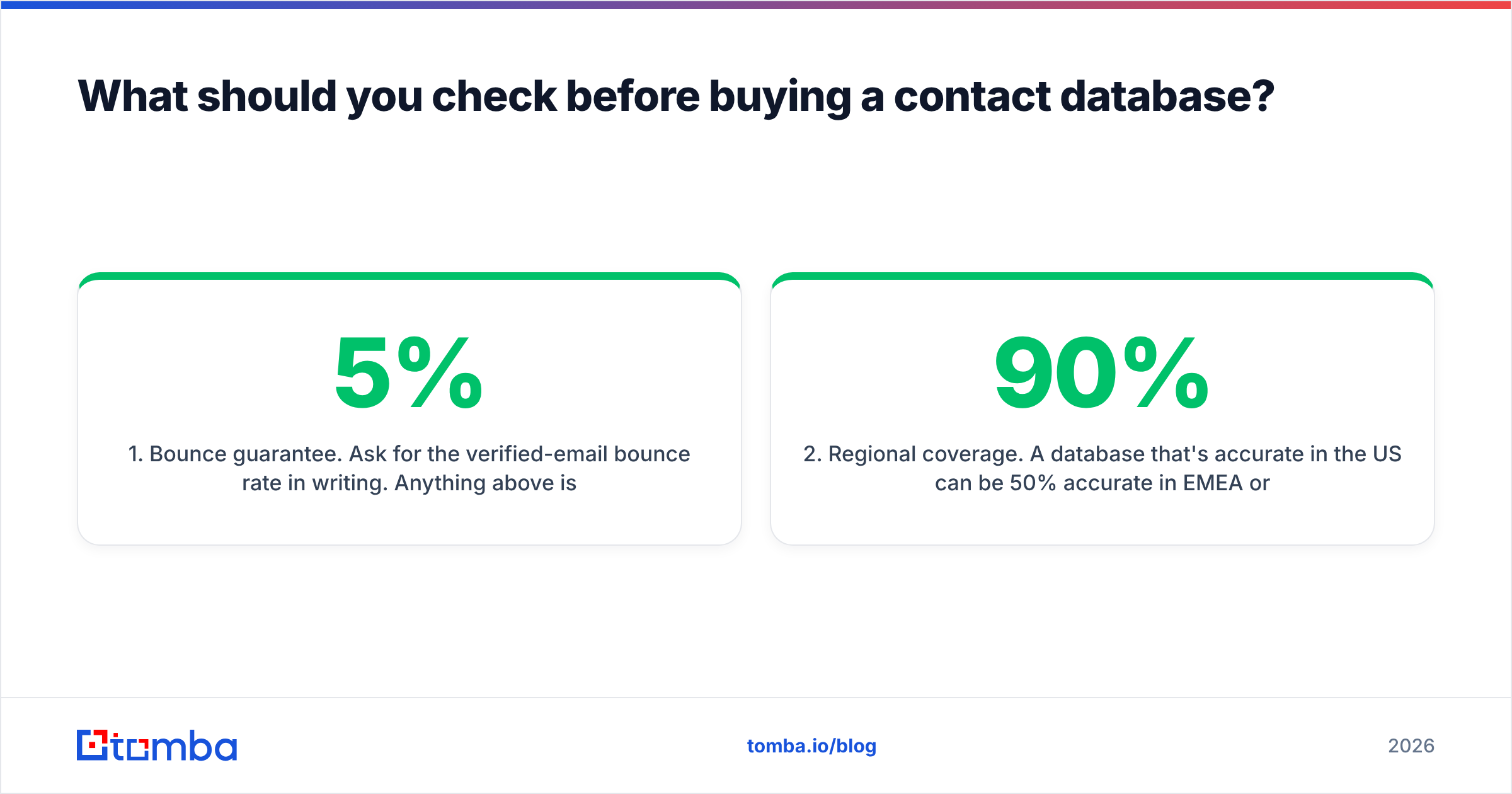
- Bounce guarantee. Ask for the verified-email bounce rate in writing. Anything above 5% is a red flag; the best providers guarantee under 2–3%.
- Regional coverage. A database that's 90% accurate in the US can be 50% accurate in EMEA or APAC. Test a sample in your target geography, not theirs.
- Compliance posture. Confirm GDPR/CCPA lawful basis, notification handling, and DNC (do-not-call) scrubbing for phone data. Cognism's compliance reputation is a real differentiator here.
- Pricing model fit. Seat-based pricing punishes small or bursty teams; credit-based pricing punishes always-on enterprise use. Match the model to your usage curve.
- Integration reality. "Has an integration" and "has a good integration" are different. Verify the HubSpot or Salesforce sync handles deduplication and field mapping the way you need.
Insist on a trial that lets you export real records, then verify a 100-contact sample yourself. If the vendor resists, that tells you what their accuracy actually is.
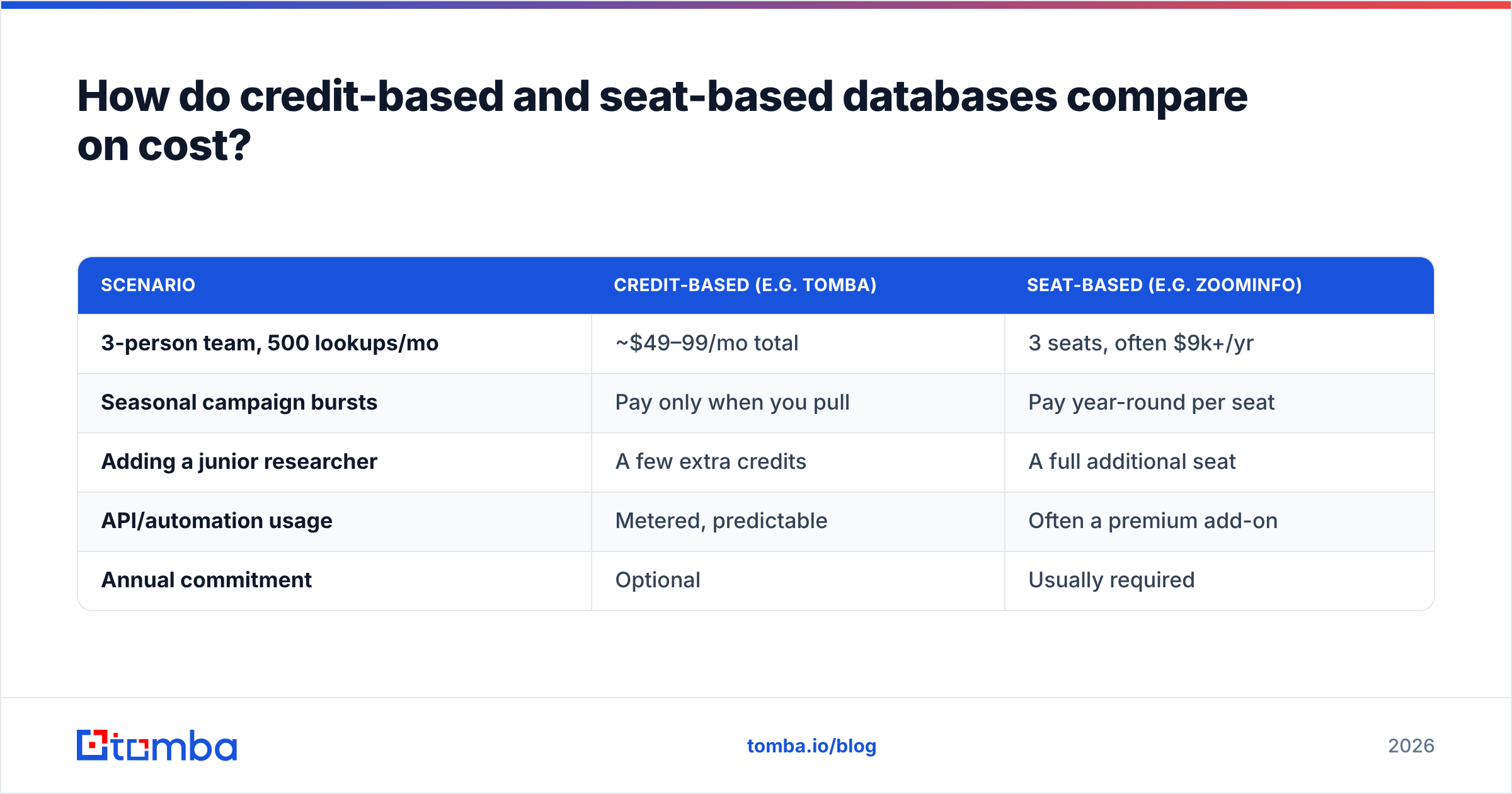
How do credit-based and seat-based databases compare on cost?#
For teams under 10 reps that prospect in bursts, credit-based wins almost every time. Seat-based pricing assumes every rep prospects heavily, every day, all year — which is rarely true.
| Scenario | Credit-based (e.g. Tomba) | Seat-based (e.g. ZoomInfo) |
|---|---|---|
| 3-person team, 500 lookups/mo | ~$49–99/mo total | 3 seats, often $9k+/yr |
| Seasonal campaign bursts | Pay only when you pull | Pay year-round per seat |
| Adding a junior researcher | A few extra credits | A full additional seat |
| API/automation usage | Metered, predictable | Often a premium add-on |
| Annual commitment | Optional | Usually required |
The exception is a large, always-on enterprise SDR floor running thousands of touches daily — there, a flat seat license can be cheaper per record than metered credits, and the bundled intent data adds value a pure database can't.
When should you use enrichment instead of a full database?#
Use enrichment when you already have leads but they're incomplete — missing emails, phones, or firmographics. You don't need to re-buy data you mostly have; you need to fill the holes and verify what's there.
A common, efficient workflow:
- Start with a list you own — webinar signups, CRM records, scraped LinkedIn exports.
- Run data enrichment to append verified emails, B2B phone numbers, and company data.
- Verify before send with an email verifier to strip anything that decayed since capture.
- Sync to your CRM so reps work from one clean source of truth.
This hybrid — own list plus on-demand enrichment plus verification — frequently beats a pure database subscription on both cost and accuracy, because you're only paying to fix what's actually broken. For inbound traffic, pairing enrichment with website visitor reveal turns anonymous sessions into contactable leads, which a static database can't do at all.
Common mistakes when choosing a contact database#
- Buying on record count. 275M contacts at 70% accuracy is worse than 50M at 96%. You only ever touch your slice.
- Skipping verification. Even a great database decays daily. Never send straight from export — re-verify first.
- Ignoring region. North-American accuracy numbers do not transfer to EMEA, LATAM, or APAC. Test your geography.
- Overlooking compliance. A cheap list with no lawful basis is a regulatory fine waiting to happen, especially under GDPR.
- Locking into seats too early. Small teams routinely overpay for seat licenses they barely use. Start credit-based and graduate later if volume justifies it.
The bottom line: pick for fit, not for size#
The best business contact database in 2026 isn't the one with the biggest number on the homepage — it's the one whose data is still true when you hit send, priced in a way that matches how your team actually works. Enterprises with intent-driven motions get real value from ZoomInfo and Cognism. SMBs and lean revenue teams get more done, for less, with a focused, verification-first tool.
If your core need is finding and confirming the right professional emails — without an annual seat contract — start with the Tomba Email Finder. The Free plan gives you 25 searches a month to test accuracy on your own target accounts, real-time verification keeps your bounce rate low, and the credit-based pricing scales with your campaigns instead of your headcount. Pull a sample, verify it yourself, and let the bounce rate decide.
Ready to find emails that actually work?
Join 150,000+ professionals who stopped guessing and started sending. Free credits on signup — no credit card required.
Get the Tomba newsletter
Practical outbound tactics and product updates — once every two weeks.
About the author