Best Closing For Email: 25+ Sign-Offs That Get Replies in 2026
Your email closing decides whether you get a reply or a read-and-forget. Here are the best closings for email in 2026, ranked by reply rate, with copy-paste examples.
The best closing for email isn't a polite goodbye — it's the last instruction your reader follows before they decide whether to reply. Most people treat the sign-off as decoration. Top performers treat it as the second-most-important line in the whole message, right after the subject.
This guide ranks the closings that actually move reply rates, shows you which ones to retire, and gives you copy-paste lines for cold outreach, follow-ups, internal email, and customer support.
TL;DR#
- The closing is two parts: a call-to-action line (what you want) plus a sign-off (your name and goodbye). The CTA does the heavy lifting; the sign-off just shouldn't get in the way.
- "Best" and "Thanks" are the safe defaults — neutral, professional, and they won't tank your reply rate. Save personality for the CTA line above them.
- Specific, low-friction CTAs beat vague ones every time. "Open to a 15-min call Thursday?" outperforms "Let me know your thoughts."
- Retire these now: "Sincerely," "Yours truly," "Cheers" (in cold B2B), "Best regards" stacked on a 12-line signature, and anything with three exclamation points.
- Match the closing to the relationship. Cold prospect, warm lead, and an existing customer each want a different last line.
What counts as an email closing, exactly?#
Think of an email like a sales conversation at a dinner party. The body is the chat; the closing is the handshake on the way out. A weak handshake — limp, vague, overlong — undoes a good conversation. A clear one ("Great talking, I'll call you Tuesday") leaves the other person knowing exactly what happens next.
Technically, the closing has three layers:
- The CTA sentence — the single action you want the reader to take ("Worth a quick call?").
- The complimentary close — the sign-off word or phrase ("Best," "Thanks,").
- The signature block — your name, title, company, and links.
Most advice obsesses over layer 2. The data says layer 1 is where replies are won or lost. A study of millions of outreach emails by HubSpot and others consistently shows that emails ending in a clear, specific ask outperform those ending in open-ended pleasantries. Your sign-off word matters far less than whether you told the reader what to do next.
)
Which email closings get the most replies?#
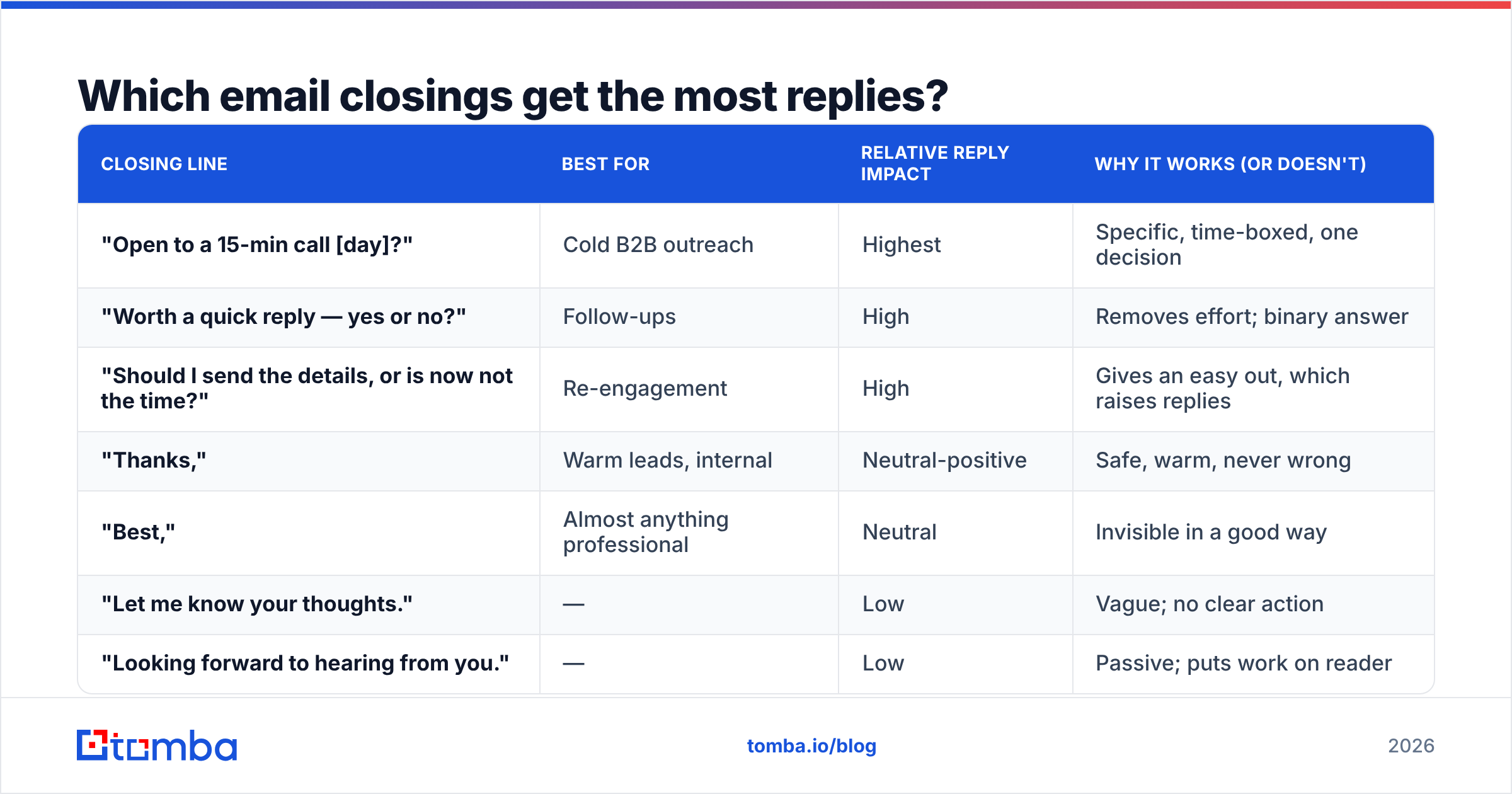
Here's the ranking that matters: closings sorted by what they do to reply rate, not by how formal they sound. The percentages below are directional ranges drawn from public outreach benchmarks and sales-team A/B tests — treat them as relative, not absolute.
| Closing line | Best for | Relative reply impact | Why it works (or doesn't) |
|---|---|---|---|
| "Open to a 15-min call [day]?" | Cold B2B outreach | Highest | Specific, time-boxed, one decision |
| "Worth a quick reply — yes or no?" | Follow-ups | High | Removes effort; binary answer |
| "Should I send the details, or is now not the time?" | Re-engagement | High | Gives an easy out, which raises replies |
| "Thanks," | Warm leads, internal | Neutral-positive | Safe, warm, never wrong |
| "Best," | Almost anything professional | Neutral | Invisible in a good way |
| "Let me know your thoughts." | — | Low | Vague; no clear action |
| "Looking forward to hearing from you." | — | Low | Passive; puts work on reader |
| "Sincerely," | Formal letters only | Low (in email) | Reads stiff and dated in 2026 |
Notice the pattern: the high performers are CTAs, and the low performers are filler. The neutral sign-off words ("Best," "Thanks,") are fine — they're just not where the leverage is. If you want to dig into the metric itself, our response rate glossary entry breaks down how to measure this properly.
What are the best closings for cold email?#
Cold email is the hardest case: no relationship, low trust, high skepticism. Your closing has to lower friction to near zero. The winning formula is one specific, easy-to-answer question followed by a plain sign-off.
Strong cold-email closings:
- "Open to a quick call Thursday or Friday?" — names the action and the window.
- "Is improving [specific metric] a priority this quarter?" — qualifies and invites a one-word reply.
- "Should I send a 2-line summary, or is this not a fit right now?" — the "not a fit" option paradoxically raises replies because it feels honest.
- "Worth a look? Happy to send the one-pager." — low commitment, clear next step.
Then sign off with "Thanks," or "Best," and your name. Don't stack "Best regards, Sincerely, Warm wishes" — pick one. Pair these with tight, personalized copy; if you need a starting point, grab a few proven structures from our library of cold email templates or generate variations with the cold email AI writer and then edit for voice.
One hard rule: a great closing on an email that lands in spam earns zero replies. Closings only matter once you're in the inbox, which means clean lists and verified addresses come first.
What are the best closings for follow-up emails?#
Follow-ups fail when they repeat the original ask in a needier tone. The best follow-up closing changes the question to make replying even easier than before.
- First follow-up: "Did this get buried? Happy to resend." (Gives them a face-saving reason to have not replied.)
- Second follow-up: "Quick yes/no — still worth exploring?" (Binary.)
- Breakup email: "I'll assume the timing's off and close this out — just say the word if that changes." (Loss aversion plus an easy door back in.)
The breakup close is the most underrated line in B2B email. It often outperforms every earlier touch because it signals you'll stop, which removes the pressure that was suppressing the reply.
What email closings should you stop using in 2026?#
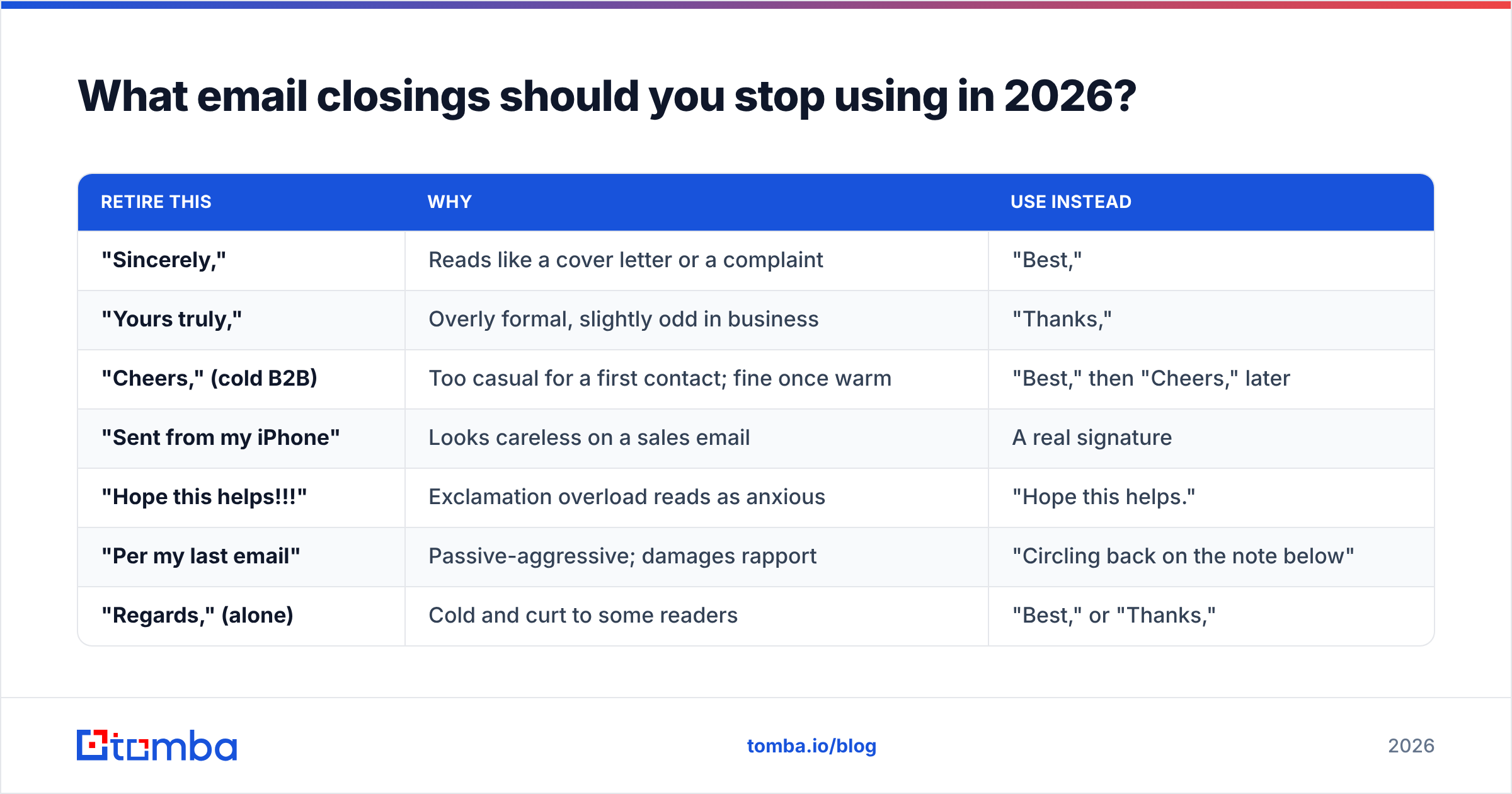
Some sign-offs aren't wrong — they're just sending a signal you don't intend. Here's what reads poorly now and what to use instead.
| Retire this | Why | Use instead |
|---|---|---|
| "Sincerely," | Reads like a cover letter or a complaint | "Best," |
| "Yours truly," | Overly formal, slightly odd in business | "Thanks," |
| "Cheers," (cold B2B) | Too casual for a first contact; fine once warm | "Best," then "Cheers," later |
| "Sent from my iPhone" | Looks careless on a sales email | A real signature |
| "Hope this helps!!!" | Exclamation overload reads as anxious | "Hope this helps." |
| "Per my last email" | Passive-aggressive; damages rapport | "Circling back on the note below" |
| "Regards," (alone) | Cold and curt to some readers | "Best," or "Thanks," |
The meta-lesson: neutral beats clever for the sign-off word. Spend your creativity on the CTA, not on finding a novel way to say goodbye.
)
How does the closing change by relationship and channel?#
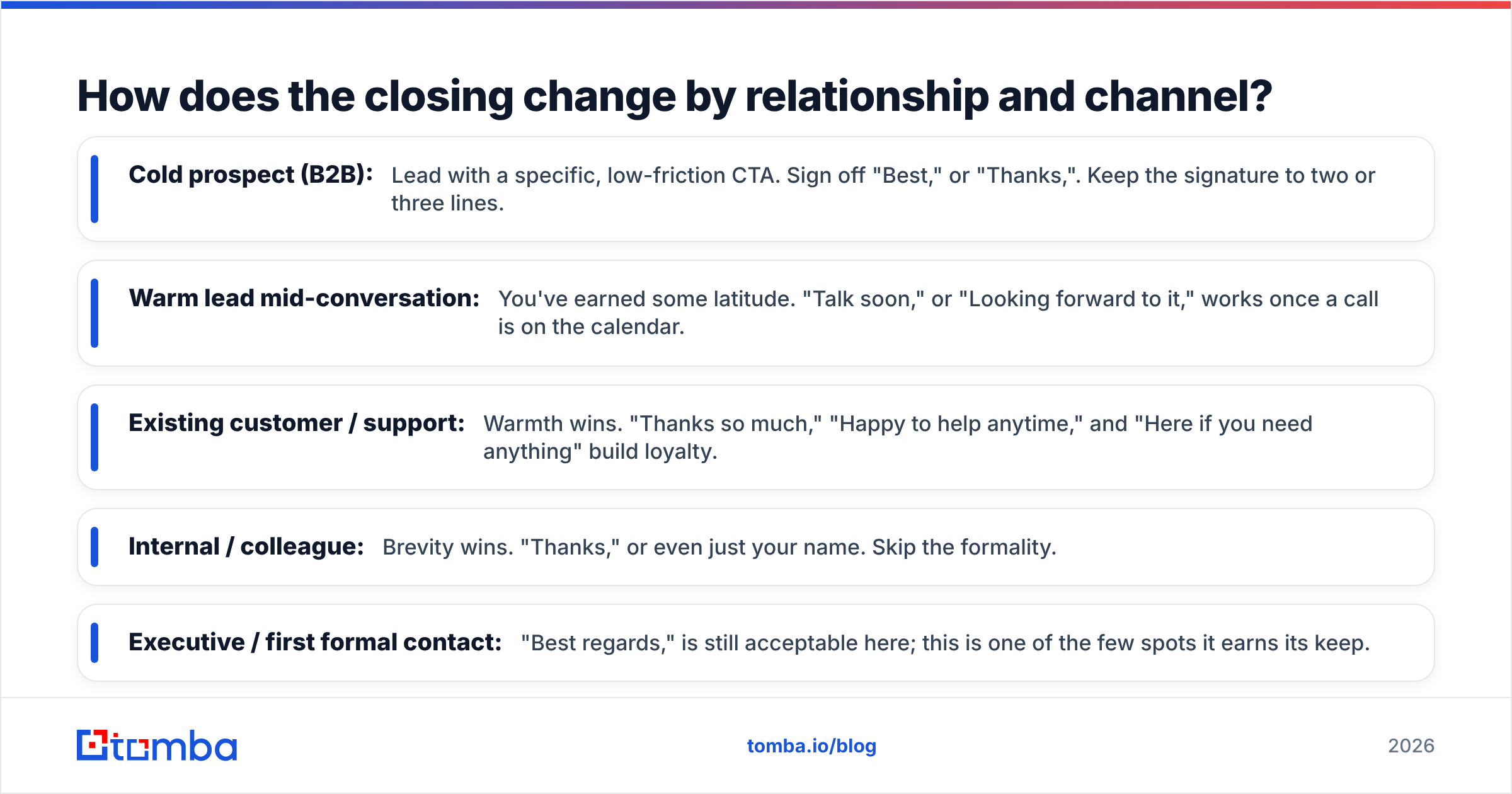
A closing that's perfect for a warm customer is wrong for a cold prospect. Calibrate on two axes: how warm the relationship is, and how formal the context is.
- Cold prospect (B2B): Lead with a specific, low-friction CTA. Sign off "Best," or "Thanks,". Keep the signature to two or three lines.
- Warm lead mid-conversation: You've earned some latitude. "Talk soon," or "Looking forward to it," works once a call is on the calendar.
- Existing customer / support: Warmth wins. "Thanks so much," "Happy to help anytime," and "Here if you need anything" build loyalty.
- Internal / colleague: Brevity wins. "Thanks," or even just your name. Skip the formality.
- Executive / first formal contact: "Best regards," is still acceptable here; this is one of the few spots it earns its keep.
If you send at volume, standardize the structure but vary the CTA. A consistent signature also protects your brand — build one cleanly with an email signature generator instead of pasting mismatched blocks across a team. For reference data on how professionals rate sign-offs, G2 and broader writing guides like the valediction entry on Wikipedia are useful sanity checks on tone norms.
How do you write a closing that actually drives action?#
Use this four-part checklist before you hit send. If your closing fails any of these, rewrite it.
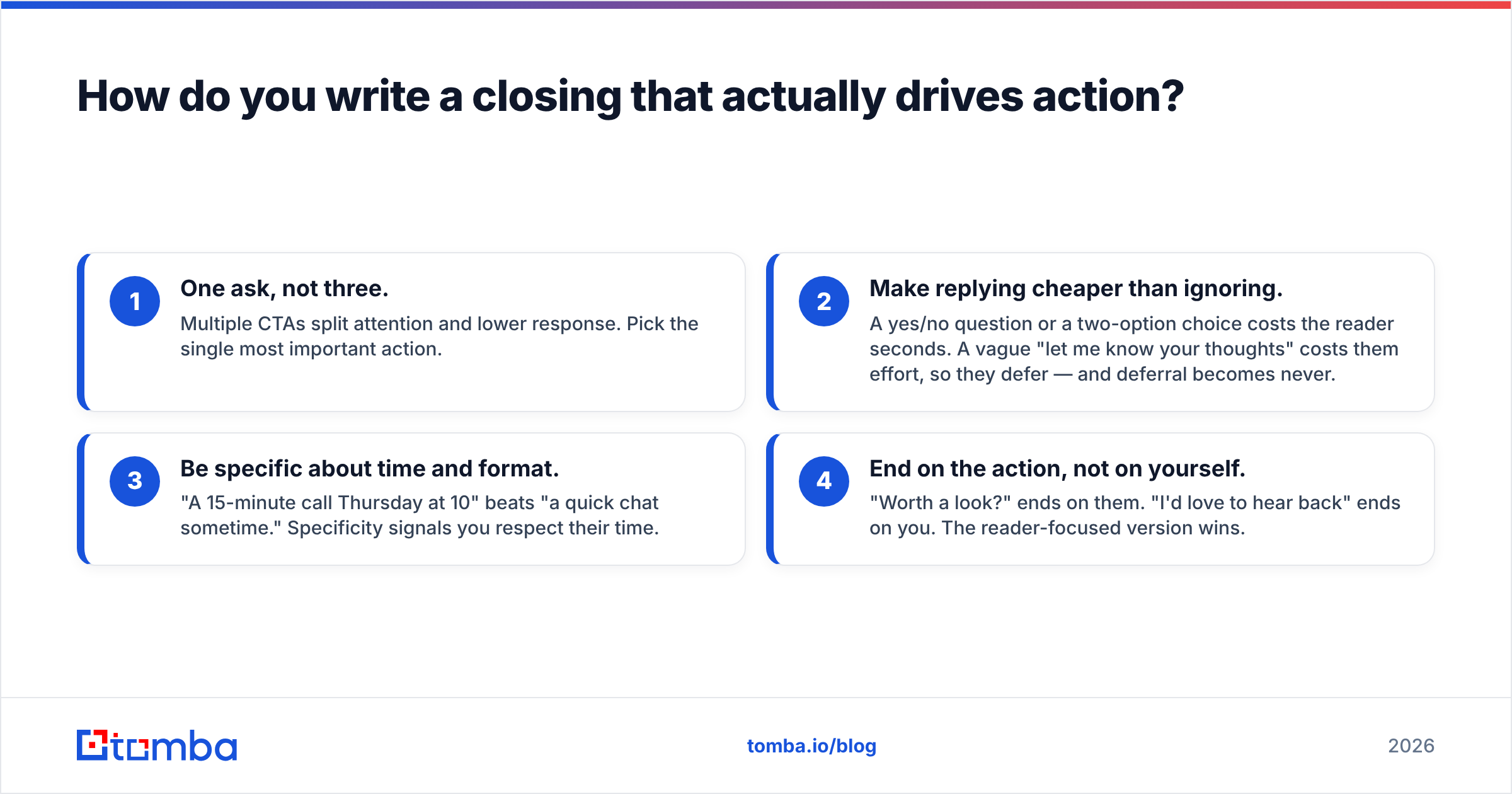
- One ask, not three. Multiple CTAs split attention and lower response. Pick the single most important action.
- Make replying cheaper than ignoring. A yes/no question or a two-option choice costs the reader seconds. A vague "let me know your thoughts" costs them effort, so they defer — and deferral becomes never.
- Be specific about time and format. "A 15-minute call Thursday at 10" beats "a quick chat sometime." Specificity signals you respect their time.
- End on the action, not on yourself. "Worth a look?" ends on them. "I'd love to hear back" ends on you. The reader-focused version wins.
A simple template that applies all four:
[Specific value-tied question]? Happy to [low-effort next step].
Best,
[Name]
Filled in: "Open to a 15-minute call Thursday to see if this fits? Happy to send a one-pager first if that's easier. Best, Sam." That's a complete, high-performing closing — one ask, easy reply, specific time, reader-focused.
Does the rest of the email affect closing performance?#
Yes — and this is where teams quietly lose. A flawless closing on an email sent to a stale, unverified, or guessed address never gets read. The closing is the last 10% of the work; the first 90% is reaching a real person who has a reason to care.
Two things gate every reply:
- Reaching the right person. A perfect CTA aimed at a generic info@ address is wasted. You need the decision-maker's actual address, which is where finding and verifying contacts comes in. Tools like the email finder get you the real address, and an email verifier confirms it's live before you send.
- Landing in the inbox. Reputation and list hygiene decide whether your beautifully closed email is even seen.
In other words, the closing converts attention you've already earned. Earn the attention first, then let the closing do its job.
Quick reference: 12 copy-paste closings#
For when you just need a line right now:
- Cold, direct: "Open to a 15-min call this week? — Best,"
- Cold, soft: "Worth a quick look? Happy to send details. — Thanks,"
- Follow-up 1: "Did this get buried? Happy to resend. — Best,"
- Follow-up 2: "Quick yes/no — still worth exploring? — Thanks,"
- Breakup: "I'll close this out unless the timing changes — just say the word. — Best,"
- Warm lead: "Looking forward to it. — Talk soon,"
- Customer support: "Here if you need anything else. — Thanks so much,"
- Internal: "Thanks, [Name]"
- Formal first contact: "I appreciate your time. — Best regards,"
- After a meeting: "Great talking today — I'll send notes by EOD. — Best,"
- Asking a favor: "No rush at all, and thank you either way. — Thanks,"
- Networking: "Would love to stay in touch. — Best,"
The bottom line#
The best closing for email is a specific, low-friction call-to-action followed by a plain, professional sign-off. Stop optimizing the goodbye word and start optimizing the ask above it. "Best," and "Thanks," are perfectly good — the leverage is in giving the reader one easy decision to make.
But a great closing only pays off if the email reaches the right inbox. Before you polish your sign-offs, make sure you're emailing real, verified decision-makers. Start with the Tomba Email Finder to get accurate professional addresses by name or domain, verify them, and then let your closing do what it does best — turn attention into replies. You can find every plan on the Tomba pricing page, including a free tier with 25 searches a month to test it on your next campaign.
// get started
Find, verify and enrich your first contacts today
Start on the free plan with 25 searches a month, then scale when your team is ready.
Free plan · No credit card required · GDPR & CCPA
// about the author