Best Cold Email Strategy in 2026: Templates, Tools & Tactics
What separates the best cold email from the 99% that get deleted? A breakdown of the data, structure, and tools that actually book replies in 2026.
You can write the most clever cold email in the world and still get ignored — because the "best cold email" isn't a sentence, it's a system. The copy is maybe 20% of the result. The other 80% is who you send to, whether the address is real, and how your domain behaves at scale.
This guide breaks down the full system: the structure of a high-reply message, the data hygiene that gets it delivered, and the sending discipline that keeps you out of spam. No fluff, no "in 2026 the landscape has shifted" filler — just what works.
TL;DR#
- The best cold email is short (50–125 words), relevant, and asks for one small thing. Long pitches lose.
- Deliverability beats cleverness. A verified list and a warmed domain matter more than your subject line.
- Personalization at the first line — not "{{first_name}}" — is what separates a 1% reply rate from an 8% one.
- Volume without verification kills your domain. Bounce rate above ~3% tanks sender reputation fast.
- Tools do the heavy lifting: finding the right contact, verifying it, and tracking what lands.
What makes a cold email "the best" instead of spam?#
The difference between a great cold email and spam is relevance plus restraint. Spam is generic, self-centered, and demands a big commitment ("Let's hop on a 30-minute call this week!"). The best cold email is specific to the recipient, leads with their world, and asks for a tiny yes.
Here's the anatomy that consistently outperforms:
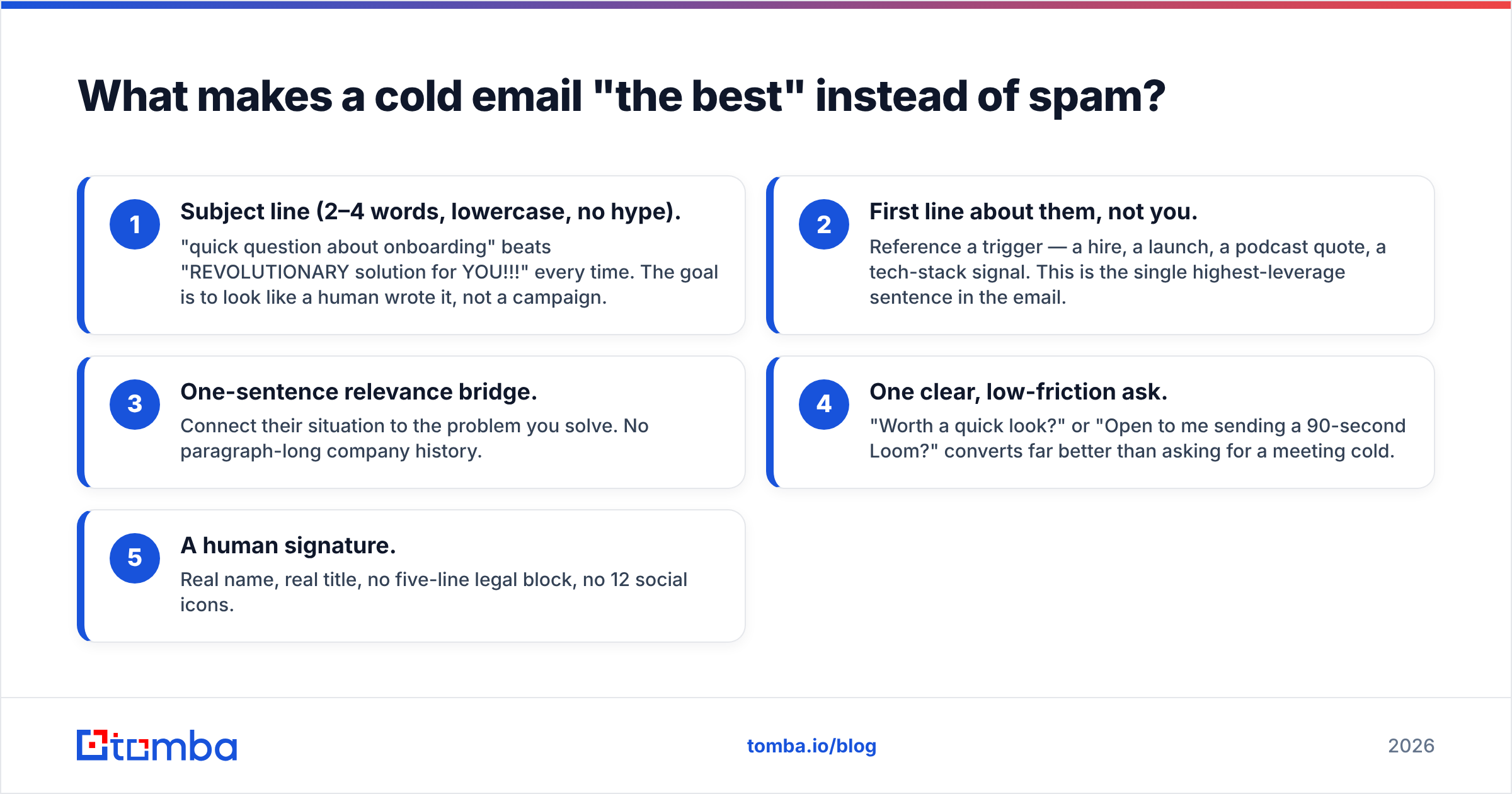
- Subject line (2–4 words, lowercase, no hype). "quick question about onboarding" beats "REVOLUTIONARY solution for YOU!!!" every time. The goal is to look like a human wrote it, not a campaign.
- First line about them, not you. Reference a trigger — a hire, a launch, a podcast quote, a tech-stack signal. This is the single highest-leverage sentence in the email.
- One-sentence relevance bridge. Connect their situation to the problem you solve. No paragraph-long company history.
- One clear, low-friction ask. "Worth a quick look?" or "Open to me sending a 90-second Loom?" converts far better than asking for a meeting cold.
- A human signature. Real name, real title, no five-line legal block, no 12 social icons.
Notice what's missing: feature lists, adjectives, and pressure. The best cold email reads like a note from a busy peer, because that's exactly the impression you want to create.
Is the subject line really the most important part?#
No — and this is where most "best cold email" advice goes wrong. The subject line gets you opened, but the contact data and deliverability decide whether you were ever seen at all. A perfect subject line sent to a stale, unverified list lands in spam, where open rates are irrelevant.
Think of it like a restaurant. The subject line is the dish on the menu. But if the kitchen (your domain reputation) is shut down by the health inspector (spam filters), nobody ever tastes the food. You fix the kitchen first.
That's why high-performing senders obsess over their list quality and warmup before they A/B test copy. Run every address through an email verifier before sending, keep bounce rates under 3%, and your subject-line tests will finally produce reliable numbers — because your emails are actually reaching inboxes.
What does the best cold email structure look like?#
Below is a field-tested template. Keep it under 100 words and resist the urge to add "just one more sentence."
Subject: onboarding at {{Company}}
Hi {{First name}},
Saw {{Company}} just rolled out {{specific trigger — new product, role, funding}}. Usually when teams hit that stage, {{specific pain}} starts eating support hours.
We help {{similar company}} cut that by {{concrete number}} without adding headcount.
Worth a quick look? Happy to send a 90-second walkthrough — no call needed.
{{Your name}}
{{Title}}, {{Company}}
The reason this works: every line earns the next. The trigger proves you did homework, the pain creates relevance, the proof reduces risk, and the ask costs the reader almost nothing. For more variations you can adapt, browse a library of proven cold email templates and tweak the trigger line to your niche.
How do the best cold email approaches compare?#
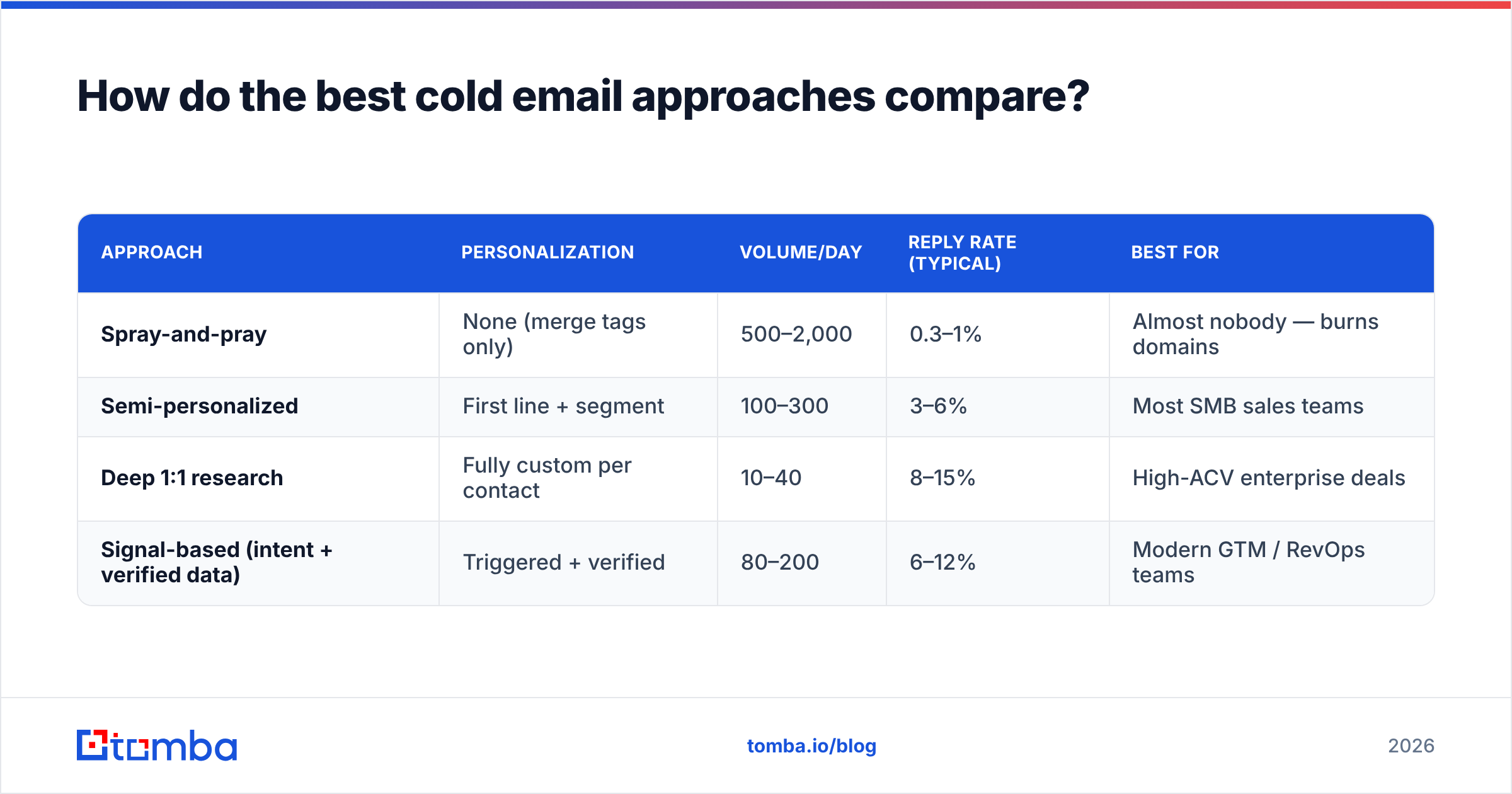
Not every strategy fits every team. Here's an honest comparison of the three dominant approaches in 2026, so you can pick based on your resources rather than hype.
| Approach | Personalization | Volume/day | Reply rate (typical) | Best for |
|---|---|---|---|---|
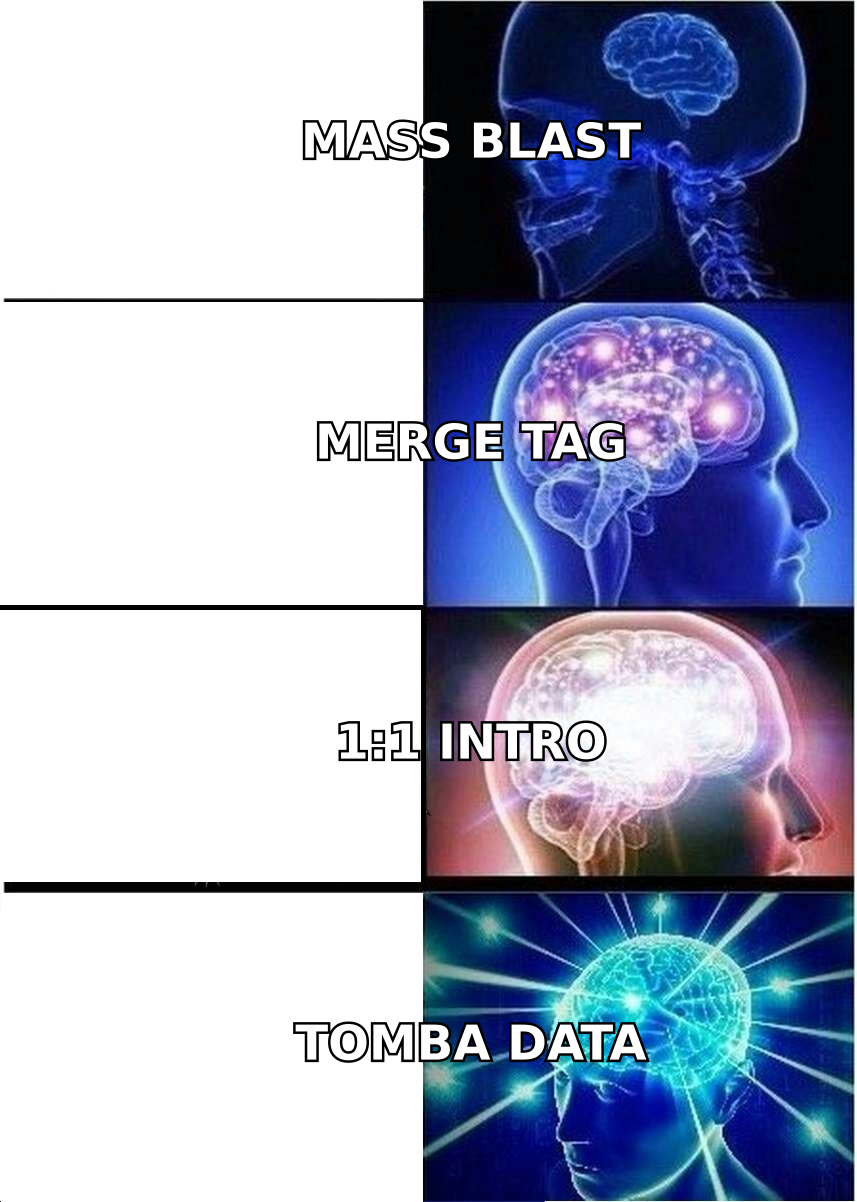
| Spray-and-pray | None (merge tags only) | 500–2,000 | 0.3–1% | Almost nobody — burns domains |
| Semi-personalized | First line + segment | 100–300 | 3–6% | Most SMB sales teams |
| Deep 1:1 research | Fully custom per contact | 10–40 | 8–15% | High-ACV enterprise deals |
| Signal-based (intent + verified data) | Triggered + verified | 80–200 | 6–12% | Modern GTM / RevOps teams |
The takeaway: reply rate scales with relevance, not volume. Doubling your send count with a bad list usually halves your domain reputation. The sweet spot for most teams is semi-personalized or signal-based — enough volume to fill a pipeline, enough relevance to get replies.
Why does data quality decide your reply rate?#
Because you can't personalize a contact you can't reach. The "best cold email" sent to the wrong person, a generic info@ inbox, or a dead address is worth exactly zero. Three data problems quietly destroy most campaigns:
- Wrong person. You're emailing a junior coordinator instead of the VP who owns budget. Use domain search to map a company's real org and find the decision-maker by role, not guesswork.
- Dead addresses. People change jobs every 18–24 months on average. An address that worked last quarter may bounce today, dragging your sender score down.
- Catch-all uncertainty. Many corporate domains accept every address, so a standard verifier can't confirm validity. A dedicated catch-all verifier resolves the ones generic tools mark "unknown."
According to HubSpot's research on email marketing, list hygiene and segmentation are among the strongest predictors of campaign performance — ahead of copy tweaks. Clean data isn't glamorous, but it's the foundation everything else sits on.
How do you protect deliverability while scaling?#
Treat your domain like a credit score: easy to damage, slow to rebuild. The best cold email program in the world fails if your messages never reach the inbox. Follow these non-negotiables:
- Authenticate everything. Set up SPF, DKIM, and DMARC before your first send. Use a free SPF checker to confirm your record is valid — a misconfigured one alone can route you to spam.
- Warm up new domains. Ramp gradually over 3–4 weeks. Don't blast 500 emails from a domain that sent zero yesterday. Google and Microsoft notice.
- Use a separate sending domain. Send cold outreach from a domain variant (e.g.,
getcompany.com), never your primary corporate domain. If reputation tanks, your real email keeps working. - Keep bounce rate under 3% and spam complaints under 0.1%. This is where verification pays for itself — every bounce you prevent protects your reputation.
- Monitor your reputation. Tools like Google Postmaster Tools show your domain reputation, spam rate, and authentication status straight from Gmail. Check it weekly.
Microsoft and Google both tightened bulk-sender rules in recent years, and the trend is clear: authentication and low complaint rates are now table stakes. Skipping warmup or sending to unverified lists isn't a shortcut — it's a slow-motion domain suicide.
What about follow-ups — do they actually work?#
Yes, decisively. Most replies to cold email come from follow-ups, not the first message. A single send leaves the majority of your pipeline on the table. The discipline:
- Send 2–4 follow-ups, spaced 3–4 days apart.
- Each follow-up adds value — a case study, a relevant stat, a different angle — never just "bumping this up" or "did you see my last email?"
- Keep them shorter than the original. By follow-up three, a single line ("Still worth a look, or should I close the loop?") often outperforms a fresh pitch.
- Stop gracefully. A polite breakup email ("I'll assume the timing's off — I'll stop here") frequently earns a reply from people who meant to respond but forgot.
The math is simple: if your first email gets a 5% reply rate and each follow-up adds 2–3 points, a four-touch sequence can triple your total replies without finding a single new contact.
Which tools build the best cold email workflow?#
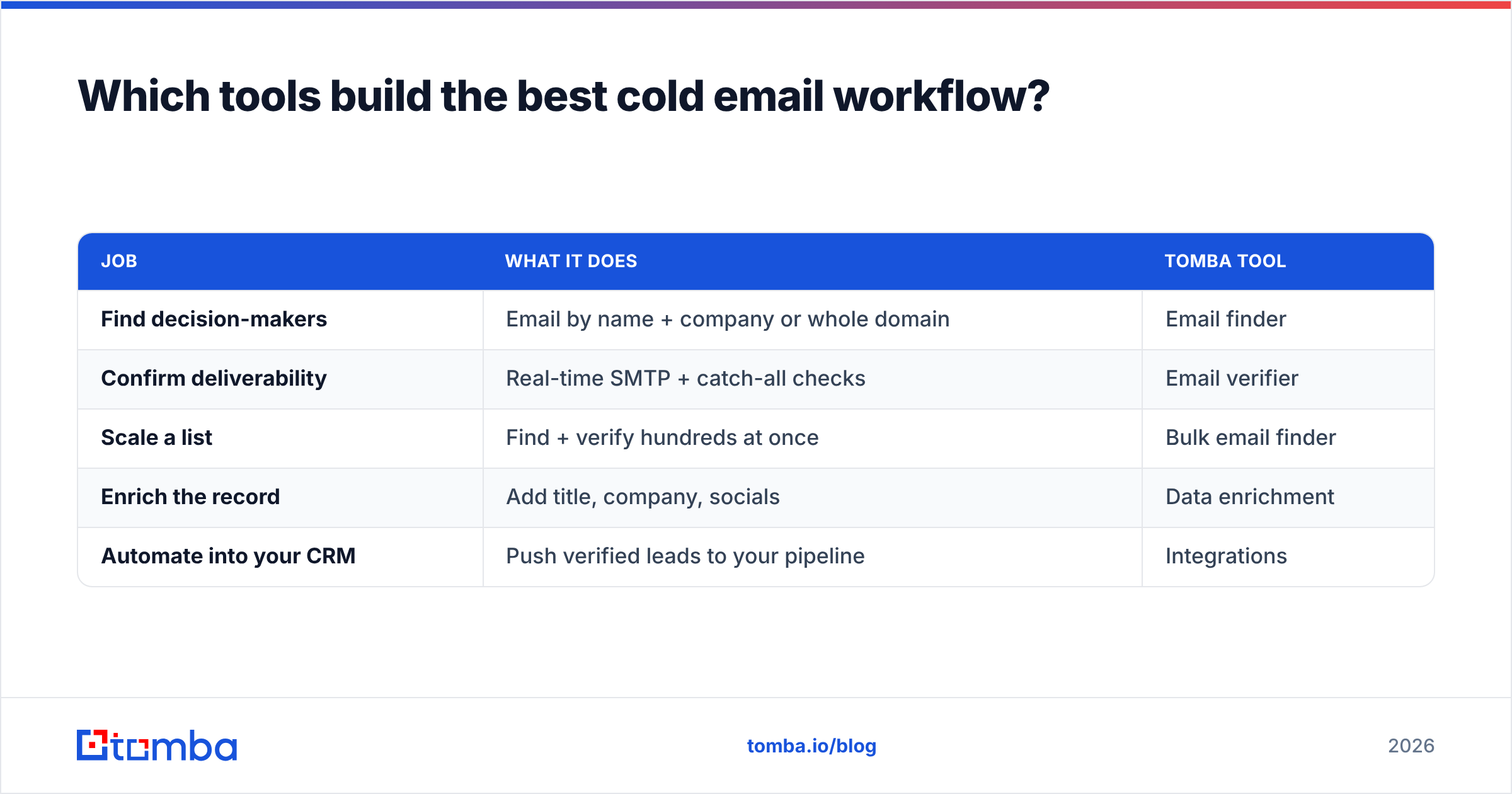
You need three capabilities: find the right contact, verify it's real, and send with tracking. You can stitch these together or use an integrated stack. Here's how the core pieces fit:
| Job | What it does | Tomba tool |
|---|---|---|
| Find decision-makers | Email by name + company or whole domain | Email finder |
| Confirm deliverability | Real-time SMTP + catch-all checks | Email verifier |
| Scale a list | Find + verify hundreds at once | Bulk email finder |
| Enrich the record | Add title, company, socials | Data enrichment |
| Automate into your CRM | Push verified leads to your pipeline | Integrations |
For most teams, the workflow is: pull a target account list, use domain search to find the right roles, verify in bulk, enrich the records, then load the clean list into your sending tool. The sending platform (Instantly, Smartlead, Apollo, etc.) handles the actual delivery and sequencing — but it's only as good as the data you feed it. Compare plans and credits on the Tomba pricing page to size your stack; the Free tier (25 searches/mo) is enough to test the workflow before you commit.
How do you measure if your cold email is actually "best"?#
Track these four metrics, in order of importance:
- Reply rate — the only metric that maps to revenue. Aim for 5%+ on semi-personalized campaigns.
- Positive reply rate — replies that aren't "unsubscribe" or "not interested." This is the real signal.
- Bounce rate — keep under 3%. Anything higher means your verification step is failing.
- Open rate — useful for subject-line tests, but treat it skeptically; privacy features inflate and deflate it unreliably.
Ignore vanity metrics like total emails sent. A campaign that sends 100 emails and books 8 meetings beats one that sends 5,000 and books two — and it won't get your domain blacklisted. You can sanity-check your sending domain anytime with a blacklist checker before a big push.
What are the most common cold email mistakes?#
Even strong copywriters torpedo their own campaigns with these:
- Asking for too much, too soon. A meeting request in email one is a stranger asking you to marry them. Earn the date first.
- Talking about yourself. "We're the leading provider of..." Nobody cares. Lead with their problem.
- Sending to unverified lists. The fastest way to spam folder. Always verify first.
- No follow-up. Leaving 70% of your replies unclaimed.
- Walls of text. If it looks like work to read, it gets archived. Short wins.
- Faking familiarity. "Great chatting last week!" when you've never met destroys trust instantly.
Fix these six and you'll outperform the majority of senders before you've even optimized a single subject line.
Ready to build campaigns that actually get replies?#
The best cold email starts long before the copy: it starts with reaching the right person at a real, verified address. That's exactly what the Tomba Email Finder is built for — find professional emails by name, company, or domain, verify them in real time, and load a clean list into your sequencing tool so every message you send has a chance to land.
Start free with 25 searches a month, prove the workflow on your next campaign, and scale up only when the replies start coming in. Clean data was always the secret behind every great cold email — now you can build your list on it.
// get started
Find, verify and enrich your first contacts today
Start on the free plan with 25 searches a month, then scale when your team is ready.
Free plan · No credit card required · GDPR & CCPA
Get the Tomba newsletter
Product and data updates
// about the author