Best CRM for Startup in 2026: Top 7 Picks Compared
Choosing the best CRM for a startup in 2026 comes down to price, setup speed, and data quality. Here's an honest, hands-on comparison of the top 7 options.
Best CRM for Startup in 2026: Top 7 Picks Compared
Picking a CRM as a startup feels like choosing a foundation before you know how big the house gets. Go too lightweight and you outgrow it in six months. Go too heavy and you spend your runway configuring fields nobody fills in. This guide cuts through that, with concrete pricing, setup times, and the one factor most founders ignore until it bites them: the quality of the data going in.
TL;DR#
- Best overall for early-stage: HubSpot — generous free tier, fast setup, scales with you.
- Best for pure sales pipelines: Pipedrive — cheap, visual, and dead simple to learn.
- Best for design-led founders: Folk — lightweight, contact-centric, modern UX.
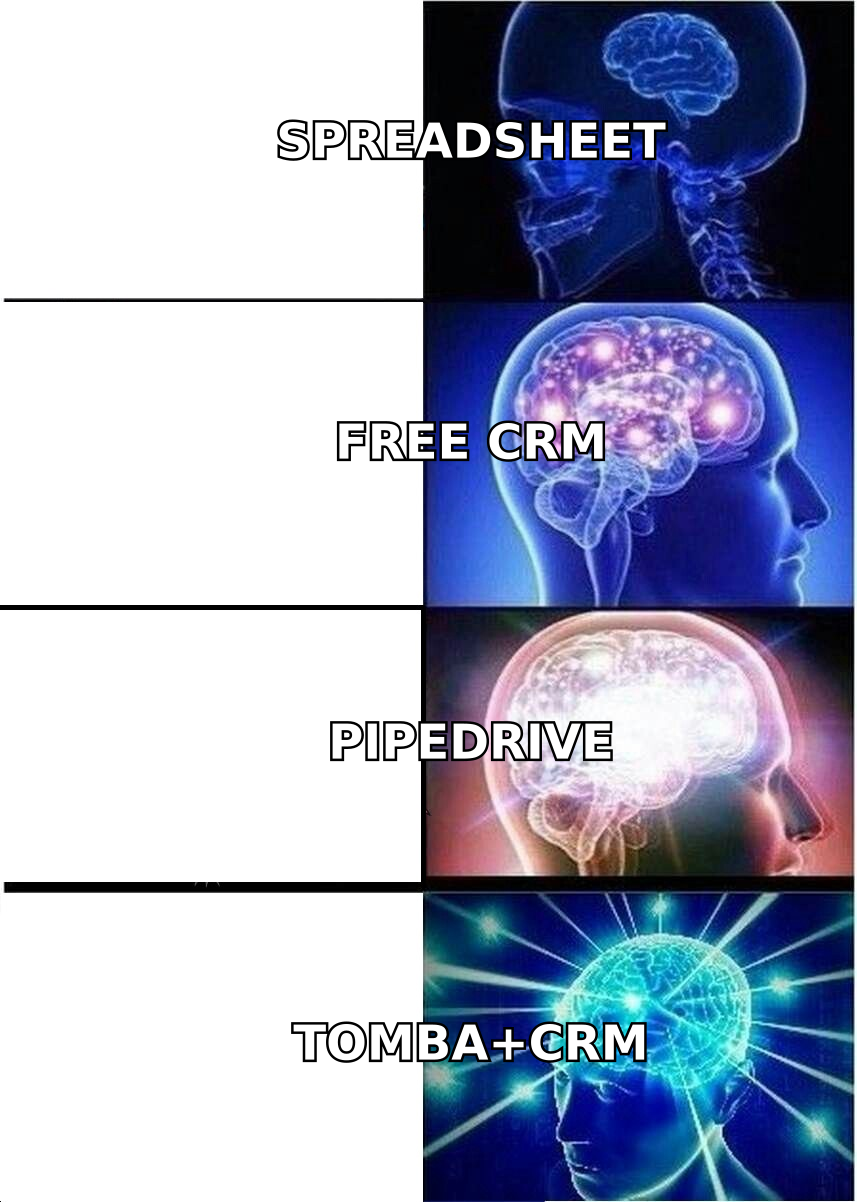
- Best free option that won't trap you: Zoho CRM and HubSpot both have real free plans.
- The hidden lever: your CRM is only as good as the contact data in it. Pair any of these with an email finder and verification step so reps aren't emailing dead addresses.
What should a startup actually want from a CRM?#
A startup CRM should do three things well: capture deals without friction, keep contact data clean, and get out of the way. Everything else is a nice-to-have until you have a real sales team.
Think of your first CRM like a kitchen for a new restaurant. You don't need a 20-burner range on day one — you need a clean counter, sharp knives, and a system so the next cook can find things. Over-buying capacity you can't staff is just clutter you pay rent on.
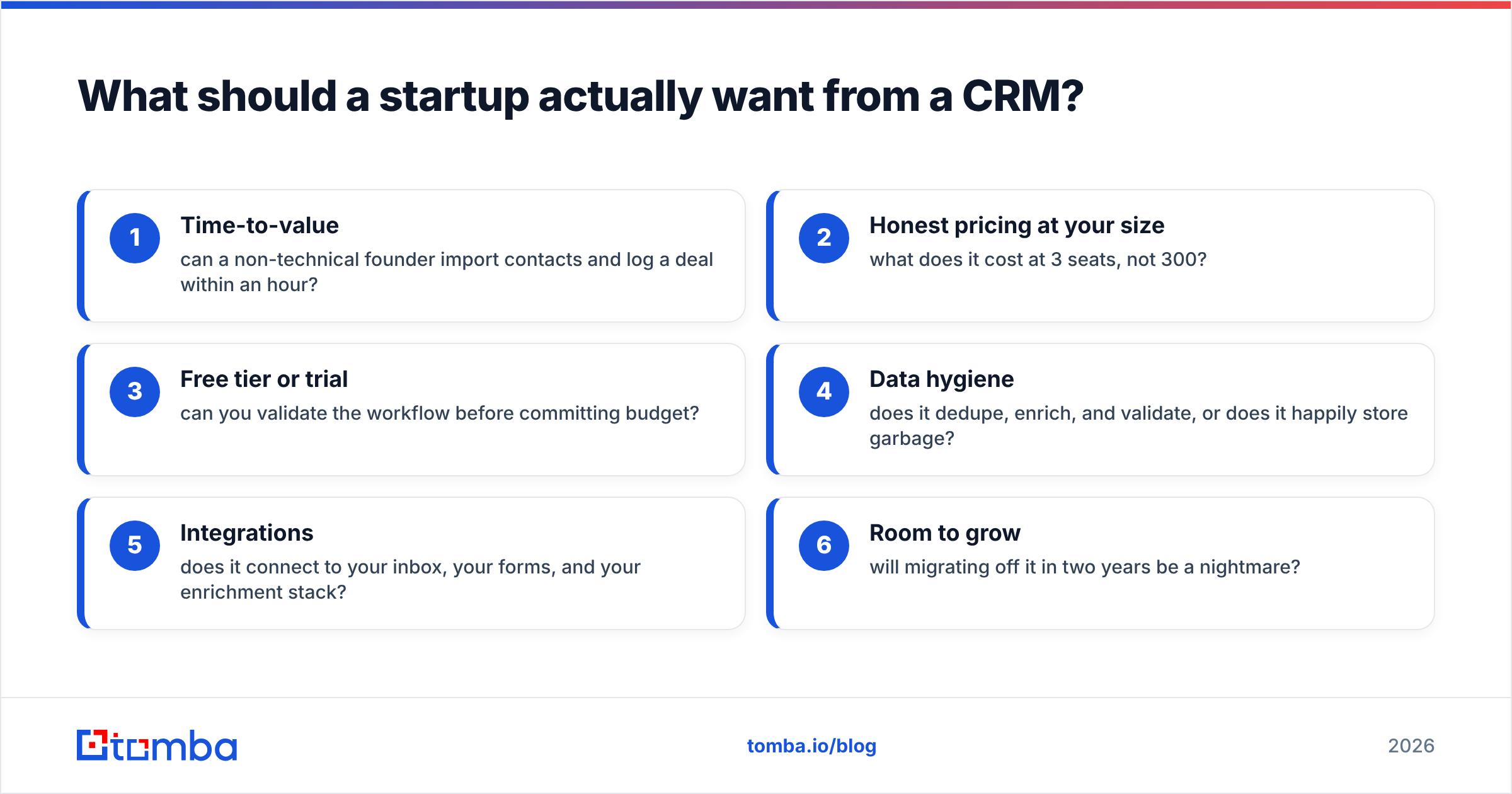
Here's what matters most when you're under 20 people:
- Time-to-value — can a non-technical founder import contacts and log a deal within an hour?
- Honest pricing at your size — what does it cost at 3 seats, not 300?
- Free tier or trial — can you validate the workflow before committing budget?
- Data hygiene — does it dedupe, enrich, and validate, or does it happily store garbage?
- Integrations — does it connect to your inbox, your forms, and your enrichment stack?
- Room to grow — will migrating off it in two years be a nightmare?
If a tool nails the first four, it's a contender. The last two separate the CRMs you keep from the ones you rip out after Series A.
Which is the best CRM for a startup in 2026?#
There's no single winner — there's a winner for your stage and motion. A two-person SaaS doing product-led growth wants something different from a five-rep outbound agency. Below is the honest breakdown.
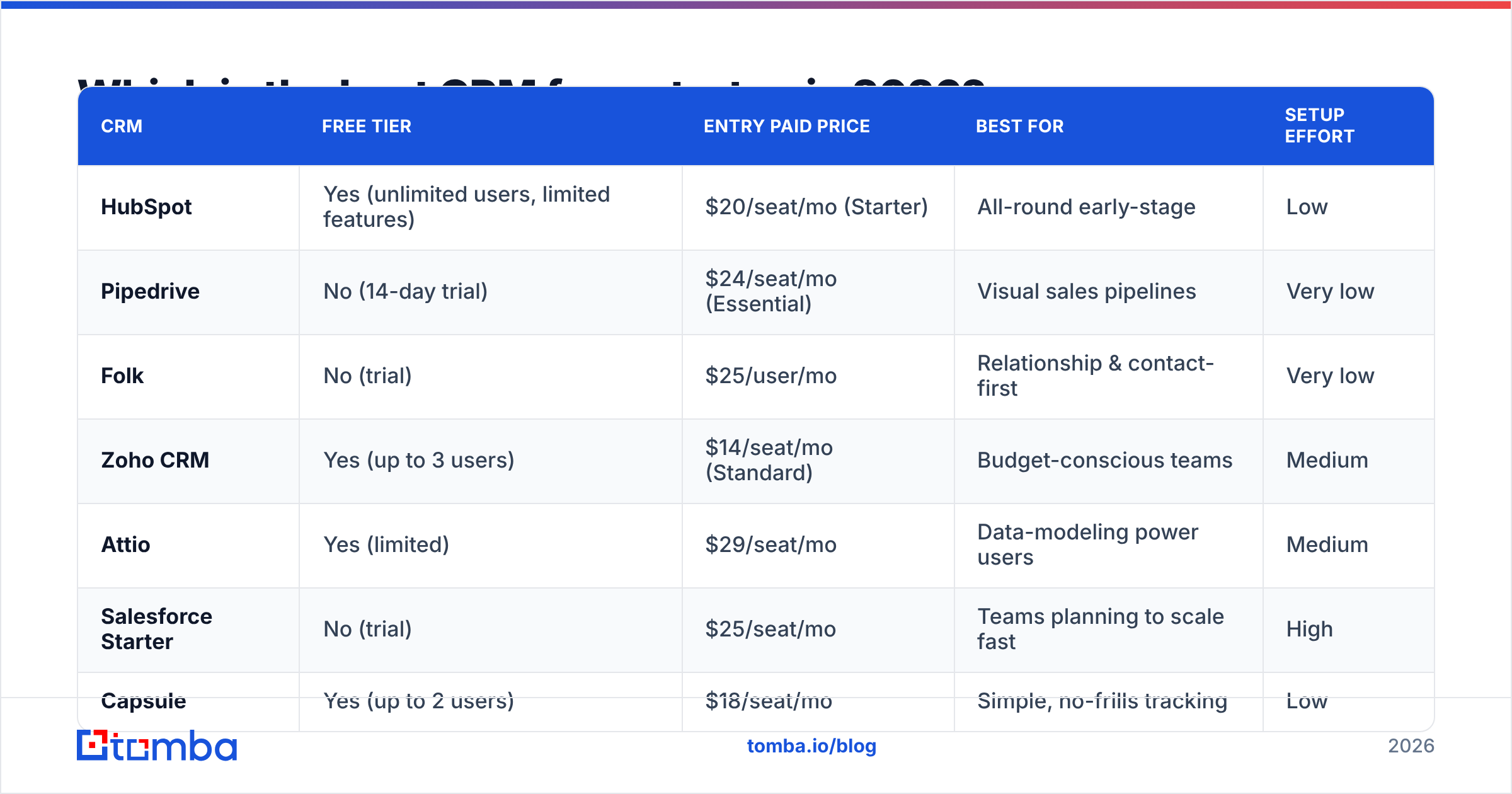
| CRM | Free tier | Entry paid price | Best for | Setup effort |
|---|---|---|---|---|
| HubSpot | Yes (unlimited users, limited features) | $20/seat/mo (Starter) | All-round early-stage | Low |
| Pipedrive | No (14-day trial) | $24/seat/mo (Essential) | Visual sales pipelines | Very low |
| Folk | No (trial) | $25/user/mo | Relationship & contact-first | Very low |
| Zoho CRM | Yes (up to 3 users) | $14/seat/mo (Standard) | Budget-conscious teams | Medium |
| Attio | Yes (limited) | $29/seat/mo | Data-modeling power users | Medium |
| Salesforce Starter | No (trial) | $25/seat/mo | Teams planning to scale fast | High |
| Capsule | Yes (up to 2 users) | $18/seat/mo | Simple, no-frills tracking | Low |
A few notes from using these in anger:
- HubSpot wins on breadth. The free tier is genuinely usable, and you can layer on marketing and service hubs later without switching tools. The catch is that costs climb quickly once you want automation and reporting — read the HubSpot pricing page line by line before committing.
- Pipedrive is the fastest to "aha." If your motion is straightforward — leads in, deals through stages, won or lost — it's hard to beat. It does less than HubSpot, which is exactly why founders like it.
- Folk and Attio are the modern challengers. Folk feels like a beautifully designed contact book with pipeline bolted on; Attio is for founders who think in databases and want to model their own objects.
- Salesforce Starter exists to get startups onto the platform early. It's capable, but the setup tax is real — budget for an admin or a consultant if you go this route.
For a deeper category view, G2's CRM grid is a useful cross-check against real user reviews rather than vendor marketing.
Is a free CRM good enough for a startup?#
Yes — for most pre-revenue and early-revenue startups, a free CRM is not a compromise, it's the correct choice. HubSpot Free, Zoho's free plan for up to three users, and Capsule's free tier all handle the core job: store contacts, track deals, log activity.
The free tier becomes a problem only when you hit one of these walls:
- Automation limits — you're manually moving deals and copy-pasting follow-ups.
- Reporting limits — you can't see conversion by stage or rep.
- Seat limits — your fourth hire can't get a login.
When you hit those, you've usually got enough revenue to justify a paid seat. Don't pre-pay for a problem you don't have yet. The mistake isn't starting free — it's staying free six months after the pain is obvious.
What's the real difference between these CRMs?#
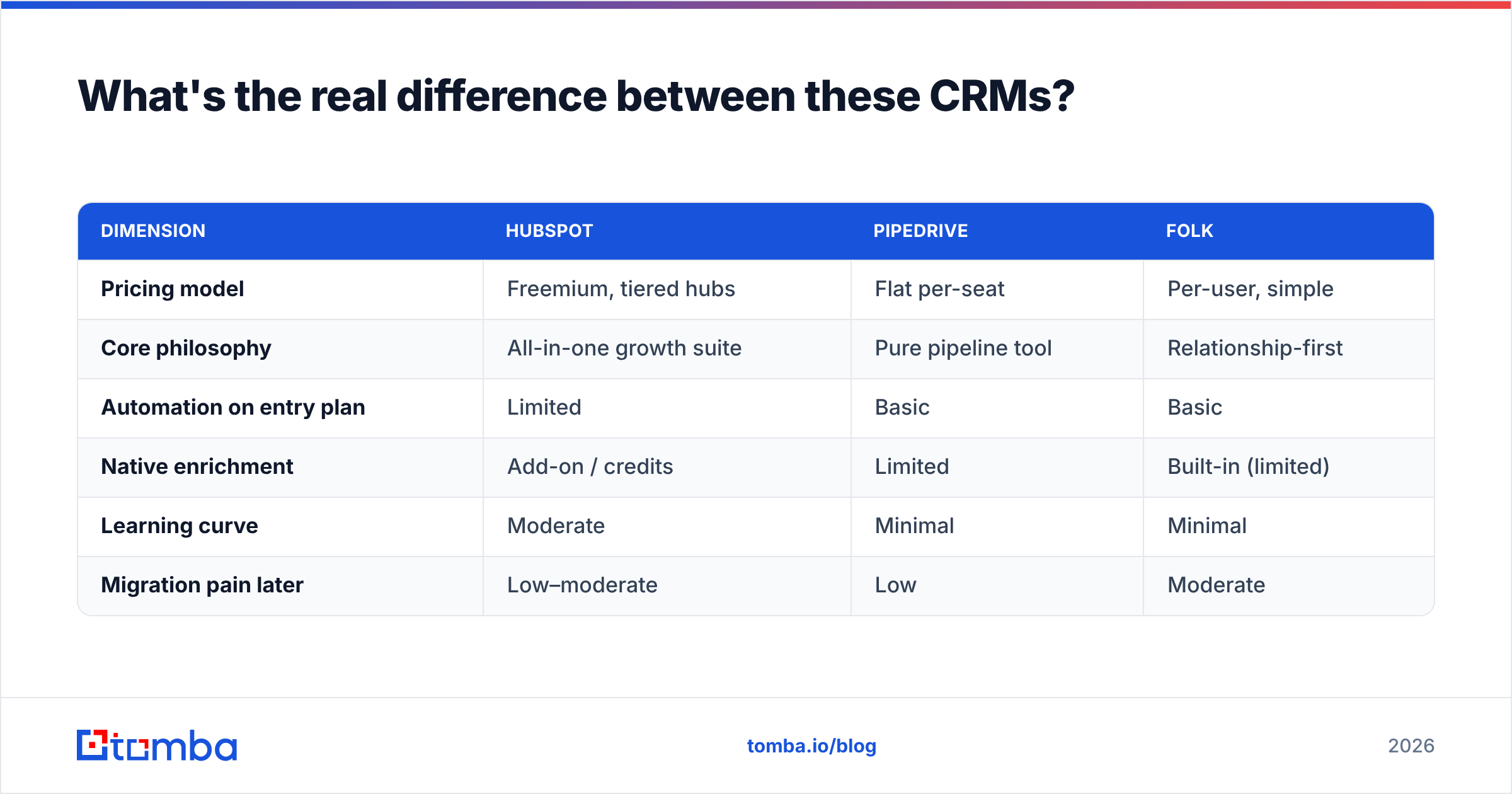
Feature lists blur together. The real differences show up in three places: pricing model, philosophy, and data handling.
| Dimension | HubSpot | Pipedrive | Folk |
|---|---|---|---|
| Pricing model | Freemium, tiered hubs | Flat per-seat | Per-user, simple |
| Core philosophy | All-in-one growth suite | Pure pipeline tool | Relationship-first |
| Automation on entry plan | Limited | Basic | Basic |
| Native enrichment | Add-on / credits | Limited | Built-in (limited) |
| Learning curve | Moderate | Minimal | Minimal |
| Migration pain later | Low–moderate | Low | Moderate |
Notice that "native enrichment" row. Every CRM claims some form of contact enrichment, but coverage and accuracy vary wildly — and that's the part that quietly decides whether your pipeline data is trustworthy.
Why does contact data quality matter more than the CRM itself?#
Your CRM is a container; the data is the product. A perfectly configured pipeline full of bounced emails and wrong job titles is worse than a spreadsheet, because it looks authoritative while quietly wasting every rep's time.
This is the part founders learn the hard way. You evaluate seven CRMs on UI and price, pick one, import 2,000 contacts from a list you bought — and three months later your deliverability is wrecked because 30% of those addresses never existed.

Two habits fix this, regardless of which CRM you pick:
- Find emails from a verified source, not a scraped dump. Use a tool that searches by domain and name and returns a confidence score. Tomba's email finder does this and exposes the source signals behind each result, so you know why an address is trusted.
- Verify before you import and on a schedule after. Catch-all domains, role addresses, and decayed contacts slip in over time. A verification pass keeps your bounce rate low and your sender reputation intact.
- Enrich on entry. When a lead fills a form with just an email, data enrichment fills in company, role, and firmographics so your reps aren't researching manually.
Tomba isn't a CRM and doesn't pretend to be — it's the data layer that sits in front of one. It connects to most of the tools above; the HubSpot integration pushes verified, enriched contacts straight into your pipeline. On Tomba pricing, the Free tier gives you 25 searches a month to test, with Starter at $49/mo and Growth at $99/mo as your volume grows.
How do I choose without overthinking it?#
Match the tool to your motion, not to a feature checklist:
- Product-led / inbound-heavy: HubSpot Free → Starter. The marketing and form tooling pays for itself.
- Outbound sales, small team: Pipedrive. Fast, visual, cheap. Add an enrichment and finder layer on top.
- Founder-led, relationship-driven (agencies, fundraising, BD): Folk or Attio.
- Tight budget, need more than free: Zoho CRM at $14/seat is the value play.
- Planning to scale headcount fast and have admin help: Salesforce Starter to avoid a migration later.
Then, whichever you pick, wire in a data step before contacts hit the CRM. The CRM decision is reversible in a weekend. A poisoned contact database and a burned sending domain are not.
What does a good startup CRM stack look like?#
A lean, effective stack in 2026 has three layers:
- System of record (the CRM) — HubSpot, Pipedrive, or Folk. Where deals and activity live.
- Data layer — an email finder, verifier, and enrichment service feeding clean contacts in. This is where Tomba fits.
- Outreach layer — your email sequencer or inbox, sending only to verified addresses.
Keep those three honest and you'll outperform competitors running a bloated 12-tool stack on dirty data. Cross-check vendor claims against independent reviews on Pipedrive's own site and G2 before you sign anything annual.
The bottom line#
The best CRM for a startup in 2026 is the cheapest one that fits your sales motion and gets out of your way — for most teams that's HubSpot Free or Pipedrive. But the CRM is only half the decision. The other half, the one that actually determines whether your pipeline is real or a mirage, is the quality of the contacts you put in it.
Start your CRM free. Then make every contact count: use the Tomba Email Finder to source verified, enriched professional emails by domain or name, and feed only clean data into whichever CRM you choose. Spin up the free 25-search tier today and see the difference accurate data makes before you ever pay for a seat.
Ready to find emails that actually work?
Join 150,000+ professionals who stopped guessing and started sending. Free credits on signup — no credit card required.
Get the Tomba newsletter
Practical outbound tactics and product updates — once every two weeks.
About the author