15 Best Data Enrichment Tools for B2B Teams in 2026
A neutral, hands-on breakdown of the best data enrichment tools in 2026 — pricing, coverage, accuracy, and which platform fits your GTM stack.
Data enrichment is the difference between a CRM full of half-filled rows and a pipeline your reps actually trust. The right tool turns a bare email or company domain into a complete, routable, sellable record. The wrong one fills your database with stale titles and bounced inboxes you pay to email.
This guide ranks the best data enrichment tools for 2026 on the four things that matter: match rate, accuracy, coverage depth, and how much you pay to keep records fresh.
TL;DR#
Best overall value: Tomba — strong email/firmographic coverage, a clean API, and a free tier that lets you test match rates before you commit.
Best for all-in-one prospecting: Apollo.io, if you want enrichment bundled with a database and a sequencer.
Best for big-company firmographics: Clearbit (now Breeze Intelligence inside HubSpot).
Don't pay for what you can't verify. Every enrichment vendor inflates "records available." Test match rate and accuracy on your list first.
Enrichment is a pipeline, not a purchase. Budget for re-enrichment — B2B data decays roughly 25–30% per year.
What is a data enrichment tool?#
A data enrichment tool takes a thin piece of input — an email, a domain, a company name, a LinkedIn URL — and appends the missing attributes around it. Think of it like a reverse phone book that never stops updating: you hand it one known fact, and it returns the full record attached to that fact.
Enrichment generally falls into a few buckets:
Contact enrichment — appends a person's email, phone, title, seniority, and social profiles.
Firmographic enrichment — appends company size, revenue, industry, HQ location, and tech stack.
Intent and behavioral data — signals like hiring activity, funding, or website visits that hint at buying readiness.
Identity resolution — matching anonymous activity (a website visitor, a form fill) back to a real person or account.
Most teams need the first two. The third and fourth are where budgets balloon, so add them only after the basics are clean.

How should you evaluate the best data enrichment tools?#
Vendor marketing leads with one number: total records in the database. That number is close to meaningless. A provider can claim 700 million contacts and still whiff on the 200 accounts in your ICP. Evaluate on outcomes instead.
Match rate — of the records you submit, what percentage come back enriched? This is the metric that determines real coverage for your market.
Accuracy — of the records returned, how many are correct and current? An email that exists but bounces is worse than a blank field.
Freshness — how often is the underlying data re-crawled and re-verified? Ask for the cadence, not a marketing adjective.
Coverage by geography and segment — North American mid-market is easy. EMEA SMB, APAC, or niche verticals separate the serious vendors.
Delivery method — API, bulk CSV, native CRM sync, spreadsheet add-on. The best data enrichment workflow is the one your team will actually run.
Compliance — GDPR and CCPA posture, opt-out handling, and documented data sources.
A practical test: take a sample of 200 of your own accounts, run them through each tool's free or trial tier, and measure match rate and accuracy yourself. According to Gartner research, poor data quality costs organizations millions annually — a one-afternoon test is cheap insurance.
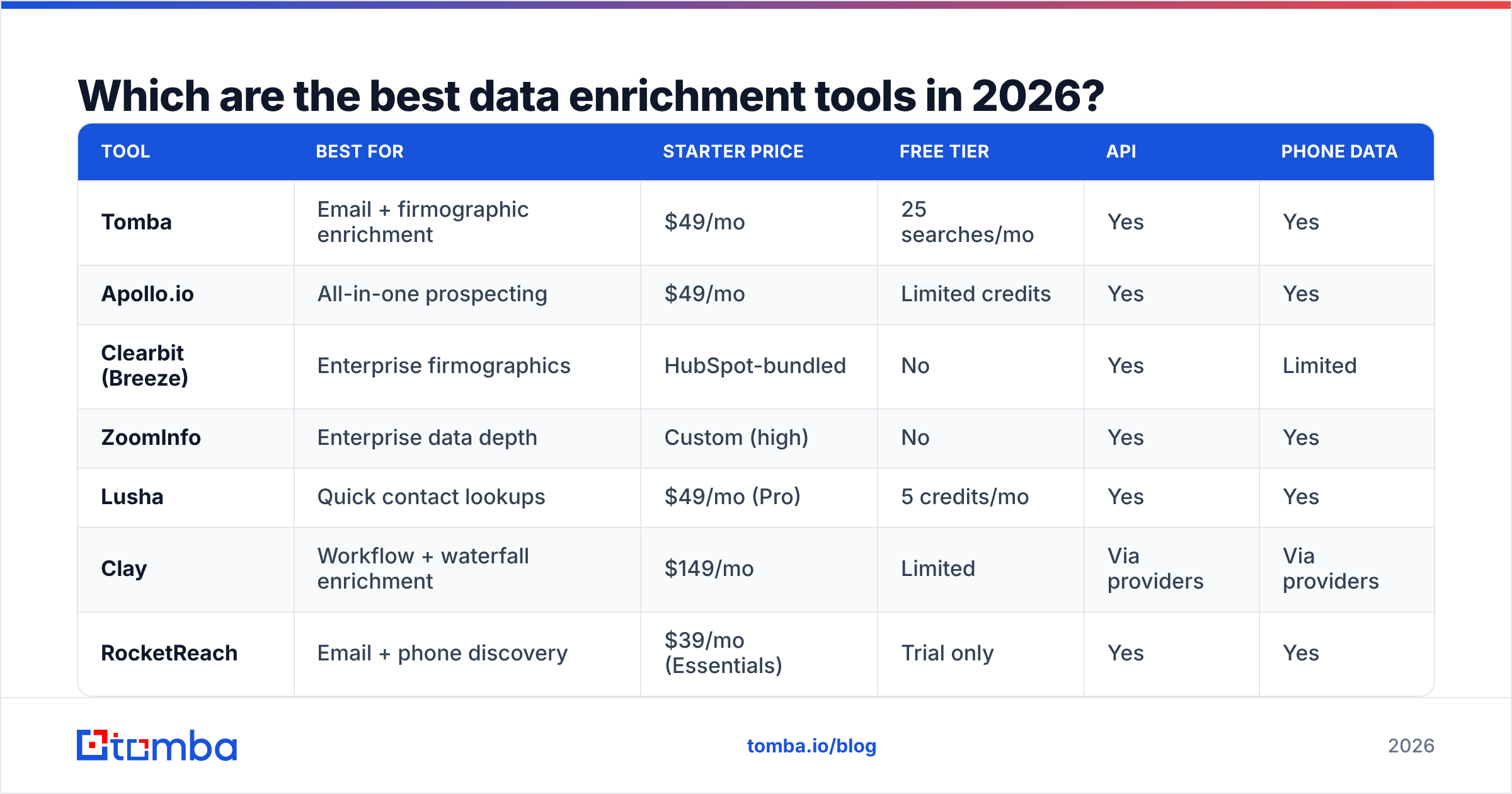
Which are the best data enrichment tools in 2026?#
Here's how the leading platforms compare on the attributes that drive ROI. Prices are entry-level paid tiers as published by each vendor; confirm current rates before buying.
Tool
Best for
Starter price
Free tier
API
Phone data
Tomba
Email + firmographic enrichment
$49/mo
25 searches/mo
Yes
Yes
Apollo.io
All-in-one prospecting
$49/mo
Limited credits
Yes
Yes
Clearbit (Breeze)
Enterprise firmographics
HubSpot-bundled
No
Yes
Limited
ZoomInfo
Enterprise data depth
Custom (high)
No
Yes
Yes
Lusha
Quick contact lookups
$49/mo (Pro)
5 credits/mo
Yes
Yes
Clay
Workflow + waterfall enrichment
$149/mo
Limited
Via providers
Via providers
RocketReach
Email + phone discovery
$39/mo (Essentials)
Trial only
Yes
Yes
A few notes on the table. ZoomInfo has the deepest enterprise dataset but is the priciest and sells annual contracts. Clay is not a data source itself — it's an orchestration layer that "waterfalls" requests across providers, which is powerful but only as good as the vendors you plug into it. For most teams that want strong coverage without a five-figure commitment, Tomba's combination of a real free tier, a transparent pricing ladder, and a developer-friendly API hits the sweet spot.
Tomba#
Tomba started as an email finder and grew into a full enrichment suite. You can append emails, verify them, pull firmographics, and find phone numbers through one API or the Chrome extension. The free tier gives you 25 searches a month — enough to benchmark match rate honestly. Paid plans run Starter $49/mo, Growth $99/mo, Pro $249/mo, and Enterprise custom. The standout is the bulk email finder plus verification in one pass, so you enrich and clean in a single workflow instead of paying two vendors.
Apollo.io#
Apollo bundles a contact database, enrichment, and a sales engagement sequencer. If you want one tool to find, enrich, and email, it's compelling. The trade-off is that database accuracy varies by segment, and heavy senders often pair it with a dedicated verifier. See how the two stack up in detail on the Apollo alternative page.
Clearbit (Breeze Intelligence)#
Clearbit is now folded into HubSpot as Breeze Intelligence. If you live inside HubSpot, the native enrichment is smooth and the firmographic data is strong for established companies. Outside the HubSpot ecosystem it's far less flexible, and there's no standalone free tier. Compare the standalone options on the Clearbit alternative breakdown.
ZoomInfo#
The 800-pound gorilla. ZoomInfo's dataset depth, intent signals, and org charts are genuinely best-in-class for enterprise GTM teams — and priced accordingly, with annual contracts that routinely run into five figures. Overkill for SMB and early-stage teams, ideal for large outbound orgs with budget.
Lusha and RocketReach#
Both are solid for quick, person-level lookups, especially direct dials. They shine as point tools for reps who need a contact now, less so as the backbone for programmatic, CRM-wide enrichment. RocketReach's published entry tier starts around $39/mo; Lusha's Pro tier is $49/mo.
SmartReach.io
SmartReach.io is a cold email software with multichannel outreach capabilities via channels like email, LinkedIn, calls and WhatsApp. For enrichment, its B2B Lead Finder searches 300M+ contacts across 50M+ companies live, so you aren't buying a fixed list. You can also enrich a CSV of LinkedIn profile URLs with work emails, and those emails are verified for free before they're used. Enriched contacts go straight into email, LinkedIn and call sequences without exporting to a separate tool. Plans start at $29/month with no per-seat pricing, and there's a 14-day free trial with no credit card. Best for teams that want enrichment and outreach in one place.
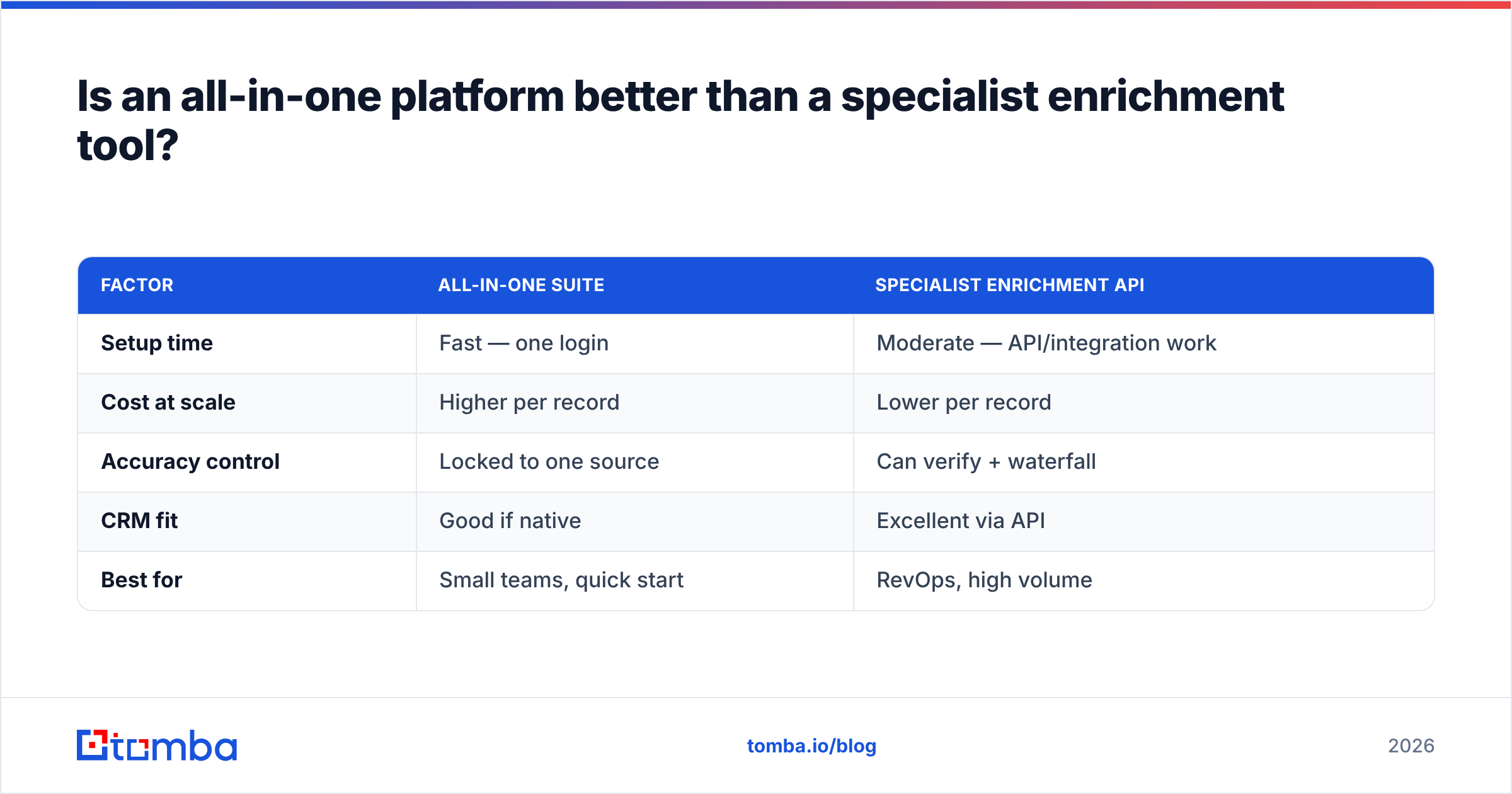
Is an all-in-one platform better than a specialist enrichment tool?#
It depends on volume and where your data lives. Conclusion first: if you run high-volume, programmatic enrichment across a CRM, a specialist API beats a bundled suite on cost-per-record and accuracy. If you're a small team that wants one login for prospecting and sending, an all-in-one saves setup time.
Factor
All-in-one suite
Specialist enrichment API
Setup time
Fast — one login
Moderate — API/integration work
Cost at scale
Higher per record
Lower per record
Accuracy control
Locked to one source
Can verify + waterfall
CRM fit
Good if native
Excellent via API
Best for
Small teams, quick start
RevOps, high volume
The hybrid most mature teams land on: a specialist for enrichment and verification feeding a CRM, with an all-in-one only where the sales team needs a sequencer. Tomba's API and native HubSpot integration let you enrich on record creation, then re-enrich on a schedule.
How do you keep enriched data from going stale?#
Enrichment is not a one-time event. People change jobs, companies get acquired, and direct dials get reassigned. Industry estimates put B2B data decay at roughly 25–30% per year, which means a database you enriched in January is materially wrong by summer if you never touch it again.
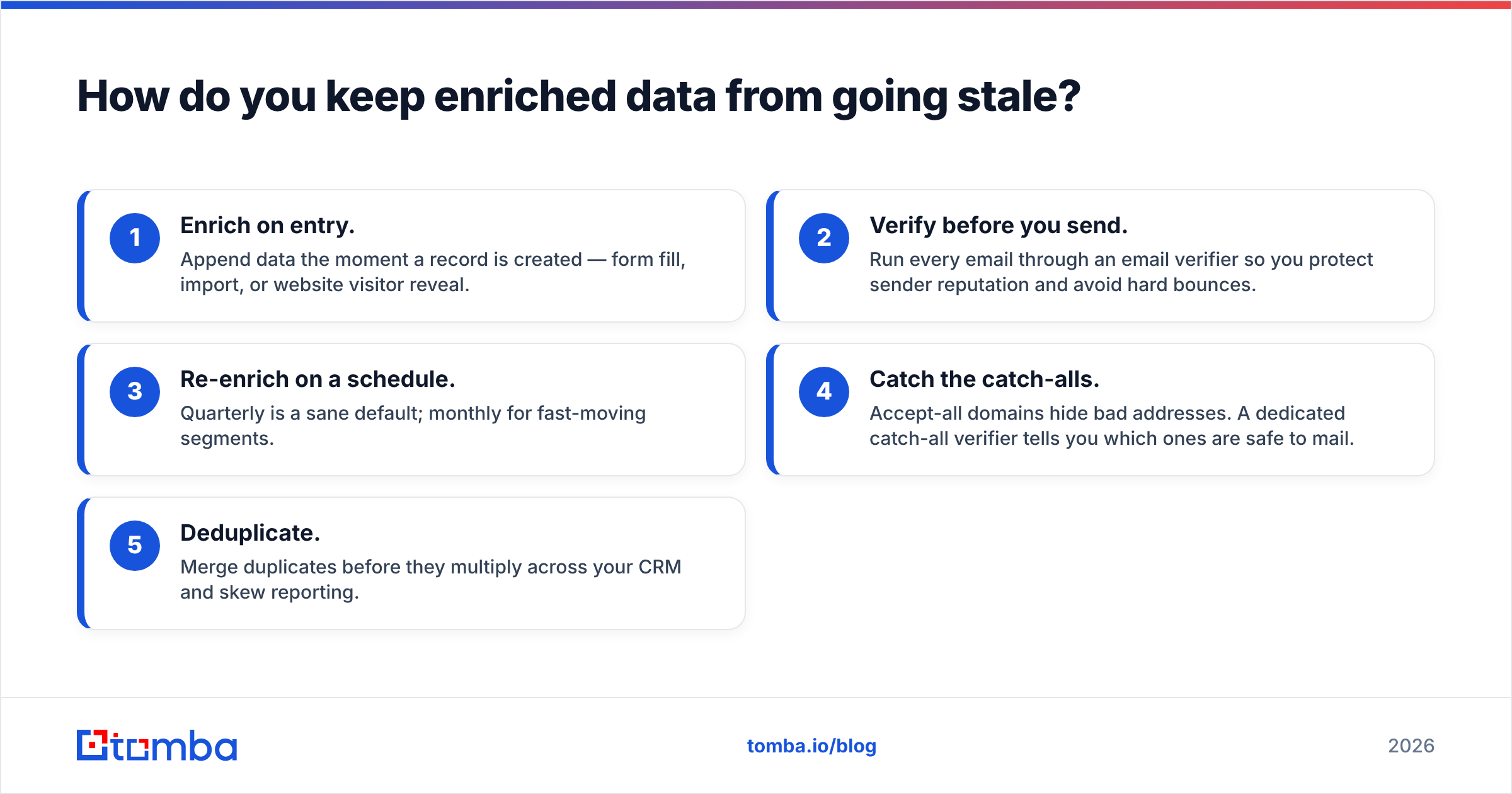
Build a maintenance loop:
Enrich on entry. Append data the moment a record is created — form fill, import, or website visitor reveal.
Verify before you send. Run every email through an email verifier so you protect sender reputation and avoid hard bounces.
Re-enrich on a schedule. Quarterly is a sane default; monthly for fast-moving segments.
Catch the catch-alls. Accept-all domains hide bad addresses. A dedicated catch-all verifier tells you which ones are safe to mail.
Deduplicate. Merge duplicates before they multiply across your CRM and skew reporting.
This loop matters as much as which vendor you pick. A mediocre dataset maintained well outperforms a premium dataset you bought once and let rot. For the deliverability side, keeping records clean is the single biggest lever on email deliverability — bounces and spam traps tank your sender reputation faster than any subject line can save it.
What does data enrichment actually cost?#
The sticker price is only part of the bill. Watch for these real costs:
Per-credit pricing creep. Many vendors charge a credit per attribute, so enriching one contact across email, phone, and firmographics can burn three credits.
Annual lock-in. Enterprise tools often require 12-month commitments with steep early-termination terms.
Verification add-ons. If your enrichment vendor doesn't verify, you'll pay a second vendor to clean the output.
Integration engineering. Budget time, not just money, to wire the API into your CRM and keep it running.
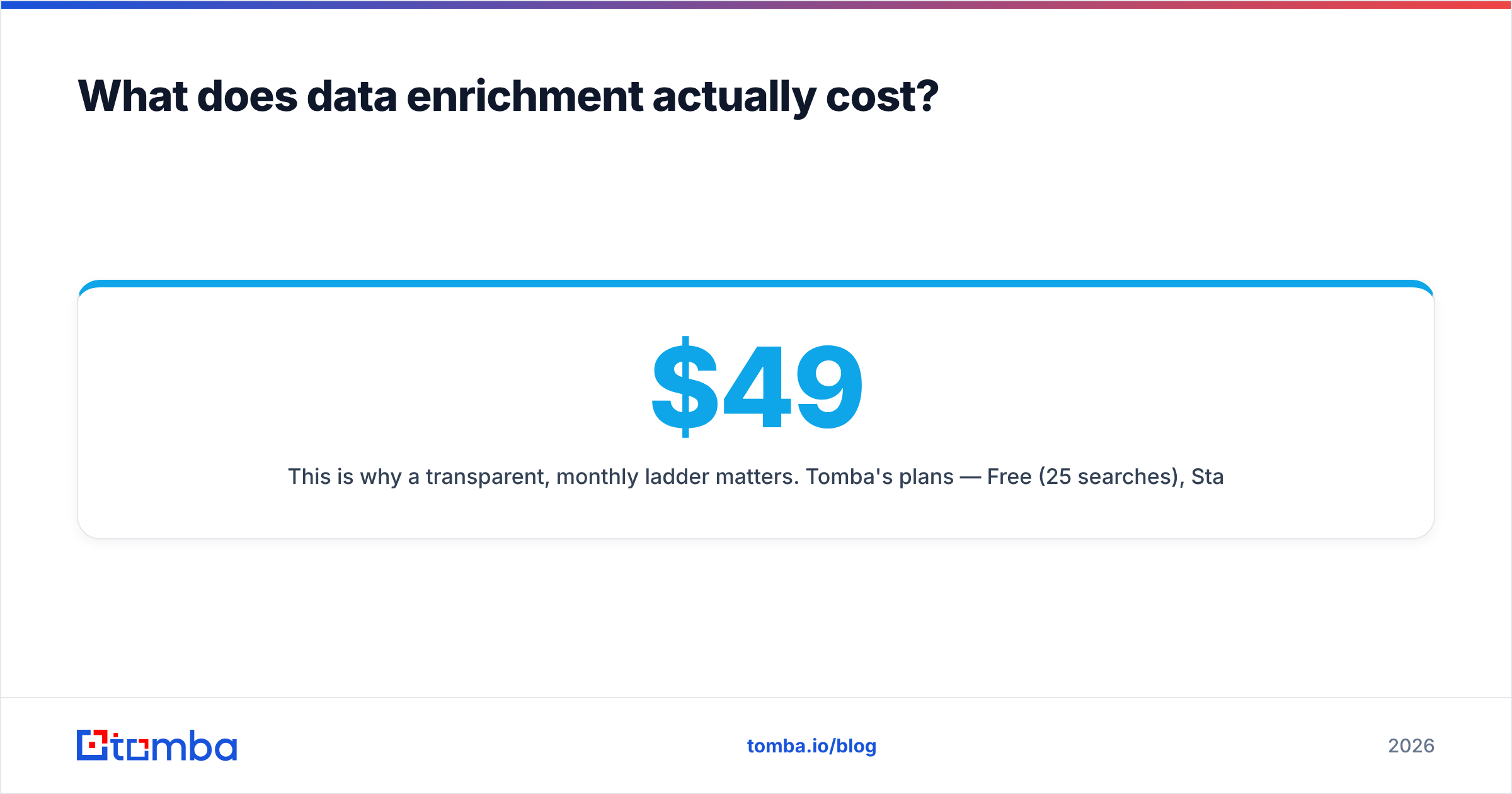
This is why a transparent, monthly ladder matters. Tomba's plans — Free (25 searches), Starter $49/mo, Growth $99/mo, Pro $249/mo, Enterprise custom — bundle finding and verification, so you're not stitching two invoices together. Always model your true cost as cost per usable record, not cost per credit. A cheap credit that returns a stale address isn't cheap.
How do you pick the right tool for your team?#
Match the tool to your motion, not the other way around:
Solo founder or small team: Start with a free tier and a Google Sheets or Chrome extension workflow. You don't need an enterprise contract to enrich a few hundred accounts a month.
RevOps building a clean CRM: Prioritize a strong API, native CRM sync, and verification. Set up enrich-on-entry plus scheduled re-enrichment.
High-volume outbound team: Look at match rate in your specific geos and a bulk pipeline. Pair enrichment with verification to protect domains.
Enterprise with budget and complex orgs: ZoomInfo-class depth and intent data justify the spend when account complexity is high.
Whatever you choose, run the 200-record test first. Vendor benchmarks are marketing; your own list is truth. Cross-check published reviews on G2 to sanity-check claims, but trust your test over any star rating.
The bottom line#
The best data enrichment tools in 2026 aren't the ones with the biggest database claims — they're the ones that return accurate, current records for your accounts at a cost you can sustain quarter after quarter. For most B2B teams, that means a specialist platform with a real free tier, verification built in, and an API that drops cleanly into your CRM.
If you want to test that without a sales call or an annual contract, start with the Tomba Email Finder and its enrichment suite. Use the free 25 searches to benchmark match rate on your own list, layer in verification to protect deliverability, then scale up only when the numbers prove out. Enrichment should earn its budget — make it prove the match rate before you commit.
// get started
Find, verify and enrich your first contacts today
Start on the free plan with 25 searches a month, then scale when your team is ready.
Free plan · No credit card required · GDPR & CCPA
Get the Tomba newsletter
Product and data updates
// about the author