Best Day for Email Campaign: 2026 Send-Time Data Guide
Tuesday wins most benchmarks, but the real best day for your email campaign depends on audience, list quality, and testing. Here's the 2026 data.
You picked Tuesday because everyone says Tuesday. The honest answer is more useful than that — and it starts with admitting that "best day" is a starting hypothesis, not a law.
TL;DR — What's the best day for an email campaign?#
- Tuesday, Wednesday, and Thursday consistently lead open and reply rates across major 2026 benchmarks. Mid-week is the safe default if you have no data of your own.
- Tuesday around 10am in the recipient's local time is the single most-cited high-performing window for B2B sends.
- Weekends and Mondays underperform for most B2B audiences, but B2C, e-commerce, and creator newsletters often break this rule.
- The "best day" is a hypothesis you test, not a fixed answer. Your list quality matters more than the calendar.
- Sending to unverified or stale lists sinks deliverability no matter the day — clean data is the real lever.
Why does the day of the week matter at all?#
Think of email timing like a coffee shop. Open at 3am and the espresso is perfect, but nobody's there. The best day works the same way: it's the window when your recipient is at their desk, mentally in "work mode," and not yet buried under the backlog that builds up after a weekend.
The mechanism is attention, not magic. On Monday, inboxes are flooded with everything that arrived Saturday and Sunday, so your message competes harder and gets archived faster. By Tuesday, people have cleared the worst of it and are processing new items deliberately. By Friday afternoon, they've mentally checked out. Day-of-week performance is really a proxy for where your reader's attention is.
That's also why a single global "best day" is misleading. A campaign to software engineers, a newsletter to weekend hobbyists, and a flash sale to online shoppers each have different attention curves. The benchmarks below are a strong default — but they're the average of millions of very different audiences.
What do the 2026 benchmarks actually say?#
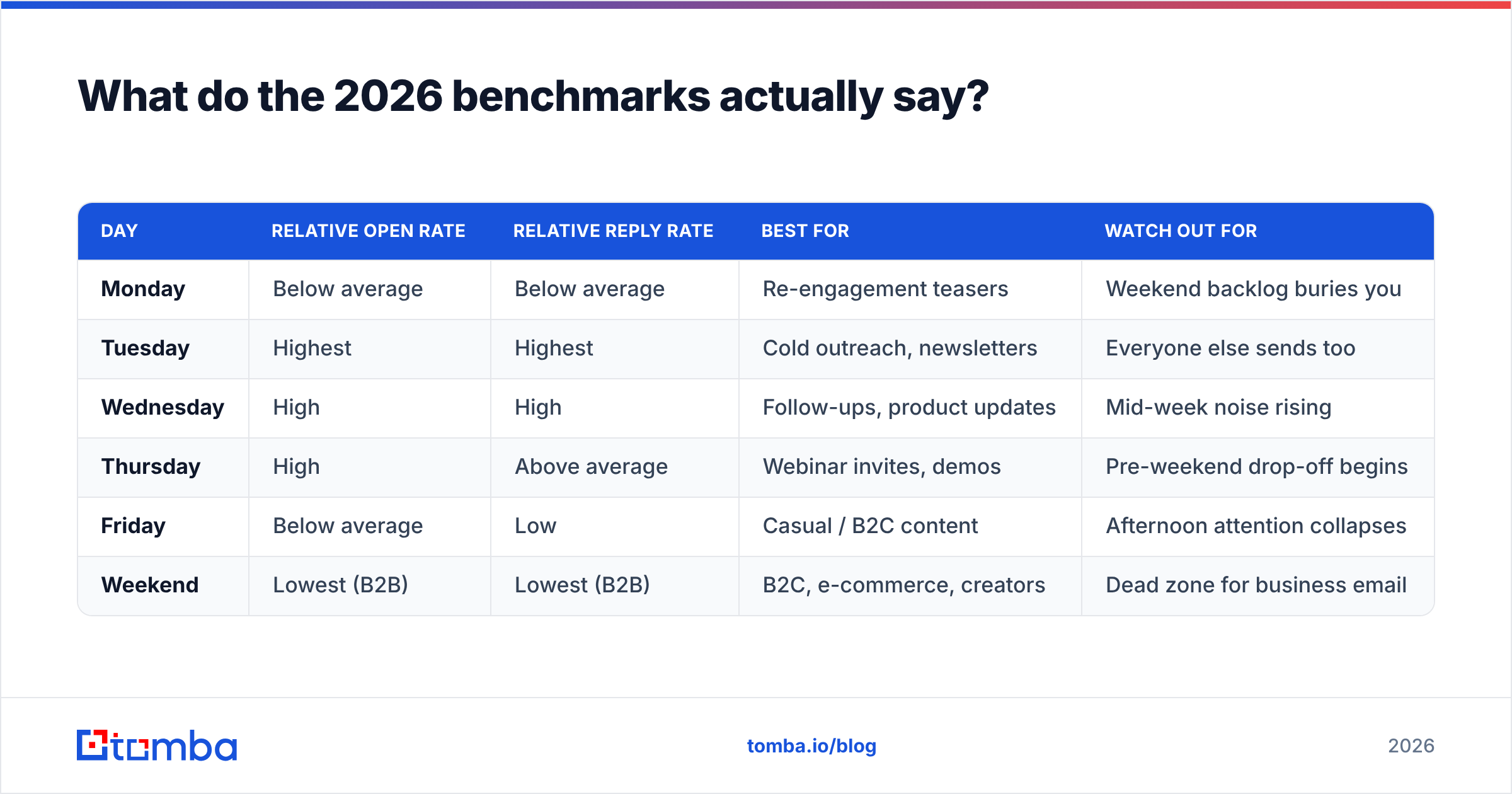
Aggregated send-time studies from inbox providers and ESPs point to a clear mid-week cluster. Here's how the days stack up for a typical B2B audience, based on relative open and reply performance.
| Day | Relative open rate | Relative reply rate | Best for | Watch out for |
|---|---|---|---|---|
| Monday | Below average | Below average | Re-engagement teasers | Weekend backlog buries you |
| Tuesday | Highest | Highest | Cold outreach, newsletters | Everyone else sends too |
| Wednesday | High | High | Follow-ups, product updates | Mid-week noise rising |
| Thursday | High | Above average | Webinar invites, demos | Pre-weekend drop-off begins |
| Friday | Below average | Low | Casual / B2C content | Afternoon attention collapses |
| Weekend | Lowest (B2B) | Lowest (B2B) | B2C, e-commerce, creators | Dead zone for business email |
Two patterns hold across almost every dataset: Tuesday leads, and the weekend trails for business audiences. The gaps between Tuesday, Wednesday, and Thursday are usually small — often within a few percentage points — which is why you should treat the mid-week trio as a band rather than crown one winner.
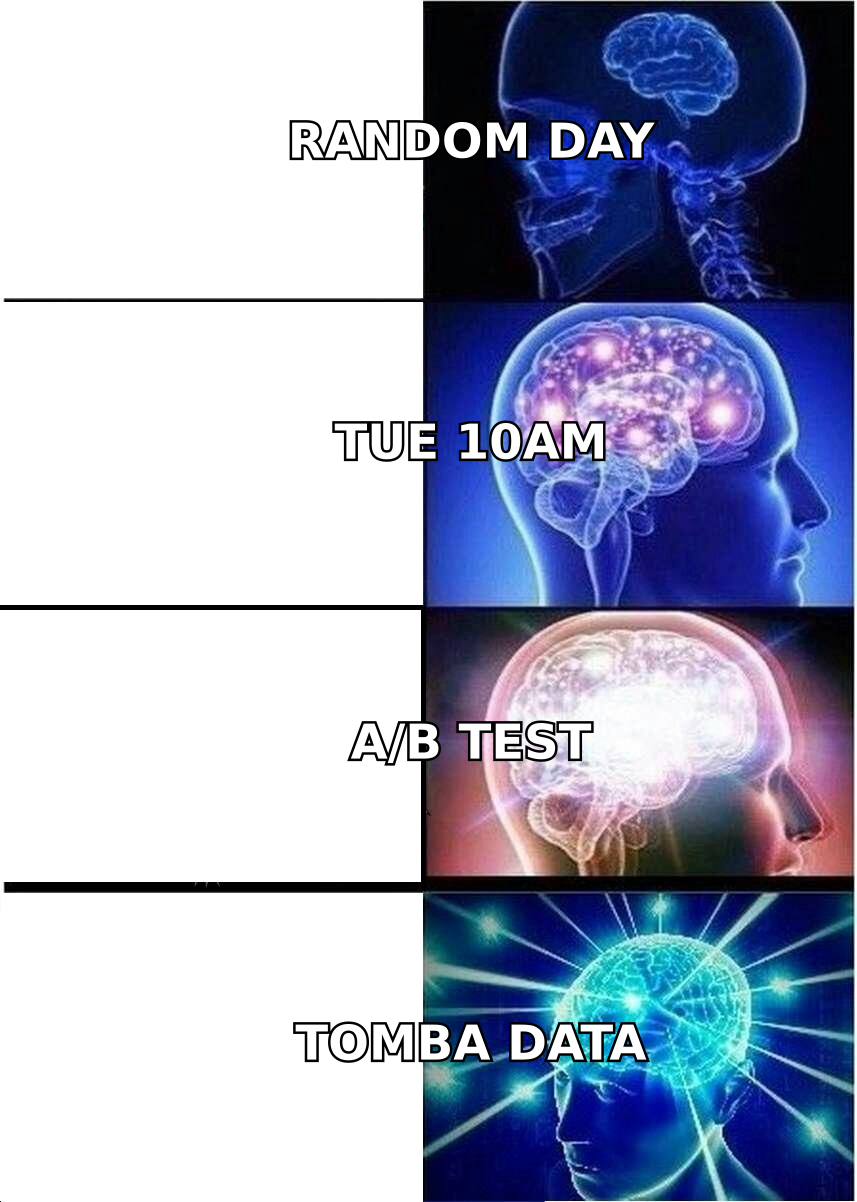
One caveat the averages hide: as more senders pile onto Tuesday at 10am, the "best" slot gets crowded. Some teams now find Tuesday afternoon or Wednesday morning outperforms the classic window precisely because it's less contested. That's a reason to test, which we'll get to.
What's the best time of day to send?#
Day and time work together — a great day at a dead hour still flops. Here are the windows that repeatedly outperform, mapped to the recipient's local time zone, not yours.
- 9–11am — The strongest B2B window. People have triaged urgent items and are open to new, considered messages. The 10am mark is the most-cited single peak.
- 1–3pm — The post-lunch window. Energy dips, inbox-clearing rises, and reply-friendly messages land well.
- 5–6pm — A smaller secondary spike as people clear their inbox before logging off. Good for short, skimmable sends.
- Before 7am / after 8pm — Generally weak for B2B, but rising for mobile-first B2C audiences who check phones off-hours.
The biggest, most common mistake is sending in your time zone. If you blast at 10am Pacific to a list that's mostly East Coast, you've actually hit 1pm for most readers. Segment by time zone and schedule per-segment — most modern sending tools support this, and the lift is real. For a deeper look at how timing interacts with inbox placement, see our primer on email deliverability.
Is the "best day" different for cold email vs newsletters?#
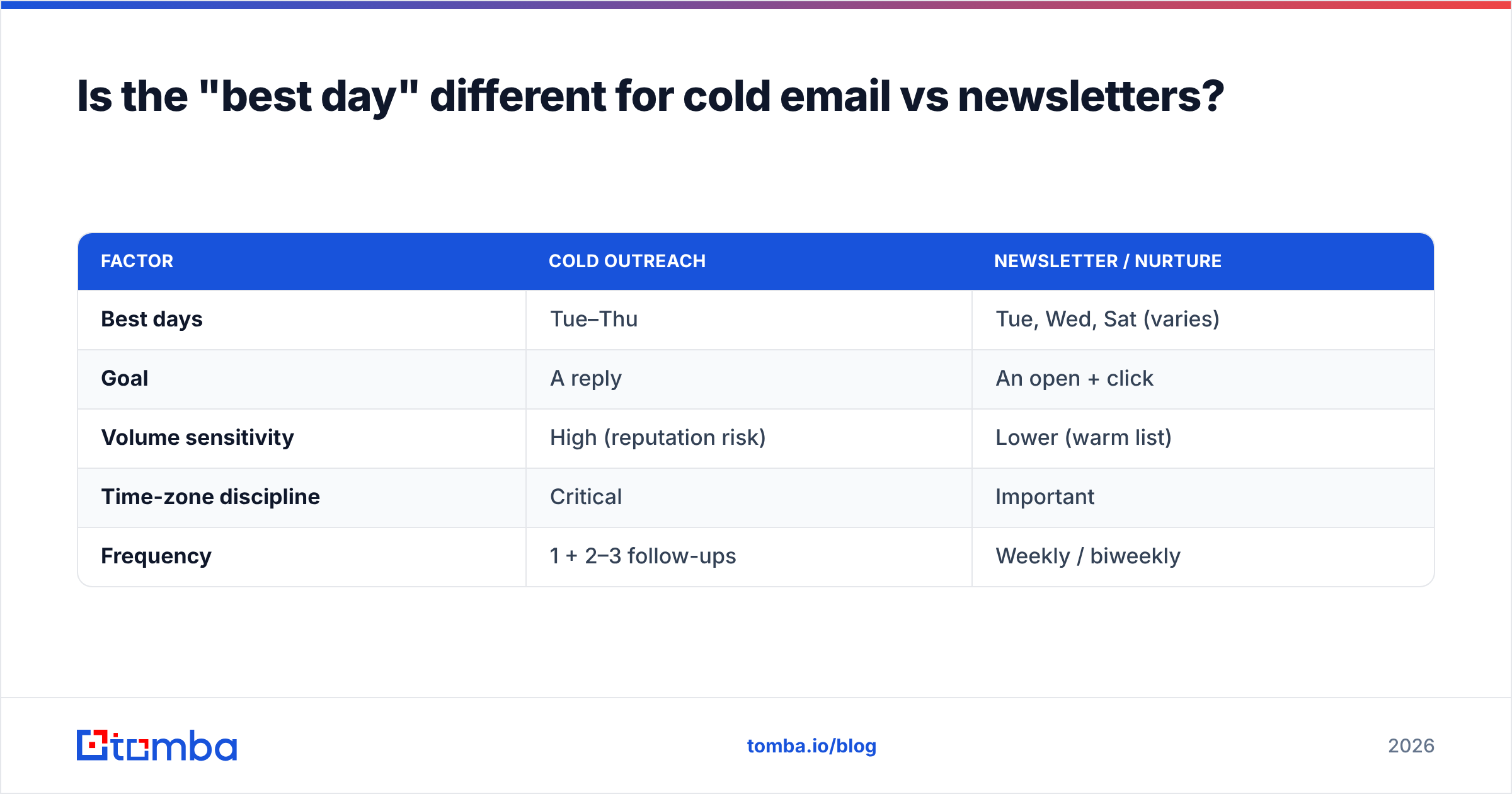
Yes — and conflating them is why generic advice disappoints. The intent and the relationship differ, so the timing does too.
| Factor | Cold outreach | Newsletter / nurture |
|---|---|---|
| Best days | Tue–Thu | Tue, Wed, Sat (varies) |
| Goal | A reply | An open + click |
| Volume sensitivity | High (reputation risk) | Lower (warm list) |
| Time-zone discipline | Critical | Important |
| Frequency | 1 + 2–3 follow-ups | Weekly / biweekly |
For cold email, mid-week mornings dominate because you're asking a stranger for attention and a response — friction is highest, so you want them fresh and unhurried. For newsletters and nurture sequences, the audience already opted in, so you have more latitude; some consumer newsletters even win on Saturday mornings when readers have leisure time. If your campaign is outbound, our guide to cold email timing and structure goes deeper on cadence and follow-ups.
A practical rule: the colder the relationship, the more the day matters. Warm audiences will find you whenever you send. Strangers won't.
Does the best day even matter if your list is bad?#
No. This is the part most "best day" articles skip, and it's the most important.
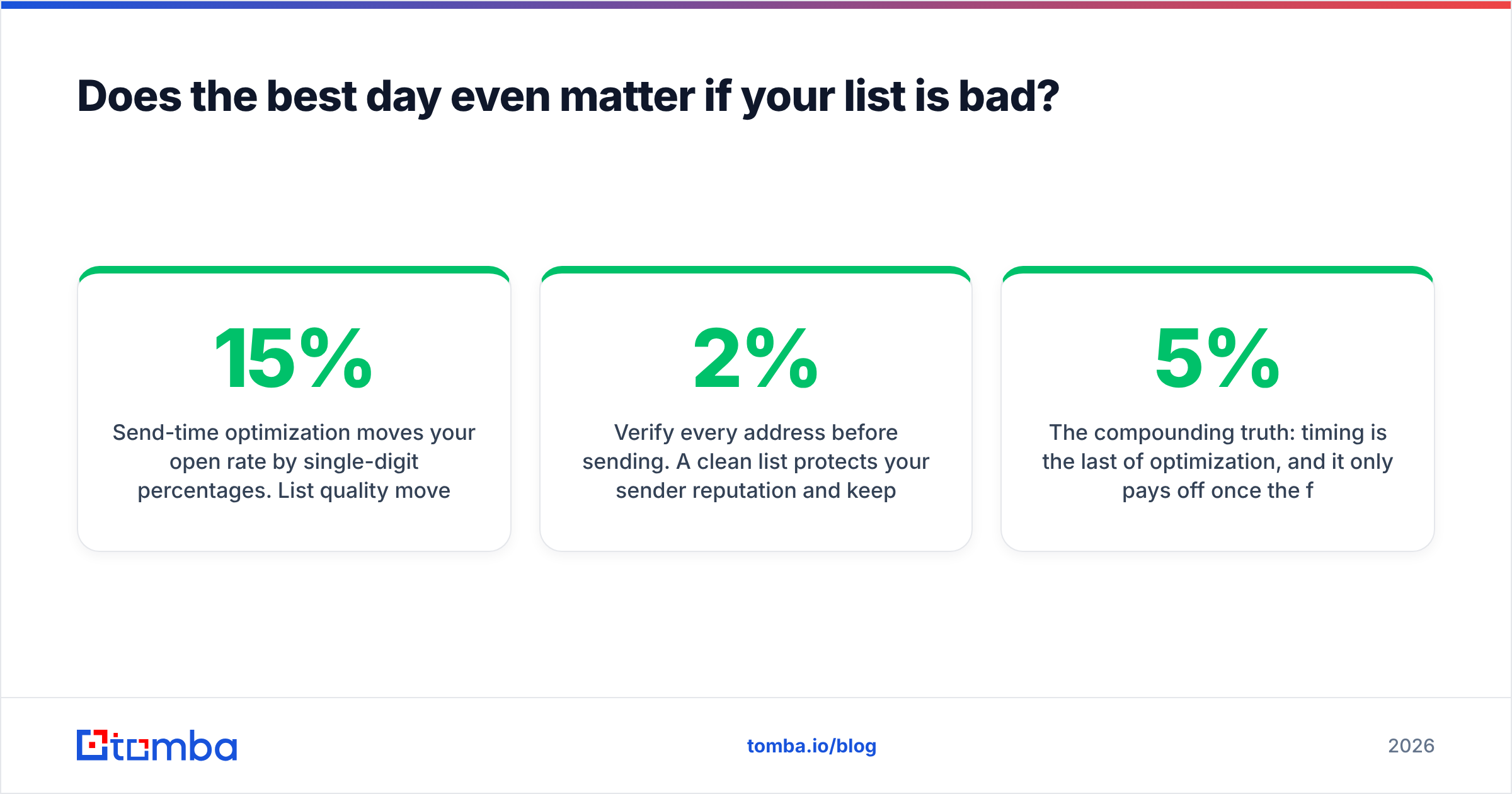
Send-time optimization moves your open rate by single-digit percentages. List quality moves it by tens. If 15% of your addresses bounce, mailbox providers read that as a spammer signal, throttle your delivery, and route you to spam — on Tuesday at 10am or any other time. You can't out-schedule a dirty list.
Before you obsess over the calendar, get the fundamentals right:
- Verify every address before sending. A clean list protects your sender reputation and keeps bounce rates under the ~2% threshold providers tolerate. Run lists through an email verifier and quarantine the risky ones.
- Warm up new sending domains gradually so providers learn to trust you. Ramping from a cold domain to thousands of sends overnight is a fast track to the spam folder regardless of the day.
- Authenticate your domain with SPF, DKIM, and DMARC so providers can confirm you are who you claim to be.
- Segment and personalize so the content matches the recipient — relevance beats timing every time.
The compounding truth: timing is the last 5% of optimization, and it only pays off once the first 95% (data quality, authentication, reputation) is solid. Get those right and Tuesday becomes a real advantage instead of a placebo. Authoritative benchmarks from HubSpot and the community data on G2 both reinforce the same hierarchy: deliverability first, timing second.
How do you find YOUR best day instead of copying a benchmark?#
The benchmarks give you a hypothesis. Your own A/B test gives you the answer. Here's a framework that takes about three weeks and produces data you can trust.
- Start with the consensus default. Send your control to Tuesday, 10am recipient-local. You're not testing whether Tuesday is good — you're testing whether something beats it for your list.
- Hold everything else constant. Same subject line, same segment, same content. If you change the copy and the day at once, you won't know which moved the needle. (Test subject lines separately with a subject line tester.)
- Test one variable per round. Week one: Tuesday vs Thursday. Week two: winner vs Wednesday. Week three: best day, morning vs afternoon.
- Use a big enough sample. A 200-person list won't give you statistical significance. Aim for at least a few hundred per variant, ideally more, so a 2% difference isn't just noise.
- Measure the metric that matters. For newsletters, track opens and clicks. For cold outreach, track replies — opens are increasingly unreliable thanks to privacy features that auto-load images.
- Re-test quarterly. Audience behavior drifts, inbox-provider algorithms change, and the crowded "best" slots shift. Last year's winner isn't guaranteed this year's.
The teams that win at email don't have a secret day. They have a habit of testing, a clean list, and the discipline to change one thing at a time. Reply rate is the north-star metric for outbound — if you're tracking it, you'll see send-time effects clearly against the noise.
Quick answers to common send-time questions#
Is Tuesday always the best day? It's the best default, not a guarantee. It wins most aggregate benchmarks, but your audience may prefer Wednesday or Thursday — and the slot is increasingly crowded.
What's the worst day to send? Sunday and Saturday for B2B; Monday morning is also weak because of weekend backlog. B2C and e-commerce often see weekend success, so segment by audience type.
Does send time matter more than the day? They're inseparable. A great day at midnight still fails. Aim for mid-week mornings in the recipient's local time zone.
How many follow-ups should I send? For cold outreach, the initial email plus two to three spaced follow-ups typically captures the bulk of replies. Space them two to four days apart and vary the day of the week.
Can good timing fix bad deliverability? No. If you're landing in spam, no day helps. Fix authentication, list hygiene, and sender reputation first.
The bottom line#
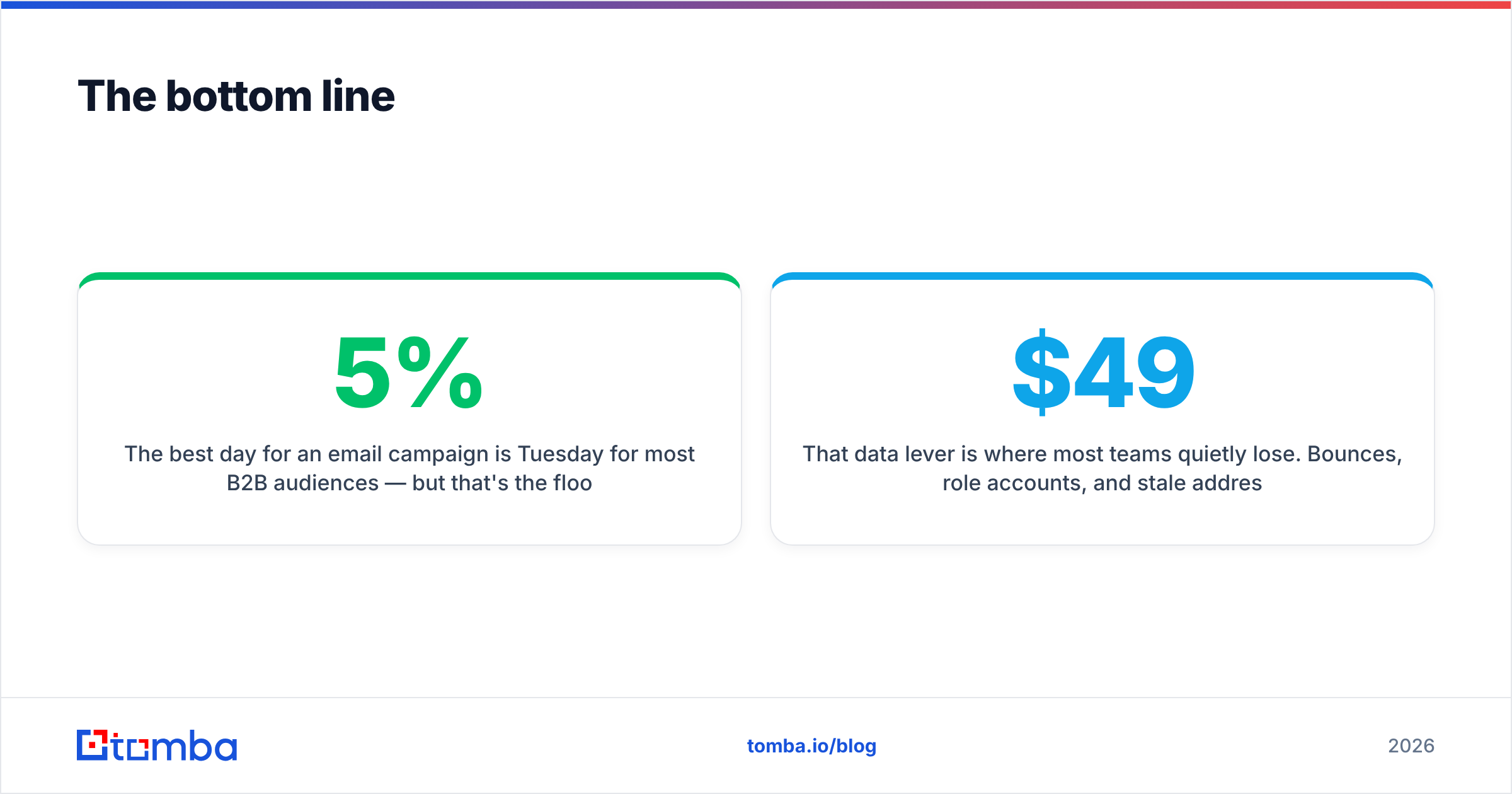
The best day for an email campaign is Tuesday for most B2B audiences — but that's the floor, not the ceiling. The real wins come from sending to verified addresses, in the recipient's time zone, mid-week morning, and then testing your way to your audience's actual peak. The calendar is a 5% lever. Your data is the other 95%.
That data lever is where most teams quietly lose. Bounces, role accounts, and stale addresses silently drag down every send regardless of timing. Build your campaigns on accurate contacts in the first place: the Tomba Email Finder sources and verifies professional email addresses by name, domain, or company, so the list you schedule on Tuesday at 10am actually reaches inboxes. Start free with 25 searches a month, and when you scale, Tomba pricing runs from $49/mo Starter to $99/mo Growth — far cheaper than the deliverability you'd lose sending to bad data on the "perfect" day.
Ready to find emails that actually work?
Join 150,000+ professionals who stopped guessing and started sending. Free credits on signup — no credit card required.
Get the Tomba newsletter
Practical outbound tactics and product updates — once every two weeks.
About the author