Best Discovery Questions for Sales Calls That Close in 2026
The best discovery questions uncover real pain, budget, and timing fast. Here are 40+ field-tested questions, a framework, and a comparison of discovery models for 2026.
Most lost deals are not lost in the demo or the negotiation. They are lost in a sloppy discovery call where the rep talked too much, asked surface-level questions, and never found the real reason a buyer would change anything. The best discovery questions fix that by pulling pain, priority, budget, and timing into the open before you ever pitch.
This guide gives you a working bank of questions, a repeatable framework, and a side-by-side comparison of the major discovery models so you can pick one and run it on Monday.
TL;DR#
- Discovery is research, not interrogation. The best discovery questions are open-ended, follow a thread, and make the buyer think — not just fill in a CRM field.
- Structure beats improvisation. Use a model (SPIN, MEDDIC, or a simple pain-first flow) so every call covers problem, impact, decision process, and timing.
- Quantify the pain. A problem without a dollar figure or a deadline rarely becomes a deal.
- Prep wins calls. Walking in with the right contact and company context — the kind you get from accurate data enrichment — lets you skip basics and go deep.
- Talk less. Aim for a 70/30 listening ratio. Your questions should trigger long answers, not yes/no replies.
What makes a discovery question "good"?#
A good discovery question gets the prospect to reveal something they would not have volunteered on their own. It is open-ended, it is specific to their situation, and it earns the right to ask the next question.
Think of discovery like a doctor's appointment. A bad doctor reads your chart and immediately prescribes. A good doctor asks where it hurts, how long it has hurt, what makes it worse, and what you have already tried. By the time they recommend treatment, you trust the diagnosis because they understood the problem first. Sales discovery works the same way.
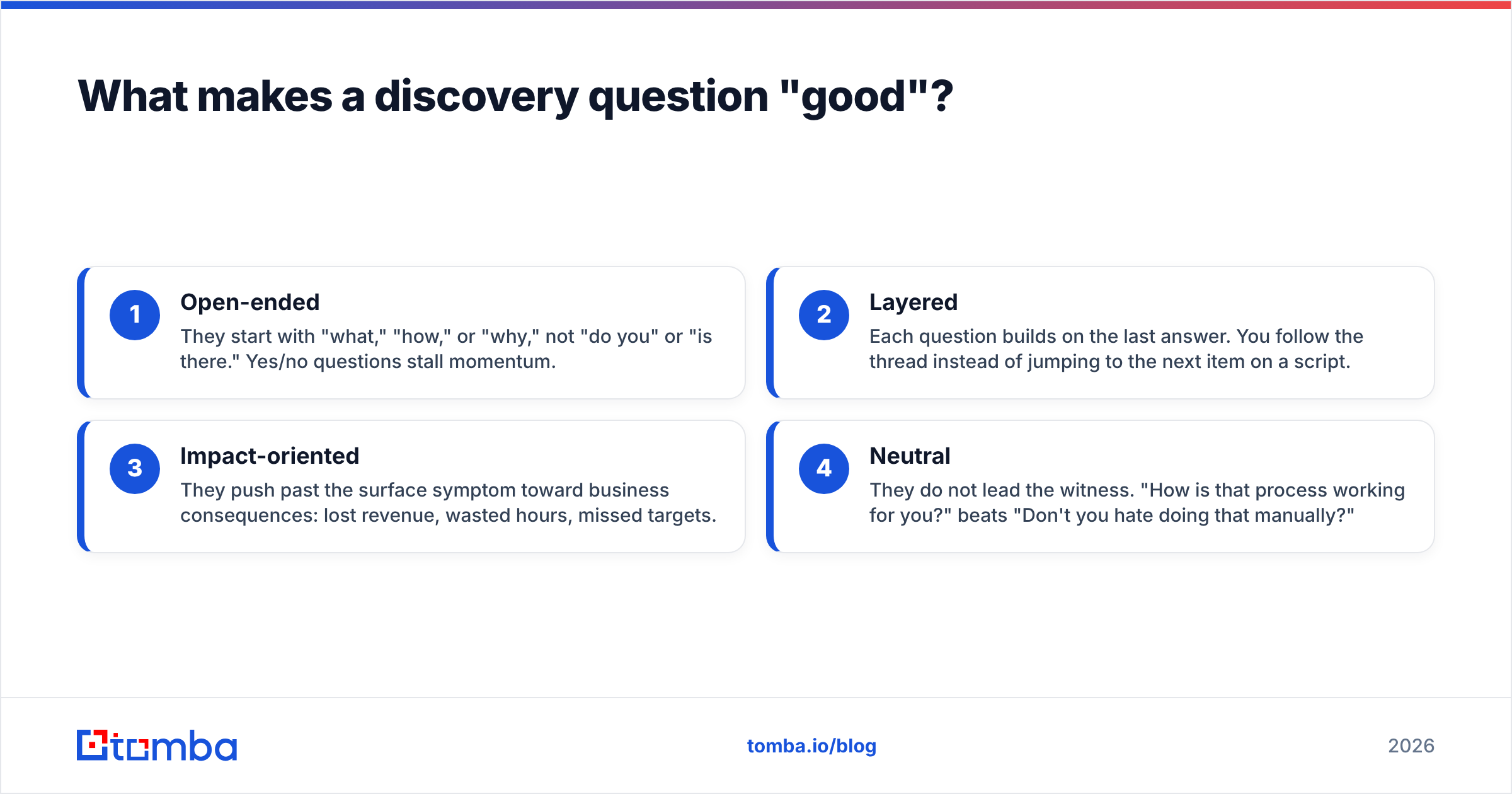
The four traits that separate strong questions from filler:
- Open-ended — They start with "what," "how," or "why," not "do you" or "is there." Yes/no questions stall momentum.
- Layered — Each question builds on the last answer. You follow the thread instead of jumping to the next item on a script.
- Impact-oriented — They push past the surface symptom toward business consequences: lost revenue, wasted hours, missed targets.
- Neutral — They do not lead the witness. "How is that process working for you?" beats "Don't you hate doing that manually?"
)
What are the best discovery questions to ask?#
Below is a categorized bank. You will not ask all of them on one call — pick three or four per category that fit the conversation and let the answers steer you.
Situation and context
- "Walk me through how your team handles [process] today."
- "What does your tech stack look like for this?"
- "Who else touches this workflow besides you?"
Problem and pain
- "What made you take this call now, as opposed to six months ago?"
- "Where does the current approach break down most often?"
- "If nothing changed, what happens over the next year?"
Impact and quantification
- "How many hours a week does your team spend on that?"
- "What is that costing you — in revenue, churn, or headcount?"
- "How are you measured on this internally?"
Decision process and authority
- "Besides yourself, who needs to weigh in before a decision?"
- "What did your last rollout of a tool like this look like?"
- "What would have to be true for this to get approved?"
Timing and priority
- "Where does solving this rank against everything else on your plate?"
- "Is there an event or deadline driving the timeline?"
- "What happens if this slips to next quarter?"
The magic is in the follow-up. When a prospect says "it's slowing us down," do not move on. Ask "slowing you down how — can you give me a recent example?" Specific stories are where deals are won.
Which discovery framework should you use?#
There is no single correct model. The right one depends on deal size, sales cycle, and how complex the buying committee is. Here is how the most common frameworks compare.
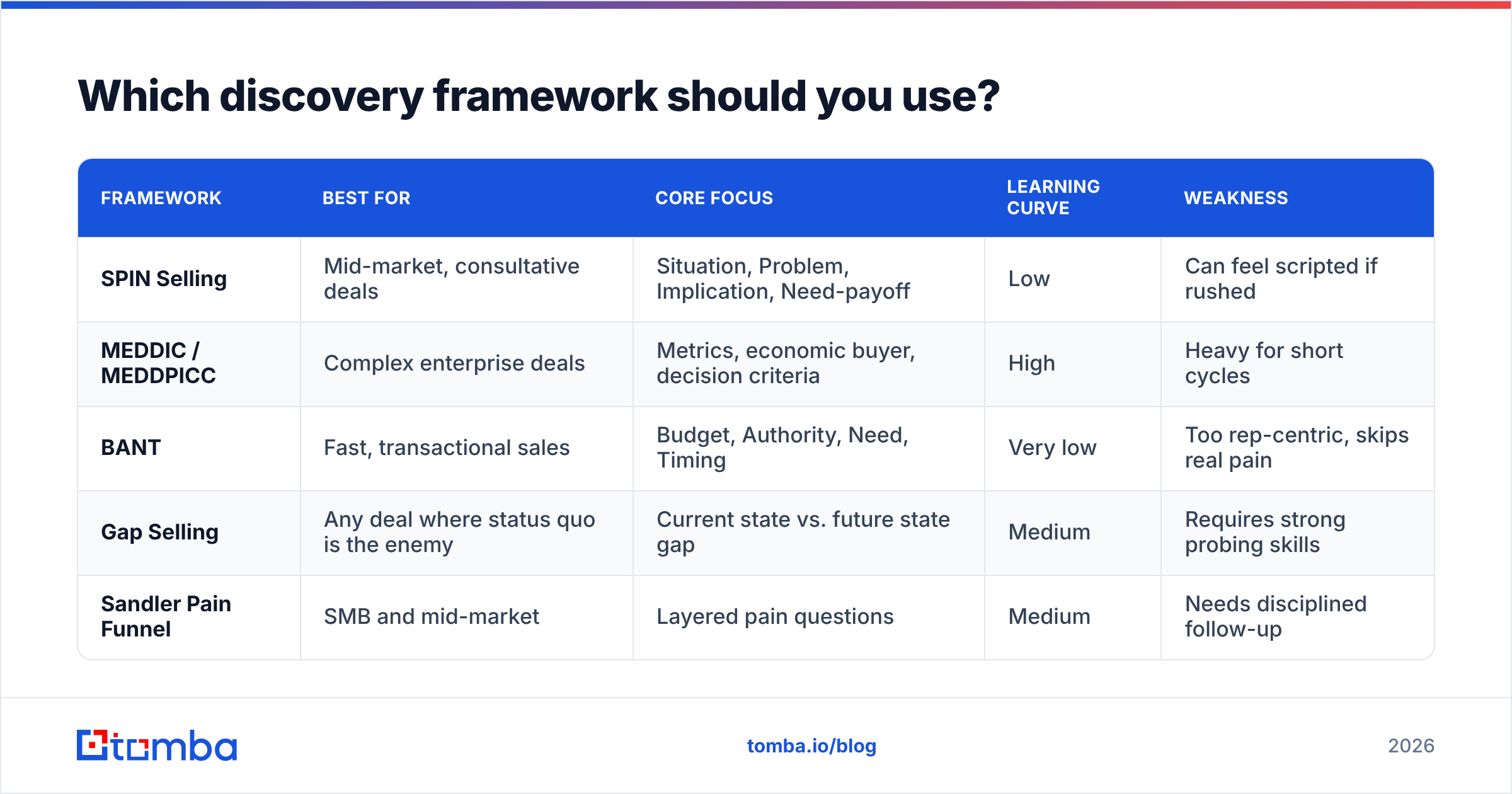
| Framework | Best for | Core focus | Learning curve | Weakness |
|---|---|---|---|---|
| SPIN Selling | Mid-market, consultative deals | Situation, Problem, Implication, Need-payoff | Low | Can feel scripted if rushed |
| MEDDIC / MEDDPICC | Complex enterprise deals | Metrics, economic buyer, decision criteria | High | Heavy for short cycles |
| BANT | Fast, transactional sales | Budget, Authority, Need, Timing | Very low | Too rep-centric, skips real pain |
| Gap Selling | Any deal where status quo is the enemy | Current state vs. future state gap | Medium | Requires strong probing skills |
| Sandler Pain Funnel | SMB and mid-market | Layered pain questions | Medium | Needs disciplined follow-up |
A practical rule: if your average deal involves one or two decision-makers and closes in under 60 days, lean on SPIN or the Sandler pain funnel. If you are selling six-figure contracts to a committee of seven, MEDDIC's emphasis on the economic buyer and decision criteria will save you from late-stage surprises. You can read the original research behind consultative questioning in Neil Rackham's SPIN Selling overview on Wikipedia, and most modern CRMs like HubSpot ship templates for these frameworks out of the box.
How do you structure a discovery call?#
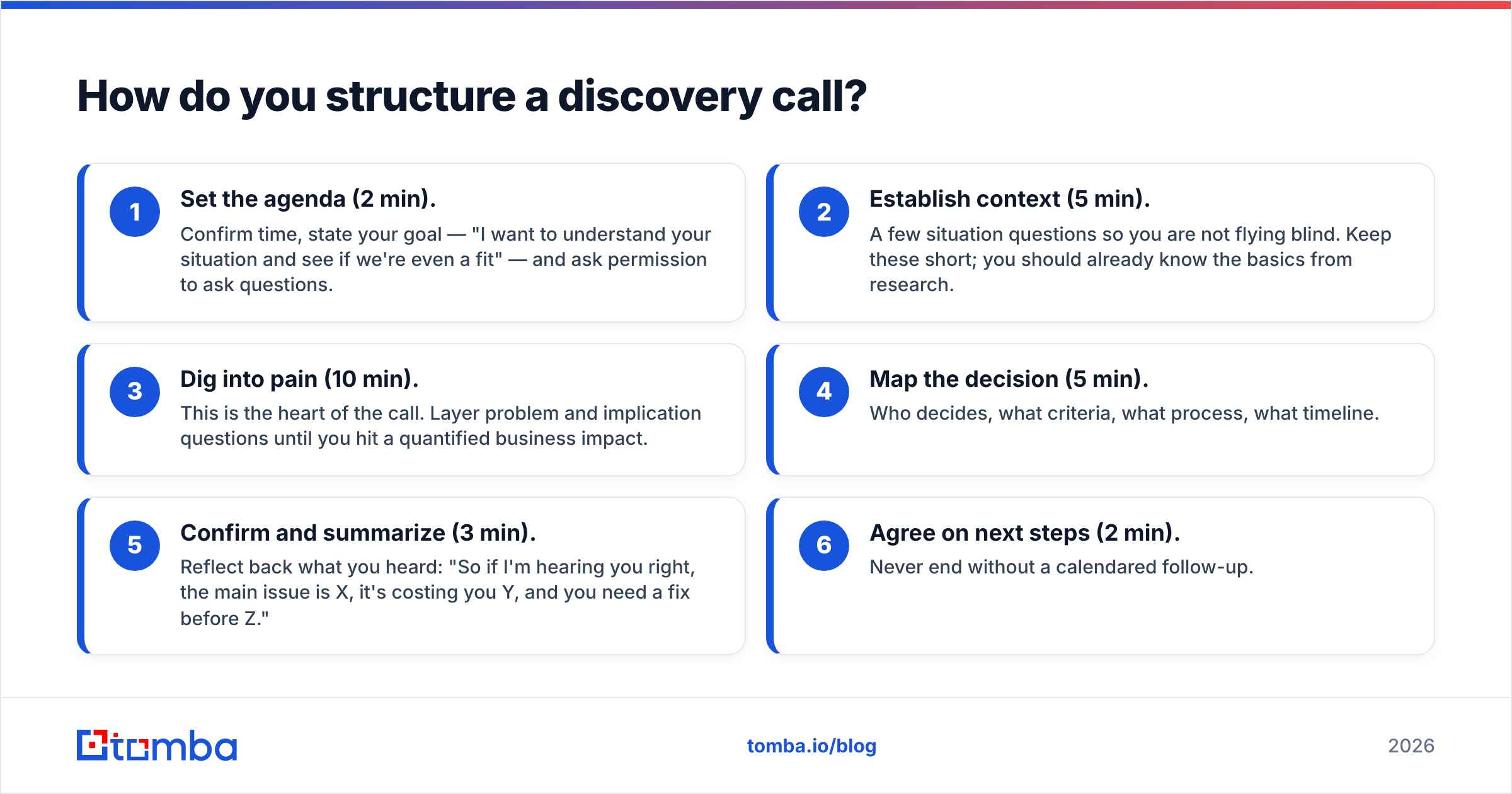
A strong call follows a predictable arc even though the questions feel conversational. Here is a six-step flow that works across frameworks:
- Set the agenda (2 min). Confirm time, state your goal — "I want to understand your situation and see if we're even a fit" — and ask permission to ask questions.
- Establish context (5 min). A few situation questions so you are not flying blind. Keep these short; you should already know the basics from research.
- Dig into pain (10 min). This is the heart of the call. Layer problem and implication questions until you hit a quantified business impact.
- Map the decision (5 min). Who decides, what criteria, what process, what timeline.
- Confirm and summarize (3 min). Reflect back what you heard: "So if I'm hearing you right, the main issue is X, it's costing you Y, and you need a fix before Z."
- Agree on next steps (2 min). Never end without a calendared follow-up.
That summary step in particular signals you were listening and forces the prospect to either confirm or correct your understanding — both of which move the deal forward.
How does research make your discovery questions better?#
The best discovery questions come from the best preparation. If you spend the first ten minutes of a call asking what the company does and how many people work there, you have burned your most valuable time on things you could have looked up.
Walking in informed lets you ask sharper, more specific questions — "I saw you just opened a second office in Austin; how is that affecting your support coverage?" lands far harder than a generic "tell me about your business." That specificity signals you did your homework and earns trust fast.
Reaching the right person is half the battle. Before the call you need the decision-maker's verified contact details, not a generic info@ inbox. Tools like the Tomba Email Finder and domain search let you find the actual stakeholder by name and company, while data enrichment fills in role, seniority, and company size so your questions match the buyer's reality. The cleaner your inputs, the deeper your discovery can go.
)
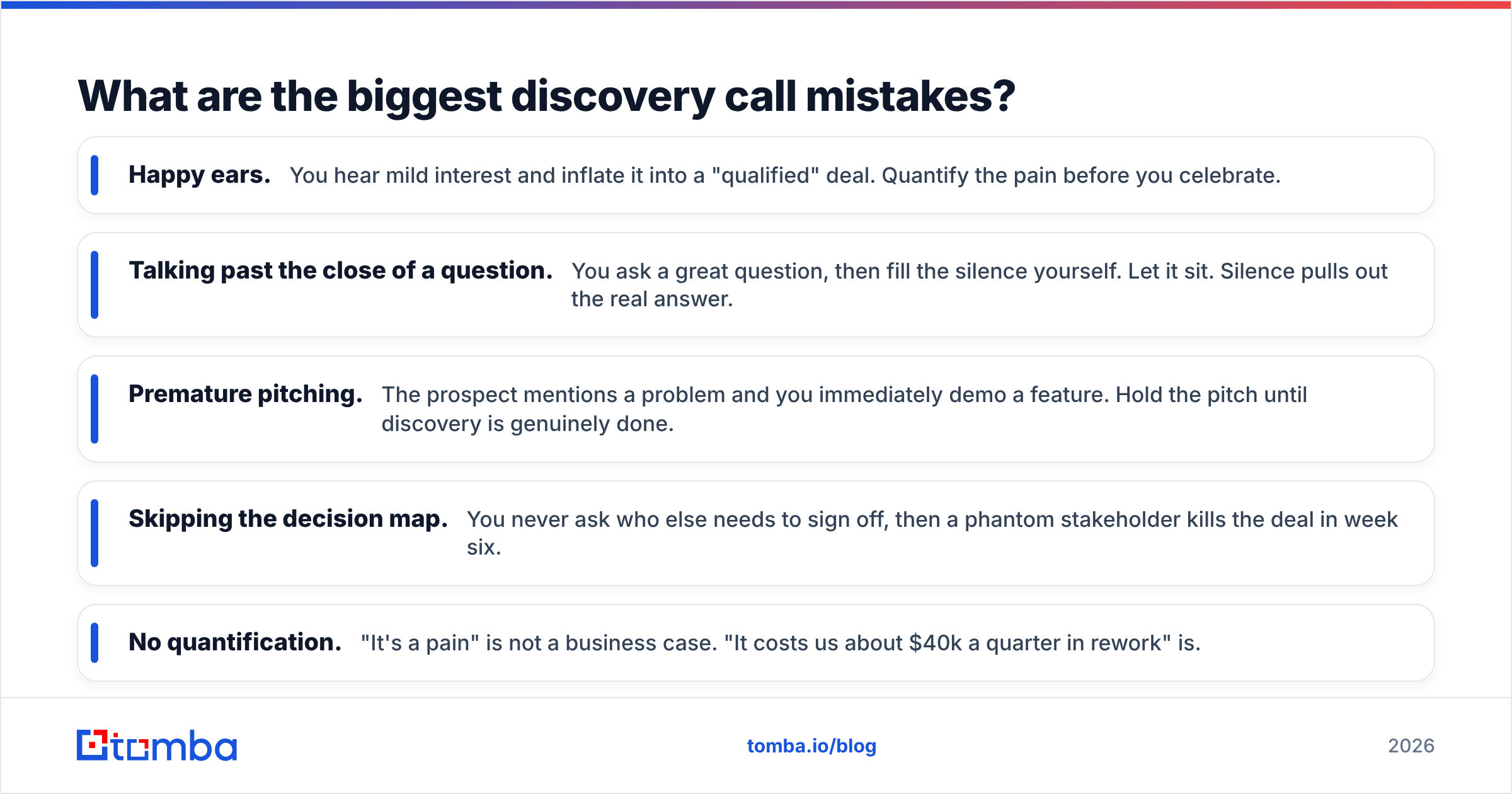
What are the biggest discovery call mistakes?#
Even reps with good questions sabotage calls in predictable ways. Watch for these:
- Happy ears. You hear mild interest and inflate it into a "qualified" deal. Quantify the pain before you celebrate.
- Talking past the close of a question. You ask a great question, then fill the silence yourself. Let it sit. Silence pulls out the real answer.
- Premature pitching. The prospect mentions a problem and you immediately demo a feature. Hold the pitch until discovery is genuinely done.
- Skipping the decision map. You never ask who else needs to sign off, then a phantom stakeholder kills the deal in week six.
- No quantification. "It's a pain" is not a business case. "It costs us about $40k a quarter in rework" is.
Industry research consistently backs this up: review platforms like G2 and analyst notes from firms tracking sales productivity show that reps who quantify impact during discovery close at materially higher rates than those who don't. Discovery quality is the single biggest controllable lever on win rate.
How many discovery questions should you ask?#
Quality over quantity. Most strong discovery calls cover eight to twelve substantive questions, with follow-ups stacked on the two or three that hit a nerve. If you fire off twenty questions in thirty minutes, it feels like an interrogation and the prospect shuts down.
The better metric is your talk-to-listen ratio. Aim for roughly 30% talking, 70% listening on a discovery call. If you are doing most of the talking, you are pitching, not discovering — and you are learning nothing you can use to close.
A simple self-check after every call: can you write down, in one sentence each, the prospect's core problem, the cost of that problem, who decides, and when they need to act? If you can answer all four, discovery worked. If any is fuzzy, you have a follow-up call to book — and a gap to track in your sales pipeline.
Putting it together: a quick-start checklist#
Before your next call, run this:
- Research the account and contact so your situation questions are specific, not generic.
- Pick one framework and write your four anchor questions for pain, impact, decision, and timing.
- Plan your silence — decide which two questions you will let breathe.
- Prepare your summary template so you close the loop and confirm understanding.
- Book the next step before you hang up, every time.
Discovery is not a phase you rush through to get to the demo. It is the deal. Get the questions right and the rest of the cycle gets dramatically easier.
Start your discovery prep with better contact data#
The sharpest discovery questions in the world are wasted on the wrong contact or a bounced email. Before you dial, make sure you are reaching the actual decision-maker with verified, enriched details. The Tomba Email Finder finds professional emails by name, domain, or company so you spend your prep time researching pain points instead of chasing inboxes — and you can start free with 25 searches a month, then scale on the Starter plan at $49/mo as your pipeline grows. See full Tomba pricing to match a plan to your outbound volume, and walk into every call already knowing who you are talking to and why they should care.
// get started
Find, verify and enrich your first contacts today
Start on the free plan with 25 searches a month, then scale when your team is ready.
Free plan · No credit card required · GDPR & CCPA
// about the author