Best Email Call To Action Examples That Convert in 2026
A field guide to the best email call to action examples for 2026 — with copy-paste CTAs, a comparison table, and the psychology behind why some buttons get clicked and others get ignored.
Your email can have a flawless subject line, a tight opening, and a genuinely useful offer — and still die at the last sentence. The call to action (CTA) is where intention turns into a click or a reply, and it is the single most-rewritten line in any high-performing email. This guide breaks down the best email call to action examples for 2026, the psychology behind why they work, and exactly how to adapt them to cold outreach, newsletters, and nurture sequences.
TL;DR#
- One email, one ask. Emails with a single clear CTA consistently out-convert emails that stack two or three competing requests.
- Specificity beats urgency. "Grab a 15-minute slot Thursday" outperforms "Let's connect soon" because it removes the reader's decision-making cost.
- Soft CTAs win cold replies; hard CTAs win warm clicks. Match the ask to the relationship stage or you tank your reply rate.
- Buttons win in newsletters, text links win in cold email. A bright button in a 1:1 cold email screams "automated blast" and hurts deliverability signals.
- Test the verb, not just the offer. Swapping "Schedule" for "Grab" or "See" can move click-through more than redesigning the whole email.
What makes a call to action actually work?#
A great CTA does one job: it makes the next step feel small, obvious, and low-risk. Think of it like a doorway. If the door is heavy, unmarked, and you are not sure what is on the other side, you walk past it. If it is propped open with a sign that says exactly where it leads, you step through without thinking.
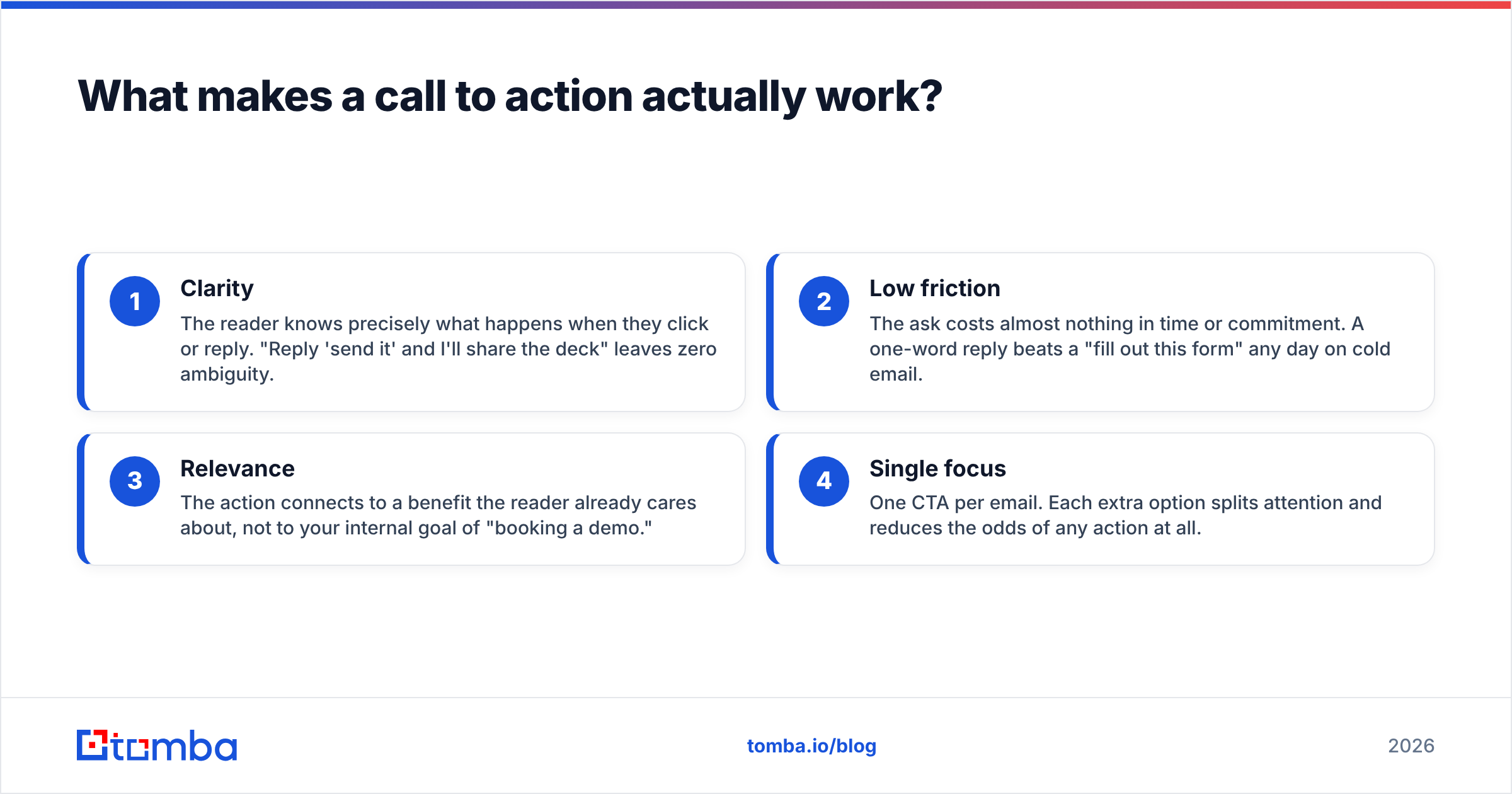
Every strong CTA balances four levers:
- Clarity — The reader knows precisely what happens when they click or reply. "Reply 'send it' and I'll share the deck" leaves zero ambiguity.
- Low friction — The ask costs almost nothing in time or commitment. A one-word reply beats a "fill out this form" any day on cold email.
- Relevance — The action connects to a benefit the reader already cares about, not to your internal goal of "booking a demo."
- Single focus — One CTA per email. Each extra option splits attention and reduces the odds of any action at all.
Most weak CTAs fail on clarity and friction. "Looking forward to hearing your thoughts" is polite, but it asks the reader to invent the next step themselves — and a confused reader does nothing. For a deeper foundation on the metric you are trying to move, see how a strong ask affects your email response rate.
What are the best email call to action examples by goal?#
CTAs are not one-size-fits-all. The best phrasing depends on what you are asking for and how warm the relationship is. Here is a tested library you can adapt immediately.
Cold outreach (soft, reply-based):
- "Worth a quick chat, or am I off base?"
- "Open to me sending a 90-second Loom on this?"
- "Reply '1' and I'll send the case study — no call needed."
- "Is improving [specific metric] on your radar this quarter?"
Booking a meeting (specific, time-bound):
- "Grab any 15-minute slot here: [link]"
- "Does Tuesday 2pm or Wednesday 10am work better?"
- "I'll send a calendar invite for Thursday — just say go."
Newsletter / content (click-based):
- "Read the full breakdown →"
- "See the 7-step framework"
- "Steal the template"
Re-engagement (low-pressure):
- "Should I keep these coming, or close the loop?"
- "Still the right person for this? Point me to whoever is."
Free trial / product (value-forward):
- "Start free — 25 searches, no card needed"
- "Try it on your own list in 2 minutes"
Notice the verbs. "Grab," "Steal," "See," and "Start" carry less psychological weight than "Schedule," "Download," or "Register." If you want a fast way to generate variations, a tool like the cold email AI writer can spin up CTA options for A/B testing in seconds.
Soft CTA vs hard CTA: which converts better?#
The right answer depends entirely on relationship temperature. Pushing a hard CTA on a cold prospect is like proposing marriage on a first date — technically a clear ask, but wildly mistimed.
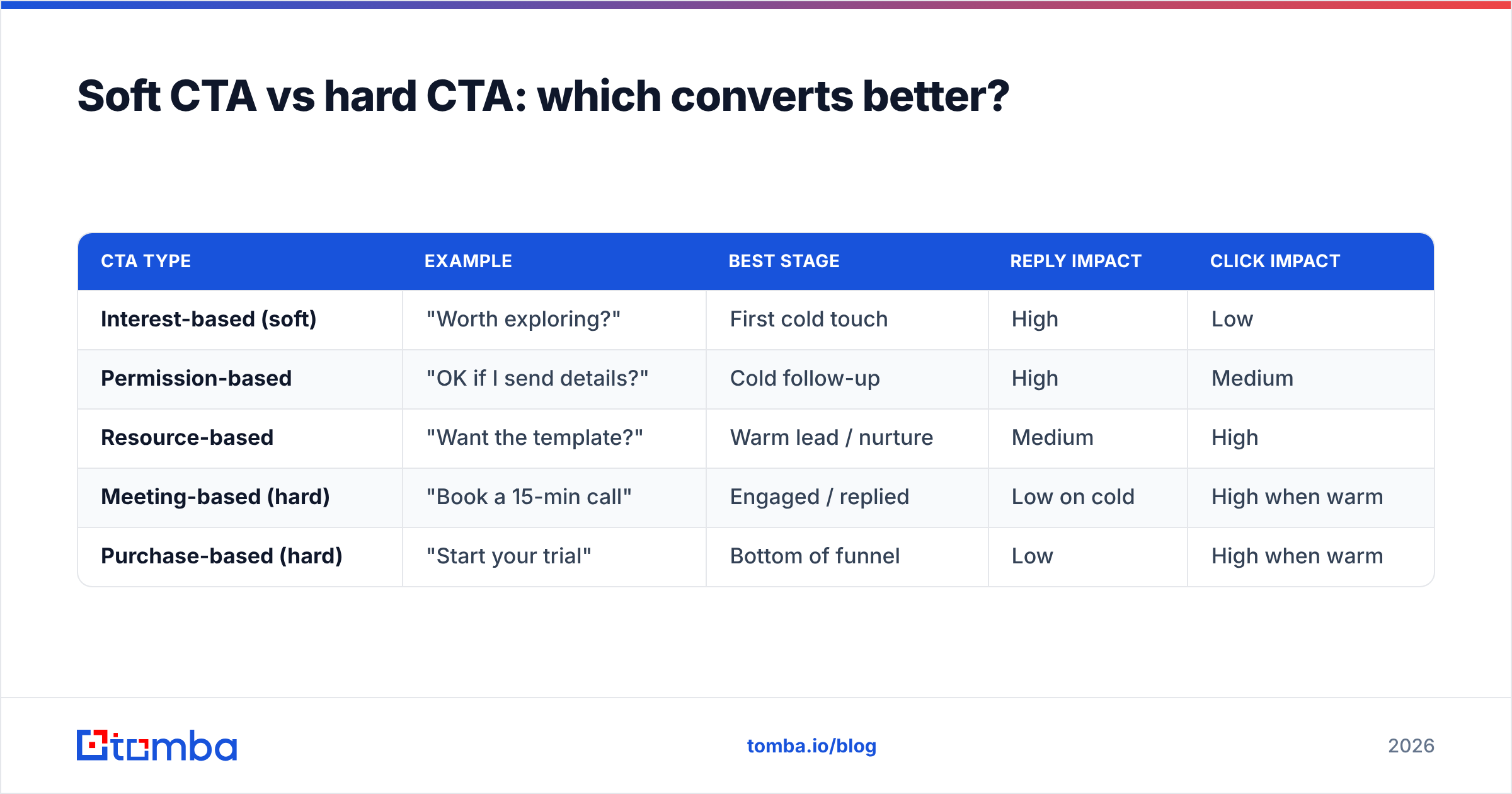
| CTA type | Example | Best stage | Reply impact | Click impact |
|---|---|---|---|---|
| Interest-based (soft) | "Worth exploring?" | First cold touch | High | Low |
| Permission-based | "OK if I send details?" | Cold follow-up | High | Medium |
| Resource-based | "Want the template?" | Warm lead / nurture | Medium | High |
| Meeting-based (hard) | "Book a 15-min call" | Engaged / replied | Low on cold | High when warm |
| Purchase-based (hard) | "Start your trial" | Bottom of funnel | Low | High when warm |
The pattern is consistent: soft CTAs maximize replies early, hard CTAs maximize action once trust exists. A common mistake in cold sequences is leading with "Book a demo" in email one. You are asking for 30 minutes from someone who has known you for 30 seconds. Lead with an interest-based or permission-based CTA, then escalate to the meeting ask once they engage.
For account-based and outbound programs, this escalation logic should map to your broader outbound sales strategy — the CTA is the tactical edge of a sequence that is already calibrated to buyer intent.
Should you use a button or a text link?#
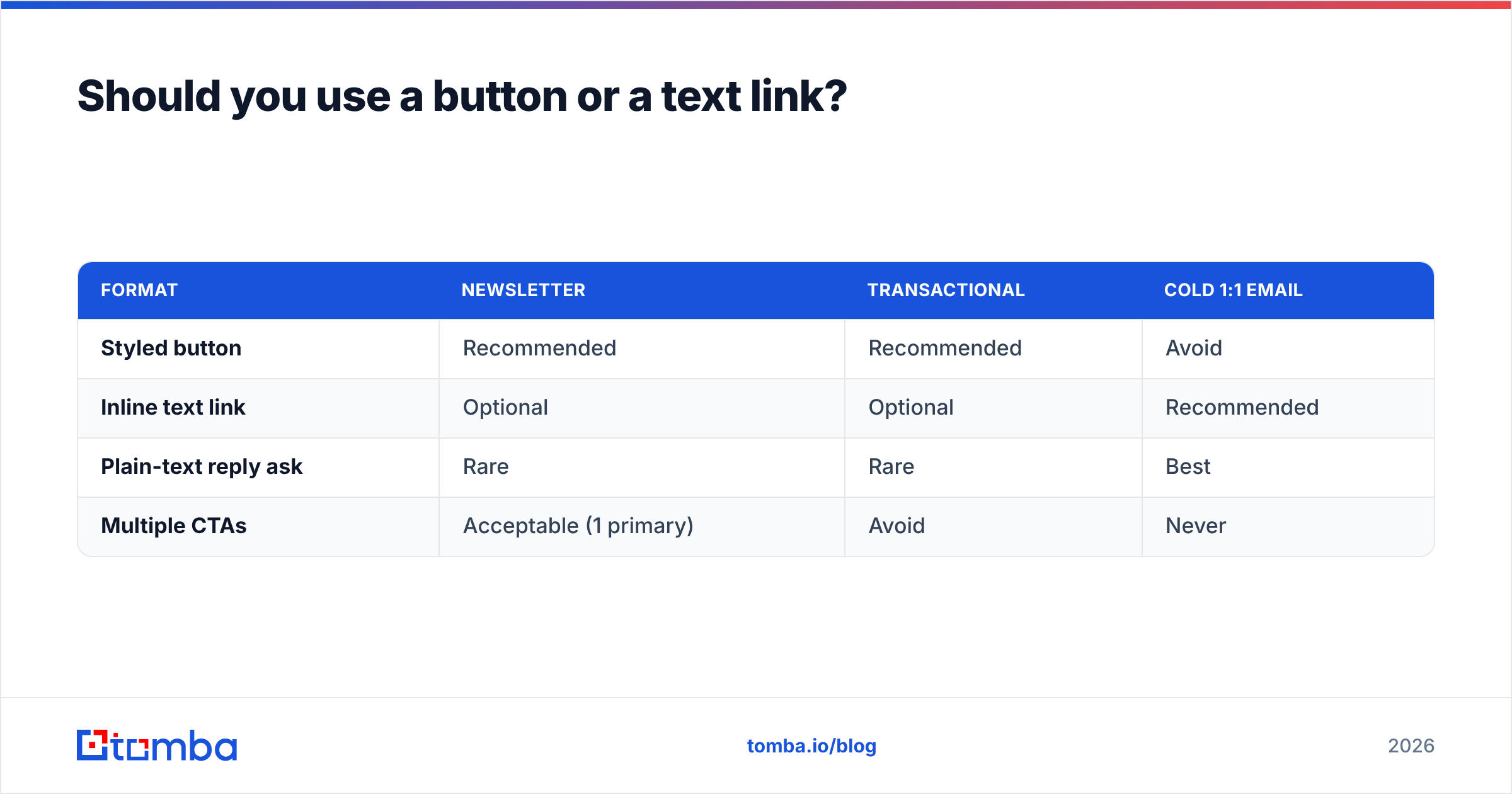
Use buttons for one-to-many email; use plain text links for one-to-one cold email. That single rule prevents most CTA-design mistakes.
A bright, centered button looks professional in a newsletter or a transactional email where the recipient already knows your brand. But drop that same button into a "personal" cold email and you have just announced that the message is an automated blast. It breaks the 1:1 illusion and can nudge spam filters, because heavy HTML and image-button ratios correlate with bulk sending. Cold email should look like it came from a colleague typing in Gmail.
| Format | Newsletter | Transactional | Cold 1:1 email |
|---|---|---|---|
| Styled button | Recommended | Recommended | Avoid |
| Inline text link | Optional | Optional | Recommended |
| Plain-text reply ask | Rare | Rare | Best |
| Multiple CTAs | Acceptable (1 primary) | Avoid | Never |
If deliverability is shaky, the format of your CTA is only part of the story — sender setup matters more. Before scaling any campaign, confirm your authentication with an SPF checker and review the fundamentals of email deliverability so your perfectly-worded CTA actually reaches the inbox.
How do you write a CTA that doesn't feel pushy?#
Frame the action as a benefit to the reader, give them an easy out, and keep it to one sentence. Pushiness comes from pressure and self-interest; the fix is to shift the focus back to them.
Three reframing patterns that consistently soften a CTA without weakening it:
- The opt-out close. "If it's not a fit, no worries at all — but if it is, reply and I'll send times." Giving permission to say no paradoxically increases yes rates because it removes the feeling of being cornered.
- The micro-yes. Instead of asking for a meeting, ask for a one-word reply. "Reply 'curious' and I'll send the details." A tiny commitment is easier to make and opens the conversation.
- The question CTA. End with a genuine question rather than a directive. "Is reducing onboarding time a priority for your team right now?" invites a response instead of demanding an action.
Avoid stacking urgency words ("Act now! Limited time! Don't miss out!") in B2B. According to research compiled by HubSpot, clarity and relevance drive clicks far more reliably than manufactured scarcity, which often reads as spammy to professional buyers. If you are unsure whether your copy trips spam triggers, run it through a spam checker before sending.
What CTA mistakes kill conversions?#
Most underperforming emails repeat the same handful of errors. Audit your own templates against this list.
- Multiple competing CTAs. "Reply, or book a call, or check our blog, or follow us on LinkedIn" — every extra option dilutes the primary action. Pick one.
- Vague timing. "Let's connect sometime" pushes the scheduling work onto the reader. Offer specific times or a booking link.
- Burying the ask. A CTA hidden in the middle of a paragraph gets skimmed past. Give it its own line.
- Asking too much, too soon. Requesting a 45-minute demo from a cold contact is a friction wall. Escalate gradually.
- No CTA at all. "Just wanted to introduce myself" with no next step trains the reader to do nothing.
- Generic verbs. "Click here" tells the reader nothing about the value. "See your team's email patterns" does.
The biggest lever is point one. The data across cold email and marketing alike — well documented by analytics teams at Mailchimp — shows that single-CTA emails outperform multi-CTA emails on the action that actually matters to your pipeline.
How do you test and optimize your CTAs?#
Test one variable at a time, measure the action you actually want, and give each variant enough volume to reach significance. Most teams "test" by rewriting the entire email, which makes it impossible to learn what moved the needle.
A practical CTA testing roadmap:
- Round 1 — the verb. Hold everything constant and test only the action word. "Grab a slot" vs "Book a call" vs "Worth a chat?"
- Round 2 — soft vs hard. Test an interest-based CTA against a direct meeting ask on the same audience.
- Round 3 — placement. Test the CTA as the final line vs embedded right after the value proposition.
- Round 4 — format. For newsletters, test button color, copy, and position. For cold email, test text link vs plain reply ask.
Measure the downstream action, not just the click. A CTA that earns clicks but no booked meetings is a vanity win. Tie your CTA performance back to pipeline by tracking it alongside win rate and reply quality, not raw open or click counts.
One overlooked prerequisite: your test is only valid if your emails actually land in real inboxes. Sending to dead or risky addresses inflates bounce rates and distorts every metric. Clean your list with an email verifier before you run a single CTA test, or you will be optimizing copy against noise.
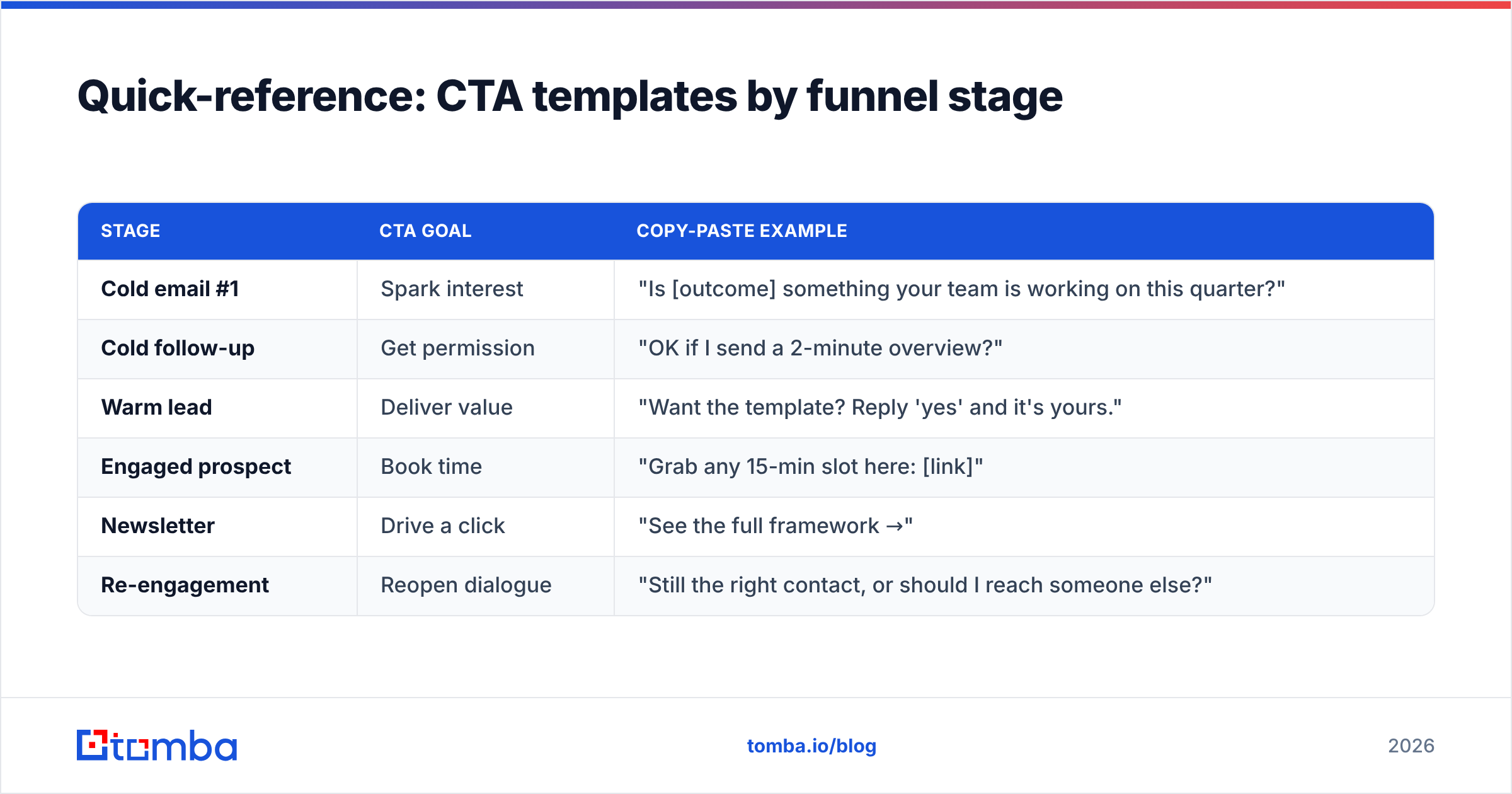
Quick-reference: CTA templates by funnel stage#
| Stage | CTA goal | Copy-paste example |
|---|---|---|
| Cold email #1 | Spark interest | "Is [outcome] something your team is working on this quarter?" |
| Cold follow-up | Get permission | "OK if I send a 2-minute overview?" |
| Warm lead | Deliver value | "Want the template? Reply 'yes' and it's yours." |
| Engaged prospect | Book time | "Grab any 15-min slot here: [link]" |
| Newsletter | Drive a click | "See the full framework →" |
| Re-engagement | Reopen dialogue | "Still the right contact, or should I reach someone else?" |
Bookmark this table and pull from it the next time you stare at a blank "next step" line. Pair it with proven cold email templates and you have most of an outreach sequence built before you write a custom word.
Put your CTAs in front of the right people#
A perfect CTA is wasted on the wrong inbox. The fastest way to lift conversions is often not better copy — it is reaching the actual decision-maker instead of a generic info@ address. Use the Tomba Email Finder to pull verified, role-based contacts by domain, name, or company, then drop them straight into the sequences and CTAs you just built. Start free with 25 searches a month, or scale up on the Starter plan at $49/mo — and stop sending your best calls to action to dead addresses. Check the full Tomba pricing to match a plan to your outbound volume.
// get started
Find, verify and enrich your first contacts today
Start on the free plan with 25 searches a month, then scale when your team is ready.
Free plan · No credit card required · GDPR & CCPA
// about the author