Best Email Outreach Tool in 2026: Top Picks Compared
Choosing the best email outreach tool in 2026 comes down to deliverability, scale, and the data feeding your sequences. Here is an honest, side-by-side breakdown of the top platforms.
Picking the best email outreach tool is less about who has the prettiest sequence builder and more about three unglamorous things: can it land in the inbox, can it scale without torching your domain, and is the data feeding it actually accurate. Get those right and almost any modern platform works. Get them wrong and the slickest UI in the world still ends up in spam.
This guide breaks down the leading outreach platforms in 2026, what each is genuinely good at, and where they fall short — so you can match a tool to your motion instead of buying the loudest name.
TL;DR#
- There is no single best email outreach tool for everyone — the right pick depends on send volume, team size, and whether you need a full sales engagement suite or a lean cold-email sender.
- Deliverability beats features. Inbox placement, warmup, and inbox rotation matter more than the number of integrations a vendor advertises.
- Instantly and Smartlead lead for high-volume cold email; Apollo and Salesloft lead for all-in-one sales engagement; lemlist wins on multichannel personalization.
- Your data layer is the real differentiator. Bad contact data ruins even the best sender — pair your outreach tool with an accurate email finder and email verifier.
- Expect to spend $30–$150 per user/month for sending tools, plus a separate budget for data and enrichment.
What is an email outreach tool?#
An email outreach tool is software that sends personalized email sequences at scale, tracks replies and engagement, and automates the follow-ups a rep would otherwise send by hand. Think of it as a mail-merge engine with a conscience — it knows when someone replied, pauses the sequence, rotates between inboxes to protect your reputation, and reports on what actually books meetings.
Most tools cluster into three categories:
- Cold-email senders — built for volume and deliverability (Instantly, Smartlead). Lean, fast, focused on getting thousands of emails into primary inboxes.
- Sales engagement platforms — multichannel cadences across email, phone, and LinkedIn with deep CRM ties (Salesloft, Outreach, Apollo).
- Personalization-first tools — heavy on dynamic variables, images, and multichannel touches for smaller, high-intent lists (lemlist, Reply.io).
The category you need depends on whether you are running spray-and-measure outbound or surgical, account-based sequences.
)
How do you judge the best email outreach tool?#
Before comparing logos, score every candidate against the criteria that actually move reply rates. A flashy feature list means nothing if the fundamentals are weak.
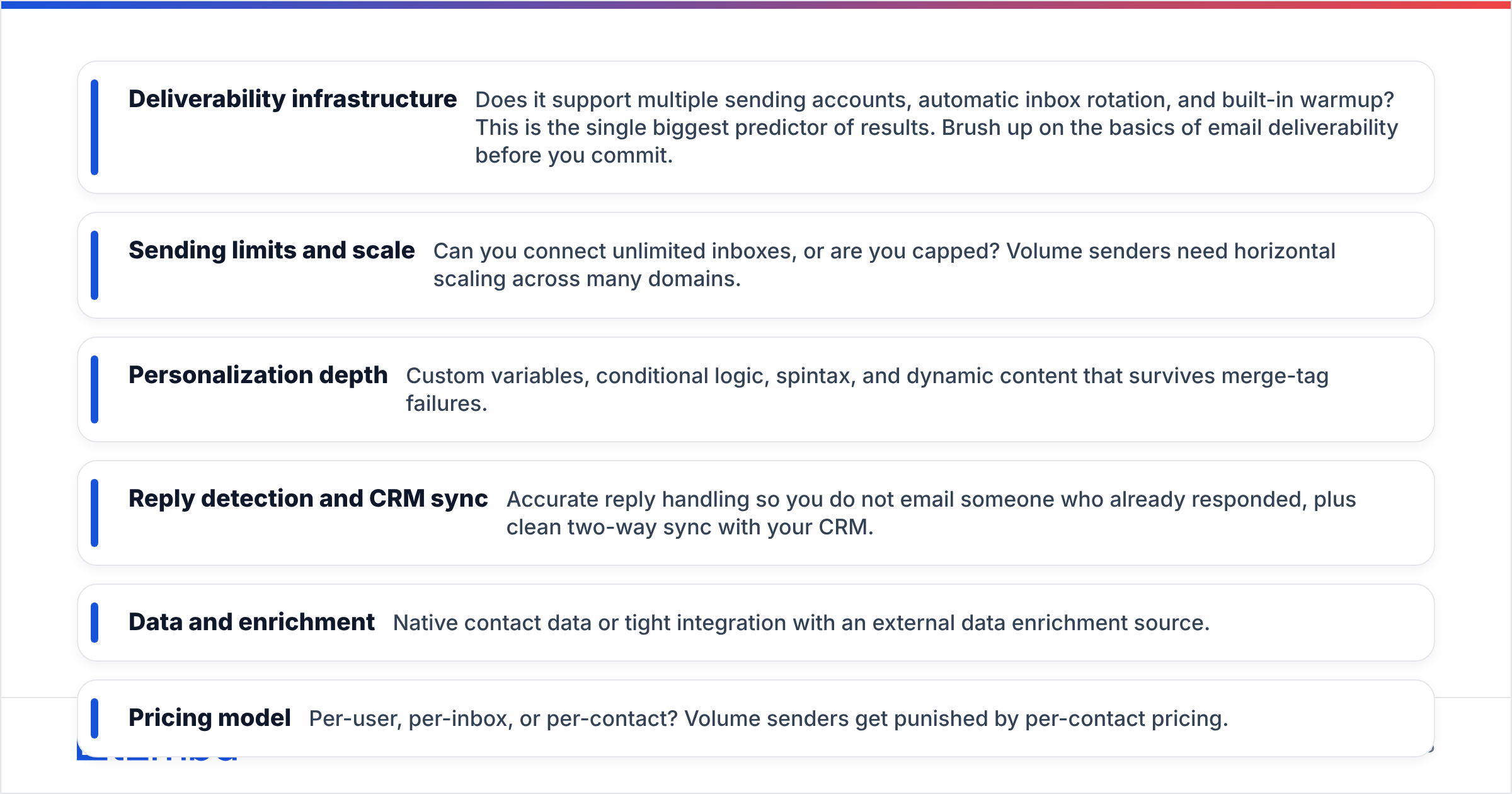
- Deliverability infrastructure — Does it support multiple sending accounts, automatic inbox rotation, and built-in warmup? This is the single biggest predictor of results. Brush up on the basics of email deliverability before you commit.
- Sending limits and scale — Can you connect unlimited inboxes, or are you capped? Volume senders need horizontal scaling across many domains.
- Personalization depth — Custom variables, conditional logic, spintax, and dynamic content that survives merge-tag failures.
- Reply detection and CRM sync — Accurate reply handling so you do not email someone who already responded, plus clean two-way sync with your CRM.
- Data and enrichment — Native contact data or tight integration with an external data enrichment source.
- Pricing model — Per-user, per-inbox, or per-contact? Volume senders get punished by per-contact pricing.
Weight these by your motion. A two-person startup doing 200 hyper-targeted emails a month cares about personalization; an agency blasting 50,000 cold emails cares about inbox rotation and warmup above all else.
Which is the best email outreach tool in 2026?#
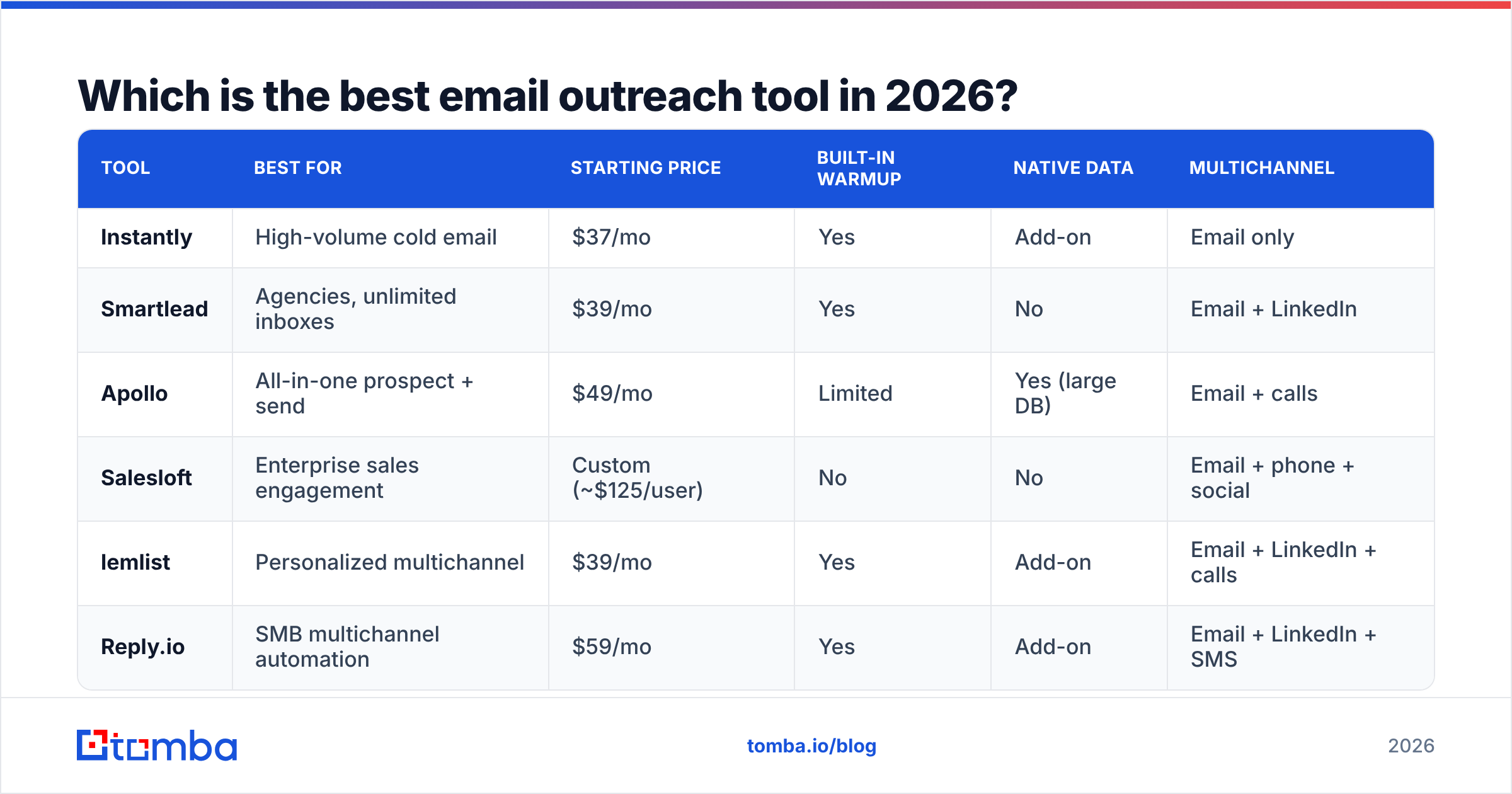
Here is an honest side-by-side of the platforms that consistently show up on shortlists. Prices reflect publicly listed entry tiers as of 2026 and shift often — always confirm on the vendor's own pricing page.
| Tool | Best for | Starting price | Built-in warmup | Native data | Multichannel |
|---|---|---|---|---|---|
| Instantly | High-volume cold email | $37/mo | Yes | Add-on | Email only |
| Smartlead | Agencies, unlimited inboxes | $39/mo | Yes | No | Email + LinkedIn |
| Apollo | All-in-one prospect + send | $49/mo | Limited | Yes (large DB) | Email + calls |
| Salesloft | Enterprise sales engagement | Custom (~$125/user) | No | No | Email + phone + social |
| lemlist | Personalized multichannel | $39/mo | Yes | Add-on | Email + LinkedIn + calls |
| Reply.io | SMB multichannel automation | $59/mo | Yes | Add-on | Email + LinkedIn + SMS |
A few takeaways from the table:
- Instantly and Smartlead are the volume workhorses. Smartlead's unlimited-inbox model makes it a favorite among agencies and anyone running many domains; Instantly pairs a clean UI with a strong deliverability network.
- Apollo is the closest thing to an all-in-one — a built-in B2B database plus a sequencer — but teams often outgrow its data accuracy and bolt on a dedicated finder. If that sounds like you, an Apollo alternative focused on data quality is worth a look.
- Salesloft and Outreach dominate enterprise sales engagement with phone, social, and analytics, but they are priced and built for full revenue teams, not solo founders.
- lemlist still leads on personalization — dynamic images, landing pages, and conditional sequences — for smaller, high-intent lists.
Is a cold-email sender better than an all-in-one platform?#
It depends on your volume and team structure — neither is universally better.
Choose a dedicated cold-email sender (Instantly, Smartlead) when you are running outbound at scale, rotating across many inboxes, and care most about inbox placement. They are cheaper per send, faster to set up, and purpose-built for the one job that matters: landing in the primary tab.
Choose an all-in-one sales engagement platform (Salesloft, Apollo, Outreach) when email is just one channel in a coordinated cadence, when reps also dial and send LinkedIn touches, and when leadership needs pipeline analytics tied to the CRM. The trade-off is cost and complexity.
A useful rule of thumb: if your bottleneck is getting emails delivered, buy a sender. If your bottleneck is coordinating a multichannel team, buy an engagement platform. For deeper context on coordinating channels, see how teams structure sales automation across the funnel.
Why does data quality decide the winner?#
Because the best email outreach tool in the world cannot save bad data. This is the part most "top 10" lists skip, and it is the one that quietly kills campaigns.
Here is the chain of failure. You upload a list with 20% invalid or guessed addresses. Your sender dutifully emails all of them. Bounces spike. Mailbox providers read high bounce rates as a spam signal, your sender reputation drops, and now even your valid emails start landing in spam. One dirty list can poison a domain for weeks.
)
The fix is a clean data pipeline before anything hits your sequencer:
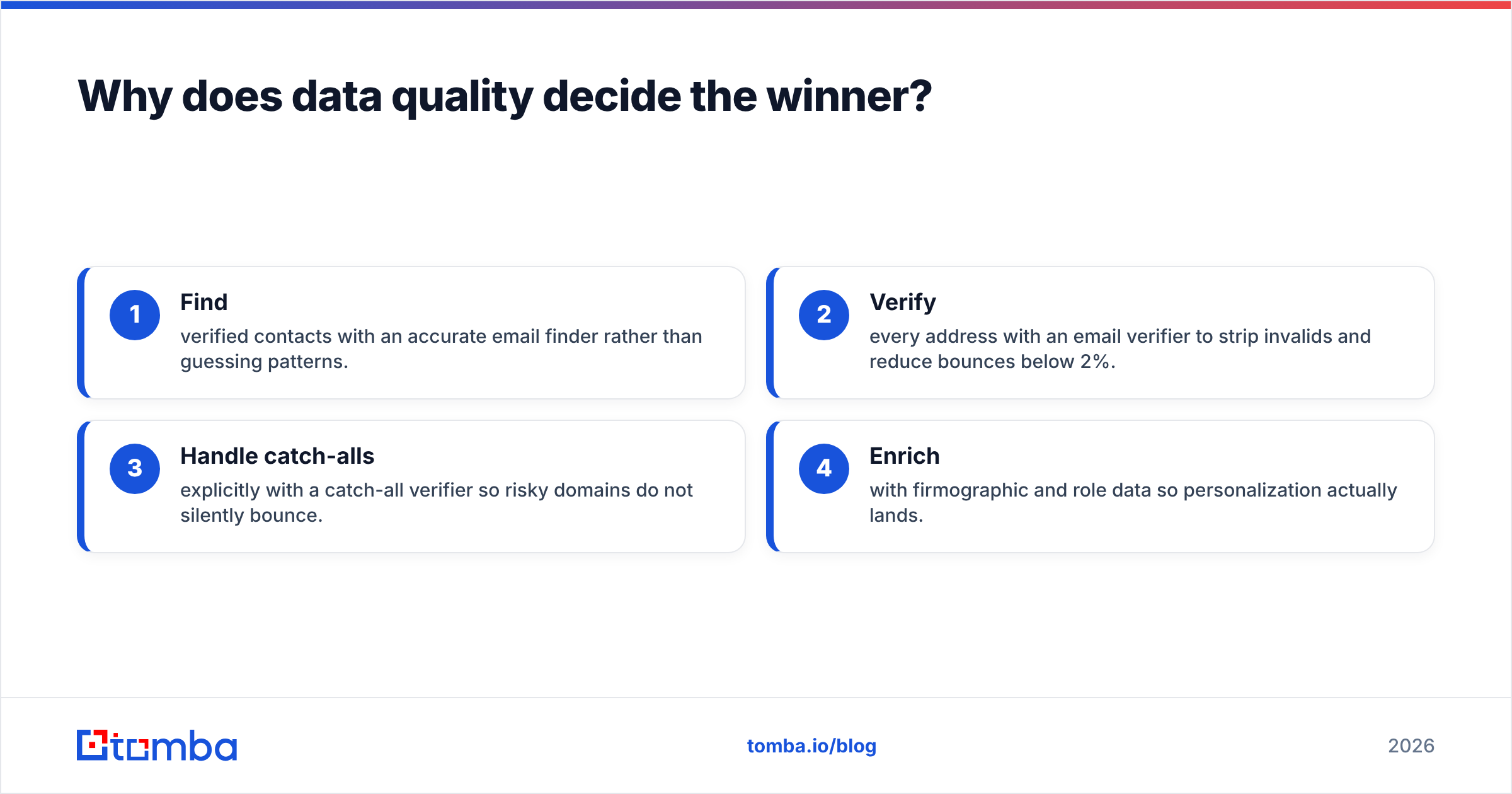
- Find verified contacts with an accurate email finder rather than guessing patterns.
- Verify every address with an email verifier to strip invalids and reduce bounces below 2%.
- Handle catch-alls explicitly with a catch-all verifier so risky domains do not silently bounce.
- Enrich with firmographic and role data so personalization actually lands.
This is where Tomba fits into the outreach stack. It is not a sending tool and does not pretend to be — it is the data layer that feeds whichever sender you pick. You find and verify accurate, role-based addresses in Tomba, push them into Instantly, Smartlead, Apollo, or lemlist, and let the sender do what it does best on a clean list. Independent buyer reviews on G2 and Capterra consistently rank verification as the highest-ROI step teams add to their workflow.
How much should you pay for outreach in 2026?#
Budget in two buckets, because they are genuinely separate purchases.
Sending tool: Expect $30–$60/month for solo cold-email senders (Instantly, Smartlead, lemlist entry tiers) and $100–$150+ per user/month for enterprise engagement platforms (Salesloft, Outreach). Watch for per-inbox or per-contact pricing that balloons as you scale.
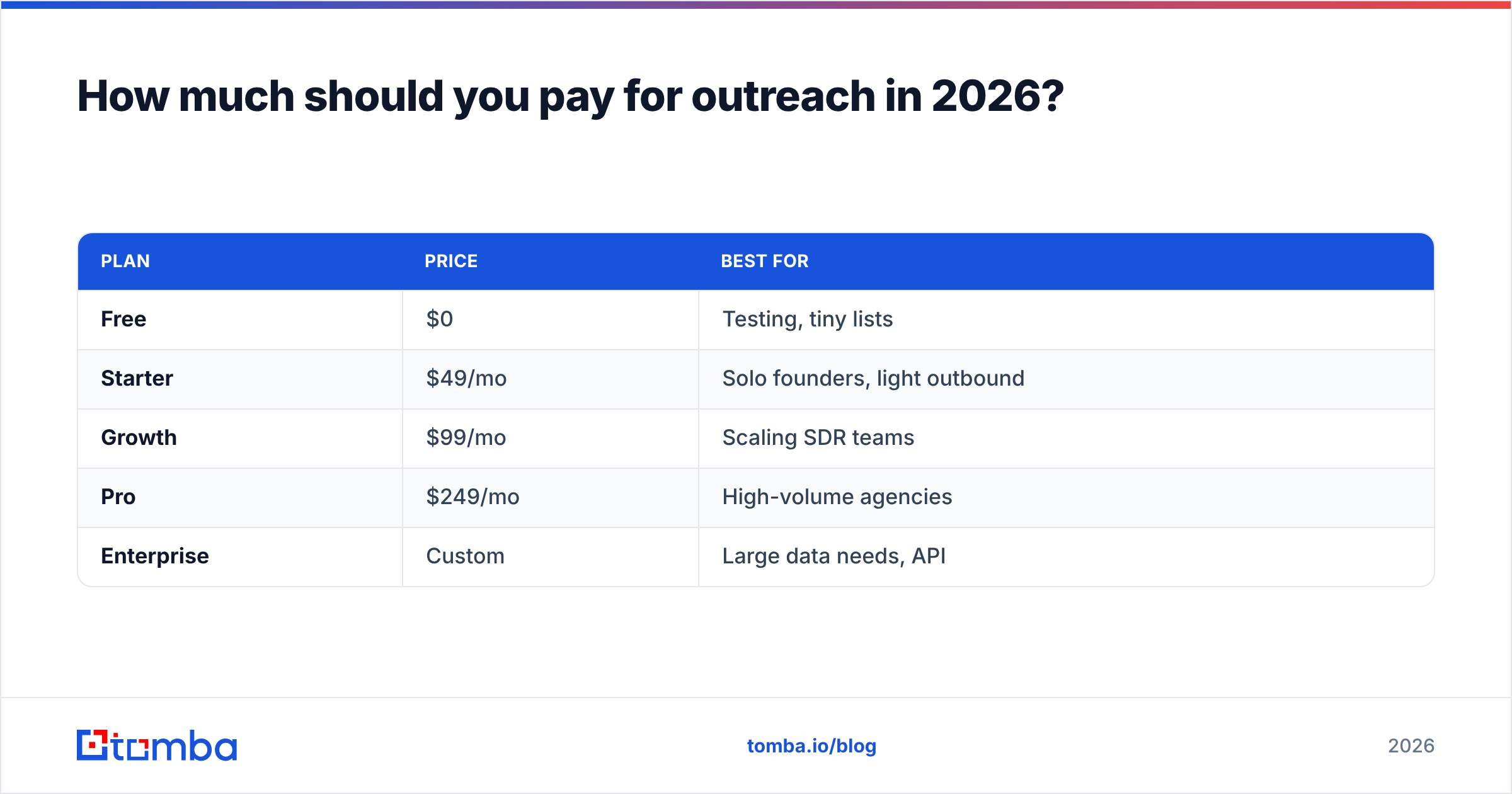
Data and verification: This is where most teams under-budget. Email-finding and verification typically run on a credit model. For reference, Tomba pricing starts with a Free tier of 25 searches per month, then:
| Plan | Price | Best for |
|---|---|---|
| Free | $0 | Testing, tiny lists |
| Starter | $49/mo | Solo founders, light outbound |
| Growth | $99/mo | Scaling SDR teams |
| Pro | $249/mo | High-volume agencies |
| Enterprise | Custom | Large data needs, API |
A realistic small-team stack lands around $90–$150/month combined — a sender plus a data plan — and that pairing outperforms a single pricier all-in-one whose data accuracy you cannot control. If you run outbound through code, the Tomba API lets you verify and enrich inline before a single email sends.
What is the best email outreach tool for your situation?#
Quick recommendations by profile:
- Solo founder / early startup: Instantly or Smartlead for sending, paired with a Tomba Starter plan for clean data. Cheap, fast, deliverability-first.
- Outbound agency: Smartlead for unlimited inboxes and client workspaces, plus a bulk email finder and verification at Pro volume.
- SMB sales team: Apollo or Reply.io for the all-in-one workflow, with an external verifier to clean Apollo's data before sending.
- Enterprise revenue org: Salesloft or Outreach for multichannel cadences and analytics, with Tomba's data enrichment and Salesforce integration feeding accurate records.
- Personalization-led / ABM: lemlist for dynamic, multichannel touches on smaller high-intent lists.
The common thread across every profile: the sender is interchangeable, but the data layer is not. Teams switch sending tools all the time with little disruption. Teams that switch to clean, verified data see bounce rates drop and reply rates climb on the same sequences.
The bottom line#
The best email outreach tool is the one whose deliverability fundamentals match your volume — and that you feed with accurate, verified contacts. Pick Instantly or Smartlead for lean high-volume cold email, Apollo or Salesloft for coordinated multichannel engagement, and lemlist for deep personalization. Then stop optimizing subject lines for a week and fix your data first; it is almost always the higher-leverage move.
Before your next campaign, run your list through a real data pipeline. Use the Tomba Email Finder to source verified, role-based addresses by domain or name, confirm them with the email verifier, and push a clean list into whichever sender you chose. Start free with 25 searches a month — no card required — and watch your bounce rate fall before you spend a dollar on more sends.
// get started
Find, verify and enrich your first contacts today
Start on the free plan with 25 searches a month, then scale when your team is ready.
Free plan · No credit card required · GDPR & CCPA
// about the author