The 37 Best Email Sign-Offs to Boost Reply Rates in 2026
Your email closing does more work than you think. Here are the 37 best email sign-offs for 2026, ranked by reply rate, plus the ones quietly killing your responses.
You spend twenty minutes crafting the perfect cold email, then close it with "Best" and never think about it again. That last line is a mistake hiding in plain sight. Your sign-off is the final thing a prospect reads before they decide to reply, ignore, or delete — and the words you pick measurably move that decision.
This guide ranks the best email sign-offs for 2026 by context and reply impact, shows you the closings that quietly tank your response rate, and gives you copy-paste templates for cold outreach, follow-ups, and formal replies.
TL;DR: The Best Email Sign-Offs at a Glance#
- Highest-performing all-rounder: "Thanks" and "Thank you" consistently top reply-rate studies — gratitude beats formality.
- Best for cold email: A sign-off that pairs a low-friction CTA with a casual close ("Worth a quick look? — [Name]") outperforms bare "Regards."
- Avoid: "Sincerely," "Yours faithfully," and anything with "Sent from my iPhone" left on by accident — they read as stiff or careless.
- Context rules everything: The right close for a legal contract is the wrong close for a founder-to-founder pitch. Match tone to relationship.
- Your signature is part of the sign-off. A clean name, title, and one link does more than a clever phrase.
Why Does Your Email Sign-Off Actually Matter?#
Think of your sign-off like the last handshake at the end of a meeting. The conversation could have gone perfectly, but a limp, distracted goodbye leaves a worse impression than you realize. The close is the recency anchor — psychologically, people weight the final moment of an interaction heavily when they form an overall judgment.
There's data behind this too. A widely cited Boomerang study of more than 350,000 email threads found that emails ending in a variation of "thanks" got meaningfully higher response rates than those ending in "regards" or "best." Gratitude-based closings outperformed neutral ones by roughly double digits in percentage terms.
For sales and outreach, that gap compounds. If you send 500 cold emails a month, a few percentage points of reply lift is the difference between a full pipeline and a dry one. The sign-off isn't decoration — it's a cheap, repeatable lever on your email response rate.
What Are the Best Professional Email Sign-Offs?#
For everyday business email — colleagues, clients you already know, vendors — you want warmth without trying too hard. These are safe, tested, and rarely wrong:
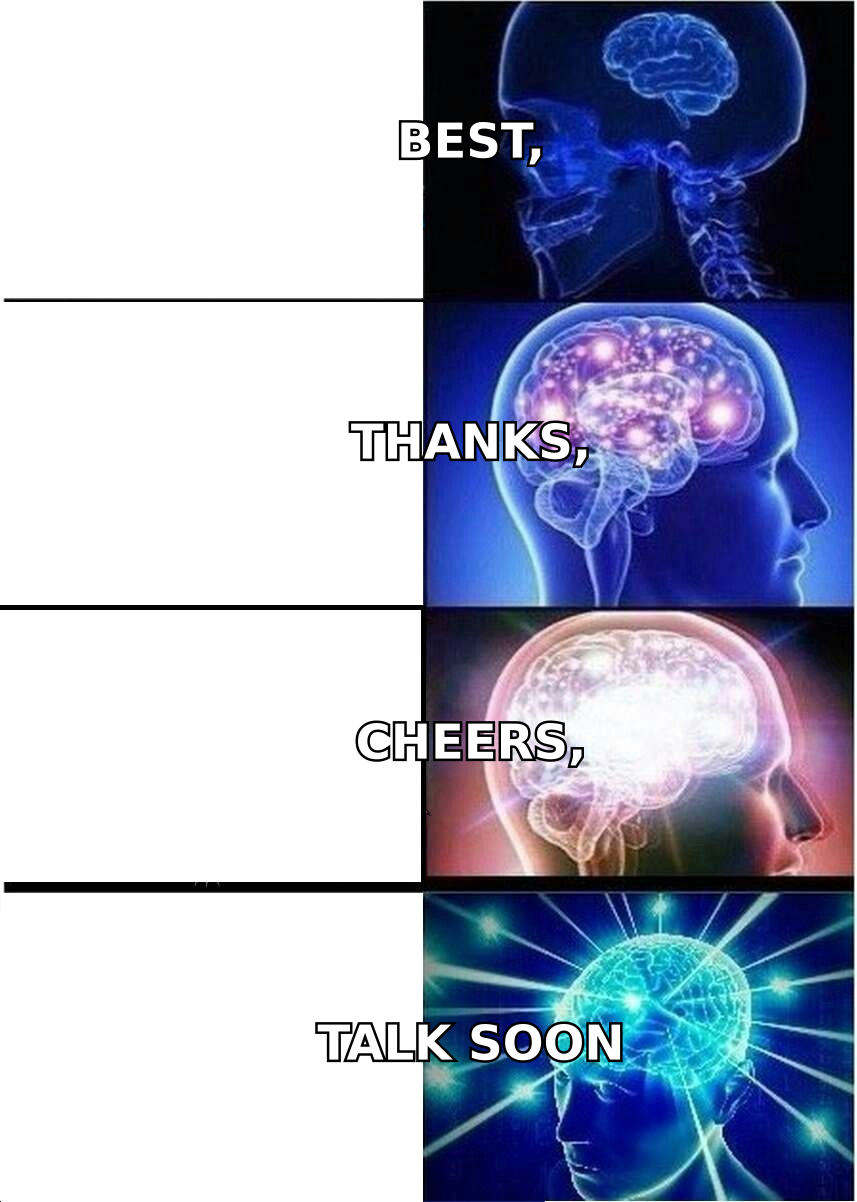
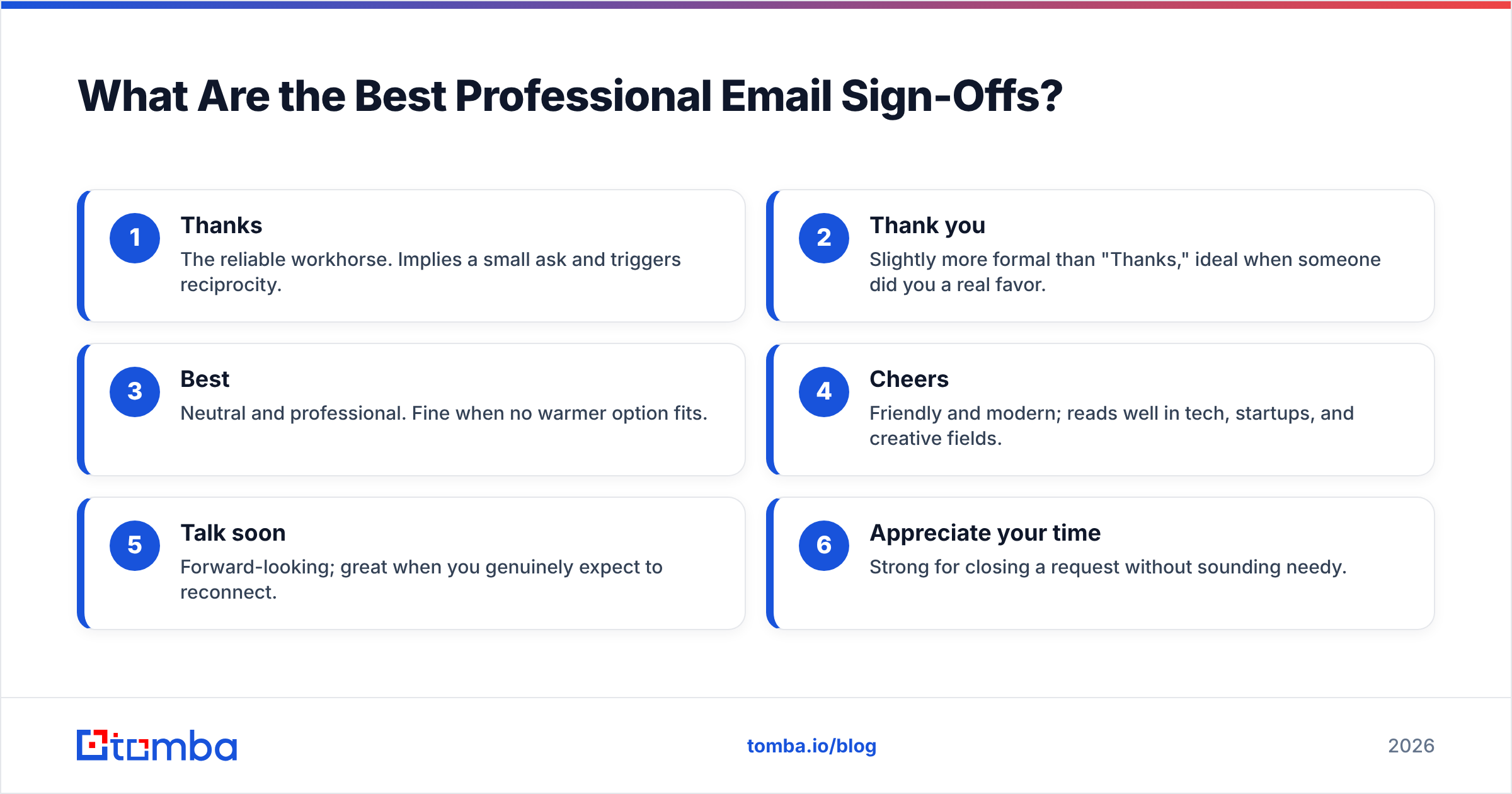
- Thanks — The reliable workhorse. Implies a small ask and triggers reciprocity.
- Thank you — Slightly more formal than "Thanks," ideal when someone did you a real favor.
- Best — Neutral and professional. Fine when no warmer option fits.
- Cheers — Friendly and modern; reads well in tech, startups, and creative fields.
- Talk soon — Forward-looking; great when you genuinely expect to reconnect.
- Appreciate your time — Strong for closing a request without sounding needy.
The pattern: closings that acknowledge the reader or the future relationship beat closings that just announce you're done typing.
What Are the Best Cold Email Sign-Offs?#
Cold email is a different animal. The recipient doesn't know you, owes you nothing, and is scanning for a reason to bail. Your sign-off here has one job: make replying feel easy.
The best cold-email closes do two things — they keep the tone human, and they sit right below a single, low-commitment CTA. "Sincerely, [Full Name]" signals a mass blast. "Worth a quick chat? — Sara" signals a person.
Try these:
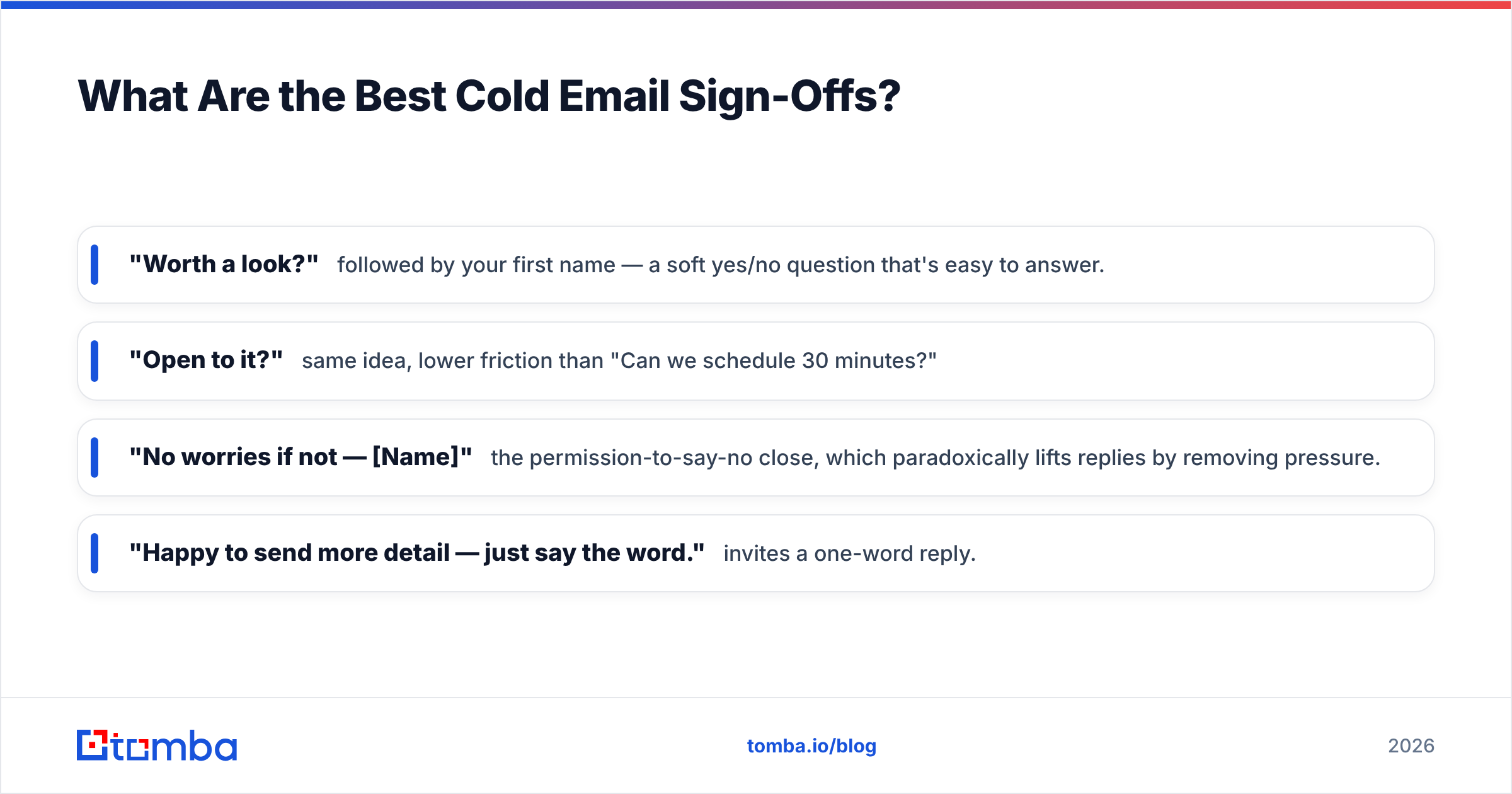
- "Worth a look?" followed by your first name — a soft yes/no question that's easy to answer.
- "Open to it?" — same idea, lower friction than "Can we schedule 30 minutes?"
- "No worries if not — [Name]" — the permission-to-say-no close, which paradoxically lifts replies by removing pressure.
- "Happy to send more detail — just say the word." — invites a one-word reply.
Pair these with a tight subject line and body. If you need help there, the subject line generator and a cold email AI writer can stress-test the whole message, not just the close. And before any of it ships, make sure you're actually reaching a real inbox — a great sign-off means nothing if the address bounces.
Which Email Sign-Offs Should You Avoid?#
Some closings actively cost you. Here's the avoid list and the reason each one hurts:
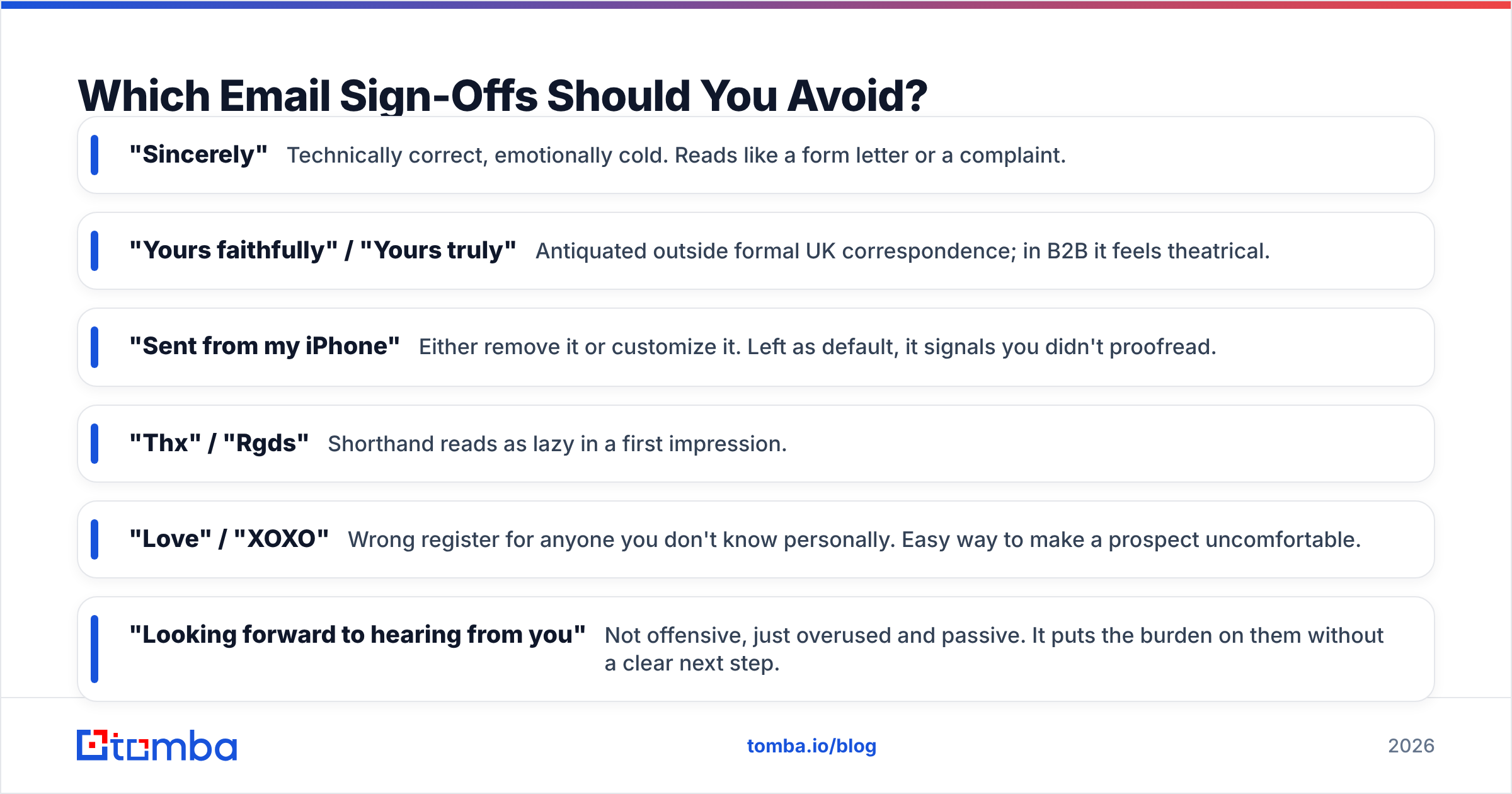
- "Sincerely" — Technically correct, emotionally cold. Reads like a form letter or a complaint.
- "Yours faithfully" / "Yours truly" — Antiquated outside formal UK correspondence; in B2B it feels theatrical.
- "Sent from my iPhone" — Either remove it or customize it. Left as default, it signals you didn't proofread.
- "Thx" / "Rgds" — Shorthand reads as lazy in a first impression.
- "Love" / "XOXO" — Wrong register for anyone you don't know personally. Easy way to make a prospect uncomfortable.
- "Looking forward to hearing from you" — Not offensive, just overused and passive. It puts the burden on them without a clear next step.
- No sign-off at all — Abruptly ending makes you seem curt, even if you didn't mean it.
The through-line: avoid closings that are either too cold, too casual, or too generic to register.
How Do the Top Sign-Offs Compare by Context?#
Different situations call for different closings. Use this table to match the close to the moment instead of defaulting to one phrase for everything.
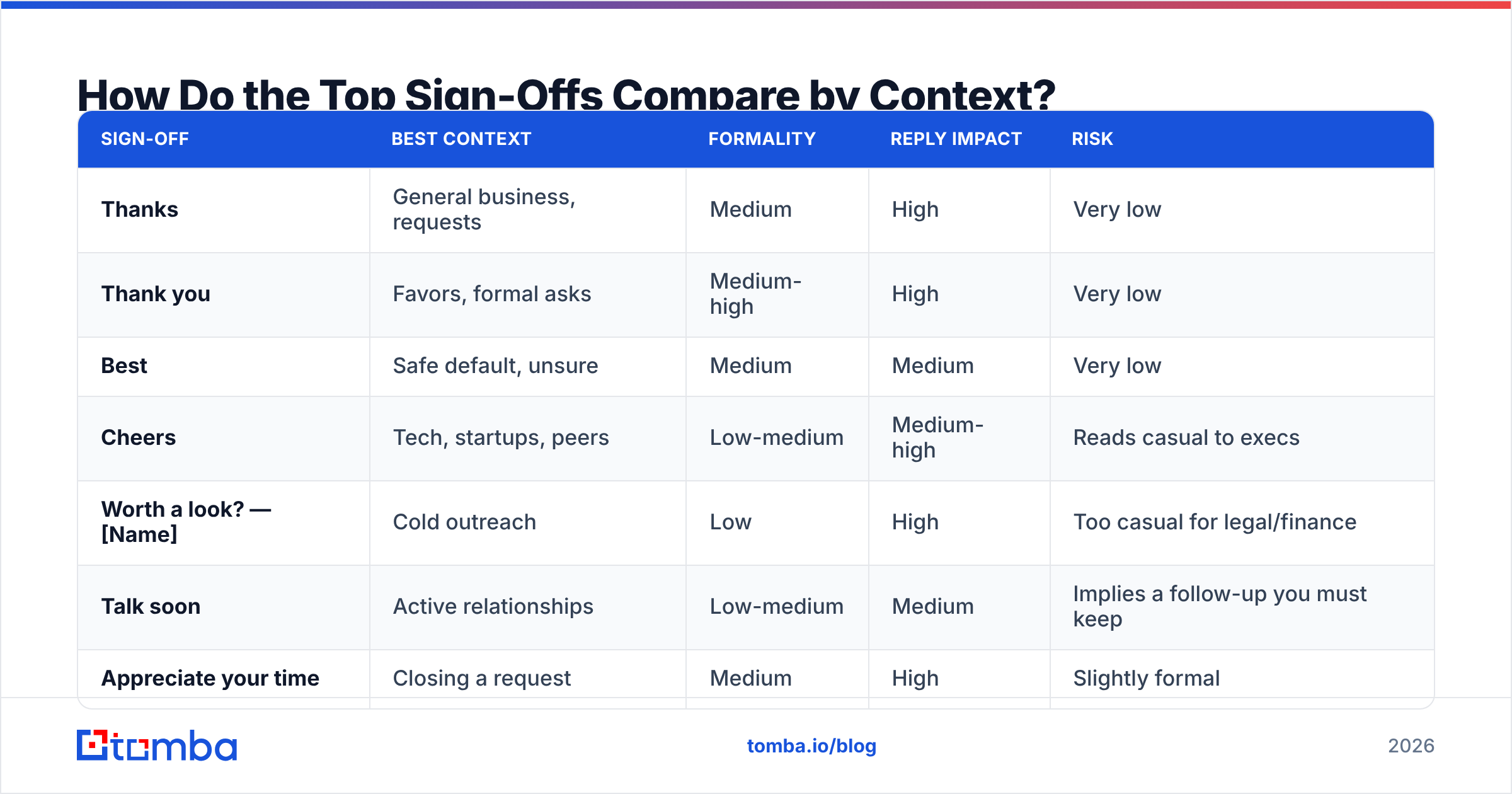
| Sign-off | Best context | Formality | Reply impact | Risk |
|---|---|---|---|---|
| Thanks | General business, requests | Medium | High | Very low |
| Thank you | Favors, formal asks | Medium-high | High | Very low |
| Best | Safe default, unsure | Medium | Medium | Very low |
| Cheers | Tech, startups, peers | Low-medium | Medium-high | Reads casual to execs |
| Worth a look? — [Name] | Cold outreach | Low | High | Too casual for legal/finance |
| Talk soon | Active relationships | Low-medium | Medium | Implies a follow-up you must keep |
| Appreciate your time | Closing a request | Medium | High | Slightly formal |
| Sincerely | Legal, official letters | High | Low | Cold for sales |
| Regards | Default corporate | Medium | Medium-low | Forgettable |
Read it like a thermostat. Formal contexts (legal, finance, first contact with an enterprise) sit at the high end; founder-to-founder and peer outreach sit at the low end. Most B2B email lives comfortably in the middle, which is why "Thanks" wins so often.
What Makes a Sign-Off Convert in Cold Outreach?#
Three things separate a sign-off that gets ignored from one that gets a reply.
1. It follows a single CTA. Your close should reinforce one ask, not three. If your body offered a demo, a case study, and a call, the reader freezes. One clear next step, echoed by the sign-off, removes the friction.
2. It sounds like one human wrote it to one person. Personalization research from sales teams consistently shows that messages reading as 1:1 outperform mass sends. A casual, first-name close supports that illusion of a personal note even at scale.
3. The signature does its share. Your sign-off phrase is half the job — the block beneath it is the other half. A tidy signature with your name, role, company, and a single relevant link builds credibility. Skip the five social icons and the inspirational quote. If you want a clean one fast, a free email signature generator handles the formatting.
When you're running real volume, consistency matters more than cleverness. Build two or three sign-off variants into your sequences, A/B test them, and keep the winners. The email templates library is a good starting point for systemizing this so every rep isn't reinventing the close.
Copy-Paste Sign-Off Templates for 2026#
Steal these directly. Swap the brackets for your details.
Cold outreach (soft CTA):
Worth a quick look? Either way, thanks for the read.
— [First name], [Company]
Follow-up (no response yet):
Bumping this in case it slipped — happy to close the loop either way.
Thanks, [First name]
After a meeting:
Great talking today. I'll send the recap by Thursday.
Appreciate your time, [Full name]
Formal / first contact with enterprise:
Thank you for considering this. I'm glad to answer any questions.
Best regards, [Full name] | [Title], [Company]
Breakup email (last touch):
I'll stop here so I'm not cluttering your inbox — no worries if the timing's off.
All the best, [First name]
Notice how each one ends on the reader or the next step, never on dead air. That's the whole trick.
Does the Sign-Off Matter More Than Deliverability?#
No — and this is the honest caveat. The best email sign-offs in the world won't help if your message never reaches the inbox. Strong email deliverability comes first: clean lists, verified addresses, warmed-up domains, and a healthy sender reputation. The sign-off optimizes replies among emails that actually land.
So treat the close as the last 5% — the polish on a message that's already targeting the right person at a real, verified address. Get the foundation right, then sweat the closing line.
Frequently Asked Questions#
What is the most professional email sign-off? "Best regards" and "Thank you" are the safest professional closings. They work across industries and seniority levels without reading as cold or overly casual.
Is "Best" a good way to end an email? Yes — "Best" is a neutral, widely accepted default. It's not the highest-performing option for replies, but it's never wrong, which makes it a reliable fallback when you're unsure of tone.
What sign-off gets the most replies? Variations of "Thanks" and "Thank you" consistently lead reply-rate studies. Gratitude triggers reciprocity, nudging the reader toward a response.
Should cold emails use formal sign-offs? No. Formal closings like "Sincerely" signal a mass send. Casual, first-name closes that follow a single soft CTA outperform formal ones in cold outreach.
The Bottom Line on the Best Email Sign-Offs#
Your sign-off is a low-cost lever you're probably ignoring. Lead with gratitude for everyday business mail, go casual and CTA-driven for cold outreach, kill the stiff and the careless closings, and let a clean signature carry its weight. Match the close to the context using the table above and you'll lift replies without writing a single extra word of body copy.
But none of it works if you're emailing the wrong address. The most persuasive close in your arsenal is wasted on a guessed email that bounces or routes to a catch-all nobody reads. Start every campaign by finding verified, accurate contacts with the Tomba Email Finder — search by name, company, or domain, and ship your perfectly-closed emails to inboxes that actually exist. Plans start free with 25 searches a month; see full Tomba pricing when you're ready to scale. Nail the address first, then nail the sign-off.
Want to benchmark your tools? Compare options on G2 and read HubSpot's take on email best practices before you commit a budget.
// get started
Find, verify and enrich your first contacts today
Start on the free plan with 25 searches a month, then scale when your team is ready.
Free plan · No credit card required · GDPR & CCPA
// about the author