Best Enterprise Sales Intelligence Software (2026 Guide)
A neutral, comparison-heavy breakdown of the best enterprise sales intelligence software in 2026 — data accuracy, coverage, pricing, and which platform fits your GTM motion.
Enterprise sales intelligence software promises the same thing every vendor's homepage shouts: more pipeline, better data, faster reps. The hard part is telling which platform actually delivers at the price your finance team will sign off on. This guide cuts through the positioning and ranks the field on the only things that matter at scale — data accuracy, coverage depth, enrichment quality, compliance, and total cost.
TL;DR — Who Wins and Why#
- ZoomInfo has the deepest enterprise dataset and intent signals, but it's the most expensive and locks you into long annual contracts.
- Apollo is the best all-in-one for mid-market teams that want data plus a sequencer in one seat.
- Cognism leads on GDPR-compliant European mobile numbers and phone-verified data.
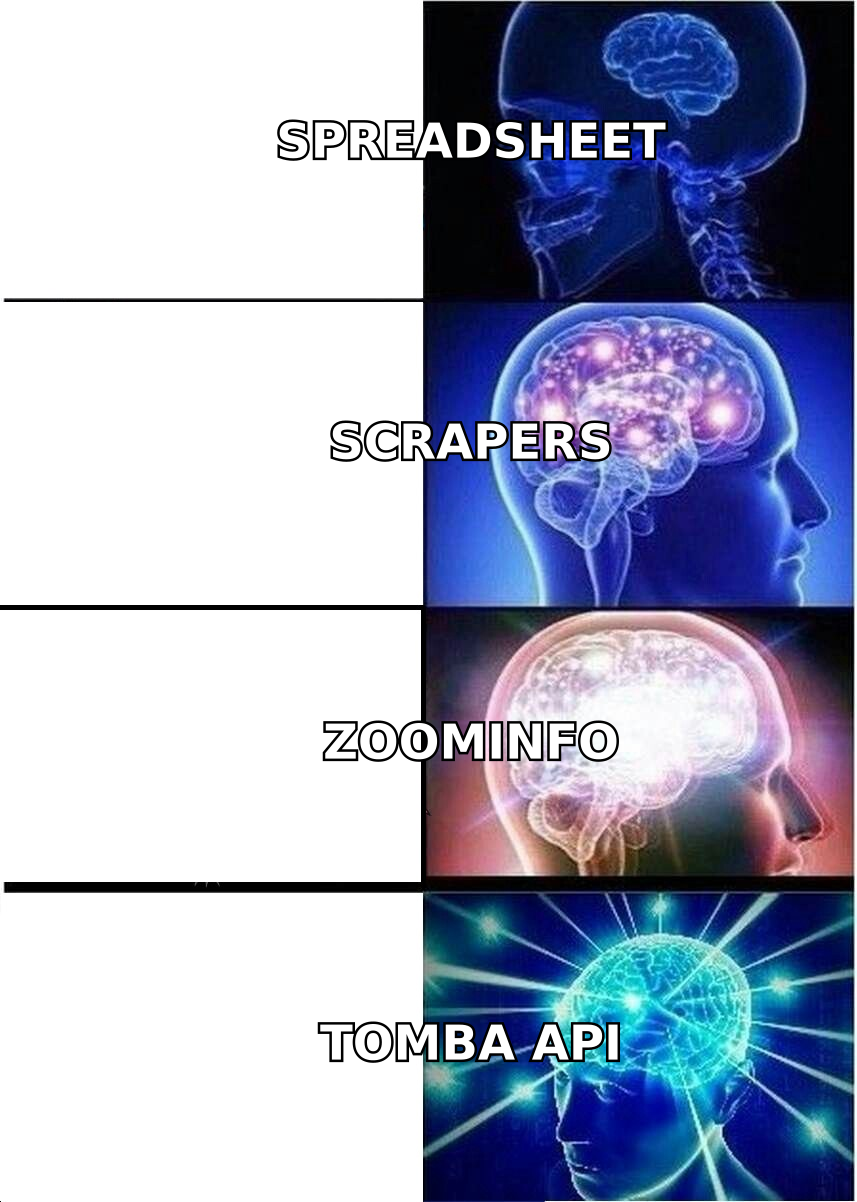
- Tomba is the most cost-efficient choice when your core need is accurate, verified B2B email and contact data via API or bulk — without paying for a bundled CRM you won't use.
- There is no single "best" — match the platform to your motion (outbound, ABM, or RevOps enrichment), not to the loudest G2 badge.
What Is Enterprise Sales Intelligence Software?#
Think of sales intelligence software as the GPS for your go-to-market team. A map alone tells you the roads exist; a GPS tells you which turn to take right now based on live traffic. Sales intelligence does the same for revenue — it turns a static list of companies into a prioritized, enriched, contactable set of accounts and people, refreshed continuously.
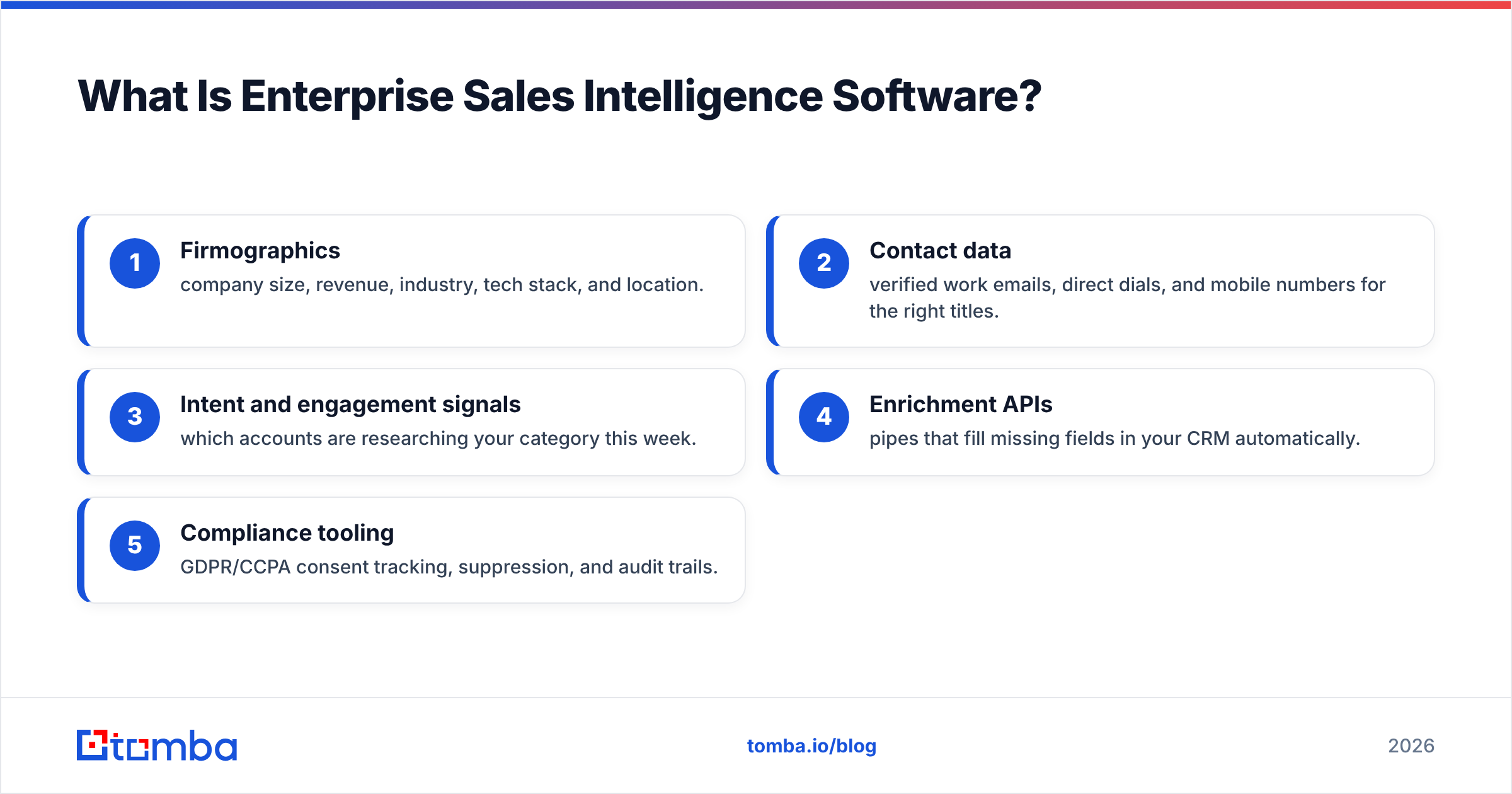
Technically, an enterprise-grade platform combines several data layers:
- Firmographics — company size, revenue, industry, tech stack, and location.
- Contact data — verified work emails, direct dials, and mobile numbers for the right titles.
- Intent and engagement signals — which accounts are researching your category this week.
- Enrichment APIs — pipes that fill missing fields in your CRM automatically.
- Compliance tooling — GDPR/CCPA consent tracking, suppression, and audit trails.
The difference between a consumer-grade list and true B2B data intelligence is freshness and verification. A name and a guessed email pattern is a liability; a verified, deliverable email tied to a current role is an asset. That distinction is the whole game at enterprise scale, where a 10% bounce rate can torch your sending domain's sender reputation across thousands of sends.
How Should You Evaluate Sales Intelligence Platforms?#
Don't start with the feature checklist. Start with your motion and work backward. A platform that's perfect for a 200-rep outbound org is overkill — and overpriced — for a RevOps team that just needs clean enrichment.
Score every vendor on these six dimensions:
- Data accuracy — Ask for a verification rate, not a database size. A 700M-record database with 60% accuracy is worse than a 300M-record one at 95%.
- Coverage by geography — North American data is commoditized; European and APAC mobile coverage is where vendors diverge sharply.
- Refresh cadence — How often is the data re-verified? People change jobs every ~3 years on average, so stale data decays fast.
- Integration surface — Native CRM sync, API access, and bulk tooling. If you have to export CSVs manually, it doesn't scale.
- Compliance posture — Documented GDPR lawful basis, suppression handling, and a real DPA.
- Total cost — Per-seat and per-credit. Bundled platforms hide cost in seats you don't use.
Independent review sites like G2 and analyst coverage from Gartner are useful for sentiment, but they won't tell you the accuracy on your ICP. Always run a paid pilot on a sample of your actual target list before signing anything annual.
Which Are the Best Enterprise Sales Intelligence Software Platforms in 2026?#
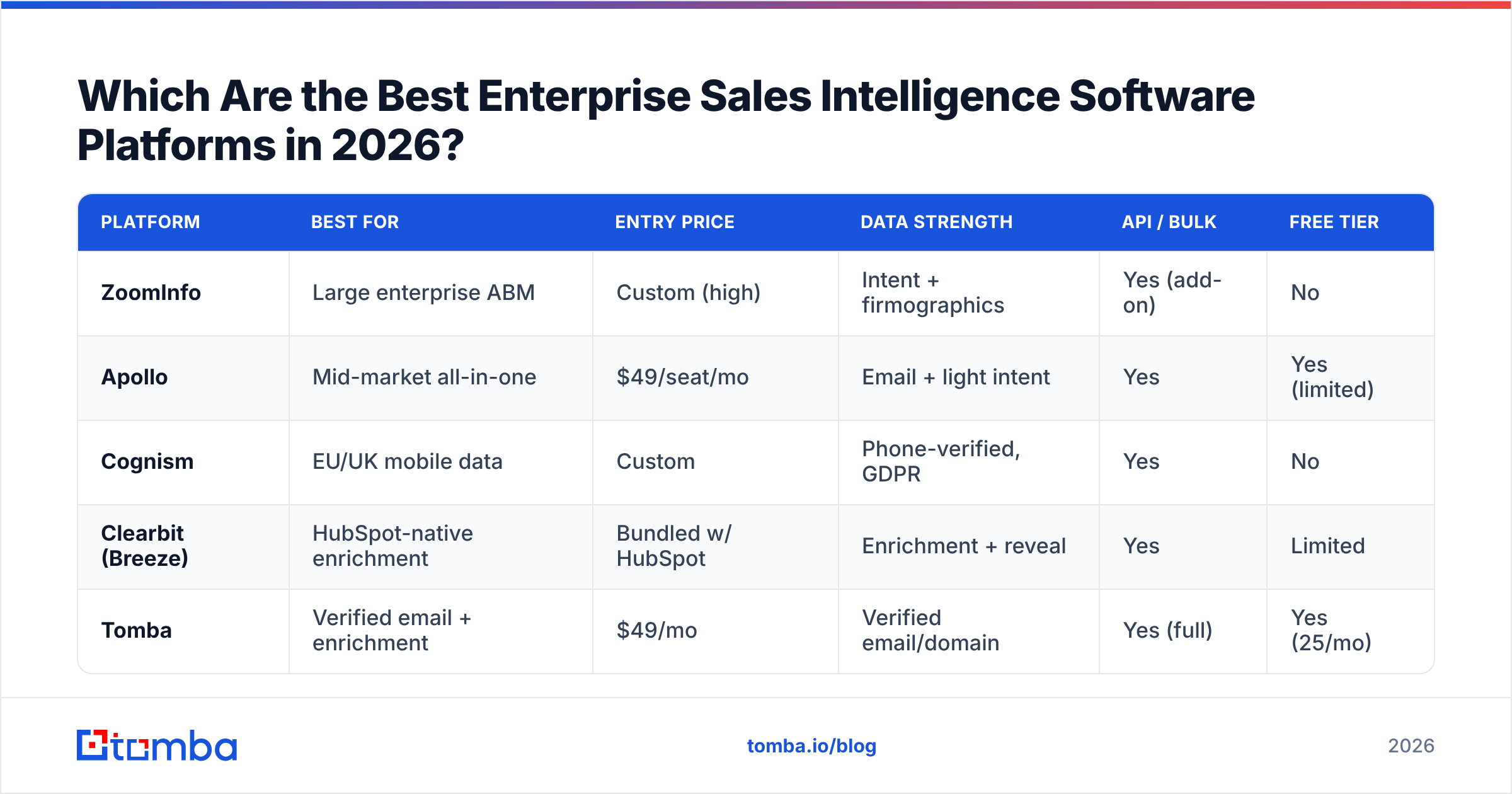
Here's the head-to-head on the attributes that survive a procurement review. Pricing reflects publicly available entry points; enterprise quotes vary with volume and contract length.
| Platform | Best for | Entry price | Data strength | API / bulk | Free tier |
|---|---|---|---|---|---|
| ZoomInfo | Large enterprise ABM | Custom (high) | Intent + firmographics | Yes (add-on) | No |
| Apollo | Mid-market all-in-one | $49/seat/mo | Email + light intent | Yes | Yes (limited) |
| Cognism | EU/UK mobile data | Custom | Phone-verified, GDPR | Yes | No |
| Clearbit (Breeze) | HubSpot-native enrichment | Bundled w/ HubSpot | Enrichment + reveal | Yes | Limited |
| Tomba | Verified email + enrichment | $49/mo | Verified email/domain | Yes (full) | Yes (25/mo) |
A few honest takeaways from the table:
- ZoomInfo earns its enterprise reputation on breadth and intent data, but you pay for the whole platform whether you use the workflow tools or not. It's the right call when ABM and intent drive your number.
- Apollo packs database, enrichment, and a sequencer into one product. That convenience is also its trade-off — the data depth is good, not best-in-class, and power users often pair it with a dedicated finder.
- Cognism is the specialist pick if your reps live on the phone in Europe. Its "Diamond Data" phone verification is genuinely differentiated.
- Clearbit, now folded into HubSpot's Breeze Intelligence, is the path of least resistance if you're already a HubSpot shop — but it's not a standalone enterprise platform anymore.
- Tomba wins on cost-per-verified-record when your core need is accurate email and contact data piped into your stack via the Tomba API or bulk tools, rather than a bundled CRM.
Is Tomba a Real Enterprise Option or Just an Email Finder?#
Both — and the distinction matters less than vendors want you to think. The expensive suites bundle a database, a sequencer, a dialer, and enrichment into one contract. But most enterprise teams already own a CRM, a sequencer, and a dialer they like. What they actually need from a data vendor is a clean, verified, API-accessible feed of contacts.
That's exactly the lane Tomba runs in. The email finder resolves names and domains into verified work emails; domain search pulls every reachable contact at a target company; and data enrichment backfills missing fields in your CRM at scale. You assemble best-of-breed instead of paying for a walled garden.
The pricing gap is the headline. Tomba's transparent plans start with a free tier (25 searches/month), then Starter at $49/mo, Growth at $99/mo, and Pro at $249/mo, with Enterprise quoted on volume. Compare that to six-figure annual commitments common at the top of this market and the math gets interesting fast — especially for RevOps teams whose entire mandate is enrichment, not workflow.
What Does Each Platform Actually Cost at Scale?#
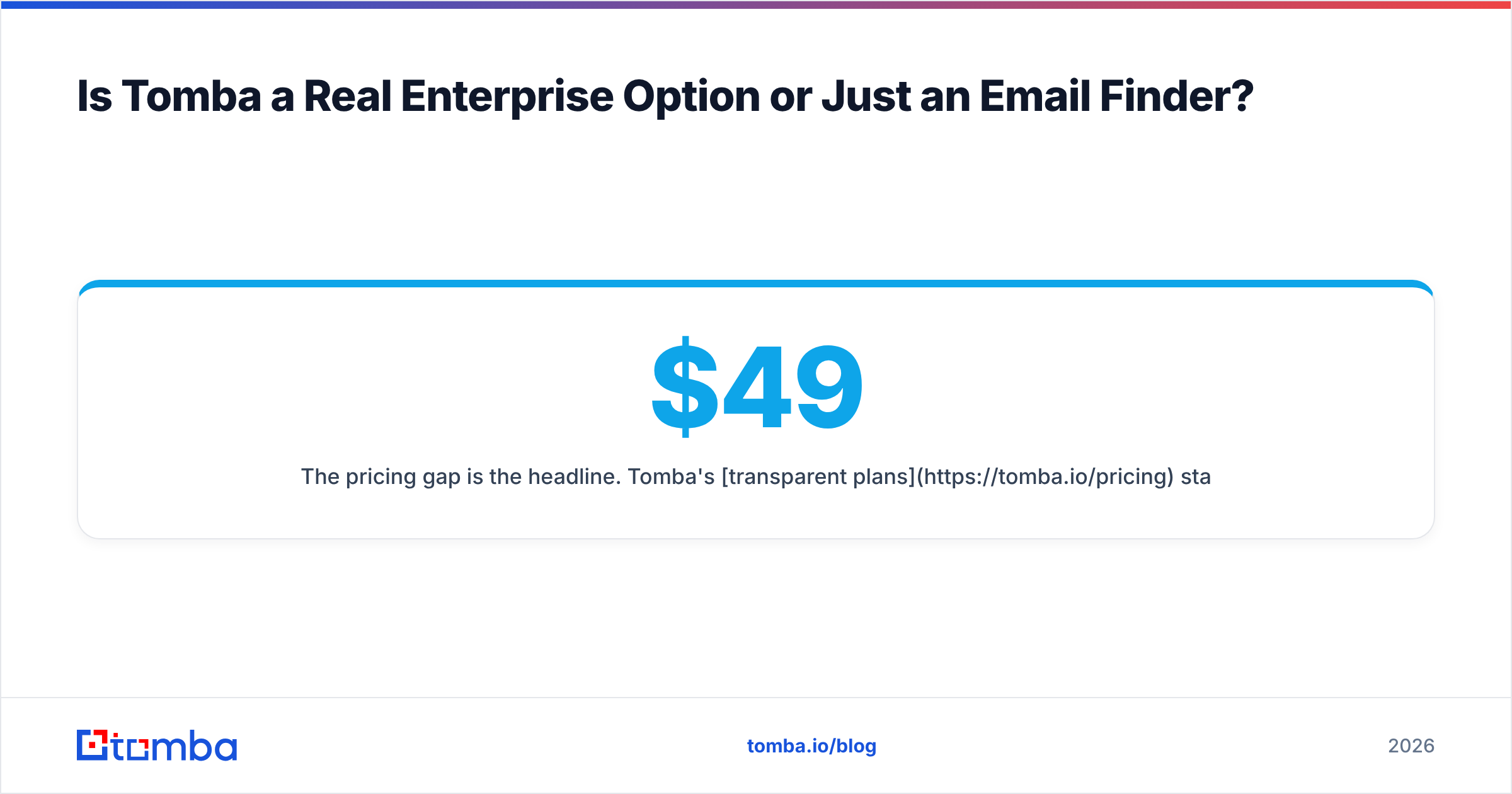
Sticker price and real cost diverge wildly in this category. Here's how the cost models compare on the dimensions procurement actually questions.
| Cost factor | Suite platforms (ZoomInfo/Cognism) | All-in-one (Apollo) | Data-focused (Tomba) |
|---|---|---|---|
| Pricing model | Annual seats + platform fee | Per seat, monthly OK | Per credit / API, monthly OK |
| Minimum commitment | Annual, often multi-year | Monthly available | Monthly, free tier |
| Hidden cost | Unused workflow modules | Data depth ceiling | None bundled |
| Best ROI scenario | Intent-driven ABM at scale | One-team go-to-market | API/bulk enrichment |
| Entry point | Custom (high four-five figures) | $49/seat/mo | Free, then $49/mo |
The pattern is consistent: bundled suites deliver the most if you use every module, and the worst ROI if you don't. A focused data layer like Tomba avoids paying for shelfware, but you're responsible for stitching it to your own sequencer and CRM — which, with native integrations for HubSpot, Salesforce, Pipedrive, and Zapier, is usually a one-afternoon job.
When Should You Choose a Suite vs. a Focused Data Layer?#
Choose a full suite (ZoomInfo, Cognism) when:
- Intent data and ABM orchestration directly drive your pipeline strategy.
- You have a large team that will live inside one platform daily.
- Budget is not the binding constraint and procurement prefers one vendor.
Choose a focused data layer (Tomba, or a finder + your own stack) when:
- Your core need is accurate, verified contact data, not workflow tooling.
- You already own a sequencer and CRM your reps won't give up.
- You're a RevOps or growth team enriching records via API or bulk.
- Cost-efficiency and month-to-month flexibility matter.
Most maturing GTM orgs end up running a hybrid: a suite for the strategic accounts team and a lean, API-driven finder for everyone doing high-volume data enrichment and list-building. The two aren't mutually exclusive, and the second is far cheaper to add.
How Do You Keep Data Quality High After You Buy?#
Buying the platform is step one; the decay starts the next day. B2B data goes stale at roughly 2–3% per month as people change roles, so treat data quality as an ongoing process, not a purchase.
- Verify before you send. Run new contacts through an email verifier to catch invalid and risky addresses before they hit your sequencer.
- Handle catch-all domains deliberately. Many enterprise domains accept everything; a catch-all verifier tells you which are actually deliverable instead of guessing.
- Re-enrich on a cadence. Schedule a quarterly enrichment pass so titles, companies, and emails stay current.
- Protect your domain. High bounce rates damage email deliverability; keeping bounces under 2–3% is a sender-reputation issue, not just a data one.
Whichever platform you pick, the discipline is the same: verify on the way in, re-verify on a schedule, and never blast an unverified list from a domain you care about.
The Bottom Line#
There is no universal "best enterprise sales intelligence software" — there's only the best fit for your motion and budget. If intent-driven ABM at scale is your strategy and budget is open, ZoomInfo or Cognism earn their price. If you want one tool for a single team, Apollo is the convenient middle. But if your real need is accurate, verified contact data delivered by API or bulk — without paying for a CRM you already own — a focused data layer wins on every cost dimension that matters.
Start with the cheapest test that proves accuracy on your list. Spin up Tomba's free tier, run your actual target accounts through the Tomba Email Finder, and measure the verified-deliverable rate before you ever sit through an enterprise demo. Real data on your ICP beats any vendor benchmark — and it costs you nothing to find out.
// get started
Find, verify and enrich your first contacts today
Start on the free plan with 25 searches a month, then scale when your team is ready.
Free plan · No credit card required · GDPR & CCPA
// about the author