Best GTM Tools in 2026: The Go-To-Market Stack Compared
A neutral, hands-on breakdown of the best GTM tools in 2026 — data, enrichment, intent, sequencing, and RevOps — with a comparison table, pricing, and how to avoid buying overlap.
Go-to-market (GTM) is no longer one team buying one tool. It is data, enrichment, signals, sequencing, and reporting stitched into a single revenue engine. The hard part in 2026 is not finding software — it is choosing tools that compound instead of overlap. This guide ranks the best GTM tools by job-to-be-done, shows where they fit, and flags where you are paying twice for the same data.
TL;DR#
- The best GTM tools cluster into five layers: data/enrichment, intent and signals, sequencing/outbound, RevOps/CRM, and analytics. You need one strong tool per layer — not three.
- Data accuracy is the foundation. A flashy sequencer on top of stale contact data just sends bad email faster. Start with a clean source like a data enrichment and email layer.
- All-in-one suites (Apollo, Clearbit/Breeze) trade depth for convenience. Best-of-breed stacks win on accuracy and deliverability but cost more to integrate.
- Most teams overbuy. Two platforms quietly resell the same B2B database, so you pay for the same record twice.
- Budget guide: a lean 3-tool GTM stack runs roughly $200–$600/mo for an SMB team; enterprise intent platforms (6sense, Demandbase) start in the four-to-five-figure range per month.
What are GTM tools?#
GTM tools are the software your revenue teams use to find, reach, convert, and expand customers. Think of your go-to-market motion like a kitchen: data is your ingredients, enrichment is prep, intent signals tell you what to cook tonight, sequencing is the line that plates orders, and RevOps is the head chef keeping everything timed. A great sequencer with rotten ingredients still ships a bad dish.
In practice, the category spans everything from email finders and CRMs to revenue operations platforms and attribution dashboards. Because vendors keep expanding into each other's lanes — your CRM now sends sequences, your sequencer now enriches data — the lines blur. That overlap is exactly why a layered view beats a feature checklist.
What are the five layers of a GTM stack?#
Sort every tool you evaluate into one of these jobs. If a tool spans two layers, it is probably mediocre at one of them.
- Data & enrichment — Find and verify contacts, fill firmographic and technographic fields. Tools: Tomba, Clearbit, ZoomInfo, Apollo. This is where accuracy is won or lost.
- Intent & signals — Detect accounts researching your category, website visitors, and job-change triggers. Tools: 6sense, Demandbase, Bombora.
- Sequencing & outbound — Send and track multichannel cadences (email, LinkedIn, phone). Tools: Outreach, Salesloft, Instantly, Smartlead.
- CRM & RevOps — System of record, pipeline, forecasting, automation. Tools: HubSpot, Salesforce, Pipedrive.
- Analytics & attribution — Tie activity to revenue, score leads, and find decay. Tools: Gong, native CRM reporting, BI layers.
A focused stack picks one anchor tool per layer and wires them together. The mistake is buying three "platforms" that each claim all five layers and then fighting their overlapping data.
What are the best GTM tools in 2026?#
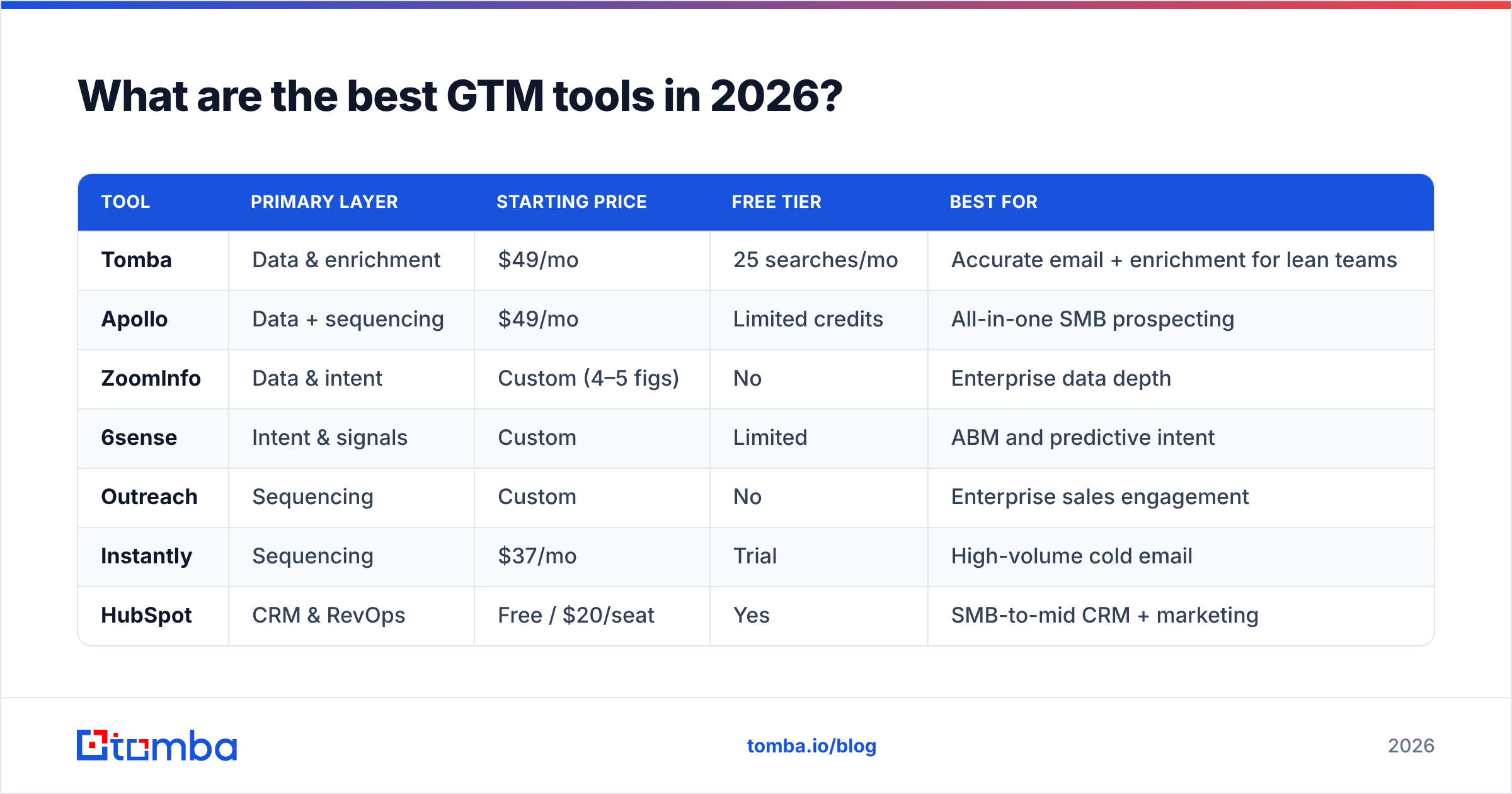
Here is a neutral comparison of widely used GTM platforms by primary layer, starting price, free tier, and the buyer they fit best. Prices are entry tiers and change often — confirm on each vendor's page before committing.
| Tool | Primary layer | Starting price | Free tier | Best for |
|---|---|---|---|---|
| Tomba | Data & enrichment | $49/mo | 25 searches/mo | Accurate email + enrichment for lean teams |
| Apollo | Data + sequencing | $49/mo | Limited credits | All-in-one SMB prospecting |
| ZoomInfo | Data & intent | Custom (4–5 figs) | No | Enterprise data depth |
| 6sense | Intent & signals | Custom | Limited | ABM and predictive intent |
| Outreach | Sequencing | Custom | No | Enterprise sales engagement |
| Instantly | Sequencing | $37/mo | Trial | High-volume cold email |
| HubSpot | CRM & RevOps | Free / $20/seat | Yes | SMB-to-mid CRM + marketing |
| Salesforce | CRM & RevOps | $25/seat/mo | No | Customizable enterprise CRM |
| Gong | Analytics | Custom | No | Conversation + deal intelligence |
A few honest takeaways from the table. The all-in-ones (Apollo, ZoomInfo) are convenient but bundle data quality you cannot independently tune. Best-of-breed picks — a dedicated email verifier plus a separate sequencer — usually beat bundles on deliverability because each tool does one job well. And enterprise intent platforms are powerful but priced for teams with a defined ABM motion, not a five-rep startup.
Why is data accuracy the foundation of any GTM stack?#
Because every downstream tool inherits your data's error rate. If 20% of your contacts bounce, your sequencer's "open rate" is measured against a polluted list, your CRM forecasts on phantom accounts, and your sender reputation erodes with every hard bounce. Fixing data later is far more expensive than sourcing it clean.
This is the layer where Tomba is genuinely competitive rather than just adjacent. Its core email finder sources professional addresses by name, domain, or company, and pairs with verification and catch-all checks so you are not guessing at risky sends. For teams scaling beyond manual lookups, the Tomba API and bulk tools push verified records straight into the rest of your stack.
The practical rule: verify before you sequence. A clean list of 500 verified contacts outperforms 5,000 unverified ones on reply rate, deliverability, and rep morale. Buying a faster outbound tool to compensate for bad data is like buying a faster car to outrun a flat tire.
Should you buy an all-in-one suite or best-of-breed tools?#
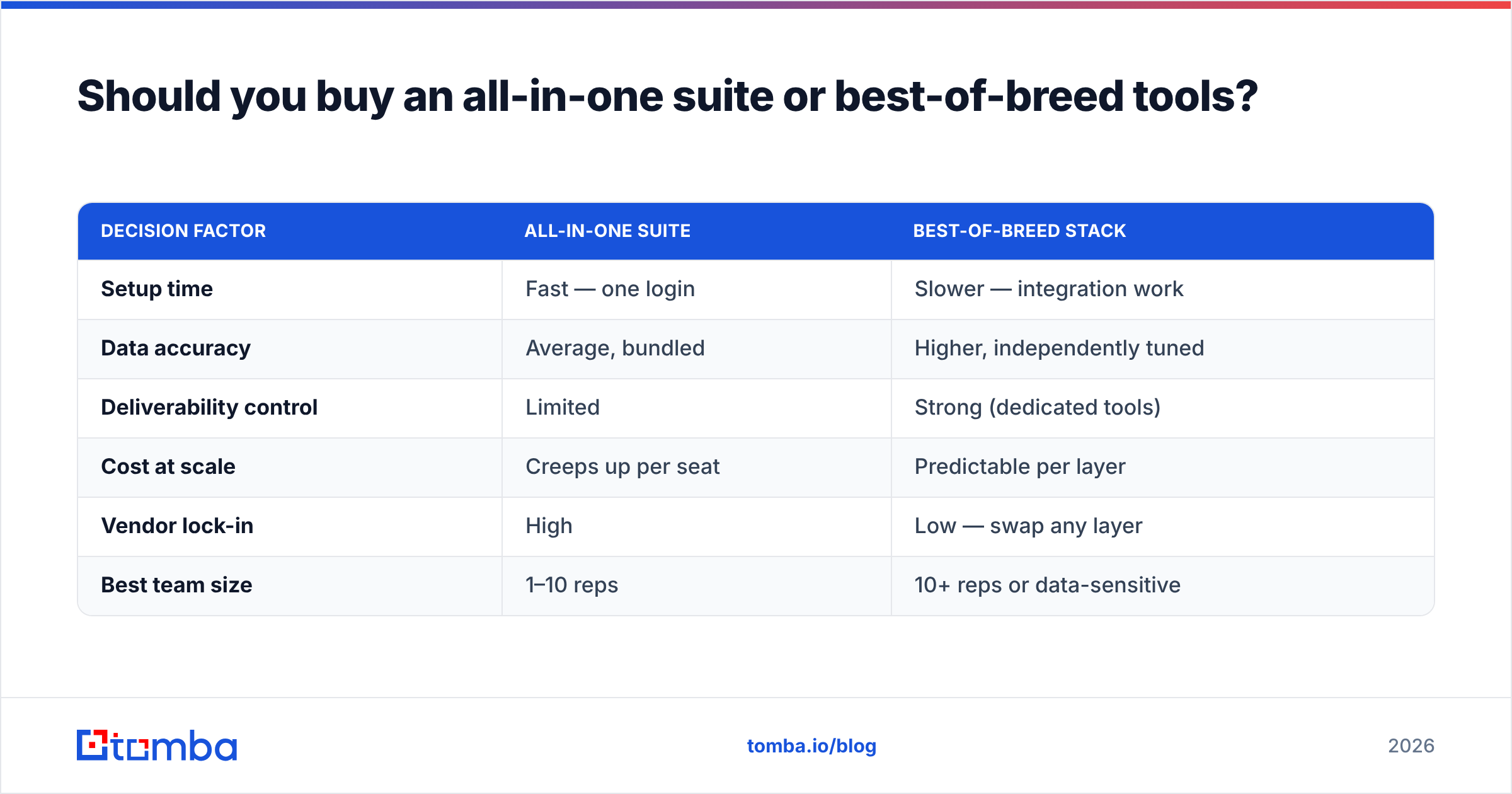
Choose all-in-one for speed and a small team; choose best-of-breed for accuracy, deliverability, and scale. Here is the honest trade-off.
| Decision factor | All-in-one suite | Best-of-breed stack |
|---|---|---|
| Setup time | Fast — one login | Slower — integration work |
| Data accuracy | Average, bundled | Higher, independently tuned |
| Deliverability control | Limited | Strong (dedicated tools) |
| Cost at scale | Creeps up per seat | Predictable per layer |
| Vendor lock-in | High | Low — swap any layer |
| Best team size | 1–10 reps | 10+ reps or data-sensitive |
All-in-one suites like Apollo make sense when you are starting out and need one bill, one login, and "good enough" everything. The moment deliverability, data freshness, or compliance becomes a board-level concern, the best-of-breed approach pays back — you can swap your sequencer without losing your data layer, or upgrade your B2B database without re-platforming your CRM.
A middle path works for most mid-market teams: keep a strong CRM (HubSpot or Salesforce) as the hub, plug in a dedicated data/enrichment layer, and add one focused sequencer. That is three tools, three clear jobs, no overlap.
How do you avoid paying twice for the same data?#
Audit who actually originates each record. Many GTM tools do not own their B2B data — they license it from the same upstream providers, then resell it under their brand. So your "intent platform" and your "enrichment tool" may surface identical contacts, and you are paying two subscriptions for one dataset.
Run this quick audit before renewing anything:
- List every tool that touches contact data — finders, enrichers, intent, CRM enrichment add-ons.
- Check the data source page of each vendor (look for their compliance and sourcing disclosures, like Tomba's data sources page).
- Spot-test 50 overlapping records across two tools — if accuracy and coverage are near-identical, you have redundancy.
- Consolidate to the most accurate source and cancel the duplicate, redirecting budget to a layer you are actually missing (often intent or analytics).
Independent review sites like G2 and analyst coverage from Gartner are useful for sanity-checking vendor accuracy claims, since self-reported "95% accuracy" numbers rarely survive contact with your real ICP.
What does a good GTM stack cost in 2026?#
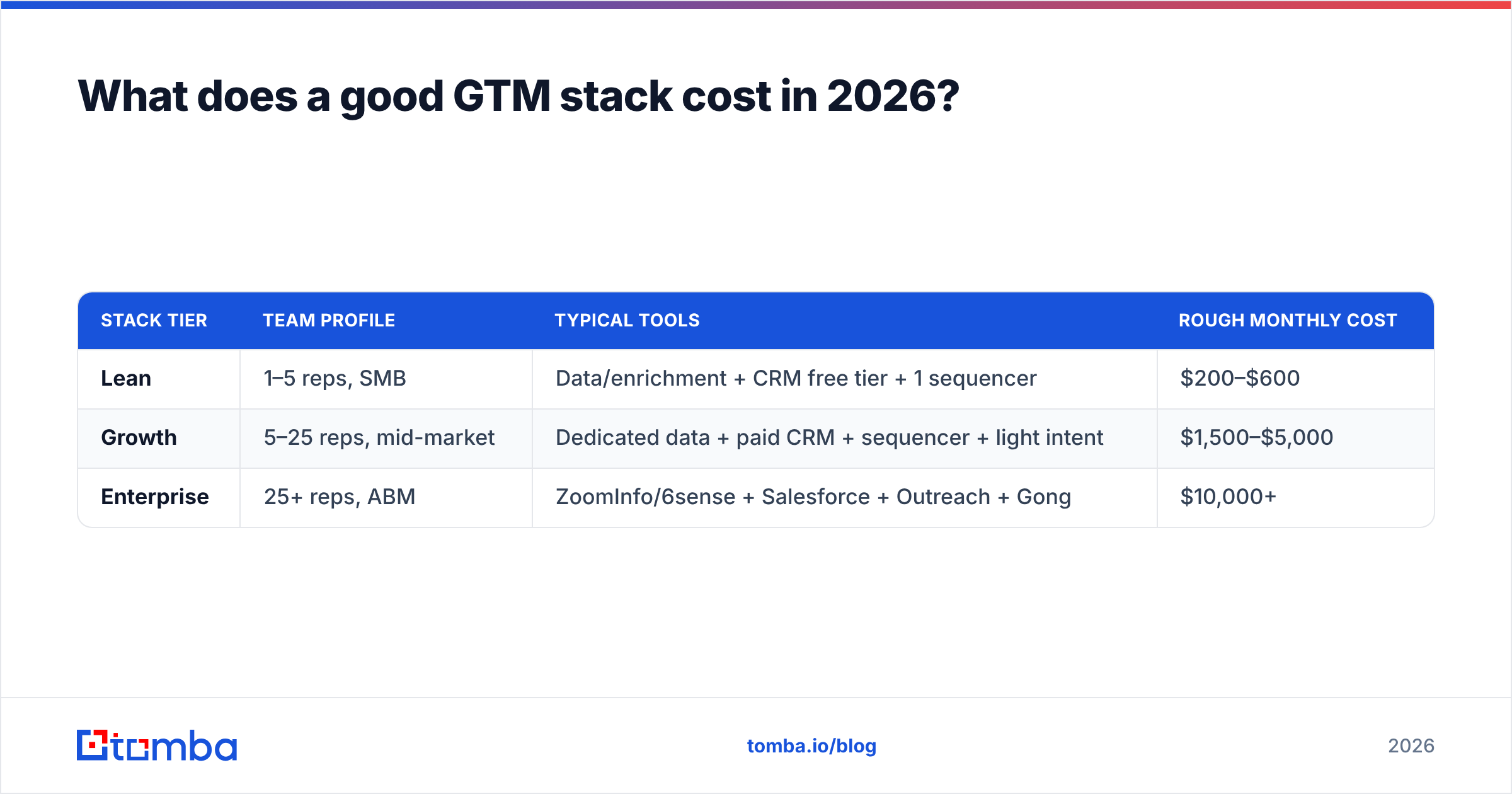
It depends on team size and motion, but most stacks fall into three tiers. The figures below are realistic monthly ranges for the tools doing the most work.
| Stack tier | Team profile | Typical tools | Rough monthly cost |
|---|---|---|---|
| Lean | 1–5 reps, SMB | Data/enrichment + CRM free tier + 1 sequencer | $200–$600 |
| Growth | 5–25 reps, mid-market | Dedicated data + paid CRM + sequencer + light intent | $1,500–$5,000 |
| Enterprise | 25+ reps, ABM | ZoomInfo/6sense + Salesforce + Outreach + Gong | $10,000+ |
Two cost notes that catch teams off guard. First, seat-based pricing in suites scales painfully — a "cheap" $49/seat tool is $2,450/mo at 50 reps. Second, credit-based data tools punish bulk work; if you enrich large lists, check overage rates carefully. On the data layer, predictable plans matter — you can see exactly how Tomba structures this on its pricing page, with a free tier to test accuracy before you commit budget.
How should you choose your GTM tools step by step?#
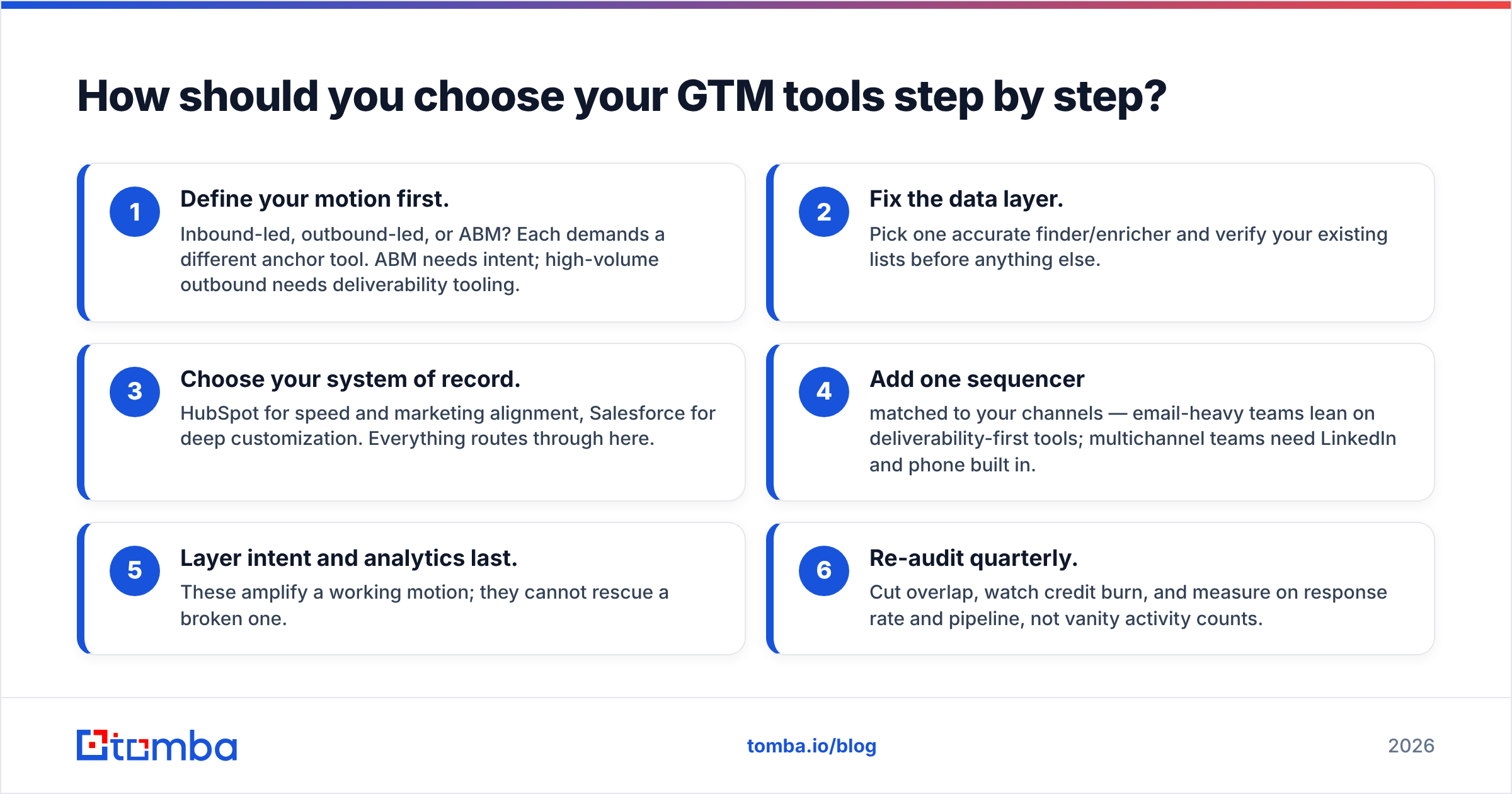
Work from the foundation up, not from the shiniest demo down.
- Define your motion first. Inbound-led, outbound-led, or ABM? Each demands a different anchor tool. ABM needs intent; high-volume outbound needs deliverability tooling.
- Fix the data layer. Pick one accurate finder/enricher and verify your existing lists before anything else.
- Choose your system of record. HubSpot for speed and marketing alignment, Salesforce for deep customization. Everything routes through here.
- Add one sequencer matched to your channels — email-heavy teams lean on deliverability-first tools; multichannel teams need LinkedIn and phone built in.
- Layer intent and analytics last. These amplify a working motion; they cannot rescue a broken one.
- Re-audit quarterly. Cut overlap, watch credit burn, and measure on response rate and pipeline, not vanity activity counts.
The teams that win are not the ones with the most tools. They are the ones whose tools share clean data and hand off cleanly. A modest, well-integrated stack consistently outperforms a sprawling one held together by spreadsheet exports.
The bottom line#
The best GTM tools in 2026 are the ones that fit a layered, no-overlap stack: one strong data/enrichment source, a CRM you will not outgrow, a sequencer matched to your channels, and intent or analytics added only when the basics hum. Resist the all-in-one shortcut if accuracy and deliverability are core to your revenue — buy depth where it matters.
Start where every GTM motion either succeeds or quietly fails: the data. If your contacts bounce, nothing downstream matters. Try the Tomba Email Finder to source and verify accurate professional emails — free for 25 searches a month, with bulk and API access when you scale. Get the foundation right, and the rest of your stack finally pays off.
// get started
Find, verify and enrich your first contacts today
Start on the free plan with 25 searches a month, then scale when your team is ready.
Free plan · No credit card required · GDPR & CCPA
Get the Tomba newsletter
Product and data updates
// about the author