Best Intent Data Providers in 2026: A Buyer's Guide
Compare the best intent data providers in 2026 — Bombora, 6sense, ZoomInfo, G2 and more — by signal type, accuracy, pricing, and how to turn intent into pipeline.
Intent data is the difference between cold outreach and showing up exactly when a buyer starts shopping. But the market is crowded, the signals vary wildly in quality, and pricing is famously opaque. This guide cuts through it.
TL;DR#
- Bombora is the de facto standard for third-party topic intent and powers a huge slice of the ecosystem; 6sense and Demandbase wrap intent inside full ABM platforms with predictive scoring.
- G2 and TrustRadius sell review-site intent — high-purchase-stage signals from people actively comparing software.
- ZoomInfo and Cognism bundle intent with their contact databases, so you get the signal and the person to call in one place.
- Intent data only pays off when you can act on it fast — enrich the account, find the right contact, and reach out the same week. A signal you can't action is just trivia.
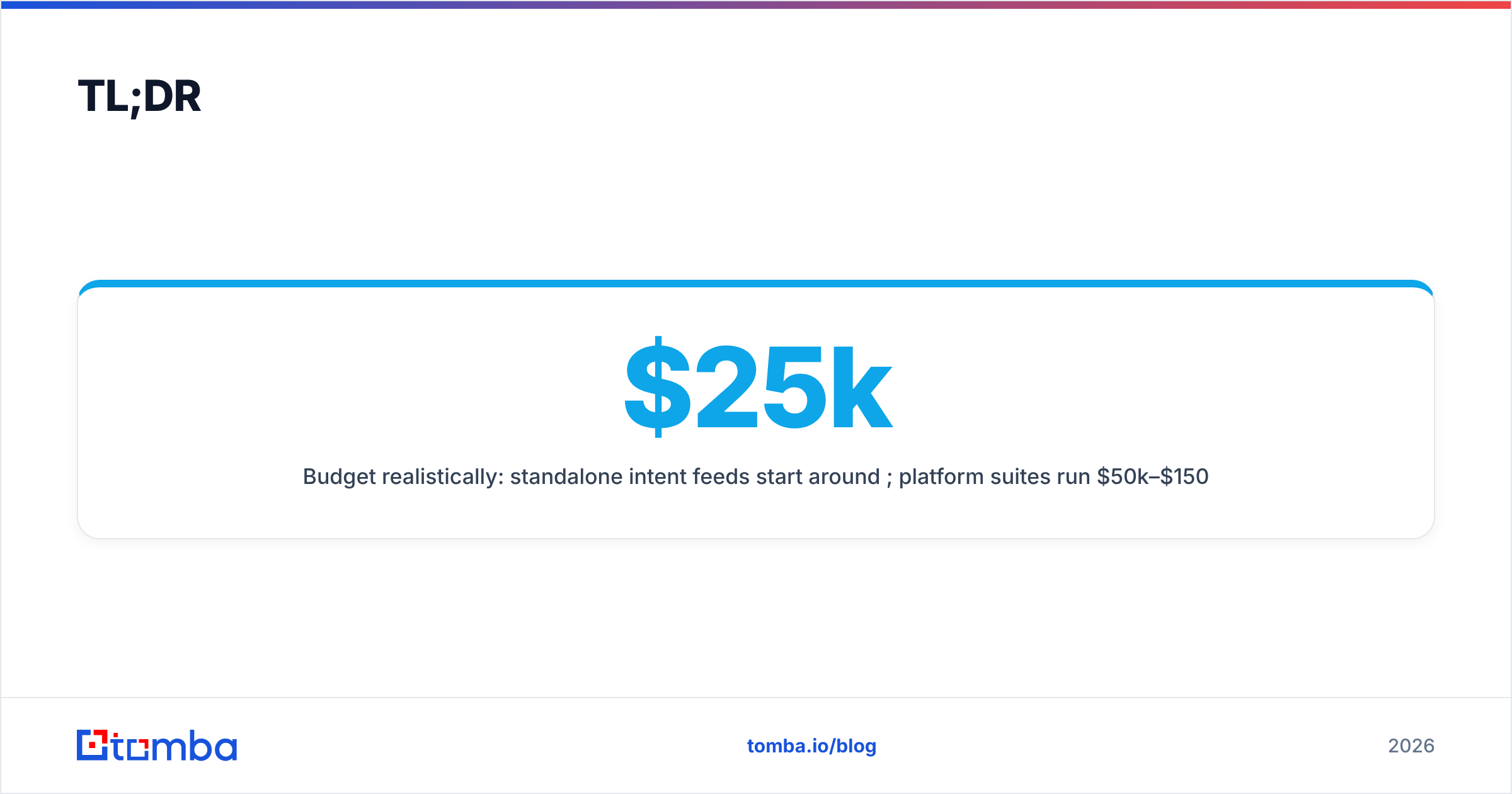
- Budget realistically: standalone intent feeds start around $25k/year; platform suites run $50k–$150k+. Pair any of them with an affordable email finder to turn flagged accounts into actual conversations.
What is intent data, and why does it matter in 2026?#
Intent data is behavioral evidence that a company is researching a problem you solve — before they ever fill out your form. Think of it like a smoke detector for buying signals: you don't wait for the fire (an inbound demo request), you catch the smoke (a spike in research activity) and walk into the room early.
There are three flavors, and mixing them up is the most expensive mistake buyers make:
- First-party intent — activity on your own properties: website visits, pricing-page dwell time, content downloads, product trials. The most reliable signal you'll ever get, because it's about you.
- Second-party intent — another publisher's first-party data, sold or shared directly (e.g., a review site telling you who looked at your category page).
- Third-party intent — aggregated research behavior across a network of B2B sites, attributed to a company (rarely a person, thanks to privacy law). This is where Bombora and the big co-ops live.
The reason intent matters more in 2026 than it did three years ago is simple: buyers complete most of their research anonymously. By the time a lead raises a hand, Gartner-style research consistently shows they're already deep into the buying journey. Intent data is how you get in before the shortlist closes.
What separates the best intent data providers from the rest?#
Not all intent is created equal. When you evaluate vendors, score them on these dimensions rather than the logo wall on their homepage:
- Signal source & breadth — Is it a genuine co-op of thousands of sites (broad but noisy), a single high-intent property like a review platform (narrow but hot), or your own first-party data modeled by AI? More sources isn't always better; relevant sources are.
- Resolution accuracy — Can they reliably tie anonymous research back to a real company (and how often)? IP-to-company resolution quality is where cheap providers fall apart.
- Freshness — Weekly surge updates vs. daily. A buyer's research window can be days, not weeks.
- Account vs. contact granularity — Most third-party intent is account-level only. You'll still need to identify the right human, which is why pairing intent with a domain search tool matters.
- Actionability — Native CRM/sequencer sync, predictive scoring, and audience activation for ads. Raw CSV exports age fast.
- Privacy posture — GDPR/CCPA-compliant sourcing is non-negotiable in 2026.
Which are the best intent data providers in 2026?#
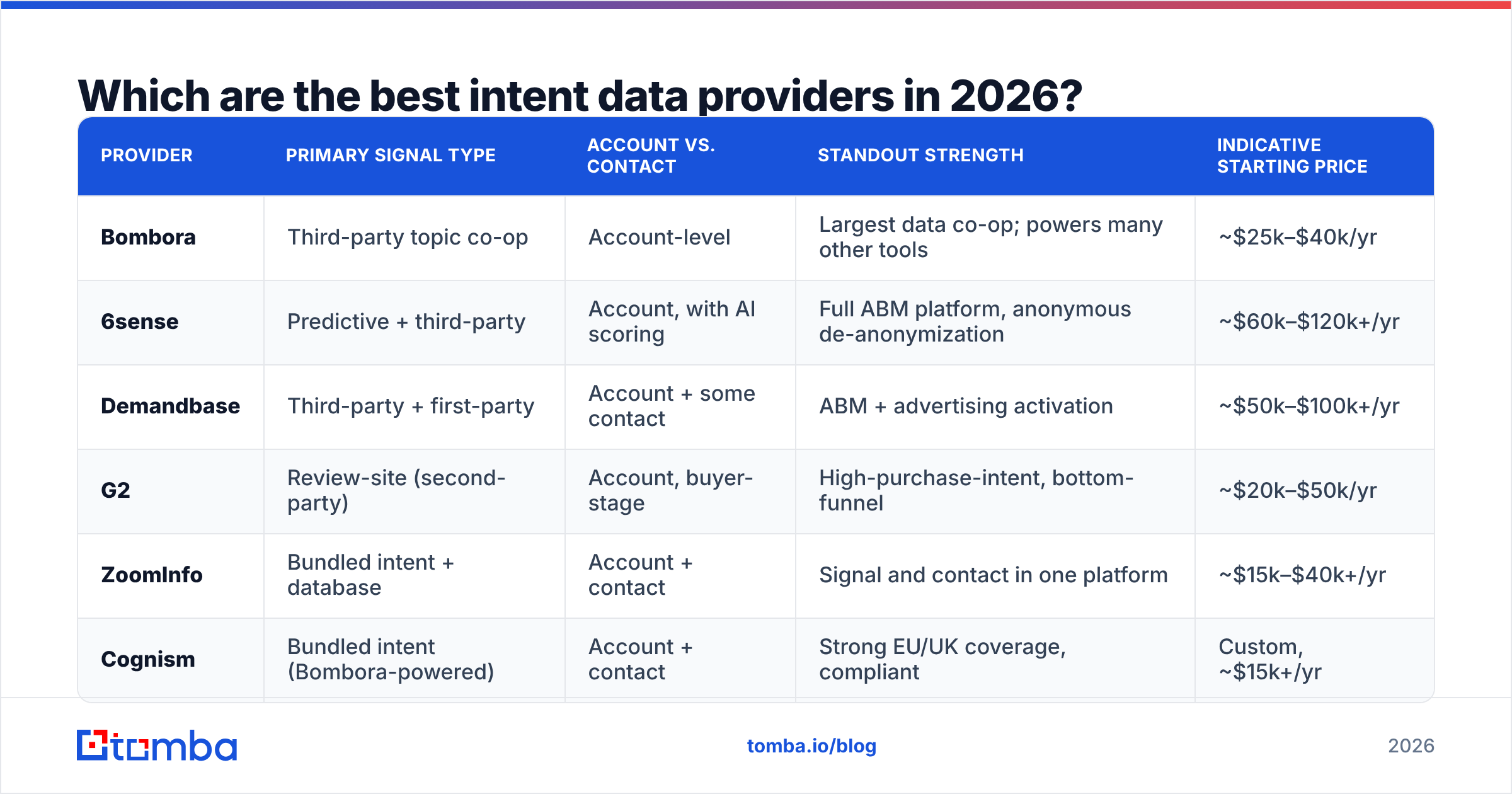
Here's a head-to-head of the providers most B2B teams shortlist, with the trade-offs that actually drive the decision.
| Provider | Primary signal type | Account vs. contact | Standout strength | Indicative starting price |
|---|---|---|---|---|
| Bombora | Third-party topic co-op | Account-level | Largest data co-op; powers many other tools | ~$25k–$40k/yr |
| 6sense | Predictive + third-party | Account, with AI scoring | Full ABM platform, anonymous de-anonymization | ~$60k–$120k+/yr |
| Demandbase | Third-party + first-party | Account + some contact | ABM + advertising activation | ~$50k–$100k+/yr |
| G2 | Review-site (second-party) | Account, buyer-stage | High-purchase-intent, bottom-funnel | ~$20k–$50k/yr |
| ZoomInfo | Bundled intent + database | Account + contact | Signal and contact in one platform | ~$15k–$40k+/yr |
| Cognism | Bundled intent (Bombora-powered) | Account + contact | Strong EU/UK coverage, compliant | Custom, ~$15k+/yr |
A few honest takeaways from that table:
- Bombora is the plumbing. If you buy 6sense, Cognism, or a dozen other tools, you're often consuming Bombora topics underneath. Buying it directly makes sense if you have a data team to operationalize raw surge scores; otherwise a platform that pre-digests it is friendlier.
- 6sense and Demandbase are platforms, not feeds. You're paying for orchestration — predictive models, ad activation, and anonymous-visitor identification — not just a list of hot accounts. Great if you'll use the whole suite; overkill if you only want a signal.
- G2 is the closest thing to "buyer is shopping right now." Review-site intent sits at the bottom of the funnel. It's narrower than a co-op but the conversion rates per flagged account are usually higher.
- ZoomInfo and Cognism win on convenience. When the intent signal and the verified phone/email live in the same record, your reps act in one click instead of three tools.
For a deeper definition of how vendors describe their categories, the B2B glossary is a useful neutral reference, and analyst houses like Gartner and Forrester publish category overviews worth reading before you sign anything.
Is third-party intent better than first-party intent?#
No — they answer different questions, and the best programs run both. First-party intent tells you who is engaging with you; third-party intent tells you who is in-market but ignoring you. The first is higher precision; the second is higher reach.
The practical pattern that works in 2026 looks like this:
- Use first-party intent (your website, product, and email engagement) to prioritize accounts already in your orbit. Tools that handle website visitor reveal turn anonymous traffic into named accounts you can route to sales.
- Use third-party intent (Bombora topics, G2 category surges) to expand the net to accounts that have never touched you but are clearly researching the problem.
- Layer both into a single account score. An account that's spiking on third-party topics and visited your pricing page twice is your hottest lead of the quarter.
The data co-op you choose matters less than your discipline in combining signals. A mediocre intent feed used rigorously beats a premium feed dumped into a CRM and ignored.

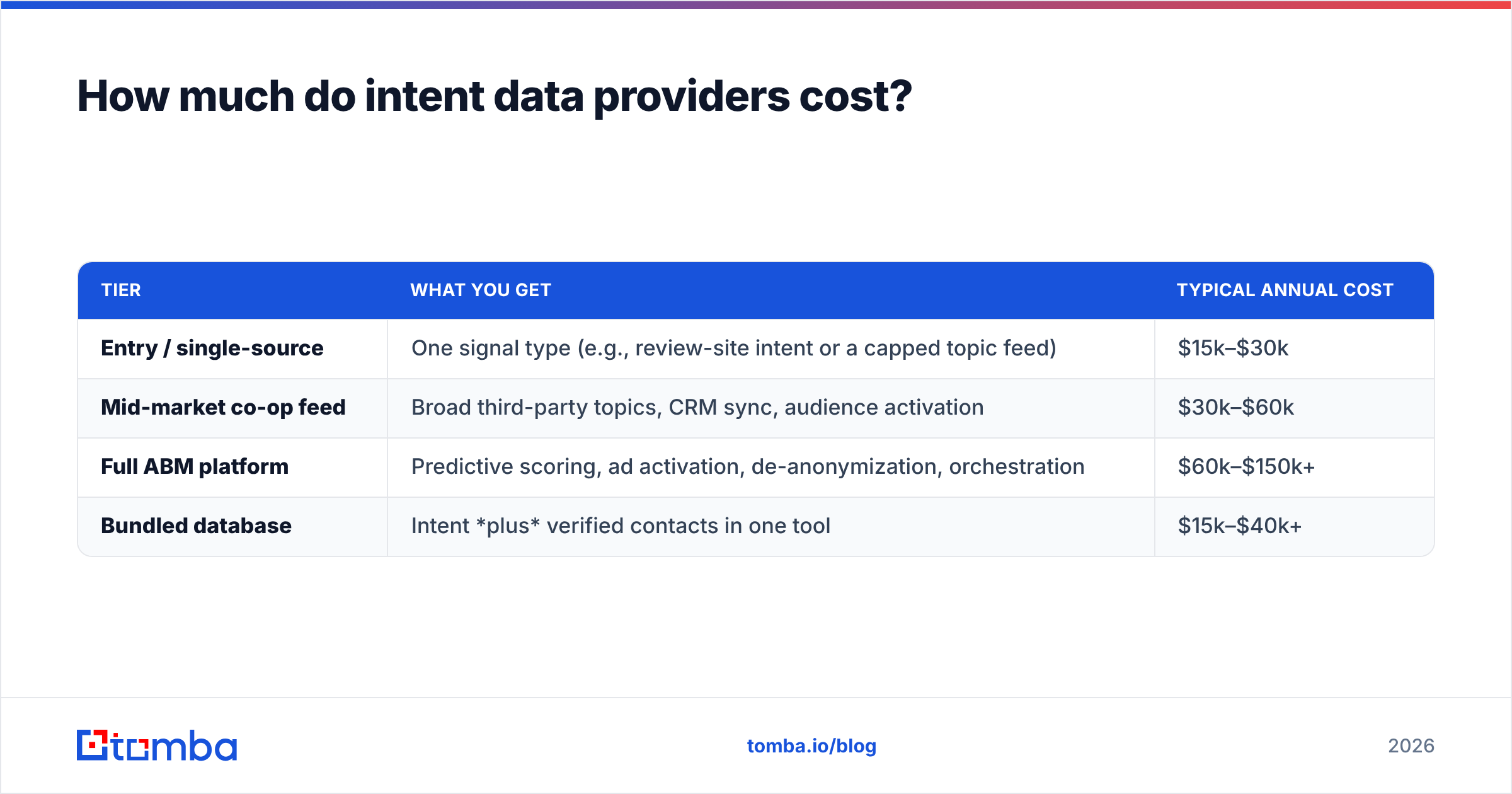
How much do intent data providers cost?#
Budget is where intent shopping gets uncomfortable, because almost no vendor lists prices. Here's the realistic shape of the market:
| Tier | What you get | Typical annual cost |
|---|---|---|
| Entry / single-source | One signal type (e.g., review-site intent or a capped topic feed) | $15k–$30k |
| Mid-market co-op feed | Broad third-party topics, CRM sync, audience activation | $30k–$60k |
| Full ABM platform | Predictive scoring, ad activation, de-anonymization, orchestration | $60k–$150k+ |
| Bundled database | Intent plus verified contacts in one tool | $15k–$40k+ |
Two cost realities people underestimate:
- Activation cost. The feed is half the bill. You also need someone to model, route, and act on the data — a RevOps owner, a sequencer, and clean contact data. Skipping this is how six-figure intent contracts get cancelled at renewal.
- Contact data gap. Most intent is account-level. Once an account lights up, you still have to find the decision-maker's email and phone. Doing that with an affordable, accurate tool keeps your cost-per-conversation sane — compare Tomba pricing (free tier with 25 searches/month, Starter at $49/mo) against per-credit enrichment add-ons that the platform vendors charge.
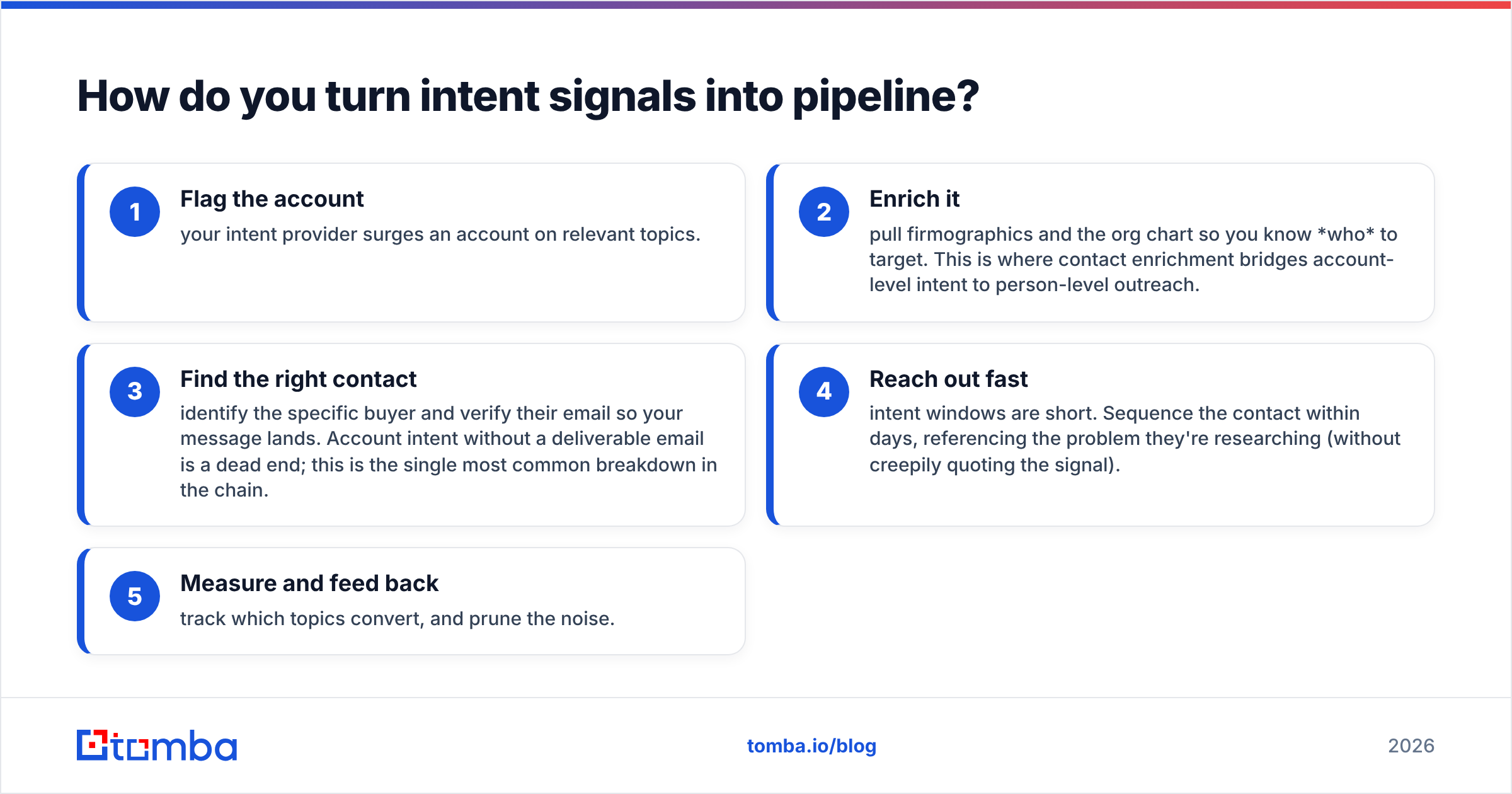
How do you turn intent signals into pipeline?#
Intent data is worthless until a human reaches out. Here's the operational loop the best teams run, and where the gaps usually open up:
- Flag the account — your intent provider surges an account on relevant topics.
- Enrich it — pull firmographics and the org chart so you know who to target. This is where contact enrichment bridges account-level intent to person-level outreach.
- Find the right contact — identify the specific buyer and verify their email so your message lands. Account intent without a deliverable email is a dead end; this is the single most common breakdown in the chain.
- Reach out fast — intent windows are short. Sequence the contact within days, referencing the problem they're researching (without creepily quoting the signal).
- Measure and feed back — track which topics convert, and prune the noise.
Steps 2–3 are where a lot of expensive intent programs quietly fail. A signal that says "Acme Corp is researching data security" is great, but if you can't get a verified email for Acme's VP of Security, the signal never becomes a meeting. That's the unglamorous plumbing that connects intent to revenue — and it's exactly where a fast, accurate email finder earns its keep.
You can validate the whole loop cheaply: take a list of intent-flagged accounts, run them through a bulk email finder, verify the results, and measure reply rate against a control list with no intent signal. If intent is working, the lift will be obvious within a quarter.
What about data accuracy and compliance?#
Accuracy and compliance are the two questions that should gate every shortlist, because both can quietly torch your sender reputation and your legal exposure.
- Resolution accuracy: Ask every vendor what percentage of their intent they can resolve to a named company, and how. Network-based co-ops vary a lot. Independent reviews on G2 are a useful sanity check against vendor claims.
- Contact accuracy: Once you're acting on accounts, bad emails wreck deliverability. Always run found addresses through an email verifier before sequencing — a clean list protects your domain reputation as much as it protects your reply rate.
- Compliance: Confirm GDPR/CCPA-aligned sourcing and consent. Bundled-database vendors like Cognism market heavily on EU compliance; verify it for your jurisdiction rather than taking the badge at face value.
Which intent data provider should you choose?#
Match the tool to your motion, not the other way around:
- You want the broadest third-party signal and have a data team: start with Bombora directly.
- You want an all-in-one ABM engine and have the budget: 6sense or Demandbase.
- You sell software and want bottom-funnel "shopping now" signals: G2 or TrustRadius.
- You want intent and contacts in one record: ZoomInfo or Cognism.
- You're scrappy and want to prove ROI before a six-figure spend: layer first-party visitor reveal with a low-cost enrichment-and-finder stack, then graduate to a co-op once the motion works.
Whichever provider you land on, the value only materializes when a flagged account becomes a real conversation — and that requires a verified email or phone for the right person, fast.
That last mile is what Tomba is built for. Once your intent platform surfaces an in-market account, Tomba's Email Finder locates the decision-maker's professional email by domain, name, or company, verifies it, and hands your reps a deliverable contact in seconds — starting free with 25 searches a month and scaling on the Starter plan at $49/mo. Pair it with your intent feed of choice and you close the gap between "this account is interested" and "this person replied." Start free, point it at your hottest intent accounts, and measure the lift yourself.
// get started
Find, verify and enrich your first contacts today
Start on the free plan with 25 searches a month, then scale when your team is ready.
Free plan · No credit card required · GDPR & CCPA
// about the author