Best Lead Generation Software in 2026: Top 9 Tools Ranked
A neutral, hands-on breakdown of the best lead generation software in 2026 — pricing, data accuracy, and which tool fits your team's budget and motion.
TL;DR
- The "best" lead generation software depends on your motion: data sourcing, outbound automation, intent signals, or all-in-one. No single tool wins every category.
- For accurate email and contact data on a budget, dedicated finders like Tomba and Findymail beat bloated all-in-one suites on cost-per-verified-lead.
- All-in-one platforms (Apollo, ZoomInfo) bundle data plus sequencing but lock you into their database quality and higher floors.
- Verify before you send. Even the best database degrades ~2–3% per month, so pairing a finder with an email verifier protects your sender reputation.
- Budget benchmark: expect $0 to start, ~$49–$99/mo for serious solo/SMB use, and $1,000+/mo once you need ZoomInfo-tier coverage.
What is lead generation software?#
Lead generation software is the toolset that turns "we need more pipeline" into a list of real people you can actually contact. Think of it as the difference between fishing with a single rod and fishing with sonar plus a net — the software tells you where the prospects are, gives you their contact details, and often automates the first cast.
In practice, "lead gen software" is an umbrella over several distinct jobs:
- Data sourcing — finding and verifying business emails, phone numbers, and firmographics (email finders, B2B databases).
- Capture — forms, chatbots, and website visitor reveal that turn anonymous traffic into named accounts.
- Enrichment — filling gaps in records you already have via data enrichment.
- Outbound automation — sequencing email, LinkedIn, and calls to those leads.
- Scoring and routing — deciding which leads sales touches first.
Most teams stitch together two or three of these rather than buying one mega-suite, because the all-in-one tax is real. Below, the tools are grouped by the job they do best so you can match spend to need.

How did we rank the best lead generation software?#
Four criteria, weighted by what actually moves pipeline:
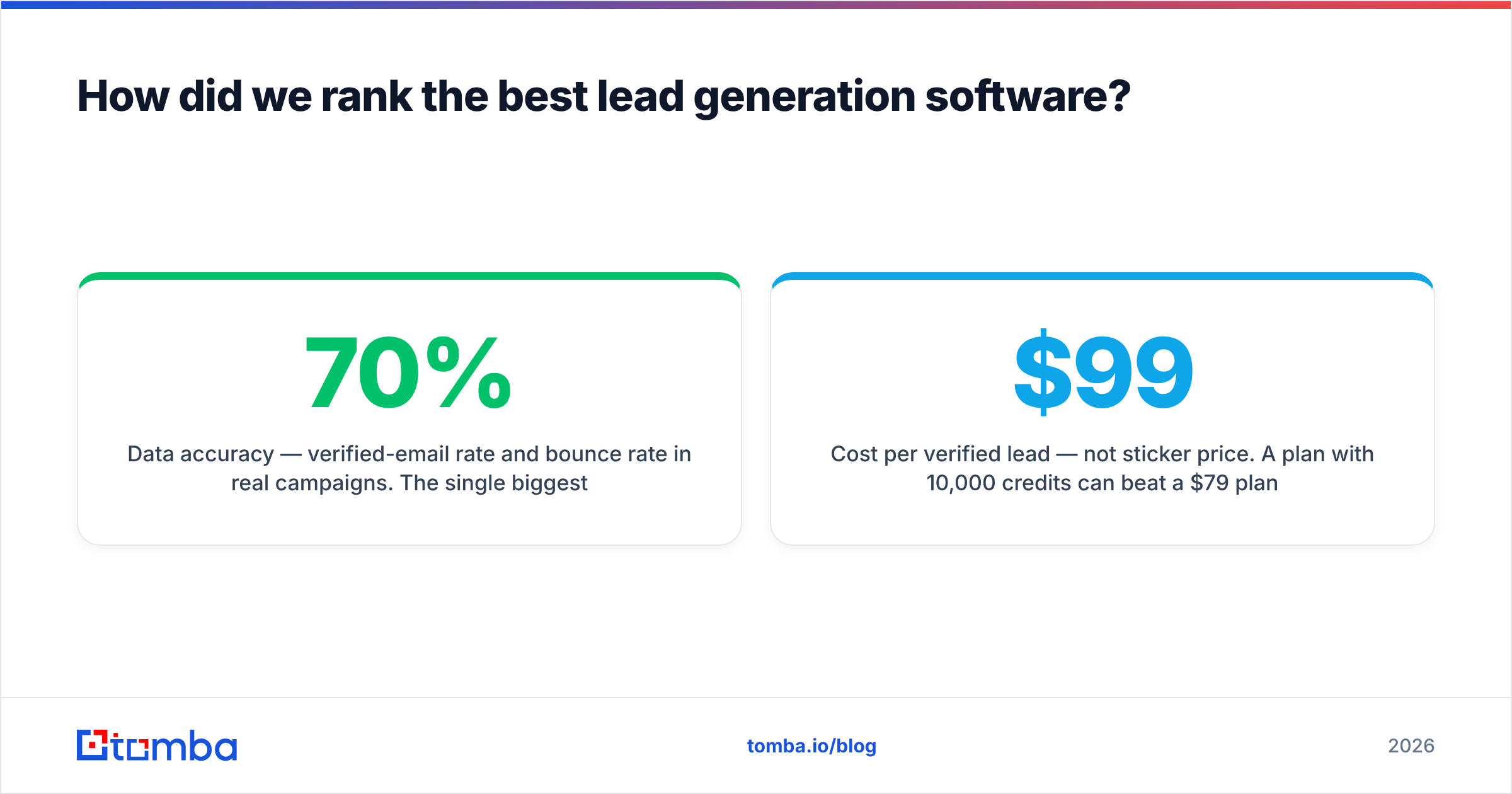
- Data accuracy — verified-email rate and bounce rate in real campaigns. The single biggest cost driver, because a cheap tool with 70% accuracy is more expensive than a pricier one at 95% once you factor in burned domains.
- Cost per verified lead — not sticker price. A $99/mo plan with 10,000 credits can beat a $79/mo plan with 1,000.
- Coverage — geographic and role depth. North America is easy; EMEA and APAC separate the contenders.
- Workflow fit — does it drop into your CRM, spreadsheet, or sequencer without engineering work?
No tool was paid to rank. Where Tomba wins, it's noted honestly; where it doesn't, that's noted too.
Which is the best lead generation software in 2026?#
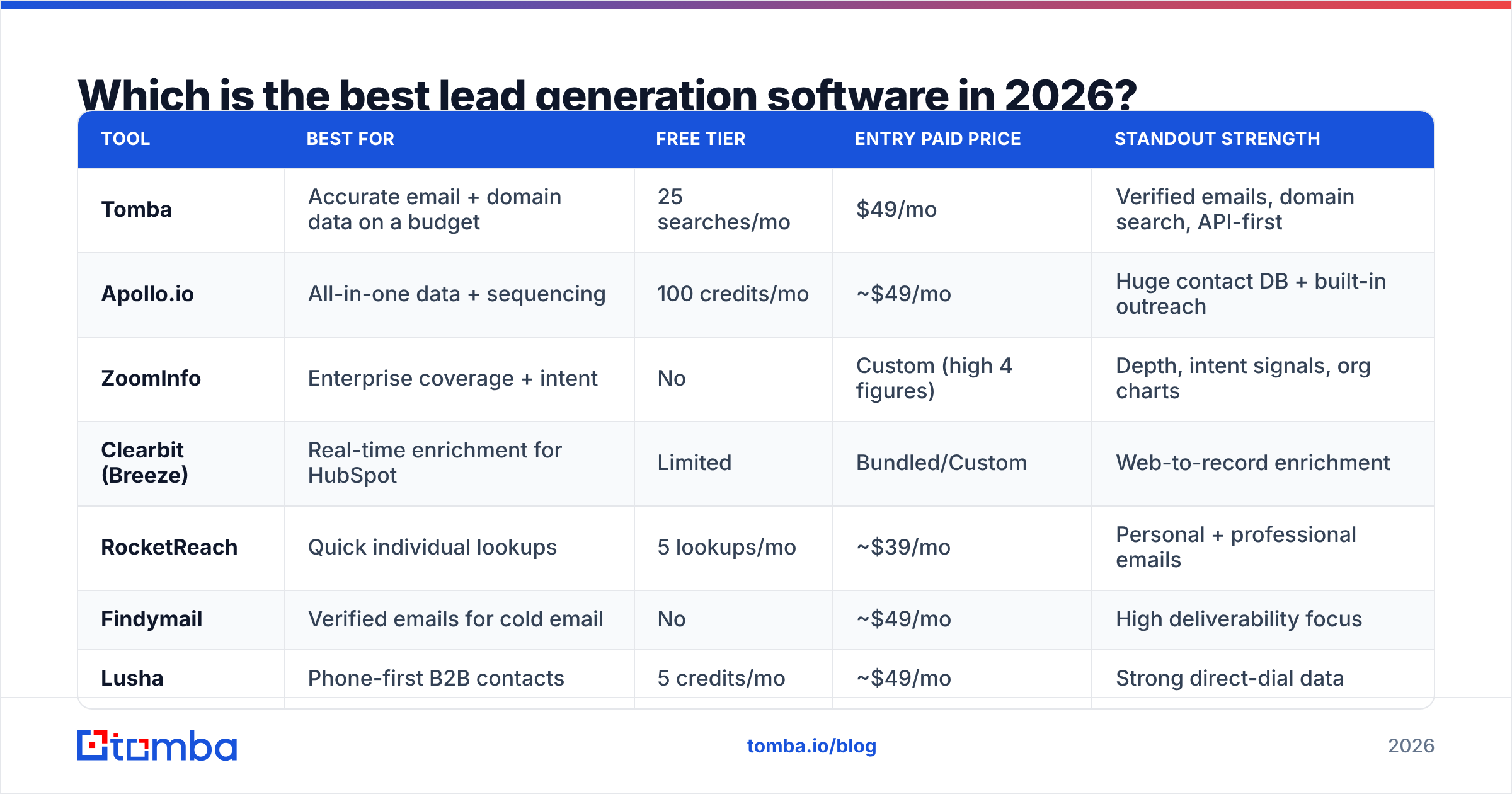
Here's the head-to-head on the attributes that decide the bill. Prices are entry paid tiers as listed publicly in 2026; always confirm on the vendor's pricing page since they change often.
| Tool | Best for | Free tier | Entry paid price | Standout strength |
|---|---|---|---|---|
| Tomba | Accurate email + domain data on a budget | 25 searches/mo | $49/mo | Verified emails, domain search, API-first |
| Apollo.io | All-in-one data + sequencing | 100 credits/mo | ~$49/mo | Huge contact DB + built-in outreach |
| ZoomInfo | Enterprise coverage + intent | No | Custom (high 4 figures) | Depth, intent signals, org charts |
| Clearbit (Breeze) | Real-time enrichment for HubSpot | Limited | Bundled/Custom | Web-to-record enrichment |
| RocketReach | Quick individual lookups | 5 lookups/mo | ~$39/mo | Personal + professional emails |
| Findymail | Verified emails for cold email | No | ~$49/mo | High deliverability focus |
| Lusha | Phone-first B2B contacts | 5 credits/mo | ~$49/mo | Strong direct-dial data |
| Instantly | Cold email sending + leads | Trial | ~$37/mo | Sending infra + lead DB |
| Cognism | Compliant EU/UK mobile data | No | Custom | GDPR-aligned phone coverage |
The pattern: dedicated data tools (Tomba, Findymail, RocketReach, Lusha) cluster near $39–$49/mo and win on cost-per-lead, while enterprise suites (ZoomInfo, Cognism) trade transparency and price for depth and intent data.
Best for accurate data on a budget: Tomba#
If your bottleneck is "I have a list of companies and need the right people's verified emails," a focused email finder is the highest-ROI purchase. Tomba sits here.
What it does well:
- Verified email finding by name, company, or domain search — useful when you know the account but not the contact.
- Built-in verification so you're not exporting to a separate email verifier for every list.
- Developer reach via the Tomba API, CLI, and a Chrome extension, plus Google Sheets and HubSpot integration.
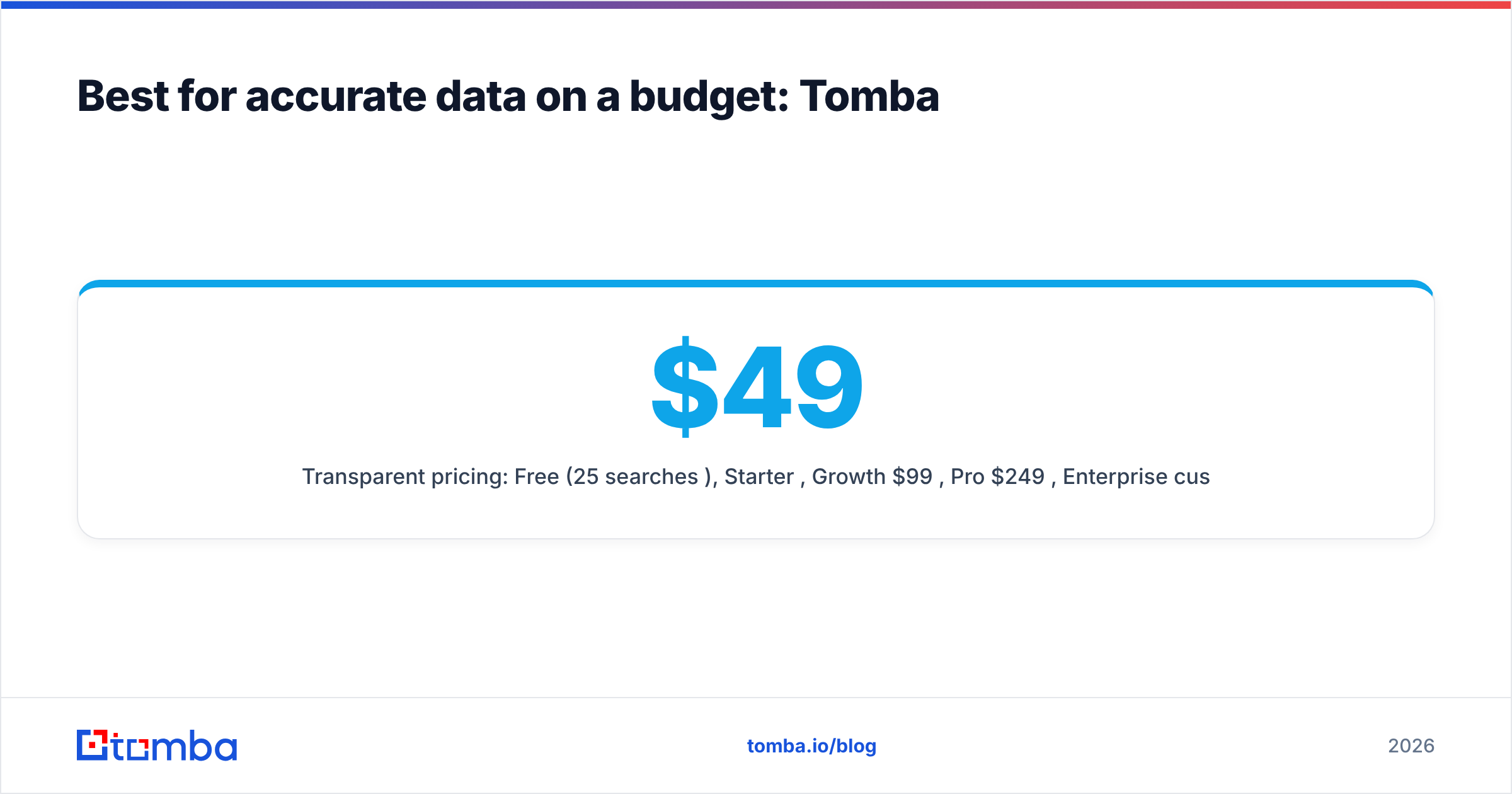
- Transparent pricing: Free (25 searches/mo), Starter $49/mo, Growth $99/mo, Pro $249/mo, Enterprise custom. See full Tomba pricing.
Where it's not the answer: Tomba isn't a sequencer. If you want sending and cadences in one login, you'll pair it with a tool like Instantly or your CRM. That's the deliberate trade — best-in-class data instead of mediocre everything.
Honesty check: for raw North American contact volume with intent layered on top, ZoomInfo's database is larger. You pay roughly 20x for that.
Best all-in-one: Apollo.io#
Apollo bundles a large contact database with sequencing, dialer, and basic enrichment. For a solo founder or small team that wants one tool, it's the default recommendation, and the free tier is genuinely usable for testing.
The catch is data accuracy variance. Apollo's database is broad but bounce rates climb in non-US regions and on smaller companies, so verify exports before sending. If you outgrow its data quality, many teams keep Apollo for sequencing and bolt on a dedicated finder — see this Apollo alternative breakdown for that split.
You can read Apollo's own feature claims on apollo.io and cross-check user-reported accuracy on G2.
Best for enterprise coverage: ZoomInfo#
ZoomInfo is the incumbent for a reason: the deepest US contact and company data, org charts, and intent signals that tell you which accounts are in-market. If you have an enterprise budget and a large SDR team, it's defensible.
The trade-offs are well documented: opaque annual contracts that typically start in the high four figures, aggressive auto-renewal terms, and a platform heavy enough that adoption needs enablement. For most SMBs it's overkill. Validate the contract terms with procurement and check independent reviews on Gartner Peer Insights before signing.
Best for enrichment inside HubSpot: Clearbit#
Now folded into HubSpot as Breeze Intelligence, Clearbit shines when you want records to enrich themselves — a form fill or website visit instantly expands into a full firmographic profile. If your stack is HubSpot-centric, it's the path of least resistance.
If you're not all-in on HubSpot, the value drops and standalone enrichment tools become more flexible. Compare the standalone route via this Clearbit alternative overview, or use Tomba's data enrichment to push enriched fields into any CRM through integrations.
What about phone numbers and outbound sending?#
Two adjacent jobs that "lead gen software" often gets asked to cover:
- Phone data: Lusha and Cognism lead on direct dials, with Cognism stronger on GDPR-compliant EU/UK mobiles. If you only occasionally need numbers, a phone finder plus a phone validator avoids a second full subscription.
- Sending: Instantly and Smartlead focus on cold-email infrastructure — inbox rotation, warmup, and deliverability — rather than data. They're complements to a finder, not replacements. If you're weighing them, the Instantly alternative comparison covers where the lines blur.
A quick decision shortcut:
- Need verified B2B emails cheaply? Start with a dedicated finder (Tomba, Findymail).
- Need data + sequencing in one tool? Apollo.
- Need enterprise depth + intent? ZoomInfo or Cognism.
- Need phone-first? Lusha or Cognism.
- Need sending infrastructure? Instantly or Smartlead, paired with a finder.
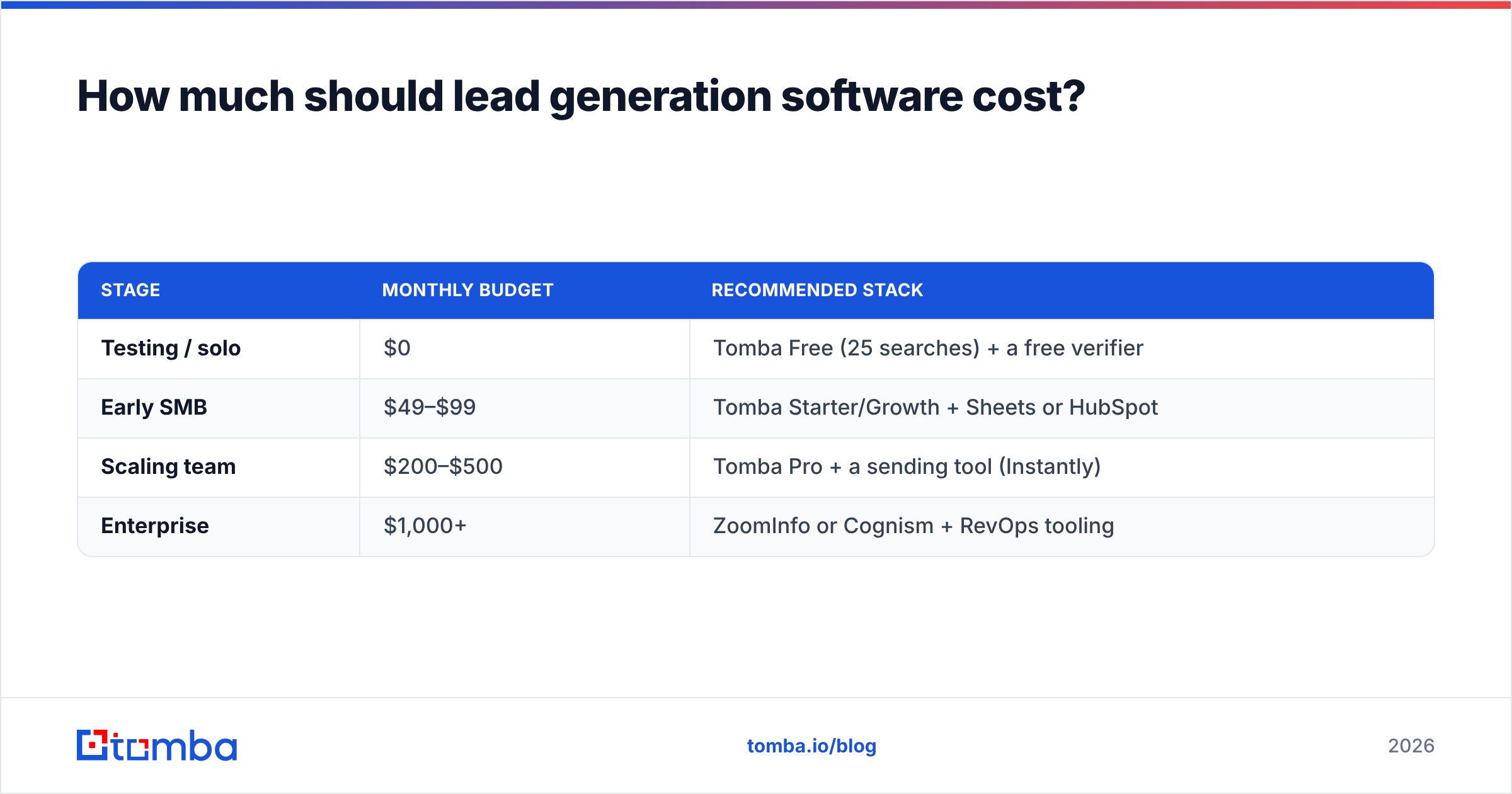
How much should lead generation software cost?#
Conclusion first: most SMB and solo teams should spend $0–$99/mo and resist the enterprise upsell until volume forces it.
| Stage | Monthly budget | Recommended stack |
|---|---|---|
| Testing / solo | $0 | Tomba Free (25 searches) + a free verifier |
| Early SMB | $49–$99 | Tomba Starter/Growth + Sheets or HubSpot |
| Scaling team | $200–$500 | Tomba Pro + a sending tool (Instantly) |
| Enterprise | $1,000+ | ZoomInfo or Cognism + RevOps tooling |
The mistake teams make is buying enterprise data before they've proven a repeatable motion. Start cheap, measure reply rate and cost-per-meeting, then scale the spend that's working. For high volume, a bulk email finder drops your cost-per-lead far below per-seat enterprise pricing.
How do you avoid wasting budget on bad leads?#
The fastest way to torch money is sending to unverified data. Three habits protect you:
- Verify every list before sending. Databases decay — people change jobs constantly. Run new lists through verification and watch for catch-all domains with a catch-all verifier.
- Protect deliverability. High bounce rates wreck sender reputation and tank inbox placement. Clean data is a deliverability tool, not just a sales tool.
- Enrich, don't re-buy. When a record is stale, enrich the gaps instead of repurchasing the whole contact.
This is where the "cheapest tool" math flips. A finder with a 95% verified rate costs less per delivered email than a 70%-accurate database, even if the sticker price is higher, because every bounce is wasted spend plus reputation damage.
Best lead generation software: the verdict#
There's no universal winner — there's a best fit per job:
- Best value data: Tomba — accurate emails, transparent Tomba pricing, API-first.
- Best all-in-one: Apollo — data plus sequencing for one login.
- Best enterprise depth: ZoomInfo — if budget is no object.
- Best for HubSpot shops: Clearbit/Breeze.
- Best phone data: Lusha and Cognism.
Match the tool to your motion and your budget, verify relentlessly, and scale spend only behind metrics that work.
Get accurate leads without the enterprise price tag#
If your goal is verified contact data you can trust — without a five-figure annual contract — start with the Tomba Email Finder. Find decision-makers by name or domain search, verify in the same workflow, and push results straight into your CRM via integrations. The free tier gives you 25 searches a month to test accuracy on your own list before you pay a cent — the honest way to compare any lead generation software. When the numbers prove out, scale up on Starter at $49/mo, not $1,000.
// get started
Find, verify and enrich your first contacts today
Start on the free plan with 25 searches a month, then scale when your team is ready.
Free plan · No credit card required · GDPR & CCPA
// about the author