Best Lead Nurturing Emails: 9 Templates That Convert in 2026
The best lead nurturing emails move buyers forward without nagging them. Here are 9 proven templates, a sequence framework, and the data hygiene that makes them land in 2026.
Best Lead Nurturing Emails: 9 Templates That Convert in 2026
Most "lead nurturing" inboxes are graveyards of ignored newsletters. The leads went cold not because the product was wrong, but because every email asked for a meeting and gave nothing back. The best lead nurturing emails flip that ratio: they deliver something useful first, and earn the reply second.
This guide gives you nine copy-ready templates, the sequence logic that connects them, and the timing and data rules that decide whether any of it lands.
TL;DR#
- Nurturing is a value exchange, not a countdown timer. Lead with insight, social proof, or a relevant resource before you ask for time.
- Segment by behavior, not just job title. A lead who viewed your pricing page needs a different email than one who downloaded a top-of-funnel guide.
- Nine templates below cover the full arc: welcome, education, social proof, objection-handling, re-engagement, and the soft ask.
- Timing matters as much as copy — space touches 3 to 7 days apart and cap most sequences at 5 to 8 emails.
- Dirty data kills the best copy. Bounces and wrong contacts wreck sender reputation before your words get read. Verify before you send.
What makes a lead nurturing email actually work?#
The best lead nurturing emails do one job per send: move the lead one concrete step closer to a buying decision. That's it. They don't recap your entire feature set or beg for a demo on email one.
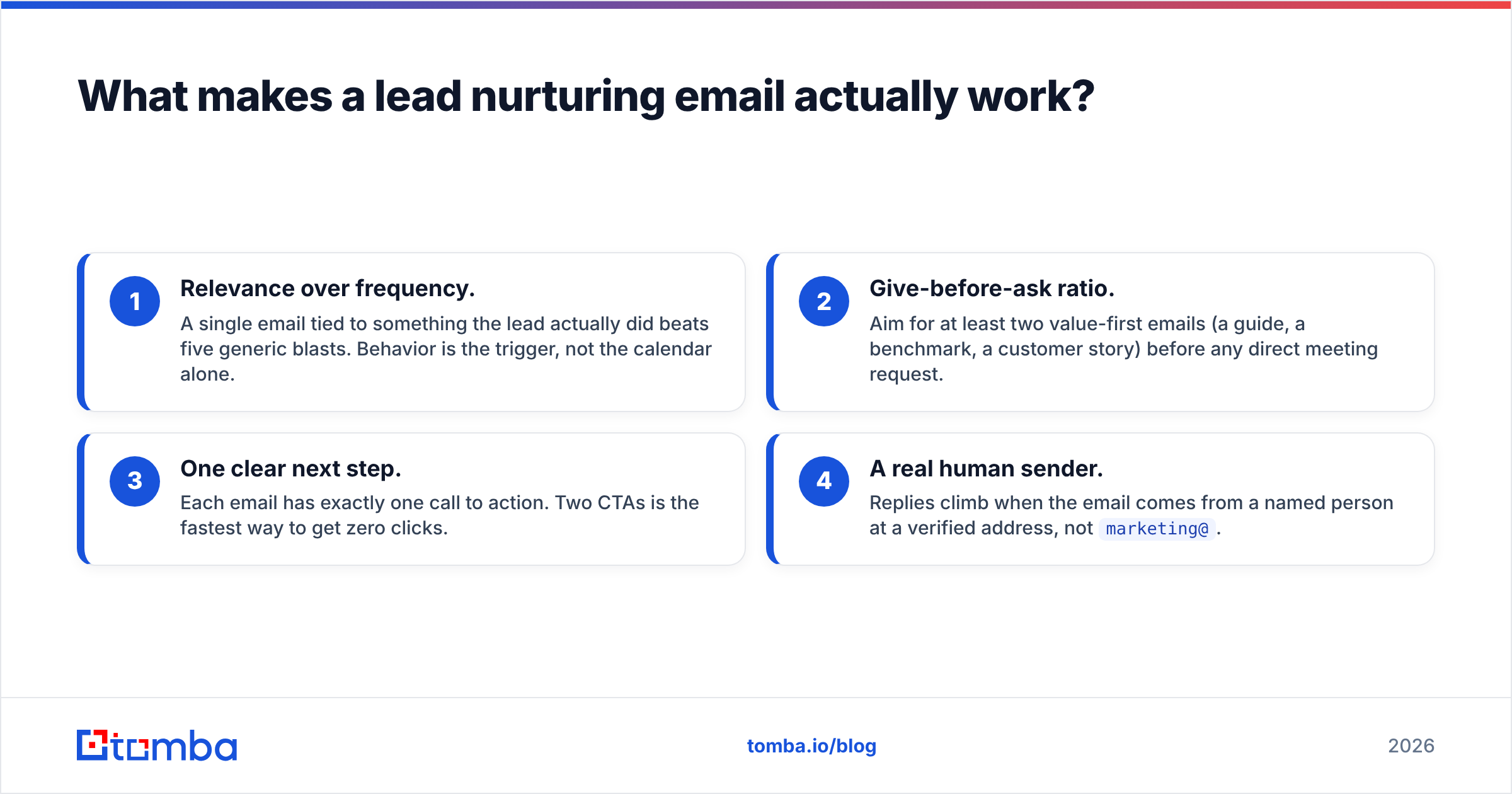
Three traits separate nurturing that converts from nurturing that gets muted:
- Relevance over frequency. A single email tied to something the lead actually did beats five generic blasts. Behavior is the trigger, not the calendar alone.
- Give-before-ask ratio. Aim for at least two value-first emails (a guide, a benchmark, a customer story) before any direct meeting request.
- One clear next step. Each email has exactly one call to action. Two CTAs is the fastest way to get zero clicks.
- A real human sender. Replies climb when the email comes from a named person at a verified address, not
marketing@.
If you want the formal definition and where nurturing sits in the funnel, the marketing qualified lead handoff is the moment nurturing either accelerates or stalls a deal.
What does a lead nurturing sequence look like?#
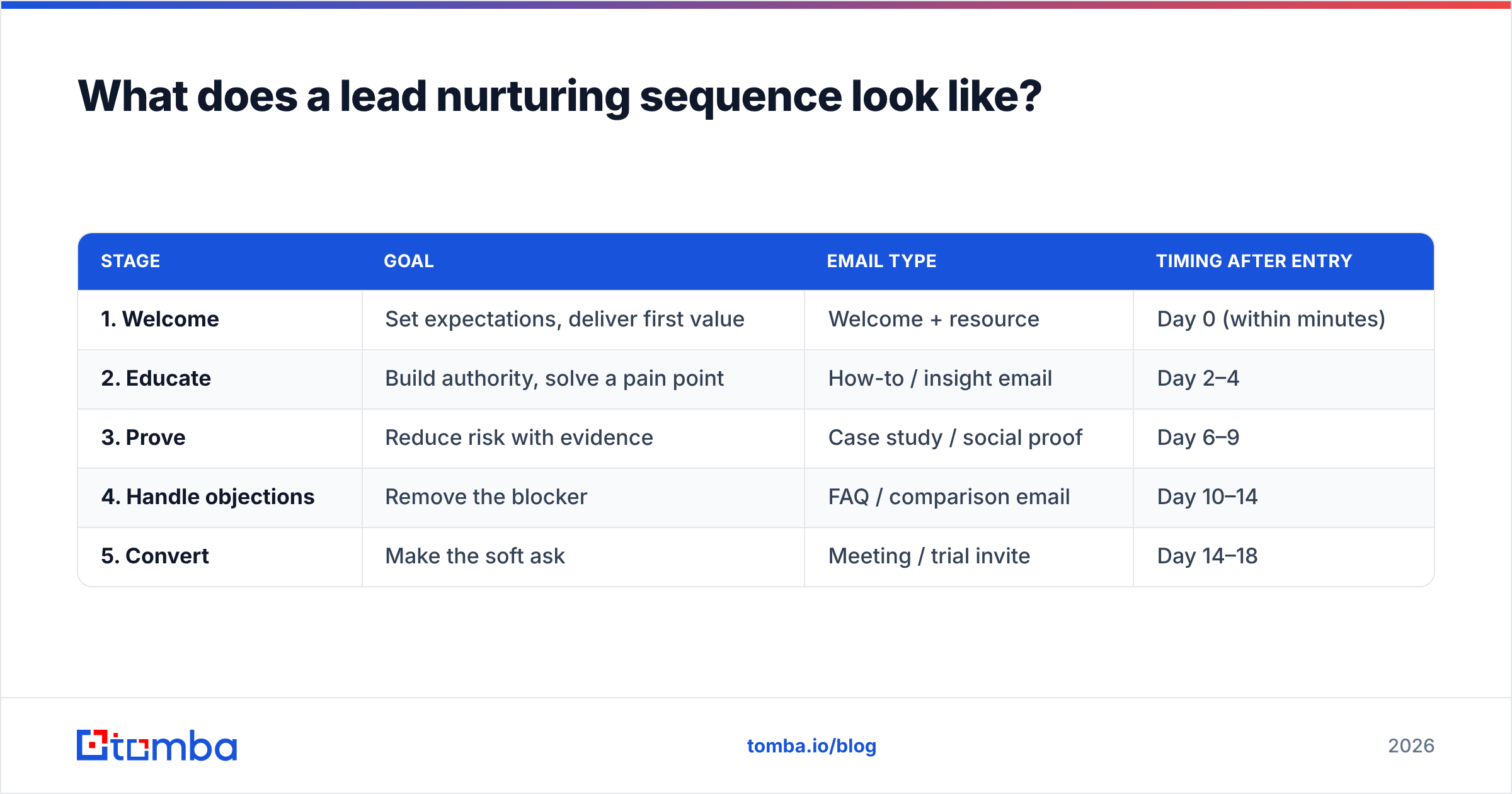
Think of a nurturing sequence like coaching a runner, not firing a starting pistol. You pace the effort across stages, and each stage has a different goal. Here's the five-stage arc the templates below map to.
| Stage | Goal | Email type | Timing after entry |
|---|---|---|---|
| 1. Welcome | Set expectations, deliver first value | Welcome + resource | Day 0 (within minutes) |
| 2. Educate | Build authority, solve a pain point | How-to / insight email | Day 2–4 |
| 3. Prove | Reduce risk with evidence | Case study / social proof | Day 6–9 |
| 4. Handle objections | Remove the blocker | FAQ / comparison email | Day 10–14 |
| 5. Convert | Make the soft ask | Meeting / trial invite | Day 14–18 |
The number of emails per stage flexes with deal size. A self-serve $49/mo product might compress this into four emails over a week; a six-figure enterprise deal might run two emails per stage across two months. The shape stays the same.
What are the best lead nurturing email templates?#
Below are nine templates you can adapt today. Keep them short — 60 to 120 words is the sweet spot for nurturing. Personalize the bracketed fields with real, verified data, not guesses.
1. The instant-value welcome#
Subject: Here's the [resource] you wanted, [First Name]
Hi [First Name],
Thanks for grabbing [the guide / signing up]. As promised, here it is: [link].
One thing most people skip on page [X]: [specific tip]. It's the part that actually moved the needle for [similar company type].
I'll send a couple more useful things this week. Reply anytime if you want the short version.
— [Your name]
2. The "one idea" education email#
Subject: The mistake costing [role]s 30% of [outcome]
Most [roles] try to fix [problem] by [common approach]. It rarely works because [reason].
What works instead: [one tactic], in two steps — [step 1], [step 2].
Want the full breakdown? Here's a 4-minute read: [link].
3. The social-proof story#
Subject: How [Customer] hit [result] in [timeframe]
[Customer], a [industry] team about your size, was stuck on [problem].
They changed one thing: [action]. Within [timeframe], [specific metric result].
Here's the 90-second version of how they did it: [link].
4. The pattern-interrupt re-engagement#
Subject: Should I close your file?
Hi [First Name] — I haven't heard back, which usually means one of three things: bad timing, wrong person, or not a fit right now.
Just reply with 1, 2, or 3 and I'll do the rest. No pitch.
5. The objection-handler#
Subject: "We already use [competitor]"
Totally fair — most teams we talk to do.
The usual reason they still switch: [differentiator]. Here's a side-by-side so you can judge for yourself: [link].
Happy to be wrong if it's not a fit.
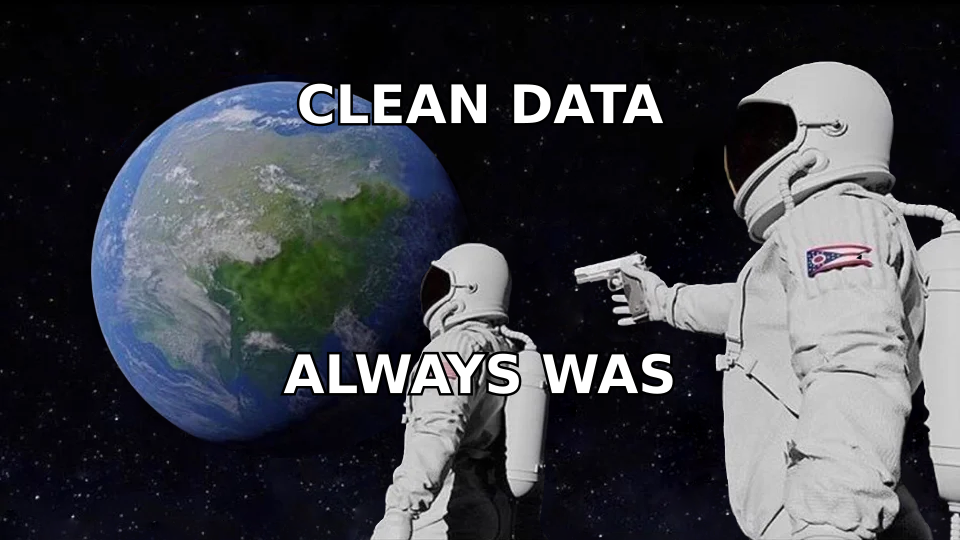
The middle of a nurturing sequence is where most teams quietly lose people — and it's almost always a data problem, not a copy problem.
6. The trigger-based behavioral email#
Subject: Saw you were looking at [feature/page]
Hi [First Name], noticed [the pricing page / a specific feature] caught your eye.
Quick answer to the question most people have at this stage: [common question + 1-line answer].
Want me to walk you through it live? Grab 15 minutes here: [link].
7. The "quick win" checklist#
Subject: A 10-minute fix for [problem]
No reading required. Here's a checklist you can run today: [3 bullet steps].
If you knock out steps 1 and 2 this week, [expected outcome]. Step 3 is where we usually help.
8. The soft meeting ask#
Subject: Worth a quick call?
[First Name], based on what you've looked at, I think 15 minutes would save you a few hours of trial-and-error.
Two times that work: [time A] or [time B]. Or send your own — [link].
9. The graceful breakup#
Subject: Last one from me
I don't want to clutter your inbox, so this is my last note for now.
If [problem] becomes a priority later, here's everything in one place: [link]. The door's open whenever.
How do you keep nurturing emails out of spam?#
The best template in the world fails if it never reaches the inbox. Nurturing volume is exactly where deliverability quietly erodes, because you're sending repeatedly to lists that decay 22–30% per year as people change jobs.
Protect your sender reputation with a few non-negotiables:
- Authenticate your domain. Set up SPF, DKIM, and DMARC. Confirm your record with an SPF checker before any campaign scales.
- Verify every address before it enters a sequence. Bounces above 2–3% signal mailbox providers to throttle you. An email verifier catches dead and risky addresses up front.
- Watch engagement. Falling open rates and rising spam complaints feed directly into sender reputation, which determines placement.
- Warm new sending domains gradually. Don't blast 5,000 nurturing emails from a domain registered last week.
Google's own Postmaster Tools guidelines are the source of truth for what large mailbox providers expect — read them before you blame your copy for low opens.
Behavior-based vs. time-based nurturing: which wins?#
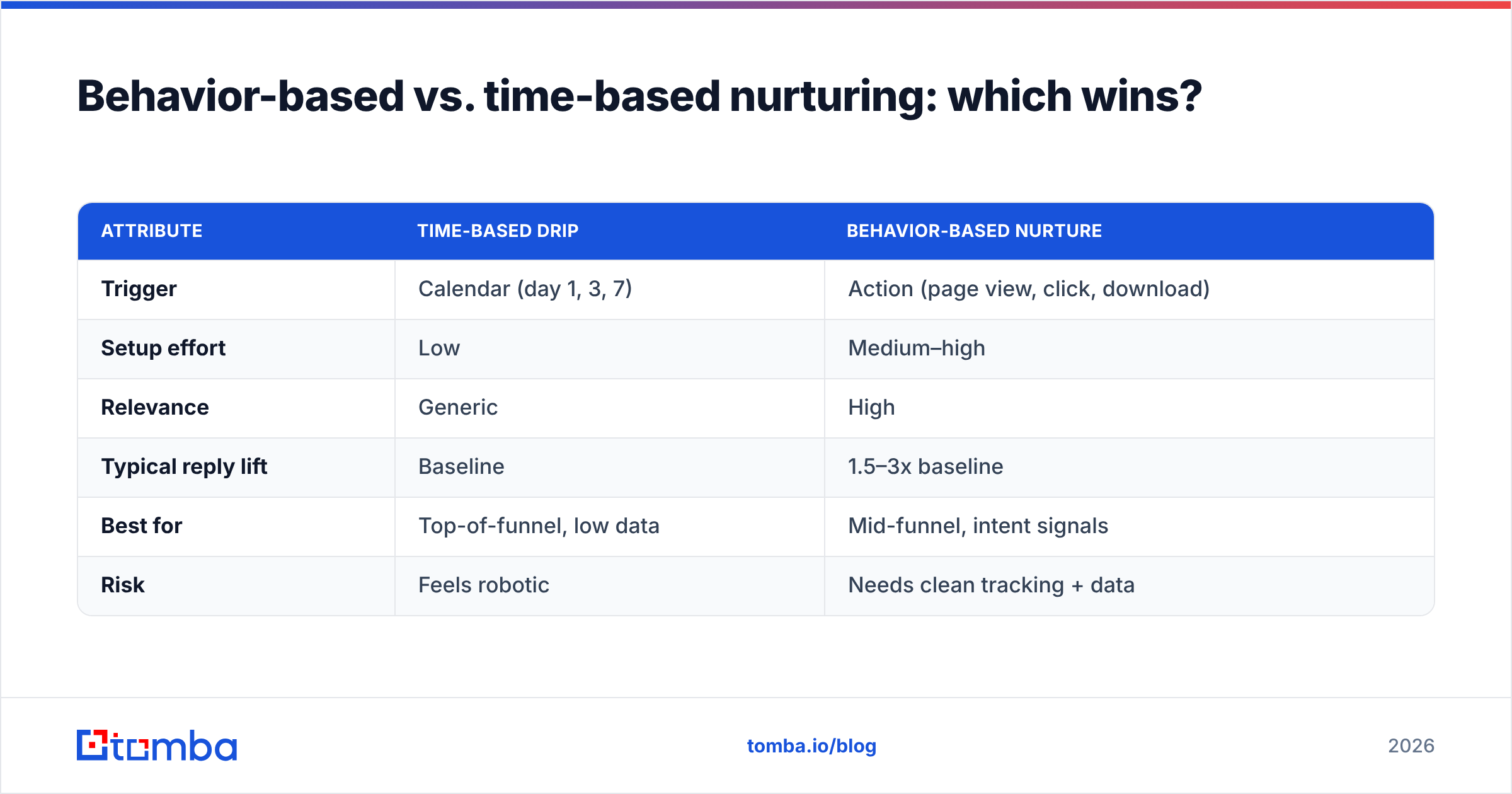
Behavior-based nurturing wins on conversion; time-based wins on simplicity. The best programs blend both — a time-based backbone with behavioral triggers that can interrupt and personalize.
| Attribute | Time-based drip | Behavior-based nurture |
|---|---|---|
| Trigger | Calendar (day 1, 3, 7) | Action (page view, click, download) |
| Setup effort | Low | Medium–high |
| Relevance | Generic | High |
| Typical reply lift | Baseline | 1.5–3x baseline |
| Best for | Top-of-funnel, low data | Mid-funnel, intent signals |
| Risk | Feels robotic | Needs clean tracking + data |
The catch with behavior-based nurturing is that it's only as good as your contact data. If your CRM has the wrong email, a stale title, or a missing decision-maker, your "personalized" trigger fires into the void. That's why teams running serious nurturing pair their sequences with ongoing data enrichment — so the name, role, and company in every merge field is current and correct.
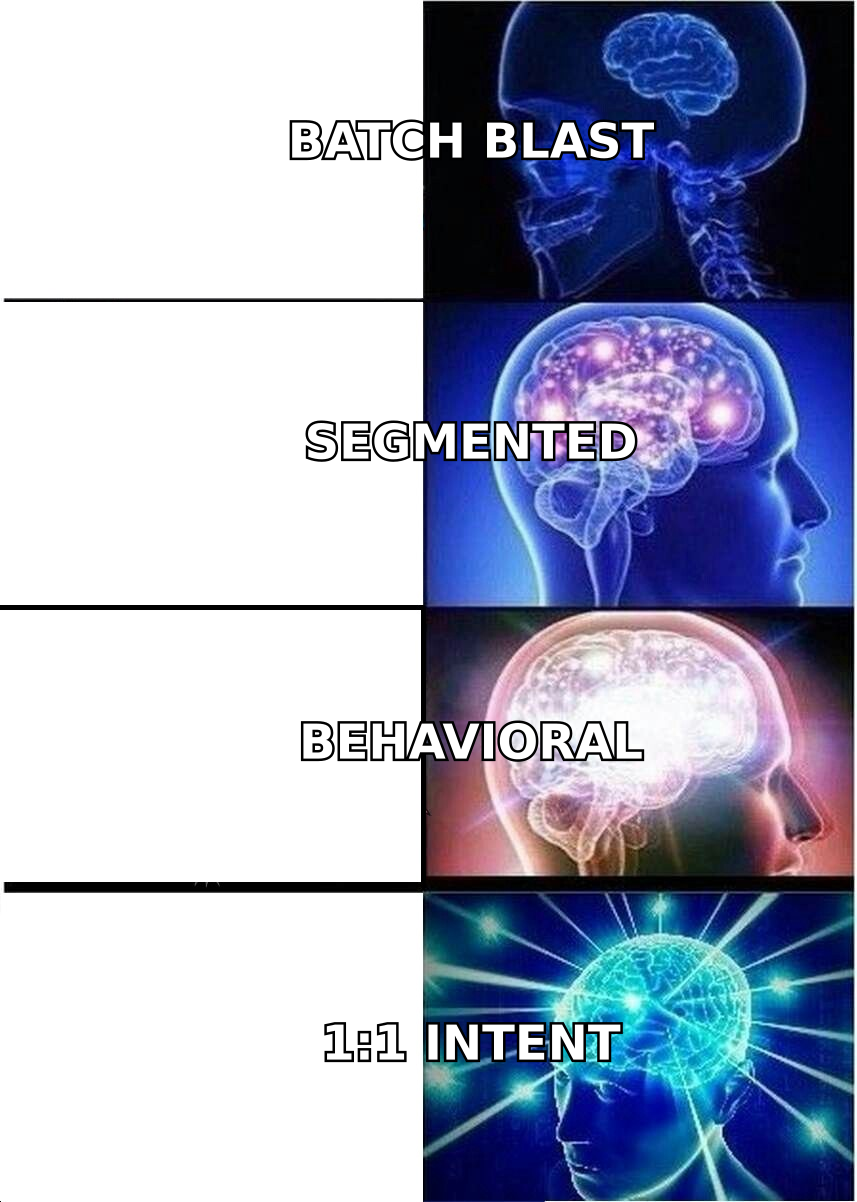
For the analytics side, both HubSpot's research on email engagement and peer reviews on G2 consistently show segmented, behavior-triggered sends outperforming batch-and-blast by wide margins.
How many emails should a nurturing sequence have?#
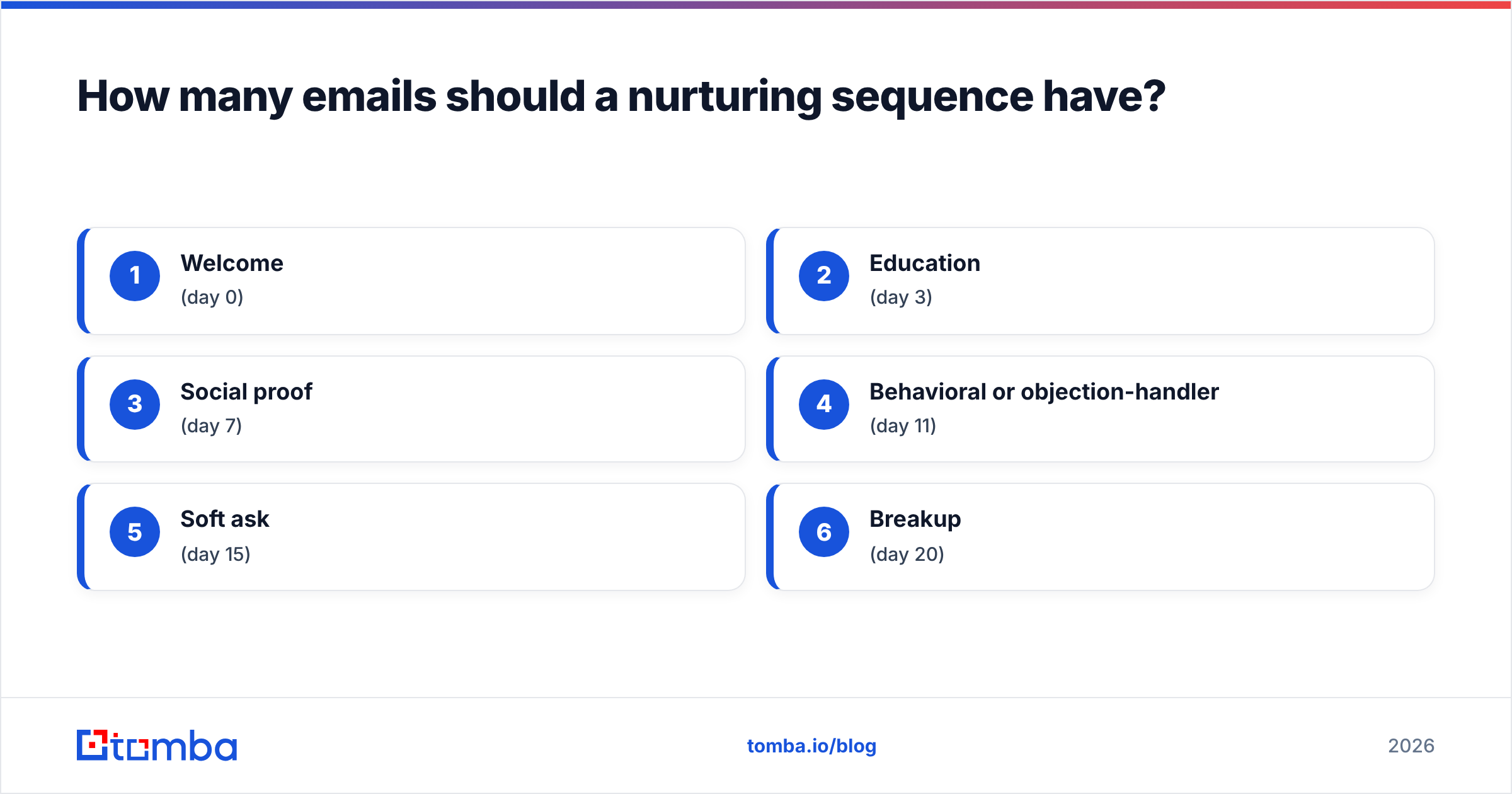
Five to eight emails is the right range for most B2B nurturing tracks. Fewer than four rarely builds enough trust to convert; more than ten starts to feel like harassment and drives unsubscribes.
A practical default:
- Welcome (day 0)
- Education (day 3)
- Social proof (day 7)
- Behavioral or objection-handler (day 11)
- Soft ask (day 15)
- Breakup (day 20)
If a lead replies or books at any point, they exit the sequence immediately — no one should get a "breakup" email the day after they booked a demo. Sync your sequence tool with your CRM so engaged leads drop out automatically.
What's the biggest mistake teams make with nurturing emails?#
Sending great copy to bad contacts. You can A/B test subject lines for a month, but if 20% of your list bounces and another 15% goes to a person who left the company, your effort is wasted before the first word is read.
Before you launch any nurturing program, run your list through three filters:
- Find the right person. Use a verified email finder to reach the actual decision-maker, not a generic inbox.
- Verify the address. Strip out invalid, role-based, and risky emails to protect deliverability.
- Enrich the record. Fill in title, company size, and recent role changes so personalization is real, not guessed.
Get those three right and average templates outperform brilliant copy sent to a dirty list. Every time.
Start with data you can trust#
The best lead nurturing emails in 2026 aren't about clever subject lines — they're about reaching the right person, at a real address, with one useful thing per send. Nail the data layer and the templates above start converting; skip it and even perfect copy bounces.
Start at the foundation: use the Tomba Email Finder to source and verify accurate, decision-maker contacts before they ever enter a sequence. Pair it with verification and enrichment, then let the nine templates do the talking. Check Tomba pricing — the free tier gives you 25 searches a month to test the workflow, and paid plans start at $49/mo when you're ready to scale your nurturing list.
Clean data first. Great emails second. That order never changes.
// get started
Find, verify and enrich your first contacts today
Start on the free plan with 25 searches a month, then scale when your team is ready.
Free plan · No credit card required · GDPR & CCPA
// about the author