Best Practices of a Chief Revenue Officer (2026 Playbook)
The CRO role lives or dies on aligned teams and clean data. Here are the best practices of a chief revenue officer that actually move pipeline in 2026.
Best Practices of a Chief Revenue Officer (2026 Playbook)
The Chief Revenue Officer is the one executive accountable for every dollar that enters the business — across sales, marketing, customer success, and partnerships. When those functions pull in different directions, revenue leaks. When they share one number, one motion, and one source of truth, revenue compounds.
This guide breaks down the best practices of a chief revenue officer that hold up under board pressure in 2026: how to align go-to-market teams, build a forecast you can defend, and run a data engine that doesn't rot underneath you.
TL;DR — The CRO Cheat Sheet#
- Own one number, not three. A CRO unifies sales, marketing, and CS under a single revenue target — siloed quotas are the root cause of most GTM dysfunction.
- Data quality is a revenue lever, not an IT chore. Stale contact data quietly kills win rates; clean enrichment is now a board-level metric.
- Forecast with evidence. Replace gut-feel commits with pipeline coverage ratios, stage conversion data, and deal inspection.
- Hire for the motion you have. PLG, enterprise, and hybrid motions need different leadership reflexes — copy the playbook that matches your reality, not LinkedIn's.
- Compensation is strategy. Comp plans are the steering wheel; if they reward the wrong behavior, no dashboard will save you.
What Does a Chief Revenue Officer Actually Do?#
A CRO is the conductor of the revenue orchestra. The VP of Sales plays one instrument, the CMO plays another, and customer success plays a third — but without someone setting tempo and key, you get noise instead of music. The CRO's job is to make those teams play the same song toward the same number.
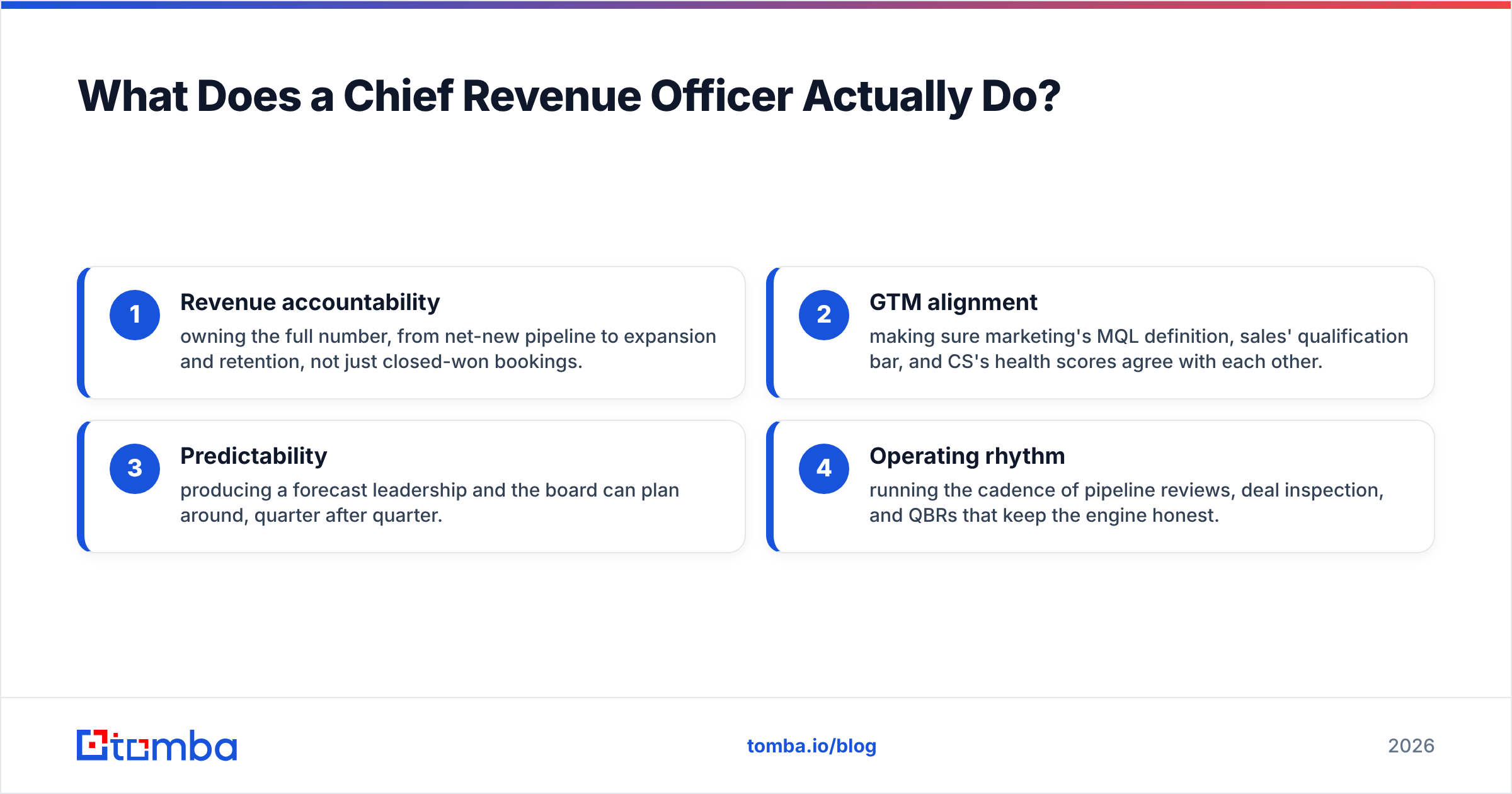
In practice, that breaks into four mandates:
- Revenue accountability — owning the full number, from net-new pipeline to expansion and retention, not just closed-won bookings.
- GTM alignment — making sure marketing's MQL definition, sales' qualification bar, and CS's health scores agree with each other.
- Predictability — producing a forecast leadership and the board can plan around, quarter after quarter.
- Operating rhythm — running the cadence of pipeline reviews, deal inspection, and QBRs that keep the engine honest.
According to Gartner, the highest-performing revenue organizations are the ones that treat go-to-market as a single connected system rather than a relay race of handoffs. The CRO is the person who owns that system.
What Are the Core Best Practices of a Chief Revenue Officer?#
The best practices of a chief revenue officer cluster into five disciplines. Master these and the rest of the role gets dramatically easier.
- Align on one revenue number. Kill the sales-vs-marketing blame game by giving both teams a shared pipeline and revenue target with shared definitions.
- Treat data as infrastructure. Your CRM is only as good as the contact and account data inside it. Garbage in, missed quota out.
- Inspect deals, don't just count them. Pipeline value means nothing without conversion math behind it. Inspect the top deals every week.
- Codify the winning motion. Write down what your best reps do, then make it repeatable through enablement and process — don't leave it tribal.
- Pay for the behavior you want. Compensation drives 80% of seller behavior. Design it deliberately, audit it quarterly.
Notice that two of the five are about data and process — not charisma. That's the shift. The modern CRO wins on operating discipline, and operating discipline runs on clean inputs. This is why revenue operations has become the CRO's most important reporting line.
How Should a CRO Align Sales, Marketing, and Customer Success?#
Conclusion first: alignment is an operating problem, not a personality problem. You don't fix it with a team lunch; you fix it with shared definitions, shared data, and a shared scoreboard.
Start with the handoff definitions. The single most common GTM failure is that marketing's "qualified lead" and sales' "qualified lead" describe different humans. Standardize what a marketing qualified lead is, what triggers a sales-accepted lead, and what data must travel with each handoff.
Then unify the scoreboard. When marketing is measured on MQLs, sales on bookings, and CS on churn — in three separate dashboards — nobody owns the gaps between them. A CRO collapses those into one revenue waterfall everyone reads from the same view.
Finally, fix the data layer underneath. Alignment dies the moment a rep opens a record with a bounced email, a wrong title, or a phone number from three jobs ago. Continuous data enrichment keeps every team operating on the same, current reality instead of arguing over whose CRM is "right."
Why Is Data Quality a CRO Responsibility?#
Because bad data is a tax on every other initiative — and the CRO is the only person senior enough to fund the fix.
Think of contact data like fuel quality in a race car. You can hire the best driver (reps) and build the fastest car (your tech stack), but contaminated fuel makes both irrelevant. Industry studies consistently show B2B data decays at roughly 2–3% per month as people change jobs, companies rebrand, and domains migrate. Left alone, a "clean" database is meaningfully stale within a year.
Here's where it hits revenue directly:
- Deliverability. Outreach to dead inboxes tanks your sender reputation, which then suppresses delivery to your good contacts too.
- Rep productivity. Sellers waste 20–30% of prospecting time chasing wrong numbers and bounced emails instead of selling.
- Forecast integrity. If your account data is wrong, your TAM math, territory design, and coverage ratios are all built on sand.
The fix is to make verified, enriched contact data a standing part of the revenue stack — not a one-time list buy. A pipeline that pairs a reliable email verifier with ongoing enrichment turns data hygiene from a fire drill into background infrastructure.
What Metrics Should a Chief Revenue Officer Track?#
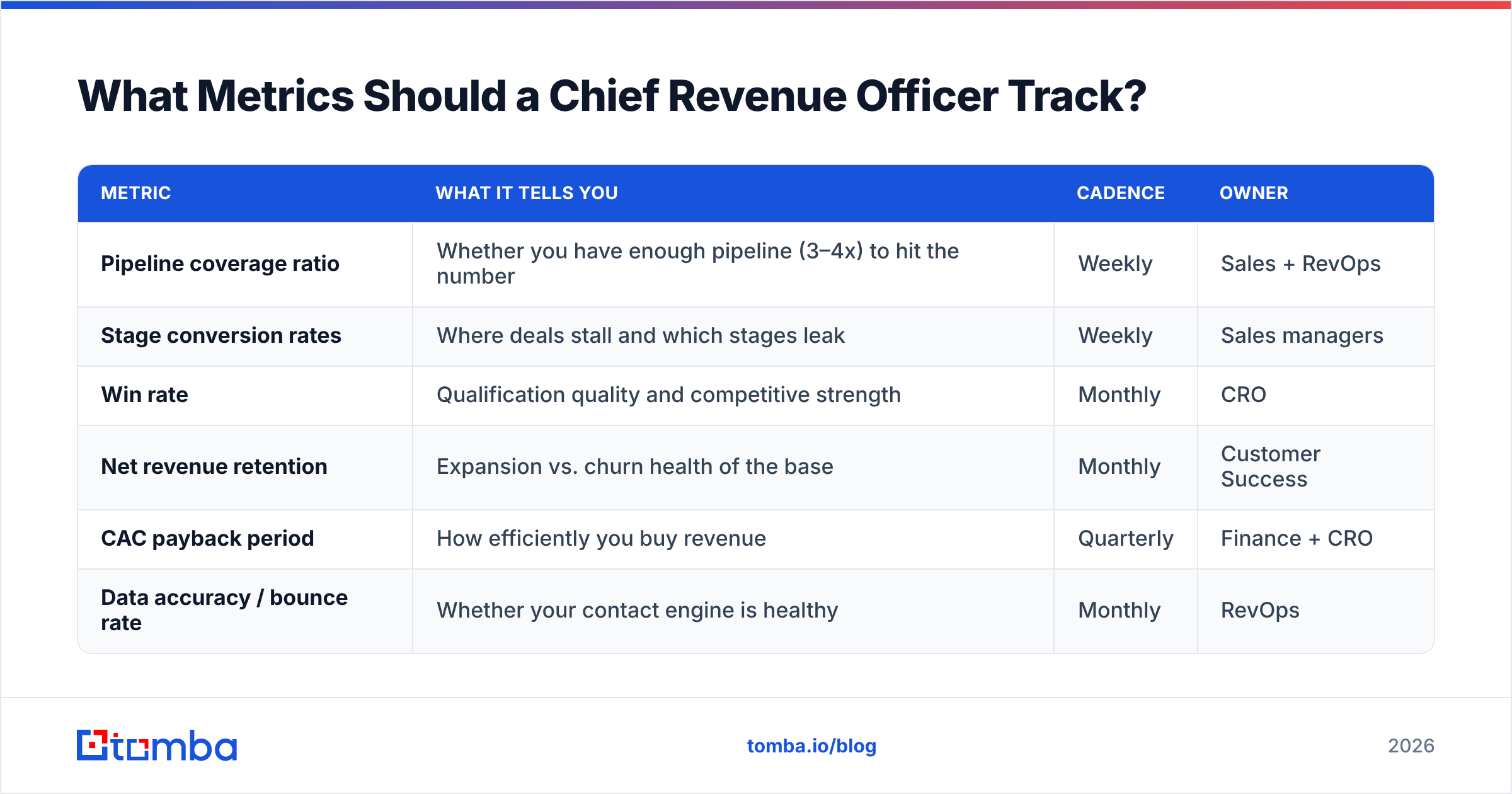
A CRO drowns in dashboards if they don't pick a tight set of leading and lagging indicators. The table below maps the metrics that actually drive decisions against why they matter and how often to inspect them.
| Metric | What It Tells You | Cadence | Owner |
|---|---|---|---|
| Pipeline coverage ratio | Whether you have enough pipeline (3–4x) to hit the number | Weekly | Sales + RevOps |
| Stage conversion rates | Where deals stall and which stages leak | Weekly | Sales managers |
| Win rate | Qualification quality and competitive strength | Monthly | CRO |
| Net revenue retention | Expansion vs. churn health of the base | Monthly | Customer Success |
| CAC payback period | How efficiently you buy revenue | Quarterly | Finance + CRO |
| Data accuracy / bounce rate | Whether your contact engine is healthy | Monthly | RevOps |
The mistake junior revenue leaders make is over-indexing on lagging metrics like bookings and win rate. Those tell you what already happened. The CRO's edge comes from the leading indicators — coverage and stage conversion — because those are the ones you can still influence this quarter. For a deeper definition, see how win rate interacts with qualification discipline.
How Does a CRO Build a Forecast the Board Trusts?#
Replace conviction with coverage math. A forecast built on "I feel good about this quarter" survives exactly until the first miss. A forecast built on pipeline coverage, historical stage conversion, and weekly deal inspection survives scrutiny.
The repeatable method:
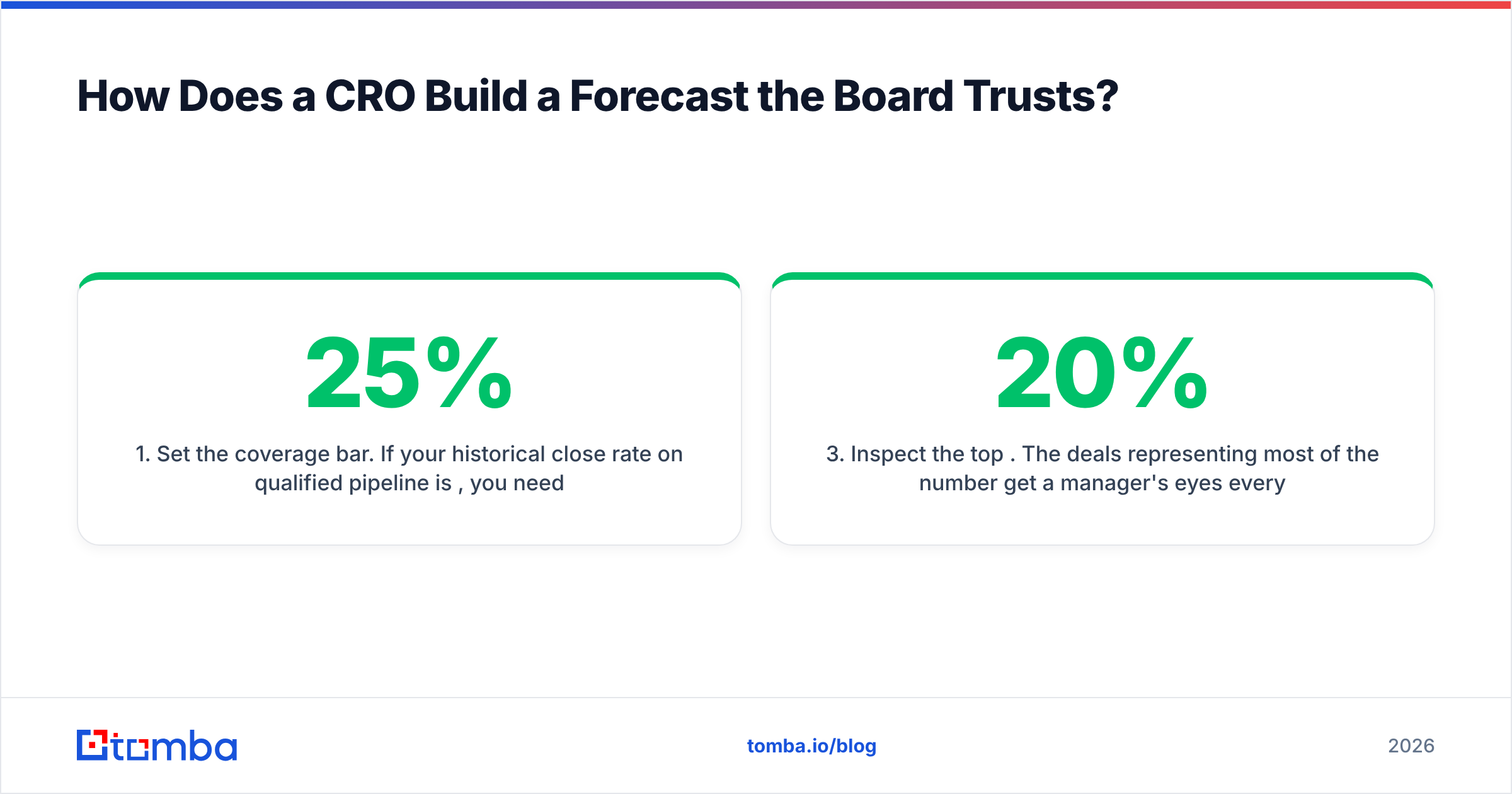
- Set the coverage bar. If your historical close rate on qualified pipeline is 25%, you need ~4x coverage to commit a number with confidence.
- Weight by stage, not by hope. Apply real, historical conversion rates to each stage instead of rep optimism.
- Inspect the top 20%. The deals representing most of the number get a manager's eyes every week — MEDDIC, gap analysis, whatever framework you run.
- Reconcile three views. Compare the rep commit, the manager roll-up, and the data-driven model. When they disagree, that's your risk list.
This is also where data quality loops back in. A forecast assumes the accounts in your pipeline are real, reachable, and correctly sized. If half your "engaged" accounts have stale decision-maker data, your weighted pipeline is fiction. Tools like a B2B database and reliable contact discovery keep the inputs honest so the model output means something.
What Are the Different CRO Operating Models?#
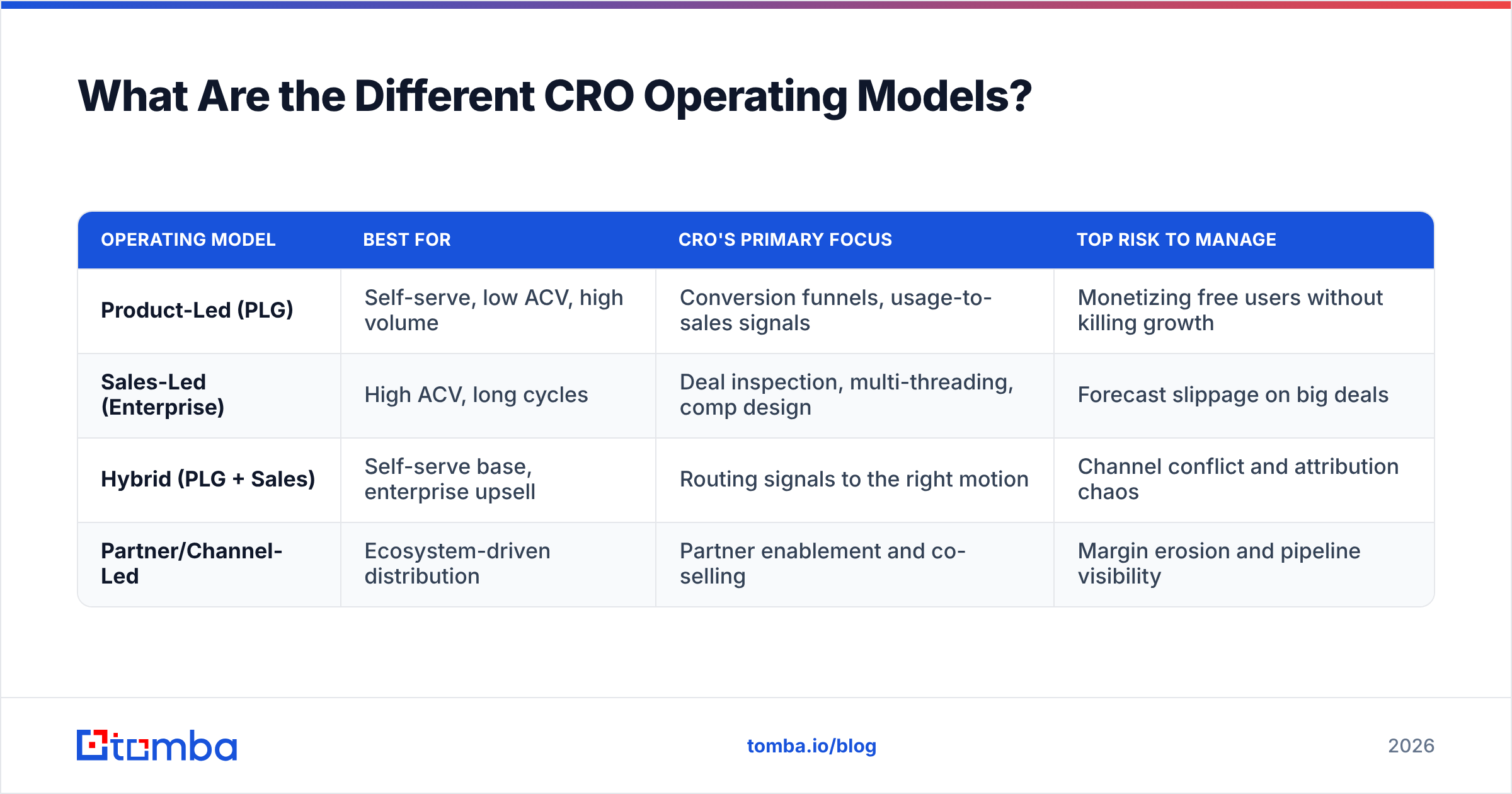
There's no universal CRO playbook — the right behaviors depend on your go-to-market motion. Forcing an enterprise playbook onto a product-led business (or vice versa) is how good leaders fail in the wrong seat.
| Operating Model | Best For | CRO's Primary Focus | Top Risk to Manage |
|---|---|---|---|
| Product-Led (PLG) | Self-serve, low ACV, high volume | Conversion funnels, usage-to-sales signals | Monetizing free users without killing growth |
| Sales-Led (Enterprise) | High ACV, long cycles | Deal inspection, multi-threading, comp design | Forecast slippage on big deals |
| Hybrid (PLG + Sales) | Self-serve base, enterprise upsell | Routing signals to the right motion | Channel conflict and attribution chaos |
| Partner/Channel-Led | Ecosystem-driven distribution | Partner enablement and co-selling | Margin erosion and pipeline visibility |
The best practice here is honesty about which column you're actually in — not which one is trendiest. A CRO who runs disciplined deal inspection in an enterprise motion, or tight funnel instrumentation in a PLG motion, will outperform the one chasing a model that doesn't fit the business.
How Should a CRO Design Compensation Plans?#
Compensation is the steering wheel of the revenue org — it determines where sellers point their effort regardless of what your strategy deck says. Design it as carefully as you'd design the product.
Three rules that hold across motions:
- Pay for outcomes you can attribute. If you want expansion revenue, put expansion in the plan. If you want multi-year deals, reward term. Vague plans produce vague behavior.
- Keep it simple enough to recite. If a rep can't explain their plan in two sentences, they'll optimize for the parts they understand and ignore the rest.
- Audit quarterly for unintended incentives. Comp plans always get gamed eventually; the question is whether you catch it in a quarter or a year.
HubSpot's research on sales compensation reinforces the point: the plans that scale are the ones tied to a small number of metrics the seller directly controls. Complexity is where alignment goes to die.
What Tools Belong in a Modern CRO's Stack?#
A CRO doesn't need fifty tools — they need a connected system with no gaps in the revenue lifecycle. The non-negotiable layers:
- CRM as the system of record (Salesforce, HubSpot).
- Data and enrichment to keep that CRM accurate — contact discovery, verification, and phone finder coverage for outbound.
- Engagement for sequencing and outreach.
- Revenue intelligence for forecasting and deal inspection.
- Analytics for the single revenue scoreboard.
You can compare options on a marketplace like G2, but the integration matters more than any single logo. The CRO's job is to ensure data flows cleanly between layers — a best-in-class forecasting tool fed by stale CRM data still produces a bad forecast.
The Bottom Line for Revenue Leaders#
The best practices of a chief revenue officer in 2026 come down to one theme: discipline beats charisma. Align the teams on one number, run a tight operating rhythm, design comp that points effort the right way — and underneath all of it, refuse to tolerate bad data. Every alignment problem, forecast miss, and wasted rep hour eventually traces back to inputs you could have cleaned.
That's where your revenue engine either compounds or quietly bleeds. If your team is operating on stale contact data, no dashboard or comp plan will close the gap. Start by fixing the inputs: use the Tomba Email Finder to source verified, current decision-maker emails by domain, name, or company — and give every GTM team the clean data the rest of these best practices depend on. Check the Tomba pricing plans to match the volume your revenue org actually runs at.
// get started
Find, verify and enrich your first contacts today
Start on the free plan with 25 searches a month, then scale when your team is ready.
Free plan · No credit card required · GDPR & CCPA
// about the author