Best Sales Content Management Software in 2026: Top 9 Picks
Compare the best sales content management software of 2026 — features, pricing, and which tool fits reps, enablement teams, and RevOps. Plus the data layer most teams forget.
Your reps don't lose deals because they lack a pitch deck. They lose deals because they can't find the right deck, send a stale version, or have no idea the prospect opened it three times last night. That is the exact gap sales content management software is built to close.
This guide compares the best sales content management software in 2026 — what each tool actually does, what it costs, and which type of team it fits. At the end, we cover the part most "best CMS" lists skip: the contact data layer that decides whether all that beautiful, well-governed content ever reaches a real buyer.
TL;DR#
- Sales content management software centralizes, governs, and tracks the assets reps use to sell — decks, one-pagers, case studies, demos, and email templates — and tells you what's actually working.
- The best fit depends on your team: Highspot and Seismic for large enablement orgs, Showpad for field sales, HubSpot for SMB go-to-market, Paperflite and Mediafly for mid-market.
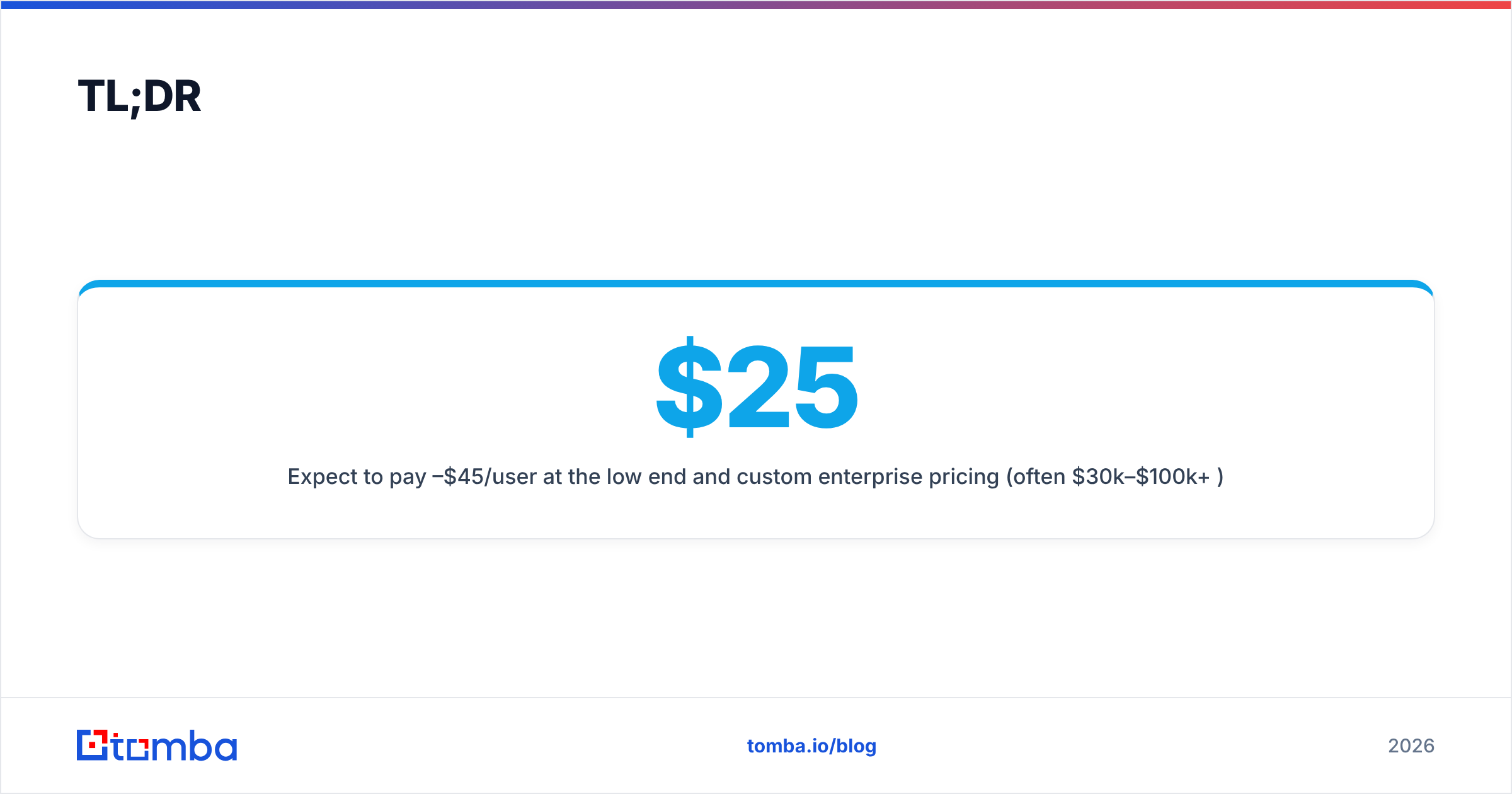
- Expect to pay $25–$45/user/mo at the low end and custom enterprise pricing (often $30k–$100k+/yr) for the big platforms.
- Content engagement analytics — not storage — is the feature that separates a real sales CMS from a glorified shared drive.
- None of it converts if your outreach lands in the void. Pair your CMS with accurate contact data from a tool like the Tomba Email Finder so the content reaches verified inboxes.
What is sales content management software?#
Sales content management software is a system for storing, organizing, distributing, and measuring the content your sales team uses to move deals forward. Think of it as the difference between a kitchen junk drawer and a professional mise en place: the same knives exist in both, but only one lets you cook fast under pressure.
A modern sales CMS does four jobs:
- Centralize — one source of truth for every approved asset, version-controlled so reps never send the 2023 pricing sheet.
- Surface — AI-assisted search and recommendations that put the right asset in front of the rep at the right deal stage.
- Distribute — trackable links, microsites, and CRM-embedded sharing so content goes out branded and consistent.
- Measure — engagement analytics showing what buyers open, skim, forward, and ignore.
That fourth job is the whole point. A document repository tells you a file exists. A sales CMS tells you the VP of Finance spent four minutes on slide 7 (the ROI math) and forwarded it to two colleagues. One is storage; the other is a buying signal.
)
What features matter most in a sales CMS?#
Not every "content management" feature earns its line item. Here's where to focus:
- Content engagement analytics — per-asset, per-buyer tracking. The single highest-impact feature.
- CRM integration — native sync with Salesforce, HubSpot, or Pipedrive so reps never leave their workflow.
- AI recommendations & search — surfaces the next best asset based on deal stage, industry, and persona.
- Version control & governance — auto-expiry, approval workflows, and brand locks so nothing off-message ships.
- Buyer-facing digital sales rooms — shareable microsites that bundle content per opportunity.
- Guided selling & playbooks — context-aware coaching baked into the content layer.
If a platform nails analytics, governance, and CRM integration, the rest is gravy. If it only nails storage and search, you bought a fancier Google Drive.
What is the best sales content management software in 2026?#
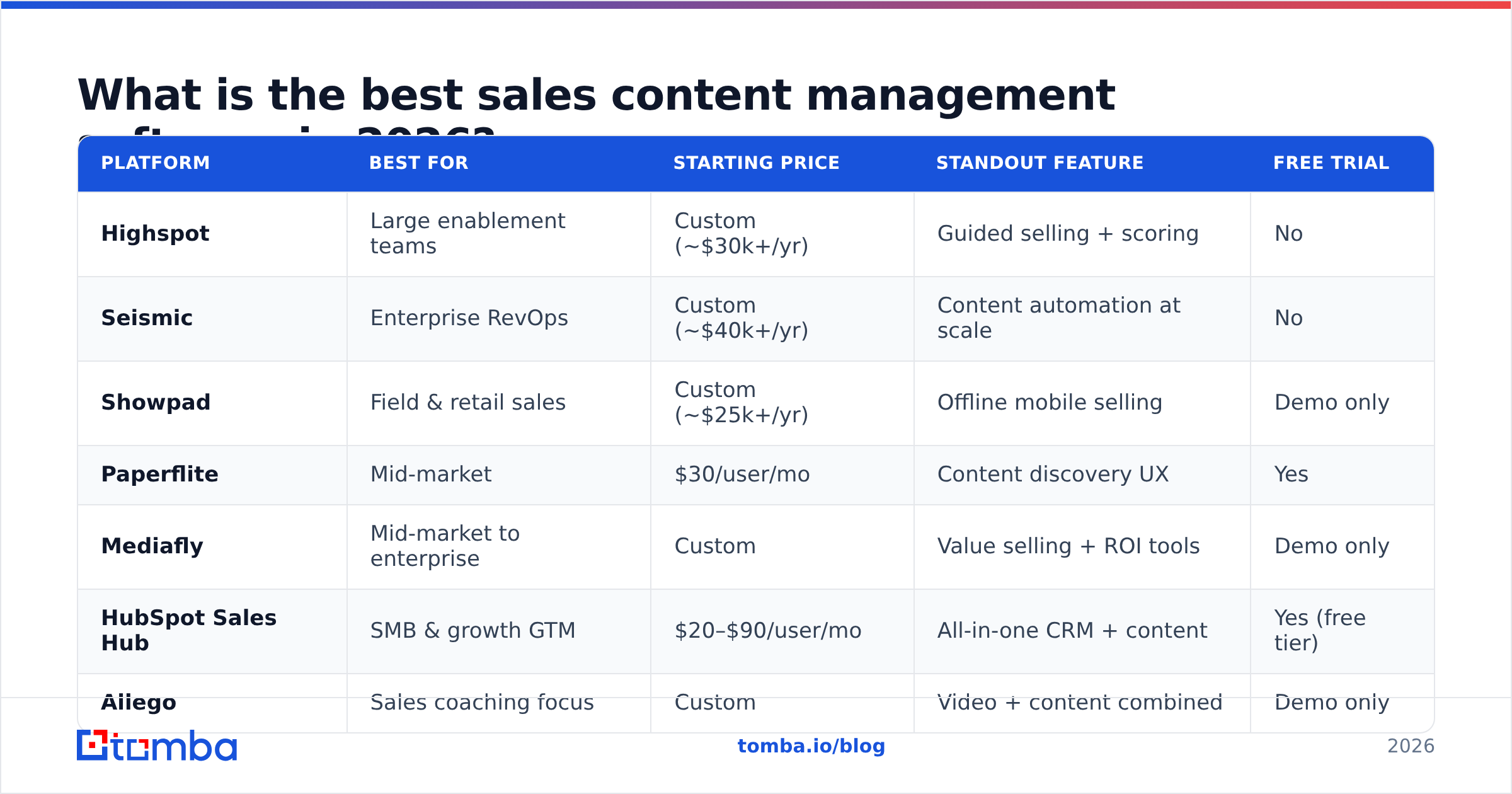
Here are nine platforms worth shortlisting, grouped loosely by who they serve. Pricing reflects publicly available 2026 figures and vendor quotes; enterprise tiers are almost always custom, so treat the numbers as directional and confirm on a demo.
| Platform | Best for | Starting price | Standout feature | Free trial |
|---|---|---|---|---|
| Highspot | Large enablement teams | Custom (~$30k+/yr) | Guided selling + scoring | No |
| Seismic | Enterprise RevOps | Custom (~$40k+/yr) | Content automation at scale | No |
| Showpad | Field & retail sales | Custom (~$25k+/yr) | Offline mobile selling | Demo only |
| Paperflite | Mid-market | $30/user/mo | Content discovery UX | Yes |
| Mediafly | Mid-market to enterprise | Custom | Value selling + ROI tools | Demo only |
| HubSpot Sales Hub | SMB & growth GTM | $20–$90/user/mo | All-in-one CRM + content | Yes (free tier) |
| Allego | Sales coaching focus | Custom | Video + content combined | Demo only |
| Bigtincan | Distributed teams | Custom | AI-driven automation | Demo only |
| DocSend | Solo / small teams | $15–$45/user/mo | Lightweight doc tracking | Yes |
Highspot#
The category leader for enablement-mature orgs. Highspot pairs content management with guided selling, training, and analytics in one platform. The trade-off is cost and onboarding weight — it's overkill for a five-rep team, ideal for a 200-rep one. See independent reviews on G2 before committing.
Seismic#
The enterprise heavyweight. Seismic's strength is content automation — personalizing decks and documents at scale using live CRM data. If you generate thousands of tailored assets a month, few tools match it. Expect a real implementation project, not a weekend setup.
Showpad#
Built with field and retail sellers in mind. Showpad's offline mode and mobile-first experience make it a favorite for reps who sell on factory floors and showroom visits, not just Zoom.
Paperflite & Mediafly#
The mid-market sweet spot. Paperflite wins on a genuinely pleasant content-discovery interface; Mediafly leans into value selling with built-in ROI and TCO calculators that help reps build the business case live.
HubSpot Sales Hub#
The pragmatic pick for SMBs and growth teams already living in HubSpot. Content tracking, document analytics, templates, and snippets sit right inside the CRM. It's not a dedicated enablement platform, but for most teams under 50 reps it's enough — and you avoid stitching two systems together. Tomba's own HubSpot integration pushes verified contacts straight in, so the content has someone to go to.
DocSend, Allego & Bigtincan#
DocSend is the lightweight choice for founders and small teams who just need trackable links and notifications. Allego folds video coaching into content. Bigtincan leans hard on AI automation for large, distributed sales forces.
How much does sales content management software cost?#
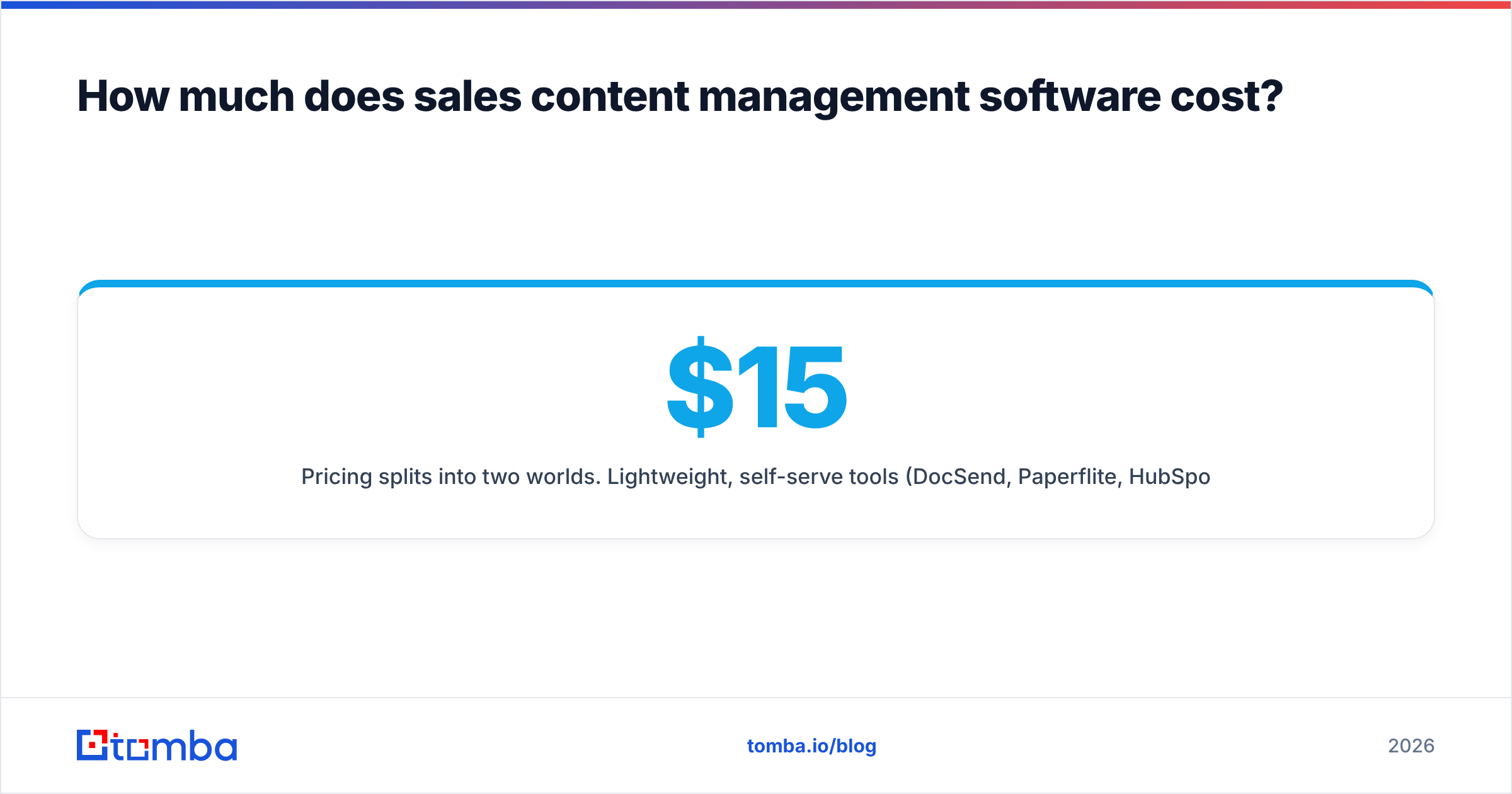
Pricing splits into two worlds. Lightweight, self-serve tools (DocSend, Paperflite, HubSpot Sales Hub) publish per-seat pricing in the $15–$45/user/mo range. Enterprise enablement platforms (Highspot, Seismic, Showpad, Mediafly, Bigtincan) gate pricing behind sales and typically land between $30,000 and $100,000+ per year, scaling with seat count, modules, and integrations.
A useful budgeting rule: the platform license is rarely the full cost. Add implementation, content migration, admin time, and the inevitable integration work. Analyst firms like Gartner track this market under "revenue enablement platforms" if you want third-party benchmarks before a procurement conversation.
How do I choose the right sales CMS for my team?#
Match the tool to your stage, not to the loudest G2 badge. Use these questions as a filter:
- How many reps? Under 25 → HubSpot, DocSend, or Paperflite. Over 100 → Highspot, Seismic, or Bigtincan.
- What's your primary pain? Findability → search-first tools. Off-brand sending → governance-first tools. "We have no idea what works" → analytics-first tools.
- Where do reps live? If they never leave the CRM, native integration beats a standalone portal every time.
- Do you sell offline or in the field? Showpad's offline mode is a genuine differentiator.
- What's your enablement maturity? No dedicated enablement function yet? Don't buy Seismic. You'll use 10% of it.
Run a 30-day pilot with real deals before signing anything annual. Adoption — not feature count — determines ROI. The most powerful platform your reps refuse to open is worth less than the simple one they use daily.
Why does contact data make or break your sales content?#
Here's the uncomfortable truth most enablement vendors won't put in their pitch: the best-managed, best-tracked, most beautifully governed content on earth is worthless if it never reaches a real human.
)
Your sales CMS optimizes the content side of outreach. It does nothing for the contact side. If your reps are pushing immaculate decks to bounced emails, generic info@ addresses, or contacts who left the company eight months ago, your engagement analytics will quietly flatline — and you'll blame the content.
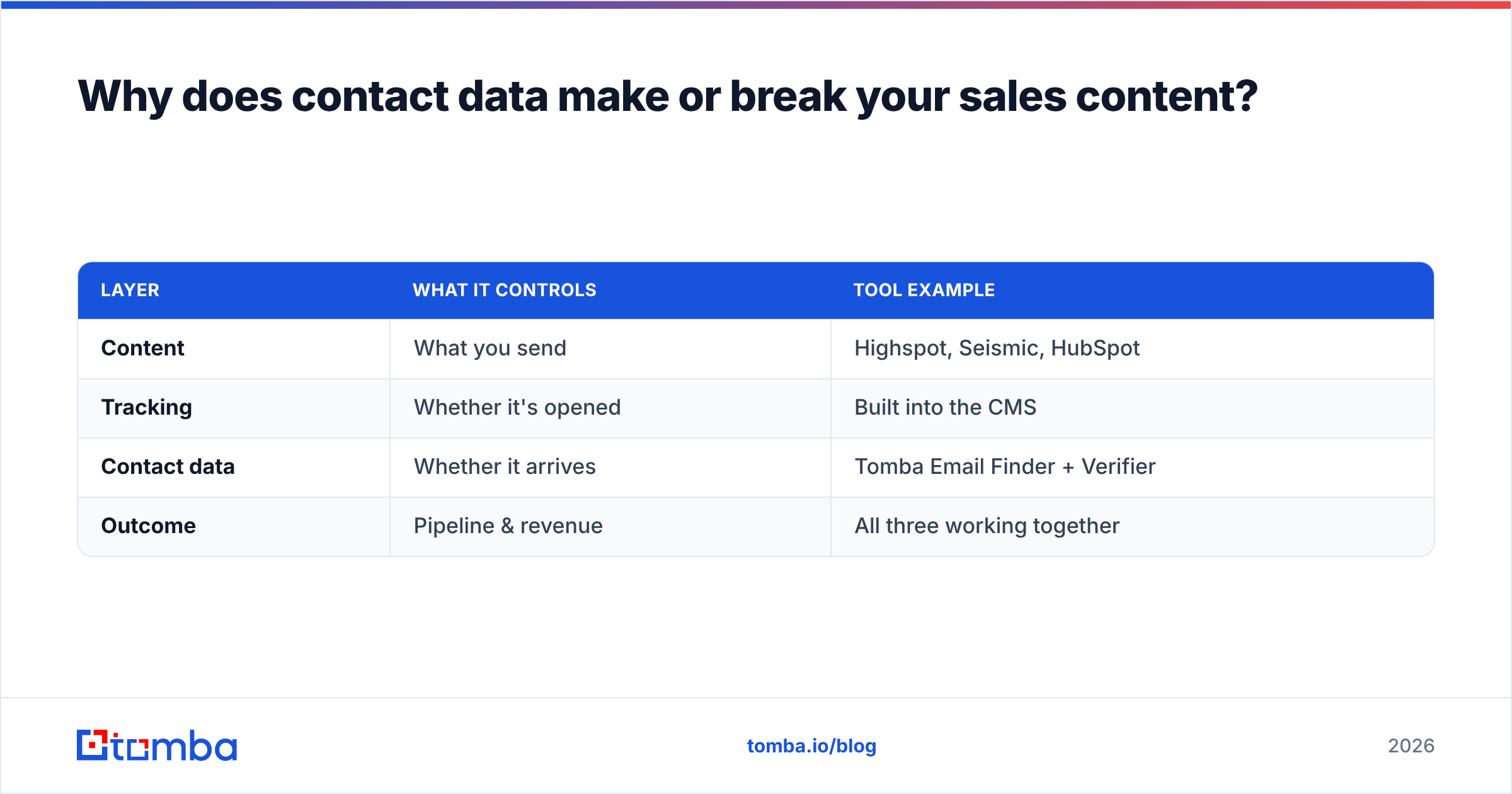
This is where a clean data layer turns a content system into a revenue system:
- Reach the right person — use a domain search to find decision-makers at target accounts, not whoever's email you happened to scrape.
- Stop the bounces — run lists through an email verifier so trackable content links actually land. Bounces wreck your sender reputation and your email deliverability alongside it.
- Enrich what you have — data enrichment fills the firmographic and role gaps that make personalization (and AI content recommendations) accurate instead of generic.
Think of it like a world-class restaurant with no street address. The food is perfect; nobody can find the door. Your CMS is the kitchen. Verified contact data is the address.
| Layer | What it controls | Tool example |
|---|---|---|
| Content | What you send | Highspot, Seismic, HubSpot |
| Tracking | Whether it's opened | Built into the CMS |
| Contact data | Whether it arrives | Tomba Email Finder + Verifier |
| Outcome | Pipeline & revenue | All three working together |
The teams that win in 2026 stop treating these as separate purchases. They wire the CMS, the CRM, and the data layer into one motion: find the verified contact, enrich it, send governed content, track engagement, repeat.
Frequently asked questions#
Is sales content management software the same as a DAM? No. A digital asset management (DAM) tool stores and organizes creative files for marketing. A sales CMS is purpose-built for the selling motion: deal-stage recommendations, CRM sync, buyer engagement tracking, and rep enablement. They overlap on storage but diverge sharply on intent.
Do I need a sales CMS if I already use a CRM? Often yes. Your CRM tracks the deal; a sales CMS manages the content that advances it. That said, all-in-one platforms like HubSpot Sales Hub blur the line and may be enough for smaller teams.
What's the fastest ROI feature? Content engagement analytics. Knowing which assets correlate with closed deals lets you kill the dead weight and double down on winners within a quarter.
How does contact data fit in? The CMS handles the asset; accurate contact data handles the recipient. Pairing the two — verified emails plus governed content — is what actually moves pipeline. You can compare Tomba plans to see where the data layer fits your budget.
The bottom line#
The best sales content management software in 2026 isn't a single product — it's the one that matches your team size, sales motion, and enablement maturity. Big enablement orgs lean Highspot or Seismic; growth teams thrive on HubSpot; field sellers love Showpad; lean teams ship fast with Paperflite or DocSend.
But pick whatever CMS you like and it still rests on one assumption: that your content reaches real, reachable buyers. Before you spend $40k a year perfecting how content is stored and tracked, make sure the contacts on the other end are real. Start free with the Tomba Email Finder — find and verify decision-maker emails by name, company, or domain, push them straight into your CRM, and give your shiny new sales CMS an actual audience. The Free tier includes 25 searches a month, with paid plans from $49/mo when you scale. Great content deserves a real inbox.
// get started
Find, verify and enrich your first contacts today
Start on the free plan with 25 searches a month, then scale when your team is ready.
Free plan · No credit card required · GDPR & CCPA
// about the author