Best Sales CRM Tools in 2026: Compare the Top 8 Platforms
A neutral, hands-on breakdown of the best sales CRM tools in 2026 — pricing, automation, data quality, and which platform fits your team size.
Picking a sales CRM in 2026 is less about features on a checklist and more about which platform your reps will actually use every day — and how clean the data flowing into it is. Below is a practical, vendor-neutral comparison of the best sales CRM tools, what each one does well, where it falls short, and how to match a CRM to your team size and budget.
TL;DR#
- Best all-rounder for SMBs: HubSpot — generous free tier, easy onboarding, gets expensive fast at scale.
- Best for enterprise customization: Salesforce — endless flexibility, but you pay for admins and consultants.
- Best for visual pipeline simplicity: Pipedrive — built by salespeople, for salespeople.
- Best value mid-market pick: Zoho CRM — deep feature set at a fraction of Salesforce pricing.
- The hidden multiplier: No CRM fixes bad contact data. Pair your CRM with a reliable email finder and verifier so reps aren't chasing dead records.
What is a sales CRM and what should it actually do?#
A sales CRM is the shared memory of your revenue team. Think of it like the kitchen pass in a busy restaurant: every order (deal), its modifications (notes), and its status (stage) sit in one place so nobody serves the same table twice or drops a ticket. Technically, it's a system of record for contacts, companies, deals, and activities, with automation layered on top.
The best sales CRM tools in 2026 share a common core, but they differentiate on four things that matter more than logo grids suggest:
- Pipeline management — Can a rep see every open deal, its stage, and next step in under five seconds? Drag-and-drop boards beat dropdown menus.
- Automation depth — Workflow triggers, sequence enrollment, and task creation that remove manual busywork without a developer.
- Data enrichment and hygiene — How easily the CRM ingests accurate contact data, dedupes records, and flags stale ones. This is where most teams quietly bleed productivity.
- Reporting and forecasting — Dashboards leaders trust enough to run a pipeline review against.
If a tool nails the first two but ignores data quality, your reps end up emailing bounced addresses and your forecast inherits the noise. That gap is exactly why standalone data tools pair so well with any CRM.
)
Which are the best sales CRM tools in 2026?#
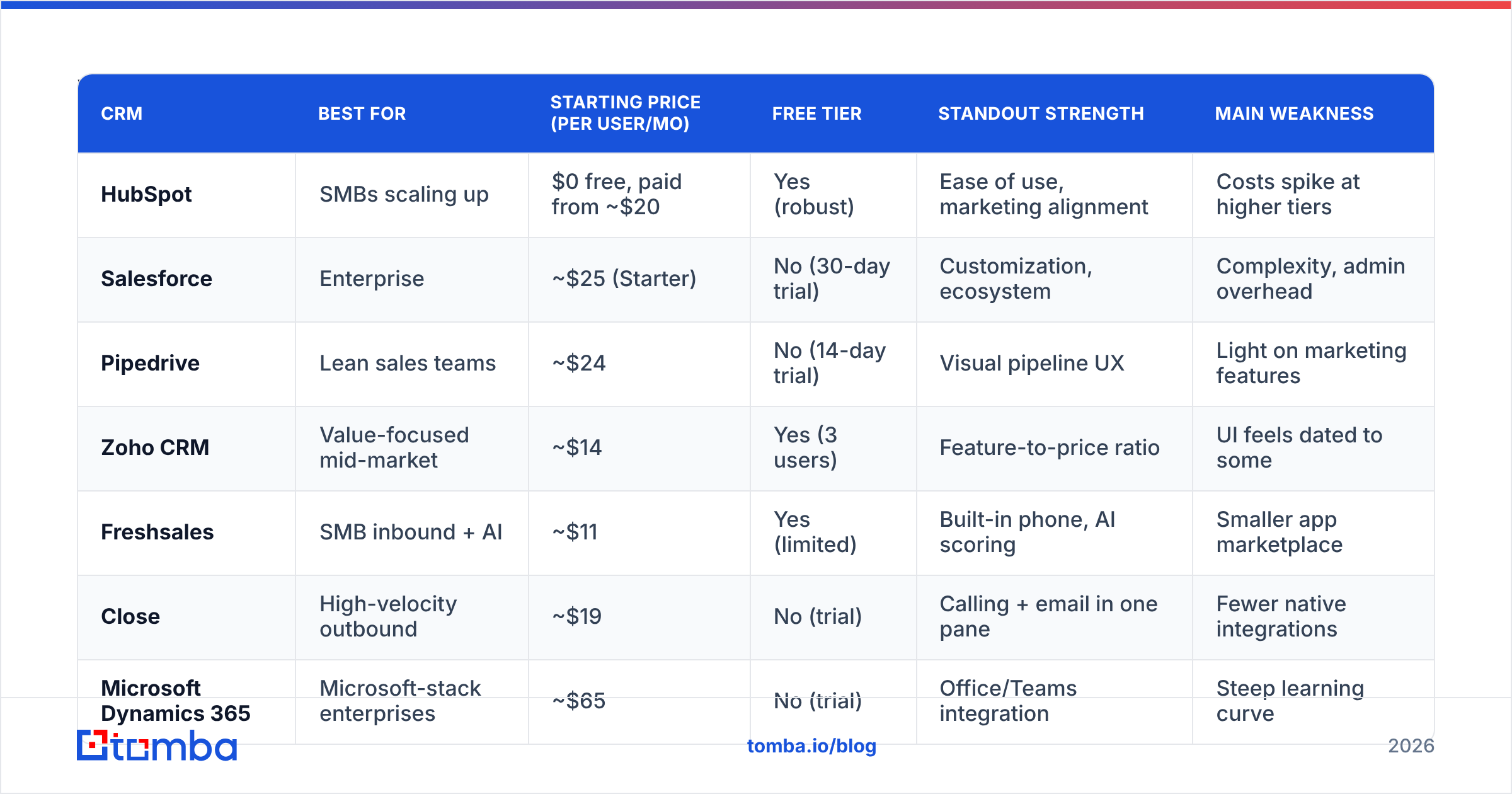
Here's the side-by-side comparison. Prices reflect per-user, billed-annually starting tiers as of 2026 and round to the nearest dollar; always confirm current rates on the vendor's own pricing page before you buy.
| CRM | Best for | Starting price (per user/mo) | Free tier | Standout strength | Main weakness |
|---|---|---|---|---|---|
| HubSpot | SMBs scaling up | $0 free, paid from ~$20 | Yes (robust) | Ease of use, marketing alignment | Costs spike at higher tiers |
| Salesforce | Enterprise | ~$25 (Starter) | No (30-day trial) | Customization, ecosystem | Complexity, admin overhead |
| Pipedrive | Lean sales teams | ~$24 | No (14-day trial) | Visual pipeline UX | Light on marketing features |
| Zoho CRM | Value-focused mid-market | ~$14 | Yes (3 users) | Feature-to-price ratio | UI feels dated to some |
| Freshsales | SMB inbound + AI | ~$11 | Yes (limited) | Built-in phone, AI scoring | Smaller app marketplace |
| Close | High-velocity outbound | ~$19 | No (trial) | Calling + email in one pane | Fewer native integrations |
| Microsoft Dynamics 365 | Microsoft-stack enterprises | ~$65 | No (trial) | Office/Teams integration | Steep learning curve |
| monday CRM | Cross-functional teams | ~$12 | Yes (limited) | Flexible, colorful boards | Not sales-purpose-built |
No single row wins every column. The right pick depends on team size, technical resources, and how much of your motion is inbound versus outbound.
Is HubSpot or Salesforce the better sales CRM?#
Short answer: HubSpot if you want speed-to-value, Salesforce if you want infinite control.
HubSpot earns its reputation with onboarding most reps finish in a day and a free tier that genuinely runs a small team. Its own product documentation leans into the all-in-one pitch — sales, marketing, and service under one roof. The catch is pricing gravity: the moment you need advanced automation, custom reporting, or more seats, you climb into Professional and Enterprise tiers where monthly bills jump quickly.
Salesforce is the opposite trade. It can model nearly any sales process you can describe, and its AppExchange ecosystem is unmatched. But that flexibility is also the tax — most serious Salesforce deployments need a dedicated admin or an outside consultant, and reviewers on G2 consistently flag the learning curve. For a 200-person revenue org with weird, branching processes, that overhead pays off. For an eight-person startup, it's a cannon to swat a fly.
A useful gut check: if you can't name who will own and maintain your CRM configuration, you are not ready for Salesforce yet.
What about Pipedrive, Zoho, and the mid-market options?#
These are the tools that win when "good enough and affordable" beats "everything and complicated."
- Pipedrive treats the pipeline as the hero. Its board is the cleanest in the category, and activity-based selling is baked into the philosophy. If your team's main job is moving deals through defined stages, it's hard to beat. It's thinner on native marketing and support features, so it suits sales-led orgs.
- Zoho CRM delivers the widest feature set per dollar. You get automation, forecasting, and a deep customization layer at entry pricing that undercuts the big two. The interface won't win design awards, but the value is real, especially if you already use other Zoho apps.
- Freshsales bundles a built-in phone dialer and AI-based contact scoring, which is handy for inbound SMB teams that don't want a separate calling tool.
- Close is purpose-built for high-velocity outbound teams that live in the dialer and inbox; calling, SMS, and email sit in one pane so reps don't tab-switch.
For most mid-market teams, the decision comes down to whether you value Pipedrive's focus or Zoho's breadth. Both are defensible. Neither will bankrupt you.
Why does CRM data quality matter more than the CRM itself?#
Because a CRM is only as good as the records inside it — and records decay fast.
Roughly a quarter to a third of B2B contact data goes stale every year as people change jobs, companies rebrand, and domains shift. That means within 12 months, a meaningful slice of your "best sales CRM tools" investment is pointing reps at addresses that bounce and phone numbers that ring nowhere. The platform isn't broken; the fuel is.
)
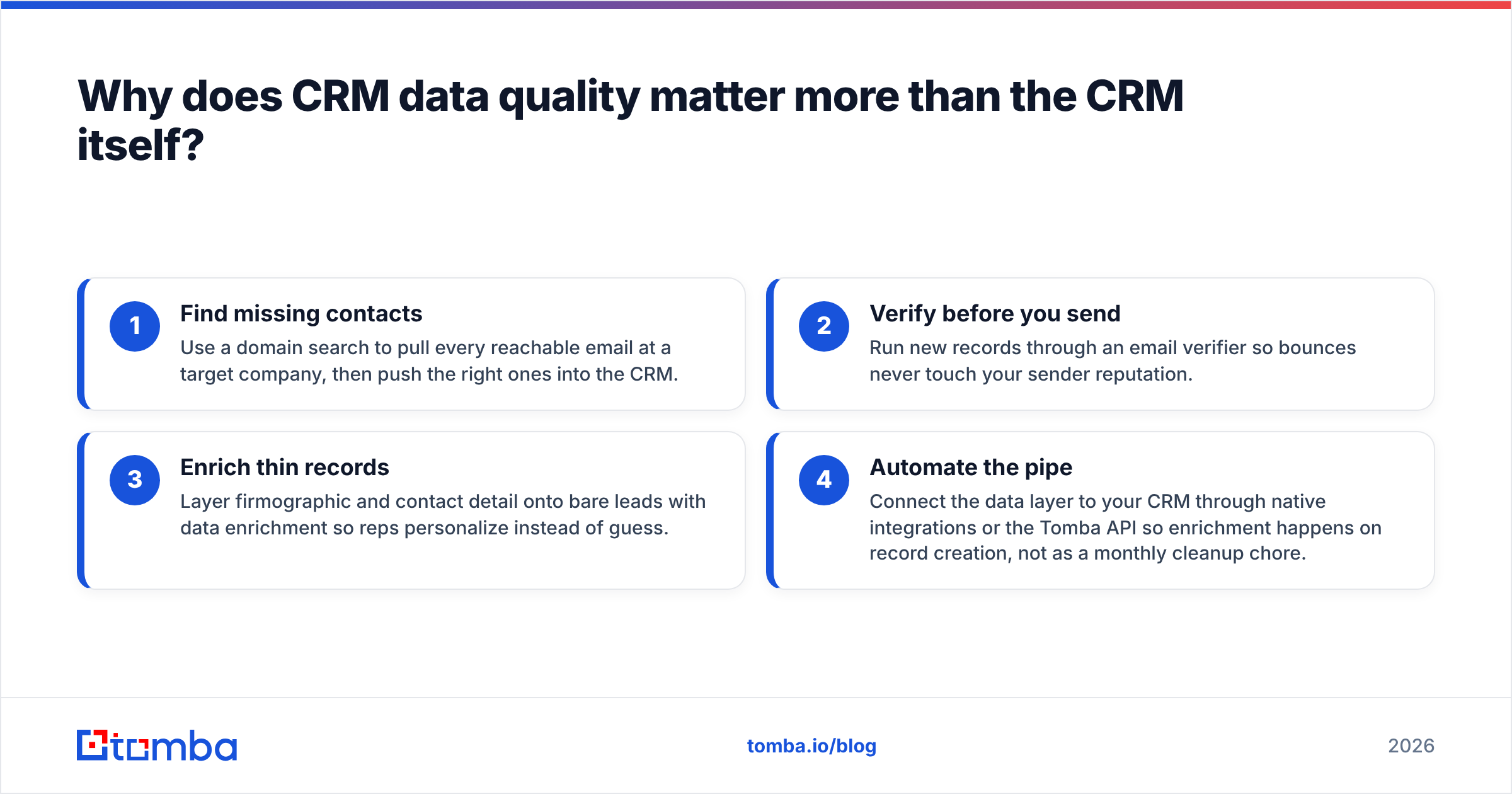
This is the part vendors gloss over. A CRM stores and routes data brilliantly. It does not, on its own, find missing email addresses, verify whether they're deliverable, or enrich a thin lead record into a full profile. For that you need a dedicated layer. A few ways teams close the gap:
- Find missing contacts — Use a domain search to pull every reachable email at a target company, then push the right ones into the CRM.
- Verify before you send — Run new records through an email verifier so bounces never touch your sender reputation.
- Enrich thin records — Layer firmographic and contact detail onto bare leads with data enrichment so reps personalize instead of guess.
- Automate the pipe — Connect the data layer to your CRM through native integrations or the Tomba API so enrichment happens on record creation, not as a monthly cleanup chore.
Treat data hygiene as a recurring process, not a one-time import. The cleanest CRM in your stack is the one with a verification step wired into intake.
How do you choose the right CRM for your team size?#
Match the tool to your stage, not to the biggest logo you can afford.
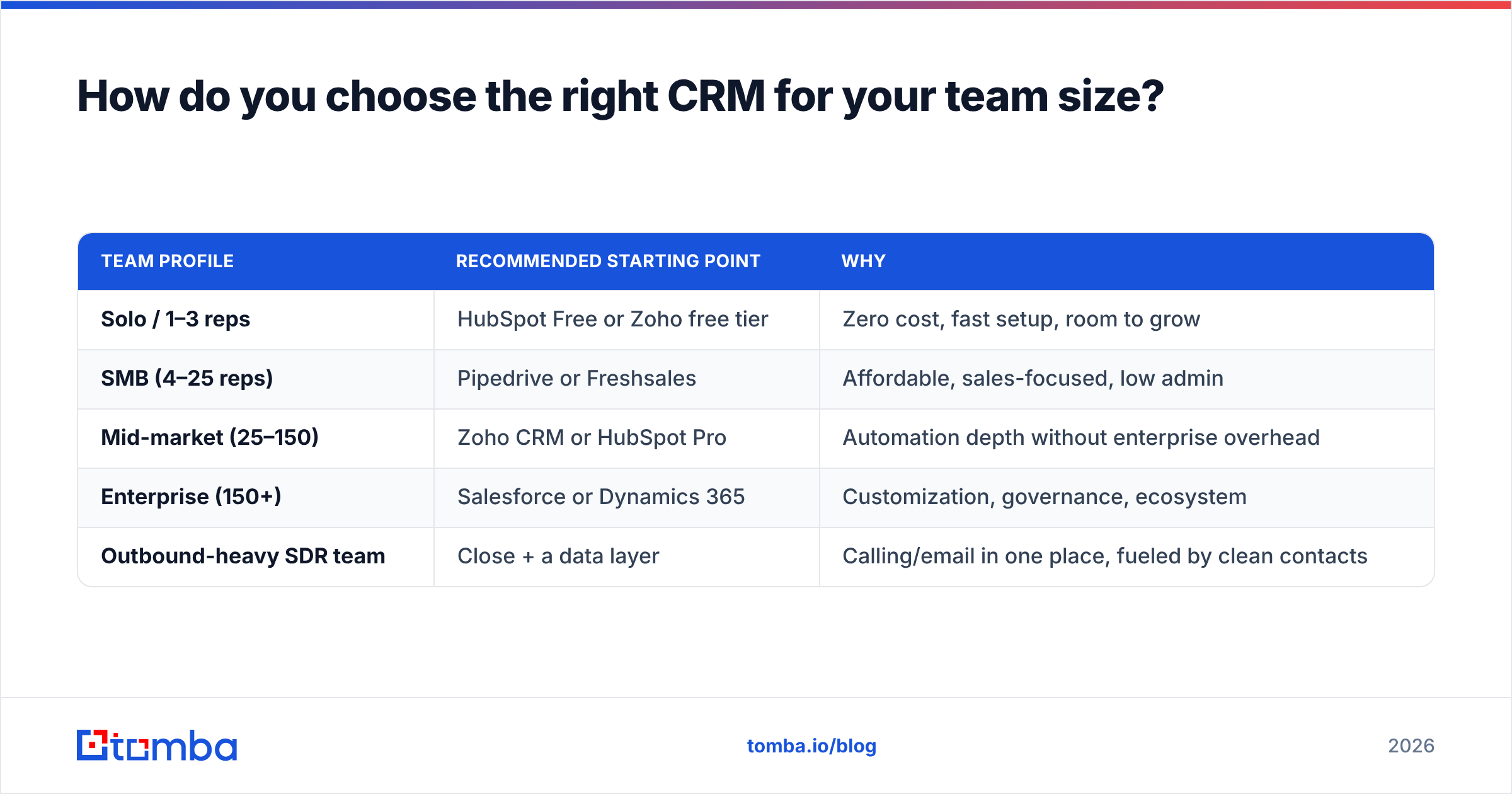
| Team profile | Recommended starting point | Why |
|---|---|---|
| Solo / 1–3 reps | HubSpot Free or Zoho free tier | Zero cost, fast setup, room to grow |
| SMB (4–25 reps) | Pipedrive or Freshsales | Affordable, sales-focused, low admin |
| Mid-market (25–150) | Zoho CRM or HubSpot Pro | Automation depth without enterprise overhead |
| Enterprise (150+) | Salesforce or Dynamics 365 | Customization, governance, ecosystem |
| Outbound-heavy SDR team | Close + a data layer | Calling/email in one place, fueled by clean contacts |
Three questions cut through most of the noise:
- Who maintains it? No dedicated admin means avoid heavyweight platforms.
- Where does your pipeline live today? If reps run on spreadsheets, prioritize a tool they'll adopt over one with the longest feature list.
- How will contacts get in and stay accurate? Decide your enrichment and verification workflow before you sign, not after the first bounce report.
A common, costly mistake is buying for the company you hope to be in three years. Buy for the team you have now; migrating CRMs is annoying but survivable, and most platforms scale a tier or two before you outgrow them.
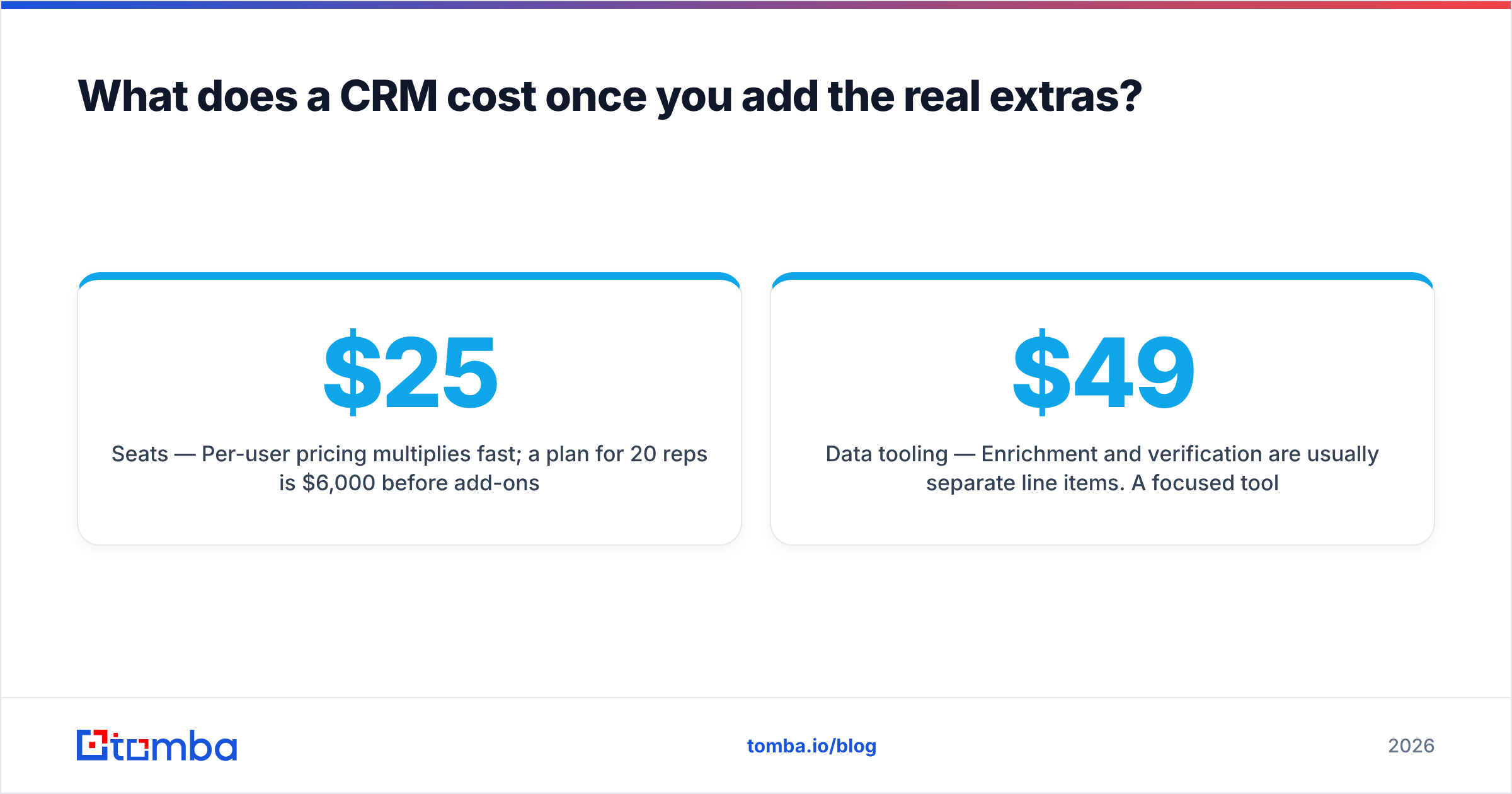
What does a CRM cost once you add the real extras?#
Sticker price is the down payment, not the total. Budget for the layers around it.
- Seats — Per-user pricing multiplies fast; a $25 plan for 20 reps is $6,000/year before add-ons.
- Add-on modules — Advanced reporting, AI features, and marketing tools often sit in higher tiers or cost extra.
- Implementation — Enterprise platforms may need consultants; budget for setup, not just subscriptions.
- Data tooling — Enrichment and verification are usually separate line items. A focused tool like Tomba covers finding and verifying contacts without the price of a full data suite; see Tomba pricing for tiers from a Free plan (25 searches/mo) up through Starter at $49/mo, Growth at $99/mo, and Pro at $249/mo.
Add those together and the cheapest-on-paper CRM isn't always cheapest in practice. A mid-tier CRM with a lean, accurate data layer often beats a premium CRM fed by stale records.
Frequently asked questions#
What is the best free sales CRM in 2026? HubSpot's free tier is the most capable for small teams, with Zoho's free plan (up to three users) a strong runner-up. Both let you run a real pipeline at zero cost before committing budget.
Do I need a separate email finder if my CRM has enrichment? Often yes. Native CRM enrichment tends to be shallow or pricey at scale. A dedicated email finder and verifier usually delivers higher match and deliverability rates for less, then feeds results straight into the CRM.
Is Salesforce overkill for a startup? Usually, yes. Unless you have unusual process complexity and someone to administer it, a lighter CRM like Pipedrive, HubSpot, or Zoho gets you selling faster with less overhead.
How often should CRM data be cleaned? Continuously is ideal — verify on record creation. At minimum, run a quarterly dedupe and verification pass to catch decay before it pollutes your forecast.
The bottom line#
The best sales CRM tools in 2026 aren't ranked by feature count — they're ranked by adoption and the quality of data inside them. HubSpot wins on ease, Salesforce on power, Pipedrive on focus, and Zoho on value. Pick the one your reps will actually open every morning, then make sure it never fills up with dead records.
That last part is where Tomba fits any stack. Before a contact ever lands in your CRM, run it through the Tomba Email Finder to source the right address and confirm it's deliverable — so your pipeline reflects real prospects, not bounce reports. Start on the free plan, wire it into your CRM, and let your reps spend their time selling instead of cleaning. Your forecast will thank you.
// get started
Find, verify and enrich your first contacts today
Start on the free plan with 25 searches a month, then scale when your team is ready.
Free plan · No credit card required · GDPR & CCPA
// about the author