Best Sales Forecasting Tools in 2026: Top 9 Compared
A neutral, hands-on breakdown of the best sales forecasting tools in 2026 — Clari, Gong, Salesforce, HubSpot and more — plus the data layer that actually makes them accurate.
Sales forecasting is the difference between a board meeting where you commit a number with confidence and one where you guess and hope. The right tooling turns a pile of CRM activity into a forecast you can actually defend — but only if the underlying data is clean. This guide ranks the best sales forecasting tools in 2026, shows where each one fits, and explains the part most "top tools" lists skip: garbage contact data quietly wrecks every forecast downstream.
TL;DR#
- Clari and Gong lead the enterprise pack for AI-driven, conversation-aware forecasting; expect custom pricing and a heavier rollout.
- Salesforce and HubSpot are the safe defaults when you want forecasting native to the CRM you already run.
- Pipedrive and Zoho win on price and simplicity for SMB and mid-market teams.
- Aviso and BoostUp are strong specialist picks for RevOps teams chasing forecast accuracy at scale.
- No tool forecasts well on dirty data — clean, enriched contact and account records are the prerequisite, not the afterthought.
What are sales forecasting tools?#
Sales forecasting tools predict future revenue by analyzing your pipeline, historical win rates, deal activity, and rep behavior. Think of them like a weather service for your revenue: they don't control the storm, but they read enough signals to tell you whether to pack an umbrella. Technically, they ingest CRM data, apply statistical or machine-learning models, and output a committed number with a confidence range.
Modern platforms go beyond a spreadsheet rollup. They score deals, flag pipeline that's slipping, and compare a rep's optimistic "commit" against what the data actually supports. The category overlaps heavily with revenue operations tooling, because accurate forecasting is really a RevOps discipline wearing a sales hat.
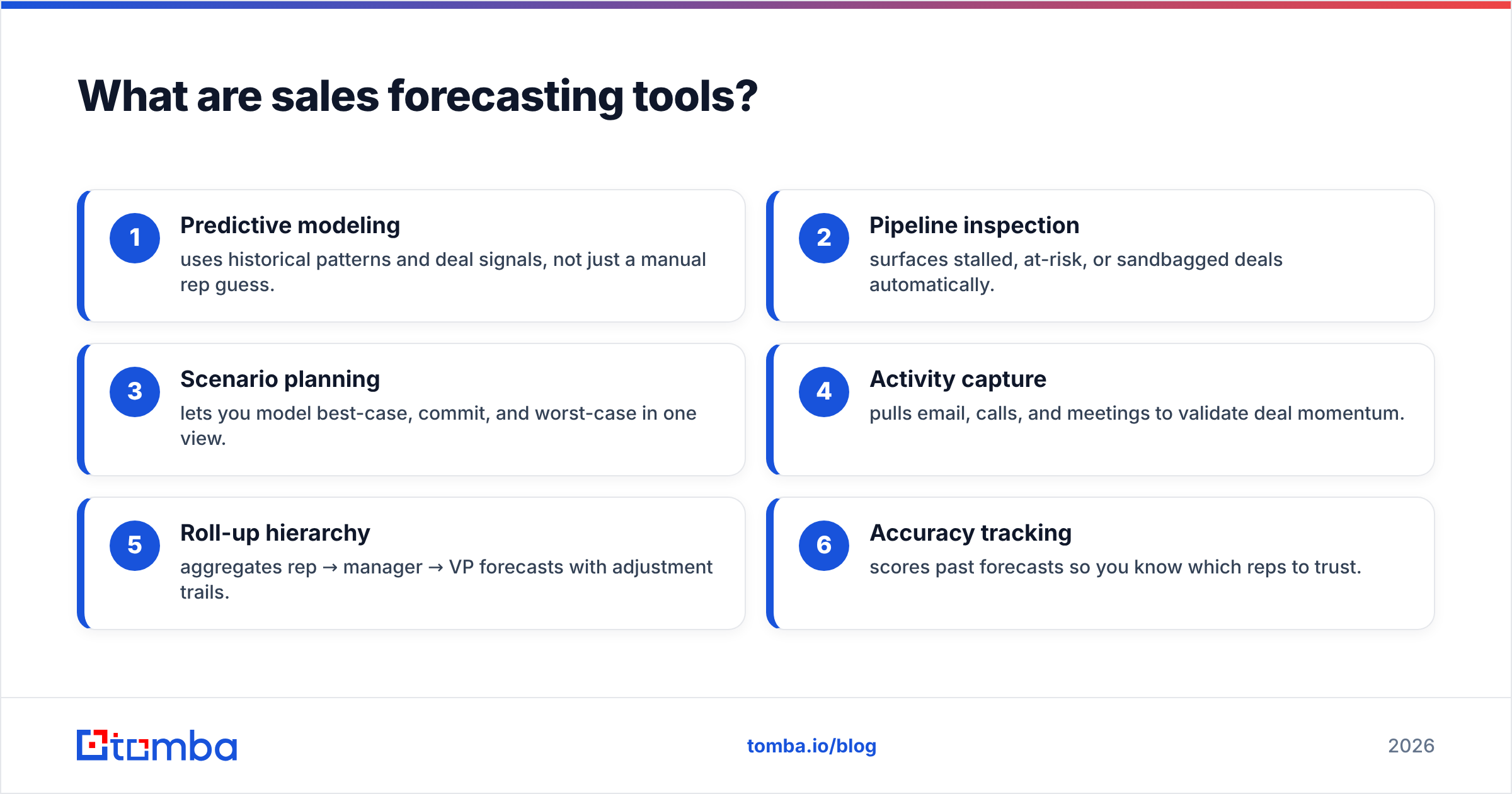
Here's what separates a real forecasting tool from a glorified report:
- Predictive modeling — uses historical patterns and deal signals, not just a manual rep guess.
- Pipeline inspection — surfaces stalled, at-risk, or sandbagged deals automatically.
- Scenario planning — lets you model best-case, commit, and worst-case in one view.
- Activity capture — pulls email, calls, and meetings to validate deal momentum.
- Roll-up hierarchy — aggregates rep → manager → VP forecasts with adjustment trails.
- Accuracy tracking — scores past forecasts so you know which reps to trust.
Why does forecast accuracy depend on data quality?#
The conclusion first: even the best model produces a wrong number if it's fed wrong data. Gartner and most RevOps leaders agree that CRM data decays roughly 20–30% per year as people change jobs, companies merge, and titles shift. A forecasting engine reading a pipeline full of dead contacts, duplicate accounts, and stale titles is confidently predicting from fiction.
This is the unglamorous layer. Before you spend $100k on an AI forecasting suite, your pipeline needs accurate contact records, deduplicated accounts, and verified decision-makers. That's where data enrichment and a reliable email finder earn their keep — they keep the records feeding your forecast current. A forecast built on a clean CRM is a forecast you can commit to.
What are the best sales forecasting tools in 2026?#
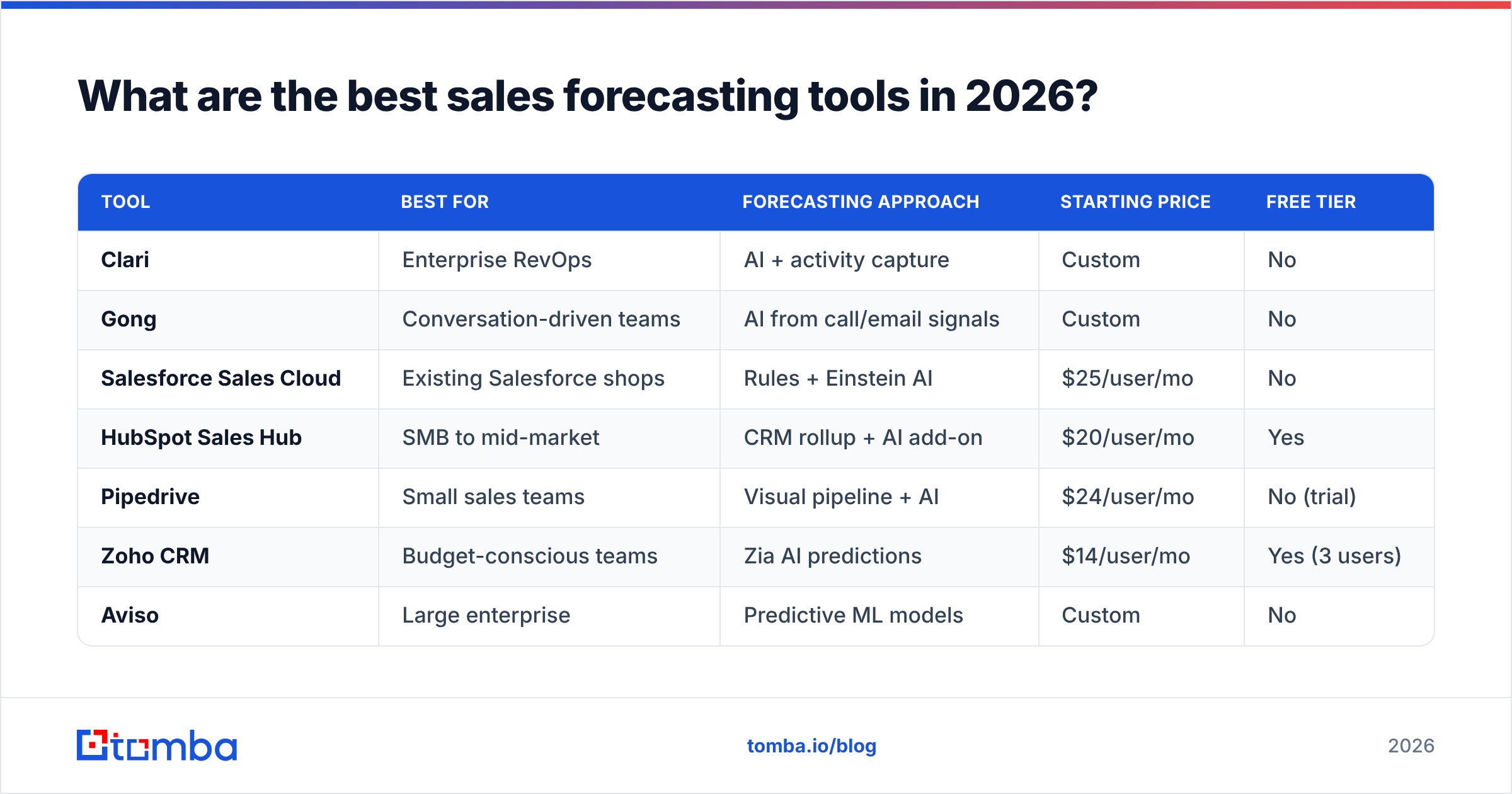
Below is a side-by-side comparison of the nine tools worth shortlisting this year. Pricing reflects publicly listed or commonly reported figures; enterprise quotes vary widely, so treat "Custom" as "book a call."
| Tool | Best for | Forecasting approach | Starting price | Free tier |
|---|---|---|---|---|
| Clari | Enterprise RevOps | AI + activity capture | Custom | No |
| Gong | Conversation-driven teams | AI from call/email signals | Custom | No |
| Salesforce Sales Cloud | Existing Salesforce shops | Rules + Einstein AI | $25/user/mo | No |
| HubSpot Sales Hub | SMB to mid-market | CRM rollup + AI add-on | $20/user/mo | Yes |
| Pipedrive | Small sales teams | Visual pipeline + AI | $24/user/mo | No (trial) |
| Zoho CRM | Budget-conscious teams | Zia AI predictions | $14/user/mo | Yes (3 users) |
| Aviso | Large enterprise | Predictive ML models | Custom | No |
| BoostUp | RevOps accuracy focus | Activity + ML scoring | Custom | No |
| Xactly Forecasting | Finance-aligned teams | Predictive + comp data | Custom | No |
Clari#
Clari pioneered the "revenue platform" framing and remains the reference standard for large enterprises. It auto-captures activity, ties it to deals, and produces a forecast that updates continuously instead of once a week in a spreadsheet. The tradeoff is cost and complexity — it's overkill for a five-rep team.
Gong#
Gong started as a conversation-intelligence tool and grew into forecasting by reading the signals inside calls and emails. If your deals live or die on what's said in meetings, Gong's forecast reflects sentiment and engagement that pure pipeline tools miss. Check current reviews on G2 before committing — the category moves fast.
Salesforce Sales Cloud#
If you already run Salesforce, its native forecasting plus Einstein AI is the path of least resistance. You avoid another integration, and the data stays in one place. Pair it with the Tomba Salesforce integration to keep contact records enriched and verified inside the same system that runs your forecast.
HubSpot Sales Hub#
HubSpot is the strongest pick for SMB and mid-market teams that want forecasting without enterprise overhead. The forecast tool is approachable, the free CRM tier lowers the entry barrier, and the AI features have matured. HubSpot's own sales forecasting guide is a decent primer even if you pick a different vendor.
Pipedrive, Zoho, and the SMB tier#
Pipedrive and Zoho CRM cover teams that need a credible forecast without a RevOps department. Pipedrive's visual pipeline makes weighted forecasting intuitive; Zoho's Zia AI undercuts almost everyone on price. Neither will satisfy a 200-rep org, but for a lean team they're more than enough.
Aviso, BoostUp, and Xactly#
These specialists target organizations where a one-point swing in win rate moves millions. Aviso and BoostUp lean hard into machine-learning accuracy and pipeline hygiene; Xactly ties forecasting to compensation data so finance and sales argue from the same numbers. Expect a longer evaluation and implementation cycle.
How do you choose the right forecasting tool?#
Start with conclusion, then criteria: pick the tool that matches your team size, your existing CRM, and your tolerance for setup — not the one with the flashiest AI demo.
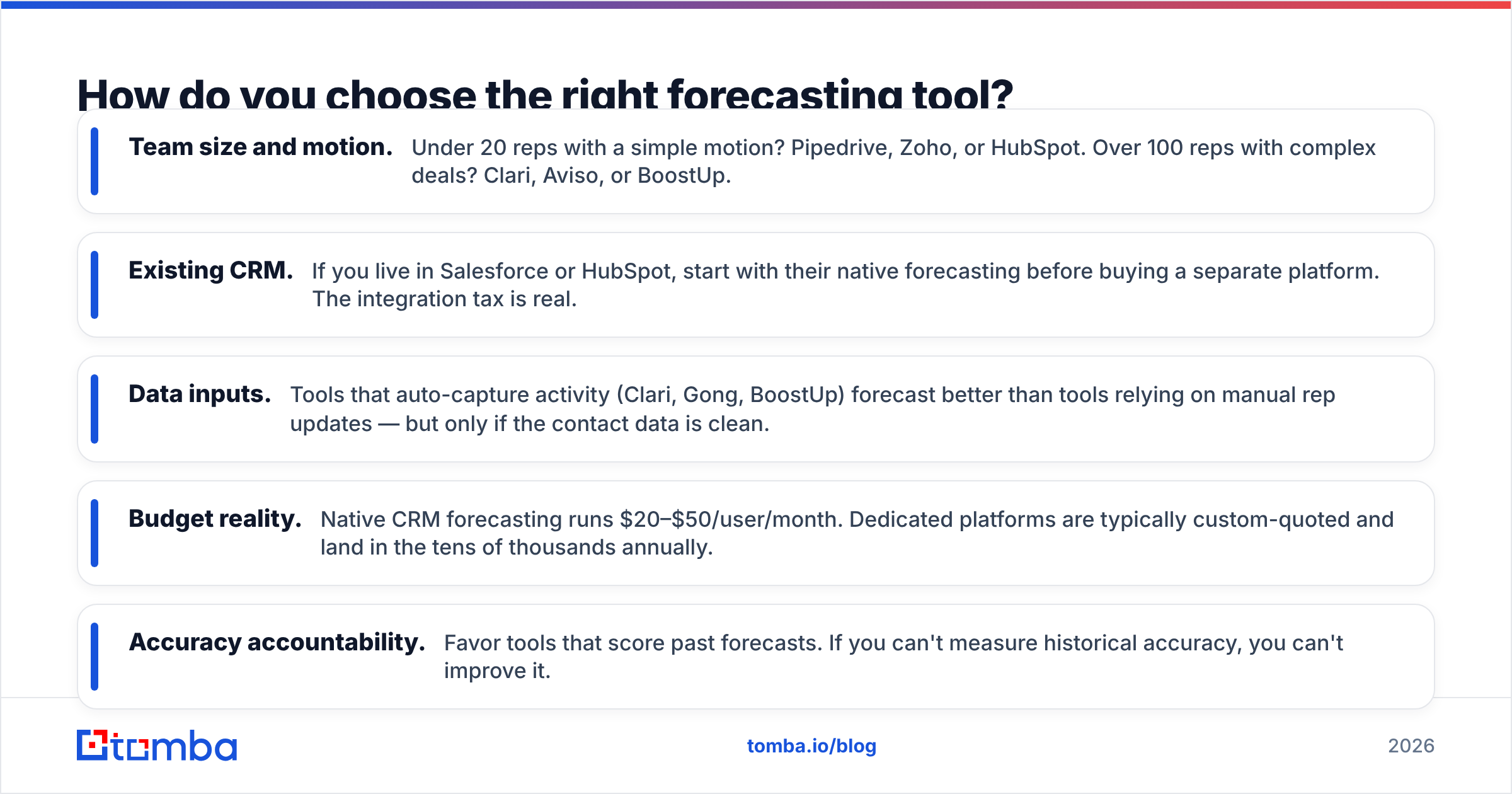
- Team size and motion. Under 20 reps with a simple motion? Pipedrive, Zoho, or HubSpot. Over 100 reps with complex deals? Clari, Aviso, or BoostUp.
- Existing CRM. If you live in Salesforce or HubSpot, start with their native forecasting before buying a separate platform. The integration tax is real.
- Data inputs. Tools that auto-capture activity (Clari, Gong, BoostUp) forecast better than tools relying on manual rep updates — but only if the contact data is clean.
- Budget reality. Native CRM forecasting runs $20–$50/user/month. Dedicated platforms are typically custom-quoted and land in the tens of thousands annually.
- Accuracy accountability. Favor tools that score past forecasts. If you can't measure historical accuracy, you can't improve it.
A useful gut check: if two vendors look equal, choose the one that makes it easiest to keep your underlying data accurate. The model is a commodity; clean data is the moat.
Are expensive AI forecasting tools worth it?#
Sometimes — but not because of the AI. The expensive platforms earn their price through activity capture, pipeline inspection, and accountability workflows that change how managers run deal reviews. The AI is the visible layer; the operational discipline is what actually lifts accuracy.
For many teams, the smarter spend is splitting the budget: use native CRM forecasting (cheap, good enough) and invest the savings in data quality. A forecast that's 70% accurate on clean data beats a forecast that's "AI-powered" on a pipeline full of bounced contacts and dead accounts. You can verify the contacts feeding your CRM with an email verifier and fill gaps using domain search so every account record has a current decision-maker attached.
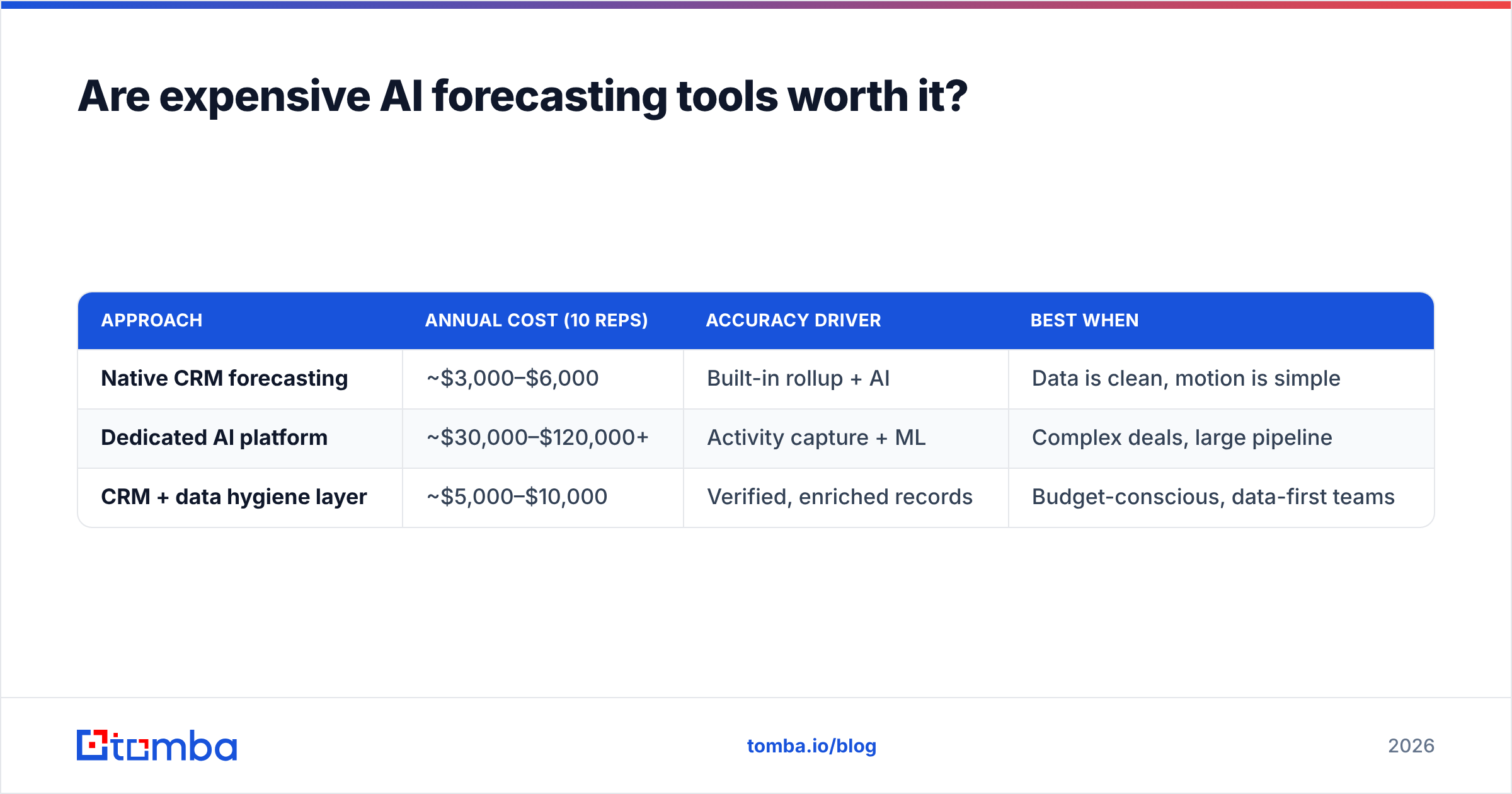
| Approach | Annual cost (10 reps) | Accuracy driver | Best when |
|---|---|---|---|
| Native CRM forecasting | ~$3,000–$6,000 | Built-in rollup + AI | Data is clean, motion is simple |
| Dedicated AI platform | ~$30,000–$120,000+ | Activity capture + ML | Complex deals, large pipeline |
| CRM + data hygiene layer | ~$5,000–$10,000 | Verified, enriched records | Budget-conscious, data-first teams |
How does data hygiene improve forecasting?#
Directly and measurably. Three failure modes quietly degrade every forecast, and all three are data problems, not model problems:
- Dead contacts. A deal tied to a champion who left the company is a deal at risk your model can't see unless the record is updated.
- Duplicate accounts. Two records for the same company double-count pipeline and inflate the forecast.
- Stale titles and roles. Forecasting tools weight deals by who's involved; wrong titles mean wrong weighting.
Fixing these is unglamorous but high-leverage. Routinely enrich and verify your records, dedupe accounts, and confirm that the people in your pipeline still work where your CRM says they do. Teams that pair a competent forecasting tool with a disciplined data layer consistently report tighter forecast ranges — not because the model improved, but because the inputs did. Tools like the bulk email finder make it practical to refresh thousands of records before a quarter-end forecast rather than one at a time.
What's the simplest forecasting stack for a growing team?#
Conclusion: CRM-native forecasting plus a data-hygiene routine beats an expensive platform for most teams under 50 reps. Run HubSpot or Salesforce forecasting, enrich your contacts on a schedule, and verify emails before they enter the pipeline. Layer in a dedicated tool like Clari or BoostUp only when deal complexity outgrows what the CRM can model — usually past the point where a single percentage point of accuracy is worth real money.
The mistake teams make is buying the model before fixing the data. Reverse the order. Get the inputs right, see how far native forecasting takes you, then upgrade with evidence instead of hope.
Final take and where Tomba fits#
The best sales forecasting tool in 2026 is the one matched to your team size and CRM — Clari or Gong at the enterprise top, Salesforce and HubSpot as native defaults, Pipedrive and Zoho for lean teams. But every one of them is only as good as the pipeline it reads.
That's the part Tomba solves. Before your forecasting model ever runs, the Tomba Email Finder helps you populate and refresh your CRM with verified, current decision-maker contacts — so the records feeding your forecast reflect reality, not last year's org chart. Start on the free tier (25 searches/month), and when you're ready to clean a full pipeline, the paid plans scale from $49/month. Fix the data first; the forecast follows.
// get started
Find, verify and enrich your first contacts today
Start on the free plan with 25 searches a month, then scale when your team is ready.
Free plan · No credit card required · GDPR & CCPA
Get the Tomba newsletter
Product and data updates
// about the author