Best Sales Voicemail Scripts for 2026 (12 Proven Templates)
Most sales voicemails get deleted in three seconds. Here are 12 of the best sales voicemail scripts for 2026, plus the data and timing tricks that actually earn callbacks.
TL;DR
- The average B2B voicemail callback rate sits around 4-6%. A tight script plus pre-call research can push that to double digits.
- The best sales voicemail scripts are short (under 25 seconds), lead with a reason that matters to the prospect, and end with a clear, single ask.
- Personalization beats polish. A message that references the prospect's role, company, or trigger event outperforms a smoother generic pitch every time.
- Pair voicemails with email and the right phone data — voicemail alone rarely closes, but voicemail plus a same-day email lifts response meaningfully.
- Below are 12 copy-paste scripts for cold outreach, follow-ups, referrals, re-engagement, and inbound speed-to-lead.
Sales voicemail is the most quietly wasted channel in outbound. Reps dial, hit voicemail, panic, and ramble for 45 seconds about "circling back" and "touching base." The prospect deletes it before the beep finishes. Yet a well-built voicemail is free attention — your voice, in their pocket, on their schedule.
This guide gives you the best sales voicemail scripts to use in 2026, the structure behind why they work, and the timing and data tactics that separate a 4% callback rate from a 14% one.
Why do most sales voicemails fail?#
Most sales voicemails fail because they are about the seller, not the buyer. The rep introduces themselves, names their company, describes their product, and then — out of time — mumbles a phone number nobody writes down.
Three structural problems show up again and again:
- Too long. Anything past 25-30 seconds gets cut off mentally, if not literally. Buyers decide whether to keep listening in the first five seconds.
- No reason to care. "I wanted to introduce our platform" is not a reason. A trigger event, a peer result, or a specific pain point is.
- A weak or doubled ask. "Call me back, or email me, or check our site" gives the prospect three ways to do nothing. One clear ask wins.
The fix is not a smoother voice or more enthusiasm. It is a repeatable structure and better information about who you are calling. That is also why reps who pull accurate contact data — verified numbers, role, company context — before dialing consistently beat reps who wing it.
What makes a high-converting sales voicemail script?#
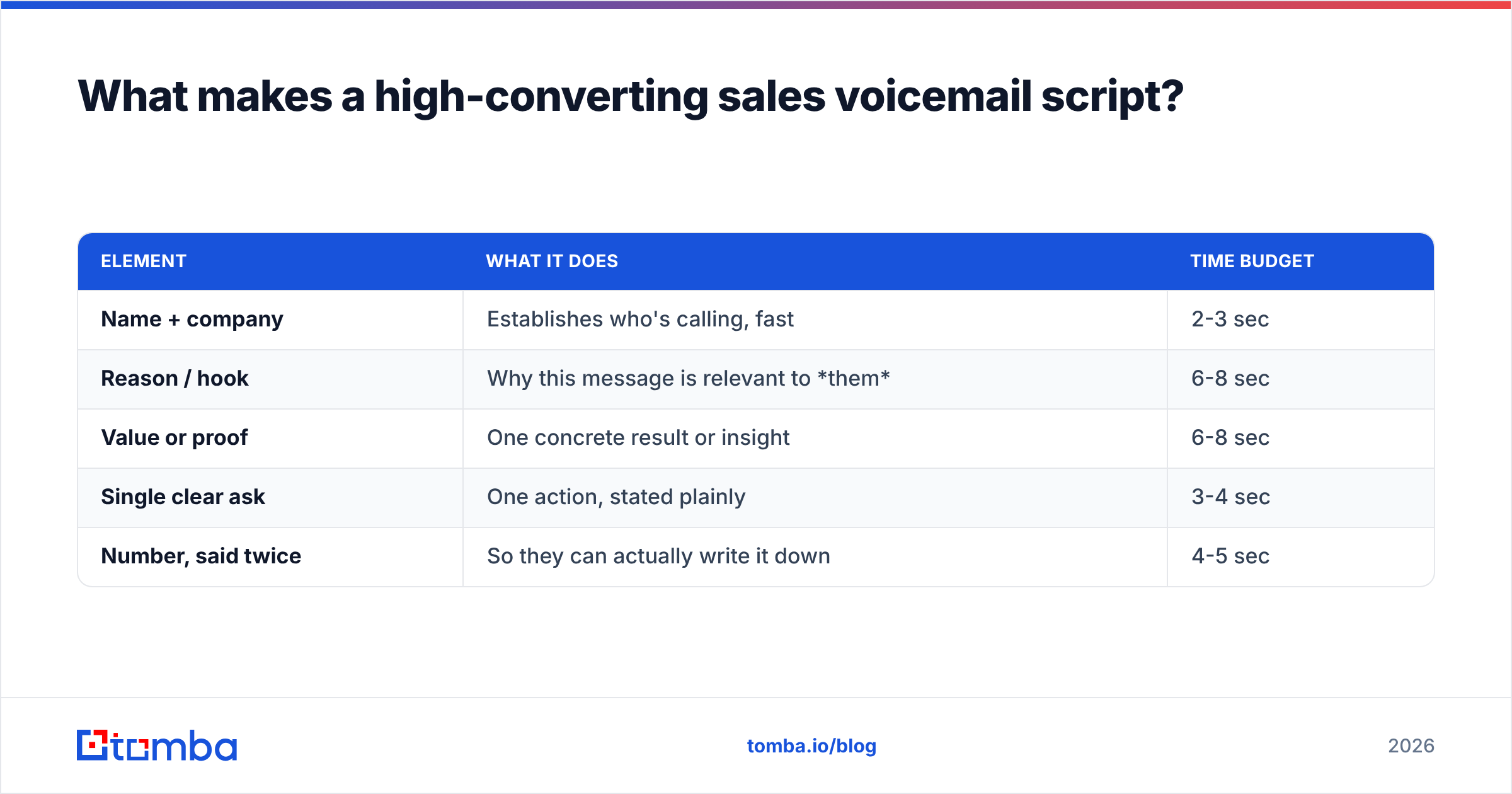
Every voicemail that earns a callback shares the same skeleton. Memorize this and you can improvise any of the scripts below.
| Element | What it does | Time budget |
|---|---|---|
| Name + company | Establishes who's calling, fast | 2-3 sec |
| Reason / hook | Why this message is relevant to them | 6-8 sec |
| Value or proof | One concrete result or insight | 6-8 sec |
| Single clear ask | One action, stated plainly | 3-4 sec |
| Number, said twice | So they can actually write it down | 4-5 sec |
Notice the value section is short and the ask is singular. The biggest lever is the hook: the more specific your reason for calling, the higher your callback rate. Generic openers get generic results.
A quick benchmark of approaches you can A/B test:
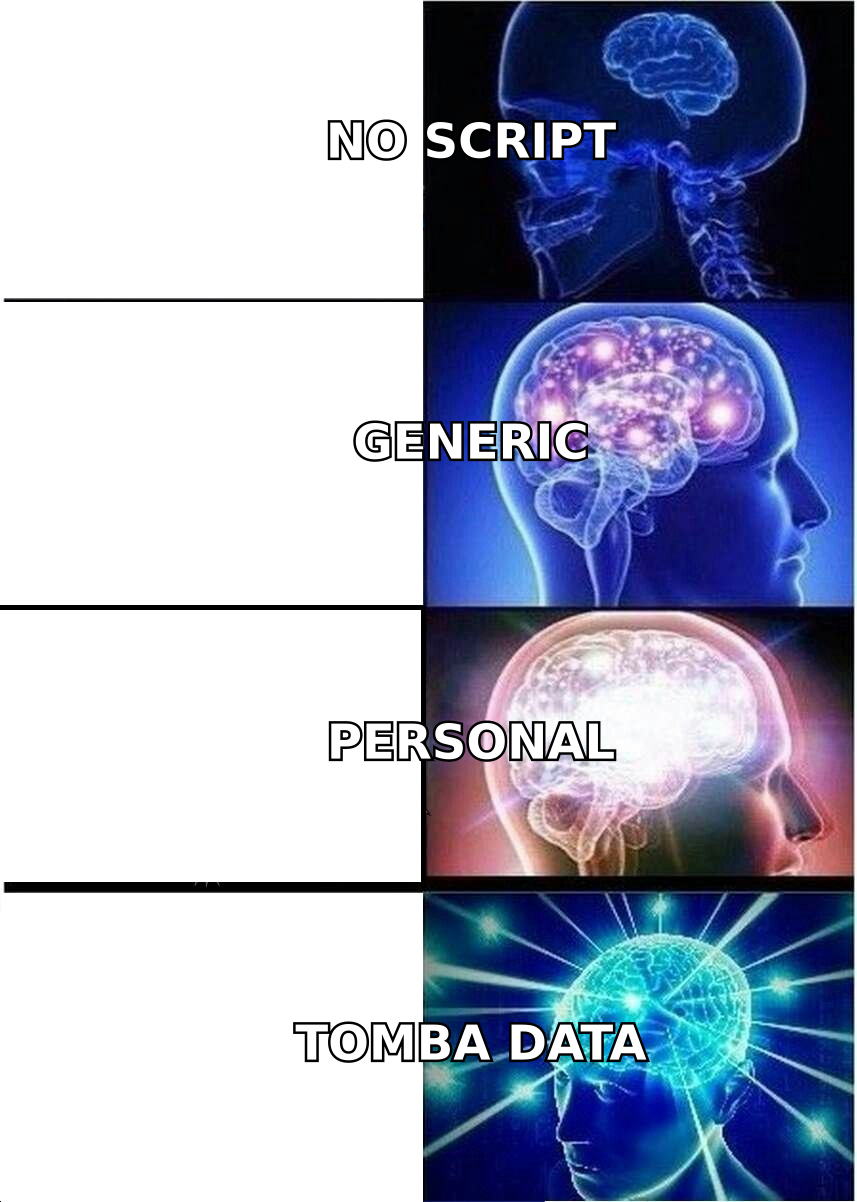
- No script, improvised: ~2-4% callback. Inconsistent and rambling.
- Generic script: ~4-6% callback. Repeatable but forgettable.
- Personalized script (role + company): ~8-11% callback. References something only this prospect cares about.
- Data-backed personalization (trigger event + verified contact): ~12-15%+ callback. Right person, right reason, right moment.
The jump from generic to data-backed is the whole game. According to HubSpot's sales research, personalized outreach and persistent, multi-touch follow-up dramatically outperform one-and-done attempts — and voicemail is one of those touches, not a replacement for them.
What are the best sales voicemail scripts for 2026?#
Here are 12 scripts grouped by scenario. Swap the brackets for your specifics. Read them out loud once before you dial — they should sound like you, not a teleprompter.
Cold outreach voicemails#
1. The trigger-event open
"Hi [Name], it's [You] at [Company]. I saw [trigger event — you just hired a VP of Sales / opened a new office / raised your Series B]. We help teams in that exact moment [specific outcome]. Worth a quick chat — I'll text you too. My number is [number], again [number]."
2. The peer-result open
"[Name], [You] from [Company]. We just helped [similar company] [measurable result — cut ramp time 30%]. Given you're at [their company], I think we could do something similar. I'll keep it short on a call — reach me at [number], [number]."
3. The single-question open
"Hi [Name], [You] at [Company]. Quick one: are you still handling [relevant process] manually? Most [their role]s I talk to are, and it's costing them [pain]. I have a 4-minute answer. Call me at [number], [number]."
4. The pattern-interrupt open
"[Name], this is [You] — and no, this isn't a pitch you've heard before. I'll be honest in 20 seconds on a callback about whether [product] even fits [company]. If it doesn't, I'll tell you. [number], [number]."
Follow-up voicemails#
5. The post-email nudge
"Hi [Name], [You] from [Company]. I sent a note about [topic] earlier — just adding a voice to it. The short version: [one-line value]. I'll resend so it's at the top of your inbox. [number]."
6. The "third touch" honesty play
"[Name], [You] again. This is my last voicemail so I'm not that rep who calls forever. If [outcome] matters this quarter, I'm worth 10 minutes. If not, I'll close your file — no hard feelings. [number], [number]."

Referral and warm voicemails#
7. The internal referral
"Hi [Name], [You] at [Company]. [Colleague's name] on your team suggested I reach out about [topic]. They thought it'd be relevant to what you own. Happy to give you the same 5-minute version I gave them. [number], [number]."
8. The mutual connection
"[Name], [You] from [Company]. [Mutual contact] and I were talking about [problem space] and your name came up. I'd value 10 minutes to compare notes. [number], [number]."
Re-engagement voicemails#
9. The "what changed" reopen
"Hi [Name], [You] at [Company]. We spoke back in [timeframe] and the timing wasn't right. Two things changed since then — [new feature / new result]. Worth a fresh look? [number], [number]."
10. The closed-lost revival
"[Name], [You] from [Company]. You went with [competitor / status quo] last time, which made sense then. I'm checking in because [reason]. No pressure — just want to be useful if it's shifted. [number]."
Inbound and speed-to-lead voicemails#
11. The fast inbound response
"Hi [Name], [You] from [Company] — you just [downloaded our guide / requested a demo], so I'm calling right away while it's fresh. I'll keep my callback to the two questions you actually care about. [number], [number]."
12. The event follow-up
"[Name], great meeting you at [event]. It's [You] from [Company]. You mentioned [specific thing they said] — I have an idea on that. 10 minutes? [number], [number]."
For more written assets to pair with these calls, our cold email templates library mirrors the same scenario structure so your voicemail and email say one consistent thing.
How do you boost callback rates beyond the script?#
The script is necessary but not sufficient. These four levers move the needle more than wording:
- Time your calls. Mid-morning and late afternoon outperform lunch and first-thing. Tuesday through Thursday beat Monday and Friday for B2B.
- Always send a same-day email. Voicemail plants the name; email gives them the easy reply. The combination beats either alone. Track which combinations land using your email response rate baseline.
- Use the right number. A direct dial or mobile gets a human; a switchboard gets a gatekeeper. Verified B2B phone numbers mean you reach the decision-maker, not their voicemail-of-a-voicemail.
- Be persistent, not annoying. Most callbacks come on touches 3-6. Plan a cadence, then stop cleanly with a script like #6.
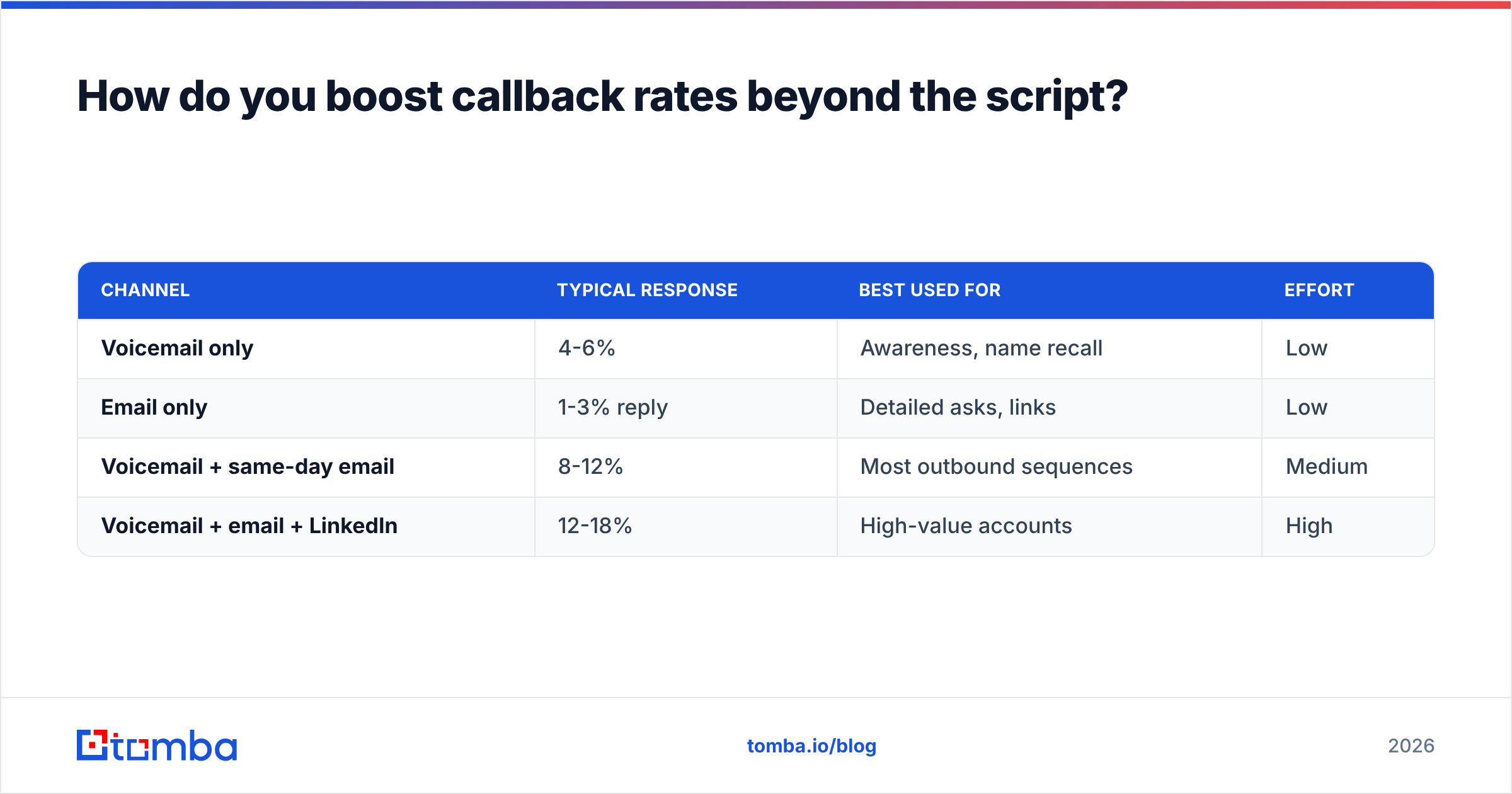
Here is how the channels stack up so you can budget your effort:
| Channel | Typical response | Best used for | Effort |
|---|---|---|---|
| Voicemail only | 4-6% | Awareness, name recall | Low |
| Email only | 1-3% reply | Detailed asks, links | Low |
| Voicemail + same-day email | 8-12% | Most outbound sequences | Medium |
| Voicemail + email + LinkedIn | 12-18% | High-value accounts | High |
The pattern is clear: the more coordinated touches you run on a verified contact, the better. That coordination breaks down the moment your data is wrong — a disconnected number or the wrong title wastes the whole sequence.
How does contact data change voicemail results?#
Better data is the difference between a script that performs and a script that gets deleted. You can have the perfect message and still fail if you are dialing the wrong person at a dead number.
This is where pre-call enrichment pays off. Before you dial, you want three things confirmed: the right person owns the problem, the number reaches them directly, and you have a verified email for the same-day follow-up. Pulling that with a tool like the Tomba Email Finder and validating it with a phone validator means every voicemail you leave lands on a real, reachable buyer — and your follow-up email actually arrives.
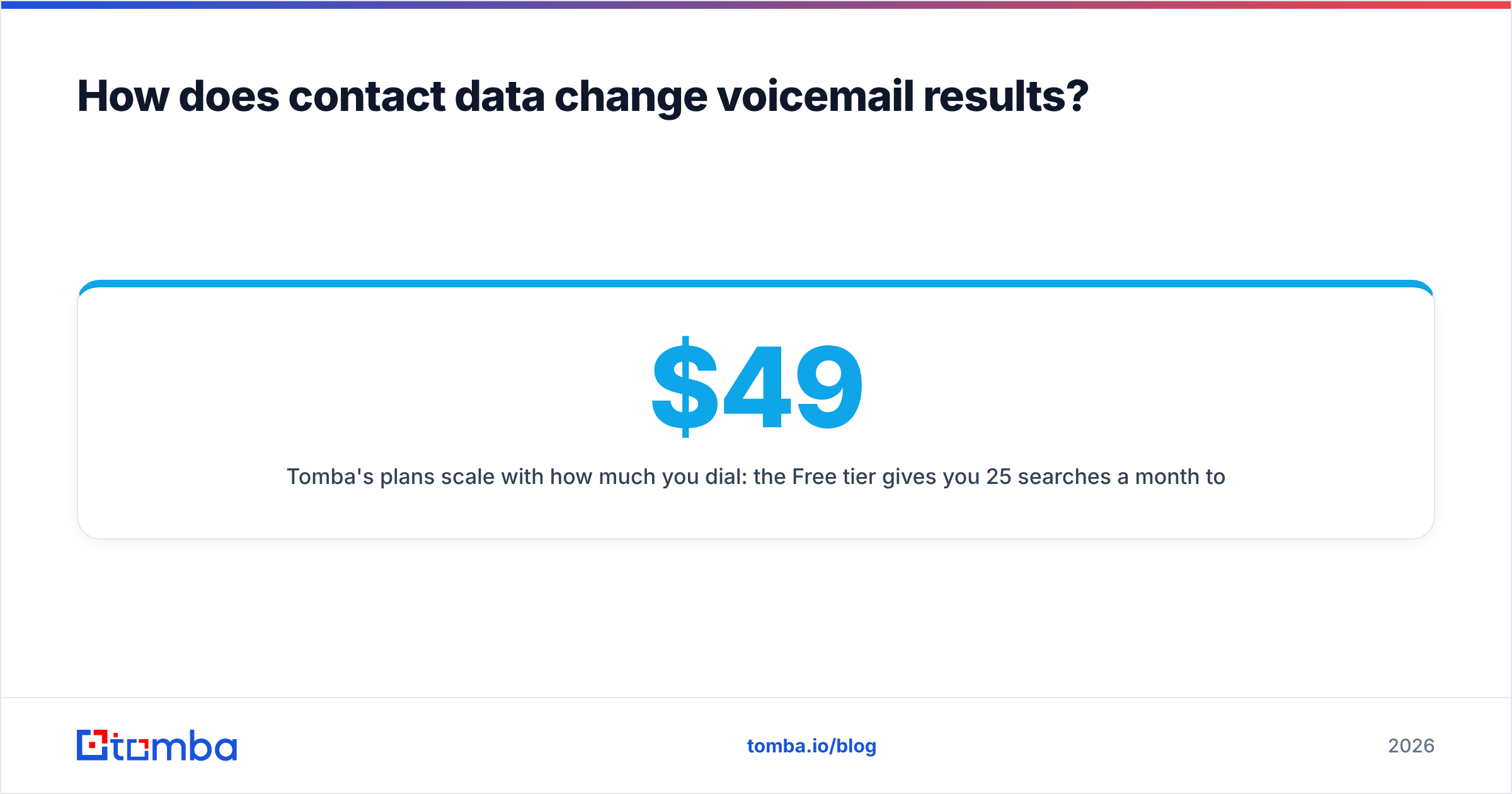
Tomba's plans scale with how much you dial: the Free tier gives you 25 searches a month to test the workflow, and paid tiers start at $49/mo (Starter), $99/mo (Growth), and $249/mo (Pro). You can see the full breakdown on the Tomba pricing page. Compared with buying separate tools for finding, verifying, and enriching contacts, consolidating that stack keeps your cost-per-conversation low.
If you want to benchmark tools and tactics independently, G2's sales intelligence category and Salesforce's sales resources are both useful neutral references for comparing approaches before you commit budget.
Frequently asked questions#
How long should a sales voicemail be? Aim for 18-25 seconds. Past 30 seconds, attention drops sharply and the prospect deletes before the ask. Time yourself reading the scripts above.
Should I leave a voicemail every time I call? No. Alternate. Leaving a message on every single attempt reads as desperate. A good rhythm is voicemail on touches 1, 3, and the final touch, with silent dials in between paired with email.
Is it better to leave a voicemail or send an email? Both, together. Voicemail builds name recognition and a sense of effort; email gives the prospect a frictionless way to reply. The combination consistently outperforms either channel on its own.
Do I really need to say my number twice? Yes. Prospects rarely have a pen ready in the first three seconds. Saying the number at the start and end of your close gives them a second chance to capture it — and meaningfully increases callbacks.
What's the single biggest mistake reps make? Making the voicemail about themselves instead of the buyer. Lead with a reason that matters to the prospect, not with your company's origin story.
Start leaving voicemails people actually return#
The best sales voicemail scripts only work when they reach the right person at a working number, backed by a same-day email that lands. That is a data problem before it is a scripting problem. Use the Tomba Email Finder to confirm you are reaching real decision-makers, enrich every contact before you dial, and pair each voicemail with a verified email that actually gets delivered. Start free with 25 searches, plug the scripts above into your cadence, and watch your callback rate climb out of the single digits.
// get started
Find, verify and enrich your first contacts today
Start on the free plan with 25 searches a month, then scale when your team is ready.
Free plan · No credit card required · GDPR & CCPA
// about the author