Best Time of Day to Send Cold Emails (2026 Data Guide)
Mornings win, but the real answer is more nuanced. Here is what 2026 send-time data, time zones, and list quality actually tell you about cold email timing.
TL;DR
- The best time of day to send cold emails for most B2B teams is Tuesday–Thursday, 8:00–10:00 a.m. in the recipient's local time zone — early enough to land near the top of the inbox before the day fills up.
- A secondary window opens early afternoon (1:00–3:00 p.m.) when prospects clear their inbox after lunch.
- Send time is a multiplier, not a miracle: a perfectly timed email to a stale or unverified list still bounces and still gets ignored.
- Time zones beat clock times. "9 a.m." means nothing until you know whether your prospect is in New York, London, or Singapore.
- Test your own windows. The benchmarks below are a starting hypothesis, not a law of physics.
Why does send time matter for cold email at all?#
Think of your prospect's inbox like a grocery checkout line. If you arrive when one lane is open and ten carts are ahead of you, you wait — and maybe you walk out. If you arrive in a quiet moment, you're seen and served immediately. Your cold email is a cart in that line. Send it when the inbox is calm and uncluttered, and it sits near the top where a human actually reads it. Send it at 6 p.m. on a Friday and it's buried under 40 newer messages by Monday at 9.
Timing changes three things at once:
- Inbox position — newer emails sit higher, and most people scan top-down.
- Attention state — a prospect triaging email at 9 a.m. is in a different mindset than one drowning at 4 p.m.
- Reply likelihood — when your email arrives at a moment the prospect can act, you get same-session replies instead of "I'll deal with it later" (which means never).
None of this matters, though, if the email never reaches the inbox in the first place. That's a deliverability problem, and it's a different fight than timing. Hold that thought — we'll come back to it, because it's the thing most "best send time" articles ignore.
)
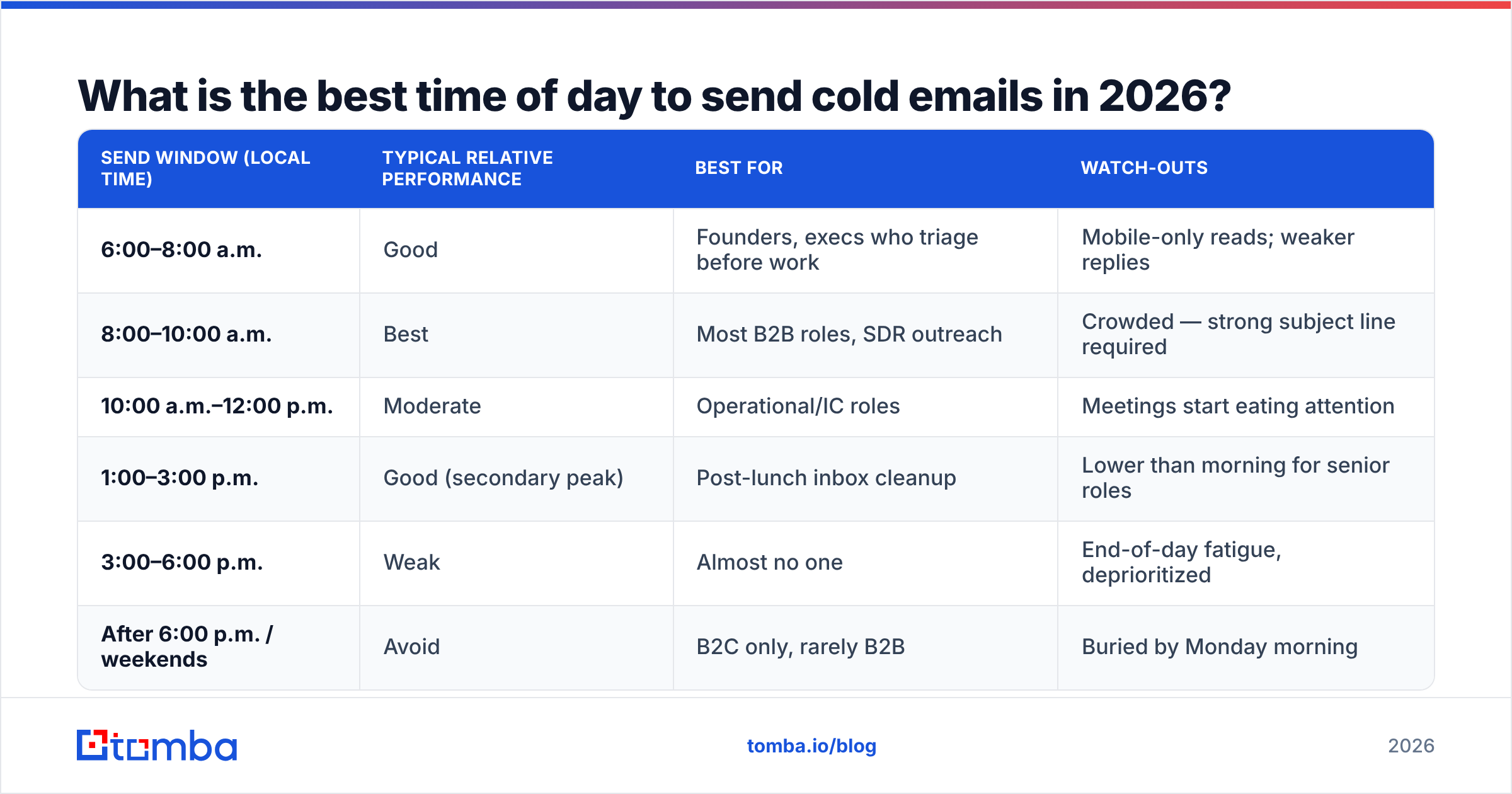
What is the best time of day to send cold emails in 2026?#
Short answer: 8:00–10:00 a.m. on Tuesday, Wednesday, or Thursday, in the recipient's local time. Across most aggregated B2B send-time studies, the early-morning weekday window consistently produces the highest open and reply rates, with a smaller secondary peak in the early afternoon.
Here's the catch every honest guide should print in bold: these are averages across millions of emails sent to other people's audiences. Your prospects, your industry, and your offer can shift the optimal window by hours. Use the table below as a hypothesis to test, not a guarantee.
| Send window (local time) | Typical relative performance | Best for | Watch-outs |
|---|---|---|---|
| 6:00–8:00 a.m. | Good | Founders, execs who triage before work | Mobile-only reads; weaker replies |
| 8:00–10:00 a.m. | Best | Most B2B roles, SDR outreach | Crowded — strong subject line required |
| 10:00 a.m.–12:00 p.m. | Moderate | Operational/IC roles | Meetings start eating attention |
| 1:00–3:00 p.m. | Good (secondary peak) | Post-lunch inbox cleanup | Lower than morning for senior roles |
| 3:00–6:00 p.m. | Weak | Almost no one | End-of-day fatigue, deprioritized |
| After 6:00 p.m. / weekends | Avoid | B2C only, rarely B2B | Buried by Monday morning |
A few patterns worth internalizing:
- Tuesday through Thursday outperform Monday (inbox backlog) and Friday (mental checkout).
- Earlier is safer than later. If you must pick one slot blind, 8–9 a.m. local is the highest-expected-value bet.
- Senior titles skew earlier; individual contributors skew toward mid-morning and post-lunch.
Does the recipient's time zone change everything?#
Yes — and this is where most cold email campaigns quietly fail. "Send at 9 a.m." is meaningless if your tool fires at 9 a.m. your time and your prospect is six hours ahead, reading it at 3 p.m. when their inbox is already a war zone.
If you sell internationally, you need to schedule by the prospect's local time, not yours. That requires knowing where each contact actually is. Reliable location data starts with a clean, enriched contact record — which is exactly why list quality and timing are the same conversation. You can pull location, role, and company signals through data enrichment so your send-time logic has something accurate to key off.
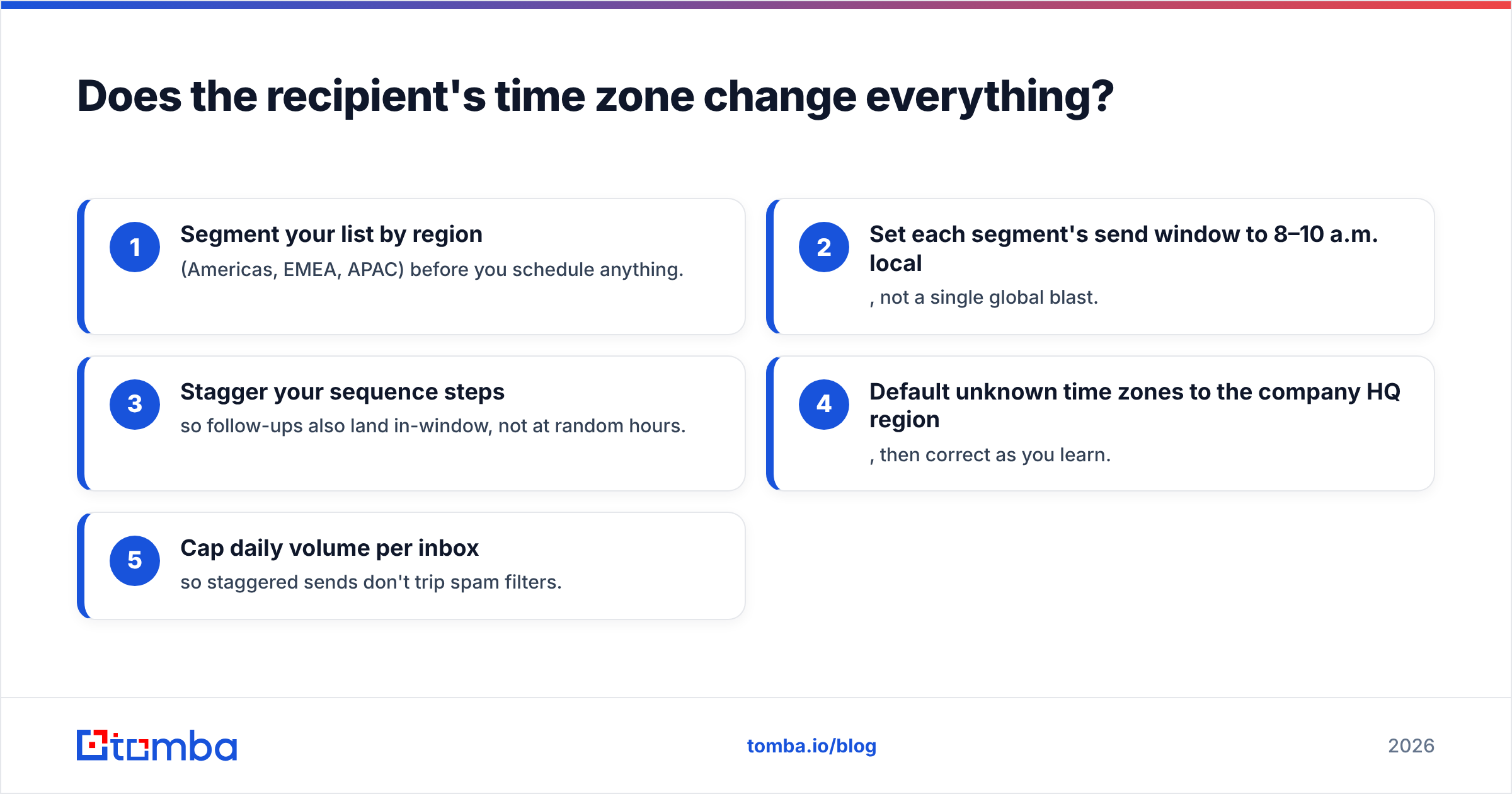
A simple time-zone playbook:
- Segment your list by region (Americas, EMEA, APAC) before you schedule anything.
- Set each segment's send window to 8–10 a.m. local, not a single global blast.
- Stagger your sequence steps so follow-ups also land in-window, not at random hours.
- Default unknown time zones to the company HQ region, then correct as you learn.
- Cap daily volume per inbox so staggered sends don't trip spam filters.
Tools like HubSpot and most modern sending platforms support time-zone-aware scheduling — turn it on. It's one of the highest-ROI settings you're probably not using.
Is send time more important than your list quality?#
No. Not even close. And this is the part the industry under-sells.
Picture two SDRs. SDR A sends at the mathematically perfect moment — 9:03 a.m. Tuesday, local time — to a list scraped six months ago, full of guessed addresses and people who left their jobs. SDR B sends at a "mediocre" 11 a.m. to a freshly verified list of real, current decision-makers. SDR B wins every time. Timing optimizes the ceiling of a good list; it cannot rescue a bad one.
Here's why list quality dominates:
- Bounces wreck deliverability. A high bounce rate from invalid addresses damages your sender reputation, and a damaged reputation means even perfectly timed future emails land in spam.
- Wrong person, wrong time. The best 9 a.m. on earth is wasted on someone who never had buying authority.
- Stale data decays fast. B2B contact data goes out of date at roughly 2–3% per month as people change roles.
So before you obsess over minutes, fix the inputs. Use a real email verifier to strip dead addresses, and build the list from a current source instead of a year-old export. When you need fresh contacts at all, an accurate email finder keyed to live company domains beats re-mailing a decaying CSV.
)
How do send times differ by industry and role?#
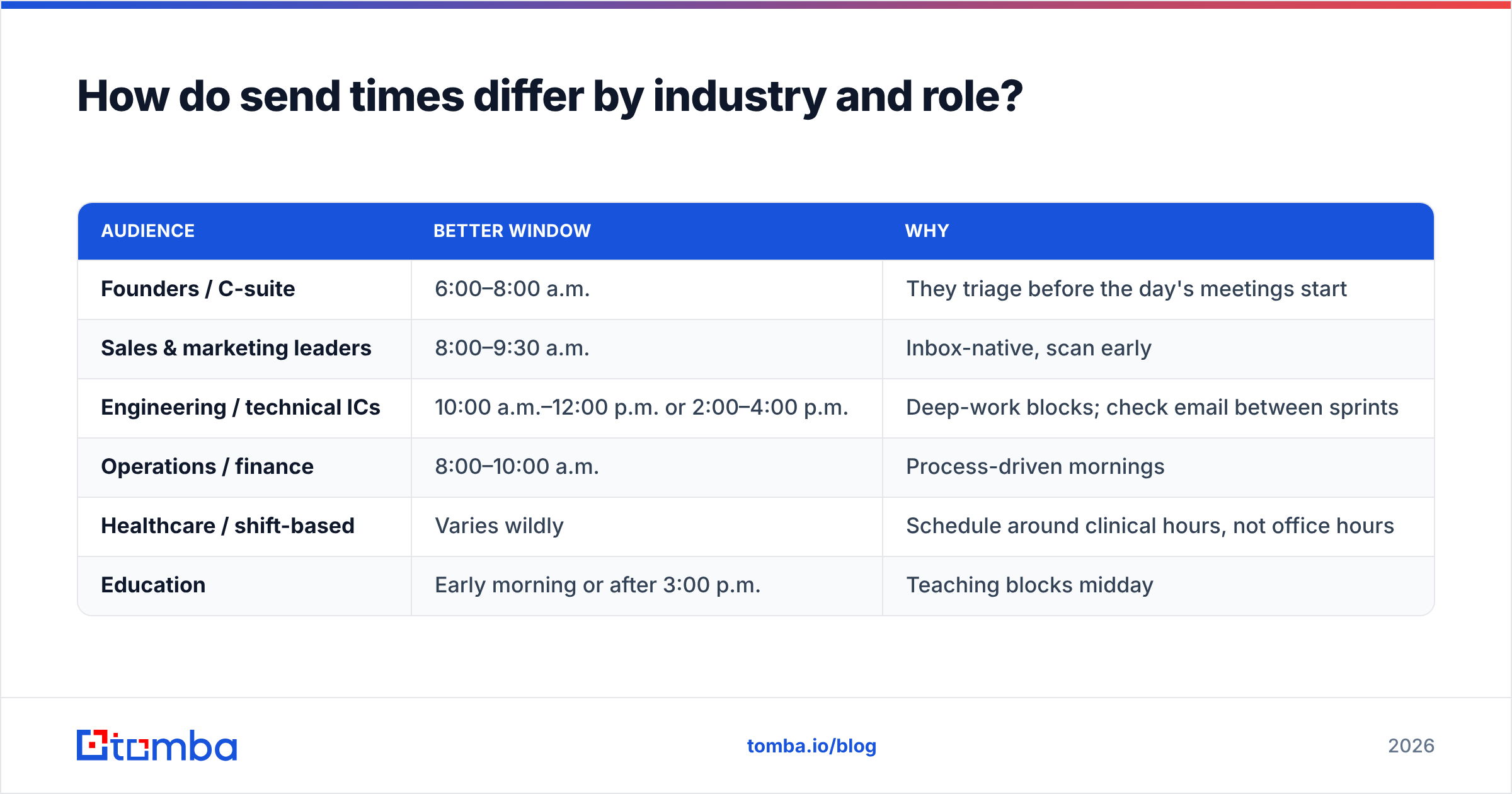
Averages hide a lot. The "8–10 a.m." rule is a fine default, but these adjustments matter once you're optimizing:
| Audience | Better window | Why |
|---|---|---|
| Founders / C-suite | 6:00–8:00 a.m. | They triage before the day's meetings start |
| Sales & marketing leaders | 8:00–9:30 a.m. | Inbox-native, scan early |
| Engineering / technical ICs | 10:00 a.m.–12:00 p.m. or 2:00–4:00 p.m. | Deep-work blocks; check email between sprints |
| Operations / finance | 8:00–10:00 a.m. | Process-driven mornings |
| Healthcare / shift-based | Varies wildly | Schedule around clinical hours, not office hours |
| Education | Early morning or after 3:00 p.m. | Teaching blocks midday |
The takeaway isn't to memorize this grid — it's to recognize that role determines rhythm. A surgeon and a CFO do not check email at the same time, and your campaign shouldn't pretend they do.
How do you actually find your own best send time?#
Stop guessing and run a structured test. You don't need a data science team — you need discipline and enough volume to mean something.
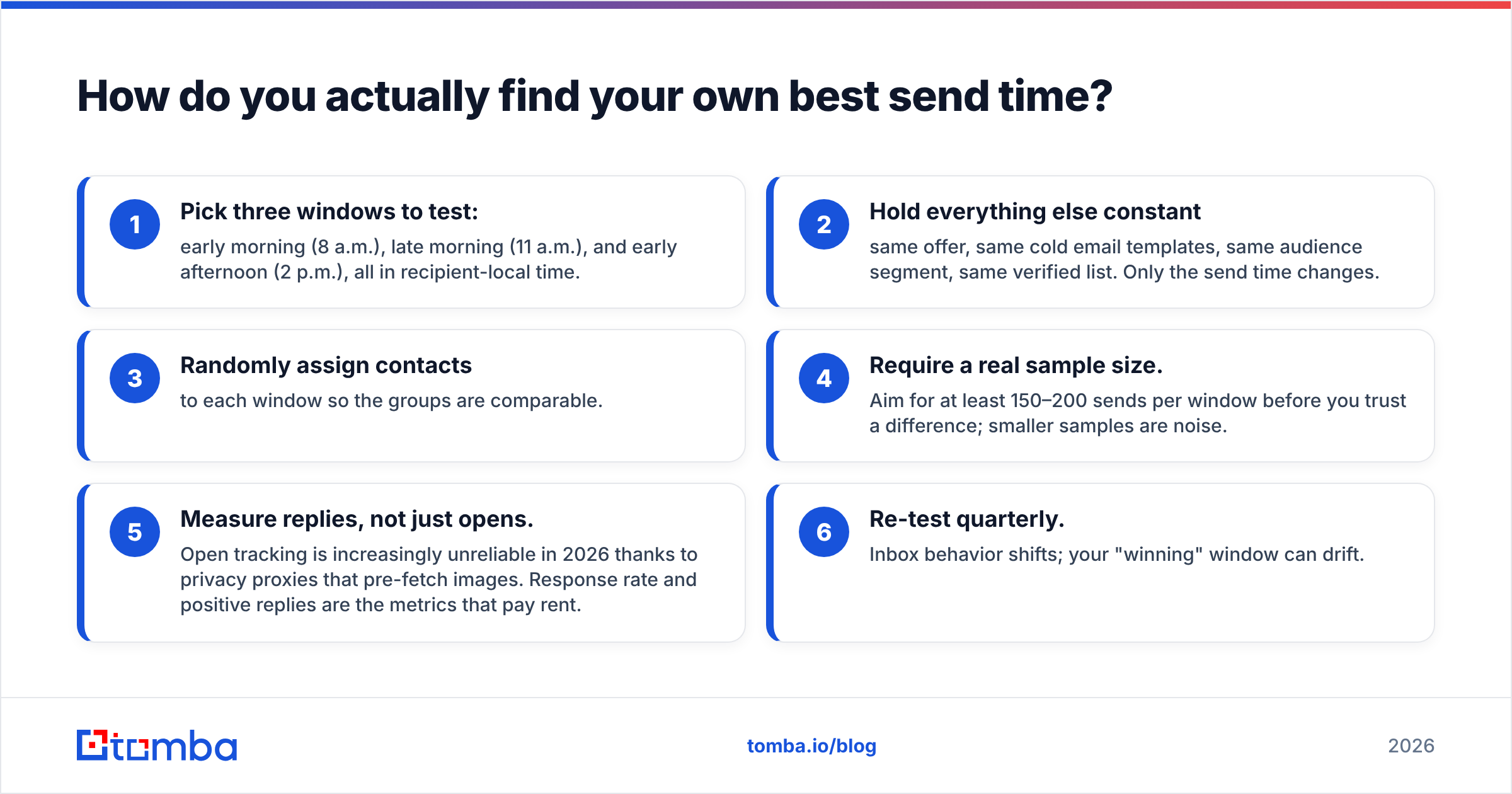
- Pick three windows to test: early morning (8 a.m.), late morning (11 a.m.), and early afternoon (2 p.m.), all in recipient-local time.
- Hold everything else constant — same offer, same cold email templates, same audience segment, same verified list. Only the send time changes.
- Randomly assign contacts to each window so the groups are comparable.
- Require a real sample size. Aim for at least 150–200 sends per window before you trust a difference; smaller samples are noise.
- Measure replies, not just opens. Open tracking is increasingly unreliable in 2026 thanks to privacy proxies that pre-fetch images. Response rate and positive replies are the metrics that pay rent.
- Re-test quarterly. Inbox behavior shifts; your "winning" window can drift.
One warning: don't change five variables and credit the win to timing. If you swap the subject line, the send time, and the list in the same week, you've learned nothing about any of them. Isolate the variable.
What ruins good timing? (Deliverability basics)#
You can nail the window and still land in spam. Timing gets your email seen only if it reaches the inbox. Three fundamentals protect that:
- Authenticate your domain. Set up SPF, DKIM, and DMARC. Check your SPF record with a quick SPF checker so you're not silently failing authentication.
- Warm up new sending domains and inboxes. Don't go from zero to 500 sends a day. Ramp volume gradually so mailbox providers learn to trust you.
- Keep bounce and spam rates low. This loops straight back to list quality — verify before you send, every time.
Google and Yahoo's bulk-sender requirements (live since 2024 and tightened since) make authentication and low spam complaint rates non-negotiable. You can read the official guidance in Google's sender requirements. Skip these and the perfect send time becomes irrelevant, because no human ever sees the message.
What does a realistic "best time" workflow look like?#
Putting it together, here's the sequence that actually moves reply rates:
- Build or refresh the list from a live source and run it through verification.
- Enrich each contact with role and time-zone data so you can segment.
- Authenticate and warm your sending infrastructure.
- Schedule by local time, defaulting to Tue–Thu, 8–10 a.m.
- A/B test windows with one variable isolated.
- Read replies, double down on the winner, re-test quarterly.
Notice that exactly one of those six steps is about the clock. That ratio is the real lesson of every send-time study ever published.
Frequently asked questions#
What is the single best time to send a cold email? If you can only pick one slot with no other information, send Tuesday at 9 a.m. in the recipient's local time zone. It's the highest-expected-value window across most B2B audiences.
Is Monday a bad day for cold email? It's usually the weakest weekday — prospects are clearing weekend backlog and triaging aggressively. Tuesday through Thursday outperform it consistently.
Should I send cold emails on weekends? For B2B, generally no. Weekend sends get buried before Monday morning. For some founder-led or B2C audiences, early Saturday can work — test it rather than assume.
Do open rates still tell me the best time? Less than they used to. Privacy features that pre-load images inflate and distort opens. Trust replies and meetings booked as your primary signal in 2026.
How much will better timing improve my results? Realistically, a single-digit-to-modest lift on an already-healthy campaign. The big swings come from list quality, targeting, and copy — timing fine-tunes a good system rather than fixing a broken one.
Get the inputs right before you optimize the clock#
The best time of day to send cold emails is a real lever — Tuesday-to-Thursday mornings in local time will beat random sends — but it's the last lever, not the first. Timing multiplies the quality of what you send to whom. If the "whom" is a stale, unverified list, you're multiplying by zero.
Start where the leverage actually is: a fresh, accurate list of the right people. Use the Tomba Email Finder to pull current, verified professional email addresses by name, company, or domain, then layer your send-time testing on top of clean data. Get the inputs right, schedule by local time, and let your perfectly timed emails actually land in front of someone who can say yes.
Ready to find emails that actually work?
Join 150,000+ professionals who stopped guessing and started sending. Free credits on signup — no credit card required.
Get the Tomba newsletter
Practical outbound tactics and product updates — once every two weeks.
About the author