Best Time To Call Prospects in 2026: Data-Backed Windows
Stop dialing at random. Here are the data-backed days, hours, and cadence rules that decide whether prospects pick up or send you to voicemail in 2026.
Most reps blame their script, their list, or the product when nobody picks up. The real culprit is usually the clock. The best time to call prospects is not a vibe — it is a pattern you can measure, copy, and exploit. Below is everything connect-rate data and field experience say about when to dial, why it works, and how to build a cadence around it.
TL;DR — When should you actually dial?#
- Best days: Wednesday and Thursday consistently beat Monday and Friday for live connects.
- Best windows: late morning (10–11:30 a.m.) and late afternoon (4–5 p.m.) in the prospect's local time zone.
- Worst time: Monday before 10 a.m. and Friday after 3 p.m. — calendars are either chaotic or already checked out.
- Speed beats timing: calling a fresh inbound lead within 5 minutes outperforms any "perfect" cold window.
- Data quality decides everything: the right number at the right time only works if the number is real — verified mobile direct dials change your whole curve.
Why does call timing matter so much?#
Think of cold calling like fishing. You can have the best rod and bait on the lake, but if you cast when the fish aren't feeding, you go home empty-handed. Timing is the difference between dropping your line into a feeding frenzy and slapping the water while everyone's asleep.
Technically, "timing" is just a proxy for one thing: is the prospect in a state where they can talk? A VP at 8:55 a.m. on Monday is triaging a weekend of email and a packed calendar. The same VP at 4:20 p.m. on Wednesday has shipped most of the day's meetings and has a few minutes of slack. Same person, same script — wildly different odds.
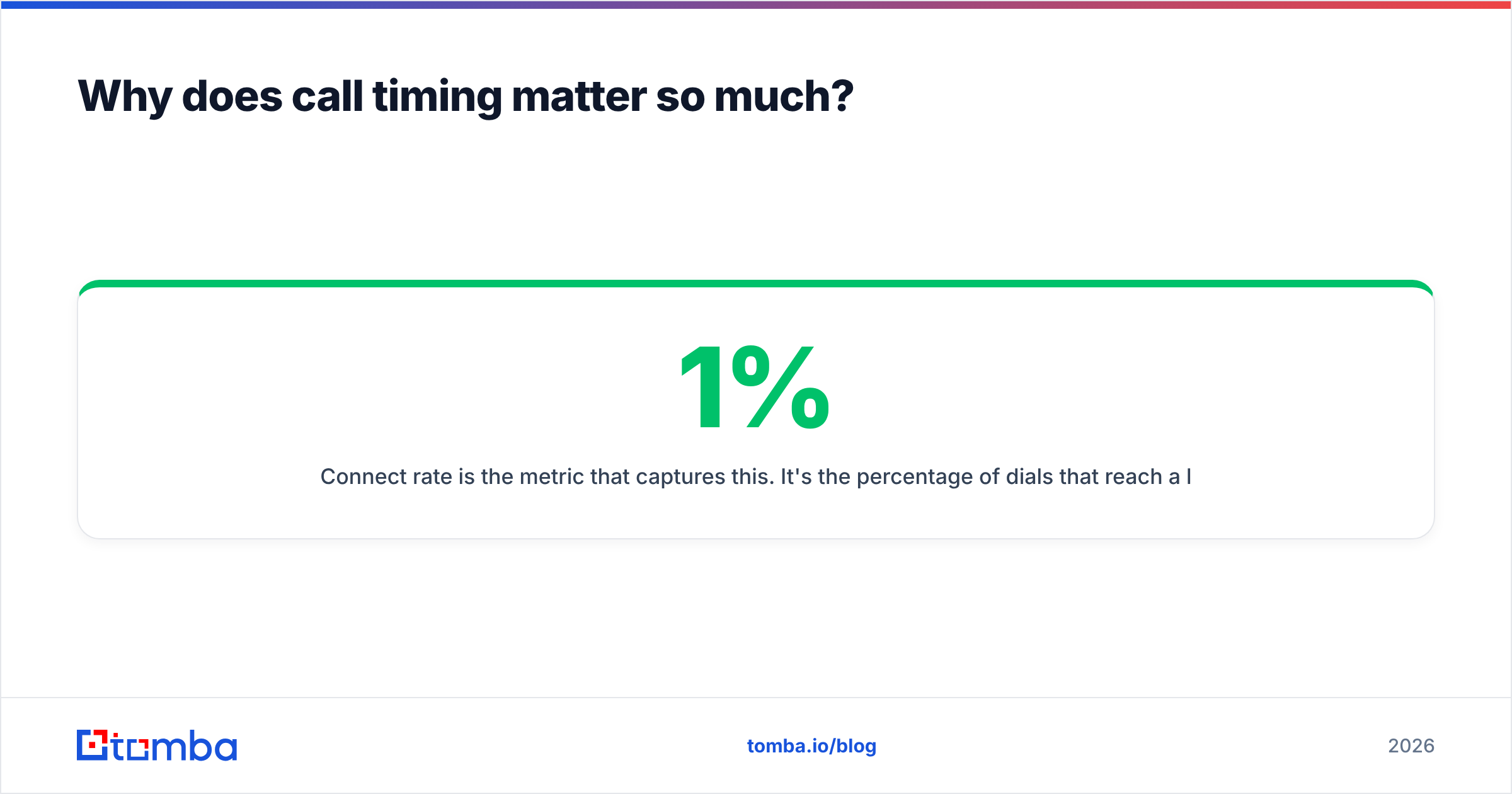
Connect rate is the metric that captures this. It's the percentage of dials that reach a live human. Industry benchmarks from sources like Gartner and aggregated dialer studies put cold connect rates anywhere from 1% to 5% depending on segment — and good timing can swing that by 30–50% relative. That's the difference between 10 conversations a week and 15 from the exact same effort.
)
What is the best time to call prospects, by day and hour?#
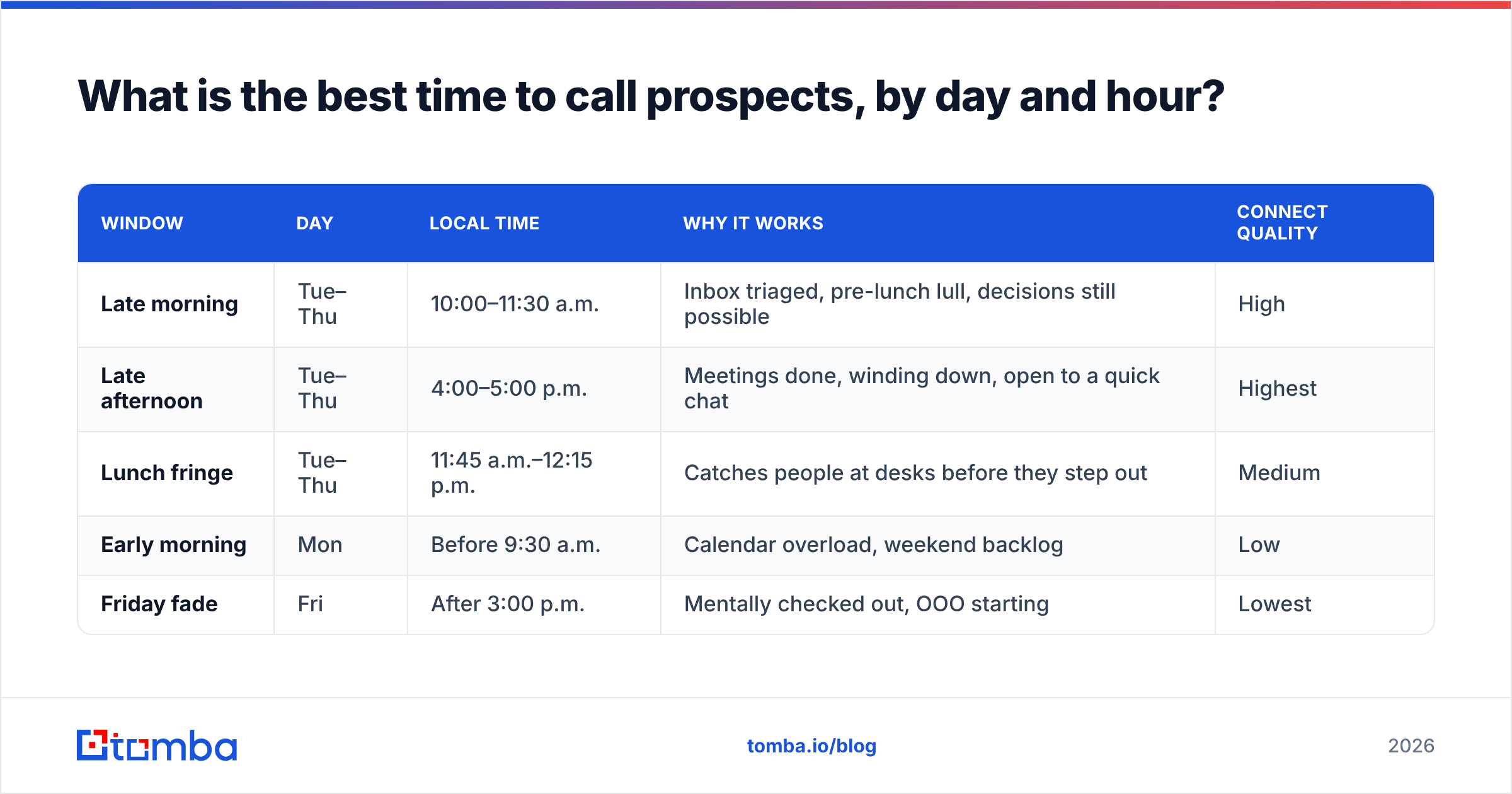
Here's the conclusion first: aim for mid-week, late morning or late afternoon, in the prospect's local time zone. Now the detail.
The pattern that shows up across most B2B phone-sales data looks like this:
| Window | Day | Local time | Why it works | Connect quality |
|---|---|---|---|---|
| Late morning | Tue–Thu | 10:00–11:30 a.m. | Inbox triaged, pre-lunch lull, decisions still possible | High |
| Late afternoon | Tue–Thu | 4:00–5:00 p.m. | Meetings done, winding down, open to a quick chat | Highest |
| Lunch fringe | Tue–Thu | 11:45 a.m.–12:15 p.m. | Catches people at desks before they step out | Medium |
| Early morning | Mon | Before 9:30 a.m. | Calendar overload, weekend backlog | Low |
| Friday fade | Fri | After 3:00 p.m. | Mentally checked out, OOO starting | Lowest |
A few rules that matter more than the exact minute:
- Time zone is non-negotiable. "4 p.m." means nothing if you're in New York and your prospect is in Los Angeles. Segment your list by region and dial each block in their afternoon, not yours.
- The first and last hour of the workday are bookends, not sweet spots. People are ramping up or shutting down; neither is a buying mindset.
- Seniority shifts the curve. Founders and C-level pick up earlier (before 9 a.m.) and later (after 5 p.m.) because their calendars are wall-to-wall during normal hours. Managers and ICs follow the standard mid-day pattern.
- Industry context overrides averages. Restaurant owners are useless to call at noon. Accountants vanish in tax season. Always layer your vertical's rhythm on top of the general curve.
Is speed-to-lead more important than the "perfect" hour?#
Yes — for inbound and warm leads, speed crushes scheduling every time. The famous Lead Response Management study found that contacting a web lead within 5 minutes versus 30 minutes makes you up to 100x more likely to connect and 21x more likely to qualify the lead. No "optimal Wednesday window" comes close to that.
The takeaway is to run two clocks:
- Inbound / trigger-based leads: call now. The best time is the minute the form hits your CRM. Build alerting so a rep dials within five minutes.
- Pure cold outbound: there's no "now" trigger, so you fall back to the day-and-hour patterns above to maximize connect probability.
This is also where data infrastructure quietly wins or loses the game. If your data enrichment flow appends a verified direct dial the instant a lead enters your system, your rep calls a working mobile in minutes. If they have to hunt for a number first, the five-minute window is gone before the phone rings.
How many times — and when — should you call before giving up?#
Most reps quit at one or two attempts. That's the real reason "cold calling doesn't work" for them. Research on sales cadences consistently shows it takes 6 to 8 touches to reach a typical B2B prospect, and call attempts spread across different days and times dramatically raise cumulative connect rate.
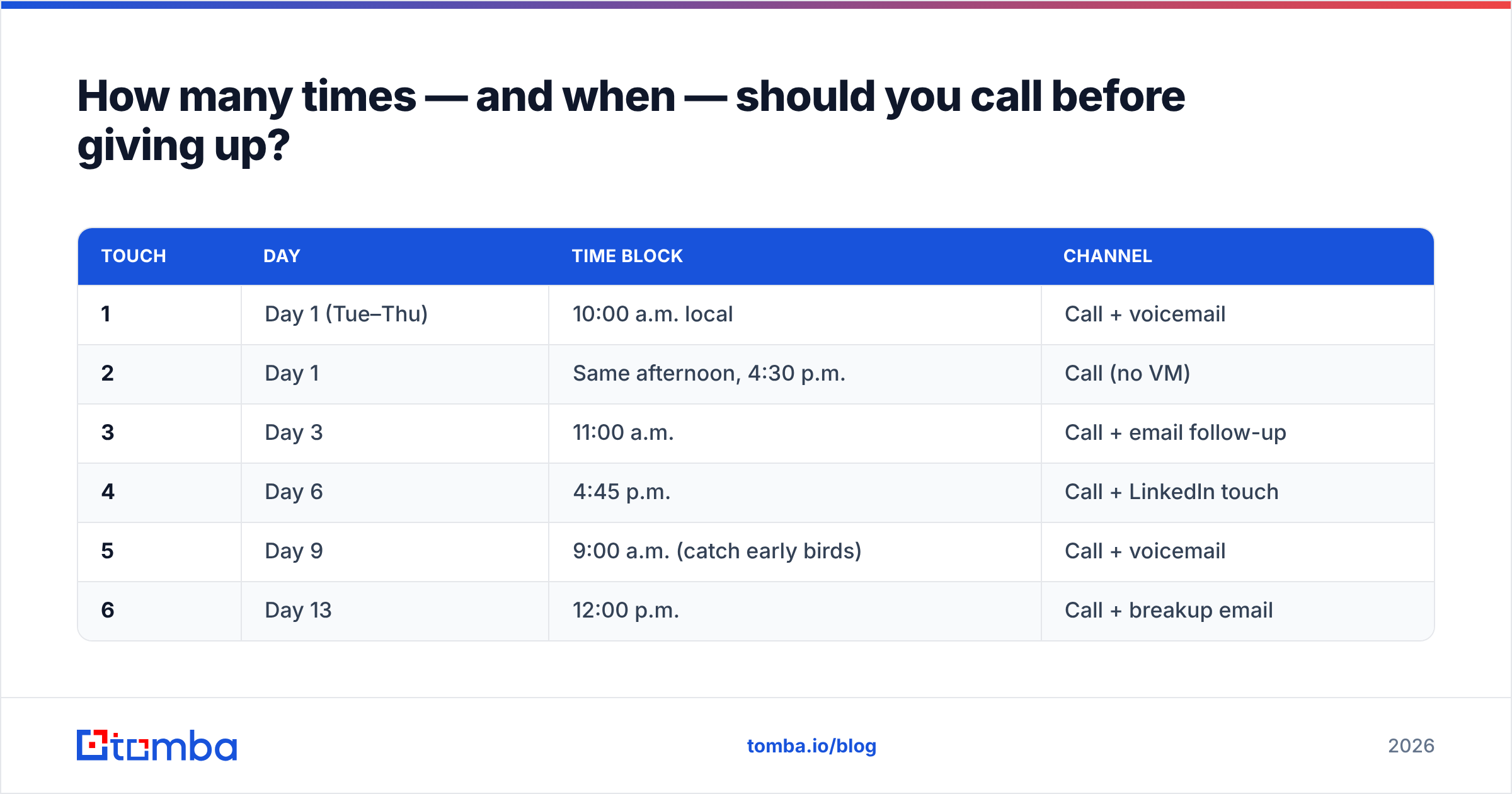
Here's a sane multi-touch cadence that respects timing instead of hammering the same dead slot:
| Touch | Day | Time block | Channel |
|---|---|---|---|
| 1 | Day 1 (Tue–Thu) | 10:00 a.m. local | Call + voicemail |
| 2 | Day 1 | Same afternoon, 4:30 p.m. | Call (no VM) |
| 3 | Day 3 | 11:00 a.m. | Call + email follow-up |
| 4 | Day 6 | 4:45 p.m. | Call + LinkedIn touch |
| 5 | Day 9 | 9:00 a.m. (catch early birds) | Call + voicemail |
| 6 | Day 13 | 12:00 p.m. | Call + breakup email |
Notice the times rotate. The point is simple: if someone never answers at 10 a.m., stop calling them at 10 a.m. Vary the slot and you eventually hit the window where that specific person is reachable. A multichannel rhythm — phone plus email plus LinkedIn outreach — keeps you visible without becoming the rep who called nine times from the same number.
)
How do you actually find your own best time to call?#
Generic benchmarks get you to the starting line; your own data wins the race. The averages above are a hypothesis, not gospel. Your segment, geography, and persona will have their own curve — and the only way to find it is to instrument your dials.
Run this loop:
- Tag every call with day, hour (prospect-local), and outcome. Most dialers and CRMs do this automatically — make sure the fields are populated, not blank.
- Calculate connect rate per time block, not per rep. You're looking for which windows convert, isolated from who's dialing.
- Find your top two blocks and concentrate your highest-value accounts there.
- Re-test quarterly. Buyer behavior shifts; remote-work patterns moved the whole curve a couple of hours later versus pre-2020 norms.
Two cheap experiments worth running:
- Time-zone A/B test: dial the same persona in two regions at their identical local time and compare. If connect rates match, time zone is your dominant variable. If they diverge, regional work culture matters more than you thought.
- Early-bird vs. night-owl test: carve out senior titles and test the 8–9 a.m. and 5–6 p.m. fringes specifically. You'll often find decision-makers are easier to reach off-peak.
What kills connect rates no matter how good your timing is?#
You can nail the hour and still strike out if the fundamentals are broken. The three silent killers:
- Bad numbers. Dialing a disconnected line or a generic switchboard at the perfect time is still a wasted dial. Direct, verified numbers are the foundation everything else sits on — this is where a dedicated phone finder and phone validator earn their keep by stripping dead and wrong numbers before your rep ever picks up the headset.
- Spam-flagged caller ID. If your number shows up as "Spam Likely," your connect rate craters regardless of timing. Rotate numbers, register them, and monitor your caller reputation.
- No local presence. Prospects answer numbers that look local far more often than out-of-area codes. Match your outbound number's area code to the region you're calling.
Timing optimization is the last 20%. The first 80% is calling real, reachable humans on a number that doesn't look like a robocall. Get the data layer right and the clock starts working in your favor instead of against it.
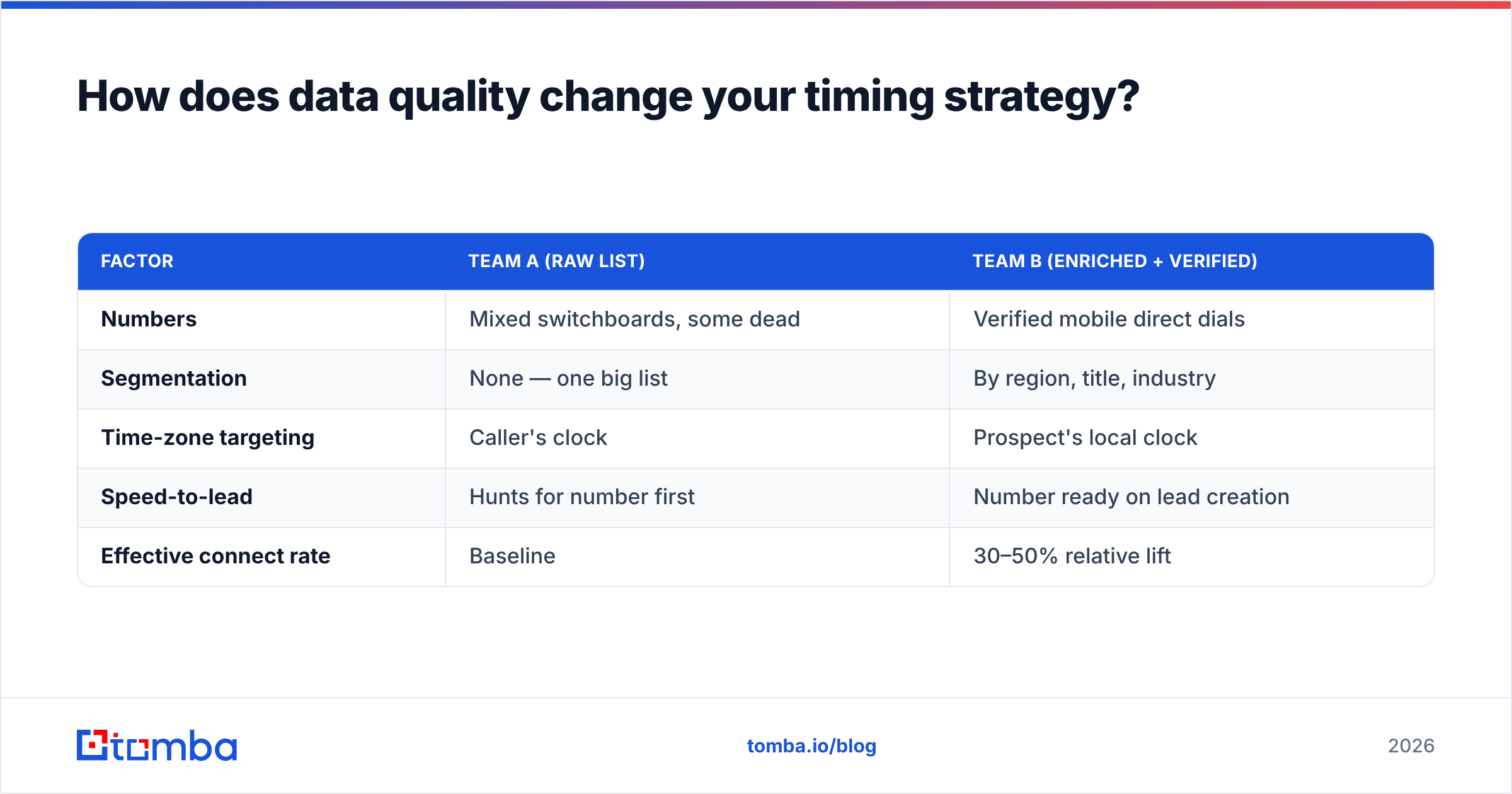
How does data quality change your timing strategy?#
It compounds it. A clean, enriched list lets you segment by the variables that drive timing — region, seniority, industry — instead of treating your whole list as one undifferentiated blob you dial 9-to-5.
Compare two teams:
| Factor | Team A (raw list) | Team B (enriched + verified) |
|---|---|---|
| Numbers | Mixed switchboards, some dead | Verified mobile direct dials |
| Segmentation | None — one big list | By region, title, industry |
| Time-zone targeting | Caller's clock | Prospect's local clock |
| Speed-to-lead | Hunts for number first | Number ready on lead creation |
| Effective connect rate | Baseline | 30–50% relative lift |
Team B isn't working harder — they're dialing the right person, on a working number, in the right local window. That's the entire game. You can read more about where Tomba gets data and how verification feeds straight into a faster dial.
For broader context on building outbound cadences, HubSpot's sales blog and peer reviews on G2 are solid reference points on how teams structure multi-touch sequences around connect data.
Quick reference: the best-time-to-call cheat sheet#
- Default cold window: Tue–Thu, 10–11:30 a.m. and 4–5 p.m., prospect-local.
- Senior titles: add the 8–9 a.m. and 5–6 p.m. fringes.
- Inbound leads: within 5 minutes, no exceptions.
- Avoid: Monday a.m. and Friday p.m.
- Cadence: 6–8 touches, rotating the time slot each attempt.
- Foundation: verified direct dials and local-presence numbers before you optimize anything else.
Where Tomba fits#
The "best time to call" only matters once you have a real number for the right person. Tomba's Email Finder, combined with the phone finder and data enrichment tools, builds you a clean, segmented, time-zone-aware calling list so every dial lands on a reachable human in their own local sweet spot. Start free with 25 searches a month, or scale up on the Starter plan at $49/mo — see full Tomba pricing to match a plan to your dial volume. Fix the data layer first, then let the clock do the rest of the work.
Ready to find emails that actually work?
Join 150,000+ professionals who stopped guessing and started sending. Free credits on signup — no credit card required.
Get the Tomba newsletter
Practical outbound tactics and product updates — once every two weeks.
About the author