Best Time To Cold Call in 2026: Best Days, Hours & Data
The best time to cold call isn't a guess. Here are the data-backed days, hours, and local-time windows that actually get prospects to pick up in 2026.
When You Dial Matters More Than What You Say
TL;DR
- The best time to cold call in 2026 is late afternoon (4:00–5:00 PM local time) and the late-morning window (10:00–11:30 AM), with Wednesday and Thursday as the strongest days.
- Monday mornings and Friday afternoons are the worst — prospects are either triaging the week or mentally clocked out.
- Connect rates swing by 2–3x depending on timing alone, so calling the right list at the wrong hour wastes good data.
- Time zone is the silent killer: a "9 AM call" means nothing until you know whether it's 9 AM for you or for them.
- Clean, accurate contact data (correct number, correct person, correct region) does more for connect rates than any opener. Garbage numbers can't be fixed by timing.
If you only change one thing about your outbound this quarter, change when you dial — not your script. The difference between a 4% and a 12% connect rate is rarely the words. It's the clock.
Why does timing change cold call outcomes so much?#
Think of cold calling like fishing. You can have the best rod and the perfect lure, but if you cast when the fish aren't feeding, you go home empty-handed. Decision-makers have predictable "feeding windows" — short stretches of the day when they're at their desk, between meetings, and willing to talk to someone they don't know.
The rest of the day they're in back-to-back calls, heads-down on deep work, commuting, or guarding their lunch. Dialing during those stretches doesn't just lower your odds — it actively trains the prospect to associate your number with interruption.
Technically, what you're optimizing is connect rate (the percentage of dials that reach a live human) and, downstream, conversation rate (connects that turn into a real talk). Timing primarily moves connect rate. And because every later metric — meetings booked, pipeline, closed revenue — is built on top of connects, a small timing improvement compounds through the whole funnel. A better response rate on the phone behaves the same way it does in email: it multiplies everything after it.

What is the best time of day to cold call?#
There are two reliable windows, and they map to natural gaps in a knowledge worker's day.
- Late afternoon, 4:00–5:00 PM (local time). The day's meetings are mostly done, urgent fires are out, and people are in a "wrap-up" headspace where a quick exploratory call feels low-risk. This is consistently the top window across multiple sales studies, including data summarized by HubSpot.
- Late morning, 10:00–11:30 AM (local time). Prospects have cleared their inbox, gotten coffee, and haven't yet mentally checked out for lunch. It's the second-best block and a great fallback when 4 PM is crowded.
The two windows you want to avoid:
- Early morning, before 9:00 AM. People are commuting, settling in, or protecting focus time. You'll hit voicemail.
- The lunch dead zone, 12:00–1:30 PM. Self-explanatory — nobody wants a pitch while they're eating.
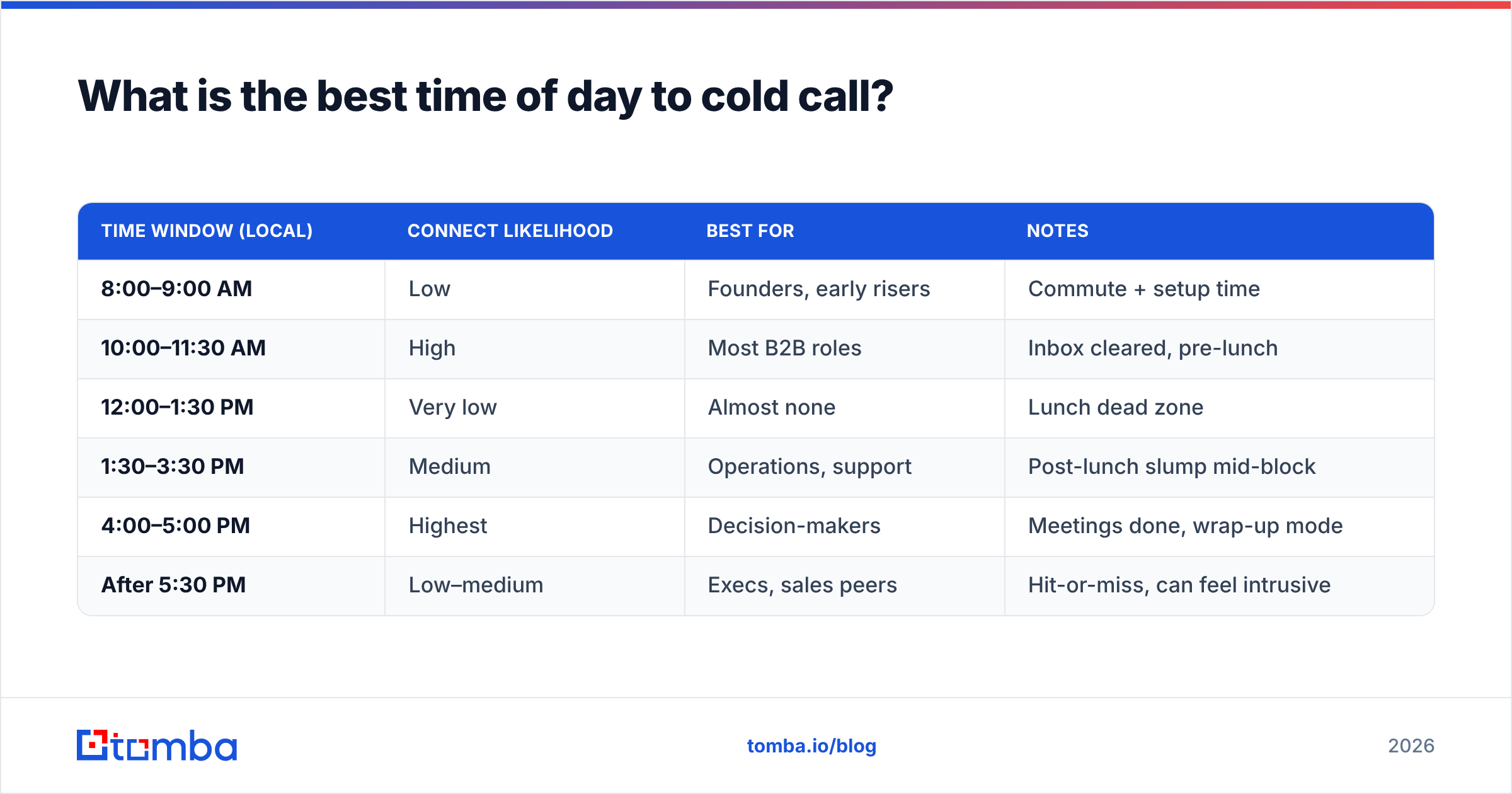
Here's how the major windows stack up.
| Time window (local) | Connect likelihood | Best for | Notes |
|---|---|---|---|
| 8:00–9:00 AM | Low | Founders, early risers | Commute + setup time |
| 10:00–11:30 AM | High | Most B2B roles | Inbox cleared, pre-lunch |
| 12:00–1:30 PM | Very low | Almost none | Lunch dead zone |
| 1:30–3:30 PM | Medium | Operations, support | Post-lunch slump mid-block |
| 4:00–5:00 PM | Highest | Decision-makers | Meetings done, wrap-up mode |
| After 5:30 PM | Low–medium | Execs, sales peers | Hit-or-miss, can feel intrusive |
Treat this as a starting hypothesis, not gospel. Your specific market — a hospital CIO versus a startup founder versus a retail district manager — will skew the windows. The point is to test against a baseline instead of dialing randomly.
What is the best day of the week to cold call?#
Wednesday and Thursday win. By midweek, Monday's chaos has settled and Friday's checkout hasn't started, so prospects are at their most reachable and most receptive.
- Monday: Weak, especially mornings. People are planning their week and clearing weekend backlog. Late Monday afternoon is salvageable.
- Tuesday: Solid. A reliable B-tier day, good for volume.
- Wednesday: Excellent. Peak reachability.
- Thursday: Excellent, often the single best day. Decisions are being made before the week closes.
- Friday: Mixed. Mornings can work; afternoons collapse as people mentally leave for the weekend.
Stack the two levers and the message is obvious: Wednesday or Thursday at 4 PM local is your highest-probability slot. Build your week so your best lists get dialed in those blocks, and use Monday/Friday for research, list-building, and follow-up admin.
How does time zone change your cold calling schedule?#
Time zone is where most reps quietly sabotage themselves. If you're in New York calling a prospect in Los Angeles at your 4 PM, it's their 1 PM — a decent slot. But call your 9 AM and you're ringing their phone at 6 AM, which lands you in the "do not call this company again" mental folder.
The fix is to segment your calling list by the prospect's local time, not yours. Then dial each segment during their 10–11:30 AM and 4–5 PM windows. Practically, that means an East Coast rep can:
- Open the day (their 8–9 AM) calling Europe in its afternoon.
- Mid-morning, work the East Coast late-morning window.
- Early afternoon, hit the Central and Mountain late-morning windows.
- Late afternoon, catch the East Coast 4 PM block, then roll into West Coast afternoon.
This only works if your data is correct. You need the right number and a reliable signal of where the contact actually sits — region, company HQ, mobile vs. office line. That's a data-quality problem before it's a scheduling problem. Sourcing direct dials from a trustworthy phone finder and confirming they're live with a phone validator is what makes time-zone routing possible instead of theoretical.

Does timing matter if your phone data is wrong?#
No — and this is the trap. You can nail the day, the hour, and the time zone, and still hit a dead number, a wrong department, or a contact who left the company eight months ago. Timing optimizes reaching a person. It does nothing if the number was never going to connect to the right person in the first place.
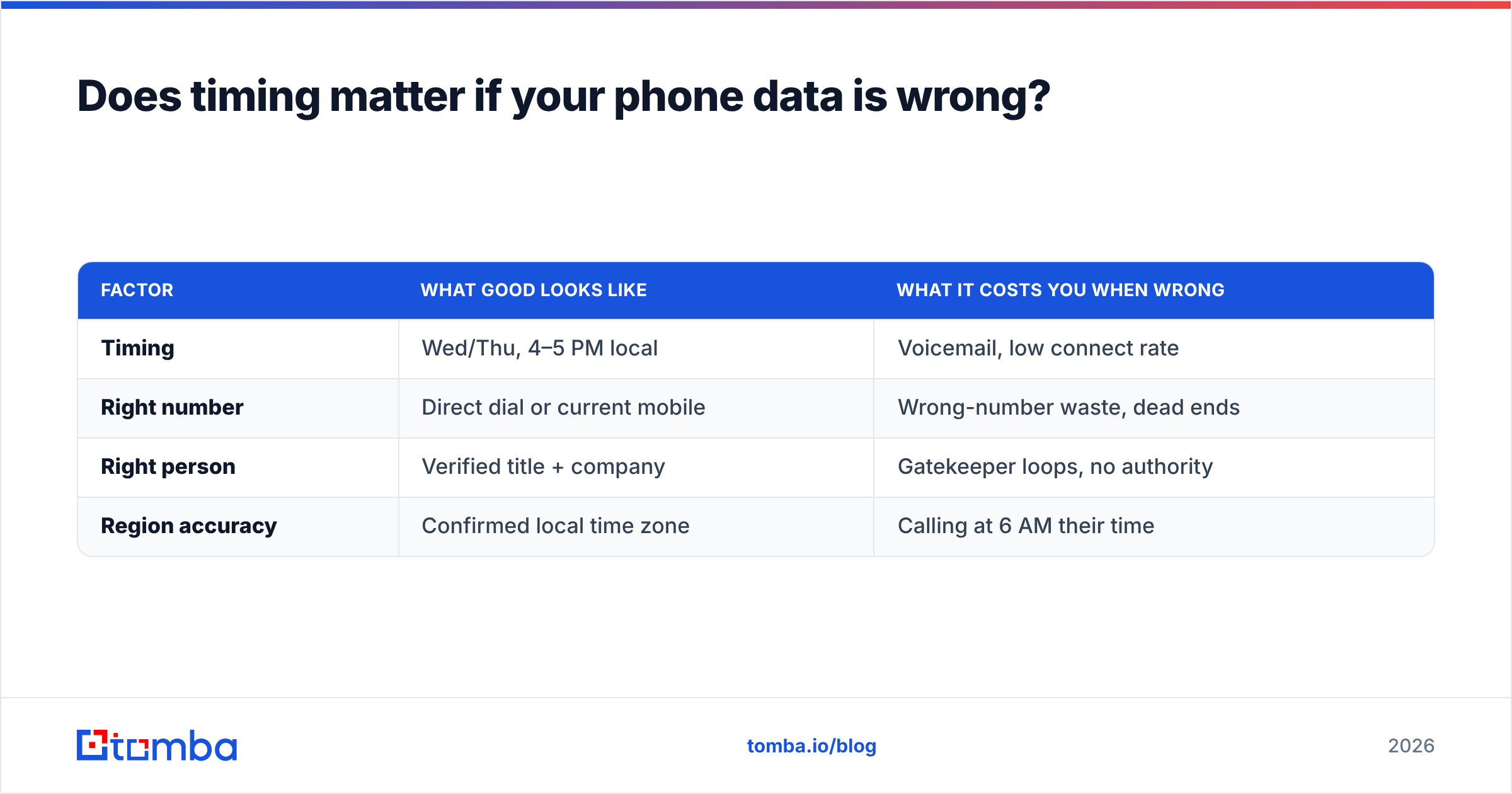
A quick gut-check on the two halves of a productive dial:
| Factor | What good looks like | What it costs you when wrong |
|---|---|---|
| Timing | Wed/Thu, 4–5 PM local | Voicemail, low connect rate |
| Right number | Direct dial or current mobile | Wrong-number waste, dead ends |
| Right person | Verified title + company | Gatekeeper loops, no authority |
| Region accuracy | Confirmed local time zone | Calling at 6 AM their time |
Most teams obsess over scripts and ignore the denominator. If 30% of your list has stale numbers, you've capped your connect rate before the first dial. Enriching and de-duplicating your list with proper data enrichment and pulling fresh contacts from a maintained B2B database raises the ceiling that timing then optimizes against. Salesforce's research on sales productivity makes the same point repeatedly — reps spend a punishing share of their week on bad-data busywork. (See Salesforce on rep time allocation.)
How should you build a weekly cold calling schedule?#
Turn the principles above into a repeatable week. Here's a template a single rep or a small team can run as-is.
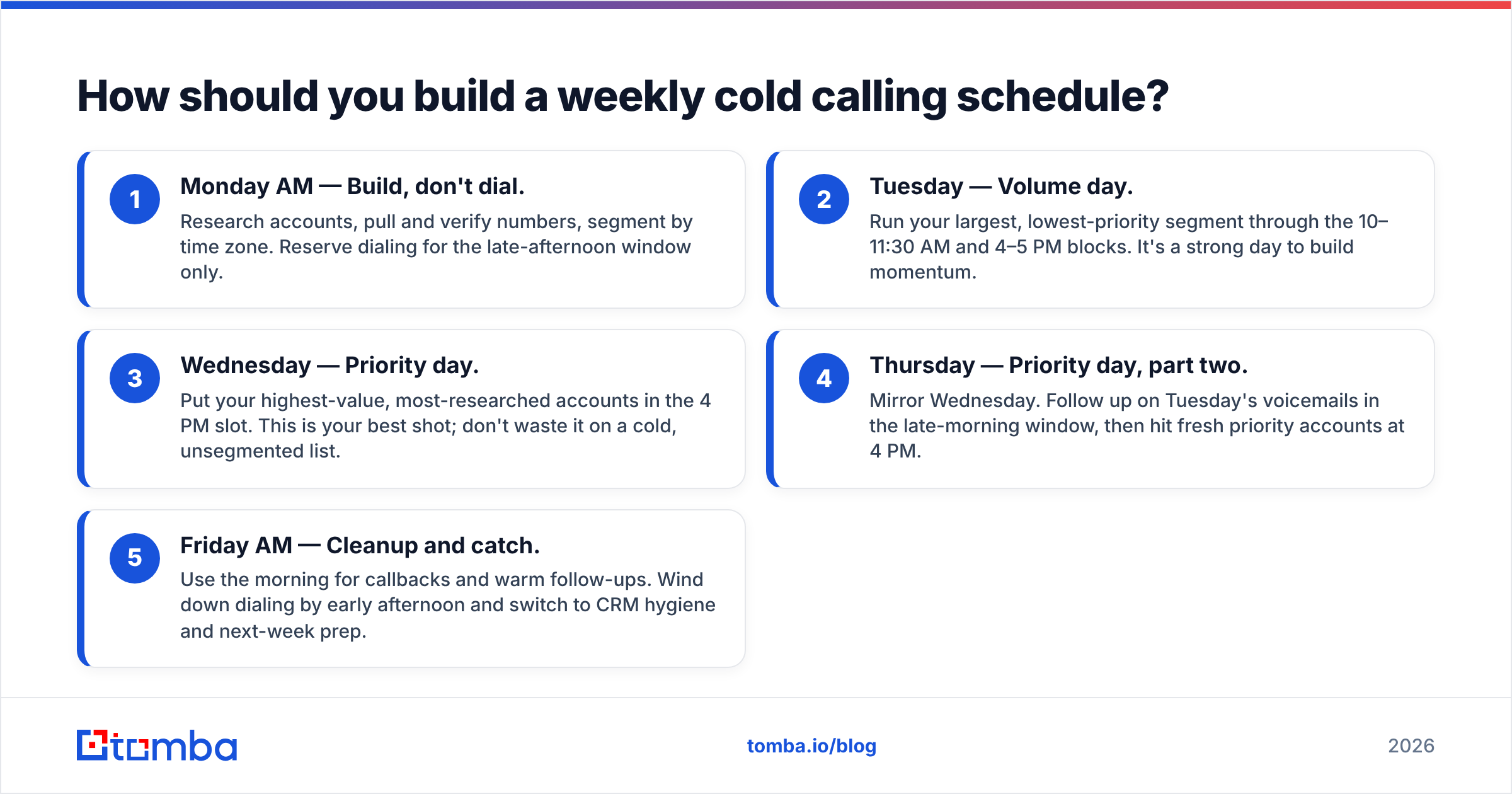
- Monday AM — Build, don't dial. Research accounts, pull and verify numbers, segment by time zone. Reserve dialing for the late-afternoon window only.
- Tuesday — Volume day. Run your largest, lowest-priority segment through the 10–11:30 AM and 4–5 PM blocks. It's a strong day to build momentum.
- Wednesday — Priority day. Put your highest-value, most-researched accounts in the 4 PM slot. This is your best shot; don't waste it on a cold, unsegmented list.
- Thursday — Priority day, part two. Mirror Wednesday. Follow up on Tuesday's voicemails in the late-morning window, then hit fresh priority accounts at 4 PM.
- Friday AM — Cleanup and catch. Use the morning for callbacks and warm follow-ups. Wind down dialing by early afternoon and switch to CRM hygiene and next-week prep.
Two rules that make the schedule actually work:
- Block the windows on your own calendar. If 4–5 PM Wednesday isn't a protected, no-meetings dialing block, it will get eaten by everything else.
- Log every dial with outcome and local time. After two weeks you'll have your own heatmap, which beats any generic study. Industry roundups from sites like G2 are a fine starting baseline, but your data wins ties.
What about voicemails and follow-up timing?#
Connecting on the first dial is rare — most conversations happen after multiple touches. So your timing strategy has to cover the misses too.
- Leave a voicemail on the first miss, not the second. A short, specific 20-second message ("I'll try you Thursday around 4") sets up the next dial.
- Vary the window between attempts. If Wednesday 4 PM missed, try Thursday 10:30 AM. Hitting the same slot repeatedly just confirms they're not reachable then.
- Cap attempts and sequence them. Six to eight touches across two weeks, alternating call and email, is a sane default. Pair the call cadence with email so a missed dial isn't a dead end — pulling verified addresses with an email finder lets you keep the conversation moving between calls.
The goal is a multichannel rhythm where timing applies to every touch, not just the first ring.
Quick answers: best time to cold call#
- Best overall slot: Wednesday or Thursday, 4:00–5:00 PM in the prospect's time zone.
- Best backup slot: Tuesday–Thursday, 10:00–11:30 AM local.
- Worst times: Monday before 10 AM, the 12:00–1:30 PM lunch zone, and Friday after 2 PM.
- Non-negotiable prerequisite: correct number, correct person, correct region. Timing optimizes good data; it can't rescue bad data.
Start with data, then optimize the clock#
The best time to cold call is real and worth exploiting — but it's the second lever, not the first. The first lever is reaching the right person at a working number in a known time zone. Get that right and a timing tweak turns a mediocre day into a great one; get it wrong and the perfect 4 PM Wednesday slot just produces faster voicemails.
If you want your dialing windows to actually pay off, start by fixing the list. Use Tomba's phone finder to source direct dials and mobiles, validate them so you're not burning your best slots on dead numbers, and enrich each contact with the region data you need to route calls by local time. Pair it with the email finder for the multichannel follow-up your cadence depends on. You can start free (25 searches a month) and scale up as your pipeline grows — see Tomba pricing for the Starter ($49/mo), Growth ($99/mo), and Pro ($249/mo) plans. Clean data first, perfect timing second — that's the order that books meetings.
// get started
Find, verify and enrich your first contacts today
Start on the free plan with 25 searches a month, then scale when your team is ready.
Free plan · No credit card required · GDPR & CCPA
// about the author