Best Time to Cold Call B2B in 2026: Data-Backed Windows
Stop dialing at random. Here are the proven days, hours, and cadences for B2B cold calling in 2026 — backed by connect-rate data and a clean-list workflow.
Cold calling is not dead — bad timing is. If you are dialing prospects whenever you happen to have a free minute, you are leaving connect rate, conversations, and pipeline on the table. The good news: the best time to cold call B2B is predictable, and once you stack timing on top of accurate contact data, the same rep with the same script can roughly double their conversations per hour.
TL;DR#
- Best days: Wednesday and Thursday consistently outperform Monday and Friday for B2B connect and conversion.
- Best windows: Late morning (around 10–11 a.m.) and late afternoon (around 4–5 p.m.) in the prospect's local time beat the post-lunch dead zone.
- Worst time: Monday before 10 a.m. and Friday after 3 p.m. — inboxes and calendars are either chaos or checked out.
- Cadence beats single dials: It often takes 5–8 touches to connect. Spread them across days and hours, not all in one afternoon.
- Data is the multiplier: The right hour is wasted on a wrong or disconnected number. Verified B2B phone numbers make every dial count.
Why does timing matter so much in B2B cold calling?#
Think of cold calling like fishing. You can have the best rod, the sharpest hook, and perfect technique — but if you cast when the fish are not feeding, you go home empty. Call timing is choosing the moment the fish are biting.
In practice, "timing" controls one thing above all: the chance a human actually picks up. Industry connect-rate studies from sales-engagement vendors and analysts at Gartner repeatedly show that pickup rates swing by 2–3x depending on the day and hour. A decision-maker who ignores a 9:05 a.m. Monday call — buried in weekend backlog — may happily talk at 4:30 p.m. on a Wednesday when the day's fires are out and the next meeting hasn't started.
Two forces drive every "best time" finding:
- Cognitive load. People answer unknown numbers when they have spare attention — between tasks, not inside them.
- Calendar rhythm. Mornings open with triage; mid-week settles into routine; Friday afternoons drift toward the weekend.
What is the best time to cold call B2B prospects?#
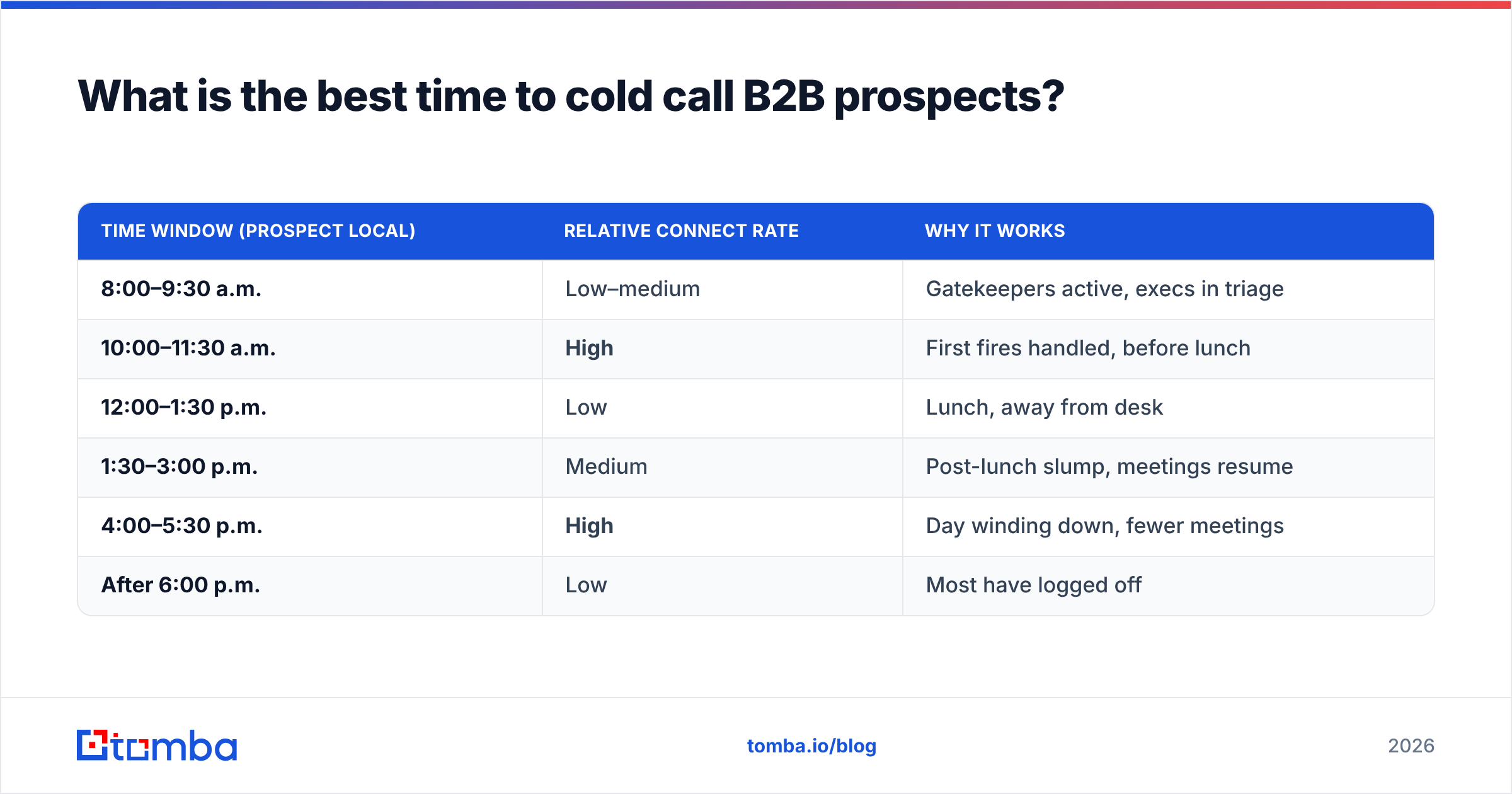
Here is the short answer, then the nuance. The best time to cold call B2B is mid-week, late morning or late afternoon, in the prospect's local time zone. Aggregated findings across sales-engagement platforms and outbound teams converge on the windows below.
| Time window (prospect local) | Relative connect rate | Why it works |
|---|---|---|
| 8:00–9:30 a.m. | Low–medium | Gatekeepers active, execs in triage |
| 10:00–11:30 a.m. | High | First fires handled, before lunch |
| 12:00–1:30 p.m. | Low | Lunch, away from desk |
| 1:30–3:00 p.m. | Medium | Post-lunch slump, meetings resume |
| 4:00–5:30 p.m. | High | Day winding down, fewer meetings |
| After 6:00 p.m. | Low | Most have logged off |
The two peaks — late morning and late afternoon — are the windows you should protect for live dialing. Use the dead zones for research, list building, and voicemail-and-email follow-ups.
Best days of the week to cold call#
Day-of-week matters as much as hour. A simple, defensible ranking for B2B outbound:
- Wednesday — peak focus, mid-week routine, highest answer rates.
- Thursday — nearly as strong; decisions before the week closes.
- Tuesday — solid once Monday's backlog clears.
- Monday — avoid before 10 a.m.; weekend pileup kills pickups.
- Friday — front-load it; after 3 p.m. is mostly checked out.
If you only have two prime dialing blocks per week, put them Wednesday and Thursday afternoon.
Does the prospect's industry and role change the best time?#
Yes — the generic windows are a starting point, not a law. Adjust for who you are calling.
- Founders and C-suite at startups often answer early (before 8:30 a.m.) or late (after 5:30 p.m.), outside the meeting-packed core day.
- IT and engineering leaders lean later in the day; mornings are stand-ups and incident triage.
- Retail, hospitality, and operations managers are unreachable during their own peak hours — call mid-morning on slow days, never over a lunch rush.
- Finance teams disappear at month-end and quarter-end; time your outreach to the first two weeks of a month.
The lesson: segment your list by role and industry, then map each segment to its own best window. This is where good data turns a generic playbook into a personalized one. Enriching records with title, seniority, and time zone — for example via contact enrichment — lets you sort a raw list into "call Wednesday 4 p.m." vs. "call Tuesday 8 a.m." buckets.
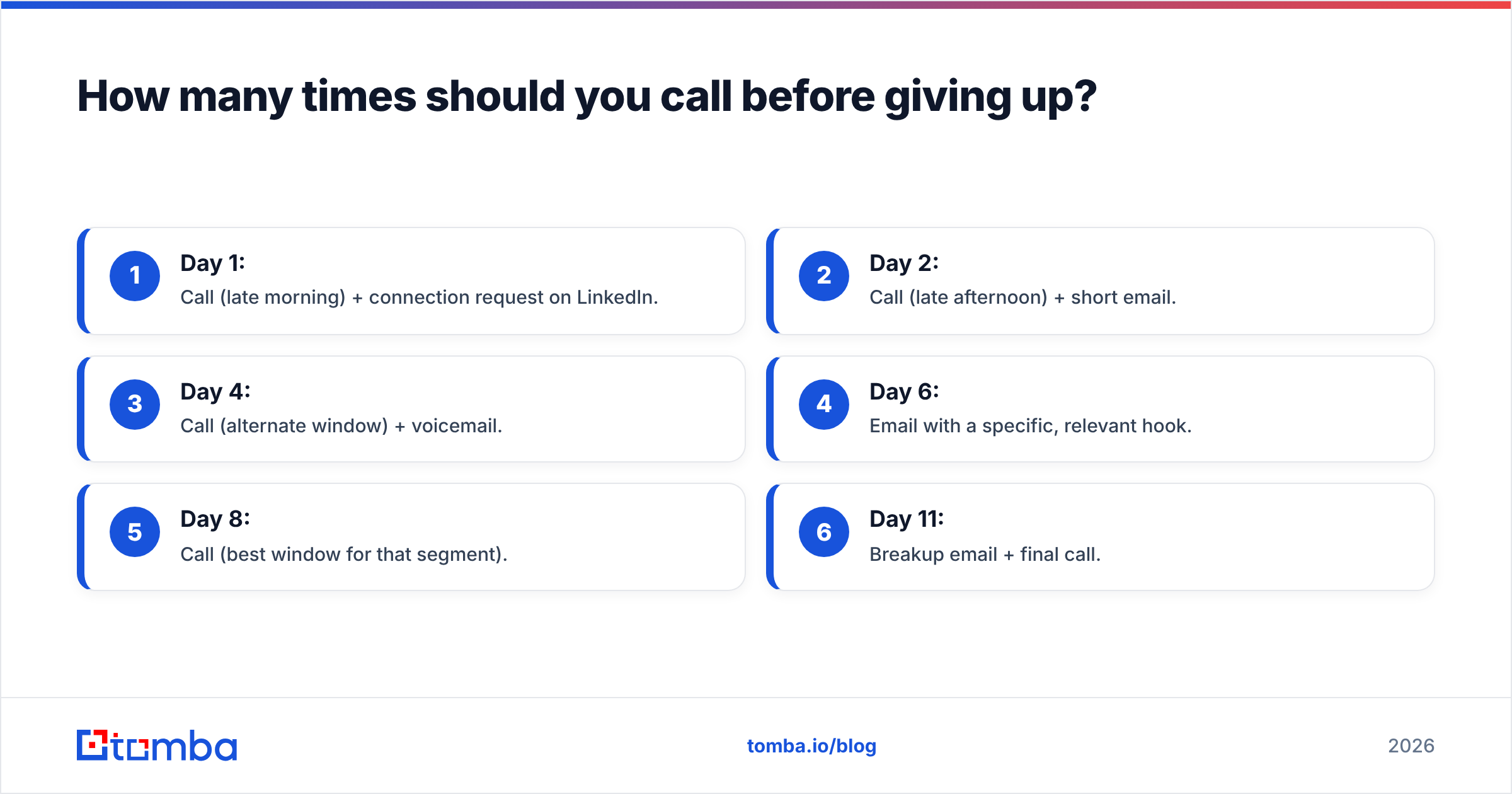
How many times should you call before giving up?#
One dial is not a cadence — it is a coin flip. Most connects happen on the fourth through eighth touch, and reps who quit after one or two attempts never see the prospects who would have picked up on attempt five.
A balanced multi-channel cadence over two weeks:
- Day 1: Call (late morning) + connection request on LinkedIn.
- Day 2: Call (late afternoon) + short email.
- Day 4: Call (alternate window) + voicemail.
- Day 6: Email with a specific, relevant hook.
- Day 8: Call (best window for that segment).
- Day 11: Breakup email + final call.
Rotate the hour on each attempt. If Tuesday 9 a.m. didn't land, try Thursday 4 p.m. — you are sampling different slices of the prospect's week, not hammering the same dead slot. For more on multi-channel sequencing, HubSpot's sales blog has solid cadence breakdowns worth bookmarking.
/blog/generated/memes/2026-06-19/best-time-to-cold-call-b2b-meme-1.png
Why does great timing fail without accurate phone data?#
Here is the trap teams fall into: they optimize the when and ignore the who and the number. A perfectly timed call to a disconnected line, a wrong extension, or a person who left the company 14 months ago is a perfectly timed waste.
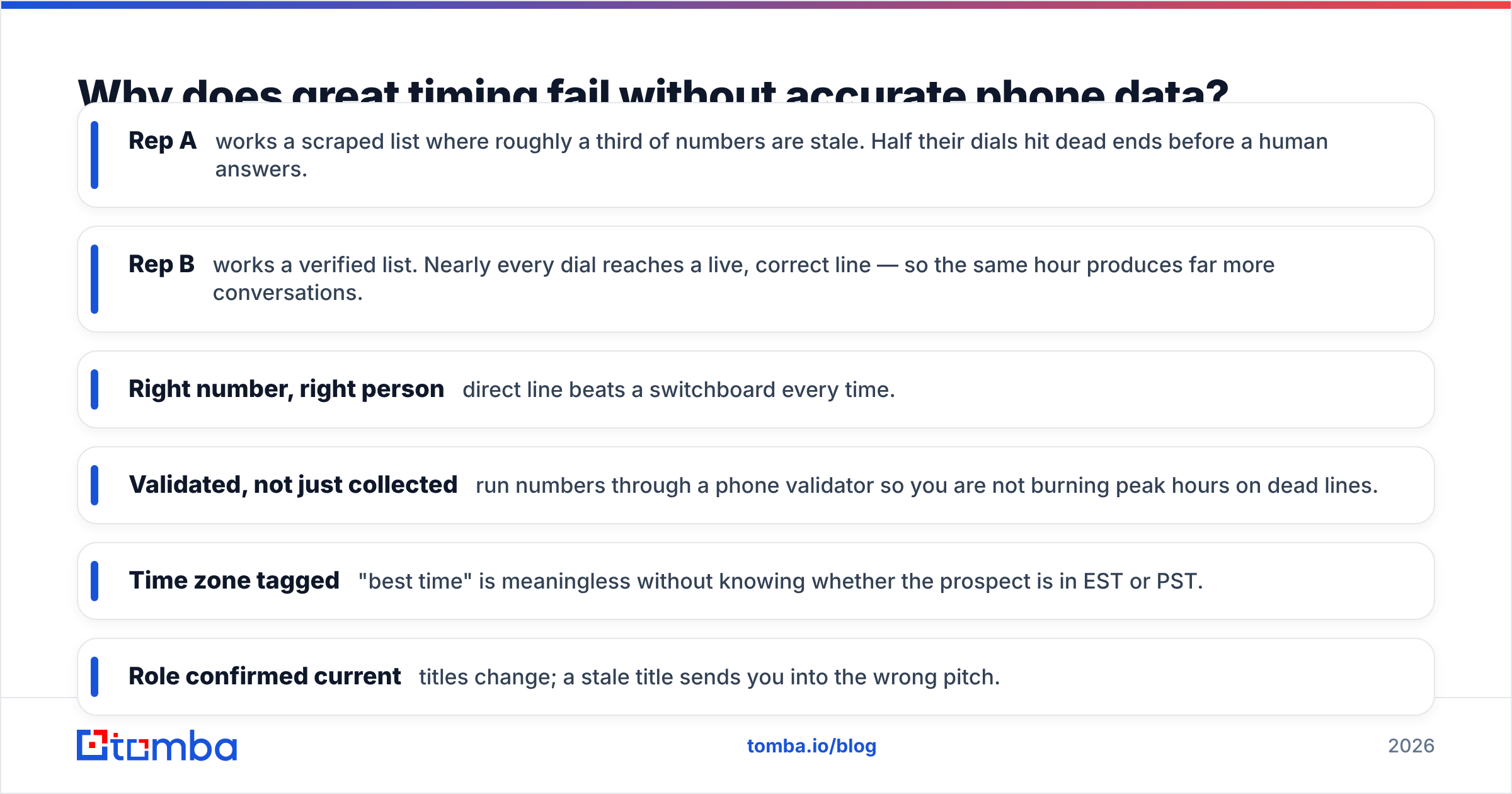
Picture two reps, both dialing Wednesday at 4 p.m.:
- Rep A works a scraped list where roughly a third of numbers are stale. Half their dials hit dead ends before a human answers.
- Rep B works a verified list. Nearly every dial reaches a live, correct line — so the same hour produces far more conversations.
Same script, same window, very different pipeline. Timing sets the ceiling; data determines how much of that ceiling you actually reach. That is why your dialing strategy and your B2B database hygiene are the same project, not two separate ones.
/blog/generated/memes/2026-06-19/best-time-to-cold-call-b2b-meme-2.png
A quick pre-call data checklist#
Before a single dial in your prime window, confirm:
- Right number, right person — direct line beats a switchboard every time.
- Validated, not just collected — run numbers through a phone validator so you are not burning peak hours on dead lines.
- Time zone tagged — "best time" is meaningless without knowing whether the prospect is in EST or PST.
- Role confirmed current — titles change; a stale title sends you into the wrong pitch.
How do you find the right people and numbers to call?#
You cannot time a call you cannot place. The workflow that feeds a high-connect dialing block looks like this:
- Build the target list by company and role — use a domain search to surface the right contacts at each account.
- Get the direct line — a dedicated phone finder returns B2B numbers tied to the person, not a generic main line.
- Verify before you dial so peak hours go to reachable prospects.
- Enrich with time zone and seniority so you can bucket each contact into its ideal window.
- Load into your dialer or CRM and schedule blocks by segment.
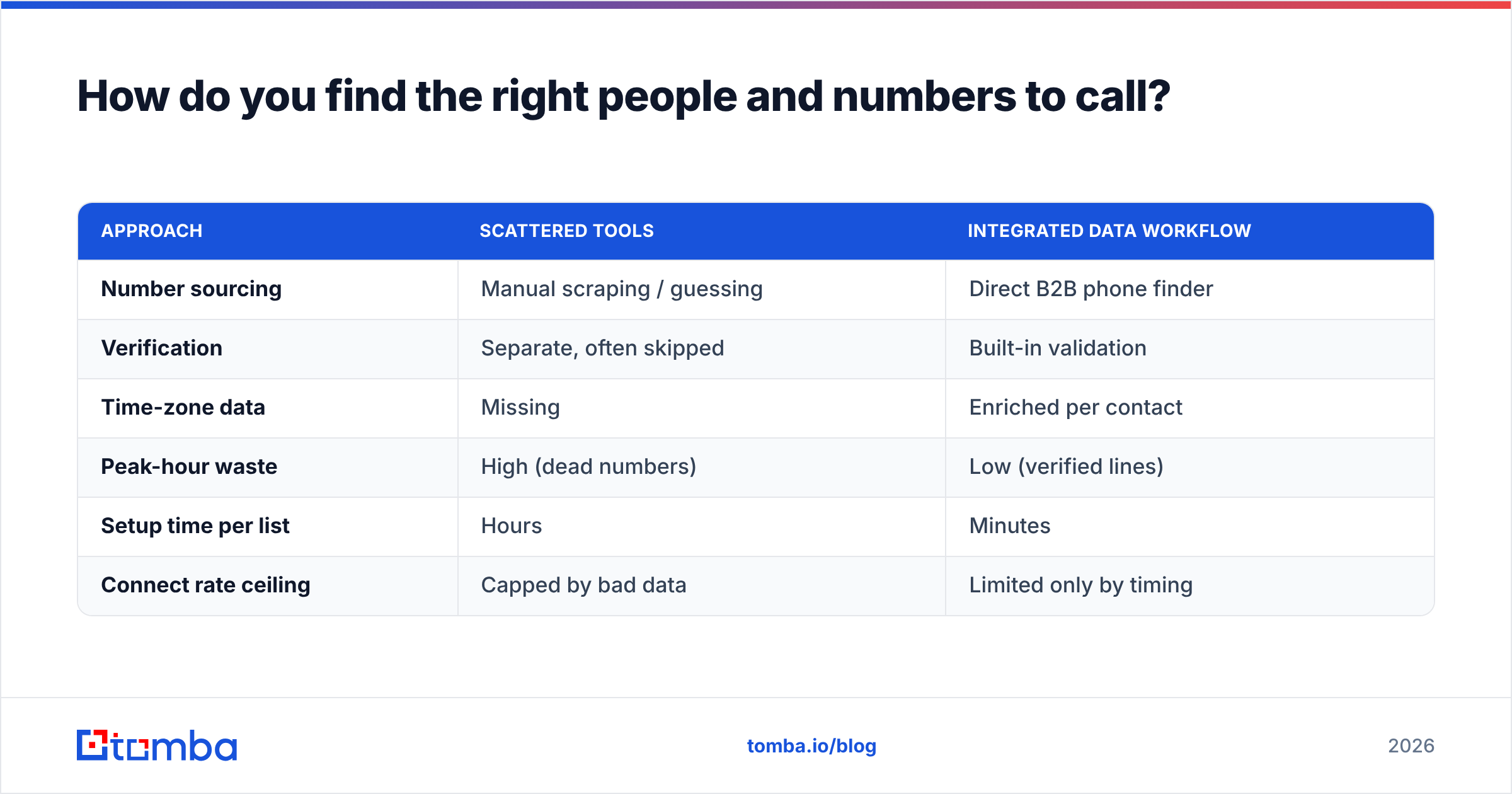
Tools that combine finding and verifying in one place save you the messy export-import-clean loop. Here is how a focused workflow stacks up against the scattered approach.
| Approach | Scattered tools | Integrated data workflow |
|---|---|---|
| Number sourcing | Manual scraping / guessing | Direct B2B phone finder |
| Verification | Separate, often skipped | Built-in validation |
| Time-zone data | Missing | Enriched per contact |
| Peak-hour waste | High (dead numbers) | Low (verified lines) |
| Setup time per list | Hours | Minutes |
| Connect rate ceiling | Capped by bad data | Limited only by timing |
How should you measure and refine your own best time?#
Benchmarks get you started; your own data makes you sharp. The "best time to cold call B2B" in the studies is an average — your market, region, and ICP will have their own peaks. Track these three numbers by hour and day:
- Connect rate = live conversations ÷ dials. This tells you when people answer.
- Conversation-to-meeting rate = meetings booked ÷ conversations. This tells you when people are receptive.
- Dials per meeting = total dials ÷ meetings booked. This is your efficiency score.
Run it for two to four weeks, then double down on the windows where both connect rate and conversion are high. You will often find a "hidden" window specific to your audience — a Thursday 8 a.m. founder slot, or a Tuesday 5 p.m. ops-manager pocket — that no generic article could have told you.
A note on compliance and respect: calling at the right time is also about calling within legal and reasonable hours. Stay inside local calling-hour regulations and never dial outside business hours for the prospect's region. Good timing and good manners point the same direction.
What's the single highest-leverage change you can make today?#
If you change one thing this week, make it this: stop dialing random numbers at random times, and start dialing verified numbers in mid-week peak windows. Timing without data is a fast car with no fuel; data without timing is fuel with no car. You need both.
Map your list to time zones, protect your Wednesday and Thursday late-afternoon blocks, commit to a 5–8 touch cadence, and feed the whole machine with numbers you have actually verified.
Ready to make every dial land on a real, reachable person? Start by building a clean, accurate call list with the Tomba Email Finder and pairing it with Tomba's phone finder and verification tools — so your perfectly timed calls reach perfectly correct numbers. Check Tomba pricing to find the plan that fits your outbound volume, then put your best hours to work.
// get started
Find, verify and enrich your first contacts today
Start on the free plan with 25 searches a month, then scale when your team is ready.
Free plan · No credit card required · GDPR & CCPA
// about the author