Best Time To Send B2B Emails in 2026 (Data-Backed Guide)
Mornings win, Mondays lose, and your list matters more than the clock. Here's what the 2026 data says about the best time to send B2B emails.
Timing influences whether your B2B email gets opened — but it is one of the smallest levers you control, and most teams overrate it. This guide gives you the data-backed best windows, then shows you the four things that move reply rates far more than the clock.
TL;DR — The Best Time To Send B2B Emails#
- Best days: Tuesday and Wednesday. Avoid Monday mornings (inbox backlog) and Friday afternoons (mentally checked out).
- Best hours: 8–10 a.m. and a secondary 1–3 p.m. window, in the recipient's time zone — not yours.
- Timing is a ~10% lever. List quality, targeting, and copy decide the other 90% of your reply rate.
- Send in the recipient's local time, batch your sends, and warm up the domain before you scale.
- A clean, verified list beats perfect timing every single time — a 9 a.m. send to a dead inbox is still a bounce.
Why does send time matter for B2B email at all?#
Think of email timing like dropping a flyer on someone's desk. If you leave it when they're buried in Monday triage, it gets swept into the trash with everything else. Leave it when they've cleared the morning rush and are sipping coffee, and they actually read it. Same flyer, different outcome — purely because of when it landed.
Technically, send time affects two things: where your message sits in the inbox stack when the recipient first looks, and how fresh it is when they have attention to spare. B2B inboxes follow predictable rhythms tied to the workday. Decision-makers process email in bursts — early morning, post-lunch, and end of day — so landing near the top of one of those bursts is the entire game.
But here's the honest part most "best time" posts bury: timing is a tiebreaker, not a strategy. If your targeting is wrong or your list is full of invalid addresses, no send hour will save you. Get the foundation right first, then optimize timing as a final 5–10% gain.
)
What is the best day to send B2B emails in 2026?#
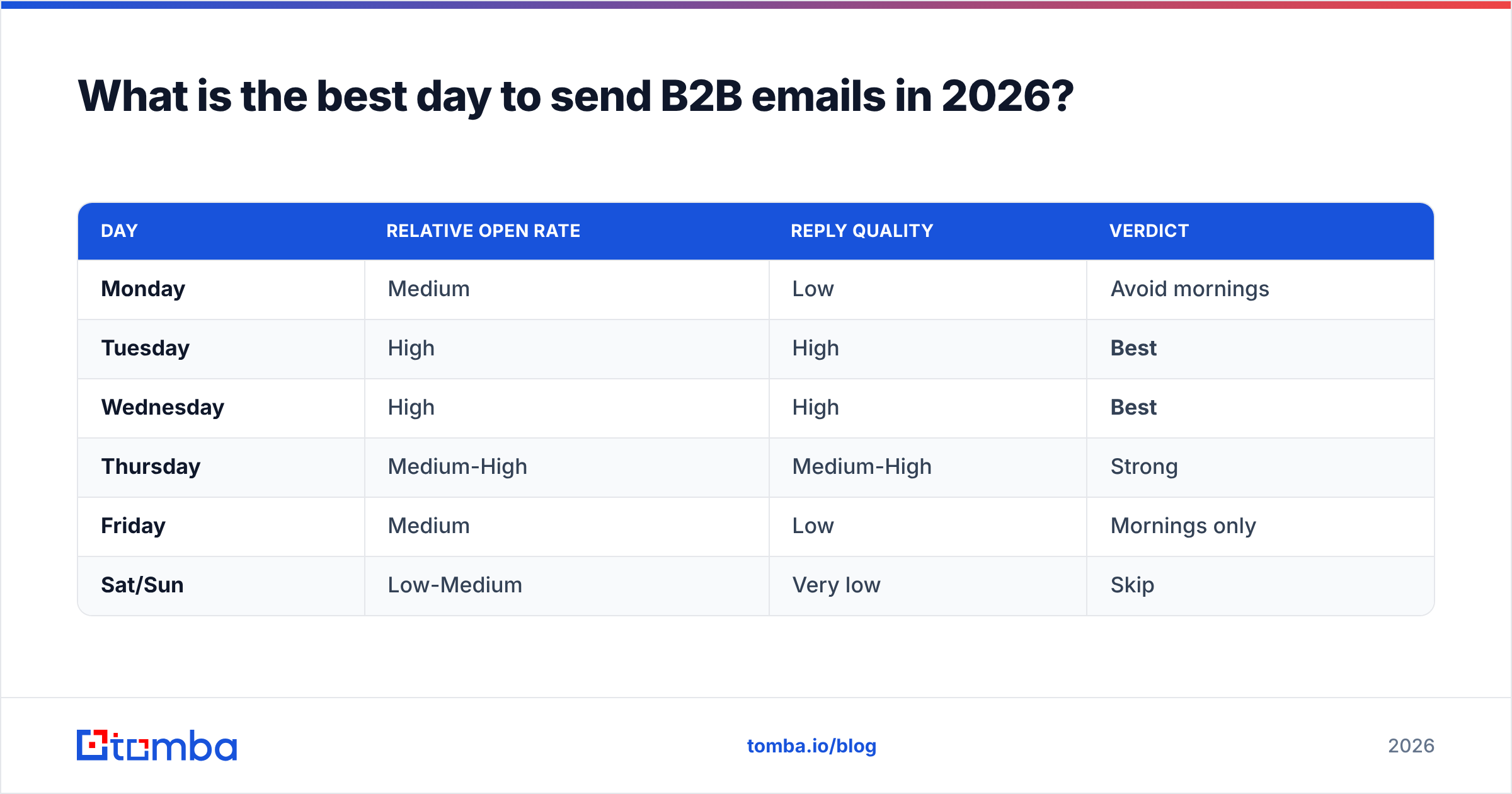
Tuesday and Wednesday are the consensus winners, with Thursday a close third. Multiple large-scale send studies — including aggregate data published by HubSpot — converge on midweek as the sweet spot for B2B opens and replies.
Here's why the bookends fail:
- Monday: Recipients are clearing weekend backlog. Your cold email competes with 40 internal threads and gets archived on reflex.
- Friday: Attention drops after lunch as people wind down. Replies that require thought get pushed to "next week" and forgotten.
- Weekends: B2B buyers are off the clock. Open rates can look fine, but action rates crater.
| Day | Relative open rate | Reply quality | Verdict |
|---|---|---|---|
| Monday | Medium | Low | Avoid mornings |
| Tuesday | High | High | Best |
| Wednesday | High | High | Best |
| Thursday | Medium-High | Medium-High | Strong |
| Friday | Medium | Low | Mornings only |
| Sat/Sun | Low-Medium | Very low | Skip |
The practical rule: concentrate your primary outreach on Tuesday–Thursday, and use Monday and Friday for follow-ups inside existing threads, where timing matters less because the recipient already knows you.
What is the best time of day to send cold emails?#
Two windows dominate: 8–10 a.m. and 1–3 p.m. local time. The morning window catches people during inbox triage; the afternoon window catches them after lunch when they're re-engaging but not yet swamped.
A simple, defensible playbook:
- 8:00–9:00 a.m. — Lands at the top of the morning triage stack. Best for first-touch cold emails.
- 9:30–10:30 a.m. — Catches people who clear their inbox a bit later. Good secondary slot.
- 1:00–2:00 p.m. — Post-lunch re-engagement. Strong for follow-ups and second touches.
- 4:00–5:00 p.m. — End-of-day clearing. Lower volume but surprisingly high reply intent from people tidying up before they leave.
The single most common mistake is sending in your time zone. If you're in New York blasting at 9 a.m. ET, your prospects in San Francisco get it at 6 a.m. — buried before they wake. Segment your list by region and schedule each batch to hit 8–10 a.m. where the recipient is. Most modern sending tools support per-contact time-zone scheduling; use it.
Does send time actually beat list quality? (No.)#
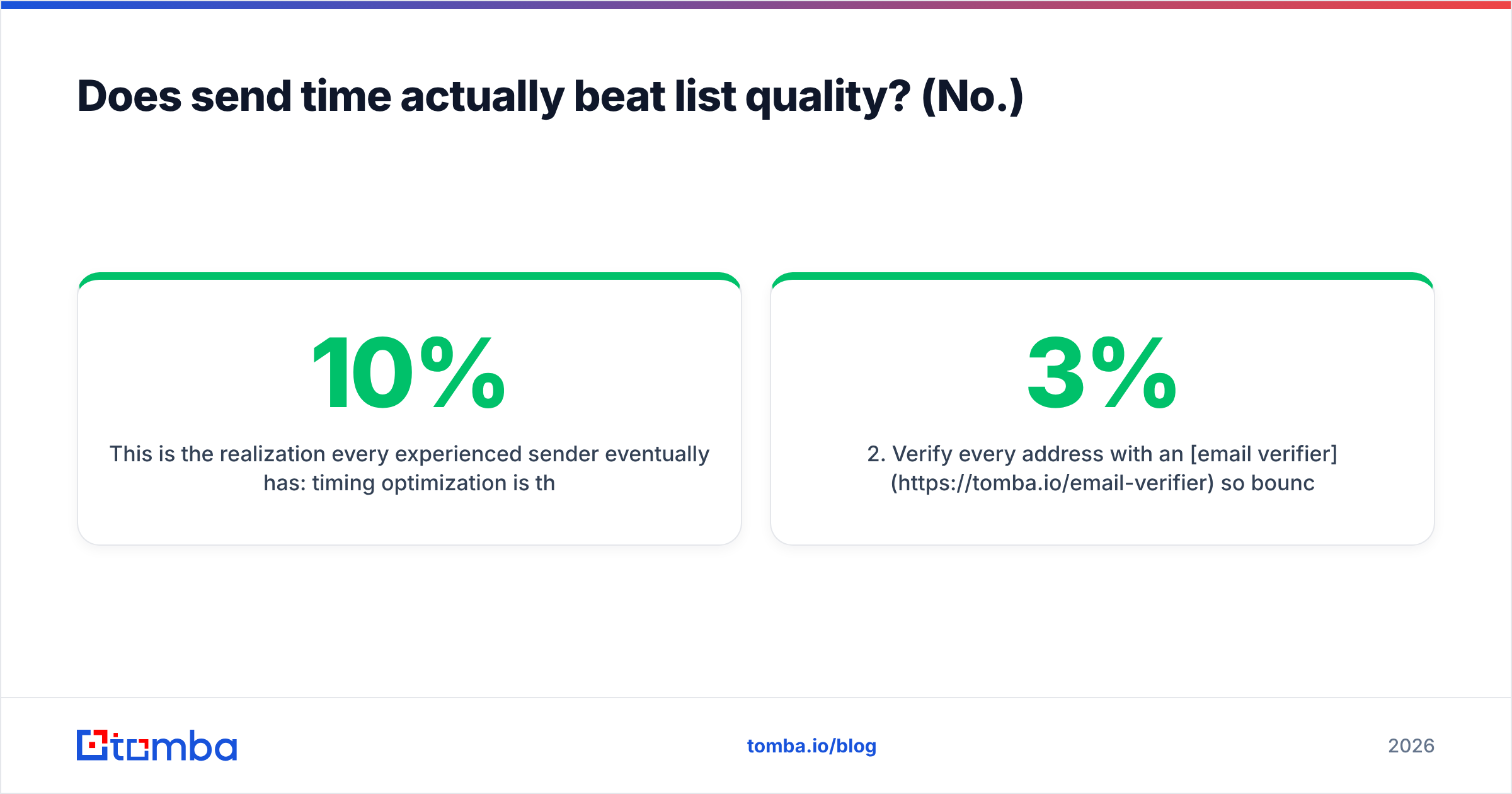
This is the realization every experienced sender eventually has: timing optimization is the last 10%, and your list is the first 90%. You can A/B test send hours forever and gain a few points. You can fix a dirty list and double your reply rate.
)
Why list quality dwarfs timing:
- Bounces tank deliverability. Send to invalid addresses and mailbox providers throttle you — so your perfectly-timed emails to good addresses start landing in spam too. Protecting your email deliverability starts with not emailing dead inboxes.
- Bad targeting kills replies regardless of hour. The wrong persona won't reply at 8 a.m. or 8 p.m.
- Catch-all and role addresses inflate your "sent" count while quietly destroying engagement metrics.
So before you obsess over Tuesday-at-9, do this:
- Build a targeted list, not a big one. Use a domain search to pull the right people at the right companies rather than scraping everyone.
- Verify every address with an email verifier so bounces stay under 2–3%.
- Warm up your domain so the volume you eventually send looks natural. Our email warmup calculator helps you ramp safely.
- Then optimize send time.
How do you find the best time for your specific audience?#
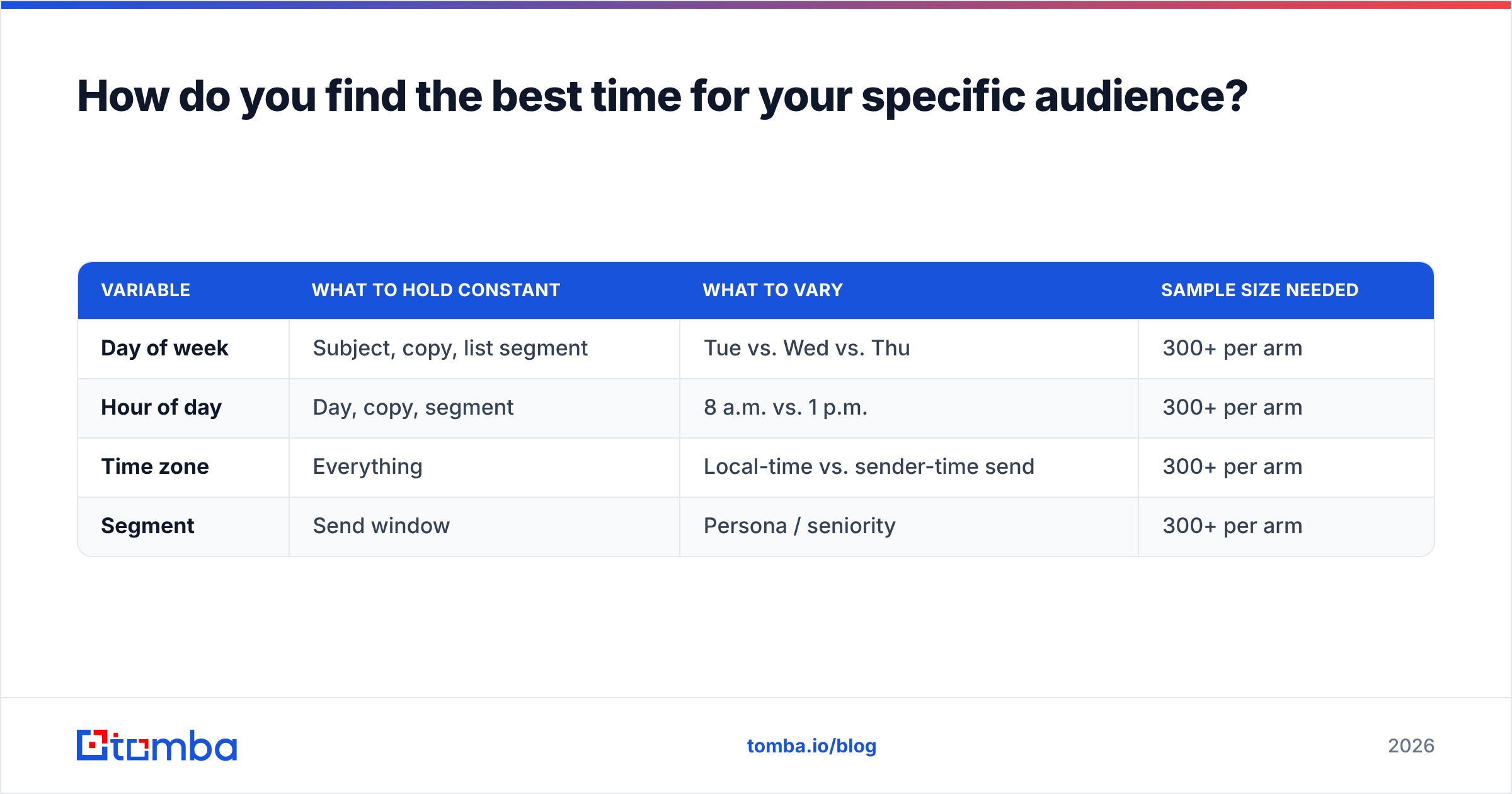
Generic benchmarks get you to the starting line; your own data wins the race. The best time to send B2B emails for a CFO in Frankfurt is not the best time for a startup founder in Austin. You have to test.
A clean testing framework:
| Variable | What to hold constant | What to vary | Sample size needed |
|---|---|---|---|
| Day of week | Subject, copy, list segment | Tue vs. Wed vs. Thu | 300+ per arm |
| Hour of day | Day, copy, segment | 8 a.m. vs. 1 p.m. | 300+ per arm |
| Time zone | Everything | Local-time vs. sender-time send | 300+ per arm |
| Segment | Send window | Persona / seniority | 300+ per arm |
Rules to keep the test honest:
- Change one variable at a time. If you vary day and copy, you learn nothing.
- Use a meaningful sample. Under ~300 sends per variant, the result is noise.
- Measure replies, not just opens. With privacy features inflating open data, replies and meetings booked are the metrics that pay rent.
- Re-test quarterly. Workday rhythms shift; hybrid schedules moved a lot of attention to early mornings and late afternoons.
Track results in your CRM or a simple sheet, and let the winning window become your default — then keep one arm of every campaign testing against it.
What about follow-ups and time zones?#
Follow-ups follow looser timing rules because the recipient already has context. A reply to an existing thread surfaces near the top of the inbox regardless of the hour, so you can use Monday and Friday — your weaker first-touch days — for second and third touches.
For time zones, three concrete tactics:
- Segment your list by region first, then schedule each segment for its local 8–10 a.m. window.
- Default unknown time zones to the company HQ location, which you can infer from the domain.
- Stagger large sends over 30–60 minutes instead of firing everything at once — it looks more human to mailbox providers and protects your sender reputation.
If you run high volume, spreading sends across the day per time zone also smooths your sending pattern, which mailbox filters reward. Pair that with solid copy — our cold email templates give you proven structures so the message earns the open your timing set up.
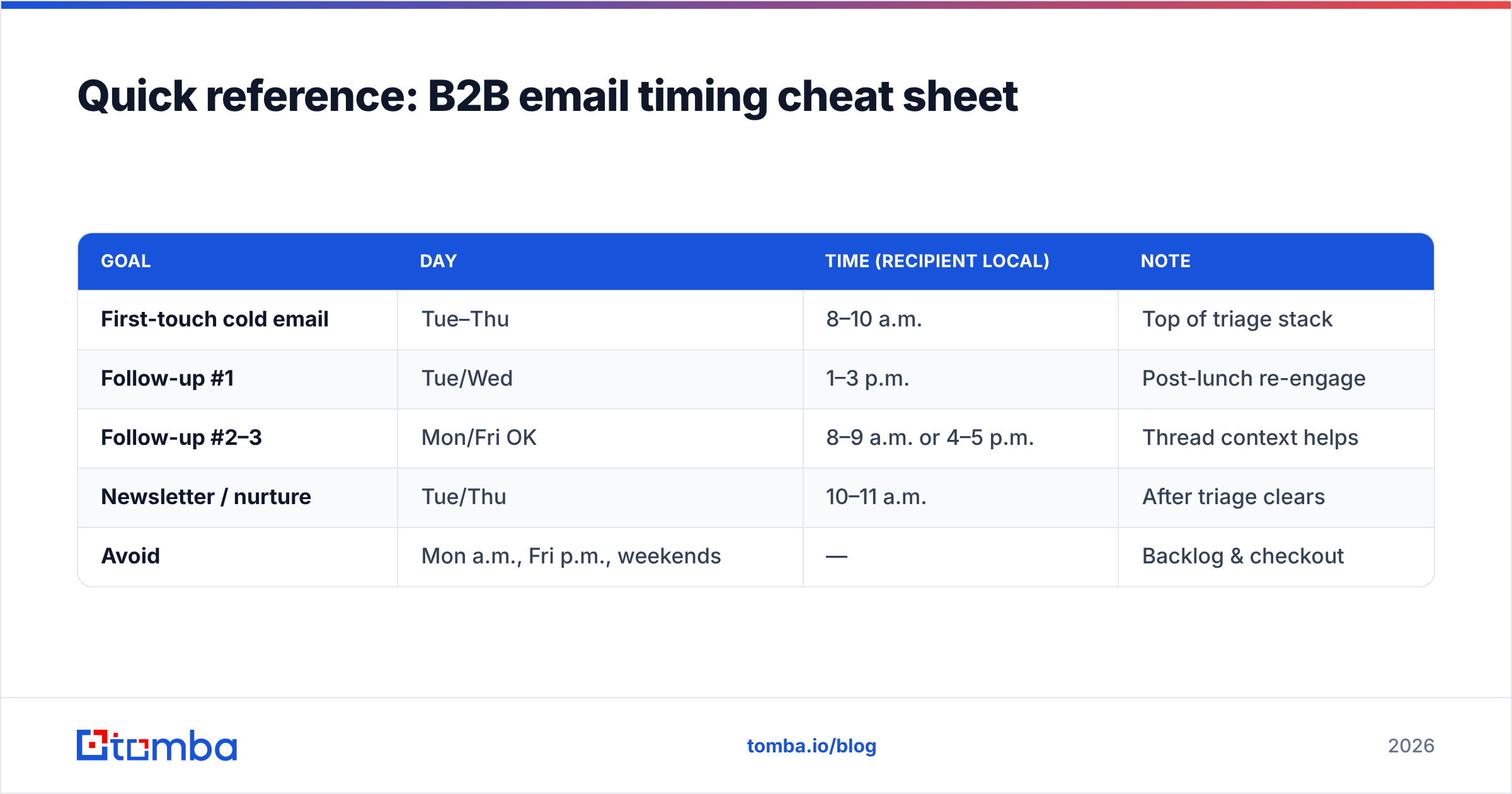
Quick reference: B2B email timing cheat sheet#
| Goal | Day | Time (recipient local) | Note |
|---|---|---|---|
| First-touch cold email | Tue–Thu | 8–10 a.m. | Top of triage stack |
| Follow-up #1 | Tue/Wed | 1–3 p.m. | Post-lunch re-engage |
| Follow-up #2–3 | Mon/Fri OK | 8–9 a.m. or 4–5 p.m. | Thread context helps |
| Newsletter / nurture | Tue/Thu | 10–11 a.m. | After triage clears |
| Avoid | Mon a.m., Fri p.m., weekends | — | Backlog & checkout |
Treat this as a starting hypothesis, not gospel. Validated benchmarks from review sites like G2 and your own A/B data should override any cheat sheet — including this one.
How does timing fit into the bigger outbound picture?#
Send time is the final tuning knob on a machine that has to be built correctly first. The order of operations that actually moves pipeline:
- Right target — accurate ICP and persona definition.
- Clean, verified contacts — low-bounce, real inboxes, no role/catch-all junk.
- Warmed-up sending domain — reputation that survives volume.
- Relevant, concise copy — a reason to reply in the first two lines.
- Smart timing — the windows in this guide, validated against your data.
Skip steps 1–4 and timing is rearranging deck chairs. Nail them, and timing turns a good campaign into a great one. The teams that win outbound in 2026 spend 90% of their energy on list quality and message relevance, and 10% on the clock — never the reverse.
Build the list that makes timing matter#
The best time to send a B2B email only pays off if it lands in a real inbox that belongs to the right person. That's a data problem before it's a scheduling problem. Tomba's Email Finder lets you find accurate, verified professional email addresses by name, company, or domain — so the messages you carefully time at 9 a.m. Tuesday actually reach decision-makers instead of bouncing.
Start free with 25 searches a month, then scale on the Starter plan at $49/mo as your outreach grows — see full Tomba pricing for the Growth ($99/mo) and Pro ($249/mo) tiers. Get the list right, layer the timing on top, and watch your reply rate climb. Find your prospects' emails with the Tomba Email Finder and send your next campaign into inboxes that are actually open.
// get started
Find, verify and enrich your first contacts today
Start on the free plan with 25 searches a month, then scale when your team is ready.
Free plan · No credit card required · GDPR & CCPA
// about the author