Best Time To Send Email Blast in 2026 (Data-Backed Guide)
Stop guessing. Here's what the data actually says about the best time to send an email blast in 2026 — by day, hour, audience, and time zone, plus how to test your own.
Best Time To Send Email Blast in 2026 (Data-Backed Guide)
You can write the perfect email, build a clean list, and still watch your campaign flop — because you hit send at the wrong moment. Timing is the cheapest lever you have. It costs nothing to change and it can swing open rates by double digits.
This guide pulls together what the data actually says about the best time to send email blast campaigns in 2026, then shows you how to stop borrowing other people's numbers and find your own.
TL;DR — When should you send your email blast?#
- Best days: Tuesday, Wednesday, and Thursday consistently outperform Mondays and Fridays for both B2B and B2C.
- Best hours: Aim for 9–11 a.m. and a secondary window around 1–3 p.m. in the recipient's local time zone.
- Worst times: Late Friday afternoon, weekends for B2B, and the 2–4 a.m. dead zone where you land at the bottom of the inbox by morning.
- The real answer: Industry averages are a starting line, not a finish line. Your list has its own rhythm — test it.
- Deliverability first: The best send time means nothing if you're landing in spam. Clean your list and warm your domain before you optimize the clock.
Why does send timing matter so much?#
Think of the inbox like a grocery store shelf. Get stocked at eye level when shoppers are walking by and you sell. Get shoved to the bottom shelf at closing time and you collect dust. Email works the same way: most inboxes show newest-first, so an email that arrives right before your audience checks their phone sits at the top. An email sent at 3 a.m. is buried under 40 newer messages by 9 a.m.
Timing affects three things at once:
- Open rate — how many people see and click into your message while it's still near the top.
- Engagement signals — opens, clicks, and replies in the first hour tell Gmail and Outlook your mail is wanted, which protects future email deliverability.
- Reply velocity — for outreach, fast replies compound. People answer when they have a free moment, and you want to land inside one of those moments.
That third point is why send time isn't only a marketing concern. A cold campaign sent into a decision-maker's morning focus block behaves very differently from one that lands during their afternoon meeting marathon.
What is the best day to send an email blast?#
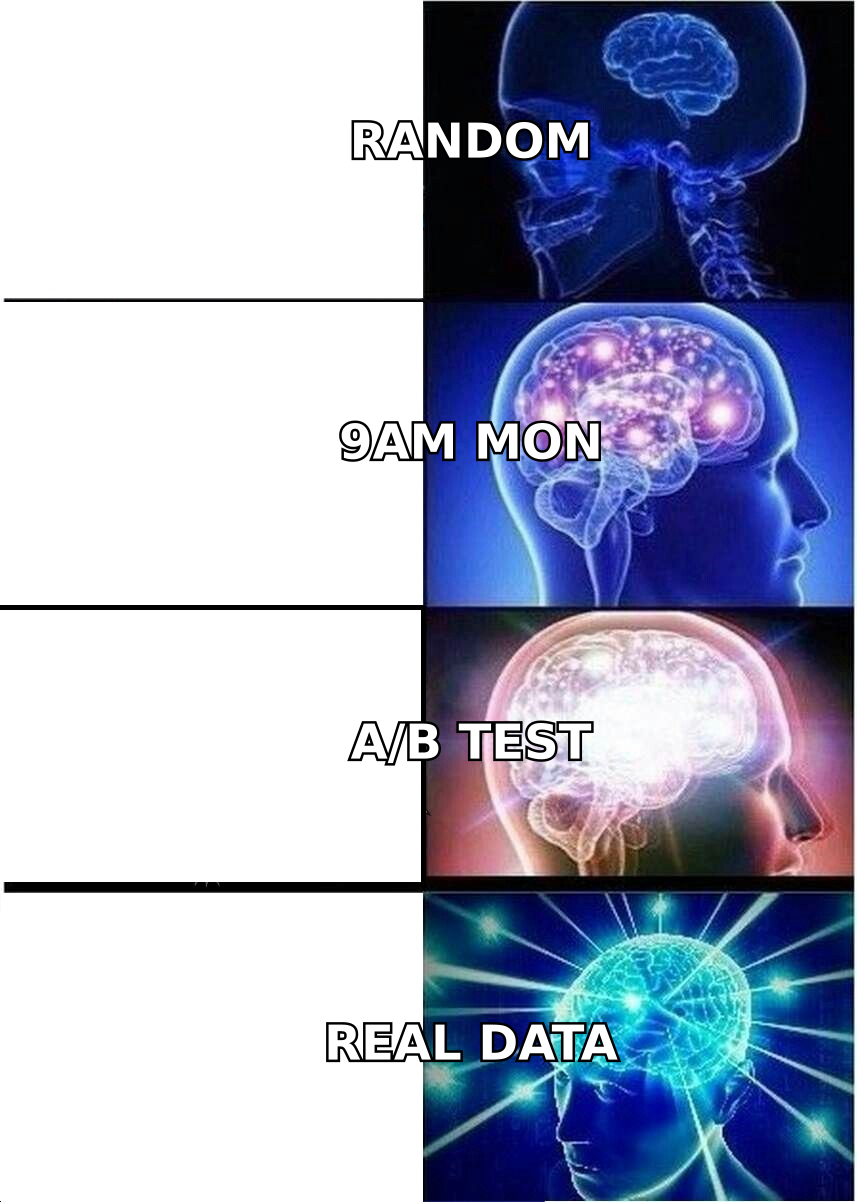
Short answer: midweek wins. Tuesday through Thursday is the sweet spot across nearly every major study, including aggregated benchmarks from HubSpot and Mailchimp.
Here's the logic behind the pattern:
- Monday — Inboxes are flooded from the weekend. People triage in delete-mode, so your message competes with a backlog and a bad mood.
- Tuesday–Thursday — People are settled into the work week, caught up, and processing email intentionally rather than defensively.
- Friday — Attention drifts toward the weekend. Open rates hold up okay, but click and reply rates fall as people mentally check out.
- Weekends — Great for some B2C niches (hobbies, retail, food), poor for B2B. Nobody is reviewing your SaaS pitch on Sunday morning.
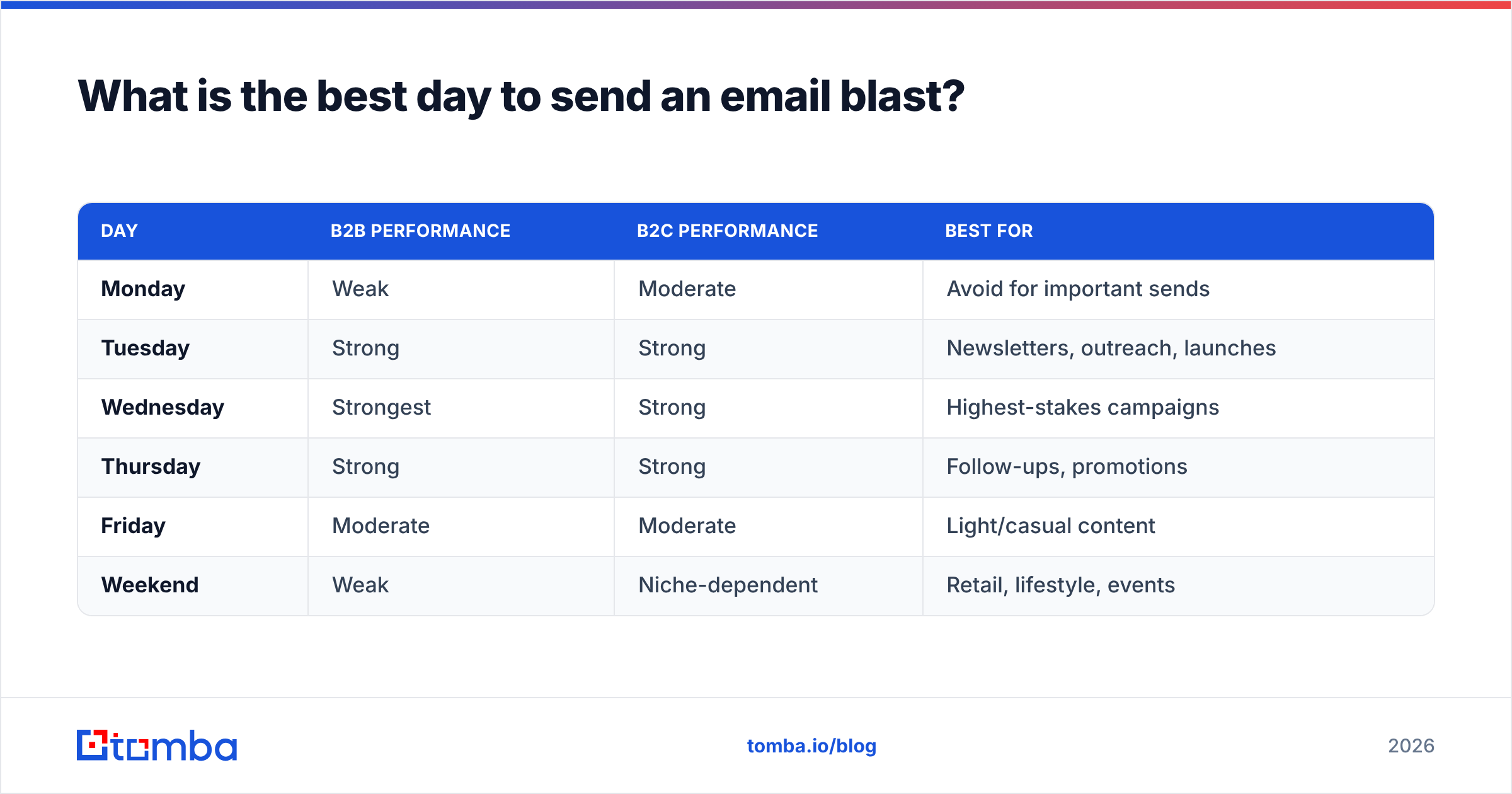
| Day | B2B performance | B2C performance | Best for |
|---|---|---|---|
| Monday | Weak | Moderate | Avoid for important sends |
| Tuesday | Strong | Strong | Newsletters, outreach, launches |
| Wednesday | Strongest | Strong | Highest-stakes campaigns |
| Thursday | Strong | Strong | Follow-ups, promotions |
| Friday | Moderate | Moderate | Light/casual content |
| Weekend | Weak | Niche-dependent | Retail, lifestyle, events |
The takeaway: if you only send one blast per week, send it Tuesday or Wednesday morning. If you run a two-touch sequence, Tuesday + Thursday spreads your touches without crowding.
What is the best time of day to send an email blast?#
The strongest windows cluster around natural inbox-check moments:
- 9–11 a.m. — The morning catch-up. People have arrived, settled in, and are working through email before deep work starts. This is the single best window for most audiences.
- 1–3 p.m. — The post-lunch reset. Energy dips, people reach for low-effort tasks, and email gets a second look.
- 5–6 p.m. — The commute/wind-down check. Decent for mobile-first B2C audiences.
Avoid sending in the small hours hoping to "be first." You won't be first — you'll be buried, because everyone else's morning sends will stack on top of yours. If you must pre-load a campaign, schedule it to deliver in the morning window, not to send at midnight.
One nuance for cold outreach specifically: the 8 a.m. hour can beat 9 a.m. for reaching founders and executives who clear their inbox before the team comes online. Test the early edge if you sell to small-company leadership.
Does the best send time change by audience?#
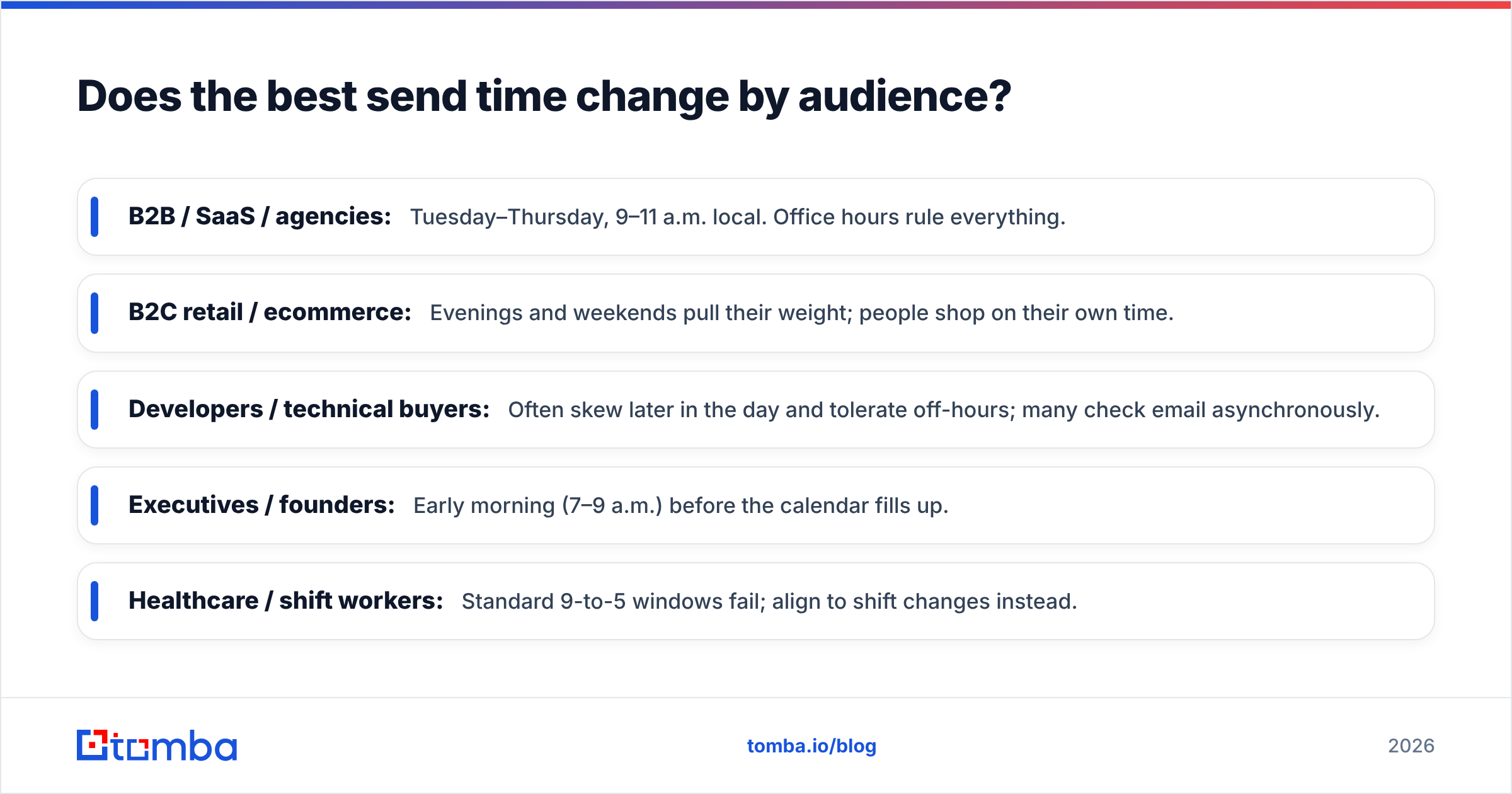
Yes — and this is where copy-pasting a generic "best time" chart costs you. Match the send to your audience's actual day.
- B2B / SaaS / agencies: Tuesday–Thursday, 9–11 a.m. local. Office hours rule everything.
- B2C retail / ecommerce: Evenings and weekends pull their weight; people shop on their own time.
- Developers / technical buyers: Often skew later in the day and tolerate off-hours; many check email asynchronously.
- Executives / founders: Early morning (7–9 a.m.) before the calendar fills up.
- Healthcare / shift workers: Standard 9-to-5 windows fail; align to shift changes instead.
The deeper point: "audience" isn't a vibe, it's data attached to each contact. If your records include role, company size, and location, you can segment send times instead of blasting everyone at one global hour. That's only possible when your contact data is accurate and enriched — which is why a clean source like the Tomba Email Finder and proper data enrichment sit upstream of any timing strategy.
How do time zones change the best time to send?#
A 9 a.m. blast sent from New York hits California at 6 a.m. and London at 2 p.m. If your list spans time zones and you send at one absolute moment, most of your audience gets a suboptimal slot.
Three ways to handle it, from worst to best:
- Single send time (lazy): Pick one hour and accept that only one region lands in the sweet spot. Fine for tiny, single-region lists.
- Time-zone batching (good): Split your list by region and schedule each batch to fire at 9–10 a.m. local. Most ESPs support this with a saved-timezone field.
- Per-recipient send-time optimization (best): Let your platform predict each contact's best moment based on past engagement and deliver individually. Available in tools like Campaign Monitor, Mailchimp, and HubSpot.
If you can't do per-recipient optimization yet, batching by time zone captures 80% of the benefit with 20% of the effort. The prerequisite is knowing where each contact is — another reason contact-level data quality drives timing.
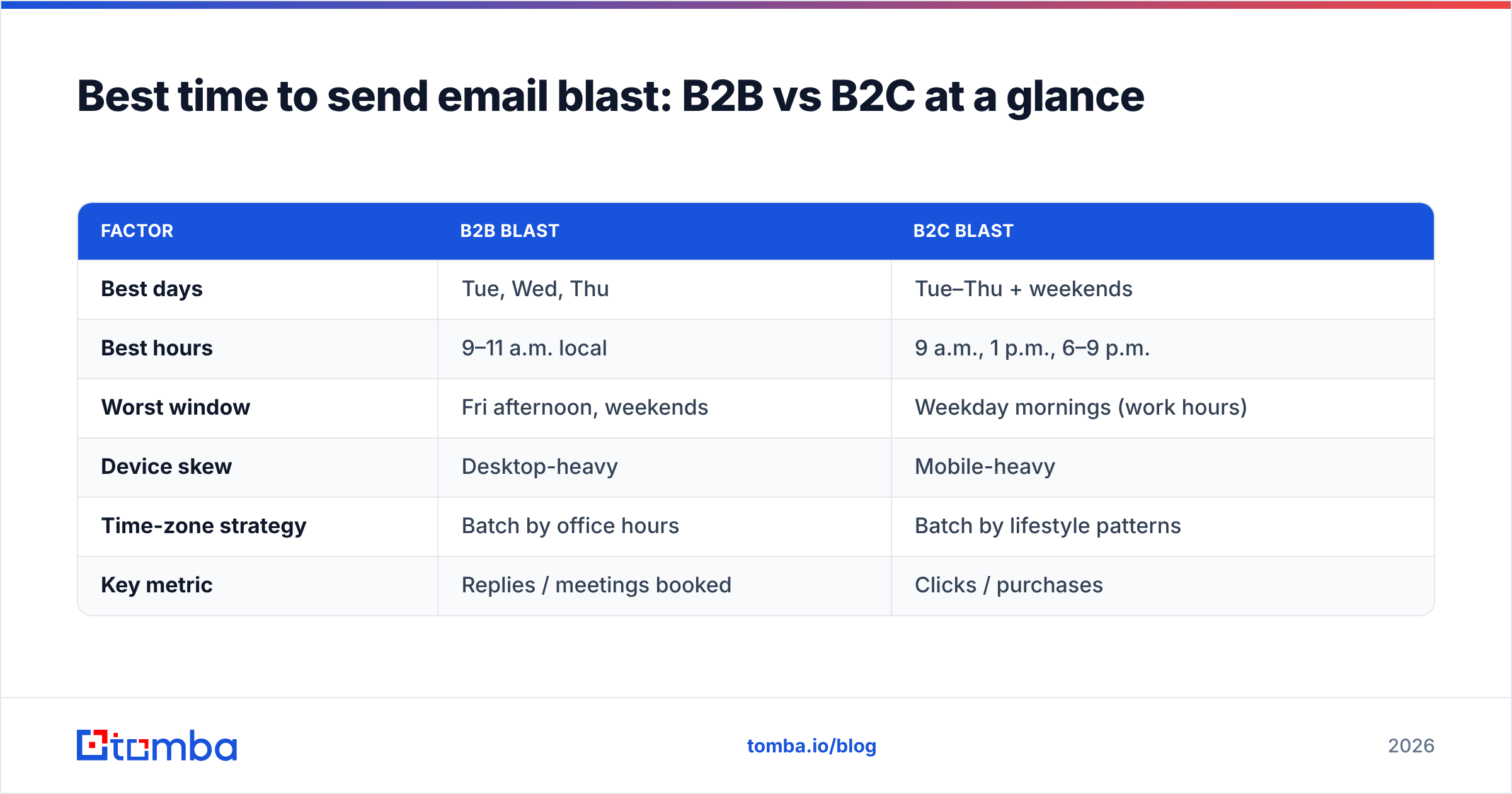
Best time to send email blast: B2B vs B2C at a glance#
| Factor | B2B blast | B2C blast |
|---|---|---|
| Best days | Tue, Wed, Thu | Tue–Thu + weekends |
| Best hours | 9–11 a.m. local | 9 a.m., 1 p.m., 6–9 p.m. |
| Worst window | Fri afternoon, weekends | Weekday mornings (work hours) |
| Device skew | Desktop-heavy | Mobile-heavy |
| Time-zone strategy | Batch by office hours | Batch by lifestyle patterns |
| Key metric | Replies / meetings booked | Clicks / purchases |
Notice the metric row. A B2B campaign optimized for opens but not replies is optimized for the wrong thing. Decide what success means before you decide when to send.
Why your data might be lying to you about send time#
Here's the uncomfortable part. Most "best time to send" studies measure open rate, and open rate has been polluted since Apple's Mail Privacy Protection started pre-fetching images and auto-firing opens. A 60% open rate that's half-bot tells you nothing about timing.
Trust these signals instead:
- Click-through rate — a human chose to act.
- Reply rate — the gold standard for outreach.
- Conversion / revenue per send — the only metric your boss cares about.
- Unsubscribe and spam-complaint rate by time slot — late-night sends often draw more complaints.
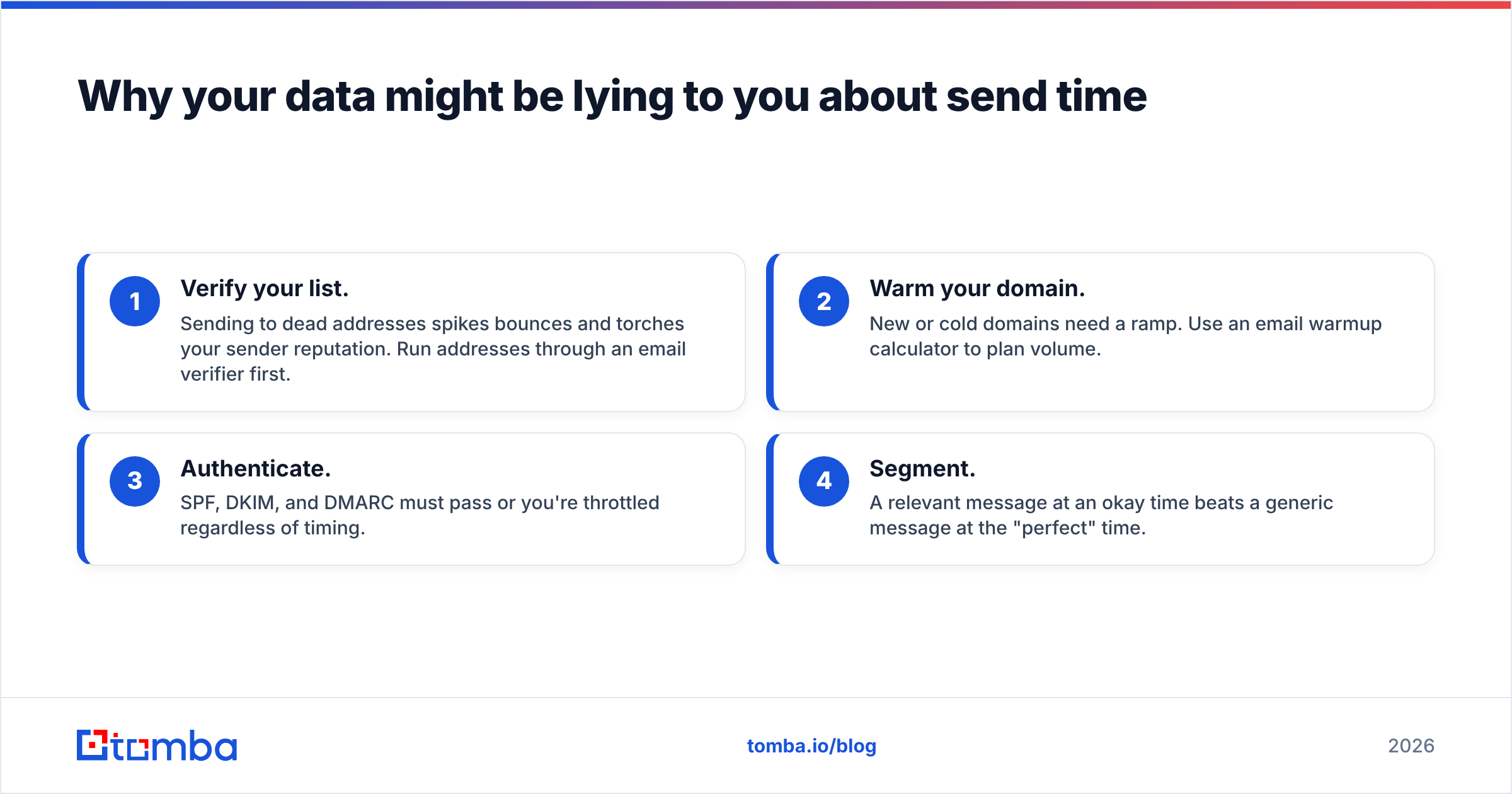
And remember that timing optimization is wasted effort if you're not actually reaching the inbox. Before you A/B test hours, make sure the fundamentals are handled:
- Verify your list. Sending to dead addresses spikes bounces and torches your sender reputation. Run addresses through an email verifier first.
- Warm your domain. New or cold domains need a ramp. Use an email warmup calculator to plan volume.
- Authenticate. SPF, DKIM, and DMARC must pass or you're throttled regardless of timing.
- Segment. A relevant message at an okay time beats a generic message at the "perfect" time.
Get those right and send time becomes the multiplier it's supposed to be — instead of lipstick on a deliverability problem.
How do you find your own best time to send?#
Stop borrowing averages. Your list has a fingerprint. Here's a four-step test you can run in two to three weeks.
Step 1 — Establish a control. Pick your current default send time and record three campaigns' worth of click and reply rates. This is your baseline.
Step 2 — Split-test the day. Take one segment and send identical content on Tuesday vs Thursday at the same hour. Hold everything else constant. Run it twice to rule out noise.
Step 3 — Split-test the hour. Once you have a winning day, test 9 a.m. vs 1 p.m. vs 4 p.m. on that day. Use a large enough sample (1,000+ per variant) for the result to mean anything.
Step 4 — Lock and re-test quarterly. Behavior shifts with seasons, product cycles, and remote-work trends. Re-run the test every quarter so your "best time" doesn't go stale.
A few testing rules that keep results honest:
- Change one variable at a time — day or hour, never both.
- Keep the subject line constant during timing tests, then optimize it separately with a subject line tester.
- Watch out for list fatigue — if you send too often, no time will perform well.
- Mind statistical significance — a 2% difference on 200 contacts is noise, not insight.
What about cold outreach specifically?#
Cold email and marketing blasts share timing principles but differ in goal. A newsletter wants opens and clicks across thousands of recipients; a cold sequence wants one reply from one decision-maker.
For cold outreach:
- Send the first touch Tuesday–Thursday, 8–10 a.m. local to the prospect.
- Space follow-ups 2–4 business days apart, varying the send hour so you catch different parts of their routine.
- Keep daily volume low per inbox to protect deliverability — quality of timing beats quantity of sends.
- Personalize enough that the message earns its slot, because even the perfect minute won't save a generic pitch.
The hard prerequisite is reaching a real, current address for the right person. Outreach timing is moot if the email bounces. Building that accurate list — verified, role-targeted, time-zone-aware — is the foundation the whole timing strategy rests on.
Common send-time mistakes to avoid#
- Sending at midnight to "beat the rush." You don't beat it; you get buried under it.
- Using one global send time for a multi-country list. Half your audience always loses.
- Optimizing open rate in a post-MPP world. Chase clicks and replies instead.
- Testing day and hour at the same time. You can't tell which variable moved the needle.
- Ignoring deliverability. No send time rescues a blacklisted domain or a dirty list.
- Setting it and forgetting it. Last year's best time may be this year's dead zone.
Frequently asked questions#
What is the single best time to send an email blast? For most audiences, Tuesday or Wednesday between 9 and 11 a.m. in the recipient's local time zone. Treat it as a starting hypothesis, then test your own list.
Is it bad to send emails on the weekend? For B2B, usually yes — engagement drops sharply. For B2C lifestyle, retail, and events, weekends can outperform weekdays. It depends entirely on your audience.
Does send time affect whether I land in spam? Indirectly. Send time influences early engagement, and strong early engagement protects your reputation. But authentication, list hygiene, and content matter far more for inbox placement.
How often should I re-test my best send time? Quarterly, or whenever your audience, product, or sending volume changes meaningfully.
Get the timing right by getting the list right#
The best time to send an email blast in 2026 is whenever your specific audience is most likely to open, click, and reply — and you'll only find that by testing on a clean, accurate list. Timing is a multiplier, not a magic trick: it amplifies good data and good deliverability, and it does nothing for a list full of bounces.
Start at the source. Use the Tomba Email Finder to build a verified, role-targeted, time-zone-aware contact list, then layer your send-time tests on top. Check the Tomba pricing plans — from a free tier with 25 searches a month up to Starter at $49/mo — and give your next campaign a foundation worth optimizing.
// get started
Find, verify and enrich your first contacts today
Start on the free plan with 25 searches a month, then scale when your team is ready.
Free plan · No credit card required · GDPR & CCPA
// about the author