Best Time to Send Email on Thursday: 2026 Data Guide
Thursday is one of the highest-converting send days in B2B. Here's the exact hour windows, time-zone tactics, and data to book more replies in 2026.
TL;DR
- The best time to send email on Thursday for B2B is 9:00–11:00 a.m. in the recipient's local time zone, with a strong secondary window at 1:00–3:00 p.m.
- Thursday consistently ranks in the top two weekdays for opens and replies because buyers are clearing decisions before Friday wind-down.
- Send time only matters if the email actually lands — deliverability, list accuracy, and warmup outweigh shaving five minutes off your schedule.
- Batch by recipient time zone, not your own. A 10 a.m. blast from your desk hits half your list at 7 a.m. and the other half at 1 p.m.
- Use real reply data, not folklore. Test two windows for two weeks, keep the winner, and re-test quarterly.
Why does Thursday matter for email timing?#
Thursday is a decision day. By midweek, inboxes have settled from the Monday backlog, and recipients are closing out tasks before the weekend mentally checks them out on Friday afternoon. That makes Thursday morning one of the rare moments when a cold or follow-up email meets a reader who is both caught up and still willing to act.
Most large-scale send-time studies — including ongoing analyses from HubSpot — put Tuesday and Thursday at the top of the weekday ranking for B2B opens and clicks. The two days trade places depending on industry, but Thursday almost never falls out of the top tier. The practical takeaway: if you only have bandwidth to optimize one day's sequence, Thursday is a smart place to start.
)
The reason isn't magic. It's rhythm. Monday is triage, Wednesday is heads-down execution, and Friday is mentally short. Thursday sits in the sweet spot where attention and intent overlap.
What is the best time to send email on Thursday?#
The best time to send email on Thursday is 9:00 to 11:00 a.m. in the recipient's local time, with a reliable second window from 1:00 to 3:00 p.m. after lunch. Avoid the pre-9 a.m. inbox flood and the post-4 p.m. drop-off, when readers are already triaging for tomorrow.
Here's how the day breaks down by intent:
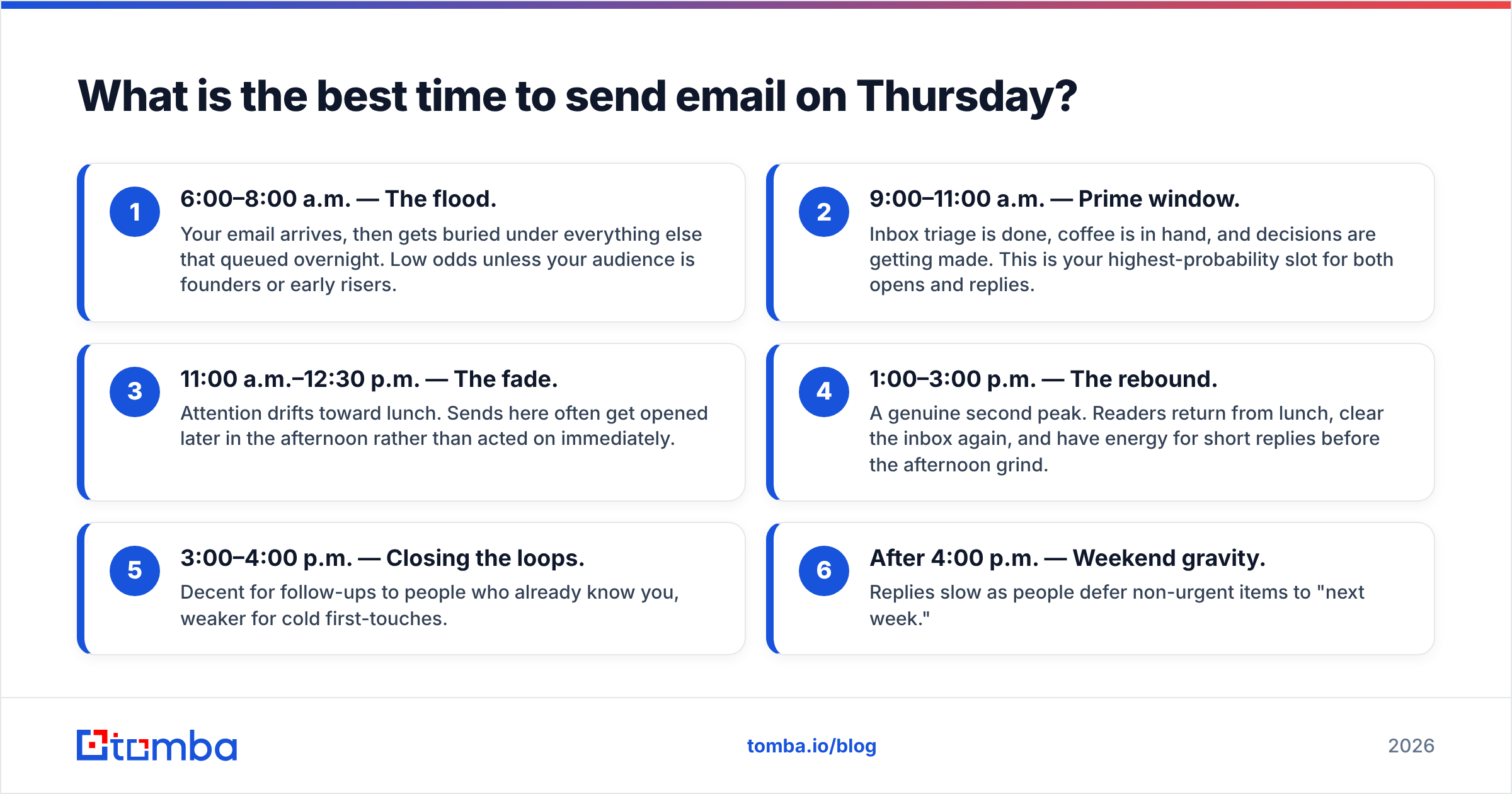
- 6:00–8:00 a.m. — The flood. Your email arrives, then gets buried under everything else that queued overnight. Low odds unless your audience is founders or early risers.
- 9:00–11:00 a.m. — Prime window. Inbox triage is done, coffee is in hand, and decisions are getting made. This is your highest-probability slot for both opens and replies.
- 11:00 a.m.–12:30 p.m. — The fade. Attention drifts toward lunch. Sends here often get opened later in the afternoon rather than acted on immediately.
- 1:00–3:00 p.m. — The rebound. A genuine second peak. Readers return from lunch, clear the inbox again, and have energy for short replies before the afternoon grind.
- 3:00–4:00 p.m. — Closing the loops. Decent for follow-ups to people who already know you, weaker for cold first-touches.
- After 4:00 p.m. — Weekend gravity. Replies slow as people defer non-urgent items to "next week."
If you remember nothing else: aim for 10 a.m. local, and treat 2 p.m. local as your backup.
How does Thursday compare to other send days?#
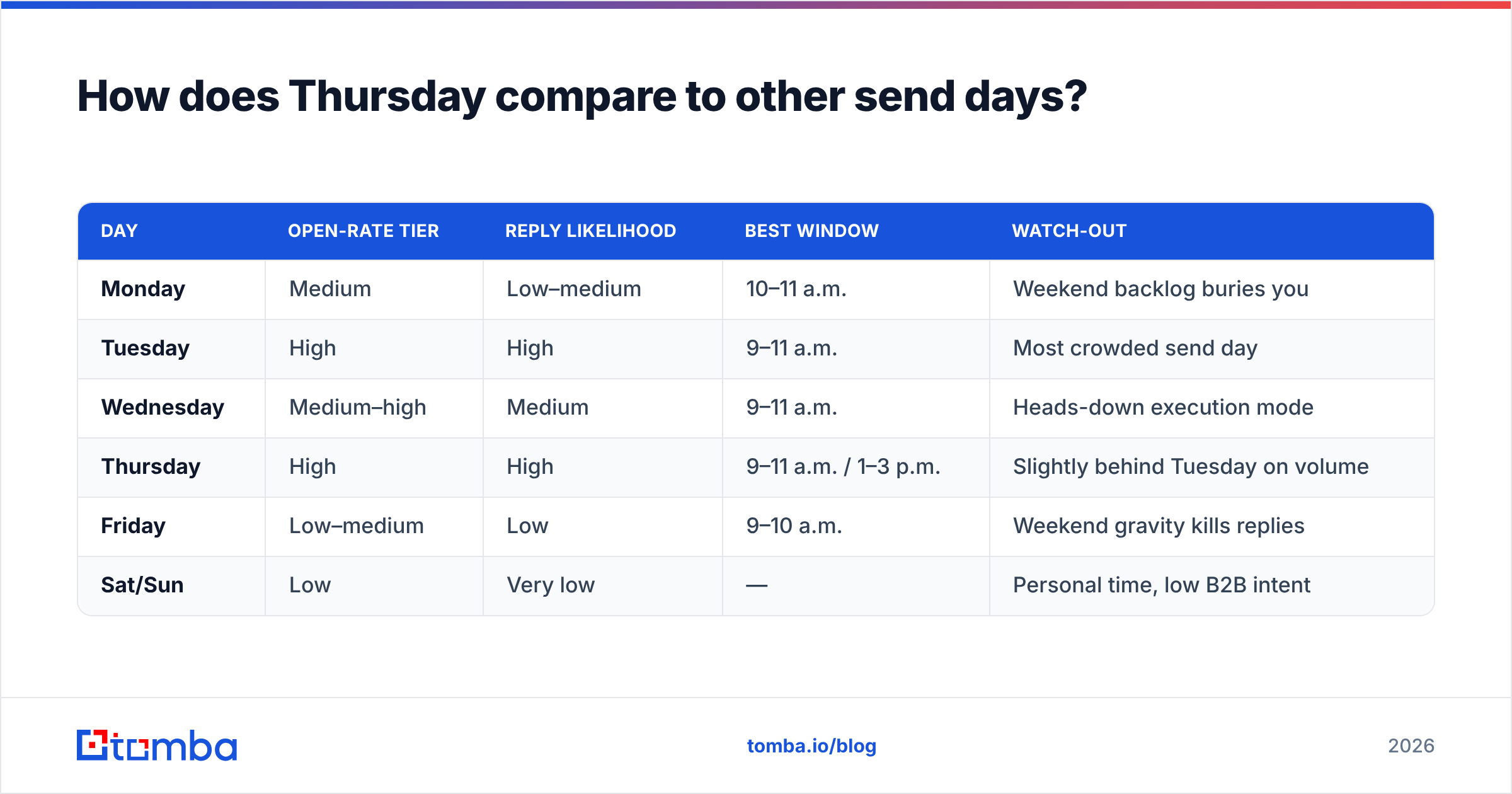
Send-day choice is a relative game — you're competing for a finite slice of attention. The table below summarizes how the major weekdays stack up for B2B outbound, based on the consensus across published deliverability and engagement studies.
| Day | Open-rate tier | Reply likelihood | Best window | Watch-out |
|---|---|---|---|---|
| Monday | Medium | Low–medium | 10–11 a.m. | Weekend backlog buries you |
| Tuesday | High | High | 9–11 a.m. | Most crowded send day |
| Wednesday | Medium–high | Medium | 9–11 a.m. | Heads-down execution mode |
| Thursday | High | High | 9–11 a.m. / 1–3 p.m. | Slightly behind Tuesday on volume |
| Friday | Low–medium | Low | 9–10 a.m. | Weekend gravity kills replies |
| Sat/Sun | Low | Very low | — | Personal time, low B2B intent |
The strategic angle most senders miss: Tuesday is the most recommended day, which means it's also the most crowded. Thursday gives you near-Tuesday performance with measurably less competition for the inbox. If your reply rates have plateaued on Tuesday, shifting your strongest sequence to Thursday is one of the cheapest experiments you can run.
Does send time actually move the needle?#
Yes — but it's a tiebreaker, not the main event. Send time can swing open rates by a few percentage points. List quality and deliverability swing them by 30 or 40. If your message is landing in spam or hitting dead mailboxes, no clock optimization will save it.
Think of it like a restaurant. Picking the right dinner hour helps you get a table, but if the kitchen is closed (bad deliverability) or you have the wrong address (bad data), the reservation time is irrelevant. Get the fundamentals right first:
- Verified, deliverable addresses. Sending to invalid mailboxes spikes your bounce rate and torches your sender reputation. Clean your list with an email verifier before any campaign.
- A warmed-up domain. New domains that suddenly blast volume look like spam to mailbox providers. Ramp gradually — our email warmup calculator shows the schedule.
- Proper authentication. SPF, DKIM, and DMARC tell receiving servers you're legitimate. Skipping them is the fastest way to land in spam regardless of when you hit send.
Only once those are solid does Thursday-at-10-a.m. start earning you incremental replies. For the full picture, see Tomba's primer on email deliverability.
How do you handle time zones on Thursday?#
Send by the recipient's local time, not yours. A single 10 a.m. blast from a New York desk reaches London at 3 p.m. (fading) and San Francisco at 7 a.m. (the flood). You'd be hitting your prime window for only a fraction of your list.
There are three workable approaches:
- Segment by time zone and stagger sends. Build separate batches for each major region and schedule each to fire at 10 a.m. local. This is the gold standard and what most modern sending tools automate.
- Pick the time zone where most of your list lives. If 70% of your prospects are on US Eastern time, optimize for that and accept that the long tail gets a slightly worse slot.
- Use send-time optimization features. Many platforms now predict each contact's best open time from past behavior. Useful at scale, but only as good as the engagement history behind it.
Whichever you choose, you can't time-zone-segment a list you don't have clean location data for. Enriching your contacts with company location, role, and verified email up front — through data enrichment — is what makes precise scheduling possible in the first place.
)
What about cold email versus newsletters versus follow-ups?#
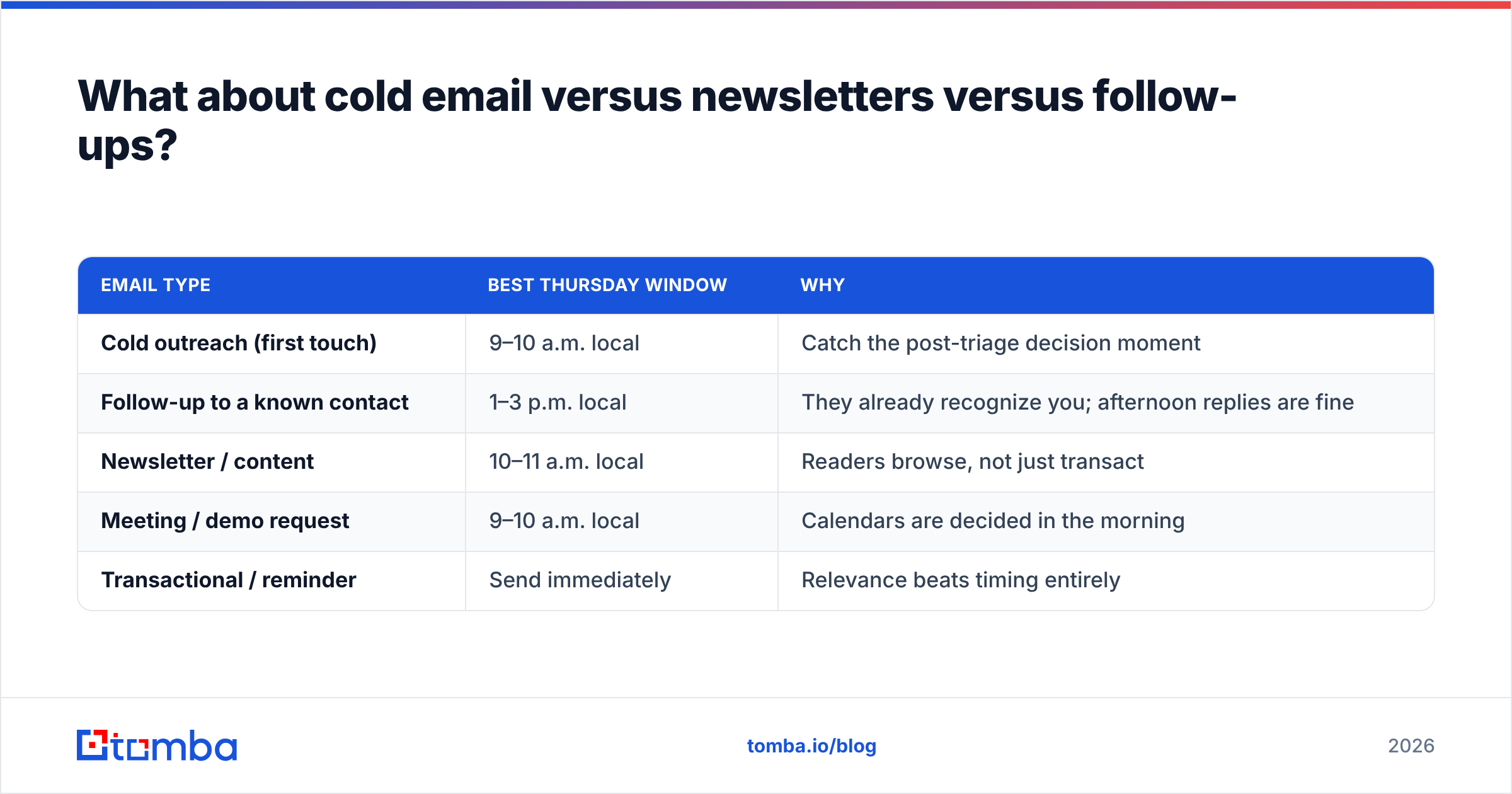
The "best time" shifts with the email's job. One Thursday window does not fit all.
| Email type | Best Thursday window | Why |
|---|---|---|
| Cold outreach (first touch) | 9–10 a.m. local | Catch the post-triage decision moment |
| Follow-up to a known contact | 1–3 p.m. local | They already recognize you; afternoon replies are fine |
| Newsletter / content | 10–11 a.m. local | Readers browse, not just transact |
| Meeting / demo request | 9–10 a.m. local | Calendars are decided in the morning |
| Transactional / reminder | Send immediately | Relevance beats timing entirely |
For cold first-touches especially, the email itself carries most of the weight. A perfectly timed message with a weak subject line still loses. Tighten your hook with a subject line generator before you obsess over the clock — open rate is decided in the inbox preview, not on the schedule.
How do you find the right time for your own list?#
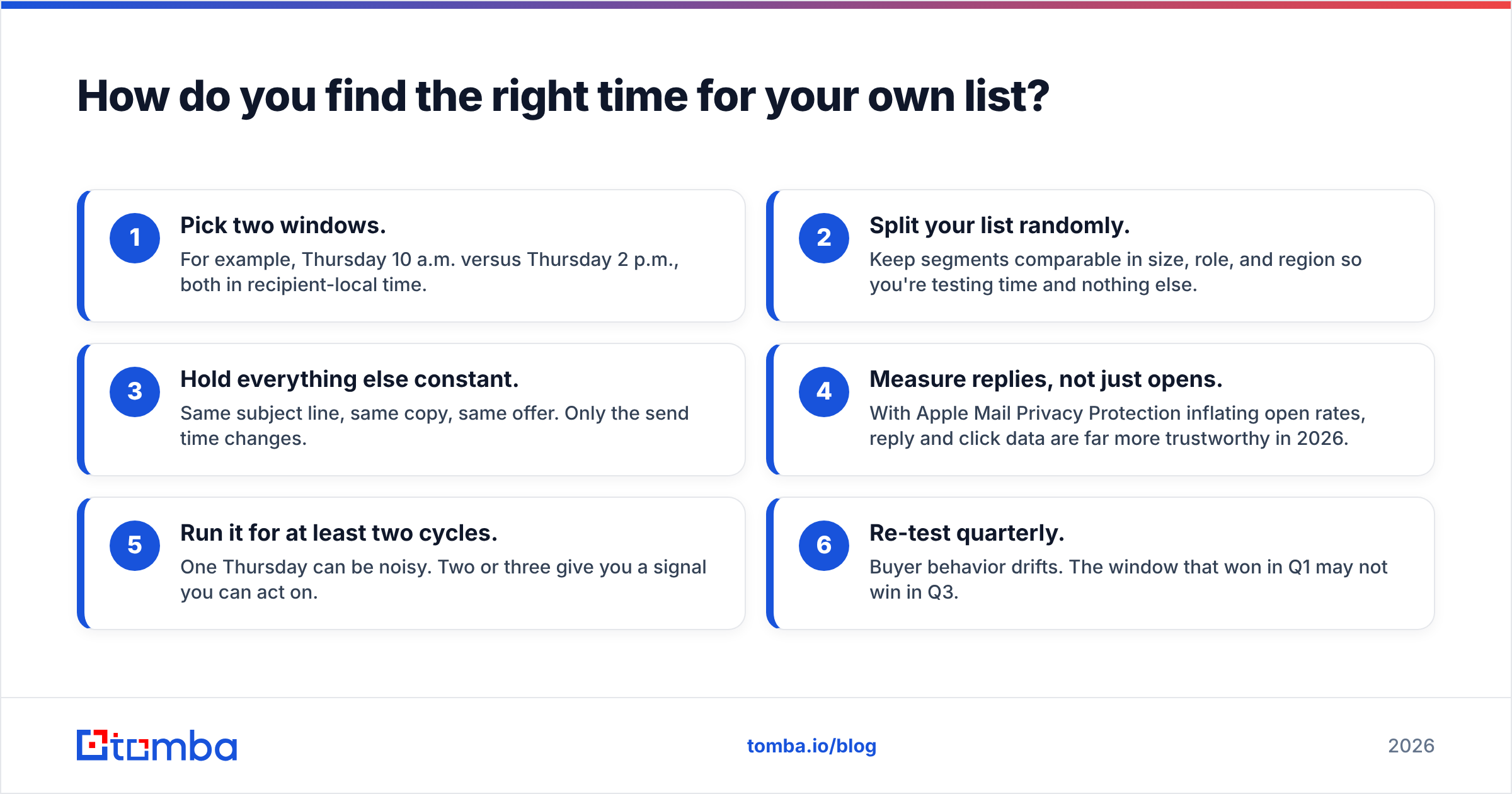
Benchmarks are a starting point; your audience is the source of truth. A two-week test is enough to get a directional read:
- Pick two windows. For example, Thursday 10 a.m. versus Thursday 2 p.m., both in recipient-local time.
- Split your list randomly. Keep segments comparable in size, role, and region so you're testing time and nothing else.
- Hold everything else constant. Same subject line, same copy, same offer. Only the send time changes.
- Measure replies, not just opens. With Apple Mail Privacy Protection inflating open rates, reply and click data are far more trustworthy in 2026.
- Run it for at least two cycles. One Thursday can be noisy. Two or three give you a signal you can act on.
- Re-test quarterly. Buyer behavior drifts. The window that won in Q1 may not win in Q3.
Compare your results against external baselines from sources like G2's email marketing benchmarks and the broader research summarized on email marketing references, but always trust your own reply data over a generic average.
What kills your Thursday send before timing even matters?#
Even a flawless 10 a.m. Thursday send fails if the basics are broken. These are the silent killers, ranked by how often they sink campaigns:
- Bad addresses. Every hard bounce signals "low-quality sender" to mailbox providers. A list with 15% invalid emails will underperform no matter when you send.
- No warmup. Cold domains blasting hundreds of emails get filtered fast. Ramp slowly and keep daily volume sane.
- Generic copy. "Hope this finds you well" at scale reads as spam to both filters and humans.
- Missing authentication. No SPF/DKIM/DMARC means receiving servers can't verify you, and spam folders fill up.
- Catch-all uncertainty. Catch-all domains accept everything, so a standard verifier can't confirm a real mailbox. Use a dedicated catch-all verifier to avoid sending into the void.
Fix these in order, and your Thursday timing optimization actually has something to optimize. Skip them, and you're polishing the schedule on a campaign that was never going to land.
Quick answer: your Thursday playbook#
If you want the condensed version to act on today:
- Send your strongest sequence Thursday at 10 a.m. recipient-local time.
- Keep 1–3 p.m. local as your follow-up and backup window.
- Segment by time zone so "10 a.m." means 10 a.m. for everyone, not just you.
- Verify and warm up before you worry about the clock.
- A/B test two windows for two weeks, keep the winner, re-test quarterly.
Thursday earns near-best-day performance with less inbox competition than Tuesday. That's the whole pitch — and it costs you nothing but a scheduling change.
Send to real people, at the right time#
The best send time in the world is wasted on a fake or outdated address. Before you fine-tune your Thursday schedule, make sure every contact on your list is a real, reachable human. The Tomba Email Finder pulls verified professional emails by name, company, or domain search, so your perfectly timed 10 a.m. Thursday send actually lands in a live inbox. Start free with 25 searches a month, then scale on the Starter plan at $49/mo when you're ready to run real volume. Get the data right first — then let Thursday do the rest.
// get started
Find, verify and enrich your first contacts today
Start on the free plan with 25 searches a month, then scale when your team is ready.
Free plan · No credit card required · GDPR & CCPA
// about the author