Best Time To Send Sales Emails in 2026 (Data-Backed Guide)
Tuesday at 10 AM gets quoted everywhere, but the real best time to send sales emails depends on your segment, time zone, and list hygiene. Here's the 2026 data.
TL;DR
- The most-cited "best time to send sales emails" is Tuesday–Thursday, 9–11 AM in the recipient's local time zone — but that's an average, not a rule for your list.
- Send time matters far less than who you send to and whether the inbox actually exists. A perfectly-timed email to a dead address gets you nothing.
- Segment before you schedule. Founders, SDRs, and procurement leads all open at different hours. Treat them differently.
- Mid-month, mid-week beats Mondays (inbox cleanup) and Fridays (checked-out). Weekends are dead for B2B with rare niche exceptions.
- Win the boring fundamentals first — verified list, warmed domain, tight subject line — then optimize the clock.
What is the "best time to send sales emails" actually measuring?#
The short answer: there is no universal best time, but Tuesday through Thursday between 9 and 11 AM local time is the safest default to test against. Every credible send-time dataset clusters around mid-morning, mid-week, because that's when a working professional has cleared the overnight pile and is still triaging rather than heads-down.
Think of send timing like catching someone at a coffee shop. Show up at 6 AM and the doors are locked (overnight sends buried by morning). Show up at 4:55 PM and they're grabbing their coat (end-of-day, checked out). Mid-morning is when they're seated, caffeinated, and willing to talk. The same human rhythm governs the inbox.
But here's the catch most "best time" listicles bury: the timing studies measure open and reply rates across millions of emails sent to already-valid, already-engaged lists. They're describing the last 5% of optimization. If your list is full of guessed addresses and your domain isn't warmed, the clock won't save you. Get the email finder and verification layer right first, then send-time tuning becomes the lever that actually compounds.
)
When is the best time to send sales emails by day and hour?#
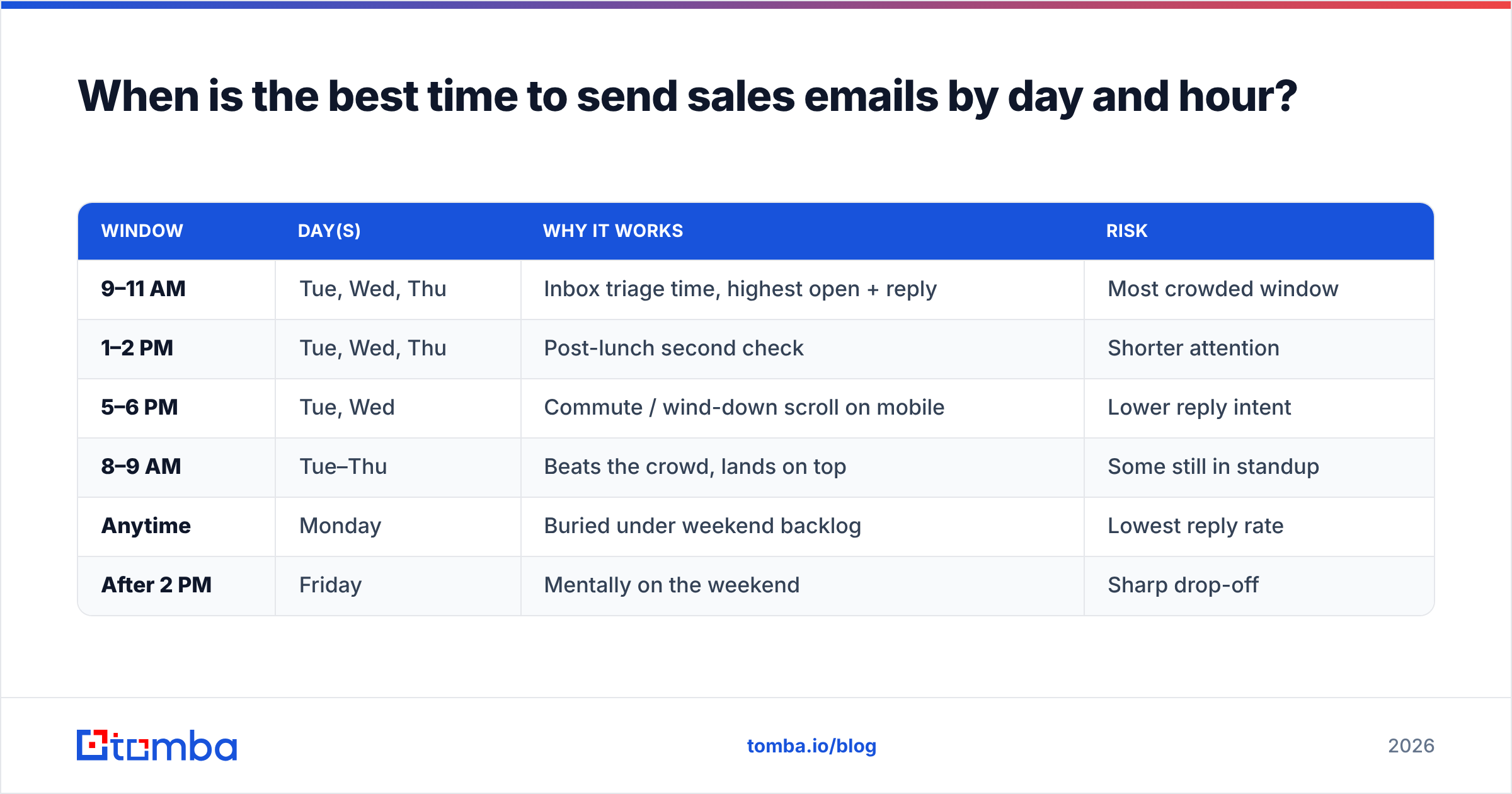
Here's the consolidated picture from the major B2B send-time studies, normalized to the recipient's local time. Use it as a starting hypothesis, not gospel.
| Window | Day(s) | Why it works | Risk |
|---|---|---|---|
| 9–11 AM | Tue, Wed, Thu | Inbox triage time, highest open + reply | Most crowded window |
| 1–2 PM | Tue, Wed, Thu | Post-lunch second check | Shorter attention |
| 5–6 PM | Tue, Wed | Commute / wind-down scroll on mobile | Lower reply intent |
| 8–9 AM | Tue–Thu | Beats the crowd, lands on top | Some still in standup |
| Anytime | Monday | Buried under weekend backlog | Lowest reply rate |
| After 2 PM | Friday | Mentally on the weekend | Sharp drop-off |
A few rules that survive across datasets:
- Mid-week wins. Tuesday, Wednesday, and Thursday consistently out-pull Monday and Friday for B2B cold and warm outreach.
- Mid-morning wins the day. The 9–11 AM block in the prospect's zone is the single most reliable window.
- Mondays are noisy. People spend Monday morning deleting, not reading. Your email competes with the whole weekend.
- Fridays fade fast. A Friday-morning send can work; a Friday-afternoon send rarely does.
- Weekends are dead for B2B — with narrow exceptions for founders and solo operators who clear email on Sunday night.
Does send time even matter compared to list quality?#
No — and this is the most important section in this guide. List quality and deliverability outrank send time by a wide margin. HubSpot's research and most deliverability vendors agree that targeting and sender reputation move reply rates far more than shifting a campaign by two hours.
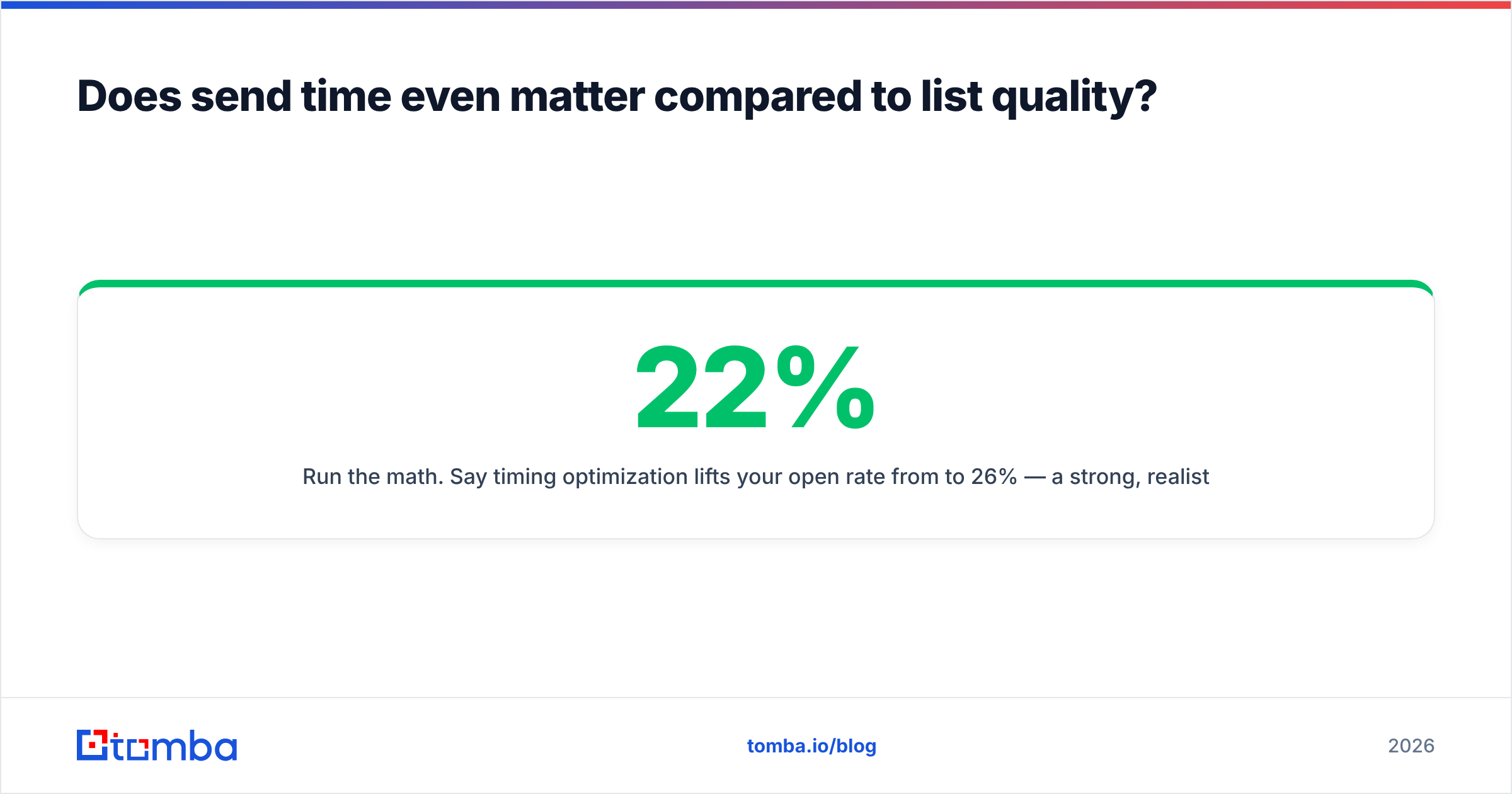
Run the math. Say timing optimization lifts your open rate from 22% to 26% — a strong, realistic gain. Now say 18% of your list is invalid or risky. Those bounces don't just waste sends; they signal mailbox providers that you're a careless sender, which quietly tanks inbox placement for the good addresses too. The timing win is real but small; the list-quality loss is structural.
So before you A/B test send hours, do this in order:
- Find the right contact with an email finder so you're emailing the actual decision-maker, not a generic info@ box.
- Verify every address with an email verifier to strip dead and risky inboxes before they bounce.
- Warm the sending domain so your reputation can carry the volume — check your ramp with a warmup calculator before scaling.
- Tighten the subject line because no send time rescues a line nobody clicks.
- Then optimize send time.
)
How do time zones change the best time to send sales emails?#
Time zones are where most teams quietly throw away their timing advantage. If you batch-send a US campaign at 10 AM Eastern, your West Coast prospects get it at 7 AM — before many are at their desks — and your London contacts got it at 3 PM, well past their morning peak.
The fix is schedule by the recipient's local time, not yours. Good sequencing tools let you set "send at 9:30 AM in the contact's time zone" and stagger delivery automatically. If your tool can't do that, segment your list into zone buckets and schedule each batch manually.
To send by local time you need to know the contact's location, which loops back to data. Enriched records that include region or company HQ let you bucket accurately. You can pull that context with data enrichment so your scheduler isn't guessing. A contact with no location data defaults to your best blanket guess — usually mid-morning in whatever zone holds the largest share of your list.
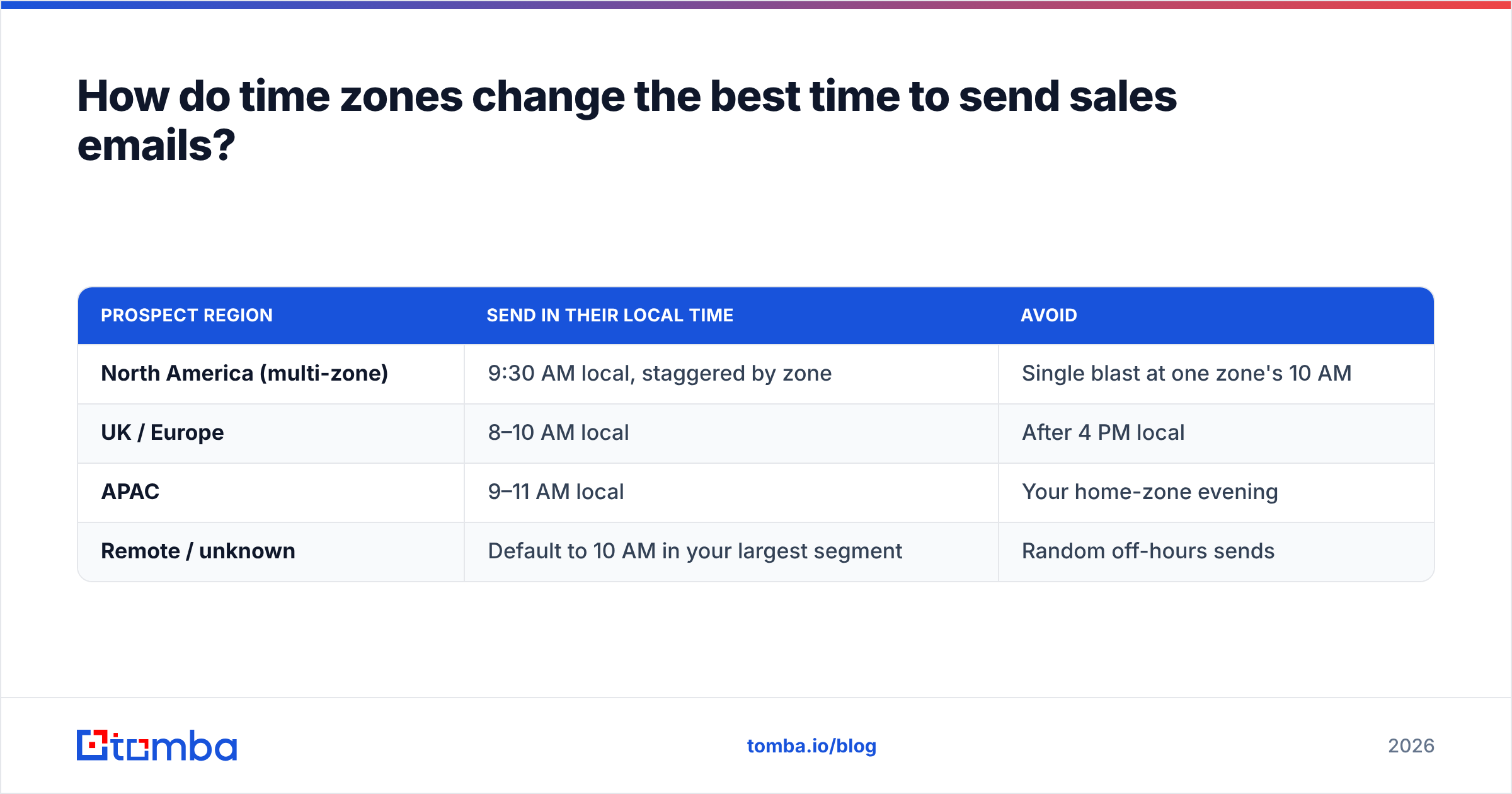
| Prospect region | Send in their local time | Avoid |
|---|---|---|
| North America (multi-zone) | 9:30 AM local, staggered by zone | Single blast at one zone's 10 AM |
| UK / Europe | 8–10 AM local | After 4 PM local |
| APAC | 9–11 AM local | Your home-zone evening |
| Remote / unknown | Default to 10 AM in your largest segment | Random off-hours sends |
Should the timing differ by persona and industry?#
Yes. The averaged "Tuesday 10 AM" advice flattens real differences between the people you're emailing. Match the clock to the human.
- Founders and C-level: Often clear email very early (6–8 AM) or late at night. A 7 AM landing can beat the gatekeeper rush. They check on mobile, so the first line has to land without a click.
- SDRs, AEs, and sales leaders: Mid-morning and right after lunch. They live in their inbox, so reply speed matters more than the exact send minute.
- Engineers and technical buyers: Later mornings and afternoons — many block early hours for deep work and surface around 11 AM or after 2 PM.
- Procurement and operations: Standard business hours, mid-week. Predictable and process-driven; Tuesday–Thursday mid-morning is reliable.
- Healthcare, field, and shift roles: Wildly variable. Test early-morning and evening windows; standard office hours often miss them entirely.
Industry shifts the picture too. Agencies and SaaS skew toward the classic mid-morning pattern. Manufacturing and logistics start earlier. Retail leadership is slammed Monday and during seasonal peaks, so avoid those entirely. The point isn't to memorize a grid — it's to segment your list and test a hypothesis per segment instead of blasting everyone at one time. When your reply rate stalls, segmented timing is often the unlock; you can sanity-check the lift against your baseline response rate.
How do you actually find your own best send time?#
Stop borrowing other people's averages and measure your own. Here's a four-week test you can run without fancy tooling.
- Pick two windows to compare, e.g. Tuesday 9:30 AM vs. Thursday 1:30 PM, both in recipient local time.
- Split a clean segment 50/50. Same persona, same offer, same subject line. Only the send time changes. (Clean is the operative word — verify first or your data is noise.)
- Send to a meaningful sample — a few hundred contacts per arm minimum, so the result isn't random.
- Measure replies, not just opens. With Apple Mail Privacy Protection inflating open data since 2021, opens are an unreliable proxy. Track booked meetings and replies.
- Repeat for 3–4 cycles before you trust the winner, then re-test quarterly because buyer behavior drifts.
Two cheap tools make this rigorous instead of vibes-based. Use a subject line tester to hold copy quality constant across arms, and keep your control segment verified so bounces don't pollute the result. A timing test on a dirty list tells you nothing — you're measuring deliverability noise, not human behavior.
One honest caveat: for transactional or trigger-based outreach — a reply to a demo request, a note after someone visits your pricing page — the best time to send is immediately. Speed-to-lead beats any calendar optimization. The day-and-hour game is for proactive, cold, and nurture sends where you choose the moment.
What about follow-ups and sequence timing?#
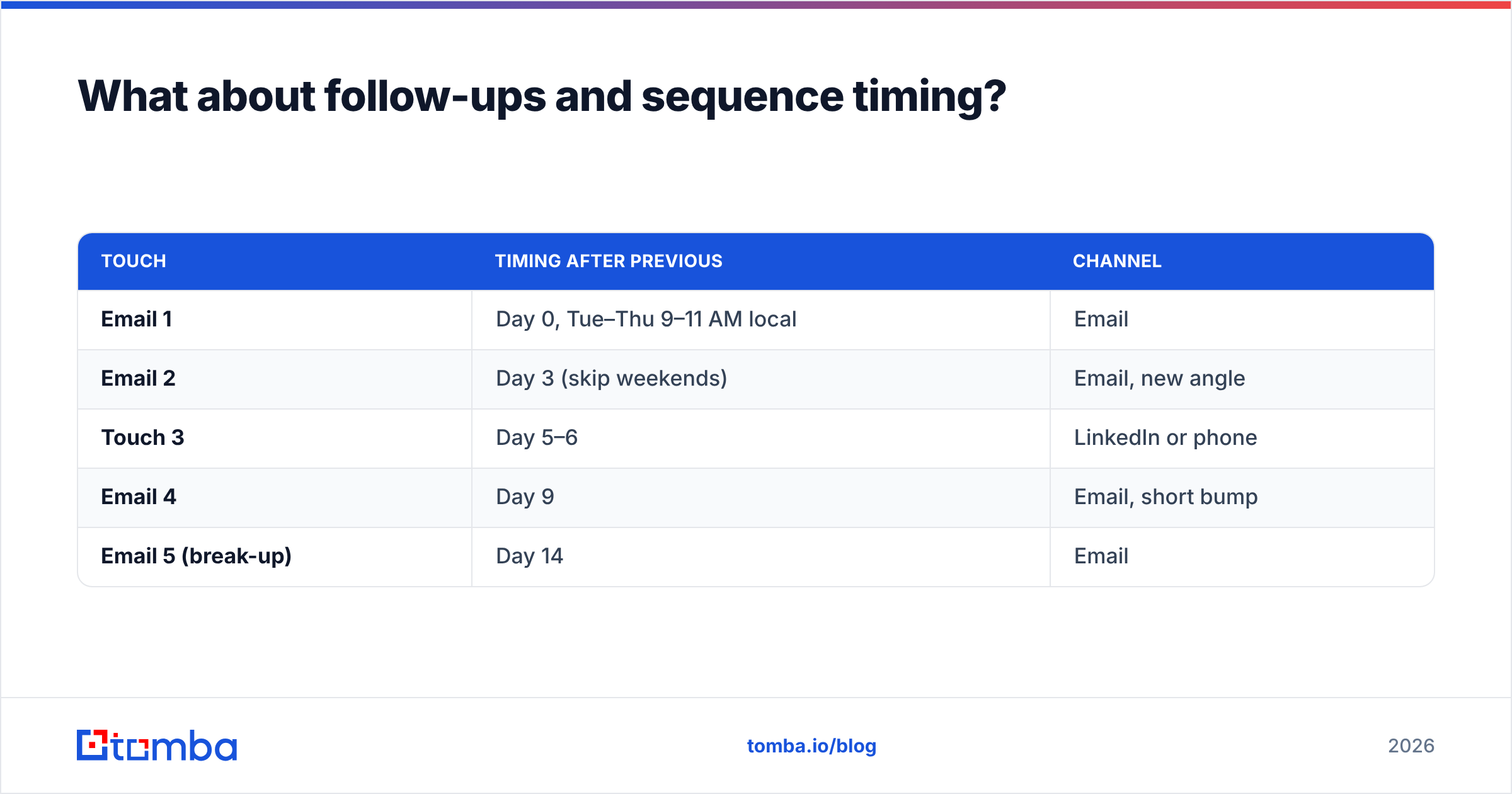
Most replies come from follow-ups, not the first email, so sequence spacing deserves as much attention as the initial send hour. A workable B2B cadence:
| Touch | Timing after previous | Channel |
|---|---|---|
| Email 1 | Day 0, Tue–Thu 9–11 AM local | |
| Email 2 | Day 3 (skip weekends) | Email, new angle |
| Touch 3 | Day 5–6 | LinkedIn or phone |
| Email 4 | Day 9 | Email, short bump |
| Email 5 (break-up) | Day 14 |
Vary the time of day across touches, not just the day. If email 1 went out at 9:30 AM, try email 2 at 1:30 PM. You're sampling different moments in the prospect's week, which raises the odds one of them catches a clear inbox. And keep every follow-up genuinely useful — a new angle, a relevant proof point — rather than "just bumping this." Pair sharp timing with sharp copy from a cold email templates library so each touch earns its place.
Reputable B2B software directories like G2 catalog the sequencing tools that handle local-time staggering and follow-up automation if you'd rather not manage cadence by hand.
The bottom line#
The best time to send sales emails in 2026 is Tuesday through Thursday, 9–11 AM in the recipient's local time zone — but treat that as the hypothesis you test, not the answer you ship. Timing is the polish on top of fundamentals: a verified list, a warmed domain, the right persona, and a subject line worth opening. Get those right and a two-hour shift can lift replies a few points. Get them wrong and no clock on earth saves the campaign.
Start where the leverage is. Build a list of real, reachable decision-makers and confirm every address resolves before you ever schedule a send. Tomba's Email Finder finds professional emails by name, domain, or company so your perfectly-timed send actually lands in a real inbox — and it pairs with built-in verification to keep your bounce rate, and your sender reputation, clean. Check the Tomba pricing plans (a free tier with 25 searches/month to start, Starter at $49/mo) and get the foundation right before you optimize the clock.
// get started
Find, verify and enrich your first contacts today
Start on the free plan with 25 searches a month, then scale when your team is ready.
Free plan · No credit card required · GDPR & CCPA
// about the author