BetterContact Pricing & Reviews 2026: Pros, Cons, Verdict
A neutral, numbers-first look at BetterContact pricing, real user reviews, pros and cons, and where waterfall enrichment helps — or quietly burns your budget.
BetterContact Pricing & Reviews 2026: Pros, Cons, and the Honest Verdict
Looking for honest BetterContact pricing reviews? This guide breaks down the real costs. It weighs the pros and the cons. And it shows when a flat-rate finder beats the waterfall.
TL;DR
- BetterContact is a waterfall enrichment tool. It queries 20+ data vendors in order. It charges only when it returns a verified email or phone. Pricing starts near $39/mo and scales to custom enterprise tiers.
- The pricing model is its biggest strength and its biggest trap. Pay-per-result looks cheap. But on large, messy lists most rows fail, and the few hits can cost more than a flat-rate finder.
- Reviews praise the match rate. They are more critical on the credit math, the learning curve, and slow support on lower tiers.
- Small-to-mid B2B teams usually pay less with a flat-rate finder like Tomba. Huge, low-quality, multi-region lists are where the waterfall pays off.
- This post lays out the real numbers, the pros and cons users report, and when to pick which tool.
What is BetterContact and how does it work?#
BetterContact is a contact-data aggregator that chains multiple email and phone providers into one "waterfall." Instead of trusting a single database, it sends each contact through a ranked list of 20+ vendors. It stops at the first one that returns a verified result. Think of it like calling five locksmiths in order and only paying the one who opens the door. You skip the ones who could not help.
That design solves a real problem. Any single email finder has blind spots. It may be strong in North American SaaS but weak in EU manufacturing, or the reverse. By stacking sources, BetterContact lifts the overall match rate. That is the headline number most reviewers praise.
The catch is that aggregation adds a cost layer. You pay BetterContact a margin on top of what the underlying vendors charge. The per-result price reflects that. For some teams the convenience is worth it. For others, it is a markup on data they could pull directly.
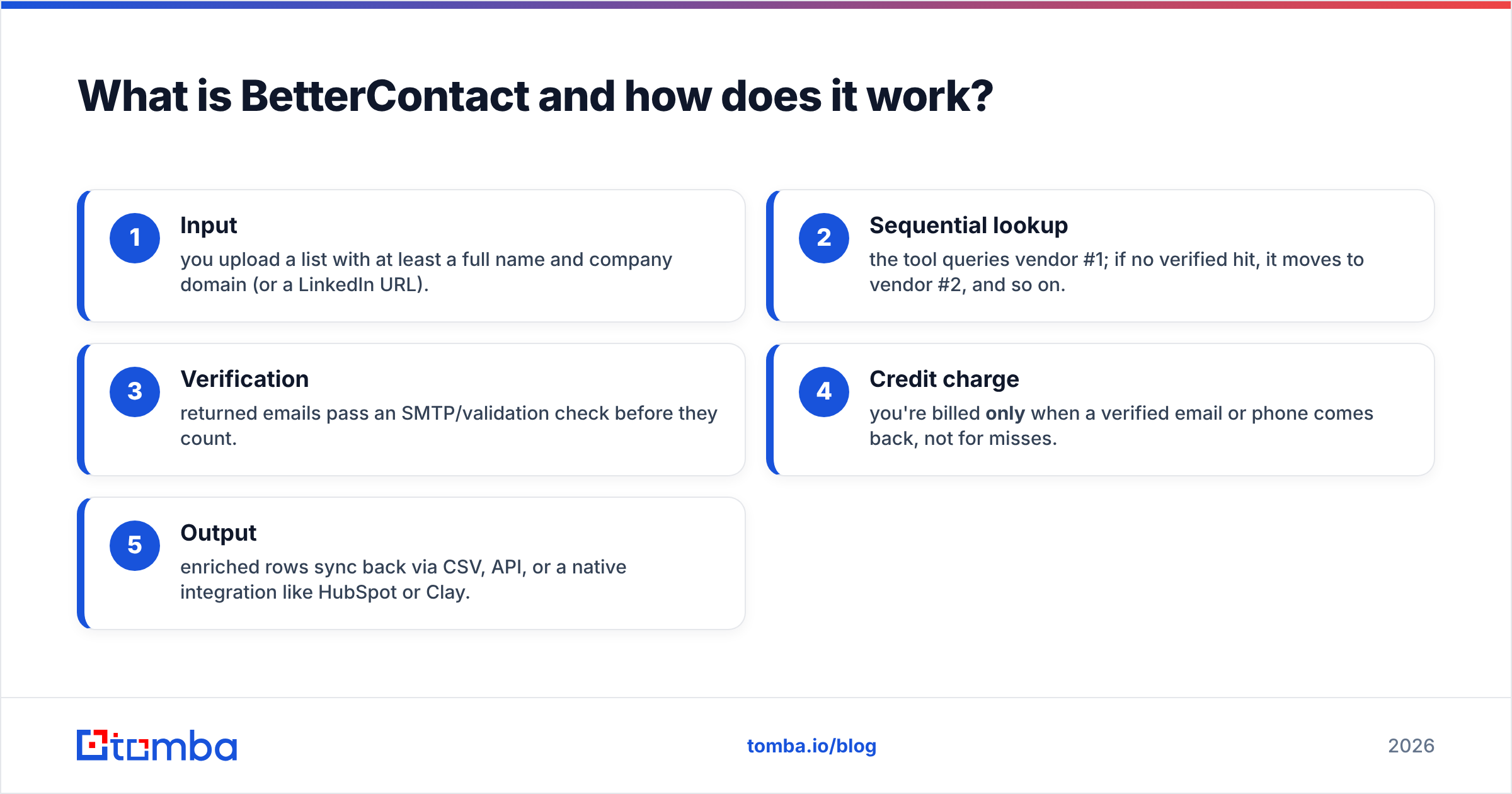
Here's how the waterfall logic plays out in practice:
- Input — you upload a list with at least a full name and company domain (or a LinkedIn URL).
- Sequential lookup — the tool queries vendor #1; if no verified hit, it moves to vendor #2, and so on.
- Verification — returned emails pass an SMTP/validation check before they count.
- Credit charge — you're billed only when a verified email or phone comes back, not for misses.
- Output — enriched rows sync back via CSV, API, or a native integration like HubSpot or Clay.

How much does BetterContact pricing cost in 2026?#
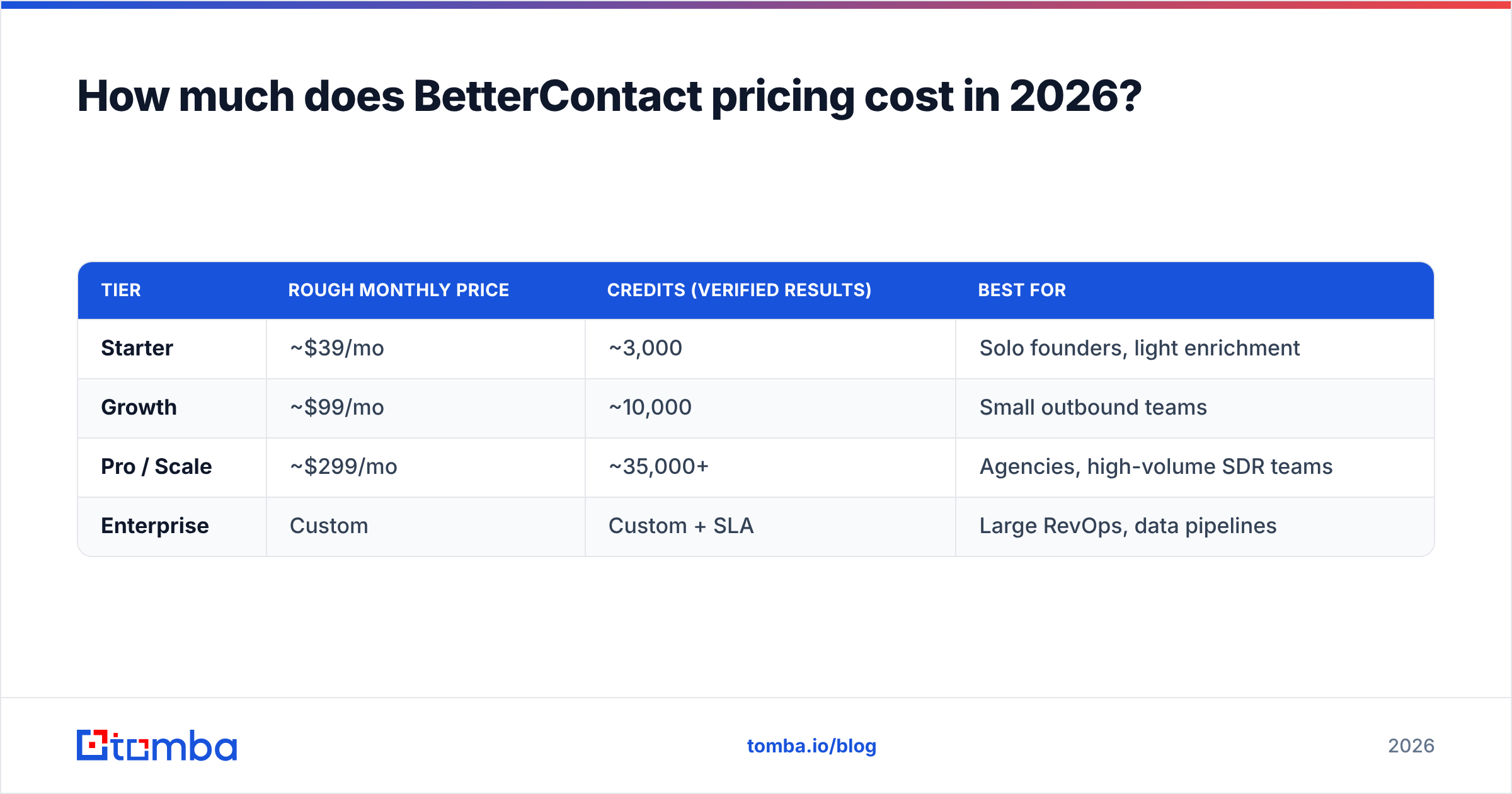
BetterContact uses credit-based, pay-for-results pricing — you buy a monthly credit bucket and one verified email typically costs one credit, with phone numbers costing more. Plans scale by credit volume rather than by feature, so even small accounts get API access.
Exact published numbers shift over time. Treat the table below as the shape of the pricing, not a contract. Always confirm current figures on the vendor's own pricing page. One pattern matters most for budgeting: cost per result drops as you commit to bigger monthly buckets, and unused credits usually don't roll over.
| Tier | Rough monthly price | Credits (verified results) | Best for |
|---|---|---|---|
| Starter | ~$39/mo | ~3,000 | Solo founders, light enrichment |
| Growth | ~$99/mo | ~10,000 | Small outbound teams |
| Pro / Scale | ~$299/mo | ~35,000+ | Agencies, high-volume SDR teams |
| Enterprise | Custom | Custom + SLA | Large RevOps, data pipelines |
A few things reviewers consistently flag about the model:
- You pay only for hits, not attempts. This is the genuinely good part — a 60% match list doesn't bill you for the 40% that failed.
- Phone numbers burn multiple credits. Mobile data is expensive to source, so a phone hit can cost several times an email hit.
- Annual commitments unlock the best per-credit rate, which is fine if your volume is steady and risky if it isn't.
- Catch-all domains complicate verification. When a domain accepts all mail, "verified" gets fuzzy — a catch-all verifier matters here regardless of which tool you use.
For comparison, a flat-rate provider like Tomba charges a predictable monthly fee — see Tomba pricing: Free (25 searches), Starter at $49/mo, Growth at $99/mo, and Pro at $249/mo — and you're not doing per-credit arithmetic on every campaign.
Is BetterContact's waterfall worth the markup?#
It depends entirely on your list quality and geography — the waterfall earns its markup on hard lists and wastes it on easy ones. That's the honest answer most "BetterContact review" articles dance around.
Run the math with a concrete example. Say you enrich 10,000 contacts:
- On a clean North American SaaS list, a single good database already hits ~70%. The waterfall might lift you to ~78%. You paid a premium for an 8-point gain you could partly close with verification alone.
- On a messy, multi-region list (EU + LATAM + APAC, mixed seniority), a single source might hit 35%. The waterfall can push that to ~65%. Here the markup is obviously worth it — no single vendor covers that spread.
So the question isn't "is BetterContact good?" It's "are my lists hard enough to need a waterfall?" If you're doing focused, domain-based prospecting where you already know the target companies, a domain search on a flat plan often returns the same contacts without the per-result meter running.
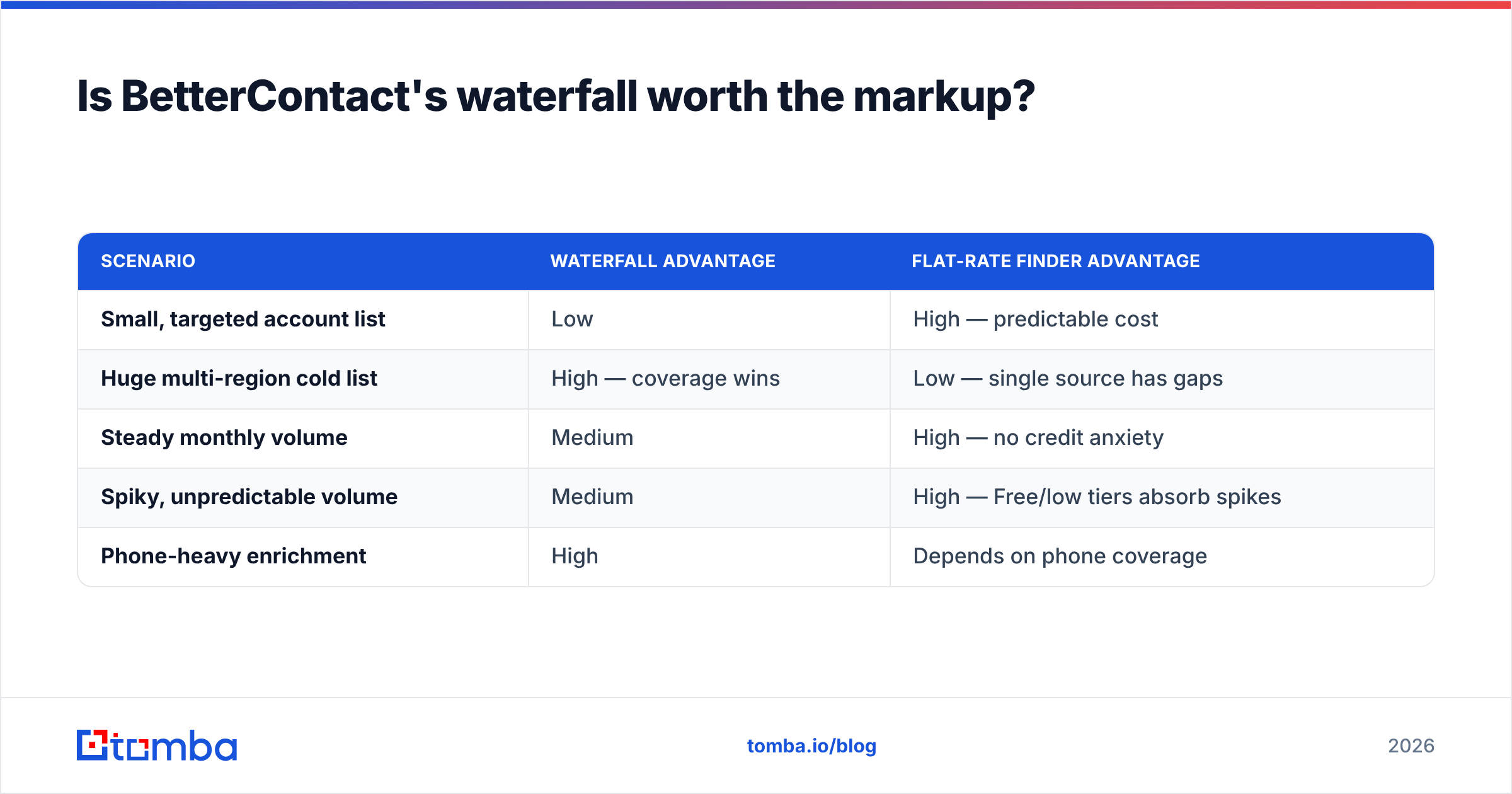
| Scenario | Waterfall advantage | Flat-rate finder advantage |
|---|---|---|
| Small, targeted account list | Low | High — predictable cost |
| Huge multi-region cold list | High — coverage wins | Low — single source has gaps |
| Steady monthly volume | Medium | High — no credit anxiety |
| Spiky, unpredictable volume | Medium | High — Free/low tiers absorb spikes |
| Phone-heavy enrichment | High | Depends on phone coverage |
What do BetterContact pricing reviews actually say?#
Across G2, Capterra, and community threads, BetterContact pricing reviews cluster around three praises and three complaints. Pulling from public review patterns rather than any single quote, here's the consensus.
What reviewers like:
- Match rate. The most repeated compliment. Users switching from a single-source tool report a meaningful lift in found emails, especially outside the US.
- Pay-for-results fairness. Not being charged for misses feels honest, and people say it.
- Clay and HubSpot integrations. For teams already living in those tools, the native hooks remove CSV gymnastics.
What reviewers criticize:
- Credit unpredictability. The top complaint. "I couldn't forecast my monthly spend" shows up repeatedly, especially for teams with variable list sizes.
- Phone-number cost and accuracy. Mobile data eats credits fast and quality varies by region.
- Support speed on lower tiers. Faster response is gated behind higher plans, which frustrates Starter users.
You can sanity-check these yourself on independent directories like G2 and Capterra — read the 3-star reviews, not just the 5-star ones, because that's where the credit-math and support gripes live.

What are the pros and cons of BetterContact?#
Here's the balanced scorecard, stripped of marketing language.
Pros
- Higher aggregate match rate than most single-source finders, thanks to 20+ chained vendors.
- Pay only for verified results — no charge on failed lookups, which protects you on low-quality lists.
- Strong international coverage where one US-centric database would leave gaps.
- Native integrations with Clay, HubSpot, and an API for pipeline automation.
- Built-in verification so most returned emails are deliverable on arrival.
Cons
- Unpredictable monthly cost — the credit model makes budgeting genuinely hard for variable workloads.
- Markup over direct vendors — you pay for aggregation convenience.
- Phone credits drain fast and vary in accuracy by region.
- Learning curve on the waterfall config and credit logic for non-technical users.
- Tiered support leaves smaller accounts waiting.
The pattern is clear. BetterContact optimizes for coverage, and trades away cost predictability to get it. Whether that trade is right for you is a budgeting decision, not a quality one. If your finance team needs a flat line item, a per-result meter is a hard sell even when the data is excellent. In that case, pair a flat-rate finder with a standalone email verifier. You get coverage and predictability without the credit anxiety.
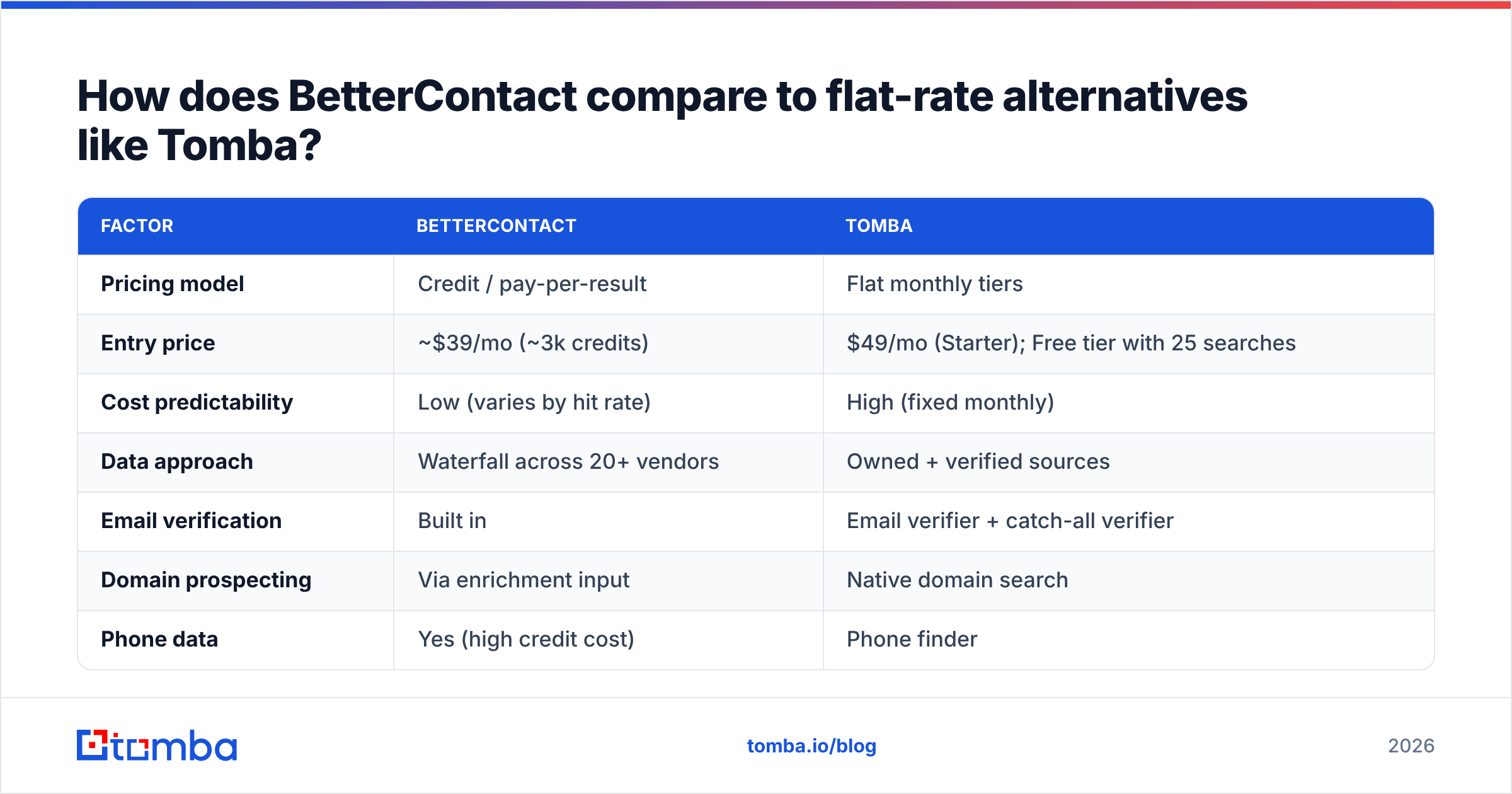
How does BetterContact compare to flat-rate alternatives like Tomba?#
For most small-to-mid B2B teams, a flat-rate finder is simpler and cheaper; for very large, low-quality, multi-region lists, the waterfall wins on coverage. Both can be right — they're built for different jobs.
| Factor | BetterContact | Tomba |
|---|---|---|
| Pricing model | Credit / pay-per-result | Flat monthly tiers |
| Entry price | ~$39/mo (~3k credits) | $49/mo (Starter); Free tier with 25 searches |
| Cost predictability | Low (varies by hit rate) | High (fixed monthly) |
| Data approach | Waterfall across 20+ vendors | Owned + verified sources |
| Email verification | Built in | Email verifier + catch-all verifier |
| Domain prospecting | Via enrichment input | Native domain search |
| Phone data | Yes (high credit cost) | Phone finder |
| Bulk workflows | CSV + API | Bulk email finder + API |
| Best fit | Huge messy lists | Predictable, targeted prospecting |
The decision framework is short:
- Choose BetterContact if your core problem is coverage — you enrich big, varied, international lists and a single source keeps leaving holes.
- Choose a flat-rate finder like Tomba if your core problem is predictability and workflow — you want a known monthly cost, native domain search, a free tier to test on, and verification built into the same platform.
Many teams actually run both. A flat-rate finder is the daily driver for targeted prospecting. A waterfall service is reserved for the occasional brutal list. There's no rule that says you must pick one vendor for everything. If you're weighing options broadly, it's worth reading up on BetterContact alternatives before committing to an annual plan.
Who should actually buy BetterContact?#
Buy it if you're a high-volume, multi-region outbound or RevOps team whose lists routinely defeat single-source tools — and whose finance side can tolerate a variable line item. That's the sweet spot, and for that profile BetterContact is a legitimately strong choice.
Skip it if any of these describe you:
- You run small, targeted lists where you already know the companies — a domain-based finder returns the same data cheaper.
- You need a predictable monthly budget and credit math gives your finance team hives.
- You're testing the waters and want a free tier before paying anything.
- Your enrichment is email-first, not phone-heavy, so you don't need the multi-vendor phone premium.
For everyone in that second group, the better starting point is a flat-rate platform where one fee covers finding, verifying, and bulk work — and where you can validate accuracy on a free tier before spending a dollar.
The bottom line#
BetterContact is a well-built waterfall enrichment tool. It does what it promises. It lifts match rates by chaining many vendors, and it bills you only for verified hits. The reviews back that up. But the same credit model that makes it fair on failed lookups makes it unpredictable on real budgets. The aggregation markup also means you pay a premium for coverage you may not always need.
If your lists are big, messy, and global, that premium is money well spent. If they're targeted and your finance team wants a flat number, you'll likely be happier — and cheaper — on a fixed-price finder.
Want predictable cost without giving up accuracy? Try the Tomba Email Finder. Start on the free tier (25 searches, no card), test the match rate on your own list, then scale to a flat $49/mo Starter plan with built-in verification, domain search, and a full API — no per-credit arithmetic on every campaign. Find the emails, know the price, move on.
// get started
Find, verify and enrich your first contacts today
Start on the free plan with 25 searches a month, then scale when your team is ready.
Free plan · No credit card required · GDPR & CCPA
// about the author