Bettermerge vs Bookyourdata 2026: B2B Data Tools Compared
Choosing between Bettermerge and Bookyourdata? Compare pricing, accuracy, coverage, and verification to see which B2B data tool actually fits your outbound motion in 2026.
Picking a B2B data vendor usually comes down to one quiet question: do you want a tool that cleans and merges the records you already have, or one that sells you new records to import? That's the core split between Bettermerge and Bookyourdata, and it's why teams keep comparing the two even though they solve different halves of the same problem.
This guide breaks down what each tool does, where each one wins, how pricing models differ, and how to decide without wasting a month of trial credits.
TL;DR: Bettermerge vs Bookyourdata#
- Bettermerge leans toward data hygiene — deduplication, record merging, and keeping an existing CRM or list clean and consistent.
- Bookyourdata is a pay-as-you-go B2B contact database: you build a list, buy verified emails and phone numbers, and export them.
- They're complementary more than competitive. Bookyourdata gets you new contacts; Bettermerge keeps the resulting database tidy.
- Neither replaces a real-time email finder + verifier. Bought lists decay fast, and merge tools can't confirm an address still accepts mail.
- Best combined play: source or find contacts, verify every address at send time, then merge and dedupe — which is where a tool like Tomba Email Finder fits between the two.
What is Bettermerge?#
Bettermerge is a data-hygiene and record-merging tool. Think of it like a librarian who walks through your shelves and notices you have three slightly different copies of the same book filed under three spellings — then consolidates them into one clean entry. In CRM terms, that means catching duplicate accounts, contacts with mismatched fields, and conflicting records, then merging them into a single source of truth.
The value here is not acquiring data. It's making the data you already paid for usable. Sales reps lose trust in a CRM the moment they email the same prospect twice or call a number that belongs to a former employee. Merge and dedupe tooling exists to stop that erosion.
Typical jobs a tool in this category handles:
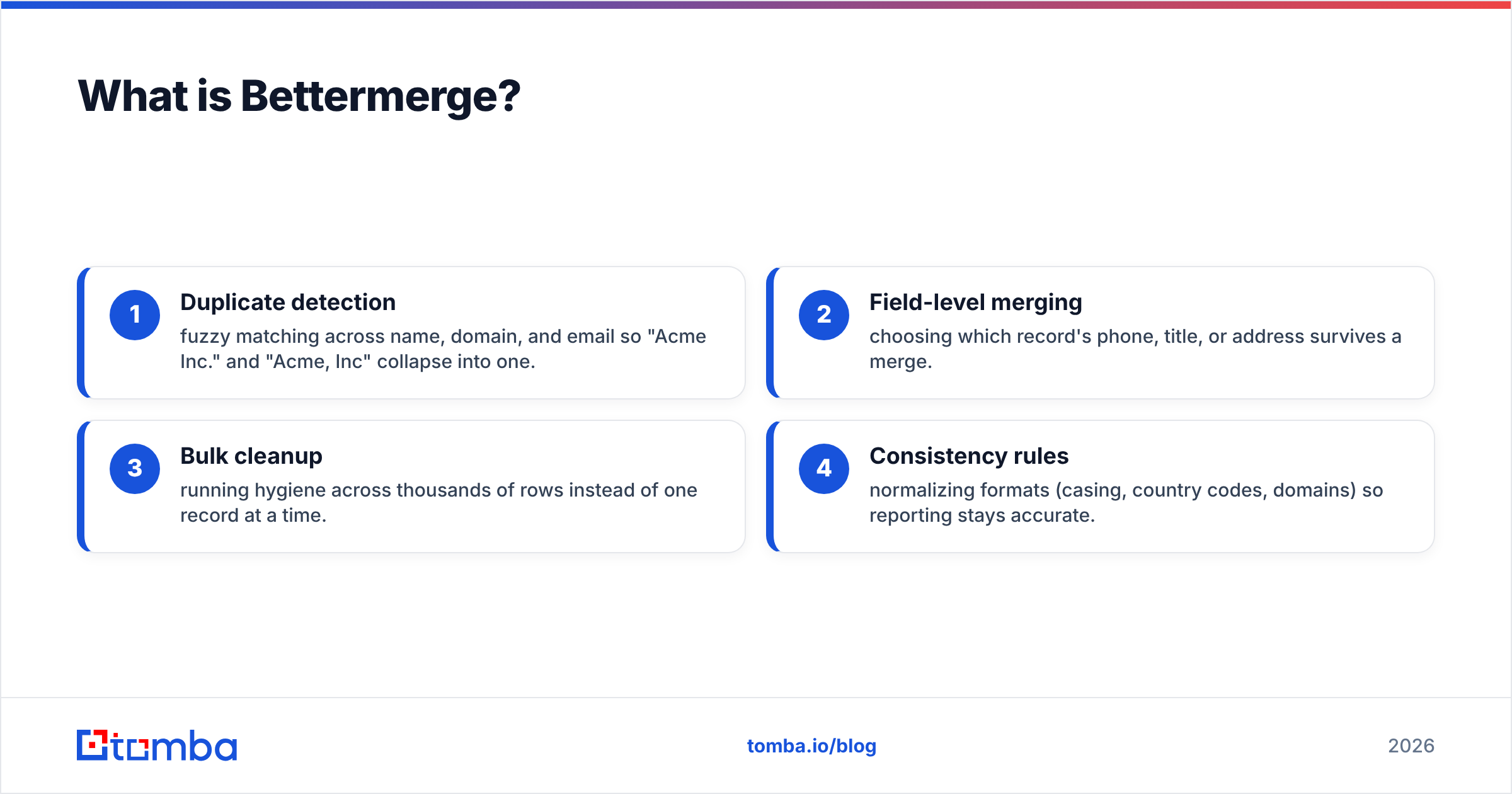
- Duplicate detection — fuzzy matching across name, domain, and email so "Acme Inc." and "Acme, Inc" collapse into one.
- Field-level merging — choosing which record's phone, title, or address survives a merge.
- Bulk cleanup — running hygiene across thousands of rows instead of one record at a time.
- Consistency rules — normalizing formats (casing, country codes, domains) so reporting stays accurate.
What it generally does not do is tell you whether an email address is currently deliverable, or hand you brand-new contacts you didn't already have.
)
What is Bookyourdata?#
Bookyourdata is a B2B contact database with a pay-as-you-go model. You filter by industry, job title, location, company size, and technology, preview the count, and buy the records you want — emails, direct dials, and firmographics — then export to CSV or push into your CRM. Their public pitch centers on a large contact pool and a high stated accuracy guarantee, and you only pay for what you download rather than committing to a seat-based subscription. You can see how they position themselves on their own site at bookyourdata.com and read peer reviews on G2.
The analogy: Bookyourdata is a grocery store for leads. You walk in with a shopping list (CMOs at 200–500 person SaaS companies in the US), fill your basket, and pay at the register. Convenient, fast, and you leave with something concrete.
The catch with any list-purchase model is the same one every outbound team eventually hits: B2B data decays. People change jobs, companies rebrand, and inboxes get deactivated. A list that was 95% accurate the day it was compiled is meaningfully worse months later. That's why verification at send time matters more than the accuracy number printed on the box. If you're buying lists, pairing them with an email verifier before you send is non-negotiable.
Bettermerge vs Bookyourdata: how do they actually compare?#
The honest answer is that these tools sit at different stages of the data lifecycle. Bookyourdata is acquisition. Bettermerge is maintenance. Comparing them head-to-head only makes sense if you're deciding where to spend your next data dollar.
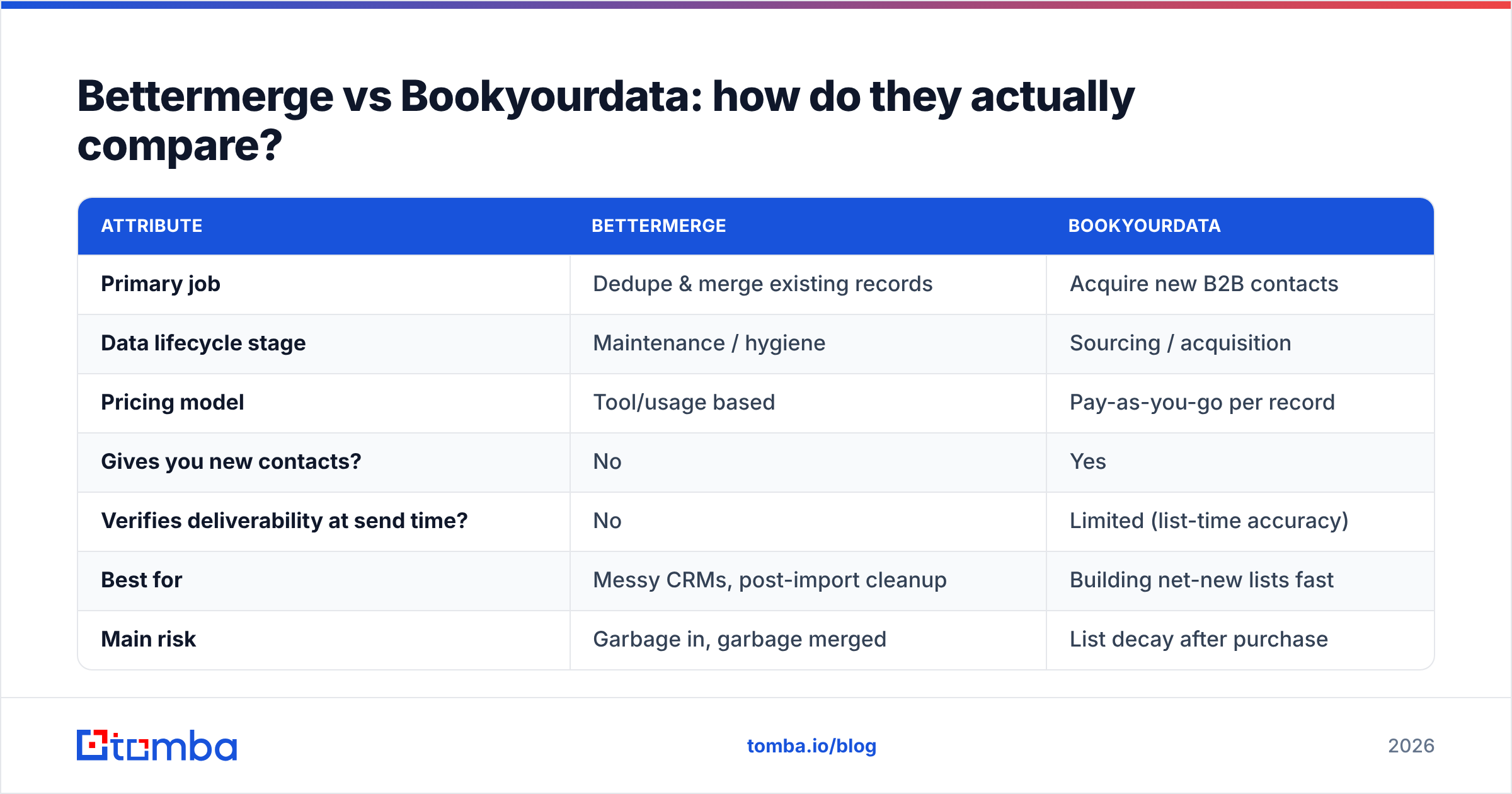
| Attribute | Bettermerge | Bookyourdata |
|---|---|---|
| Primary job | Dedupe & merge existing records | Acquire new B2B contacts |
| Data lifecycle stage | Maintenance / hygiene | Sourcing / acquisition |
| Pricing model | Tool/usage based | Pay-as-you-go per record |
| Gives you new contacts? | No | Yes |
| Verifies deliverability at send time? | No | Limited (list-time accuracy) |
| Best for | Messy CRMs, post-import cleanup | Building net-new lists fast |
| Main risk | Garbage in, garbage merged | List decay after purchase |
| Works well alongside | A contact-sourcing tool | A verification + dedupe layer |
Read that table and the conclusion writes itself: these two belong in the same workflow, not on opposite sides of a buying decision. You acquire with one, clean with the other, and verify in between. The mistake teams make is assuming either tool alone delivers a campaign-ready list.
Which one is better for cold outreach?#
Neither, on its own — and that's not a dodge. For cold outreach, the metric that matters is bounce rate, and bounce rate is governed by deliverability at the moment you hit send, not by how clean your merge was or how accurate a list claimed to be at purchase.
Here's the failure mode for each:
- Buy a Bookyourdata list and blast it. Even a high-accuracy list includes addresses that died since compilation. Mailbox providers punish high bounce rates by throttling your sender reputation, which tanks the deliverability of every future campaign.
- Run Bettermerge on a stale list. You'll get a beautifully deduplicated database of contacts who may no longer work there. Clean ≠ deliverable.
The fix is a verification step that checks each address in real time and flags catch-all domains, role accounts, and dead mailboxes. That's the layer both tools skip. A real-time finder-plus-verifier confirms the address resolves before it ever enters a sequence, and that single step does more for cold-email performance than either dedupe or list-size ever will.
)
How does pricing compare?#
Pricing is where the two diverge most, because the models are structurally different.
- Bookyourdata uses pay-as-you-go credits: you pay per record exported. Good when you need a burst of contacts and bad when you need ongoing, predictable volume — costs scale linearly with every list you pull.
- Bettermerge is priced as a hygiene tool/utility, typically tied to the volume of records processed rather than acquired. You're paying to clean, not to obtain.
Because vendor pricing changes often, confirm current numbers on each official site before you commit — don't trust a number you read in a comparison post (including this one). What you can plan around is the shape of the cost: acquisition costs recur every time you need fresh contacts, while hygiene costs recur every time your database gets messy again.
For reference, here's how a real-time finder model compares, since it's the third option most teams end up adding:
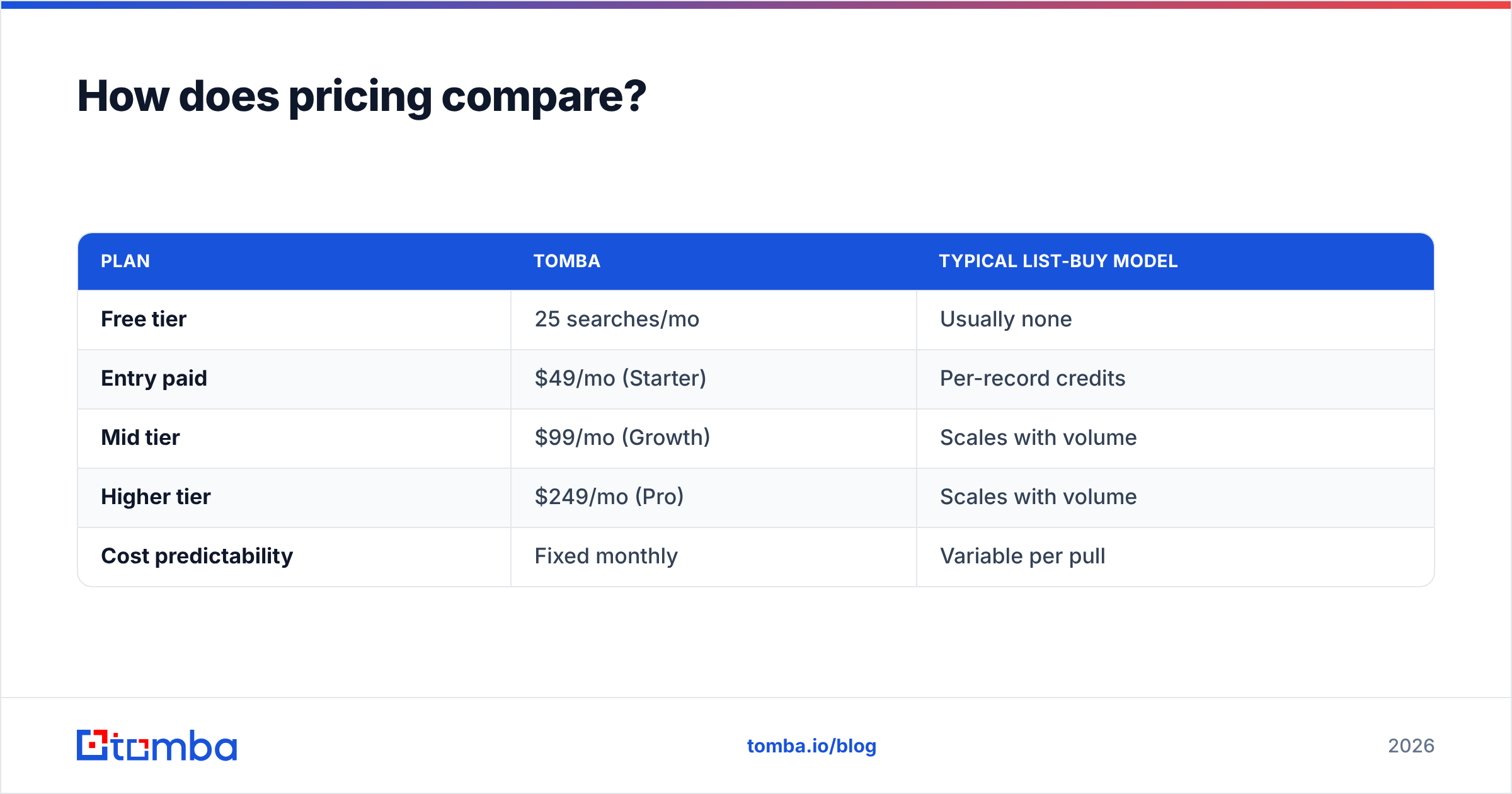
| Plan | Tomba | Typical list-buy model |
|---|---|---|
| Free tier | 25 searches/mo | Usually none |
| Entry paid | $49/mo (Starter) | Per-record credits |
| Mid tier | $99/mo (Growth) | Scales with volume |
| Higher tier | $249/mo (Pro) | Scales with volume |
| Cost predictability | Fixed monthly | Variable per pull |
You can see full Tomba pricing for the exact credit breakdowns. The point of the table isn't to crown a winner — it's to show that a subscription finder gives you predictable cost, while a pay-per-record database gives you variable cost that spikes with every campaign.
What about data accuracy and coverage?#
Coverage and accuracy are the two numbers every data vendor markets, and the two numbers you should trust least without testing.
Coverage (how many contacts exist in the database) favors large list providers like Bookyourdata — that's their whole product. But coverage is only useful if the records are current. A 250-million-contact database with 20% decay is functionally a 200-million-contact database with a 50-million-record landmine field.
Accuracy is where the marketing claim and the reality diverge. A "97% accurate" guarantee usually means accurate at the time of compilation, not at the time you send. The only accuracy figure that protects your domain is the one you measure yourself, by verifying a sample before a full send.
Practical way to test any vendor — including both tools here:
- Pull or build a sample of 100 contacts in your exact ICP.
- Run them through an independent email verifier and a catch-all verifier.
- Measure the real valid rate, not the marketed one.
- Extrapolate the cost-per-usable-contact, not cost-per-record.
This single exercise reorders most buying decisions, because cost-per-usable-contact is often double the cost-per-record once you subtract bounces, catch-alls, and role accounts. For ongoing hygiene at scale, layering in data enrichment and bulk verification keeps that usable rate high over time instead of letting it decay quietly.
When should you use a dedicated email finder instead?#
Use a dedicated finder when your workflow is targeted rather than bulk — when you have a specific list of companies or people and you need the right contact, not ten thousand maybe-contacts.
Choose a finder + verifier over a list buy or a merge tool when:
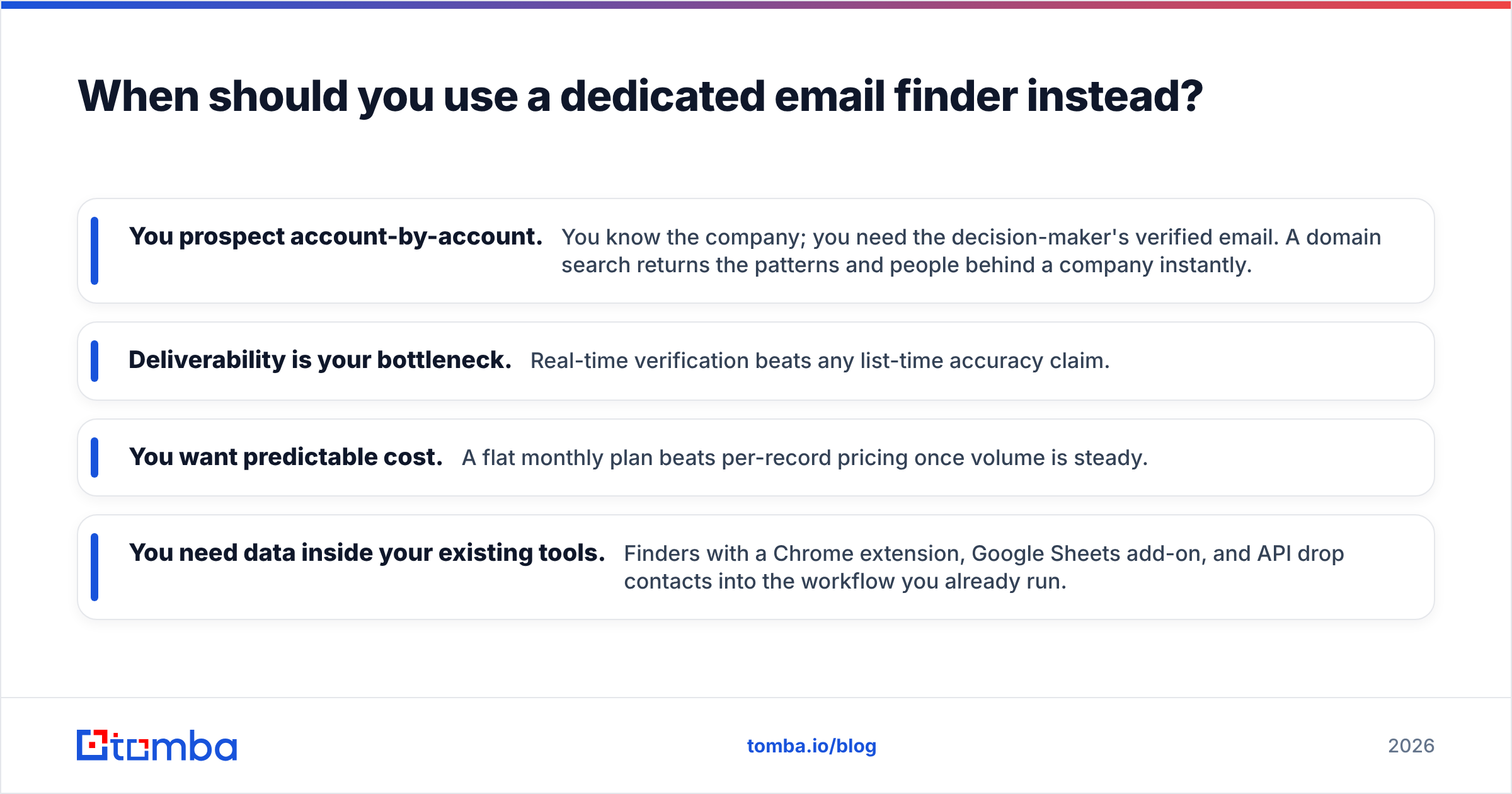
- You prospect account-by-account. You know the company; you need the decision-maker's verified email. A domain search returns the patterns and people behind a company instantly.
- Deliverability is your bottleneck. Real-time verification beats any list-time accuracy claim.
- You want predictable cost. A flat monthly plan beats per-record pricing once volume is steady.
- You need data inside your existing tools. Finders with a Chrome extension, Google Sheets add-on, and API drop contacts into the workflow you already run.
Where a finder won't replace Bettermerge is deduplication of a database you already have — for that, a merge tool is the right instrument. And where it complements Bookyourdata is by verifying whatever you bought before it touches a sequence. The three tools form a chain: source, verify, merge. Removing any link is where bounce rates and wasted spend creep in. For broader context on how vendors stack up, neutral directories like Capterra are worth a scan before you commit budget.
The bottom line#
Bettermerge and Bookyourdata aren't really rivals — one keeps your data clean, the other fills it up. The decision that actually moves your numbers is the verification layer sitting between them, because that's what protects your sender reputation and your cost-per-usable-contact.
If your real problem is finding the right verified contacts rather than buying volume or scrubbing duplicates, start with Tomba Email Finder. Find professional emails by domain, name, or company, verify deliverability before you send, and keep cost predictable on a flat plan — with a free tier of 25 searches a month to test it against your own ICP before you pay a cent. Source smart, verify everything, and let the merge tools clean up what's left.
Ready to find emails that actually work?
Join 150,000+ professionals who stopped guessing and started sending. Free credits on signup — no credit card required.
Get the Tomba newsletter
Practical outbound tactics and product updates — once every two weeks.
About the author