Bettermerge vs DiscoverOrg 2026: B2B Data Tools Compared
Bettermerge vs DiscoverOrg: which B2B data platform actually fits your budget and pipeline in 2026? A neutral breakdown of coverage, accuracy, pricing, and the leaner alternatives most teams overlook.
Choosing a B2B data provider in 2026 usually comes down to one uncomfortable question: are you paying for the data, or for the logo on the invoice? Bettermerge and DiscoverOrg sit on opposite ends of that spectrum, and picking the wrong one can lock your team into a five-figure annual contract you barely use.
This is a neutral breakdown of how the two stack up on coverage, accuracy, pricing, and contract terms — plus where a lean email-finder approach beats both for most outbound teams.
TL;DR: Bettermerge vs DiscoverOrg at a glance#
- DiscoverOrg (now part of ZoomInfo) is the enterprise heavyweight: deep org charts, intent data, and human-verified records, but seat-based pricing that routinely lands in the $15K–$40K+/year range with annual lock-in.
- Bettermerge positions itself as a lighter, merge-and-enrich data layer — cheaper and faster to onboard, but with thinner coverage outside core firmographics.
- Accuracy is the real battleground: DiscoverOrg wins on verified depth; Bettermerge wins on speed and price; both decay fast without re-verification.
- For most SMB and mid-market teams, a pay-as-you-go email finder plus targeted enrichment covers 80% of the use case at a fraction of the cost.
- Pick by motion, not brand: enterprise ABM → DiscoverOrg; fast self-serve enrichment → Bettermerge; cost-efficient outbound → a credit-based tool like Tomba.
What are Bettermerge and DiscoverOrg?#
Think of B2B data tools like grocery options. DiscoverOrg is the full-service warehouse club — enormous selection, verified quality, but you pay an annual membership whether you shop or not. Bettermerge is the corner market — quicker, cheaper, fewer aisles. And a focused email finder is buying exactly the three ingredients you need for tonight's dinner.
DiscoverOrg built its reputation on human-verified company and contact data, detailed org charts, and technographic + intent signals aimed at enterprise sales and marketing teams. After merging into ZoomInfo, much of its dataset now lives inside the broader ZoomInfo platform, but the "DiscoverOrg" depth-first DNA remains: research-team-verified records and granular account intelligence.
Bettermerge is the newer, lighter-weight entrant. It leans on data merging and enrichment — taking your existing records and filling gaps with firmographic and contact fields — with a self-serve onboarding flow and pricing meant to undercut the legacy incumbents. Its strength is speed and cost; its weakness is breadth and the depth of verification behind each record.
Here's the core trade-off in one place:
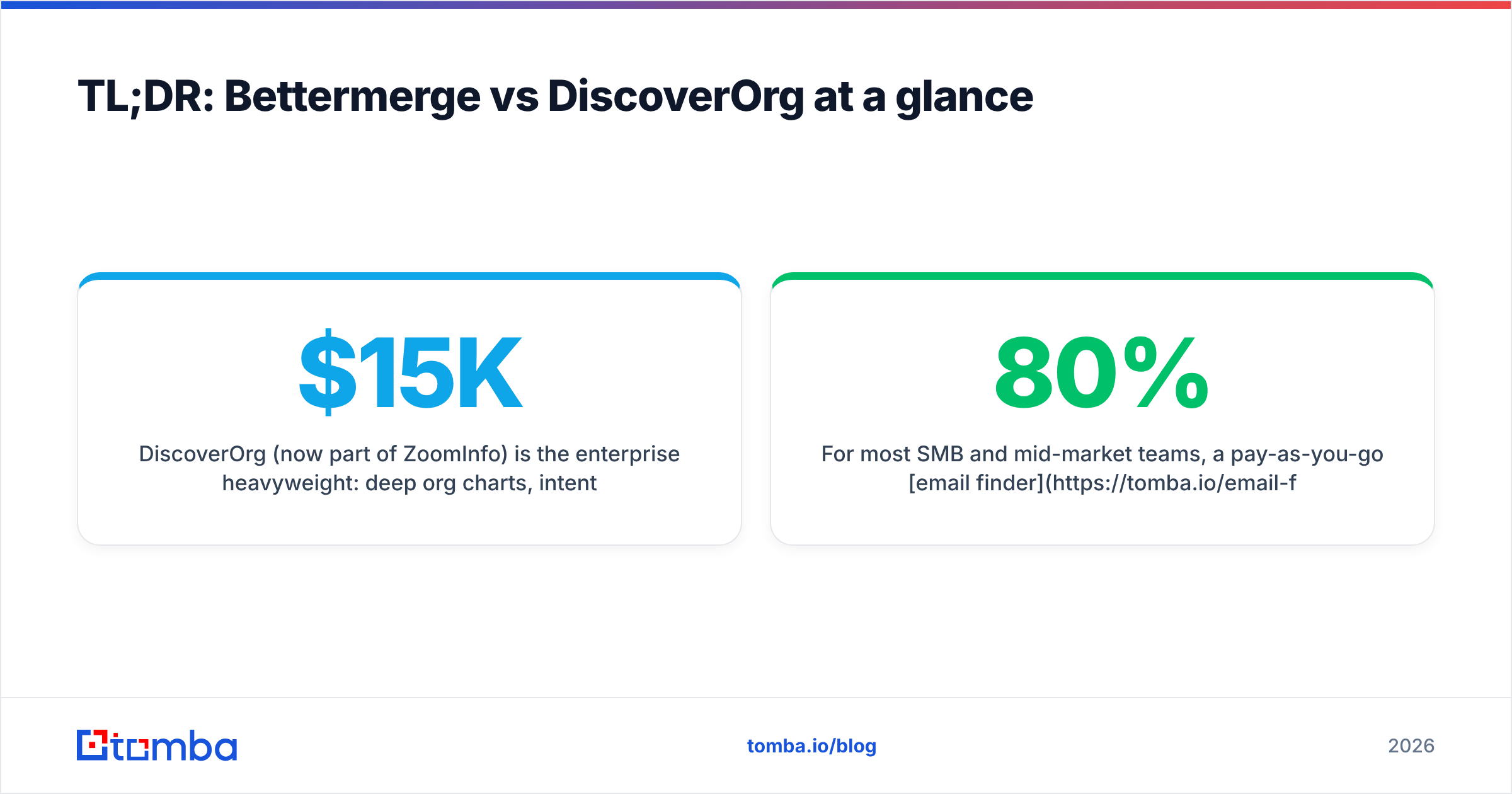
| Dimension | DiscoverOrg | Bettermerge |
|---|---|---|
| Primary strength | Verified depth, org charts, intent | Speed, price, easy enrichment |
| Data verification | Human + automated, research team | Mostly automated/merged |
| Org chart / hierarchy | Deep, role-mapped | Limited |
| Intent / technographics | Yes (robust) | Partial or add-on |
| Typical pricing | $15K–$40K+/yr, seat-based | Lower, often usage-tiered |
| Contract | Annual lock-in common | More flexible |
| Best fit | Enterprise ABM, large RevOps | SMB/mid-market enrichment |
Is DiscoverOrg better than Bettermerge for accuracy?#
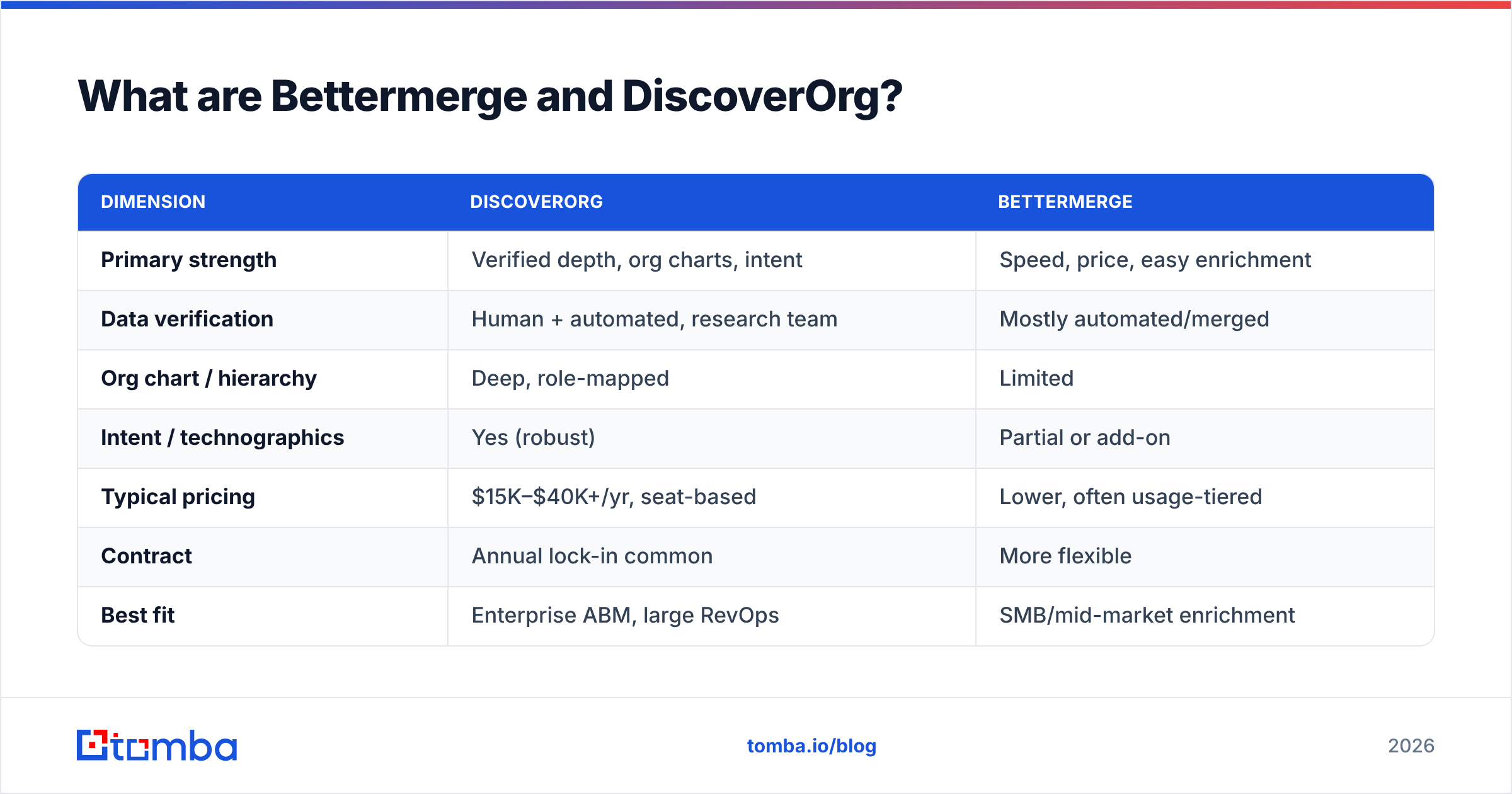
Conclusion first: DiscoverOrg generally wins on accuracy and depth, but you pay heavily for that last 10–15% of verified coverage.
DiscoverOrg's historical edge was a human research layer that re-verified records on a cycle, which kept org charts and direct dials fresher than purely scraped databases. That matters most for enterprise selling, where reaching the right VP through a mapped reporting structure is the whole game.
Bettermerge's accuracy is competitive on core firmographics (company name, size, industry, domain) but thins out on personal contact data, direct dials, and hierarchy. Because much of its enrichment is automated and merge-based, stale source records propagate into your CRM unless you re-verify.

The uncomfortable truth for both: B2B contact data decays at roughly 22–30% per year. Titles change, people leave, domains migrate. No provider — premium or budget — escapes this. That's why your verification workflow matters more than the vendor's marketing accuracy claim. Running records through an email verifier before any send protects deliverability regardless of which database sourced the lead.
If you want to sanity-check vendor claims yourself, independent reviews on G2 and the official ZoomInfo documentation (which now houses DiscoverOrg's dataset) are better evidence than any single case study.
How do Bettermerge and DiscoverOrg compare on pricing?#
Conclusion first: DiscoverOrg is an enterprise budget line; Bettermerge is a team-card purchase. The gap is often 10x.
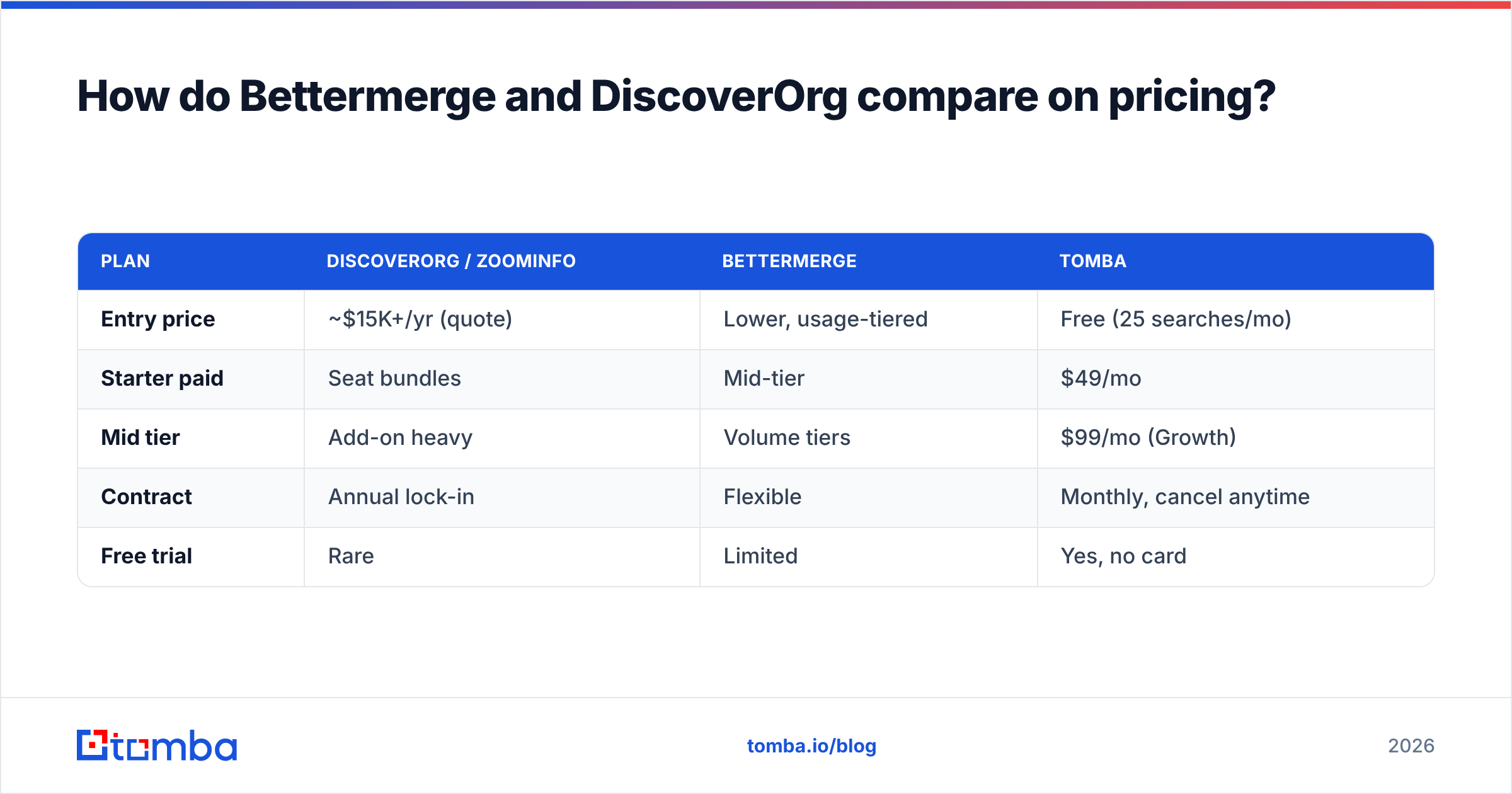
DiscoverOrg/ZoomInfo pricing is quote-based, seat-based, and almost always annual. Real-world contracts commonly start around $15,000/year and climb past $40,000 once you add seats, intent data, and API access. There's rarely a meaningful free tier, and credits are bundled into the platform rather than sold à la carte.
Bettermerge competes precisely on this pain. Its pricing is lower and more usage-oriented, with faster self-serve onboarding and less negotiation friction. But "cheaper than DiscoverOrg" is a low bar — you should still compare its effective cost-per-verified-contact, not its sticker price.
Here's where a credit-based email finder reframes the math entirely:
| Plan | DiscoverOrg / ZoomInfo | Bettermerge | Tomba |
|---|---|---|---|
| Entry price | ~$15K+/yr (quote) | Lower, usage-tiered | Free (25 searches/mo) |
| Starter paid | Seat bundles | Mid-tier | $49/mo |
| Mid tier | Add-on heavy | Volume tiers | $99/mo (Growth) |
| Contract | Annual lock-in | Flexible | Monthly, cancel anytime |
| Free trial | Rare | Limited | Yes, no card |
You can review full Tomba pricing directly — the point isn't that Tomba replaces an enterprise ABM data stack, it's that most teams buying DiscoverOrg-class contracts are overpaying for coverage they never activate.

Which one should your team actually choose?#
Match the tool to your sales motion, not to brand recognition. Here's the decision framework:
- Enterprise ABM with named accounts — DiscoverOrg/ZoomInfo earns its price if you genuinely use org charts, intent data, and a large seat count. The depth pays back when six-figure deals depend on multi-threading the right buying committee.
- Mid-market enrichment at speed — Bettermerge fits when you mostly need to fill CRM gaps and don't require deep hierarchy or premium intent. Lower friction, lower cost, "good enough" firmographics.
- Cost-efficient outbound prospecting — A credit-based find emails workflow plus a B2B database lookup covers the bulk of SMB and mid-market outbound without an annual commitment.
- Hybrid stacks — Many teams pair a premium provider for tier-1 accounts with a pay-as-you-go finder for the long tail. You stop burning expensive enterprise credits on low-priority prospects.
- API-first / programmatic — If you're enriching at scale in pipelines, compare API rate limits and per-call cost. The Tomba API and domain search handle bulk discovery without seat math.
The mistake teams make is treating this as binary. Bettermerge vs DiscoverOrg is rarely the real question — the real question is which records justify premium data, and which don't.
What do Bettermerge and DiscoverOrg miss that an email finder solves?#
Both platforms optimize for the "give me a list" use case. Neither is built for the moment you already have a name and company and just need a deliverable email — fast, verified, and cheap.
That's where a focused finder shines:
- Pay only for what you pull. No seats, no shelfware. Credits map directly to contacts found.
- Verification baked in. A finder that returns a confidence score and runs SMTP checks saves you a separate cleaning step. Catch-all domains, the bane of bulk lists, get flagged instead of silently bouncing.
- No procurement cycle. You can start on a free tier today instead of waiting on a quote and a six-month contract.
- Pattern-based discovery. When a record is missing, deterministic email pattern logic finds the likely address and verifies it, rather than leaving the field blank.
This doesn't make Tomba a drop-in replacement for enterprise intent data — it makes it the right tool for the 80% of outbound where you don't need a research team, you need a working email address before the rep's coffee gets cold.
Bettermerge vs DiscoverOrg: the honest verdict#
- Choose DiscoverOrg when verified depth, org charts, and intent data drive real enterprise revenue — and you'll actually log in enough to justify the seat cost.
- Choose Bettermerge when you want faster, cheaper enrichment and can live with thinner coverage and lighter verification.
- Choose a credit-based finder when your dominant pain is "I need a verified email for this specific person, right now, without an annual contract."
Most teams discover that their data spend is bottom-heavy: a few accounts deserve premium intelligence, and the rest just need a reliable address and a clean verify. Sizing your tooling to that reality — instead of to the biggest brand in the category — is how you cut data costs without cutting pipeline.
Get accurate emails without the enterprise contract#
If your real bottleneck is reaching the right people — not assembling a 40-field account dossier — start with the Tomba Email Finder. Find professional email addresses by domain, name, or company, verify them before you send, and pay by the credit instead of by the seat. The free tier gives you 25 searches a month with no card required, and paid plans start at $49/mo with monthly billing you can cancel anytime. Test it against your current Bettermerge or DiscoverOrg exports and compare cost-per-verified-contact for yourself — that single number usually settles the debate.
// get started
Find, verify and enrich your first contacts today
Start on the free plan with 25 searches a month, then scale when your team is ready.
Free plan · No credit card required · GDPR & CCPA
// about the author