Bidstream Intent Data in 2026: How It Works & When to Use It
Bidstream intent data promises to show who's ready to buy before they ever fill out a form. Here's how it actually works, where it falls short, and how to turn raw signals into real pipeline in 2026.
Bidstream intent data is one of the most misunderstood data sources in B2B. Vendors pitch it as a crystal ball that tells you exactly which accounts are about to buy. Skeptics call it noisy ad exhaust dressed up as insight. The truth sits in between — and where it sits decides whether this data makes you money or just inflates your dashboards.
This guide breaks down what bidstream intent data actually is, how it's collected, how it compares to other intent signals, and how to operationalize it without burning your budget on accounts that were never in-market.
TL;DR#
- Bidstream intent data is derived from the real-time bidding (RTB) auctions that happen every time an ad loads on a webpage. The bid request leaks metadata — page URL, topic, coarse location, device — and vendors aggregate that into account-level "interest" signals.
- It is wide but shallow: huge reach across the open web, but weaker accuracy and attribution than first-party or co-op intent data.
- It works best as a prioritization layer, not a source of truth. Use it to rank accounts, then verify with firmographics and real contacts.
- Accuracy is the catch. Probabilistic IP-to-company mapping and privacy changes mean a meaningful share of signals are noise. Treat scores as a starting hypothesis.
- Pair it with verified contact data so that when a signal fires, you can actually reach a real decision-maker the same day.
What is bidstream intent data?#
Bidstream intent data is buyer-interest data extracted from the advertising bidstream — the flood of bid requests generated by real-time bidding auctions across programmatic ad exchanges.
Here's the everyday version. Every time a webpage with ads loads, it's like an auctioneer shouting details about who just walked into the room: "Someone on a corporate network in Austin is reading an article about data warehouse migration on a finance site." Advertisers bid in milliseconds to show that person an ad. Bidstream vendors don't care about the ad — they record the description of the room. Multiply that across billions of daily auctions and you get a map of which topics are heating up at which companies.
Technically, each bid request carries metadata defined by ad-tech standards: the page URL and category, IP address, device type, timestamp, and sometimes coarse geo. Intent vendors ingest this firehose, map IP addresses to companies, classify page content into topics, and surface accounts showing a spike in topic consumption relative to their baseline.
The output you actually consume looks like: "Acme Corp showed elevated intent on the topic 'CRM migration' this week — surge score 78."
How is bidstream data collected and scored?#
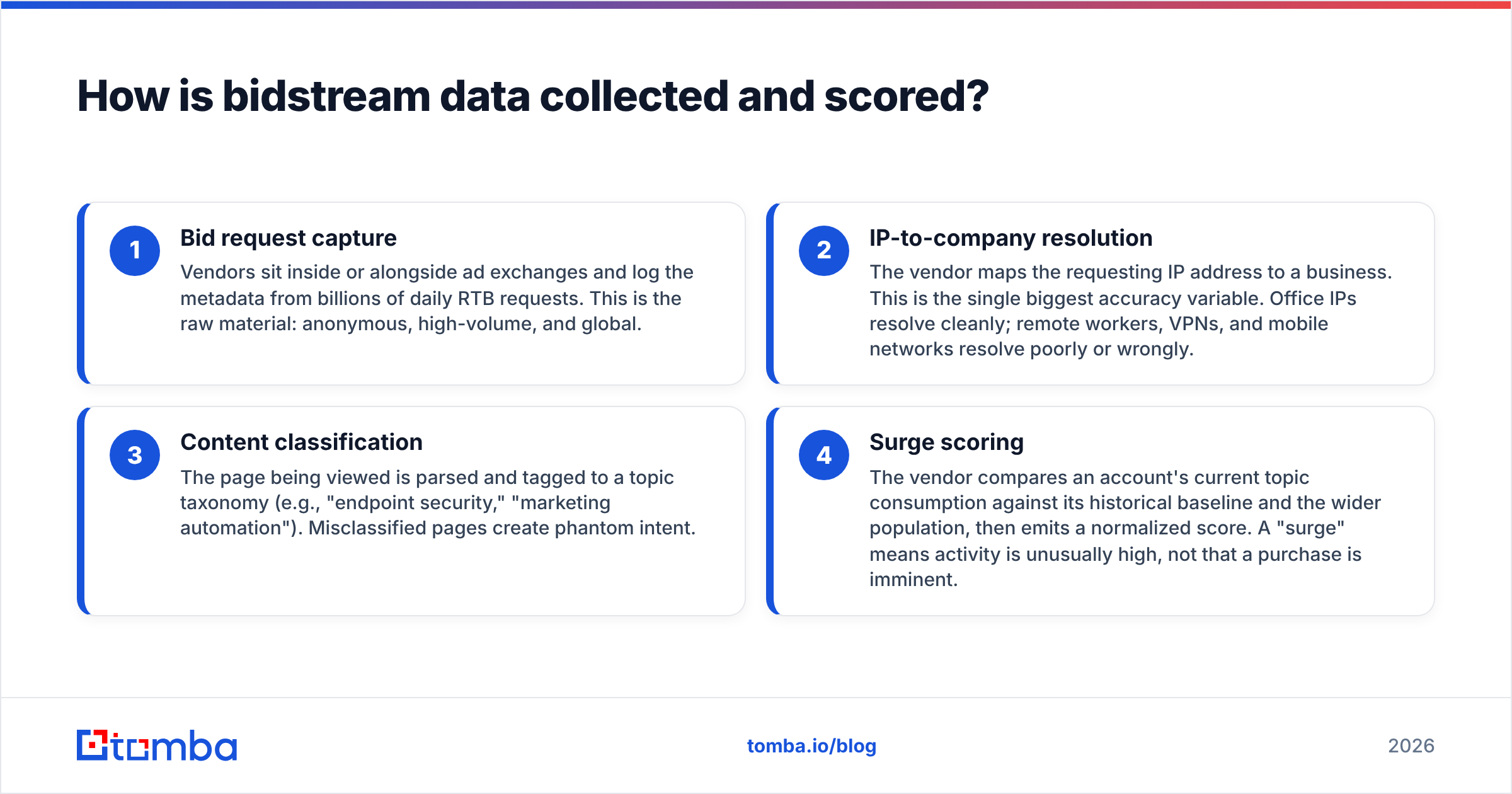
Four steps turn raw auction noise into something a sales team can act on. Understanding the pipeline tells you exactly where accuracy leaks in.
- Bid request capture — Vendors sit inside or alongside ad exchanges and log the metadata from billions of daily RTB requests. This is the raw material: anonymous, high-volume, and global.
- IP-to-company resolution — The vendor maps the requesting IP address to a business. This is the single biggest accuracy variable. Office IPs resolve cleanly; remote workers, VPNs, and mobile networks resolve poorly or wrongly.
- Content classification — The page being viewed is parsed and tagged to a topic taxonomy (e.g., "endpoint security," "marketing automation"). Misclassified pages create phantom intent.
- Surge scoring — The vendor compares an account's current topic consumption against its historical baseline and the wider population, then emits a normalized score. A "surge" means activity is unusually high, not that a purchase is imminent.
The key insight: every step is probabilistic. None of it is a logged-in user telling you they want to buy. That's why bidstream is best treated as a directional signal that earns its keep only when you layer verification on top.
How does bidstream intent data compare to other intent sources?#
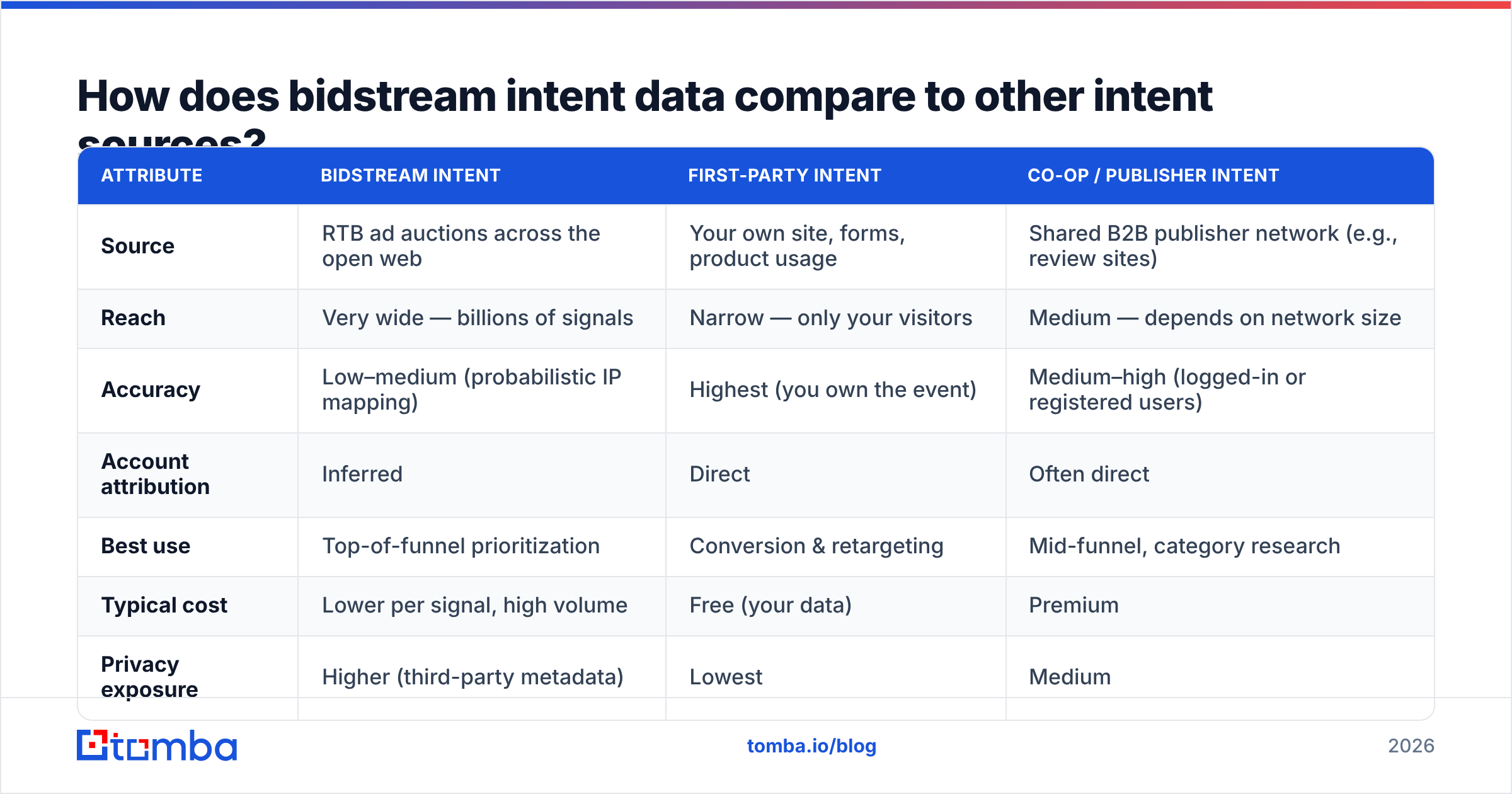
There are three broad families of B2B intent data, and bidstream is only one. Confusing them is the fastest way to overpay or under-deliver.
| Attribute | Bidstream intent | First-party intent | Co-op / publisher intent |
|---|---|---|---|
| Source | RTB ad auctions across the open web | Your own site, forms, product usage | Shared B2B publisher network (e.g., review sites) |
| Reach | Very wide — billions of signals | Narrow — only your visitors | Medium — depends on network size |
| Accuracy | Low–medium (probabilistic IP mapping) | Highest (you own the event) | Medium–high (logged-in or registered users) |
| Account attribution | Inferred | Direct | Often direct |
| Best use | Top-of-funnel prioritization | Conversion & retargeting | Mid-funnel, category research |
| Typical cost | Lower per signal, high volume | Free (your data) | Premium |
| Privacy exposure | Higher (third-party metadata) | Lowest | Medium |
Most strong programs blend all three. First-party tells you who's already engaging you. Co-op data (from review and comparison sites) catches active category research. Bidstream casts the widest net to surface accounts you've never touched — which is exactly why it needs the most scrutiny before you act on it.
Analyst firms like Gartner and Forrester consistently frame intent data as a prioritization input rather than a buying trigger, and bidstream sits at the noisiest, widest end of that spectrum.
Is bidstream intent data accurate enough to trust?#
Short answer: trust the direction, not the certainty. Bidstream is a hypothesis generator, not a verdict.
Three structural issues cap its accuracy:
- IP resolution drift. Hybrid and remote work shattered the clean office-IP-to-company link that bidstream depends on. A signal attributed to "Acme Corp" might be a single contractor on home Wi-Fi, or a misresolved consumer ISP.
- Privacy and deprecation pressure. Tightening regulation and the slow death of third-party identifiers shrink and degrade the available bidstream. Coverage gaps grow over time, not shrink.
- Topic ambiguity. A page can map to several topics, and "research" can mean a curious intern, a competitor, an analyst, or a real buyer. The score can't tell them apart.
None of this makes bidstream useless. It makes it unfinished. The fix is to treat each signal as the start of a workflow: confirm the account fits your ICP, enrich it with real firmographics, and find a verified contact before anyone spends a minute on outreach. That last step — turning an anonymous "surge" into a named person with a working email — is where most teams leak the value. A reliable email finder closes that gap so a Tuesday signal becomes a Tuesday conversation.
How do you turn bidstream signals into pipeline?#
A signal that doesn't change what a rep does this week is just a number. Here's a workflow that converts bidstream intent into action without overcommitting to noisy data.
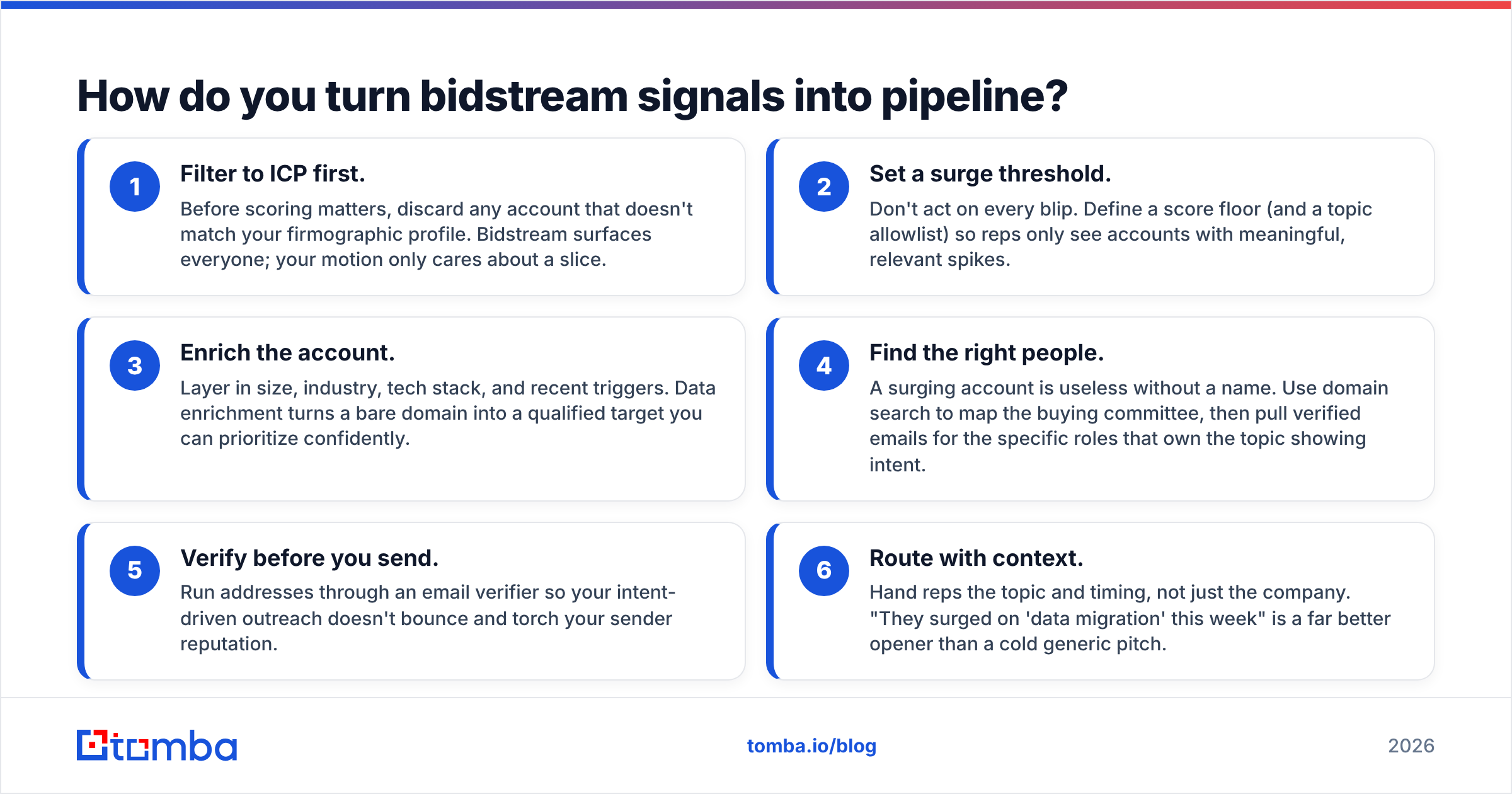
- Filter to ICP first. Before scoring matters, discard any account that doesn't match your firmographic profile. Bidstream surfaces everyone; your motion only cares about a slice.
- Set a surge threshold. Don't act on every blip. Define a score floor (and a topic allowlist) so reps only see accounts with meaningful, relevant spikes.
- Enrich the account. Layer in size, industry, tech stack, and recent triggers. Data enrichment turns a bare domain into a qualified target you can prioritize confidently.
- Find the right people. A surging account is useless without a name. Use domain search to map the buying committee, then pull verified emails for the specific roles that own the topic showing intent.
- Verify before you send. Run addresses through an email verifier so your intent-driven outreach doesn't bounce and torch your sender reputation.
- Route with context. Hand reps the topic and timing, not just the company. "They surged on 'data migration' this week" is a far better opener than a cold generic pitch.
This is the difference between intent data that informs outreach and intent data that just clutters a dashboard. The signal sets the priority; verified contact data makes it executable.
What are the privacy and quality risks to watch?#
Bidstream's biggest strength — that it scoops metadata from across the open web — is also its biggest liability. Three risks deserve a standing place in your evaluation.
- Regulatory exposure. Bidstream data is third-party by nature. As privacy frameworks tighten, the provenance and consent basis of that data matters. Ask vendors precisely where signals come from and how they're processed.
- Decay and coverage gaps. Identifier deprecation means the bidstream gets thinner and patchier. A vendor's coverage today is not a promise about next year. Demand recent coverage stats, not legacy benchmarks.
- Score inflation. Some vendors tune scores to look impressive. Always validate a sample of "high intent" accounts against reality before you wire the feed into routing. If you can't reproduce the surge in your own first-party data, be cautious.
The practical guardrail is to never let bidstream be the only thing standing between a signal and a sales touch. Verified, permissioned contact data and your own engagement history should always sit in the loop. You can compare vendor data practices and reviews on neutral marketplaces like G2 before committing budget.
Which tools fit alongside bidstream intent data?#
Bidstream is a targeting layer. It pairs with two other layers to become a complete motion: an identity/enrichment layer that names the account and people, and an activation layer that does outreach. Where bidstream tells you who might be in-market, tools like website visitor reveal tell you who's already on your own properties, and a contact platform turns both into reachable humans.
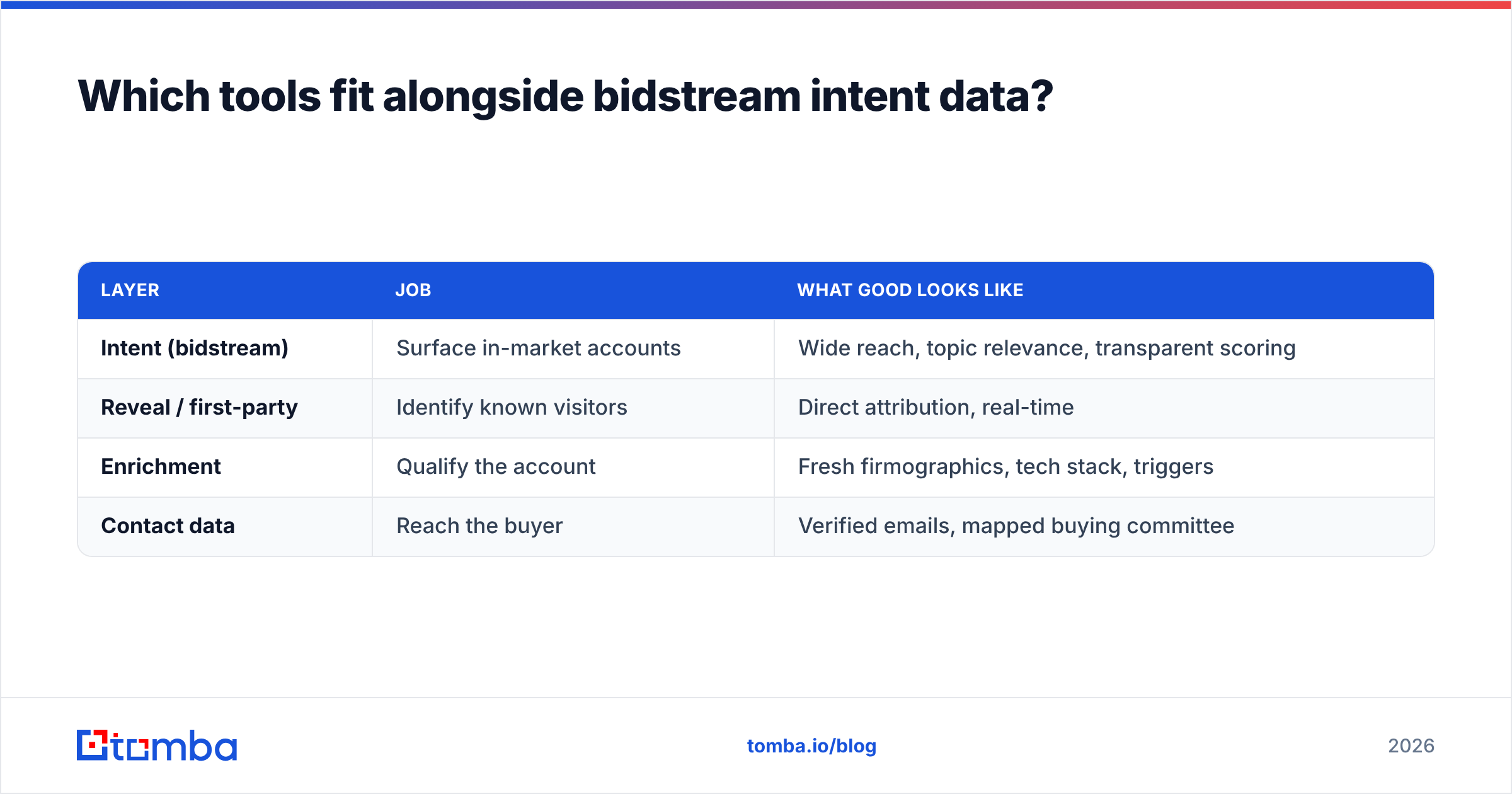
| Layer | Job | What good looks like |
|---|---|---|
| Intent (bidstream) | Surface in-market accounts | Wide reach, topic relevance, transparent scoring |
| Reveal / first-party | Identify known visitors | Direct attribution, real-time |
| Enrichment | Qualify the account | Fresh firmographics, tech stack, triggers |
| Contact data | Reach the buyer | Verified emails, mapped buying committee |
Tomba sits in the identity-and-contact layer of this stack: once a bidstream vendor flags a surging account, you bring it to Tomba to find and verify the people behind it. Transparency on where the data comes from matters as much for contact data as it does for intent — you want sources you can stand behind when a prospect asks how you found them.
Is bidstream intent data worth it for your team?#
Bidstream intent data is worth it if you have the operational maturity to treat it as a prioritization signal and the contact infrastructure to act on it fast. It is not worth it if you'll treat a surge score as proof of intent and blast generic outreach at every flagged domain.
Use it when:
- You run an outbound or ABM motion and need to prioritize a large universe of accounts.
- You already have enrichment and verified-contact workflows in place.
- You can tolerate — and filter — a meaningful amount of false positives.
Skip or delay it when:
- Your total addressable market is small enough to cover exhaustively anyway.
- You lack the data hygiene to verify signals before acting.
- Your first-party and co-op signals already keep reps busy.
The honest framing: bidstream widens the top of your funnel. It does not improve what happens after the click. The teams that win with it are the ones that pair wide signals with sharp, verified execution.
Closing: make every signal reachable#
A surging account you can't contact is a missed quarter. The moment bidstream intent flags an account, the clock starts — and the bottleneck is almost never the signal, it's finding a real, verified person to talk to before the window closes.
That's where Tomba's Email Finder earns its place in your stack. Map the buying committee on any surging domain, pull verified professional emails, and route them to reps the same day — so intent data turns into conversations instead of dashboards. Start free with 25 searches a month, and scale on the Starter plan at $49/mo when the pipeline justifies it. Wide signals, sharp execution: that's how bidstream pays off in 2026.
Ready to find emails that actually work?
Join 150,000+ professionals who stopped guessing and started sending. Free credits on signup — no credit card required.
Get the Tomba newsletter
Practical outbound tactics and product updates — once every two weeks.
About the author