BigDBM vs GetProspect 2026: Which B2B Data Tool Wins?
BigDBM sells raw data licenses; GetProspect finds verified emails by name and domain. Here's which one actually fits your prospecting workflow in 2026 — and a cheaper third option.
Choosing between BigDBM and GetProspect feels harder than it should, because the two tools barely play the same sport. One is a bulk data licensor built for marketers who want millions of records piped into a CRM. The other is a self-serve email finder for SDRs who want the right address for one specific person, right now. Picking by feature checklist alone will burn your budget on data you can't use.
This guide breaks down what each tool actually does, where the accuracy lands, what you'll pay, and which workflow each one is built for — so you stop comparing apples to data warehouses.
TL;DR — BigDBM vs GetProspect in one screen#
- BigDBM is a large-scale B2B and B2C data provider. You license bulk records (firmographics, contacts, intent, consumer data) for enrichment, audience building, and marketing — not single-lead lookups.
- GetProspect is a self-serve email finder and LinkedIn extractor. You search by name, domain, or filters and get verified business emails plus a light CRM.
- Accuracy: GetProspect publishes verification on its finds; BigDBM's quality depends on the segment and how fresh the licensed file is. Always sample before you commit.
- Pricing: GetProspect is transparent and credit-based starting free; BigDBM is custom/quote-based and aimed at higher-volume contracts.
- Best value for most SDR teams: a verified email finder like Tomba — $49/mo, real-time SMTP checks, and no enterprise data contract required.
What is BigDBM?#
BigDBM is a U.S.-focused data provider that licenses large B2B and B2C datasets: business contacts, firmographics, consumer profiles, intent signals, and identity-graph data. Think of it less like a search box and more like a wholesale supplier — you tell them the audience or fields you need, and they deliver a file or an API feed you pipe into your stack.
That model suits performance marketers, data teams, and agencies running large audience-building or enrichment programs. It does not suit a rep who needs one VP of Engineering's email before a 2pm call. The unit of value is the dataset, not the individual lookup, and pricing reflects that.
Where BigDBM shines is breadth and identity resolution across both business and consumer data. Where it strains is self-serve usability: there's no lightweight UI for picking off prospects one at a time, and quality varies by how recently a given segment was refreshed.
What is GetProspect?#
GetProspect is an email-finding tool built for prospecting. You search by person name plus company, by domain, or with filter-based list building, and it returns business email addresses with a verification status. A Chrome extension pulls contacts off LinkedIn search and profiles, and a built-in CRM lets you organize lists without exporting immediately.
The unit of value here is the verified contact. That makes GetProspect a natural fit for SDRs, recruiters, and small sales teams who live in LinkedIn and need addresses fast. It overlaps heavily with tools like a LinkedIn finder and standard domain search workflows.
The trade-off: GetProspect is narrower than BigDBM. It's strong on professional emails and list building, but it isn't a consumer-data warehouse or an intent-signal platform.
How do BigDBM and GetProspect compare at a glance?#
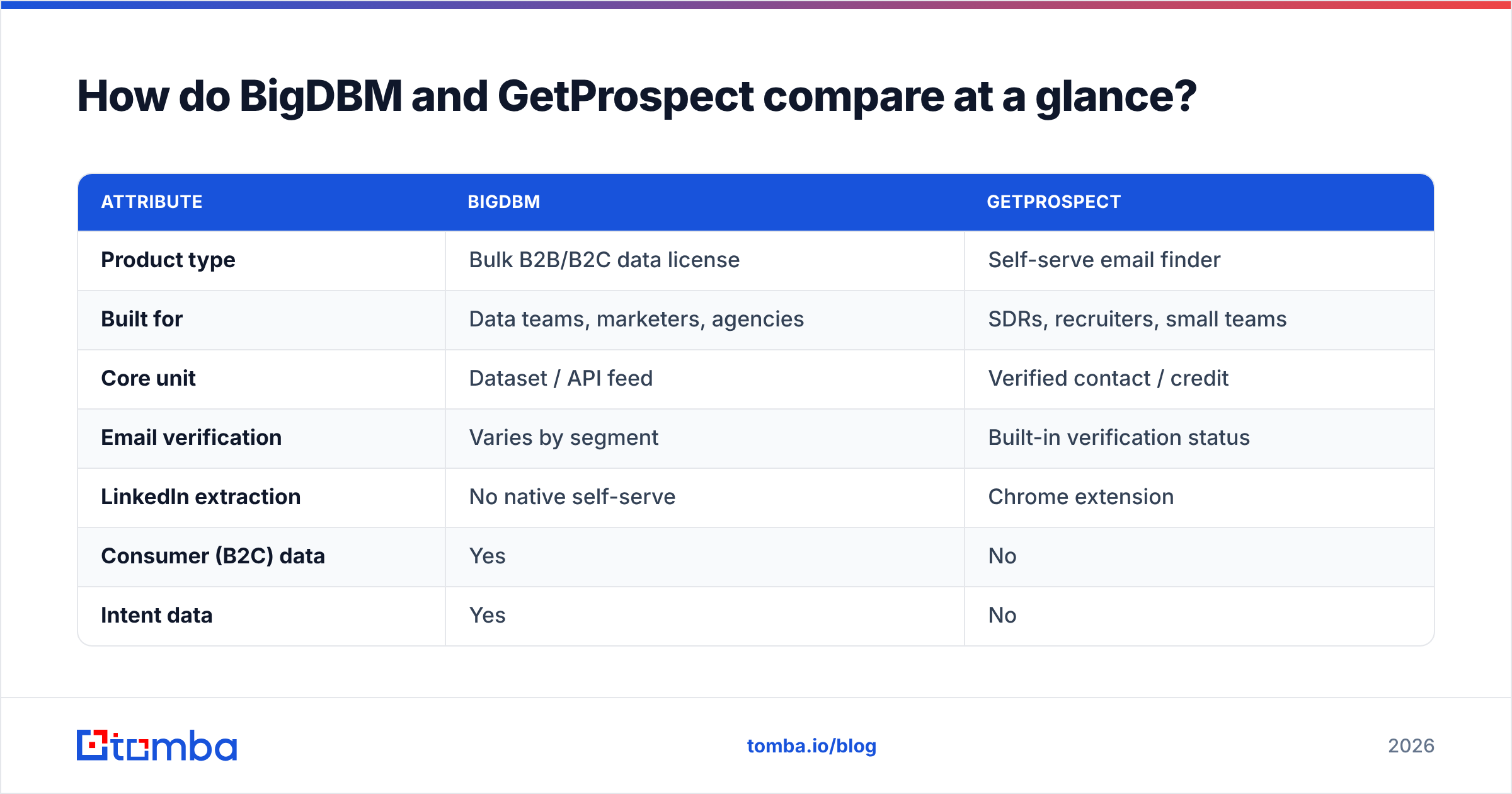
Here's the core split. Read the "Built for" row first — it decides everything else.
| Attribute | BigDBM | GetProspect |
|---|---|---|
| Product type | Bulk B2B/B2C data license | Self-serve email finder |
| Built for | Data teams, marketers, agencies | SDRs, recruiters, small teams |
| Core unit | Dataset / API feed | Verified contact / credit |
| Email verification | Varies by segment | Built-in verification status |
| LinkedIn extraction | No native self-serve | Chrome extension |
| Consumer (B2C) data | Yes | No |
| Intent data | Yes | No |
| Pricing model | Custom quote | Free tier + credit plans |
| Self-serve signup | Limited | Yes |
| Best for single lookups | No | Yes |
Which one is more accurate?#
Accuracy depends on what "a record" means to each tool, so judge them on different terms. GetProspect attaches a verification result to each email it returns, which gives you a per-contact confidence signal you can filter on before you send. BigDBM's accuracy is a property of the licensed file — a freshly refreshed B2B segment can be excellent, while an older consumer slice may carry more decay. The fix in both cases is the same: sample, then verify.
No data vendor — BigDBM, GetProspect, or anyone else — ships 100% clean records. Email decay alone runs roughly 22–30% per year as people change jobs, so even a perfect file rots fast. That's why a separate email verifier step matters regardless of which provider you choose. Run any list through real-time SMTP and catch-all checks before it touches your sending domain.

If your top priority is per-lead accuracy you can trust on send day, a finder with live verification beats a bulk file you have to clean yourself. If your priority is audience scale across millions of records, the bulk file wins — provided you budget for the cleanup.
What does each one cost?#
GetProspect uses transparent, credit-based pricing with a free tier to start, then paid plans that scale by verified-email volume. You can sign up, run a few searches, and know your cost per contact without a sales call.
BigDBM is quote-based. Pricing depends on data volume, fields, refresh cadence, and whether you want a one-time file or an ongoing feed. That's normal for the data-licensing model, but it means slower procurement and a higher floor — this is not a $49 impulse buy.
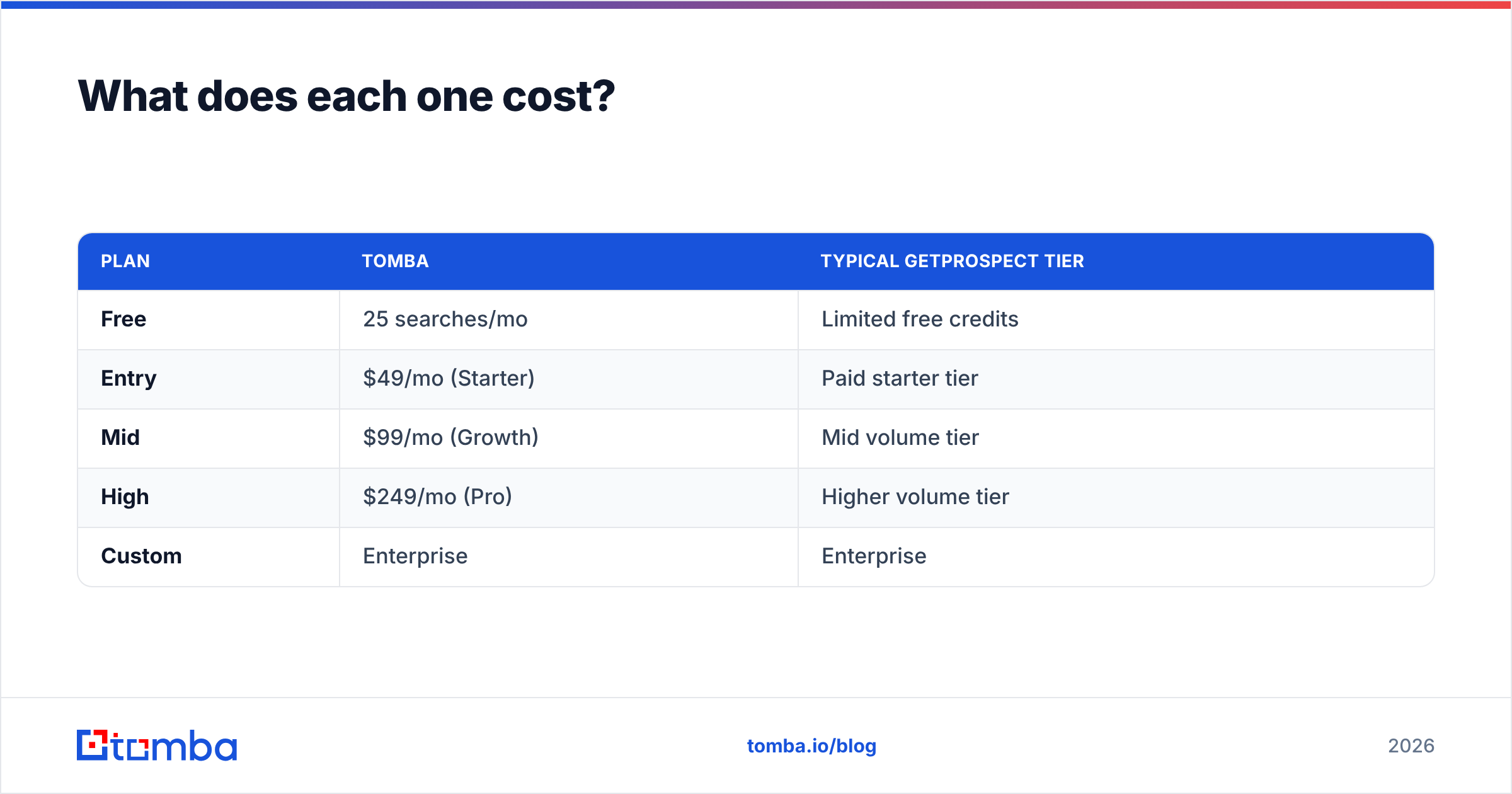
For comparison, here's how a transparent finder like Tomba prices against the GetProspect model, so you can anchor expectations:
| Plan | Tomba | Typical GetProspect tier |
|---|---|---|
| Free | 25 searches/mo | Limited free credits |
| Entry | $49/mo (Starter) | Paid starter tier |
| Mid | $99/mo (Growth) | Mid volume tier |
| High | $249/mo (Pro) | Higher volume tier |
| Custom | Enterprise | Enterprise |
See full Tomba pricing for exact credit counts. The takeaway: for self-serve prospecting, you should expect to pay per-credit transparency, not a custom enterprise contract.
Who should pick BigDBM?#
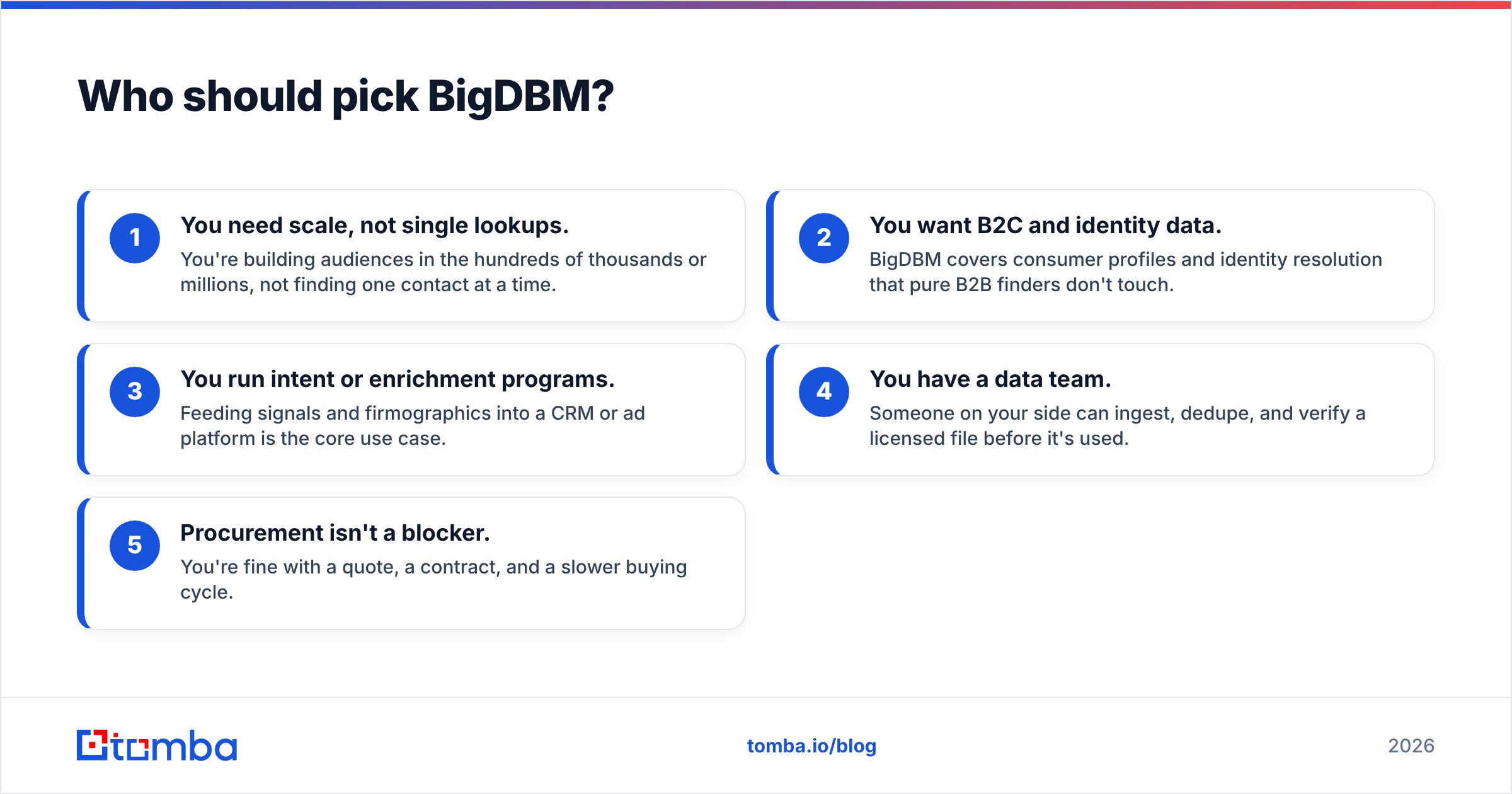
Pick BigDBM if you check most of these boxes:
- You need scale, not single lookups. You're building audiences in the hundreds of thousands or millions, not finding one contact at a time.
- You want B2C and identity data. BigDBM covers consumer profiles and identity resolution that pure B2B finders don't touch.
- You run intent or enrichment programs. Feeding signals and firmographics into a CRM or ad platform is the core use case.
- You have a data team. Someone on your side can ingest, dedupe, and verify a licensed file before it's used.
- Procurement isn't a blocker. You're fine with a quote, a contract, and a slower buying cycle.
If that's you, BigDBM is a serious supplier. If it isn't, you'll pay for a warehouse to find a doorknob.
Who should pick GetProspect?#
Pick GetProspect if you're closer to the front line:
- You prospect on LinkedIn daily. The Chrome extension turns profiles and searches into contacts fast.
- You want self-serve and a free start. No sales call to get going.
- You need verified emails one list at a time. List building with a verification status fits SDR workflows.
- You're a small-to-mid team. You don't have a data engineering function to clean bulk files.
GetProspect is the right shape for most outbound reps. The open question is whether it's the best-value tool in that shape — which brings us to the alternative.
Is there a better-value alternative to both?#
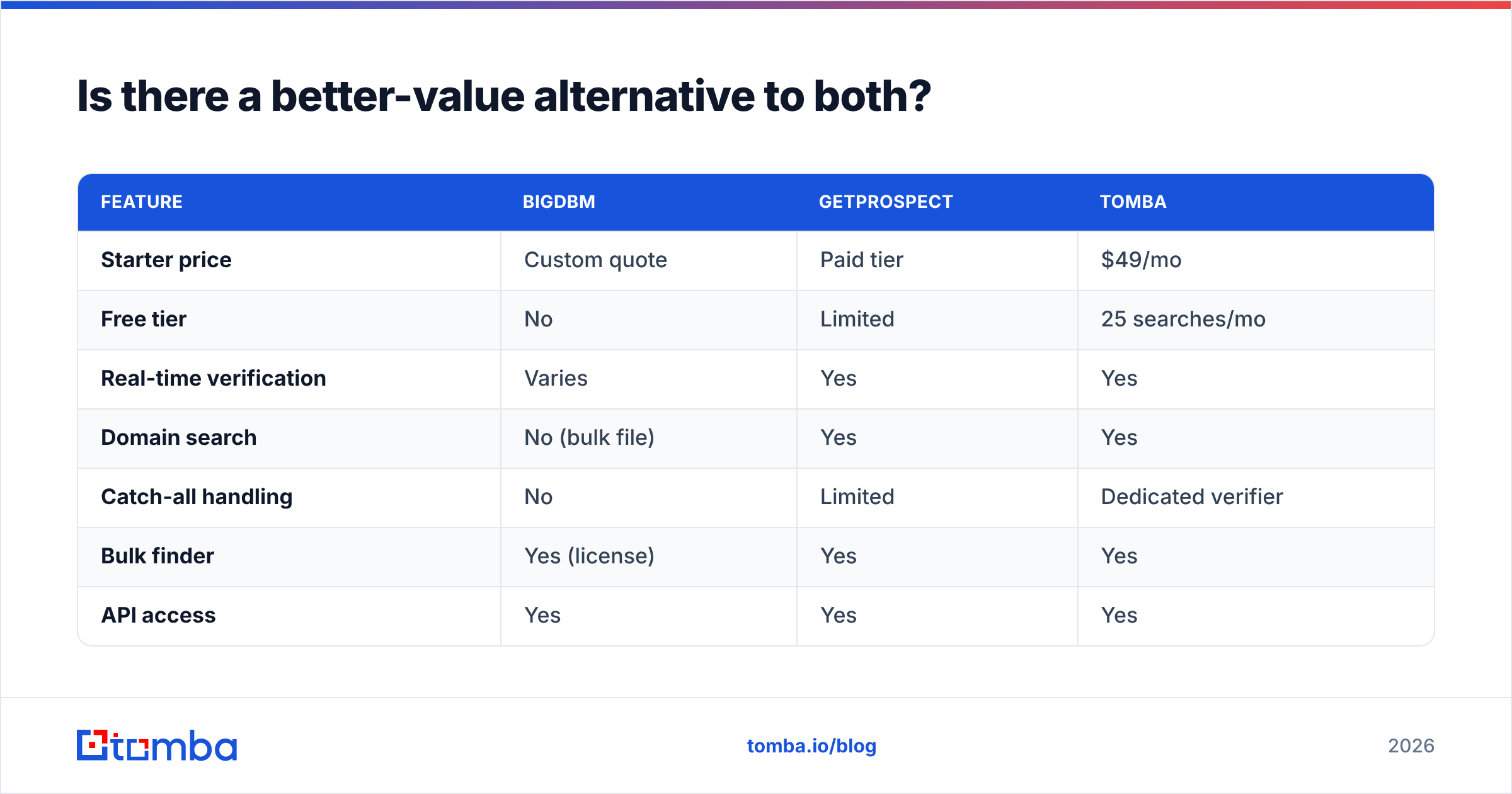
Yes — for most sales teams, a dedicated email finder with built-in verification gives you GetProspect's workflow at a sharper price and accuracy point, without BigDBM's enterprise overhead. That's where Tomba fits.
Tomba is built for exactly the job GetProspect targets — find a professional email by name, company, or domain — but adds real-time SMTP verification, a catch-all verifier for tricky domains, and a bulk email finder for when you do need volume. You get the self-serve speed of a finder and the cleanup of a verifier in one place.
| Feature | BigDBM | GetProspect | Tomba |
|---|---|---|---|
| Starter price | Custom quote | Paid tier | $49/mo |
| Free tier | No | Limited | 25 searches/mo |
| Real-time verification | Varies | Yes | Yes |
| Domain search | No (bulk file) | Yes | Yes |
| Catch-all handling | No | Limited | Dedicated verifier |
| Bulk finder | Yes (license) | Yes | Yes |
| API access | Yes | Yes | Yes |
| Self-serve signup | Limited | Yes | Yes |

If you also need phone numbers, Tomba's phone finder and contact data enrichment round out the stack — so you're not buying a separate consumer-data license just to add a field or two.
How to decide in under five minutes#
Run this quick test against your actual workflow:
- Are you licensing millions of records for marketing or enrichment? Go BigDBM. Budget for a data team and cleanup.
- Are you an SDR finding verified emails off LinkedIn and domains? GetProspect or Tomba — both fit; compare on price-per-verified-contact and accuracy.
- Do you want the finder workflow at the lowest transparent cost with verification baked in? Tomba's free tier lets you benchmark accuracy before paying a cent.
The mistake is buying BigDBM's scale for a job that needs GetProspect's precision, or vice versa. Match the tool to the unit of value — dataset or single verified contact — and the decision makes itself.
The bottom line#
BigDBM and GetProspect aren't really rivals; they're different tools for different jobs. BigDBM is a wholesale data supplier for teams operating at audience scale. GetProspect is a self-serve finder for reps who need verified emails fast. Most outbound teams want the second job done — and want it done cheaply, accurately, and without a procurement cycle.
That's the gap Tomba fills. Start free with the Tomba Email Finder — 25 searches a month, real-time verification, and no contract — then upgrade to the $49/mo Starter plan only once you've seen the accuracy on your own list. Test it against whatever BigDBM or GetProspect quote you're holding, and let the verified results decide.
Ready to find emails that actually work?
Join 150,000+ professionals who stopped guessing and started sending. Free credits on signup — no credit card required.
Get the Tomba newsletter
Practical outbound tactics and product updates — once every two weeks.
About the author