BigDBM vs Tomba 2026: B2B Data Provider vs Email Finder
BigDBM sells bulk identity data; Tomba finds and verifies emails on demand. Here is the honest 2026 breakdown of pricing, accuracy, and which one fits your B2B workflow.
BigDBM vs Tomba: Which B2B Data Tool Should You Actually Buy in 2026?
Short answer up front: BigDBM and Tomba solve different problems. BigDBM is a bulk identity-data and audience licensing provider built for large-scale marketing and data resale. Tomba is an on-demand email finder and verification platform built for sales teams who need accurate, individual contact details right now. If your job is to reach named decision-makers and keep your sender reputation clean, the comparison usually favors Tomba. If you need to license millions of consumer records for ad targeting, BigDBM is in a different lane entirely.
This post breaks down where each tool wins, what they cost, and how to choose without wasting a quarter on the wrong contract.
TL;DR#
- BigDBM = wholesale identity graphs and audience data (consumer + B2B), priced for bulk licensing and enterprise data deals.
- Tomba = self-serve email finder, verifier, and enrichment with transparent plans from a free tier to $249/mo, plus an API.
- Accuracy model differs: BigDBM ships large datasets you must clean; Tomba verifies each email at lookup time so you send to fewer bounces.
- Best fit: Pick BigDBM for data resale or programmatic audiences. Pick Tomba for targeted outbound, recruiting, and CRM enrichment.
- Price-to-value: For most SDR and growth teams, Tomba's per-contact accuracy and pay-as-you-grow plans cost far less than a bulk data license.
What is BigDBM?#
BigDBM is a US-focused data provider that aggregates large identity datasets — consumer demographics, B2B firmographics, intent signals, and contact records — and licenses them in bulk. Its core customers are marketing agencies, data platforms, and enterprises building audiences for advertising, direct mail, or identity resolution.
The model is wholesale. You typically negotiate a license, receive large files or API access to a database, and then handle matching, cleaning, and suppression on your side. That works well when you need volume and you have a data team to process it. It works poorly when you need ten verified emails for a specific account before Friday.
What is Tomba?#
Tomba is a B2B email finder and verification platform. You give it a name and a company domain (or just a domain), and it returns the professional email address with a confidence score, source citations, and a real-time verification result. Around that core sit an email verifier, domain search, catch-all detection, a phone finder, bulk processing, and data enrichment.
The model is precision on demand. Instead of buying a haystack and searching it, you ask for the needle and Tomba checks it is real before handing it over. That is the difference that protects your email deliverability and keeps bounce rates low.

How do BigDBM and Tomba compare at a glance?#
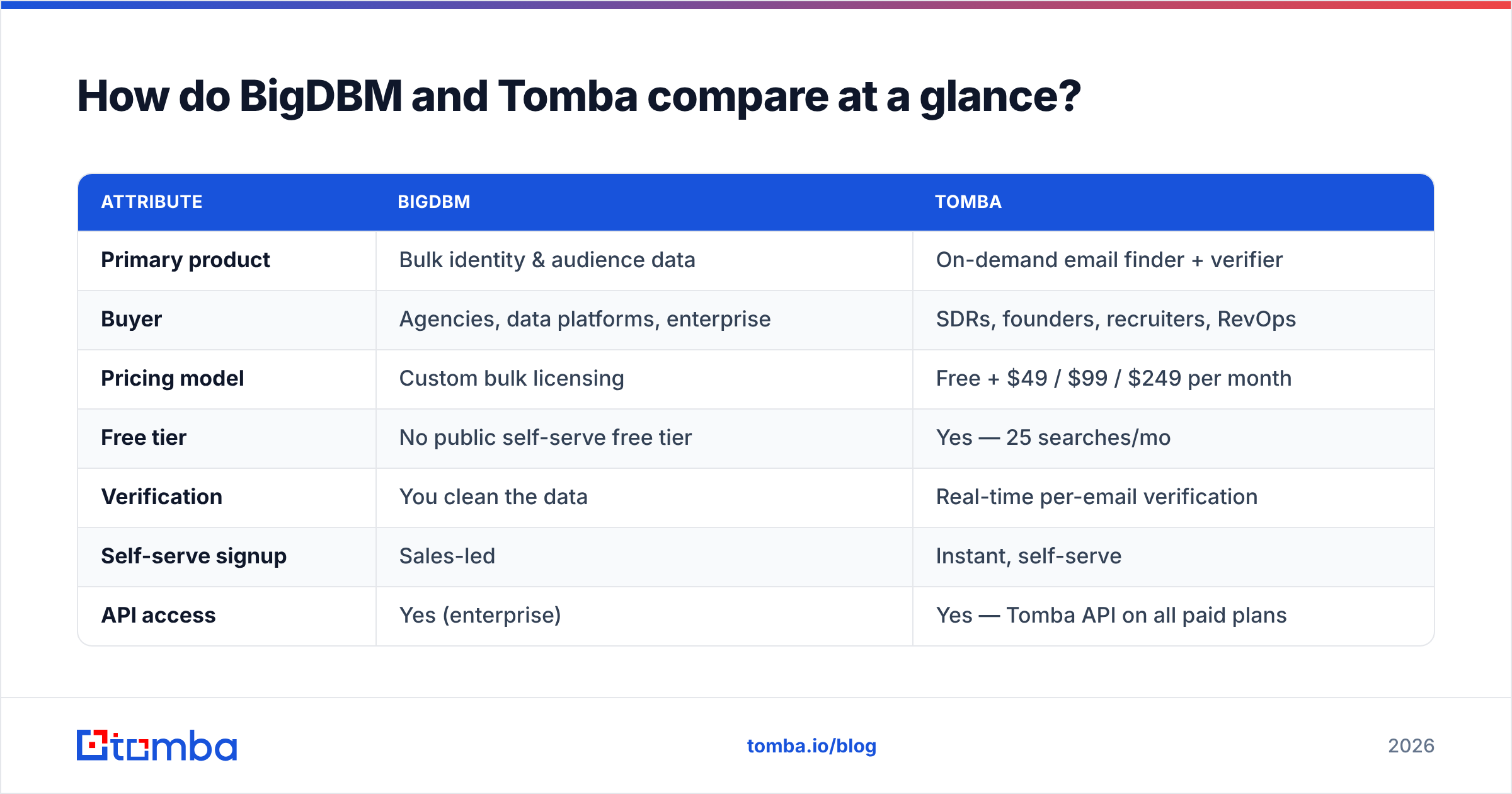
Here is the core-concept breakdown most buyers care about. Note these are two different categories of product, so "winner" depends on your job to be done.
| Attribute | BigDBM | Tomba |
|---|---|---|
| Primary product | Bulk identity & audience data | On-demand email finder + verifier |
| Buyer | Agencies, data platforms, enterprise | SDRs, founders, recruiters, RevOps |
| Pricing model | Custom bulk licensing | Free + $49 / $99 / $249 per month |
| Free tier | No public self-serve free tier | Yes — 25 searches/mo |
| Verification | You clean the data | Real-time per-email verification |
| Self-serve signup | Sales-led | Instant, self-serve |
| API access | Yes (enterprise) | Yes — Tomba API on all paid plans |
| Best for | Audience targeting, data resale | Targeted outbound & CRM enrichment |
The pattern is clear: BigDBM optimizes for scale and licensing; Tomba optimizes for accuracy per contact and time-to-value.
Is BigDBM more accurate than Tomba?#
It depends on what "accurate" means to you, and the two tools measure it differently.
- Coverage vs verification. BigDBM's strength is breadth — huge record counts across consumers and businesses. But a record existing is not the same as it being deliverable today. Bulk files decay; people change jobs roughly every two to three years.
- Point-in-time checking. Tomba verifies each address when you request it, running SMTP and pattern checks so you learn the email is valid now, not when the dataset was last refreshed. You can read how Tomba sources and scores data on its data sources page.
- Catch-all handling. Many corporate domains accept everything. Tomba's catch-all verifier flags these so you do not treat a guess as a confirmed hit — a nuance raw bulk data rarely surfaces.
- Bounce cost. Sending to a stale bulk list damages sender reputation. One bad campaign can suppress every future email, which is why per-send verification usually beats raw volume for outbound teams.
If your use case is programmatic advertising, a slightly stale record still matches a cookie or hashed identifier — BigDBM is fine. If your use case is a human reading a cold email, verification wins.
How does pricing compare?#
This is where the two diverge most. BigDBM is quote-based: you talk to sales, scope volume and fields, and sign a licensing agreement. That makes sense for six- and seven-figure data programs, but it means no instant trial and a slow start.
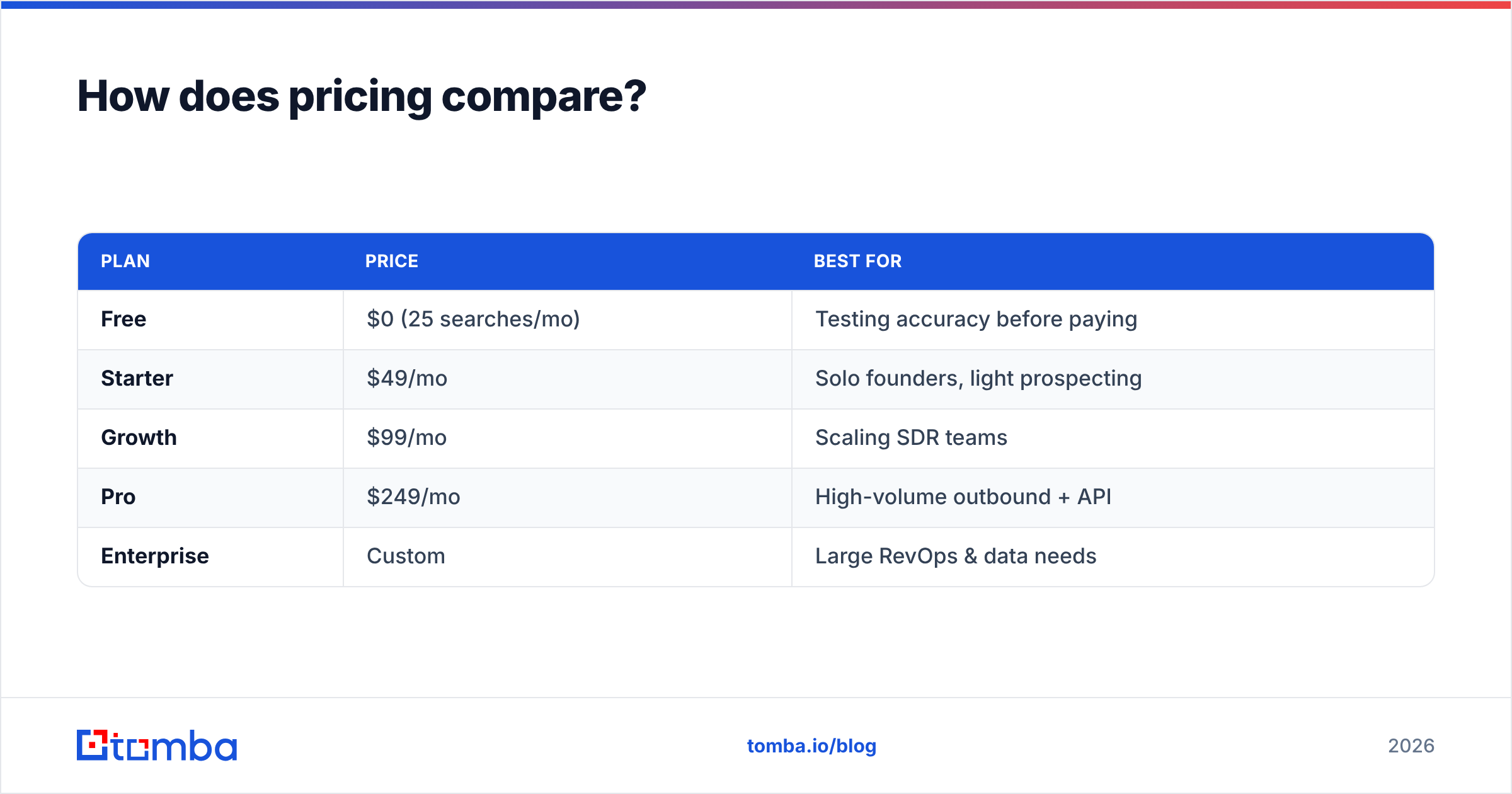
Tomba is transparent and self-serve. Full Tomba pricing looks like this:
| Plan | Price | Best for |
|---|---|---|
| Free | $0 (25 searches/mo) | Testing accuracy before paying |
| Starter | $49/mo | Solo founders, light prospecting |
| Growth | $99/mo | Scaling SDR teams |
| Pro | $249/mo | High-volume outbound + API |
| Enterprise | Custom | Large RevOps & data needs |
For a team running targeted outbound, the math is straightforward: a $99/mo Growth plan that returns verified contacts almost always beats paying for bulk records you then have to scrub. You can also start on the free tier and validate accuracy on your own domains before spending a dollar — something a sales-led data license cannot offer.
Which use cases fit BigDBM vs Tomba?#
Choose BigDBM when:
- You build advertising audiences and need household or consumer-level identity data.
- You resell or syndicate data and need licensing terms for redistribution.
- You run identity resolution at scale and have engineers to match and clean files.
- Your volume is in the millions of records, not hundreds of contacts.
Choose Tomba when:
- You run cold outbound and need verified, individual B2B emails. Compare cold tactics in our Apollo alternative breakdown.
- You enrich CRM records and want clean data flowing into HubSpot or Salesforce via integrations.
- You recruit and need to reach named candidates by domain or LinkedIn with the LinkedIn finder.
- You want to start today, self-serve, with a free tier and a real API.
A useful way to think about it: BigDBM is a wholesaler; Tomba is a precision tool. You do not send a freight train to pick up one parcel.
Can you use both together?#
Yes, and some data-heavy teams do. A common pattern: license broad firmographic or intent data from a wholesale provider to identify accounts, then use Tomba to find and verify the exact person you want to contact at each account. The wholesale layer answers "which companies," and Tomba answers "which inbox, and is it deliverable."
If you go this route, push raw lists through Tomba's bulk email finder and verifier before any send. That single step strips dead addresses, flags catch-alls, and protects the deliverability you are paying to build. You can also enrich the surviving records with phone numbers and social profiles so reps have more than one channel.
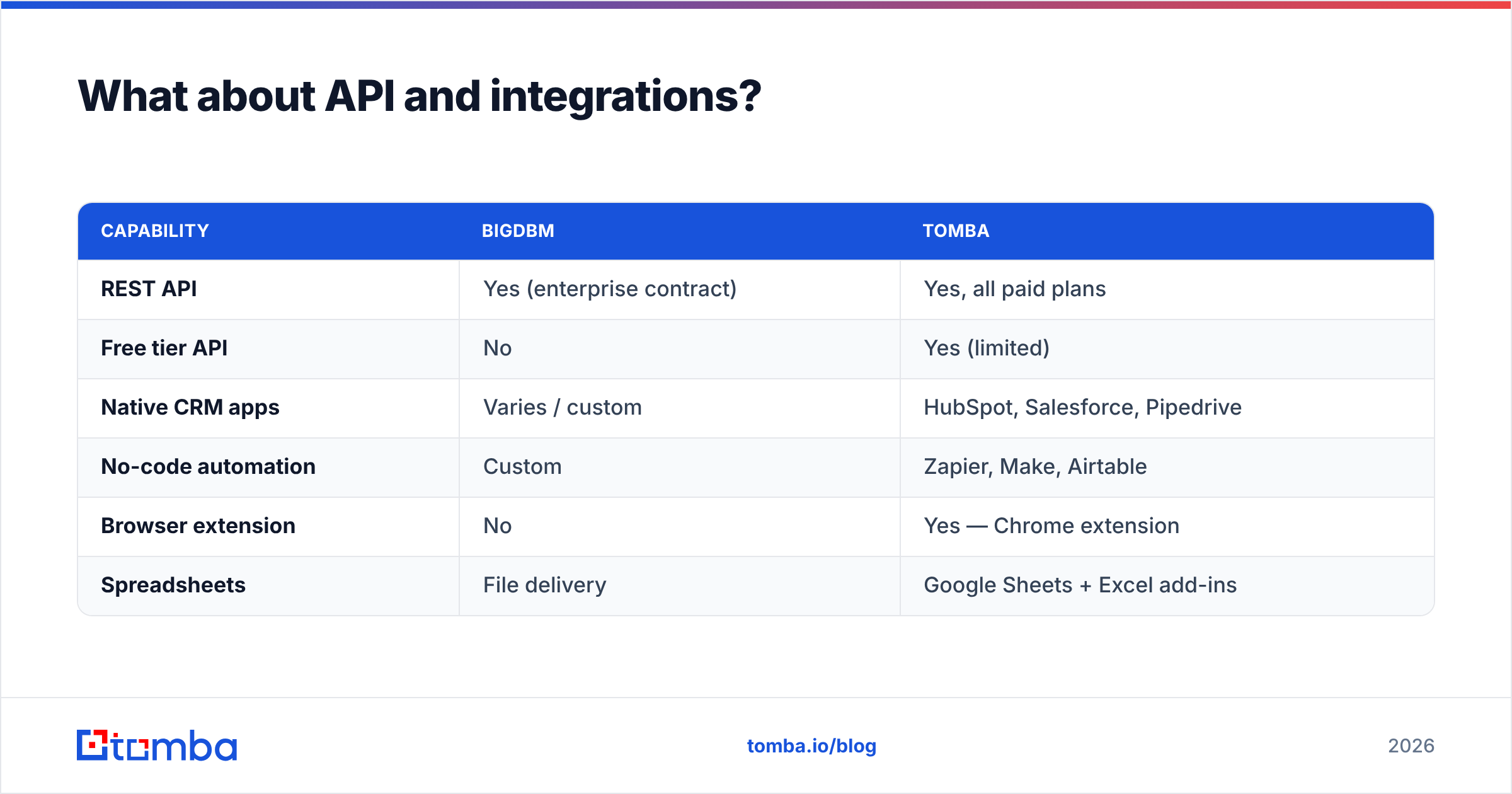
What about API and integrations?#
Both offer programmatic access, but the experience differs.
| Capability | BigDBM | Tomba |
|---|---|---|
| REST API | Yes (enterprise contract) | Yes, all paid plans |
| Free tier API | No | Yes (limited) |
| Native CRM apps | Varies / custom | HubSpot, Salesforce, Pipedrive |
| No-code automation | Custom | Zapier, Make, Airtable |
| Browser extension | No | Yes — Chrome extension |
| Spreadsheets | File delivery | Google Sheets + Excel add-ins |
Tomba is built for builders who want to wire email finding into existing tools quickly — the Tomba API, CLI, and prebuilt connectors mean you can go from idea to enriched pipeline in an afternoon. BigDBM's API is powerful but assumes an enterprise integration project.
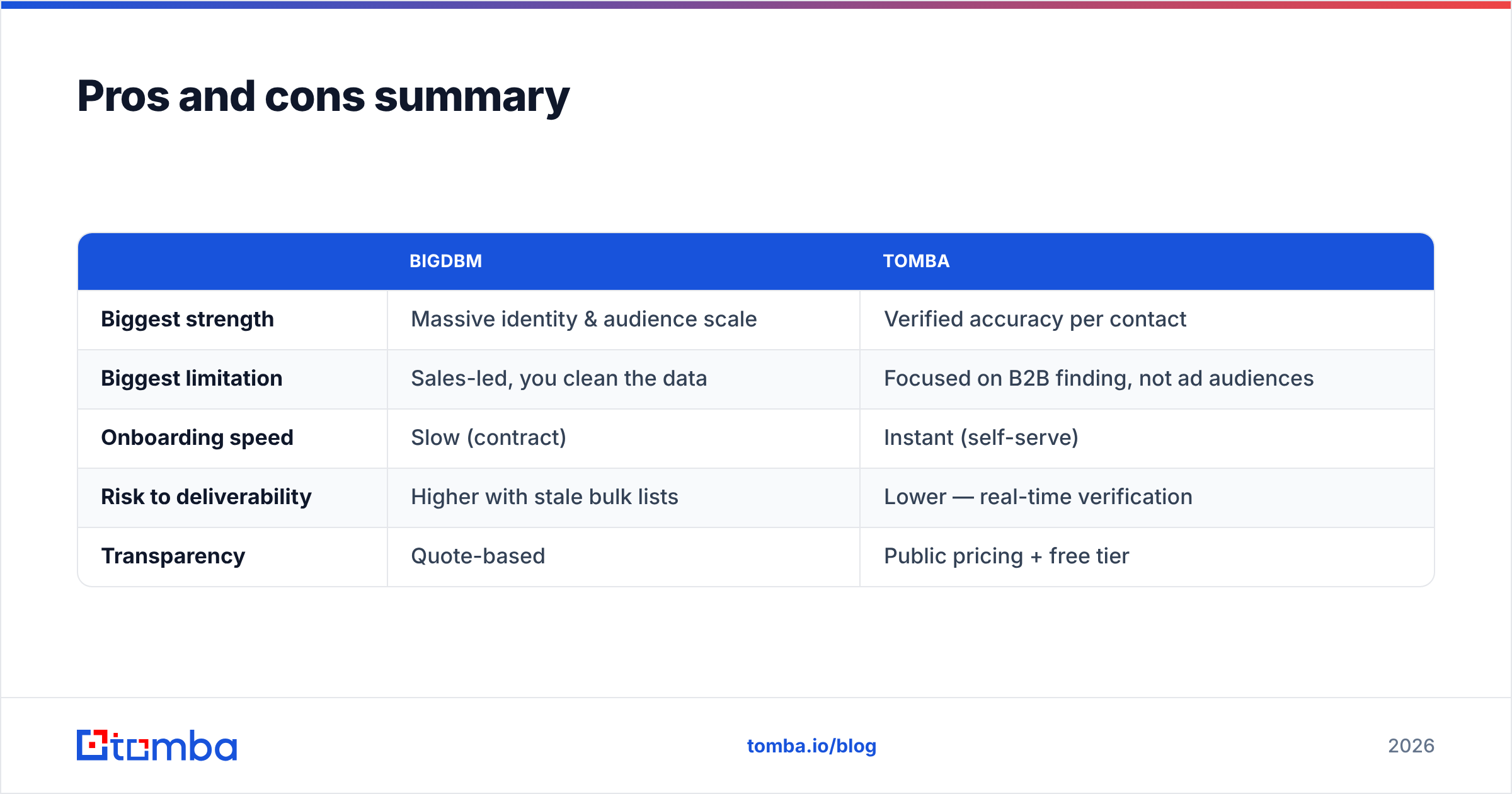
Pros and cons summary#
| BigDBM | Tomba | |
|---|---|---|
| Biggest strength | Massive identity & audience scale | Verified accuracy per contact |
| Biggest limitation | Sales-led, you clean the data | Focused on B2B finding, not ad audiences |
| Onboarding speed | Slow (contract) | Instant (self-serve) |
| Risk to deliverability | Higher with stale bulk lists | Lower — real-time verification |
| Transparency | Quote-based | Public pricing + free tier |
So, BigDBM or Tomba?#
Pick the tool that matches your job. If you are licensing audiences for advertising or building an identity product, BigDBM's scale is the right kind of expensive. If you are a sales, growth, or recruiting team that needs accurate, deliverable emails for named people — and you want to start free and scale predictably — Tomba is the better-fit, lower-risk choice for 2026.
For independent context on either vendor, check verified reviews on G2 and Capterra, and read up on how identity resolution works on Wikipedia before signing any bulk-data agreement.
Ready to find emails you can actually send to?#
Stop paying to clean data after the fact. With the Tomba Email Finder you get the right professional email, a confidence score, and real-time verification in one step — starting on a free tier with 25 searches a month, no contract required. Run your toughest target accounts through it, watch the bounce rate, and let the accuracy decide. When you are ready to scale, the $49/mo Starter and $99/mo Growth plans grow with your pipeline, and the API plugs straight into your CRM. Try it free, then upgrade only when the results have already paid for it.
// get started
Find, verify and enrich your first contacts today
Start on the free plan with 25 searches a month, then scale when your team is ready.
Free plan · No credit card required · GDPR & CCPA
// about the author