BigDBM vs Warpleads 2026: Which B2B Lead Data Wins?
BigDBM vs Warpleads compared on data coverage, pricing, accuracy, and export limits — plus where a verification layer like Tomba changes the math in 2026.
BigDBM vs Warpleads: The 2026 B2B Lead Data Showdown
You are choosing between two very different ways to fill your pipeline. BigDBM sells access to a massive licensed identity-and-intent dataset built for enrichment and audience building. Warpleads sells a fast, export-first lead engine built for cold-email operators who want volume without a per-credit meter. Picking wrong costs you either money or deliverability.
TL;DR — BigDBM vs Warpleads in 30 seconds#
- BigDBM is a data provider: deep B2B and B2C identity graphs, intent signals, and API-first enrichment. Best when you need licensed data feeding a CRM, model, or ad platform.
- Warpleads is a lead export tool: unlimited exports on higher tiers, a built-in B2B database, and a workflow aimed squarely at cold-email senders who want volume.
- Pricing model is the real divide: BigDBM tends toward custom/enterprise contracts and per-record economics; Warpleads leans on flat subscriptions with unlimited or high-cap exports.
- Neither replaces verification. Both ship raw records. Run every list through an email verifier before you send, or your bounce rate decides your fate.
- Best combo for most teams: pull data from whichever fits your motion, then enrich and validate with a dedicated layer like Tomba before it touches your sequencer.
What is BigDBM?#
BigDBM is a US-focused data provider built around a large consumer and business identity graph. Think of it less like a "find this person's email" button and more like a data warehouse you rent: emails, phone numbers, demographic attributes, property data, and intent signals, delivered through APIs, file feeds, or platform integrations.
The audience is enrichment-heavy: RevOps teams hydrating a CRM, performance marketers building lookalike audiences, and data teams scoring leads. BigDBM's pitch is depth and coverage at scale, with licensing and compliance positioning aimed at larger buyers. If your problem is "I have 200,000 partial records and need them filled in," that is BigDBM's home turf.
What it is not is a turnkey cold-email cockpit. You do not log in to write sequences. You consume the data and pipe it into your own stack — which is exactly why teams pair it with a clean data enrichment and validation step before activation.
What is Warpleads?#
Warpleads is an export-first lead generation platform aimed at cold outreach operators. Its headline feature is unlimited (or very high-cap) lead exports on paid tiers, plus a B2B database you can filter and pull from without watching a credit counter tick down on every record.
The mental model: Warpleads is a vending machine for lists. You filter by role, industry, geography, and company attributes, then export in bulk into your sequencer. For agencies and high-volume senders who burn through thousands of contacts a month, the flat-rate, unlimited framing is the entire appeal — predictable cost regardless of volume.
The trade-off with any high-volume, export-everything model is freshness and precision. When the incentive is "export as much as possible," the burden of quality control shifts to you. That makes a downstream bulk verify pass non-negotiable, not optional.
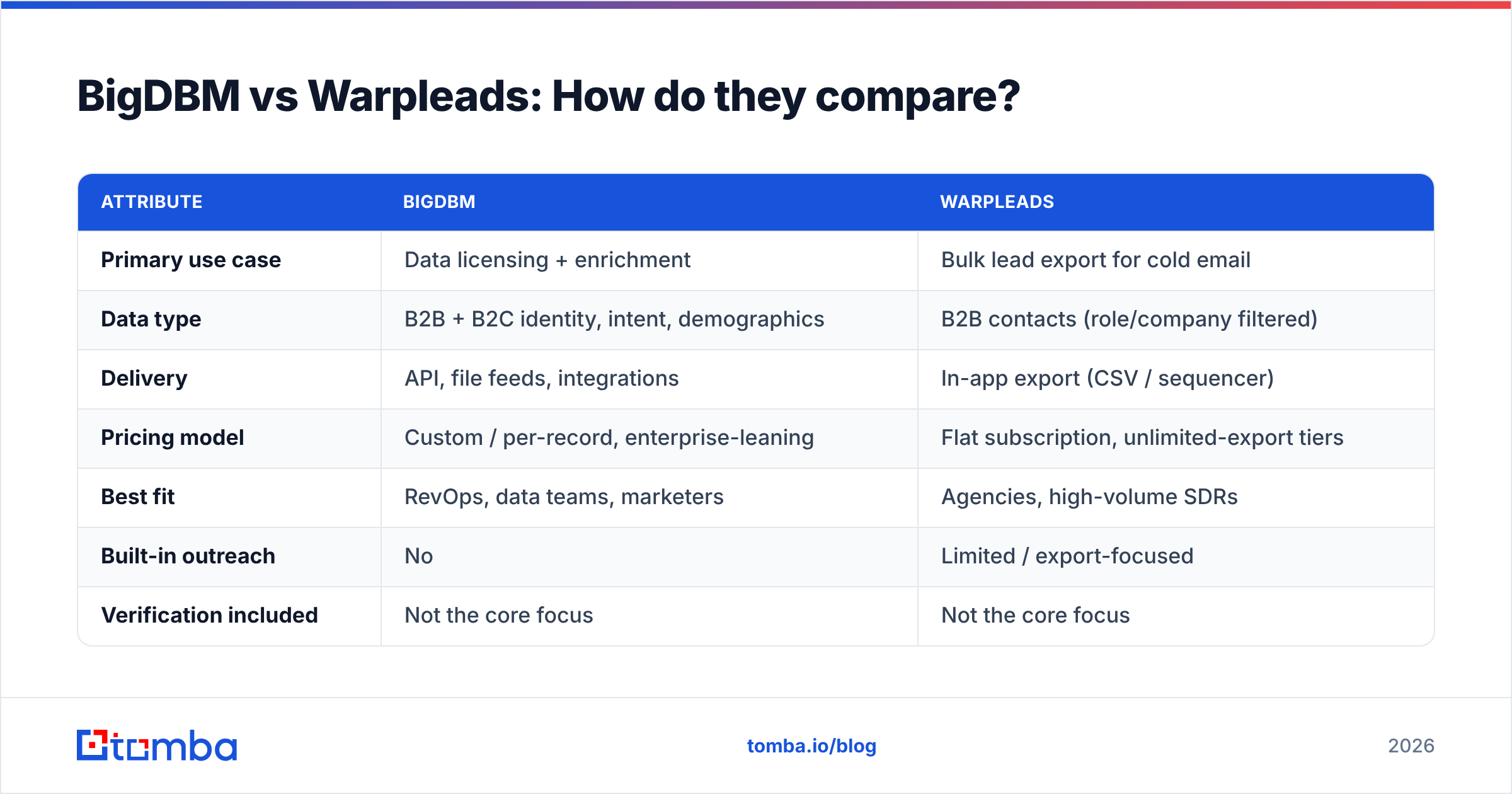
BigDBM vs Warpleads: How do they compare?#
Here is the side-by-side on the attributes that actually change your decision.
| Attribute | BigDBM | Warpleads |
|---|---|---|
| Primary use case | Data licensing + enrichment | Bulk lead export for cold email |
| Data type | B2B + B2C identity, intent, demographics | B2B contacts (role/company filtered) |
| Delivery | API, file feeds, integrations | In-app export (CSV / sequencer) |
| Pricing model | Custom / per-record, enterprise-leaning | Flat subscription, unlimited-export tiers |
| Best fit | RevOps, data teams, marketers | Agencies, high-volume SDRs |
| Built-in outreach | No | Limited / export-focused |
| Verification included | Not the core focus | Not the core focus |
| Learning curve | Higher (technical) | Lower (UI-driven) |
The pattern is clear: these tools rarely compete for the same buyer. BigDBM wins when data depth and licensing matter more than convenience. Warpleads wins when predictable, high-volume export is the whole job.
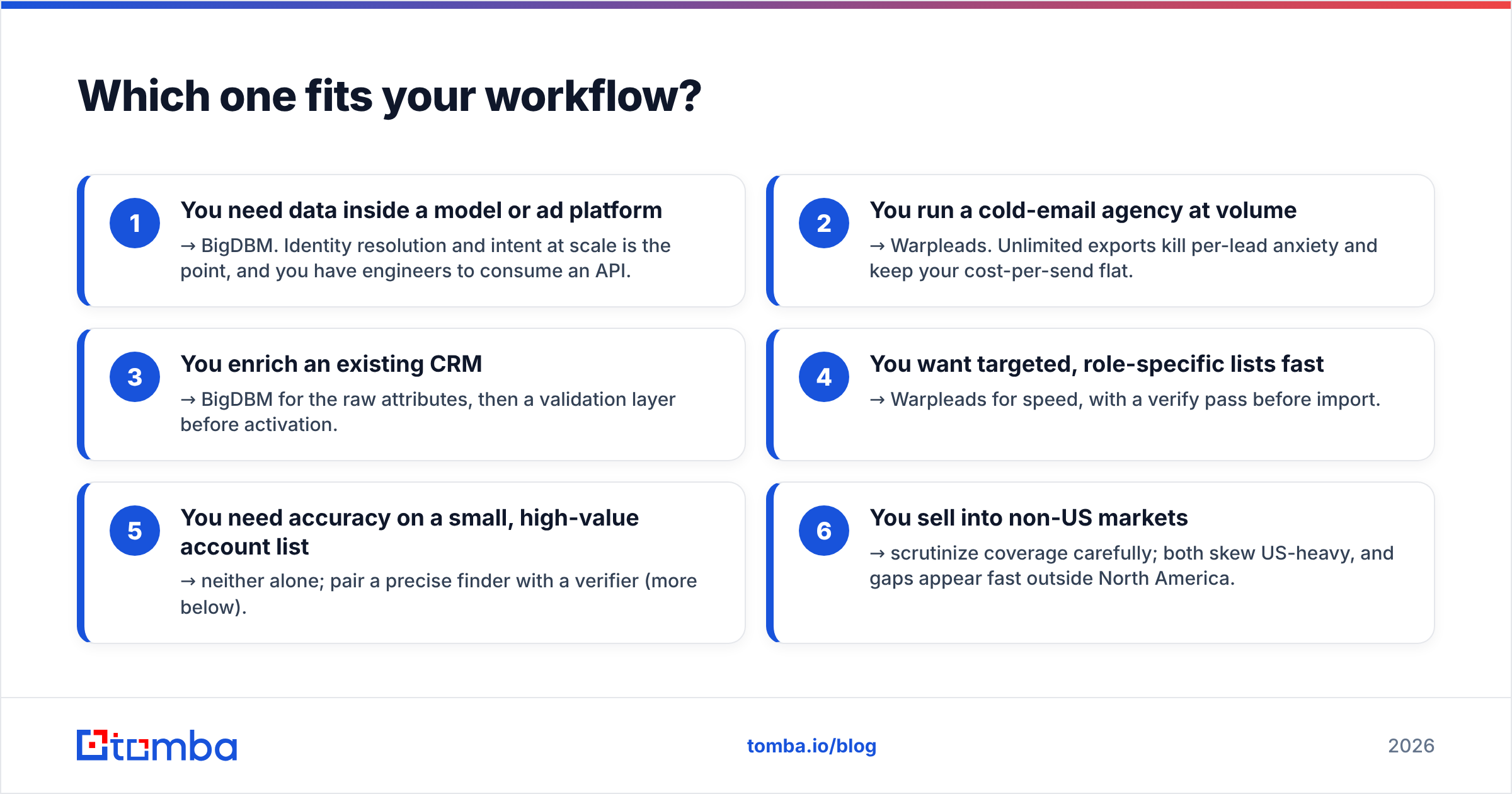
Which one fits your workflow?#
Match the tool to your motion, not the other way around. Use this checklist to self-diagnose in under a minute:
- You need data inside a model or ad platform → BigDBM. Identity resolution and intent at scale is the point, and you have engineers to consume an API.
- You run a cold-email agency at volume → Warpleads. Unlimited exports kill per-lead anxiety and keep your cost-per-send flat.
- You enrich an existing CRM → BigDBM for the raw attributes, then a validation layer before activation.
- You want targeted, role-specific lists fast → Warpleads for speed, with a verify pass before import.
- You need accuracy on a small, high-value account list → neither alone; pair a precise finder with a verifier (more below).
- You sell into non-US markets → scrutinize coverage carefully; both skew US-heavy, and gaps appear fast outside North America.
If two or more of those describe you, that is normal — most teams run a hybrid stack. The mistake is assuming one vendor solves sourcing and quality.
How accurate is the data — and why does verification matter?#
Raw lead data decays whether you bought it from BigDBM, Warpleads, or anyone else. B2B contact data goes stale at roughly 25–30% per year as people change jobs — a figure consistently cited across data-quality research, including work referenced by Gartner. A list that was 95% accurate in January is materially worse by Q4.
That decay is exactly why the "unlimited export" pitch can be a trap. Volume without validation just means you bounce faster and at greater scale. Mailbox providers read bounces and spam complaints as reputation signals, and once your sender reputation drops, even your perfect emails land in spam.
The fix is a verification step that sits between your data source and your sequencer. A good verifier checks syntax, domain, MX records, and SMTP acceptance, and flags catch-all domains so you know which addresses are genuinely risky. Tomba's catch-all verifier handles the trickiest segment — domains that accept everything and tell you nothing — which is where most "verified" lists quietly fail.
Independent reviews on platforms like G2 consistently show that the providers buyers rate highest are the ones with transparent, testable accuracy — not the ones with the biggest raw counts.
Where does Tomba fit between BigDBM and Warpleads?#
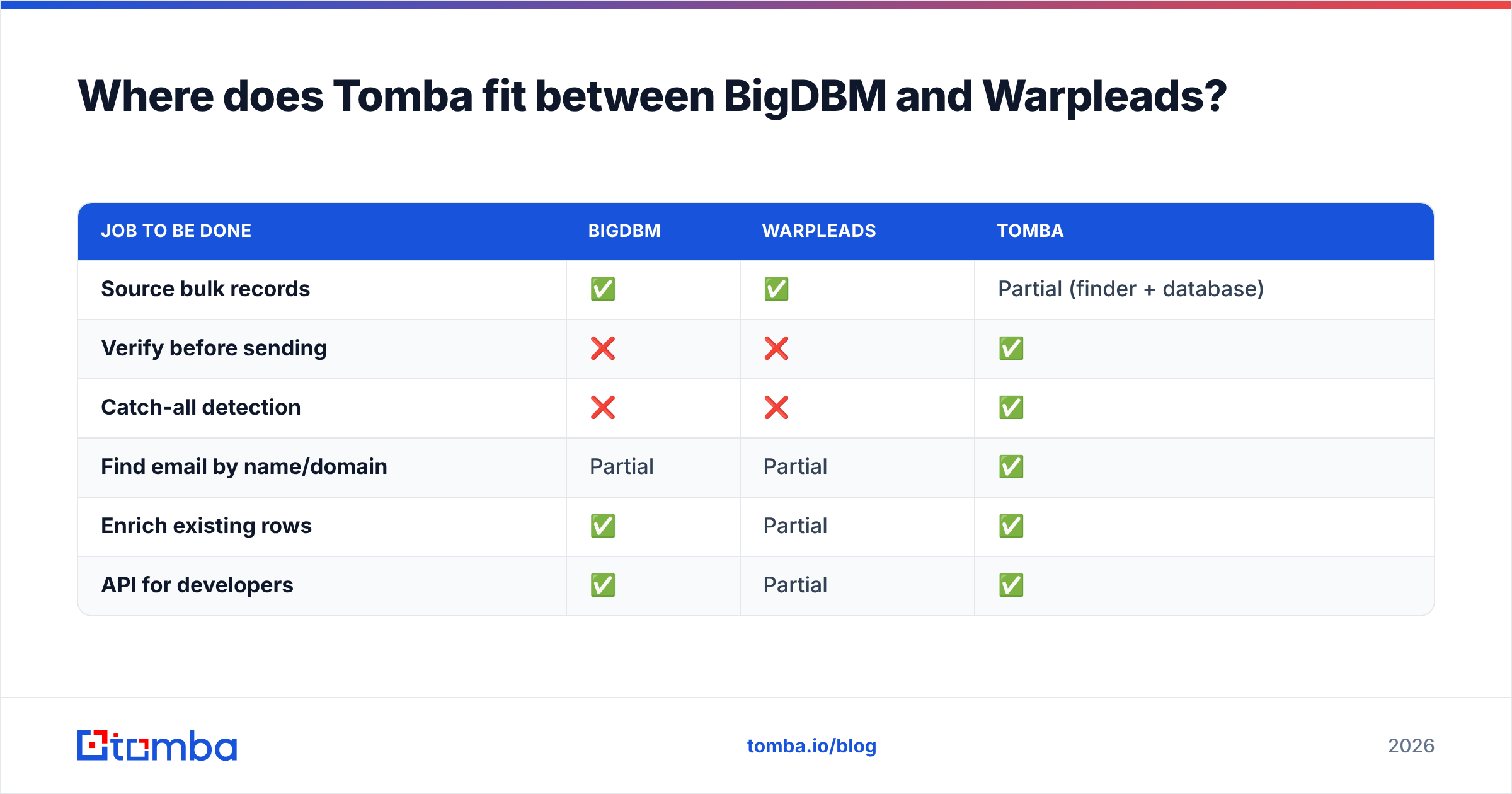
Tomba is the quality layer neither tool prioritizes. BigDBM and Warpleads answer "where do I get records?" Tomba answers "are these records real, current, and safe to send?"
Here is how the roles split across a realistic stack:
| Job to be done | BigDBM | Warpleads | Tomba |
|---|---|---|---|
| Source bulk records | ✅ | ✅ | Partial (finder + database) |
| Verify before sending | ❌ | ❌ | ✅ |
| Catch-all detection | ❌ | ❌ | ✅ |
| Find email by name/domain | Partial | Partial | ✅ |
| Enrich existing rows | ✅ | Partial | ✅ |
| API for developers | ✅ | Partial | ✅ |
Concretely, three patterns work well:
- Source then validate: export from Warpleads, run the list through Tomba's bulk email finder and verifier, drop the risky records, sequence the rest.
- Enrich then validate: license attributes from BigDBM, fill missing emails with domain search, then verify every address.
- Precision-first: for high-value target accounts, skip the bulk dump entirely and use the Tomba Email Finder to build a small, surgically accurate list.
The Tomba API makes all three programmatic, so verification becomes a pipeline step instead of a manual chore.
How much do they cost?#
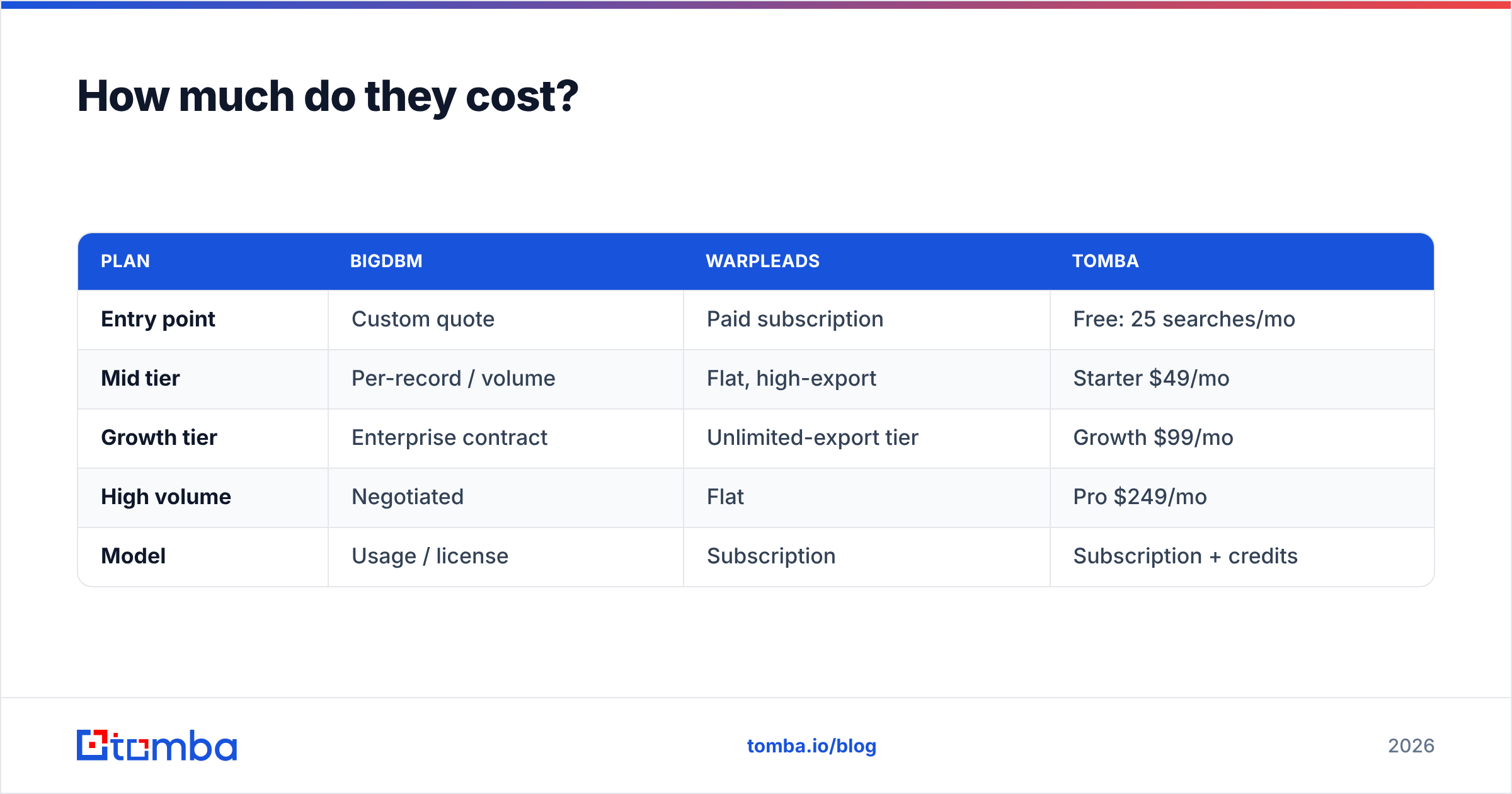
Pricing is where the two tools diverge most, and where Tomba's published, predictable tiers make budgeting simple.
| Plan | BigDBM | Warpleads | Tomba |
|---|---|---|---|
| Entry point | Custom quote | Paid subscription | Free: 25 searches/mo |
| Mid tier | Per-record / volume | Flat, high-export | Starter $49/mo |
| Growth tier | Enterprise contract | Unlimited-export tier | Growth $99/mo |
| High volume | Negotiated | Flat | Pro $249/mo |
| Model | Usage / license | Subscription | Subscription + credits |
BigDBM's enterprise-leaning model means you talk to sales and negotiate — fine for large buyers, friction for small teams. Warpleads' flat unlimited framing is attractive for agencies but shifts quality cost onto you. Tomba's pricing sits in the middle: a real free tier to test, then transparent monthly plans. Always confirm current numbers on each vendor's own site before committing — these models change.
Is BigDBM or Warpleads better for cold email specifically?#
For pure cold-email volume, Warpleads is the more natural fit — its entire design assumes you are exporting lists into a sequencer. BigDBM can absolutely feed a cold-email program, but you are building more of the plumbing yourself.
That said, "better for cold email" is the wrong frame if you stop at sourcing. The winner in cold email is decided by deliverability, not list size. A 5,000-contact Warpleads export with a 12% bounce rate will underperform a 1,500-contact verified list every time. Before any list goes live, pressure-test it: validate addresses, remove catch-alls and duplicates, and confirm your domain's SPF record and authentication are clean.
So the honest answer: Warpleads gets you raw volume faster, BigDBM gets you richer attributes, and a verification layer decides whether either one actually converts.
The verdict: BigDBM vs Warpleads in 2026#
There is no universal winner — there is a winner for your motion.
- Choose BigDBM if you are a data-mature team that needs licensed identity and intent data piped into a CRM, model, or ad platform, and you have the technical resources to consume it.
- Choose Warpleads if you are a high-volume cold-email operator or agency that values flat, predictable export costs over per-record precision.
- Choose neither alone for accuracy-critical outreach. Both are sourcing tools, not quality tools.
The teams that win in 2026 treat data sourcing and data quality as two separate purchases. Source from whichever provider fits your volume and budget, then make verification a hard gate before anything reaches your sequencer.
Start with the layer that protects your sender reputation: use the Tomba Email Finder to build precise lists and verify the ones you import from BigDBM or Warpleads. The free tier gives you 25 searches a month to test it against your current data — run a sample list through it and compare the bounce rate before you commit your domain to a big send. Your inbox placement, and your pipeline, will thank you.
Ready to find emails that actually work?
Join 150,000+ professionals who stopped guessing and started sending. Free credits on signup — no credit card required.
Get the Tomba newsletter
Practical outbound tactics and product updates — once every two weeks.
About the author