7 Best Biglittle AI Alternatives for Visitor Data in 2026
Biglittle AI promises to turn anonymous traffic into pipeline, but it is not the only option. Compare 7 Biglittle AI alternatives on data, pricing, and fit.

Biglittle AI sells a simple promise: turn the strangers hitting your website into named accounts and contacts you can actually sell to. It is a real category, and the pitch lands. But the moment you start pricing it against your goals, the same question shows up that hits every visitor-identification tool: is the data good enough, and am I paying for the right layer of the stack?
This guide breaks down the seven strongest Biglittle AI alternatives for 2026, what each one is actually good at, and where a focused contact-data tool beats an all-in-one platform.
TL;DR#
- Biglittle AI is a website visitor de-anonymization and personalization tool — strong on intent, weaker as a standalone contact database.
- The best biglittle ai alternatives split into three buckets: visitor-reveal platforms, full prospecting suites, and precise contact-data engines.
- If your bottleneck is identifying anonymous traffic, look at reveal-first tools. If it is reaching people accurately, a dedicated finder wins.
- Pricing ranges from free tiers to $1,000+/mo enterprise contracts — match the tool to the layer you are missing, not to the longest feature list.
- Tomba is the most cost-efficient pick when you need verified emails and enrichment to act on the accounts you already identified.
What is Biglittle AI and what does it actually do?#
Biglittle AI is a website visitor identification platform. It drops a script on your site, matches anonymous sessions against its identity graph, and tells you which companies — and sometimes which people — were browsing. From there it layers on personalization and intent signals so sales and marketing can prioritize warm accounts.
Think of it like a security camera for your website that also runs facial recognition. Plain analytics tells you "200 people visited pricing." A reveal tool tells you "Acme Corp's VP of Ops visited pricing three times this week." That second sentence is what teams pay for.
The catch is that visitor identification is only step one. Once you know who showed up, you still need accurate contact details, verified emails, and enrichment to do anything about it. That is where many teams discover they need a second tool — and where the alternatives below diverge sharply.
)
Why look for a Biglittle AI alternative?#
A few recurring reasons push teams to shop around:
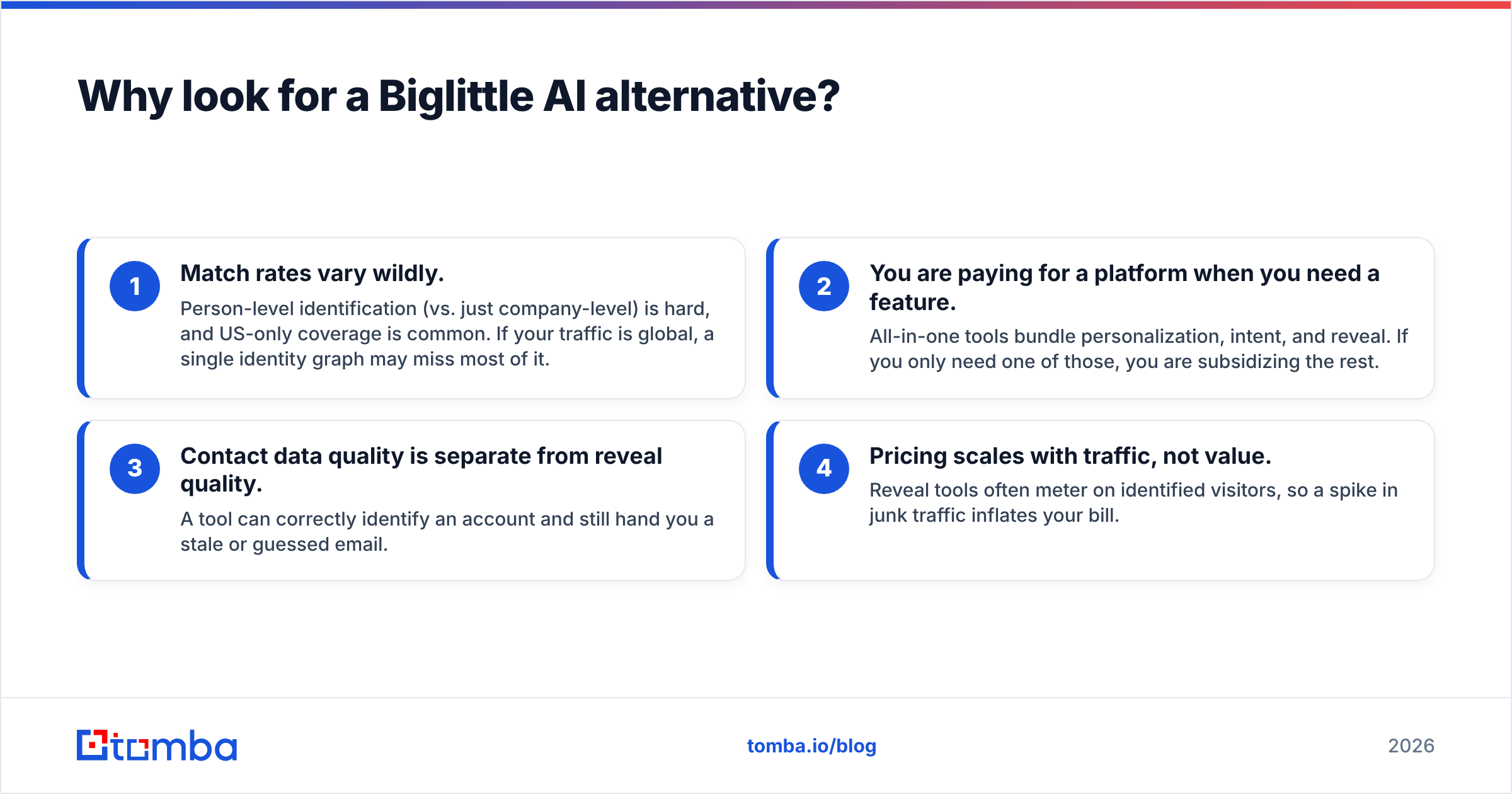
- Match rates vary wildly. Person-level identification (vs. just company-level) is hard, and US-only coverage is common. If your traffic is global, a single identity graph may miss most of it.
- You are paying for a platform when you need a feature. All-in-one tools bundle personalization, intent, and reveal. If you only need one of those, you are subsidizing the rest.
- Contact data quality is separate from reveal quality. A tool can correctly identify an account and still hand you a stale or guessed email.
- Pricing scales with traffic, not value. Reveal tools often meter on identified visitors, so a spike in junk traffic inflates your bill.
The fix is not always "find a cheaper Biglittle." Often it is decoupling the identify layer from the reach layer so each is best-in-class.
What are the best Biglittle AI alternatives in 2026?#
Here is the head-to-head. "Primary job" is the layer each tool is genuinely best at — not every checkbox on its marketing site.
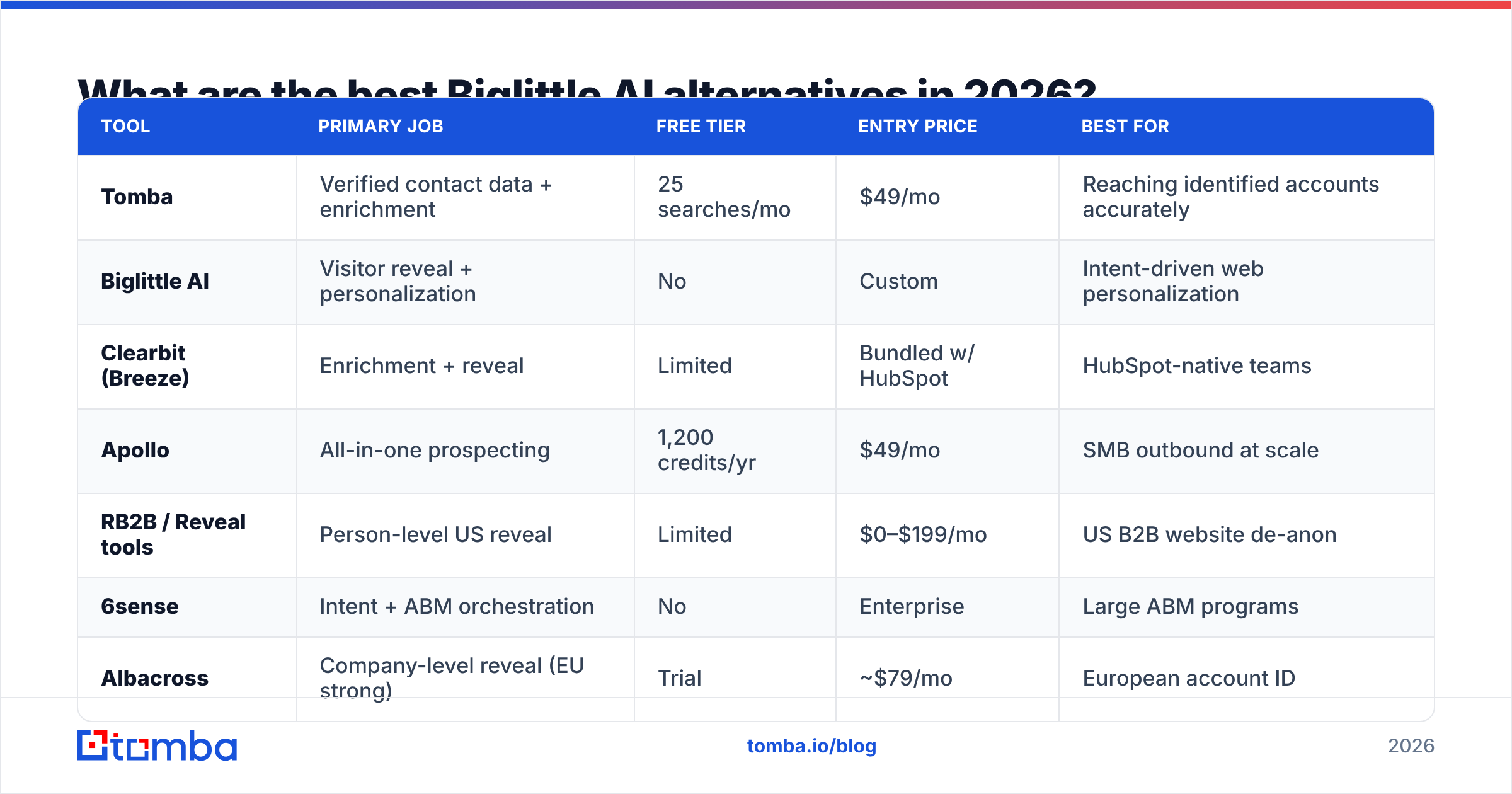
| Tool | Primary job | Free tier | Entry price | Best for |
|---|---|---|---|---|
| Tomba | Verified contact data + enrichment | 25 searches/mo | $49/mo | Reaching identified accounts accurately |
| Biglittle AI | Visitor reveal + personalization | No | Custom | Intent-driven web personalization |
| Clearbit (Breeze) | Enrichment + reveal | Limited | Bundled w/ HubSpot | HubSpot-native teams |
| Apollo | All-in-one prospecting | 1,200 credits/yr | $49/mo | SMB outbound at scale |
| RB2B / Reveal tools | Person-level US reveal | Limited | $0–$199/mo | US B2B website de-anon |
| 6sense | Intent + ABM orchestration | No | Enterprise | Large ABM programs |
| Albacross | Company-level reveal (EU strong) | Trial | ~$79/mo | European account ID |
A quick read of the table: no single tool wins every column. The decision comes down to which layer is your actual constraint.
How does Tomba compare for contact data?#
Tomba is not a visitor-reveal tool, and pretending otherwise would be dishonest. What it does is the step after reveal: taking a company or a name and returning a verified, deliverable email — plus phone and enrichment data. Once Biglittle (or any reveal tool) tells you Acme Corp is in-market, Tomba's email finder and domain search turn that account into reachable people.
Pricing is transparent and starts at a free tier of 25 searches, then $49/mo Starter, $99/mo Growth, $249/mo Pro, and custom Enterprise. For teams whose real gap is "we know the accounts but our emails bounce," this is the layer to fix first.
How does Clearbit (Breeze Intelligence) compare?#
Clearbit, now folded into HubSpot as Breeze Intelligence, is the enrichment-plus-reveal incumbent. If you live in HubSpot, the native data flowing into your CRM is hard to beat for convenience. The trade-off is lock-in and pricing that assumes you are already a HubSpot customer. Outside that ecosystem, it is less compelling than a standalone tool. You can read HubSpot's own breakdown of how the data products fit together.
How does Apollo compare?#
Apollo is the Swiss-army-knife answer. It bundles a B2B database, sequences, a dialer, and basic enrichment for $49/mo at entry. For SMB teams that want one login for everything, it is a reasonable default. The downside is depth — database accuracy and deliverability features are "good enough" rather than best-in-class, and credits get consumed fast. If you specifically want an Apollo alternative focused on data accuracy rather than breadth, a dedicated finder is the move.
How do dedicated reveal tools (RB2B, Albacross) compare?#
These are the closest functional matches to Biglittle's reveal layer. RB2B-style tools specialize in person-level US identification and push alerts into Slack. Albacross leans company-level with stronger European coverage. If pure de-anonymization is what you came for, these are the apples-to-apples swaps. Just remember they hand you an identity, not necessarily a verified inbox — you will still want a data enrichment step downstream.
How does 6sense compare?#
6sense is the enterprise ABM heavyweight. Intent data, predictive scoring, and orchestration across the funnel. It is powerful and priced accordingly — this is a six-figure-program tool, not a quick swap for a mid-market team. Browse verified reviews on G2 before committing; the gap between "demo" and "daily reality" is wide in this category.
Which Biglittle AI alternative is right for you?#
Match the tool to your actual constraint, not the flashiest feature:
- "I can't tell who visits my site." → A reveal-first tool: Biglittle, RB2B-style platforms, or Albacross for EU traffic.
- "I know the accounts but my outreach bounces." → A contact-data engine like Tomba. Identification without deliverability is a dead end.
- "I want one tool for everything and I'm SMB." → Apollo or a similar suite.
- "I run a large ABM motion." → 6sense or Demandbase.
- "I'm all-in on HubSpot." → Clearbit/Breeze for native enrichment.
Most high-performing teams end up with two tools, not one: a reveal layer to surface intent and a precise data layer to act on it. That combination beats any single all-in-one on both accuracy and cost.
)
How do you verify the data before you trust it?#
Whichever alternative you pick, run a small test batch before signing an annual contract. The reveal claim and the data claim are separate, and both need proof.
A practical 5-step check:
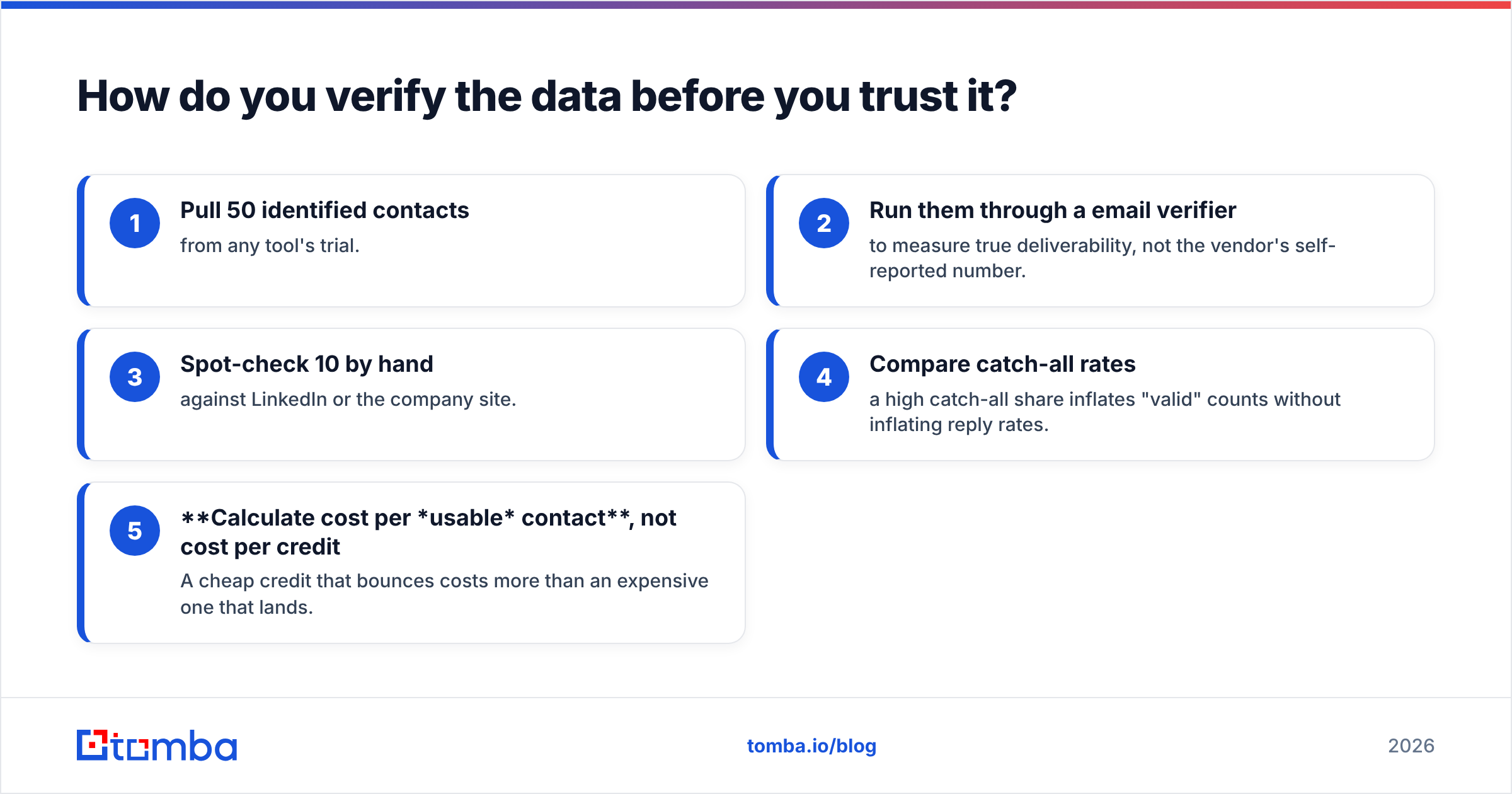
- Pull 50 identified contacts from any tool's trial.
- Run them through a email verifier to measure true deliverability, not the vendor's self-reported number.
- Spot-check 10 by hand against LinkedIn or the company site.
- Compare catch-all rates — a high catch-all share inflates "valid" counts without inflating reply rates.
- Calculate cost per usable contact, not cost per credit. A cheap credit that bounces costs more than an expensive one that lands.
This is also the honest way to compare Biglittle against any challenger: the marketing match rate rarely survives a verification pass. Tools that publish their data sources openly tend to hold up better under this test than black-box identity graphs.
What does a smart 2026 stack actually look like?#
The strongest setups treat visitor identification and contact data as separate, swappable parts:
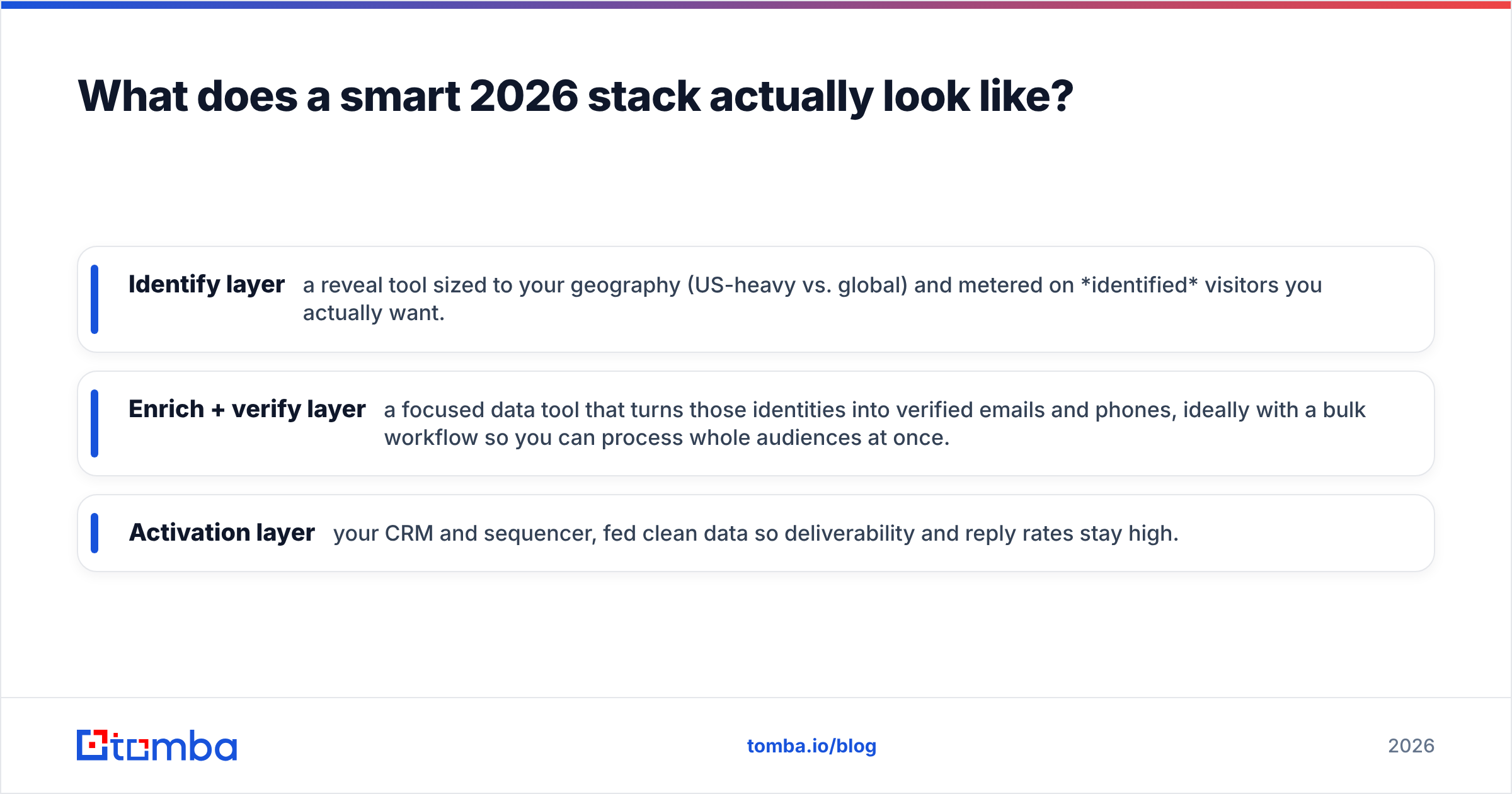
- Identify layer — a reveal tool sized to your geography (US-heavy vs. global) and metered on identified visitors you actually want.
- Enrich + verify layer — a focused data tool that turns those identities into verified emails and phones, ideally with a bulk workflow so you can process whole audiences at once.
- Activation layer — your CRM and sequencer, fed clean data so deliverability and reply rates stay high.
Decoupling these means you can upgrade one without ripping out the others. If a better reveal tool ships next quarter, you swap it in without losing your verified-data engine. That modularity is the real argument against monolithic, do-everything platforms like Biglittle AI — and it is why the "alternative" you need is often a complement, not a replacement.
The bottom line#
Biglittle AI is a legitimate visitor-identification tool, and for intent-driven personalization it earns its spot. But "best Biglittle AI alternative" usually means one of two things: a sharper reveal tool for your specific geography, or — more often — the missing data layer that makes any reveal worth acting on.
If your real gap is reaching the accounts you already surface, start with verified contact data. Tomba's Email Finder turns a company or a name into a deliverable, verified email — with a free tier of 25 searches to test it, then plans from $49/mo. Identify with whatever reveal tool fits your traffic, then let Tomba make sure the emails you send actually land. That is the combination that turns anonymous visitors into booked meetings.
// get started
Find, verify and enrich your first contacts today
Start on the free plan with 25 searches a month, then scale when your team is ready.
Free plan · No credit card required · GDPR & CCPA
// about the author