Biscred Pricing, Reviews, Pros and Cons: 2026 Buyer Guide
A neutral 2026 breakdown of Biscred pricing, real user reviews, and the honest pros and cons — plus where a general B2B data tool fits better.
This is a neutral look at Biscred pricing reviews pros and cons for 2026. We cover real cost ranges, honest user feedback, and where a broader B2B tool fits better.
TL;DR
- Biscred is a niche B2B data platform for commercial real estate (CRE). It serves brokers, lenders, owners, and proptech sellers — not general prospecting.
- Pricing is quote-based. There is no public self-serve tier. Most reviews put annual deals in the four- to five-figure range, based on seats and credits.
- Strengths: deep CRE firmographics, role tagging, and verified contacts in a niche most databases cover poorly.
- Weaknesses: opaque pricing, annual lock-in, limited value outside CRE, and contact caps that frustrate high-output teams.
- If your outbound spans many industries, a flexible email finder with clear pricing often wins on cost per lead.
What is Biscred and who is it for?#
Biscred is a commercial real estate data platform. It does not try to index every company on earth. Instead, it picks one vertical and goes deep: office, industrial, retail, and multifamily. It also maps the people who buy, sell, finance, and service those assets. If you sell to CRE brokers, REITs, lenders, property managers, or proptech buyers, Biscred covers that world well.
Think of it like a specialty climbing shop versus a big-box hardware store. The big store carries a little of everything. The specialty shop stocks exactly what one community needs, with staff who know the gear. Biscred is the specialty shop for CRE contact data. That focus is both its biggest strength and its biggest limit.
The core value is simple. It links firmographic data (company type, asset class, deal activity) with verified people data (titles, roles, emails, phones). A rep can filter to acquisitions directors at multifamily owners in the Southeast. Most general tools fumble that kind of query.
How much does Biscred cost in 2026?#
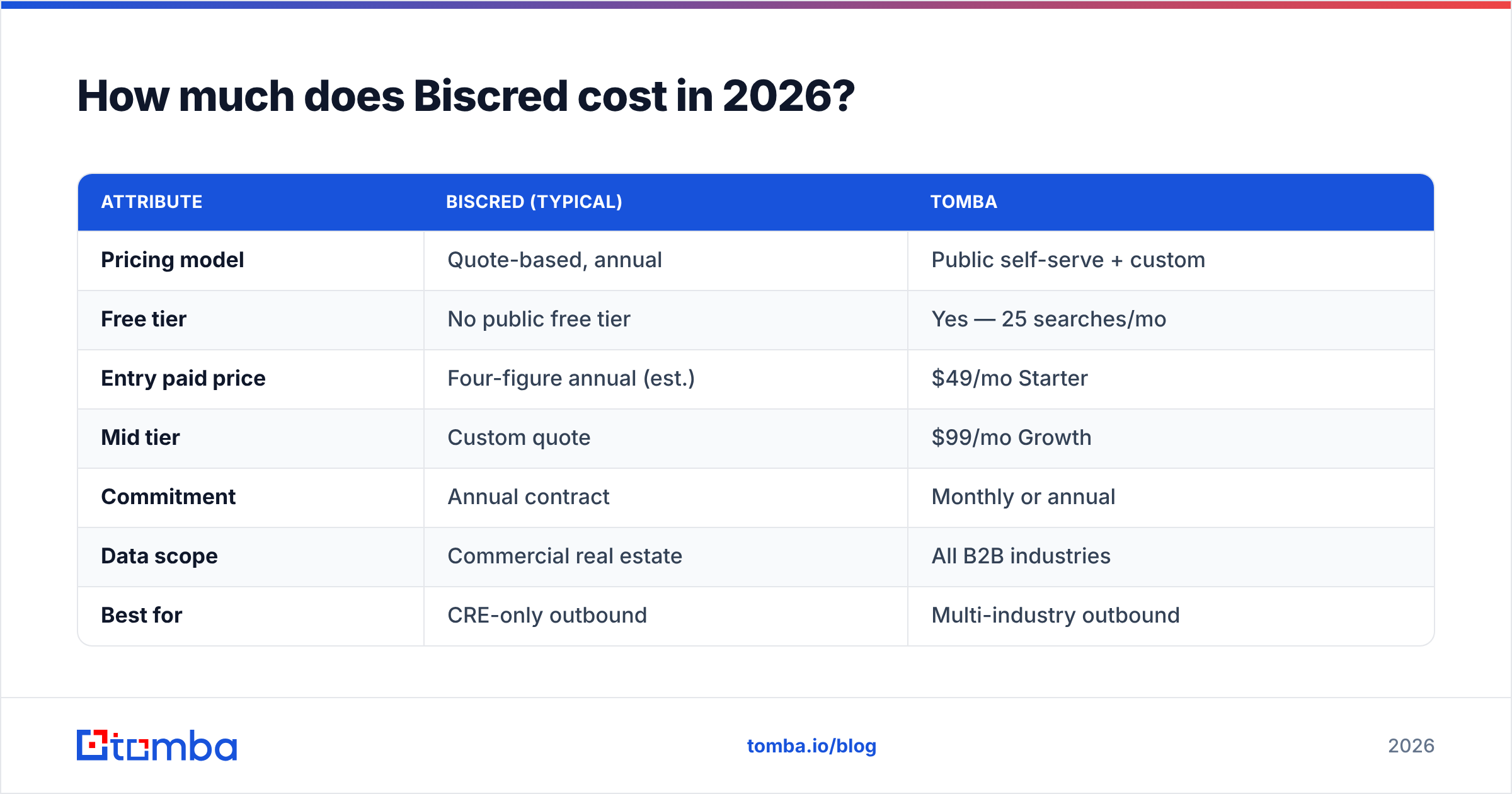
Biscred does not publish a price list. Pricing is quote-based and set per company. This is common for vertical data vendors, but it is frustrating if you just want a number. Public reviews and buyer reports suggest a pattern. Small teams often land in the low-to-mid four figures per year. Costs climb into five figures as you add seats, credits, and export volume.
There is no transparent tier, so the real cost depends on three levers. The first is the number of user seats. The second is monthly contact credits, meaning the records you can unlock or export. The third is contract length. Most deals are annual and paid upfront, with little month-to-month flexibility.
Here is how that compares to a transparent, usage-based tool. For context, Tomba pricing is fully public:
| Attribute | Biscred (typical) | Tomba |
|---|---|---|
| Pricing model | Quote-based, annual | Public self-serve + custom |
| Free tier | No public free tier | Yes — 25 searches/mo |
| Entry paid price | Four-figure annual (est.) | $49/mo Starter |
| Mid tier | Custom quote | $99/mo Growth |
| Commitment | Annual contract | Monthly or annual |
| Data scope | Commercial real estate | All B2B industries |
| Best for | CRE-only outbound | Multi-industry outbound |
The takeaway is clear. Biscred can be worth it if your whole motion lives inside CRE. The vertical depth then saves your reps hours of research. But if you only touch real estate now and then, an annual CRE-data premium rarely pays off.
What do Biscred reviews actually say?#
Reviews are positive on data relevance and negative on flexibility. Across G2 and Capterra, the themes are consistent enough to summarize fairly.
What reviewers praise:
- Vertical accuracy — CRE contacts and company tags beat what users got from general databases.
- Role precision — Filters for CRE titles like acquisitions, asset management, and debt origination find the right people.
- Time savings — Reps spend less time checking whether a company is in the target asset class.
- Responsive support — Onboarding and customer success earn repeat praise.
What reviewers criticize:
- Opaque pricing — Buyers dislike not knowing the cost before a sales call.
- Annual lock-in — Several reviews call the commitment risky for small teams testing the channel.
- Credit limits — High-volume senders hit export caps and pay more to lift them.
- Narrow scope — Once outbound moves beyond CRE, the value drops fast.
That last point matters most for buyers comparing tools. Biscred is excellent at one thing. If that one thing is your whole business, great. If not, you are buying a Ferrari to drive to the corner store.
What are the pros and cons of Biscred?#
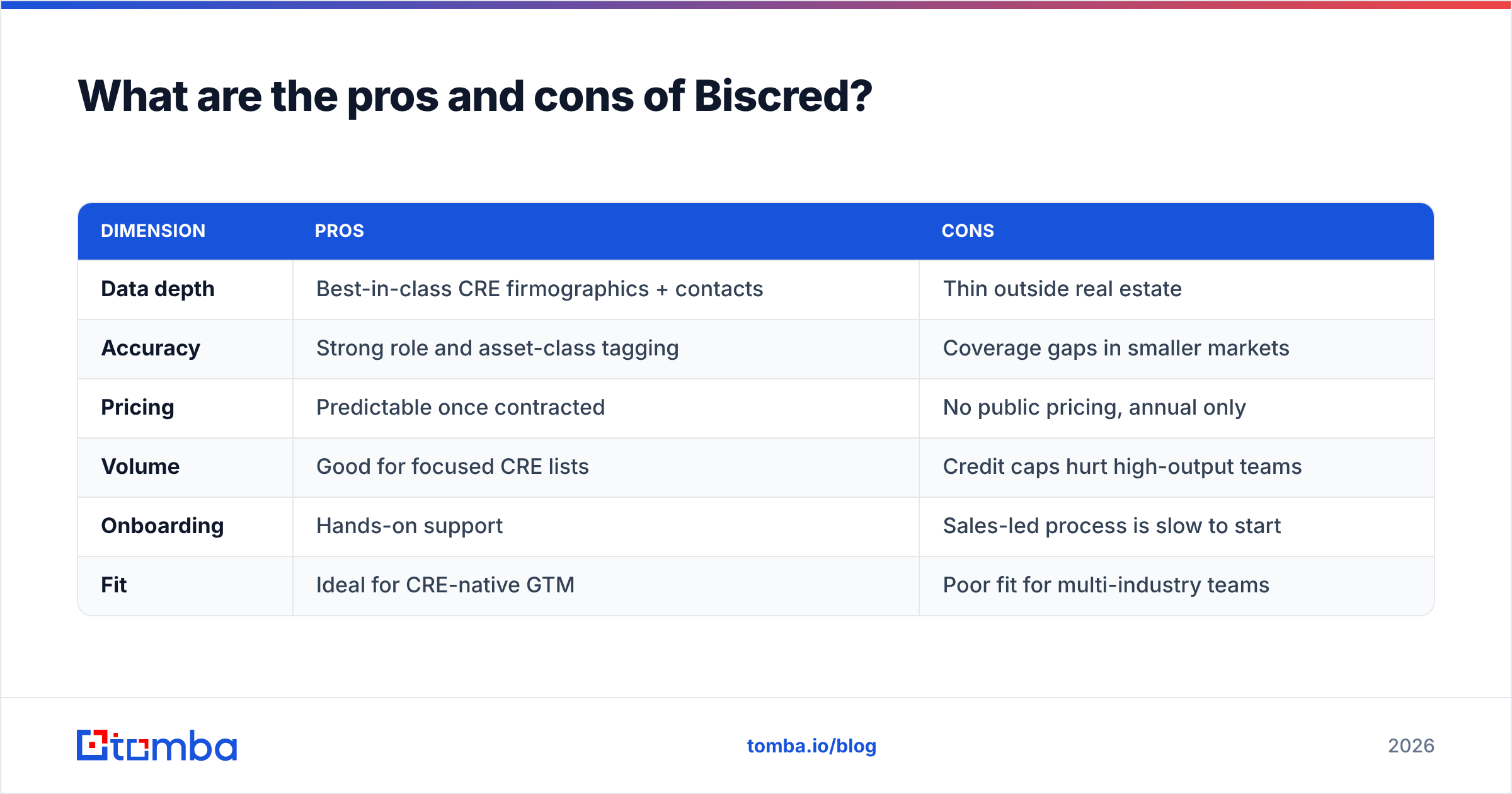
Here is the honest balance sheet on Biscred pricing reviews pros and cons. No vendor is all upside, and Biscred's tradeoffs are clear because of its niche focus.
| Dimension | Pros | Cons |
|---|---|---|
| Data depth | Best-in-class CRE firmographics + contacts | Thin outside real estate |
| Accuracy | Strong role and asset-class tagging | Coverage gaps in smaller markets |
| Pricing | Predictable once contracted | No public pricing, annual only |
| Volume | Good for focused CRE lists | Credit caps hurt high-output teams |
| Onboarding | Hands-on support | Sales-led process is slow to start |
| Fit | Ideal for CRE-native GTM | Poor fit for multi-industry teams |
Want to understand the category mechanics, like how vertical databases source and refresh records? Our B2B glossary breaks down the terms most vendors skip. And before you sign, check where a tool's records come from. Scrutinize data sources first. Provenance drives accuracy more than any marketing claim.

Is Biscred better than a general B2B data tool?#
It depends on how concentrated your market is. Here is a simple decision framework.
Choose Biscred when:
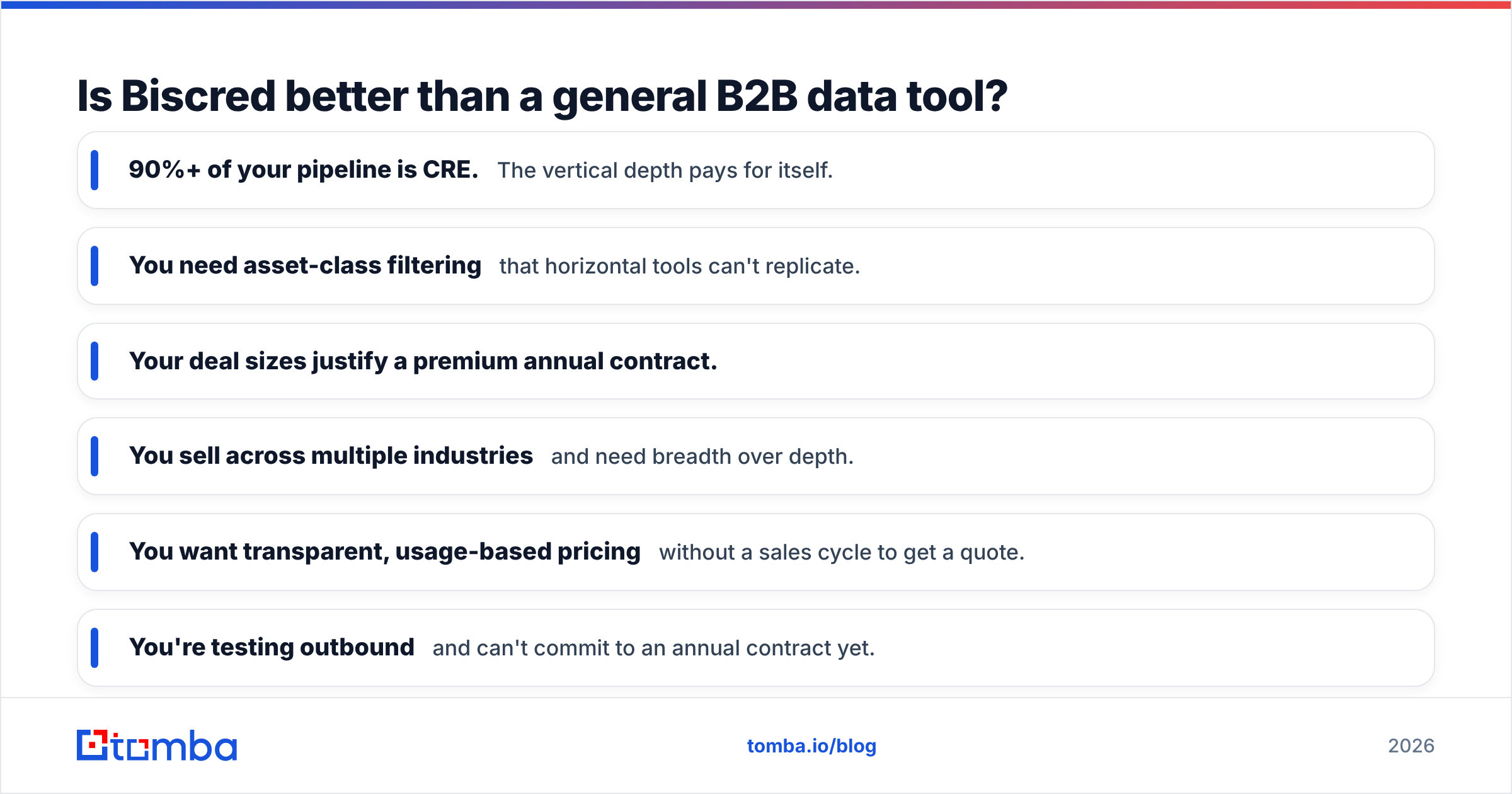
- 90%+ of your pipeline is CRE. The vertical depth pays for itself.
- You need asset-class filtering that general tools cannot match.
- Your deal sizes justify a premium annual contract.
Choose a general B2B tool when:
- You sell across many industries and need breadth over depth.
- You want clear, usage-based pricing with no sales cycle to get a quote.
- You are testing outbound and cannot commit to a year yet.
- Cost per verified lead is your main metric.
A general email finder will not tag a building's asset class. But it will find and verify decision-maker emails across every industry, including CRE. And it does so at a fraction of a vertical tool's annual cost. For teams that prospect broadly, that flexibility usually wins. You can also enrich existing CRE lists with data enrichment. That fills missing emails and phone numbers without paying for a second full platform.
The smart play for many teams is hybrid. Use a niche source where it is truly irreplaceable. Use a flexible finder and verifier for everything else. That keeps your cost per lead low without losing coverage where it counts.
How do you evaluate Biscred before buying?#
Run a structured trial, not a vibe check. Before you sign an annual contract, get evidence on these points:
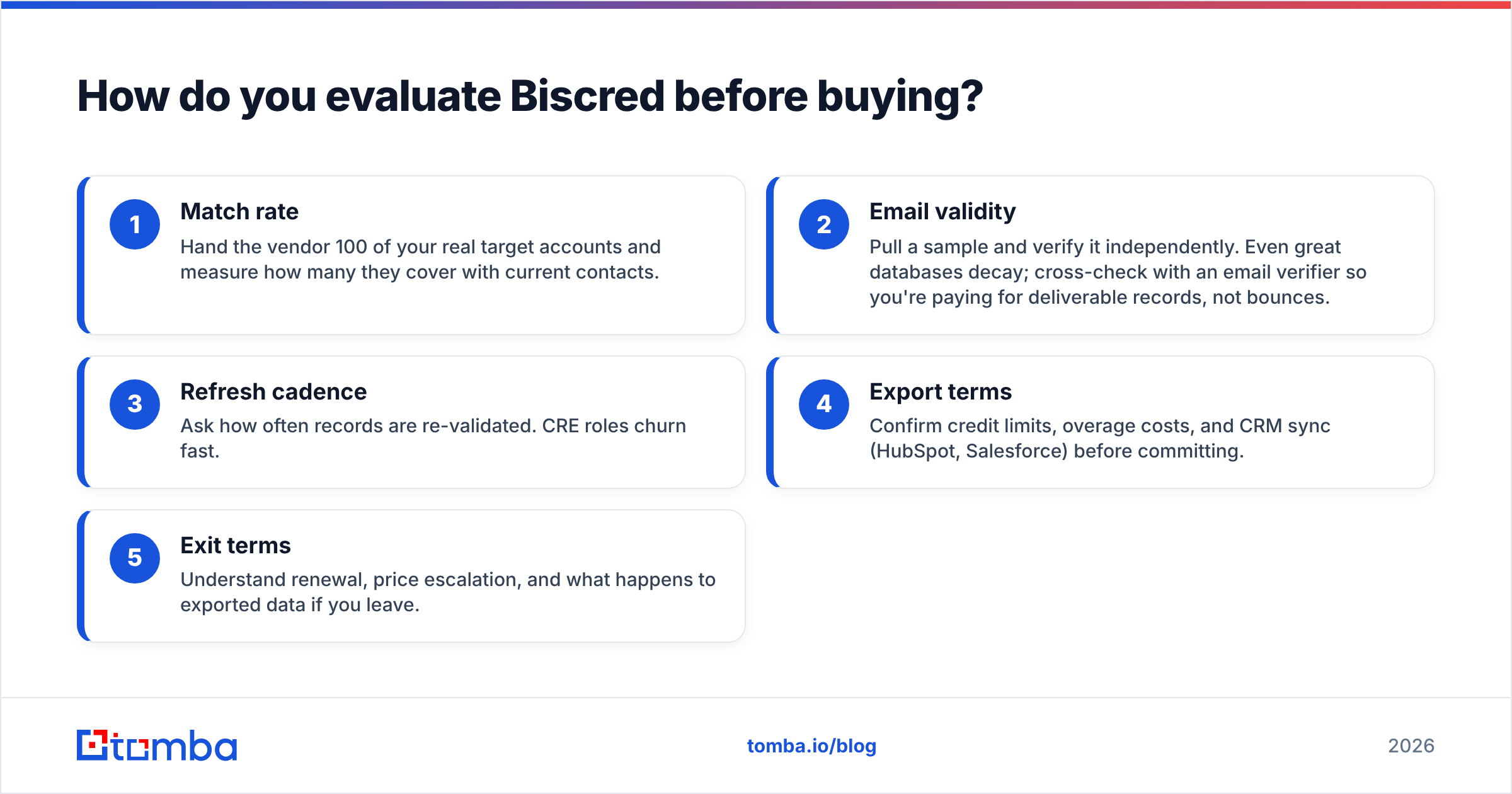
- Match rate — Give the vendor 100 of your real target accounts. Measure how many they cover with current contacts.
- Email validity — Pull a sample and verify it yourself. Even great databases decay, so cross-check with an email verifier. You want deliverable records, not bounces.
- Refresh cadence — Ask how often records are re-checked. CRE roles change fast.
- Export terms — Confirm credit limits, overage costs, and CRM sync (HubSpot, Salesforce) before you commit.
- Exit terms — Understand renewal, price increases, and what happens to exported data if you leave.
Treat a data purchase like a procurement decision, with clear acceptance criteria. That protects you from the common buyer's-remorse story: paying yearly for coverage that looked great in the demo and thin in production.
Biscred's official site, biscred.com, is the source of truth for current features. Still, always test claims against your own account list, not the marketing page.
Biscred pricing reviews pros and cons: the bottom line#
Biscred is a strong, focused tool for teams whose whole world is commercial real estate. Its pricing is opaque and annual. Its data is deep but narrow. Reviews reward it for relevance and penalize it for inflexibility. If CRE is your whole game, it is a defensible buy.
For everyone else, a transparent, multi-industry tool delivers more. This includes teams selling across industries, testing outbound, or watching cost per lead. Start free with the Tomba Email Finder. Find and verify decision-maker emails in any sector, including real estate, with 25 free searches a month and self-serve plans from $49/mo. There is no sales call and no annual lock-in. You only scale spend as your pipeline grows. Test it against your real target list this week and let the match rate decide.
Ready to find emails that actually work?
Join 150,000+ professionals who stopped guessing and started sending. Free credits on signup — no credit card required.
Get the Tomba newsletter
Practical outbound tactics and product updates — once every two weeks.
About the author