Biscred vs Apollo.io 2026: Which B2B Data Tool Wins?
Biscred targets commercial real estate data; Apollo.io covers all-industry prospecting. Here's a head-to-head on coverage, accuracy, pricing, and the best fit for your team in 2026.
You are choosing between two very different B2B data tools, and the marketing pages make them sound identical. They are not. Biscred is a commercial real estate (CRE) data platform; Apollo.io is an all-industry sales intelligence and engagement suite. The right pick depends almost entirely on who you sell to.
TL;DR — Biscred vs Apollo.io at a glance#
- Biscred wins if your entire pipeline lives in commercial real estate — owners, brokers, lenders, property managers, and the firms behind specific buildings.
- Apollo.io wins if you sell across industries and want contact data plus sequencing, dialer, and CRM-style workflows in one tool.
- Accuracy is the real battle. Biscred is deep but narrow; Apollo is broad but noisier, so verification matters more on Apollo records.
- Pricing models differ. Apollo is per-seat with a usable free tier; Biscred is quote-based and aimed at CRE teams.
- Neither is a verification engine. Pair whichever you choose with a dedicated email verifier before you send, or your bounce rate will eat your sender reputation.
What is Biscred?#
Biscred is a vertical B2B data provider built specifically for commercial real estate. Instead of trying to cover every industry, it indexes the people and companies tied to CRE: investment firms, brokerages, lenders, REITs, developers, and property owners. Its differentiator is connecting contacts to assets — you can search by property type, deal role, or firm and surface the humans who actually make decisions on a building or portfolio.
Think of Biscred like a specialist surgeon. It does one thing, and within that lane it goes deeper than a generalist ever could. If you are a CRE lender prospecting multifamily owners in three metros, that depth is exactly what you want.
The trade-off is obvious: step outside commercial real estate and Biscred has nothing for you. There is no SaaS account data, no healthcare buyers, no manufacturing procurement contacts. It is a scalpel, not a Swiss Army knife.
What is Apollo.io?#
Apollo.io is an all-industry sales intelligence and engagement platform. It combines a large contact-and-company database (hundreds of millions of records) with built-in tools to act on that data: email sequences, a dialer, LinkedIn workflows, and CRM sync. You find a lead and work it without leaving the app.
Apollo is the generalist GP. It sees every kind of patient, handles the common cases well, and refers out the rare ones. For most B2B teams selling software, services, or products across verticals, that breadth is the point. You can build a list of VP Engineering contacts at Series B startups one day and CFOs at logistics firms the next.
The catch with breadth is freshness. A database spanning every industry and title in the world cannot keep every record current, so Apollo data quality varies by segment and recency. That is normal for any large generalist provider — it just means verification is non-negotiable.
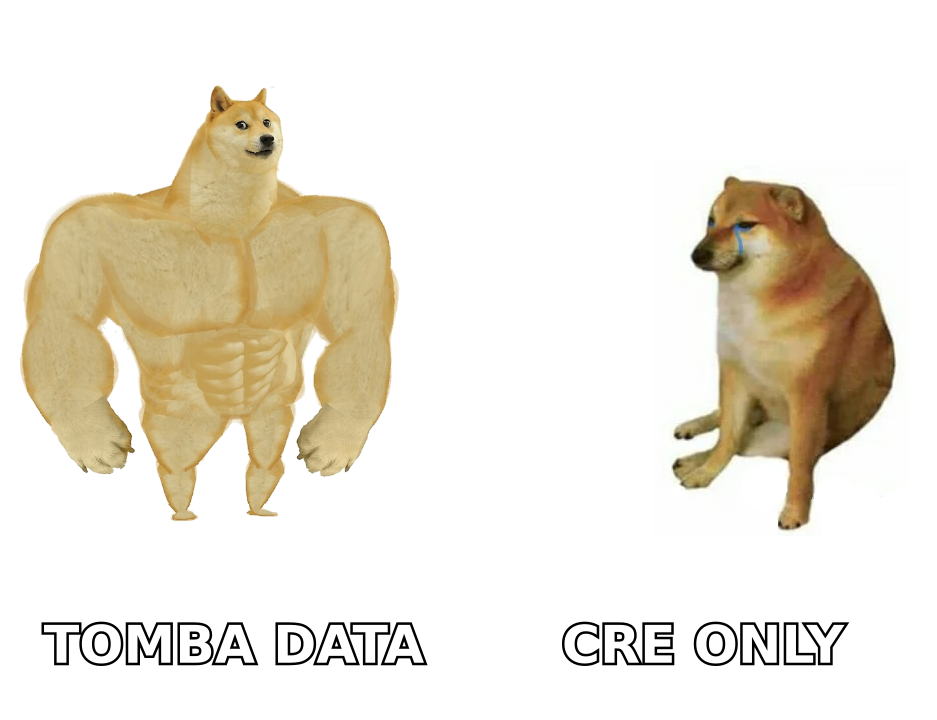
Biscred vs Apollo.io: how do they compare?#
Here is the side-by-side on the attributes that actually change your decision.
| Attribute | Biscred | Apollo.io |
|---|---|---|
| Primary focus | Commercial real estate only | All industries |
| Data model | Contacts linked to properties & deals | Contacts linked to companies |
| Database size | Niche, CRE-deep | 200M+ contacts, broad |
| Built-in outreach | Limited | Sequences, dialer, LinkedIn |
| CRM sync | Basic | Native HubSpot/Salesforce |
| Free tier | No | Yes (limited credits) |
| Pricing model | Quote-based | Per-seat, published tiers |
| Best for | CRE brokers, lenders, investors | Cross-industry SDR/AE teams |
| Verification included | Minimal | Basic, not bulletproof |
The pattern is clear. Biscred trades reach for relevance; Apollo trades precision for coverage and workflow. Neither is "better" in the abstract — they answer different questions.
Which has more accurate data?#
Within commercial real estate, Biscred is usually more accurate; everywhere else, the question does not apply because Biscred has no data there. That is the honest answer.
Accuracy in B2B data is a function of focus. Biscred maintains a smaller universe of records, so it can curate and refresh them more tightly. When it tells you who the asset manager is on a given industrial portfolio, that record is likely current.
Apollo's accuracy is more variable. Common, high-traffic segments (tech, marketing, mid-market SaaS) tend to be solid because the data gets corrected often. Long-tail roles, smaller firms, and stale records are where you hit bounces. Independent reviews on G2 reflect this — users praise Apollo's reach while flagging email accuracy in niche segments.
This is why the smartest teams treat any provider's email as a candidate, not a fact. Run it through verification before it touches your sequence. A single dedicated email finder plus verification pass routinely catches the 10–20% of records that would have bounced and quietly damaged your domain reputation.
How do Biscred and Apollo.io price their plans?#
The pricing philosophies are as different as the products.
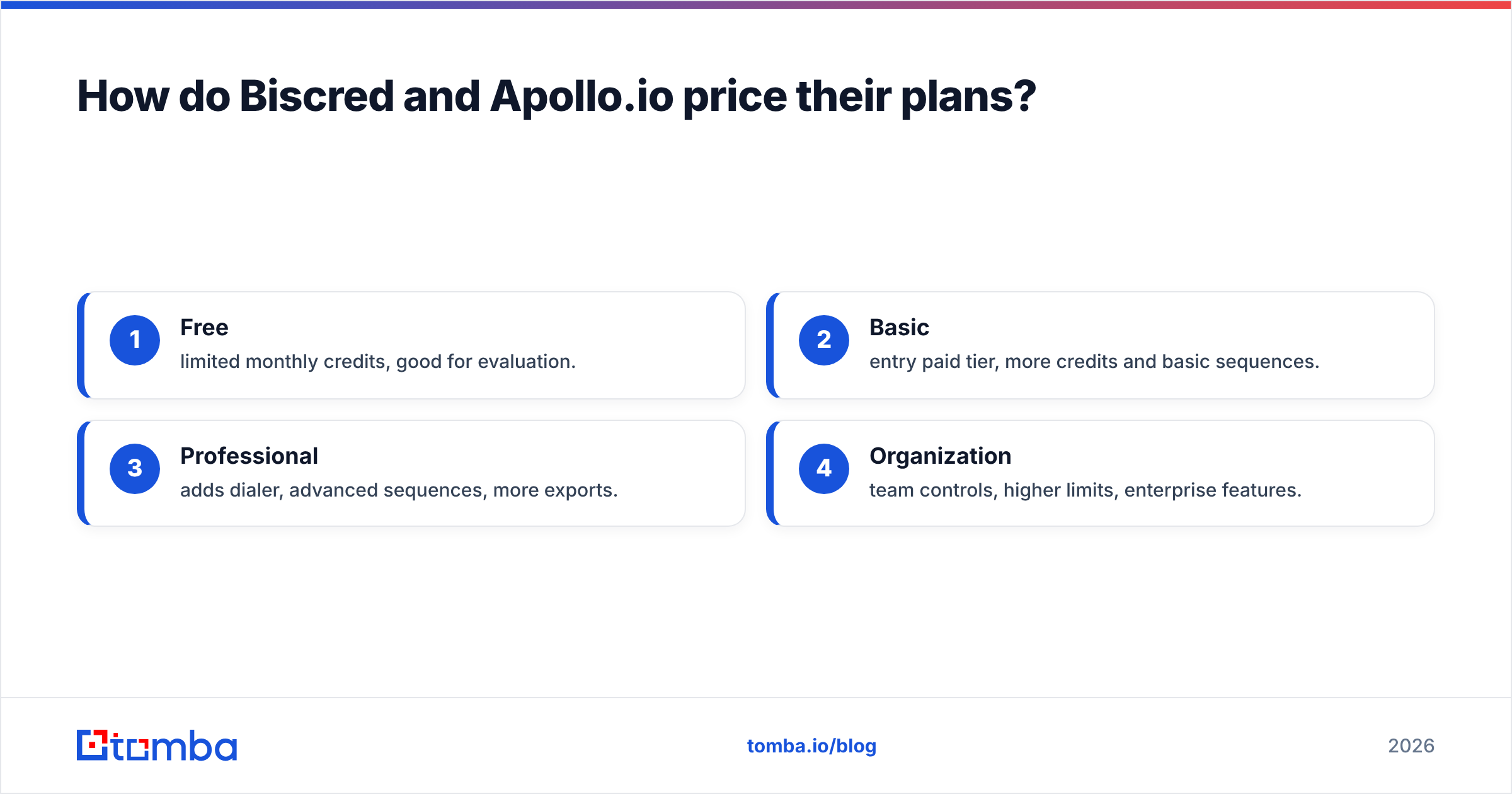
Apollo.io publishes per-seat tiers with a genuinely usable free plan, which makes it easy to test before you commit:
- Free — limited monthly credits, good for evaluation.
- Basic — entry paid tier, more credits and basic sequences.
- Professional — adds dialer, advanced sequences, more exports.
- Organization — team controls, higher limits, enterprise features.
Biscred is quote-based. There is no public free tier; you talk to sales, and pricing reflects its specialist CRE positioning. That suits enterprise CRE teams with budget, but it is friction for a solo broker who just wants to test coverage.
A practical note: per-seat tools like Apollo get expensive as headcount grows, and you pay for seats whether or not each rep is pulling data. If your data needs are spiky or programmatic, an API-metered model — pay for what you actually pull — is often cheaper. That is one reason teams blend a generalist platform with a usage-based data source like the Tomba API rather than buying seats for everyone.
Who should use Biscred?#
Choose Biscred if commercial real estate is your entire world. Specifically:
- CRE brokers sourcing owners and decision-makers for specific assets.
- Lenders and capital providers targeting sponsors by property type and deal role.
- Investors and developers mapping ownership structures behind portfolios.
- PropTech vendors selling into the CRE ecosystem.
For these teams, Biscred's property-to-contact linkage is something a generalist simply cannot replicate. You are paying for depth in one vertical, and you get it.
If even 30% of your pipeline sits outside CRE, though, Biscred leaves you running a second tool for everything else — which erases much of its convenience.
Who should use Apollo.io?#
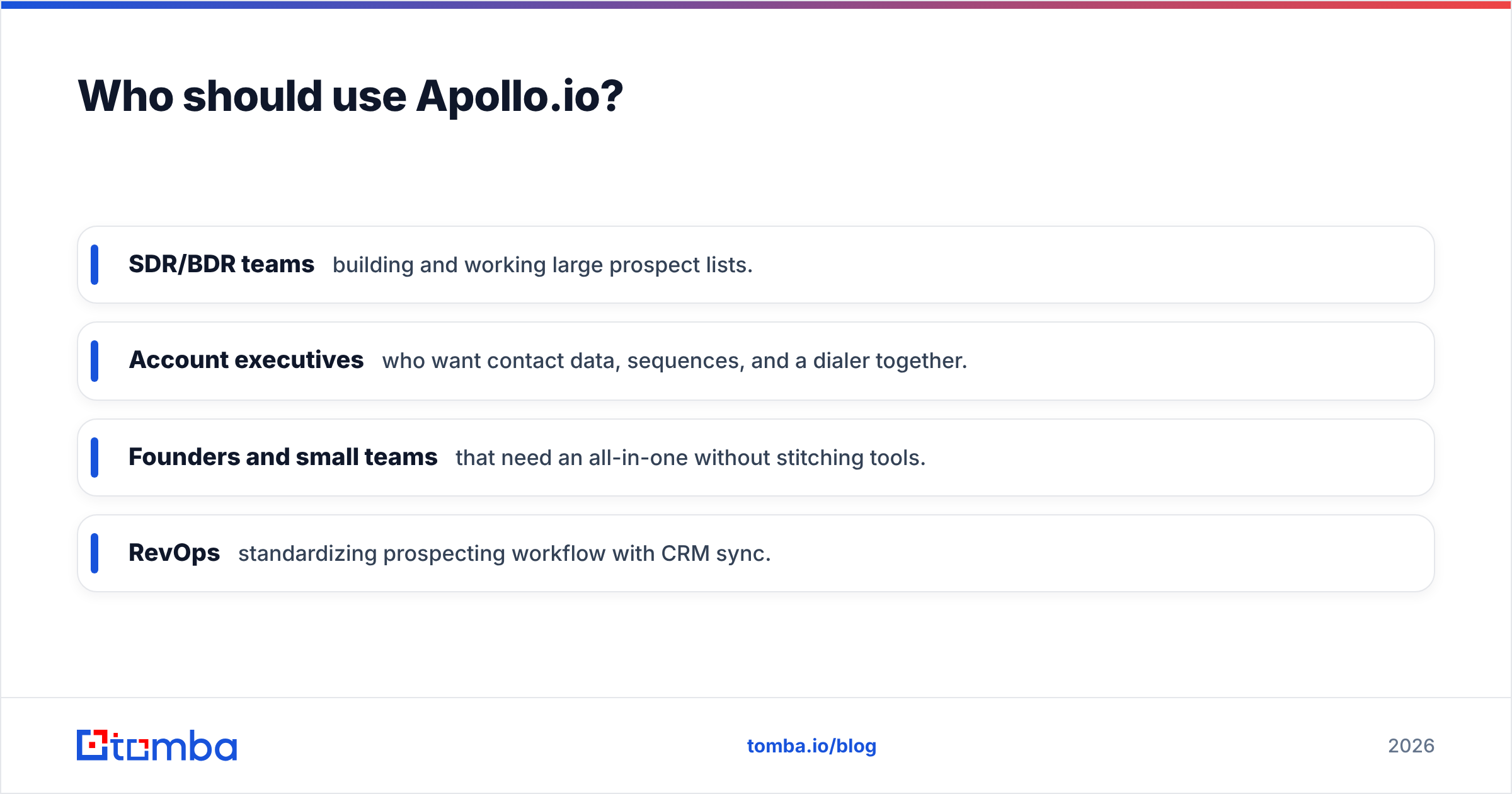
Choose Apollo if you sell across industries and want data plus action in one place:
- SDR/BDR teams building and working large prospect lists.
- Account executives who want contact data, sequences, and a dialer together.
- Founders and small teams that need an all-in-one without stitching tools.
- RevOps standardizing prospecting workflow with CRM sync.
Apollo's strength is consolidation. You research, enrich, sequence, and dial without exporting CSVs between five tabs. For a cross-vertical motion, that workflow gravity is worth a lot — even if you have to verify the data on the way out. If Apollo's per-seat cost or accuracy frustrates you, plenty of teams pair it with or swap it for an Apollo alternative focused purely on accurate contact data.
What about data you can actually trust to send to?#
Both tools share one weakness: neither was built to be your final line of defense before you hit send. Biscred is a sourcing tool; Apollo bundles light verification that is fine for triage but not for protecting a cold-email domain at scale.
The fix is a clean two-step stack:
- Source with your platform of choice (Biscred for CRE, Apollo for everything).
- Verify and enrich before outreach — confirm the mailbox exists, catch catch-all domains, and fill gaps with data enrichment.
If you are pulling thousands of records at a time, do this in batch rather than one by one. A bulk email finder and verifier turns a messy export into a send-ready list in minutes, and it is the single highest-ROI habit in cold outreach. Protecting email deliverability is cheaper than rebuilding a burned domain.
Biscred vs Apollo.io: the verdict#
There is no universal winner — there is a winner for your motion.
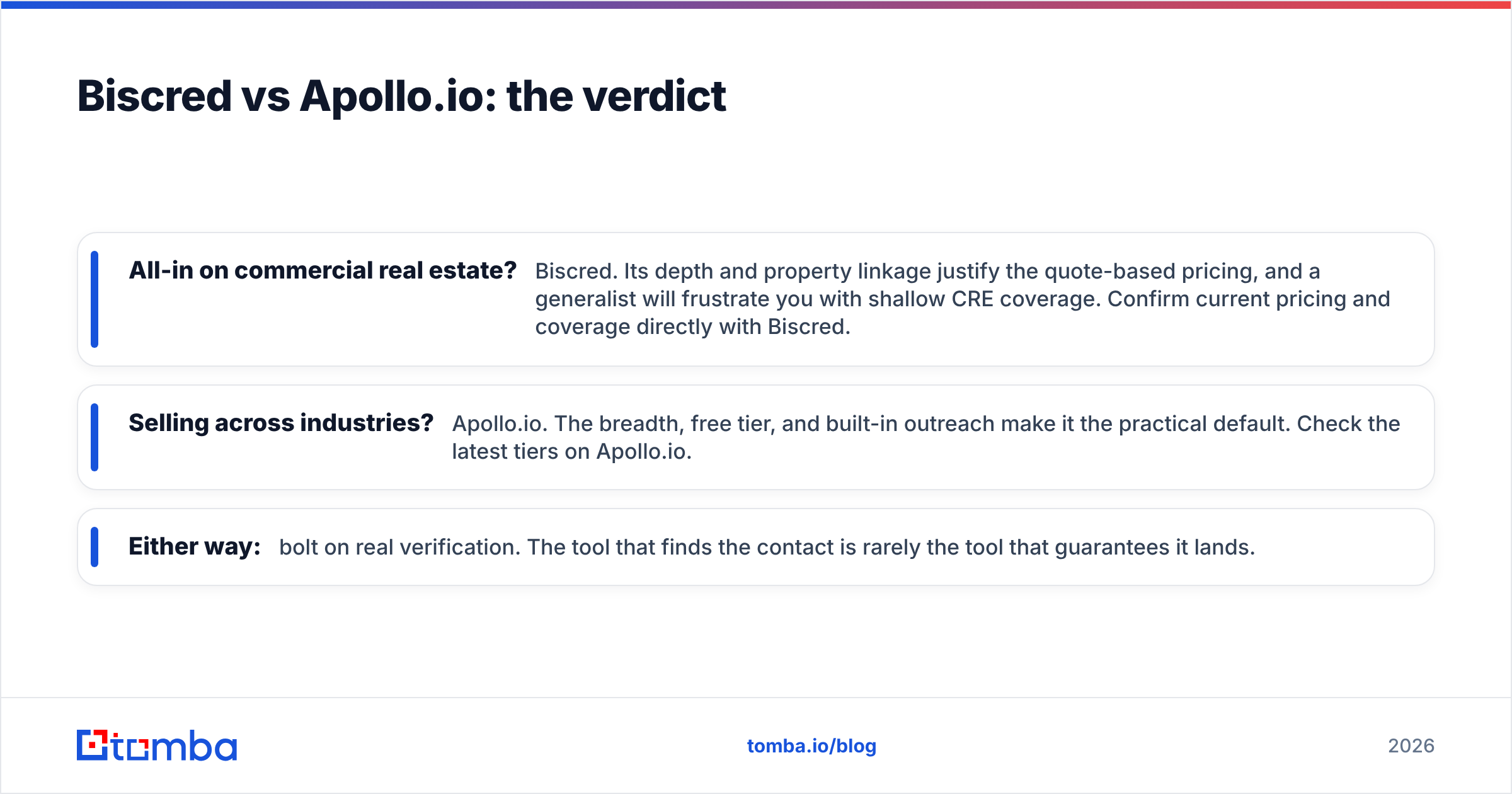
- All-in on commercial real estate? Biscred. Its depth and property linkage justify the quote-based pricing, and a generalist will frustrate you with shallow CRE coverage. Confirm current pricing and coverage directly with Biscred.
- Selling across industries? Apollo.io. The breadth, free tier, and built-in outreach make it the practical default. Check the latest tiers on Apollo.io.
- Either way: bolt on real verification. The tool that finds the contact is rarely the tool that guarantees it lands.
Most teams over-index on database size and under-index on what happens after the export. Win the second half — verification and deliverability — and an "average" data source beats a premium one you send to blindly.
Get accurate, send-ready B2B emails with Tomba#
Whether CRE-niche or cross-industry, your outreach is only as good as the addresses behind it. Tomba's Email Finder locates professional emails by domain, name, or company and pairs them with verification so your list is clean before it ever reaches a sequence. Start free with 25 searches a month, scale on the $49/mo Starter plan, and see full Tomba pricing when you are ready to grow. Source with Biscred or Apollo — then let Tomba make sure every email actually delivers.
// get started
Find, verify and enrich your first contacts today
Start on the free plan with 25 searches a month, then scale when your team is ready.
Free plan · No credit card required · GDPR & CCPA
// about the author