Biscred vs DealSignal 2026: B2B Data Platform Comparison
Biscred targets commercial real estate; DealSignal chases broad B2B coverage. See which data platform fits your pipeline in 2026 — and where a leaner stack beats both.
Choosing a B2B data provider usually comes down to one trade-off: depth in a niche versus breadth across every industry. Biscred and DealSignal sit on opposite ends of that line. Biscred is built almost entirely for commercial real estate (CRE). DealSignal sells itself as a wide-coverage, on-demand B2B contact and account database. Picking the wrong one means paying for records you can't use — or missing the segment you actually sell to.
This guide breaks down both platforms on coverage, data accuracy, pricing posture, integrations, and the use cases each one wins. It also shows where a focused email-finding stack gets you most of the value at a fraction of the cost.
TL;DR — Biscred vs DealSignal in 2026#
- Biscred is a vertical CRE data platform: brokers, owners, investors, lenders, and property contacts. If you sell into commercial real estate, it's purpose-built. Outside CRE, it's the wrong tool.
- DealSignal is a horizontal B2B database with on-demand verification, firmographics, and intent-style signals. Broader reach, less depth in any single niche.
- Accuracy is the real battleground. DealSignal markets a high verification rate; Biscred leans on CRE-specific sourcing. Both still need a verification layer before you send.
- Pricing for both is quote-based and lands in the mid-to-high range — expect annual commitments, not a $49/month card swipe.
- The lean alternative: if your core need is finding and verifying business emails on demand, a tool like Tomba's email finder covers it with transparent pricing and an API, without a five-figure contract.
What is Biscred?#
Biscred is a B2B data and prospecting platform focused on commercial real estate. Instead of trying to cover every industry, it indexes the people and companies that move CRE deals: brokers, asset managers, property owners, REIT executives, developers, lenders, and tenants. The pitch is "the right contacts for CRE, not a generic database filtered down."
Because the dataset is vertical, the filters are vertical too. You can segment by property type, asset class, deal role, and CRE-specific firmographics that a horizontal provider simply doesn't track. For a CRE sales team, that specificity is the entire value proposition — you're not wading through unrelated SaaS or healthcare records to find the 2% that matter.
The flip side is obvious. If your ICP isn't tied to real estate, Biscred's depth becomes dead weight. You're paying for a specialized index you'll barely touch.

What is DealSignal?#
DealSignal is a horizontal B2B data platform. It aims for broad coverage across industries, company sizes, and geographies, and emphasizes on-demand verification — the idea that records are re-checked at the point of delivery rather than sold from a stale, pre-built list. Its dataset spans firmographics, demographics, technographics, and buying-signal style data meant to feed account-based marketing and outbound at scale.
DealSignal positions itself against the "decay" problem every static database faces: B2B contact data goes stale at roughly 2–3% per month as people change jobs. By verifying on request, it tries to hand you fresher records than a list you bought six months ago. That's a meaningful difference if your team runs high-volume outbound and can't afford a 30% bounce rate.
The trade-off is the mirror image of Biscred's. DealSignal goes wide, so in any single vertical it won't match a dedicated niche provider's granularity. For most multi-industry GTM teams, that's an acceptable tax for reach.
Biscred vs DealSignal: side-by-side comparison#
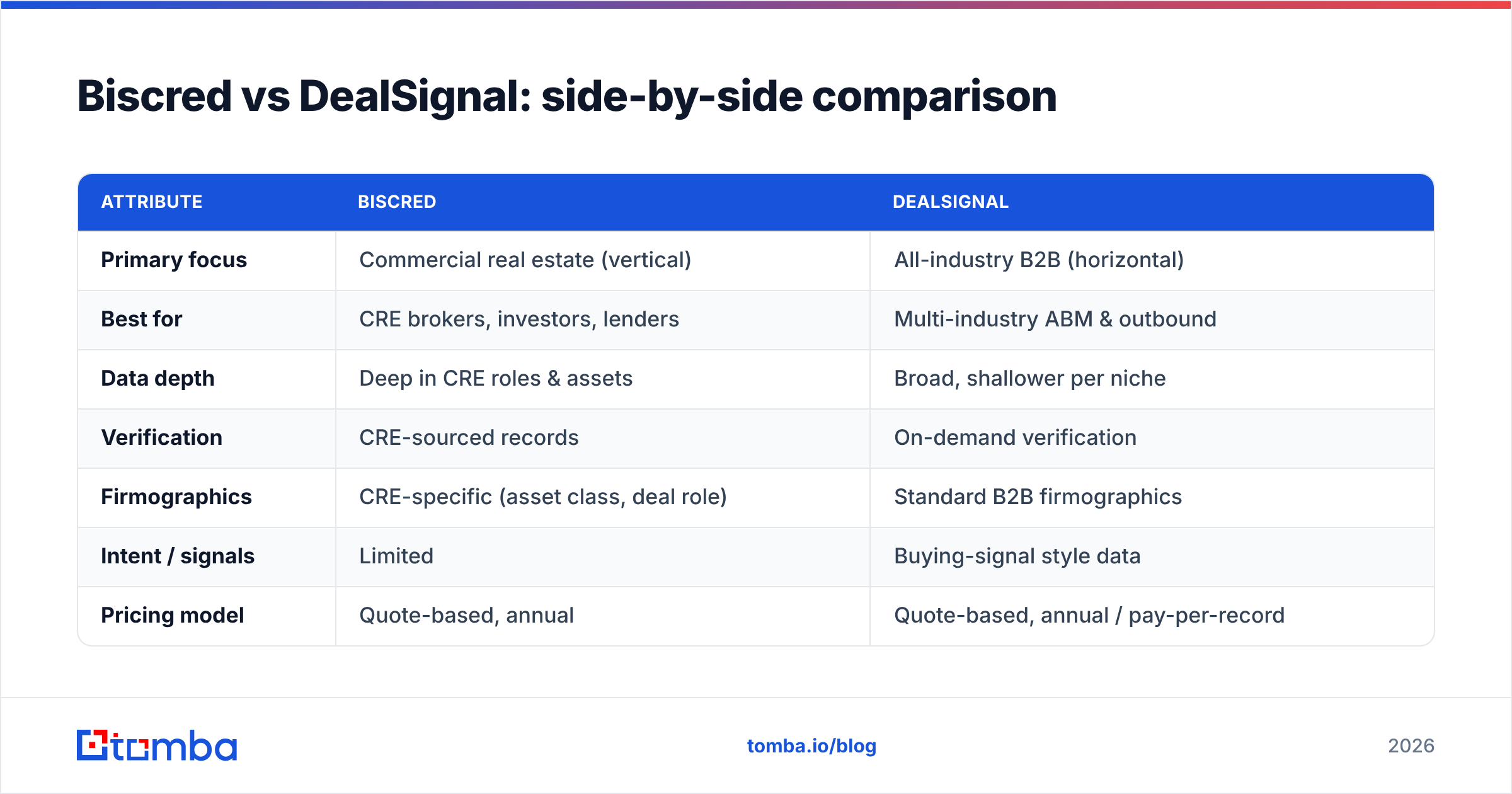
Here's how the two stack up on the attributes that actually drive a buying decision.
| Attribute | Biscred | DealSignal |
|---|---|---|
| Primary focus | Commercial real estate (vertical) | All-industry B2B (horizontal) |
| Best for | CRE brokers, investors, lenders | Multi-industry ABM & outbound |
| Data depth | Deep in CRE roles & assets | Broad, shallower per niche |
| Verification | CRE-sourced records | On-demand verification |
| Firmographics | CRE-specific (asset class, deal role) | Standard B2B firmographics |
| Intent / signals | Limited | Buying-signal style data |
| Pricing model | Quote-based, annual | Quote-based, annual / pay-per-record |
| Free self-serve tier | No | No |
| API access | Available | Available |
| Ideal team size | CRE-focused SMB to mid-market | Mid-market to enterprise GTM |
The headline: these tools rarely compete for the same buyer. A CRE brokerage shortlisting data vendors should weigh Biscred against other real-estate-specific sources, not DealSignal. A SaaS company building a multi-segment outbound motion should compare DealSignal against other horizontal providers like ZoomInfo, Apollo, or Clearbit — not Biscred. If you find yourself comparing these two directly, it usually means your ICP definition needs sharpening first.
How accurate is the data, really?#
Accuracy is where both platforms live or die, and where you should be most skeptical of marketing numbers.
Every B2B data vendor quotes an impressive verification or accuracy percentage. Those figures are measured under the vendor's own conditions, on the vendor's own sample, at the moment of capture. By the time a record reaches your sequence, three things have happened: the contact may have changed roles, the email may have been deactivated, and your sending domain has its own sender reputation to protect. None of that shows up in a sales deck.
DealSignal's on-demand verification model is genuinely a structural advantage here — re-checking at delivery beats serving from a static list. Biscred counters with tighter sourcing inside a narrow vertical, where its data simply changes less chaotically than a general database. Both approaches help. Neither eliminates the need for a verification pass on your side.
This is the practical rule: treat any provider's list as input, not gospel. Run it through an email verifier before your first send to strip dead addresses, catch-alls, and role accounts. A 5-minute verification step routinely saves a percentage point or two of bounce rate — and bounce rate is what quietly destroys deliverability.

What does each platform cost in 2026?#
Neither Biscred nor DealSignal publishes transparent self-serve pricing, and that's the first thing budget owners should note. Both run quote-based, sales-led motions with annual commitments. Here's the realistic shape of the decision.
- No free tier. Unlike self-serve tools, you can't sign up and test with 25–50 free lookups. You book a demo, scope a contract, and negotiate.
- Annual contracts dominate. Expect a 12-month commitment. DealSignal does offer pay-per-record style flexibility in some configurations, but the headline relationships are annual.
- Seat plus volume. Pricing typically blends user seats with data volume (records exported or verified). The more contacts you pull, the more you pay.
- Add-ons matter. Intent data, API access, CRM enrichment, and higher verification volumes are frequently priced as upgrades, not base features.
- Procurement overhead. Five-figure annual deals mean legal review, security questionnaires, and a buying cycle measured in weeks — fine for enterprise, heavy for a small team.
For a large GTM org running account-based plays across industries, that structure is normal and worth it. For a lean team that mostly needs verified emails for outbound, it's overkill. This is exactly the gap where a usage-based tool changes the math. Tomba's pricing starts with a free tier (25 searches/month), then Starter at $49/month, Growth at $99/month, and Pro at $249/month — no annual lock-in required to get started.
When should you pick Biscred?#
Pick Biscred when commercial real estate is your whole world. Specifically:
- You sell services or products into CRE — proptech, lending, brokerage tools, construction, property management.
- Your ICP is defined by asset class, property type, or deal role, not generic SIC codes.
- You need owner, investor, and broker relationships that a horizontal database treats as edge cases.
- Granularity inside CRE matters more to you than reach across other industries.
In that scenario, Biscred's vertical depth is hard to replicate by filtering a general-purpose database. You'd spend more on a horizontal tool and get worse CRE coverage. The niche focus is the feature.
When should you pick DealSignal?#
Pick DealSignal when you need breadth and freshness across many segments.
- Your outbound spans multiple industries, company sizes, and regions.
- You run account-based marketing and want firmographic plus signal data to prioritize accounts.
- Bounce rate is a top metric and on-demand verification is worth paying for.
- You have the budget and procurement patience for an annual data contract.
DealSignal competes in the crowded horizontal data market, so the honest comparison is against the other generalists. If you're evaluating it, also look at how it stacks up on price-per-verified-record versus tools you can test before committing. Many teams discover that a focused data enrichment and email-finding workflow covers 80% of their need at 20% of the cost.
Is there a leaner alternative to both?#
Yes — and for a large share of teams, it's the right call. Most "B2B data platform" spend is justified by one job: getting accurate contact details for the right people, then keeping them verified. If that's your core requirement, you don't need a five-figure vertical or horizontal database. You need a reliable finder, a verifier, and an API to wire it into your stack.
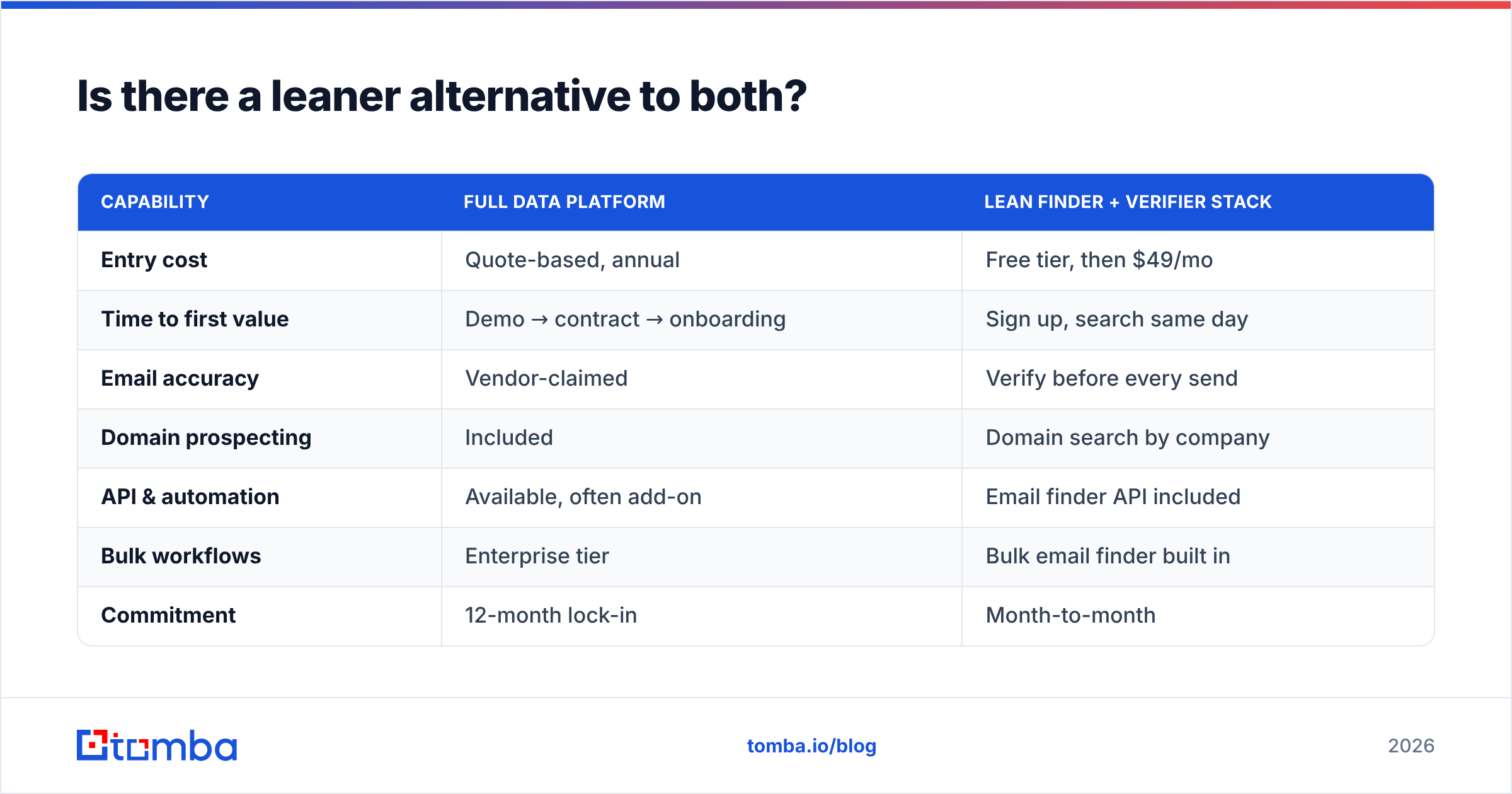
That's the niche Tomba fills. Here's how the lean approach compares to a full platform contract:
| Capability | Full data platform | Lean finder + verifier stack |
|---|---|---|
| Entry cost | Quote-based, annual | Free tier, then $49/mo |
| Time to first value | Demo → contract → onboarding | Sign up, search same day |
| Email accuracy | Vendor-claimed | Verify before every send |
| Domain prospecting | Included | Domain search by company |
| API & automation | Available, often add-on | Email finder API included |
| Bulk workflows | Enterprise tier | Bulk email finder built in |
| Commitment | 12-month lock-in | Month-to-month |
The point isn't that Biscred or DealSignal are bad — they're well-suited to specific, well-funded use cases. The point is that you should buy the smallest tool that solves your actual problem. If you genuinely need CRE-specific owner relationships, buy Biscred. If you need multi-industry intent and account data at scale, evaluate DealSignal against its true peers. If you mostly need to find and verify business emails, don't sign an annual contract to do it.
For reference on how horizontal data vendors are rated by real buyers, G2's B2B data category is a useful, neutral sanity check before any demo.
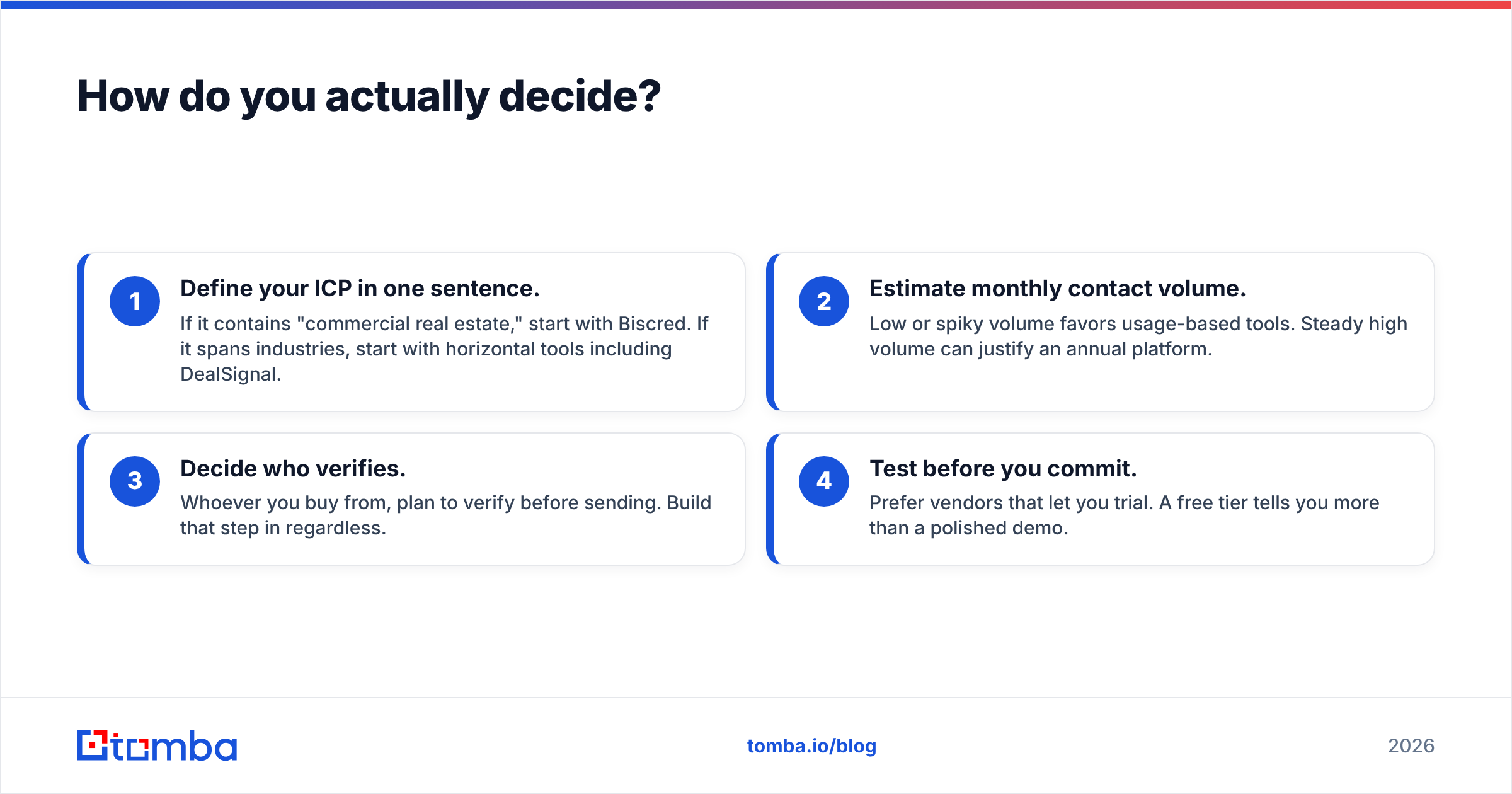
How do you actually decide?#
Run this quick decision filter before you book a single demo:
- Define your ICP in one sentence. If it contains "commercial real estate," start with Biscred. If it spans industries, start with horizontal tools including DealSignal.
- Estimate monthly contact volume. Low or spiky volume favors usage-based tools. Steady high volume can justify an annual platform.
- Decide who verifies. Whoever you buy from, plan to verify before sending. Build that step in regardless.
- Test before you commit. Prefer vendors that let you trial. A free tier tells you more than a polished demo.
Get those four answers straight and the Biscred-vs-DealSignal question usually answers itself — or dissolves into "neither, I just need verified emails."
The bottom line#
Biscred and DealSignal solve different problems for different buyers. Biscred owns the commercial real estate vertical; DealSignal plays the broad, freshness-focused horizontal game. Match the tool to your ICP, not to a feature checklist, and you'll rarely be torn between them.
But if your real job is finding accurate, verified business emails and feeding them into outbound — without a procurement cycle or annual lock-in — start lean. Try the Tomba Email Finder free with 25 searches a month, verify every address before you send, and scale up only when the volume actually justifies it. You can always add a heavyweight platform later; you can't get back the budget you burned on records you never used.
Ready to find emails that actually work?
Join 150,000+ professionals who stopped guessing and started sending. Free credits on signup — no credit card required.
Get the Tomba newsletter
Practical outbound tactics and product updates — once every two weeks.
About the author