Biscred vs DiscoverOrg: B2B Data Platform Comparison (2026)
Biscred targets commercial real estate intelligence while DiscoverOrg (now ZoomInfo) chases broad B2B coverage. Here's which data platform fits your 2026 GTM motion — and the cheaper way to fill the gaps.
TL;DR
- Biscred is a niche commercial real estate (CRE) data platform — deep firmographic and contact coverage for brokers, owners, lenders, and proptech teams. It is narrow but precise inside that vertical.
- DiscoverOrg no longer exists as a standalone product. It merged into ZoomInfo in 2019, so "DiscoverOrg" today means ZoomInfo's broad, cross-industry B2B intelligence database.
- Pick Biscred if your entire pipeline lives in commercial real estate. Pick ZoomInfo/DiscoverOrg if you sell across many industries and need org charts, intent data, and scale.
- Both carry enterprise price tags (often $15K–$40K+/year). If you mostly need accurate email addresses and enrichment, a focused tool like Tomba Email Finder covers that job for a fraction of the cost.
- The smartest 2026 stack is often hybrid: a vertical database for targeting plus a low-cost finder/verifier for contact accuracy.
What is Biscred and who is it for?#
Biscred is a B2B data platform built specifically for the commercial real estate ecosystem. Instead of trying to map every company on earth, it goes deep on a single vertical: brokerages, property owners, REITs, lenders, developers, proptech vendors, and the people who work inside them.
Think of it like a specialist surgeon versus a general practitioner. Biscred does one thing — CRE contact and firmographic intelligence — and does it with category-specific tagging (asset class, deal role, property type) that a generalist database simply doesn't model. If you sell software to property managers or want to reach acquisition teams at REITs, that tagging is the difference between a clean list and a week of manual research.
The trade-off is obvious: outside commercial real estate, Biscred has little to offer. Its value is entirely a function of how concentrated your B2B database needs are in one industry.
What happened to DiscoverOrg?#
DiscoverOrg is the more confusing half of this comparison because it isn't sold under that name anymore. DiscoverOrg acquired ZoomInfo in 2019 and then took the ZoomInfo brand for the combined company. So when buyers compare "Biscred vs DiscoverOrg" in 2026, they're really comparing Biscred against ZoomInfo's platform, which inherited DiscoverOrg's human-verified org-chart heritage.
That history matters. DiscoverOrg built its reputation on manually researched org charts and technographics for IT, sales, and marketing departments. ZoomInfo layered on massive automated data collection, intent signals, and a website visitor product. The result is one of the broadest B2B datasets available — strong across software, finance, manufacturing, healthcare, and most other verticals.
You can read ZoomInfo's own framing of the merger on zoominfo.com, and third-party reviews on G2 give a realistic picture of where coverage and accuracy actually land.

How do Biscred and DiscoverOrg compare head to head?#
Here is the core decision laid out by attribute. Prices are approximate annual figures based on public reviews and typical enterprise quotes — both vendors use custom pricing, so treat these as ranges, not quotes.
| Attribute | Biscred | DiscoverOrg (ZoomInfo) |
|---|---|---|
| Primary focus | Commercial real estate only | Broad, cross-industry B2B |
| Best for | CRE brokers, proptech, lenders | Multi-vertical sales & marketing teams |
| Contact coverage | Deep within CRE | Hundreds of millions of contacts |
| Org charts | CRE-specific roles | Strong (DiscoverOrg legacy strength) |
| Intent / technographics | Limited | Extensive |
| Verification method | Curated CRE sourcing | Human + automated, continuous |
| Typical entry price | ~$10K–$20K/yr (custom) | ~$15K–$40K+/yr (custom) |
| Free tier | No | No (limited trial only) |
| Learning curve | Low (focused UI) | Moderate to high |
The pattern is clear. Biscred wins on depth inside one vertical; DiscoverOrg/ZoomInfo wins on breadth, intent data, and scale. Neither is cheap, and neither offers a meaningful free tier for solo operators or small teams testing the waters.
Which one is more accurate?#
Accuracy depends on where you're pointing the tool, not on a single global score.
Inside commercial real estate, Biscred's curated approach often returns fresher, better-categorized contacts than a generalist database that treats a regional brokerage like any other company. Its narrow scope is its accuracy advantage.
Across everything else, ZoomInfo's continuous re-verification and sheer volume usually win. DiscoverOrg's original human-verification process for org charts still shows up as a strength in IT and enterprise software targeting.
But there's a catch that applies to both: any database decays. People change jobs every few years, companies rebrand, and email formats shift after acquisitions. No platform — niche or broad — keeps every record current. That's why the accuracy conversation can't end at "which vendor," it has to include a verification step at send time. Running new contacts through an email verifier before a campaign catches the bounces that even a premium database lets through.
Do you actually need a full data platform?#
Here's the question most buyers skip: what job are you really hiring the tool to do?
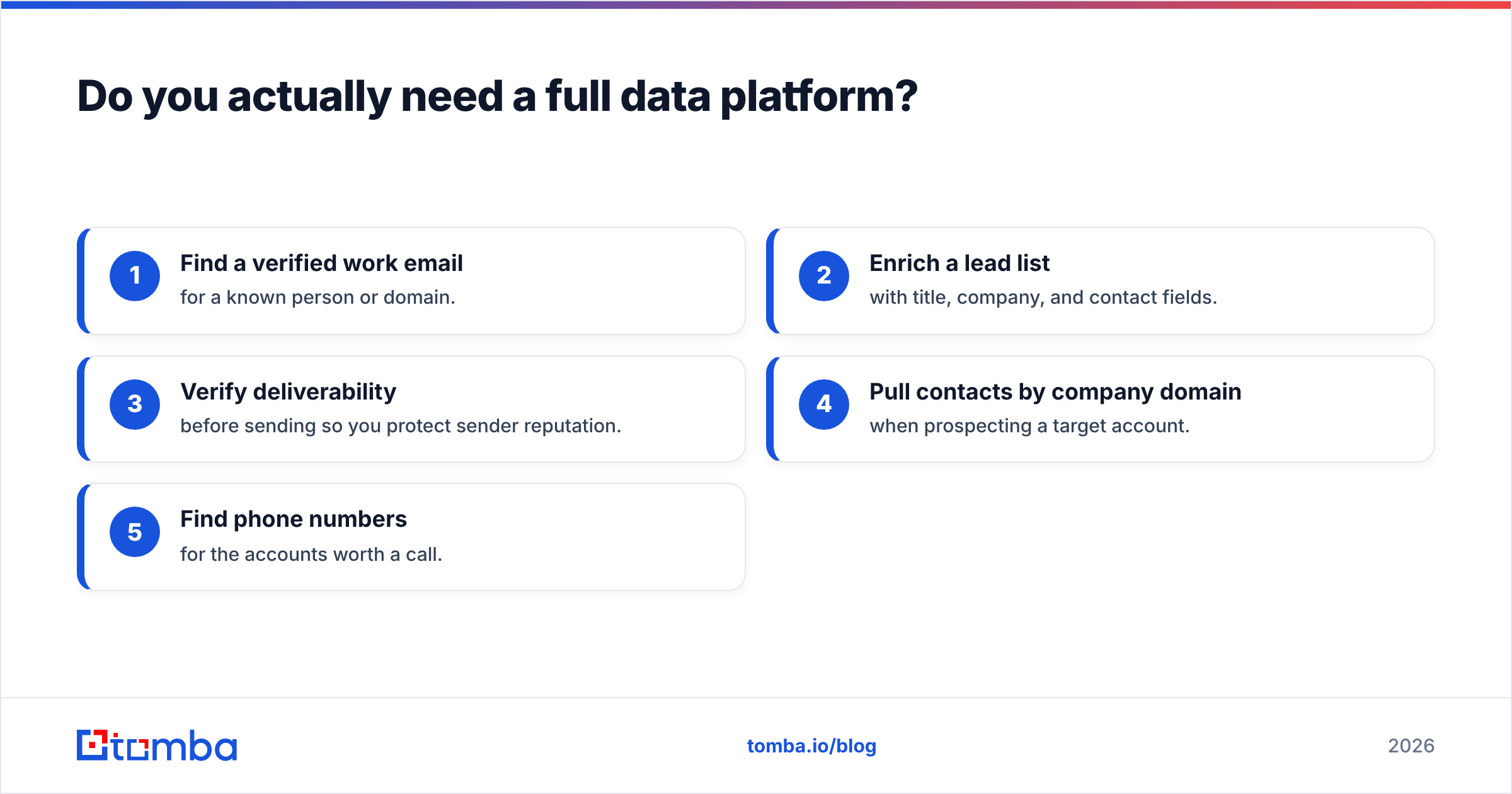
If you need org charts, buying-committee mapping, intent scoring, and territory planning across many industries, a platform like ZoomInfo earns its price. If you need deep CRE targeting, Biscred earns its price. But a large share of teams sign five-figure contracts when their actual recurring need is simpler:
- Find a verified work email for a known person or domain.
- Enrich a lead list with title, company, and contact fields.
- Verify deliverability before sending so you protect sender reputation.
- Pull contacts by company domain when prospecting a target account.
- Find phone numbers for the accounts worth a call.
If that list describes 80% of your usage, you're overpaying for a research suite when a focused finder-and-verifier stack does the work. This is exactly where a tool like Tomba fits — and why many teams run it alongside, not instead of, a vertical database.

How does Tomba fit into this comparison?#
Tomba isn't a CRE-specific intelligence suite like Biscred, and it isn't a sprawling intent-data platform like ZoomInfo. It's a focused, affordable layer for the contact-accuracy jobs above — the part of the workflow where both incumbents charge the most.
Where Tomba is the better-fit tool:
- Email discovery at scale — use domain search to pull every known email pattern for a target company, or the bulk email finder to process whole account lists.
- Verification baked in — every find can be checked, so your bounce rate stays low and your email deliverability stays healthy.
- Enrichment — data enrichment fills missing fields on records you already pulled from Biscred or ZoomInfo.
- Transparent, low pricing — no five-figure annual minimum to find out if the data works for you.
Here's how the three line up on cost and scope:
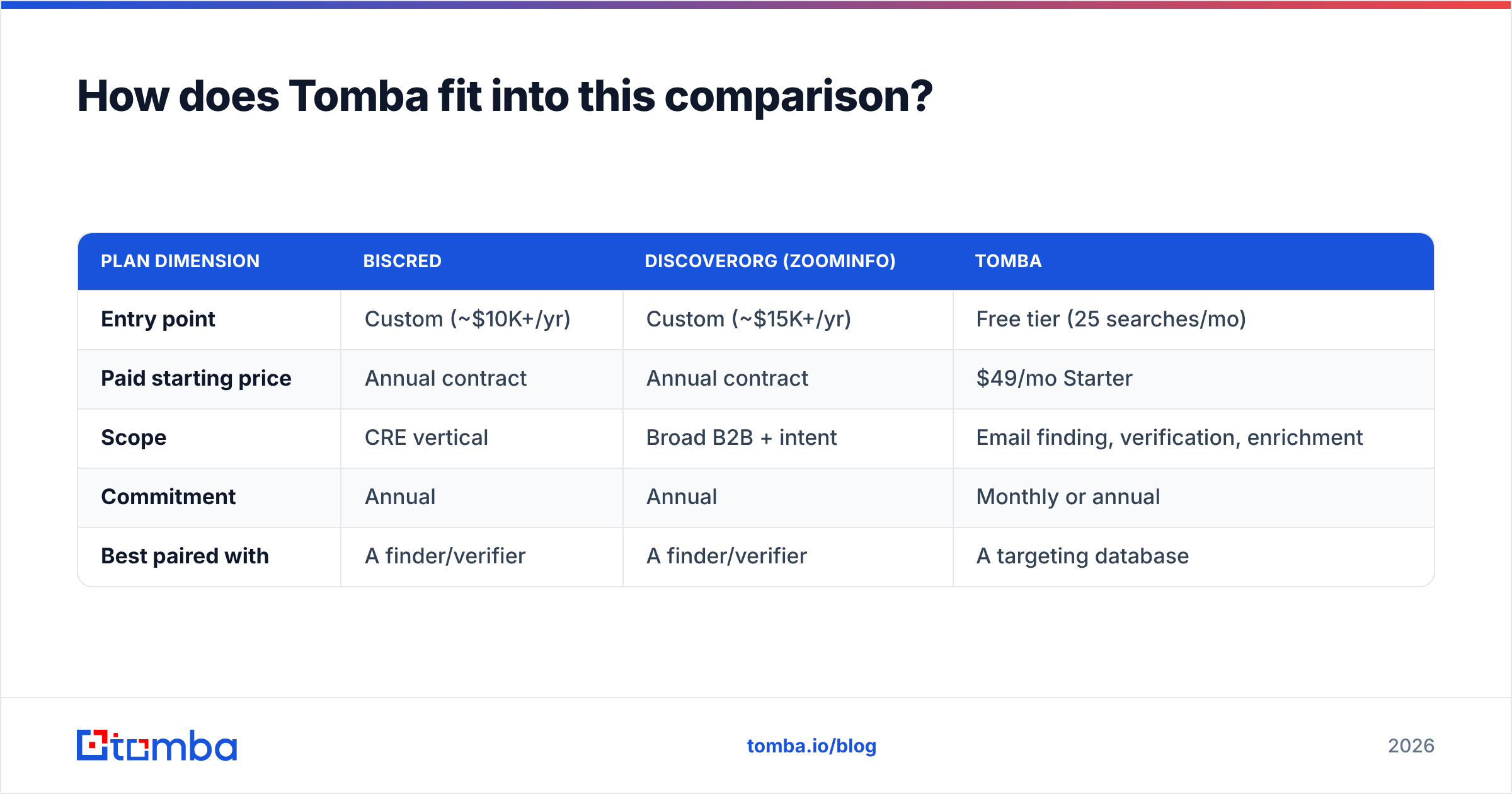
| Plan dimension | Biscred | DiscoverOrg (ZoomInfo) | Tomba |
|---|---|---|---|
| Entry point | Custom (~$10K+/yr) | Custom (~$15K+/yr) | Free tier (25 searches/mo) |
| Paid starting price | Annual contract | Annual contract | $49/mo Starter |
| Scope | CRE vertical | Broad B2B + intent | Email finding, verification, enrichment |
| Commitment | Annual | Annual | Monthly or annual |
| Best paired with | A finder/verifier | A finder/verifier | A targeting database |
Full numbers are on the Tomba pricing page: Free (25 searches/mo), Starter $49/mo, Growth $99/mo, Pro $249/mo, and custom Enterprise. The point isn't that Tomba replaces a vertical intelligence platform — it's that it removes the reason to pay platform prices for basic contact work.
What's the right stack for 2026?#
Conclusion first: match the tool to the job, and don't buy breadth you won't use.
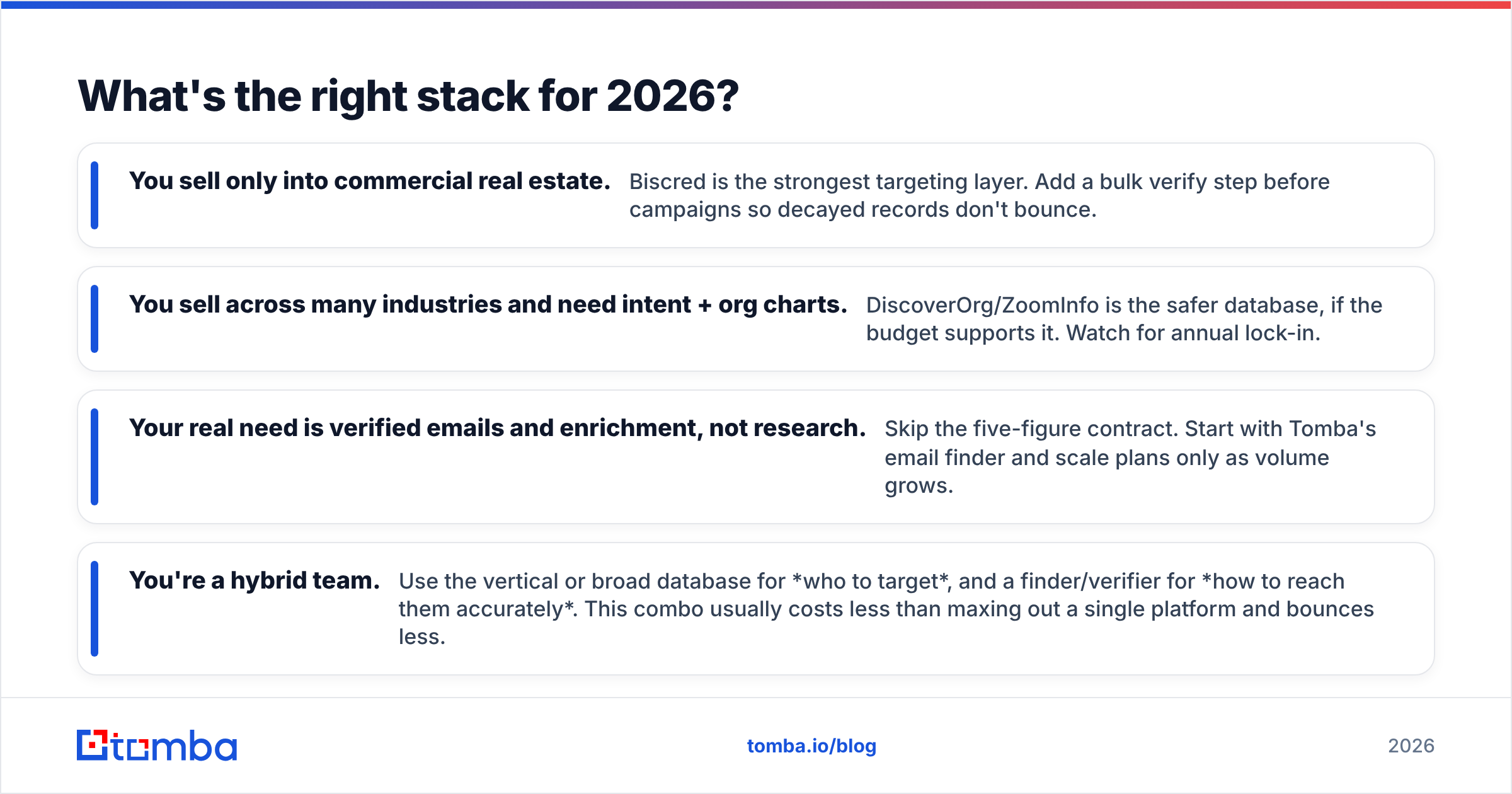
- You sell only into commercial real estate. Biscred is the strongest targeting layer. Add a bulk verify step before campaigns so decayed records don't bounce.
- You sell across many industries and need intent + org charts. DiscoverOrg/ZoomInfo is the safer database, if the budget supports it. Watch for annual lock-in.
- Your real need is verified emails and enrichment, not research. Skip the five-figure contract. Start with Tomba's email finder and scale plans only as volume grows.
- You're a hybrid team. Use the vertical or broad database for who to target, and a finder/verifier for how to reach them accurately. This combo usually costs less than maxing out a single platform and bounces less.
The biggest mistake is treating this as a binary "Biscred or DiscoverOrg" choice. The data layer (targeting) and the contact layer (accuracy) are different jobs. The teams that win in 2026 stop paying premium platform rates for contact verification that a dedicated tool does cheaper and cleaner.
Frequently asked questions#
Is DiscoverOrg still a separate product? No. DiscoverOrg merged with ZoomInfo in 2019, and the combined company operates as ZoomInfo. Comparing "Biscred vs DiscoverOrg" today effectively means comparing Biscred against the ZoomInfo platform.
Is Biscred better than ZoomInfo? Inside commercial real estate, Biscred's curated, role-tagged data is often more useful. Outside CRE, ZoomInfo's broader coverage and intent data win. It depends entirely on your target market.
Why is Tomba so much cheaper? Because it solves a narrower problem — finding and verifying contact data — rather than bundling intent, org charts, and territory planning. If you only need the contact layer, you only pay for the contact layer.
Can I use Tomba alongside Biscred or ZoomInfo? Yes, and many teams do. Use the database to decide who to target, then use Tomba to verify and enrich the contacts before outreach. You can also explore Apollo alternatives if you're rethinking the broader stack.
Ready to stop overpaying for contact data?#
If your real bottleneck is finding and verifying business emails — not buying another research suite — start where the savings are biggest. Tomba Email Finder gives you verified emails by name, domain, or company, with verification and enrichment built in, on a free tier that lets you test the data before you commit a dollar. Pair it with whichever targeting database fits your market, and put the five-figure savings back into pipeline. Find emails free at tomba.io/email-finder.
Ready to find emails that actually work?
Join 150,000+ professionals who stopped guessing and started sending. Free credits on signup — no credit card required.
Get the Tomba newsletter
Practical outbound tactics and product updates — once every two weeks.
About the author