Biscred vs Leadsrush (2026): Which B2B Data Tool Wins?
Biscred targets commercial real estate data; Leadsrush chases broad B2B leads. Here's how they compare on accuracy, pricing, and coverage in 2026 — plus a faster, cheaper alternative.
Choosing between Biscred and Leadsrush comes down to one question: do you need deep data on a single vertical, or broad reach across every industry? Both promise to fill your pipeline, but they solve different problems — and pricing, accuracy, and coverage diverge sharply once you look past the marketing pages.
This guide breaks down where each tool wins, where each falls short, and when a general-purpose email-finding stack beats both.
TL;DR#
- Biscred is a niche database built for commercial real estate (CRE) — owners, brokers, lenders, and property professionals. Deep in its lane, narrow everywhere else.
- Leadsrush is a broader B2B lead-generation and outreach tool aimed at agencies and SMB sales teams that want lists plus automation in one place.
- Accuracy is the real differentiator: vertical databases drift fast, and broad scrapers carry high bounce rates unless you verify before sending.
- Pricing for both leans toward annual contracts and seat minimums, which hurts small teams testing the waters.
- If you mostly need accurate emails and enrichment across any industry, a usage-based finder like Tomba Email Finder covers more ground for less — starting at $49/mo.
What is Biscred?#
Biscred is a B2B contact and company database focused almost entirely on commercial real estate. Think of it as a specialist directory: instead of trying to cover every industry shallowly, it goes deep on one — mapping property owners, investment firms, brokers, lenders, developers, and the people who run them.
That focus is its biggest strength. If your buyers are CRE decision-makers, Biscred's firmographic depth (asset classes, portfolio size, transaction history) is hard to match with a generalist tool. You can filter by property type or deal role in ways a horizontal database simply doesn't support.
The trade-off is obvious. The moment your ICP steps outside commercial real estate — SaaS, manufacturing, healthcare, agencies — Biscred has little to offer. You're paying premium niche pricing for a dataset that only matters if CRE is your whole world.
What is Leadsrush?#
Leadsrush sits on the opposite end. It's a broad B2B lead-generation platform that bundles list building with outreach automation, marketed mostly to agencies, freelancers, and small sales teams who want a single tool to find contacts and email them.
The pitch is convenience: scrape or pull a list, load it into sequences, and start sending — without stitching together three separate products. For a lean team, that all-in-one workflow is appealing.
The catch is data quality. Broad coverage usually means data is aggregated from many sources of varying freshness, and "all-in-one" tools rarely match a dedicated email verifier on accuracy. If you skip verification, high bounce rates can quietly wreck your sender reputation — which is far more expensive than any subscription.

Biscred vs Leadsrush: the core comparison#
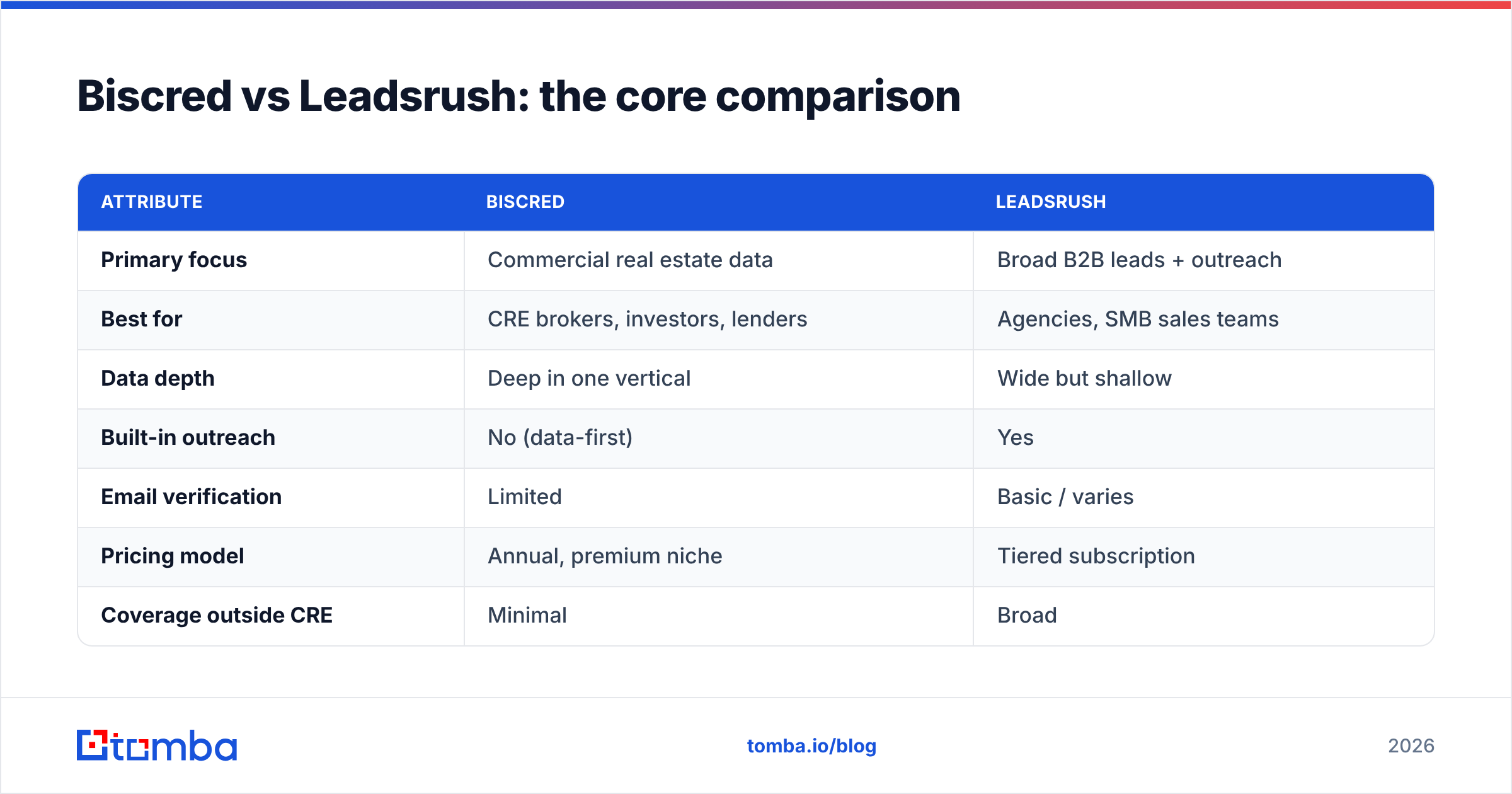
Here's how the two stack up on the attributes that actually affect your pipeline.
| Attribute | Biscred | Leadsrush |
|---|---|---|
| Primary focus | Commercial real estate data | Broad B2B leads + outreach |
| Best for | CRE brokers, investors, lenders | Agencies, SMB sales teams |
| Data depth | Deep in one vertical | Wide but shallow |
| Built-in outreach | No (data-first) | Yes |
| Email verification | Limited | Basic / varies |
| Pricing model | Annual, premium niche | Tiered subscription |
| Coverage outside CRE | Minimal | Broad |
| Learning curve | Moderate | Low |
The pattern is clear: Biscred trades breadth for depth, and Leadsrush trades depth for breadth and convenience. Neither is "better" in the abstract — it depends entirely on whether your market is one vertical or many.
Which factors actually decide the winner?#
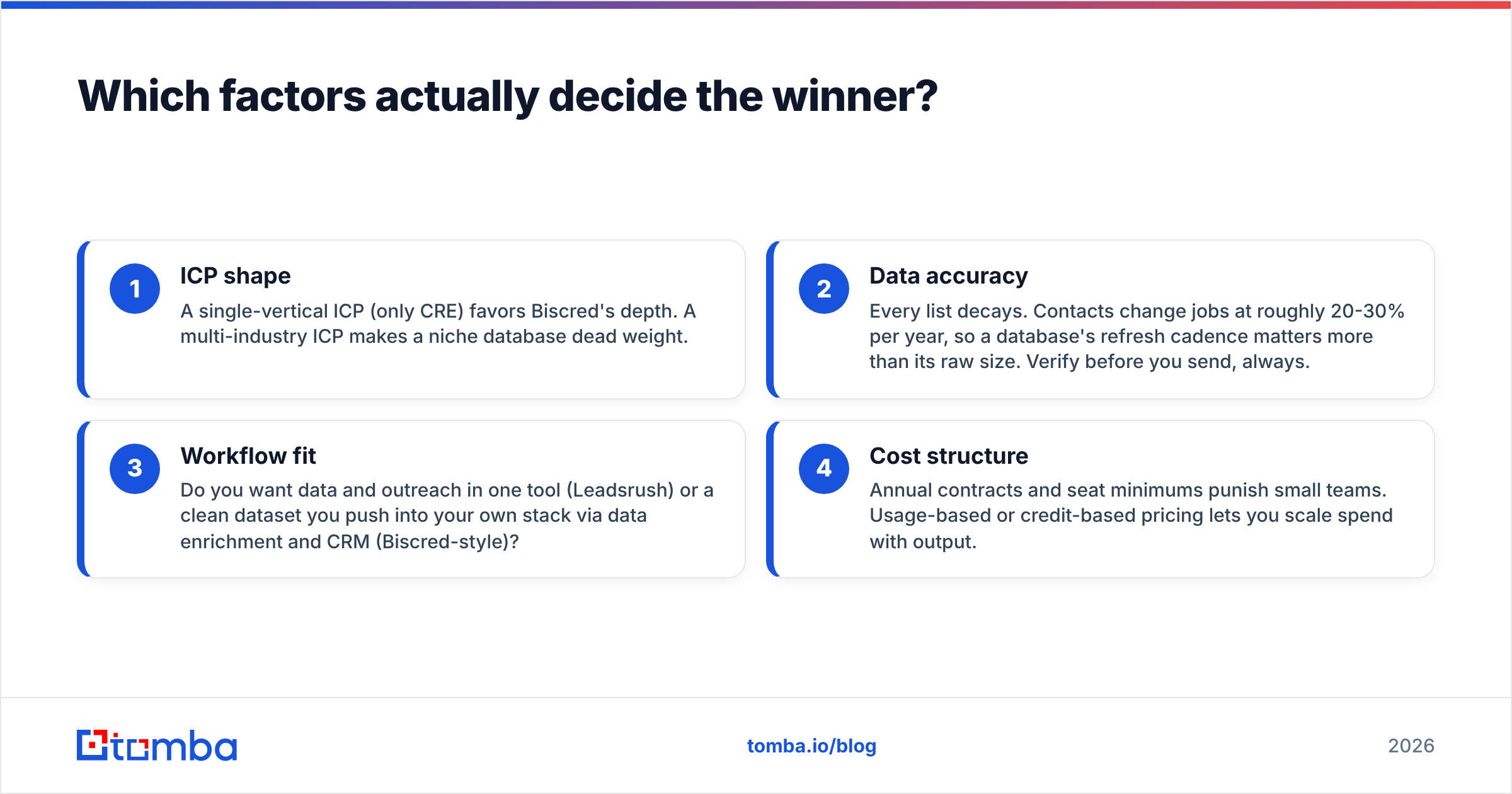
Strip away the feature lists and four things determine which tool earns its cost:
- ICP shape — A single-vertical ICP (only CRE) favors Biscred's depth. A multi-industry ICP makes a niche database dead weight.
- Data accuracy — Every list decays. Contacts change jobs at roughly 20-30% per year, so a database's refresh cadence matters more than its raw size. Verify before you send, always.
- Workflow fit — Do you want data and outreach in one tool (Leadsrush) or a clean dataset you push into your own stack via data enrichment and CRM (Biscred-style)?
- Cost structure — Annual contracts and seat minimums punish small teams. Usage-based or credit-based pricing lets you scale spend with output.
If you can only optimize for one, optimize for accuracy. A smaller list of verified, deliverable contacts outperforms a giant list that bounces — every time.
Is Biscred better than Leadsrush?#
Biscred is better if and only if commercial real estate is your entire addressable market. Its depth in property data, ownership structures, and CRE roles is genuinely useful and hard to replicate. For a CRE-focused brokerage or investment firm, that specialization can justify the premium.
For everyone else, Biscred is overkill. You'd be paying for vertical depth you can't use, with no path to prospect outside real estate.
Leadsrush is the safer default for generalist B2B teams — agencies juggling clients across industries, or SMBs that need contacts plus sending in one place. Just budget time and a separate verifier into the workflow, because broad-coverage data needs cleaning before it touches your inbox.
Where do both tools fall short?#
Two gaps show up regardless of which you pick:
- Verification is an afterthought. Niche and all-in-one tools both treat verification as a checkbox, not a core competency. Bounces above 3-5% put your domain reputation at risk, and neither tool is built to keep you under that line at scale. A dedicated catch-all verifier closes the gap that trips up most cold outreach.
- Lock-in pricing. Annual commitments and seat minimums mean you pay for capacity whether you use it or not. For teams with spiky or seasonal prospecting, that's wasted budget.
This is exactly where a flexible, accuracy-first email finder fits in — as a complement, or a replacement.
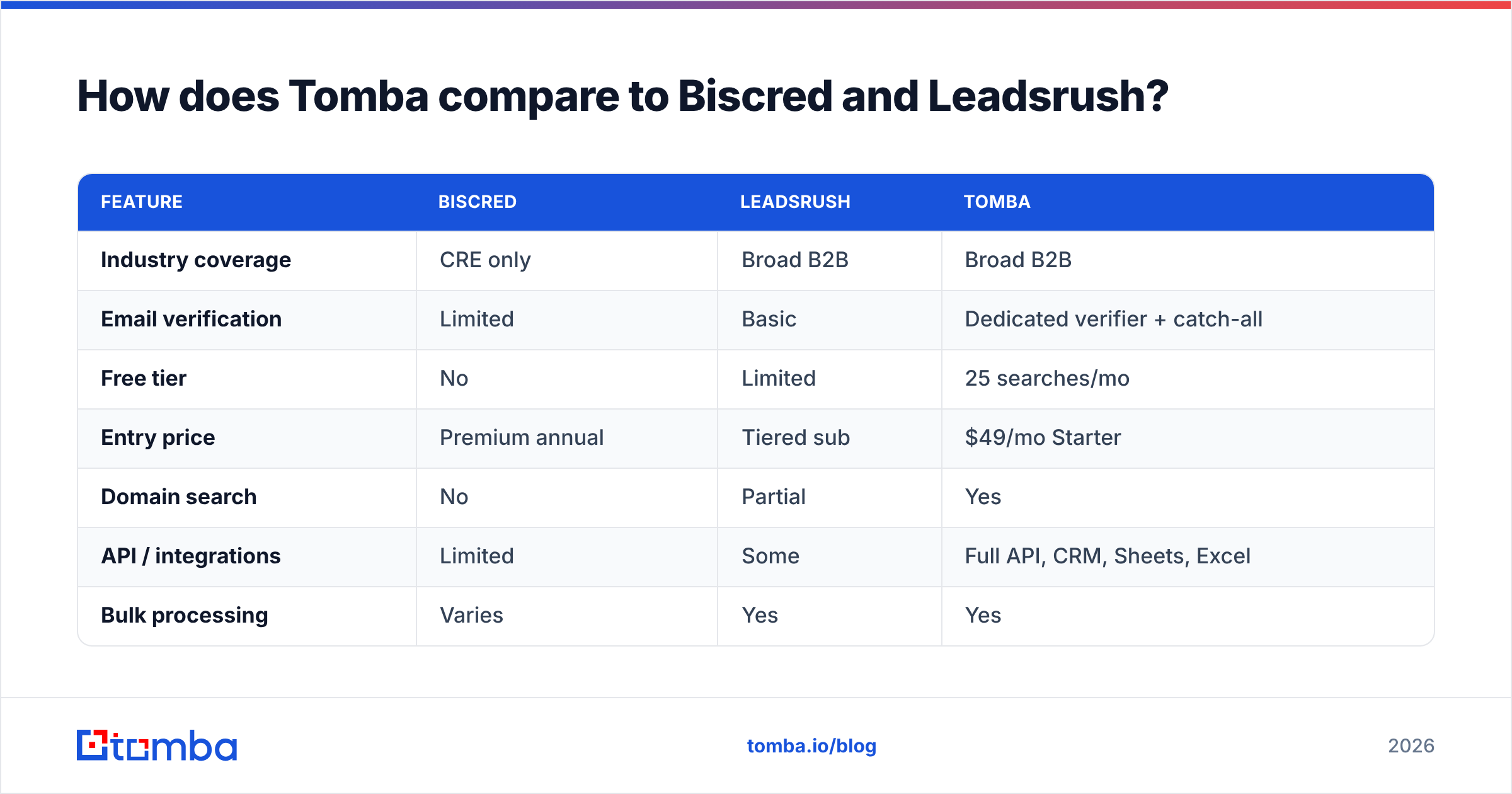
How does Tomba compare to Biscred and Leadsrush?#
Tomba takes a different angle: instead of locking you into one vertical or bundling mediocre sending, it focuses on the part both tools treat as secondary — finding and verifying accurate B2B emails across any industry, at usage-based pricing.
| Feature | Biscred | Leadsrush | Tomba |
|---|---|---|---|
| Industry coverage | CRE only | Broad B2B | Broad B2B |
| Email verification | Limited | Basic | Dedicated verifier + catch-all |
| Free tier | No | Limited | 25 searches/mo |
| Entry price | Premium annual | Tiered sub | $49/mo Starter |
| Domain search | No | Partial | Yes |
| API / integrations | Limited | Some | Full API, CRM, Sheets, Excel |
| Bulk processing | Varies | Yes | Yes |
With Tomba you can run a domain search to pull every public email pattern at a target company, verify each address before it enters a sequence, and enrich the record with role and company data. Pricing scales with use: a Free tier (25 searches/mo), then Starter at $49/mo, Growth at $99/mo, and Pro at $249/mo — see full Tomba pricing for the breakdown. No annual lock-in to test it.
That doesn't make Tomba a CRE database — Biscred still wins if you need deep property-ownership records. But for the everyday job of getting accurate, deliverable contacts across markets, a finder-plus-verifier stack is faster and cheaper than either tool here.
When should you pick each tool?#
- Pick Biscred if commercial real estate is 100% of your pipeline and you need ownership, asset, and deal-level depth that a generalist can't match.
- Pick Leadsrush if you're an agency or SMB that values one tool for list-building and sending, and you're willing to verify lists separately.
- Pick Tomba if you prospect across industries, care most about email accuracy and deliverability, and want usage-based pricing without an annual contract.
Many teams end up combining tools: a niche database for one segment, plus an accuracy-first finder for everything else. The Tomba API makes that easy to wire into an existing workflow rather than forcing a rip-and-replace.
How do you evaluate any B2B data tool?#
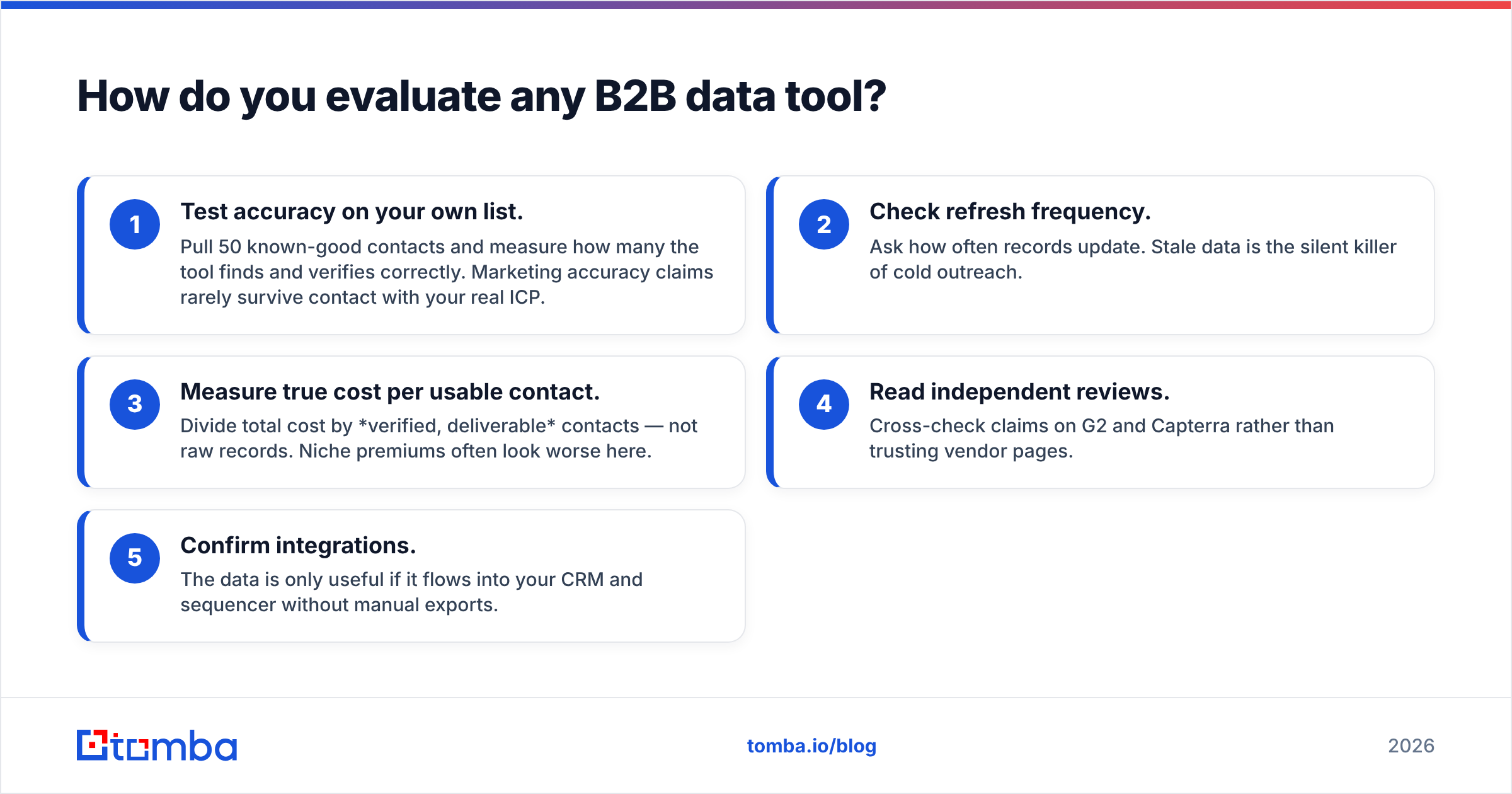
Before you commit budget to Biscred, Leadsrush, or anything else, run the same five-step check:
- Test accuracy on your own list. Pull 50 known-good contacts and measure how many the tool finds and verifies correctly. Marketing accuracy claims rarely survive contact with your real ICP.
- Check refresh frequency. Ask how often records update. Stale data is the silent killer of cold outreach.
- Measure true cost per usable contact. Divide total cost by verified, deliverable contacts — not raw records. Niche premiums often look worse here.
- Read independent reviews. Cross-check claims on G2 and Capterra rather than trusting vendor pages.
- Confirm integrations. The data is only useful if it flows into your CRM and sequencer without manual exports.
Run that on a free trial or free tier before a single annual invoice. The tool that scores best on verified contacts per dollar — not biggest database — is the one that grows your pipeline.
The bottom line#
Biscred and Leadsrush solve opposite problems: one is deep and narrow, the other wide and shallow. If your market is purely commercial real estate, Biscred's specialization is worth it. If you need broad, convenient lead-gen with built-in sending, Leadsrush fits — as long as you verify.
But if your real goal is accurate, deliverable B2B emails across any industry, without annual lock-in, start with the tool built for exactly that. Tomba's Email Finder finds and verifies contacts by name, domain, or company across every vertical, backed by a dedicated verifier and a full API — with a free tier to test before you pay. Run your toughest ICP through it and compare verified contacts per dollar against both tools above. The numbers usually make the decision for you.
Ready to find emails that actually work?
Join 150,000+ professionals who stopped guessing and started sending. Free credits on signup — no credit card required.
Get the Tomba newsletter
Practical outbound tactics and product updates — once every two weeks.
About the author