Biscred vs SalesIntel 2026: Which B2B Data Tool Wins?
Biscred targets commercial real estate data; SalesIntel chases human-verified B2B contacts. Here's an honest 2026 breakdown of pricing, coverage, accuracy, and where each one actually fits.
Choosing between Biscred and SalesIntel usually means you've already realized one thing: not every B2B database is built for your market. One of these tools was made for commercial real estate. The other was built for broad, human-verified B2B contact data. They overlap in name only.
This post breaks down where each platform actually earns its price, where it falls short, and how to decide which fits your pipeline in 2026 — without the vendor spin.
TL;DR — Biscred vs SalesIntel at a glance#
- Biscred is a niche commercial real estate (CRE) intelligence platform. If you sell into brokers, owners, investors, and property firms, its vertical depth is hard to beat.
- SalesIntel is a horizontal B2B data provider known for human-verified contacts, intent data, and US coverage across many industries.
- Pricing for both is quote-based and lands in the mid-to-high four figures annually — neither publishes a self-serve plan.
- Accuracy is SalesIntel's headline claim (human verification); Biscred's edge is CRE-specific firmographics you won't find in a general database.
- If you need flexible, pay-as-you-grow email data across any industry, a dedicated email finder like Tomba often beats both on cost and speed to value.
What is Biscred?#
Biscred is a commercial real estate data and prospecting platform. Think of it as a specialist surgeon rather than a general practitioner — it goes deep on one body of data instead of covering everything shallowly.
Its database is organized around CRE entities: property owners, brokerages, lenders, developers, and the people inside those firms. You can filter by asset class, deal role, firm type, and geography in ways a horizontal tool simply can't, because a horizontal tool never modeled that data in the first place.
For teams selling proptech, CRE services, lending products, or anything that lives inside the commercial property world, that specificity is the entire value. You're not wading through unrelated SaaS contacts to find a regional retail-property owner.
The trade-off is obvious: outside commercial real estate, Biscred has little to offer. It's a scalpel, and most go-to-market teams need a multi-tool.
What is SalesIntel?#
SalesIntel is a horizontal B2B contact and company data provider. Its signature pitch is human-verified data — a research team re-checks records on a cycle, rather than relying purely on automated scraping.
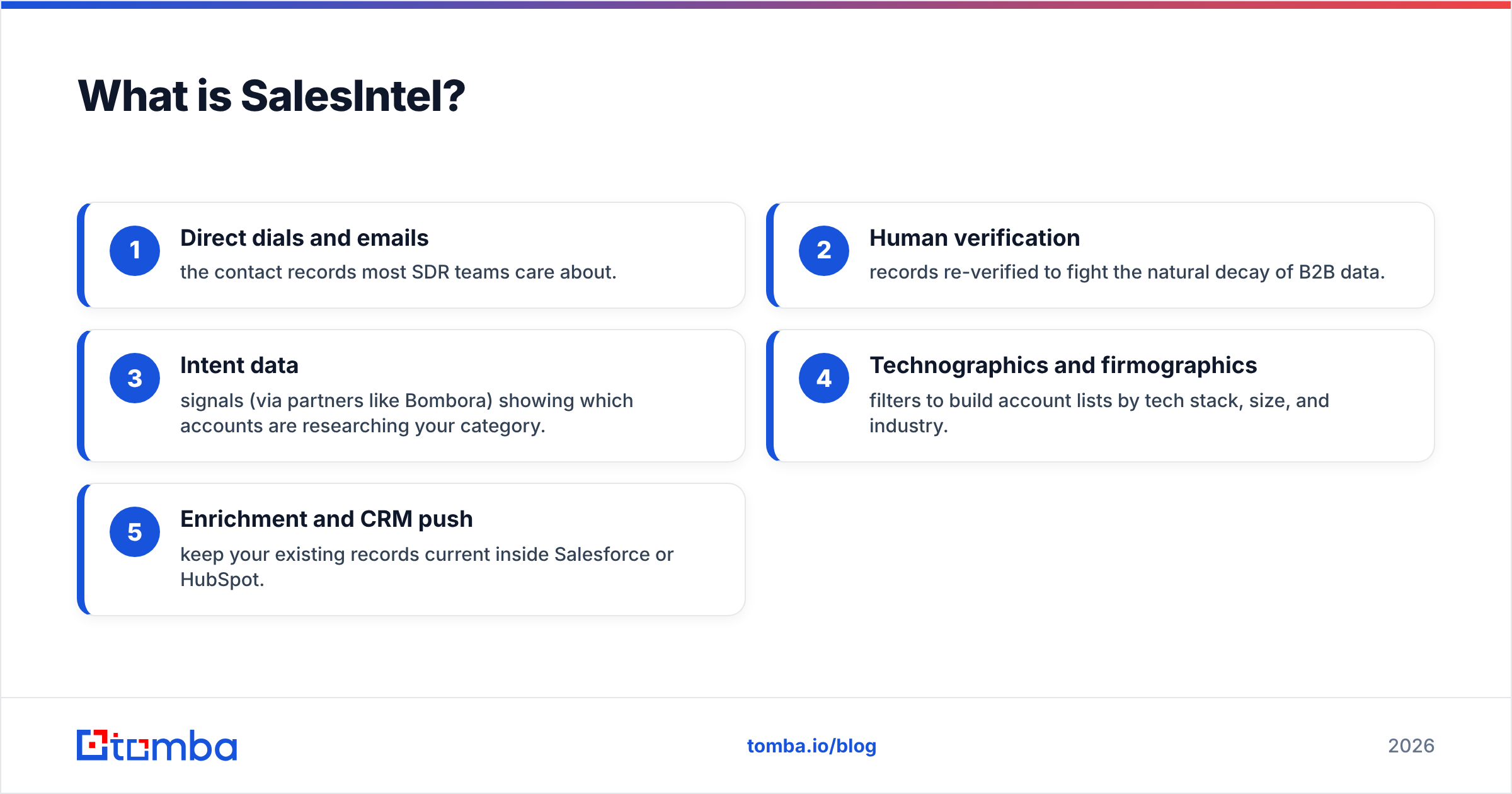
The platform combines:
- Direct dials and emails — the contact records most SDR teams care about.
- Human verification — records re-verified to fight the natural decay of B2B data.
- Intent data — signals (via partners like Bombora) showing which accounts are researching your category.
- Technographics and firmographics — filters to build account lists by tech stack, size, and industry.
- Enrichment and CRM push — keep your existing records current inside Salesforce or HubSpot.
SalesIntel competes with the likes of ZoomInfo, Lusha, and Apollo. It tends to win on US coverage and verification quality, and loses on breadth of international data and on price flexibility for small teams. You can read real-user takes on G2 before committing.

Biscred vs SalesIntel: the core comparison#
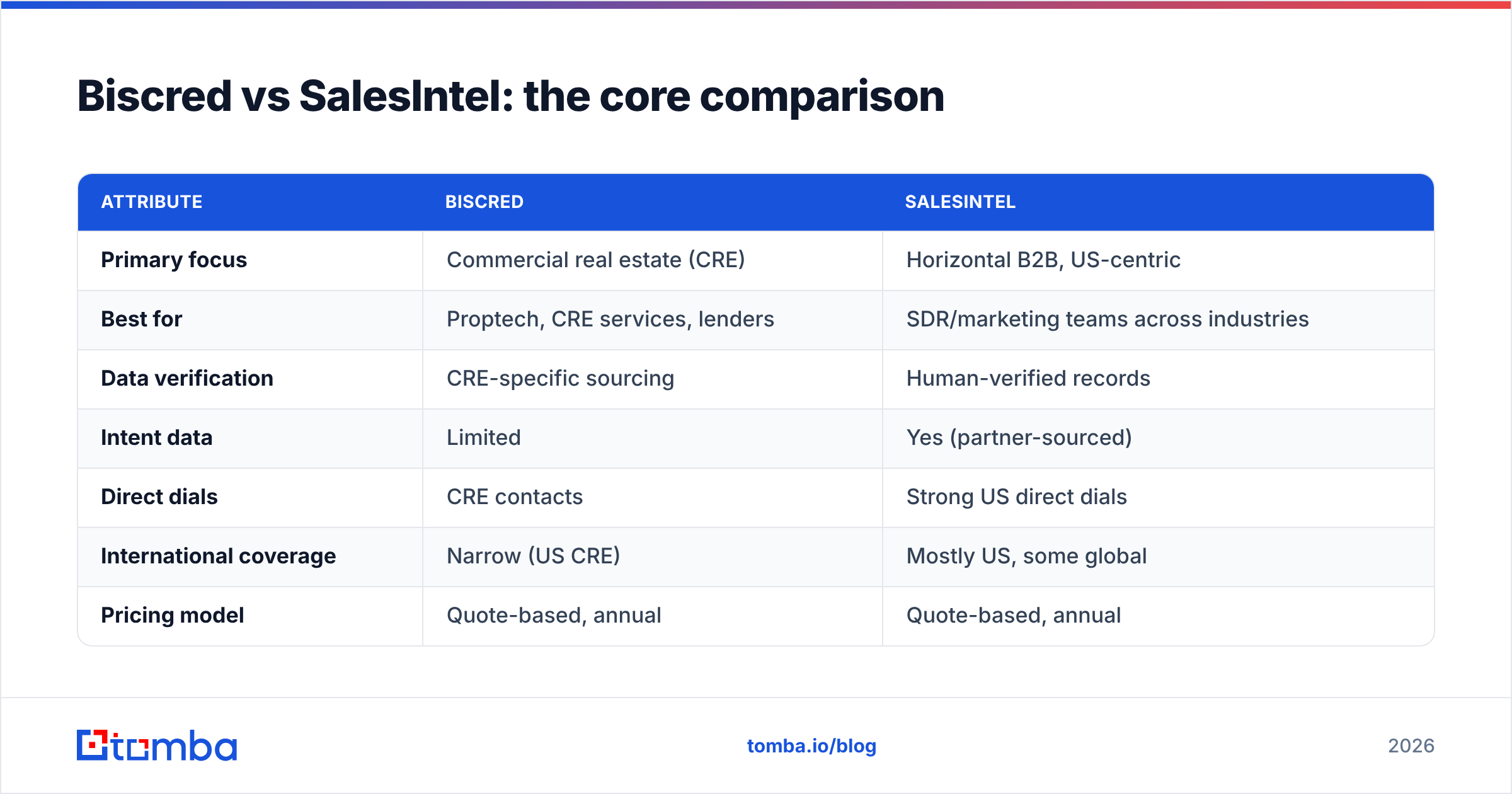
Here's the honest side-by-side. The two tools are aimed at different buyers, so "better" depends entirely on what you sell.
| Attribute | Biscred | SalesIntel |
|---|---|---|
| Primary focus | Commercial real estate (CRE) | Horizontal B2B, US-centric |
| Best for | Proptech, CRE services, lenders | SDR/marketing teams across industries |
| Data verification | CRE-specific sourcing | Human-verified records |
| Intent data | Limited | Yes (partner-sourced) |
| Direct dials | CRE contacts | Strong US direct dials |
| International coverage | Narrow (US CRE) | Mostly US, some global |
| Pricing model | Quote-based, annual | Quote-based, annual |
| Free / self-serve tier | No | No |
| Typical entry cost | Four to five figures/yr | Four to five figures/yr |
| API access | Limited | Yes |
The pattern: Biscred wins inside its vertical and is irrelevant outside it. SalesIntel wins on breadth and verification but asks for an annual commitment that smaller teams struggle to justify.
Is Biscred better than SalesIntel?#
Short answer: only if you sell into commercial real estate. For a CRE-focused team, Biscred's structured industry data will out-target SalesIntel every time, because SalesIntel was never built to model property roles, asset classes, or deal participants.
For everyone else, the question is backwards. If your ICP spans SaaS, manufacturing, healthcare, finance, or any mix, SalesIntel's horizontal coverage and human verification make it the more practical engine. Biscred would leave most of your market invisible.
So the real decision tree is:
- Selling into CRE? Start with Biscred, and bolt on a general email tool for edge cases.
- Selling broadly? Biscred is off the table; weigh SalesIntel against other horizontal providers.
- Budget-sensitive or testing channels? Neither quote-based contract is ideal — a usage-based email verifier and finder will get you live faster.
How accurate is the data?#
Accuracy is where buyers get burned, so be specific about what each vendor means.
SalesIntel leans on human verification: real researchers re-check records, which slows decay and is genuinely valuable for direct dials. No B2B database is 100% accurate — contacts change jobs constantly — but periodic re-verification meaningfully beats a stale scrape.
Biscred's accuracy is best judged within CRE. Its sourcing is tuned to property data, so a record's industry context tends to be richer than a generic provider's. But it isn't trying to be accurate about a software startup in Berlin, and you shouldn't expect it to be.
Whichever you pick, validate before you send. Even verified lists drift, and a quick verification pass protects your sender reputation and keeps bounce rates low. This is exactly why many teams pair a primary database with an independent verification layer instead of trusting a single source.
What about pricing and contracts?#
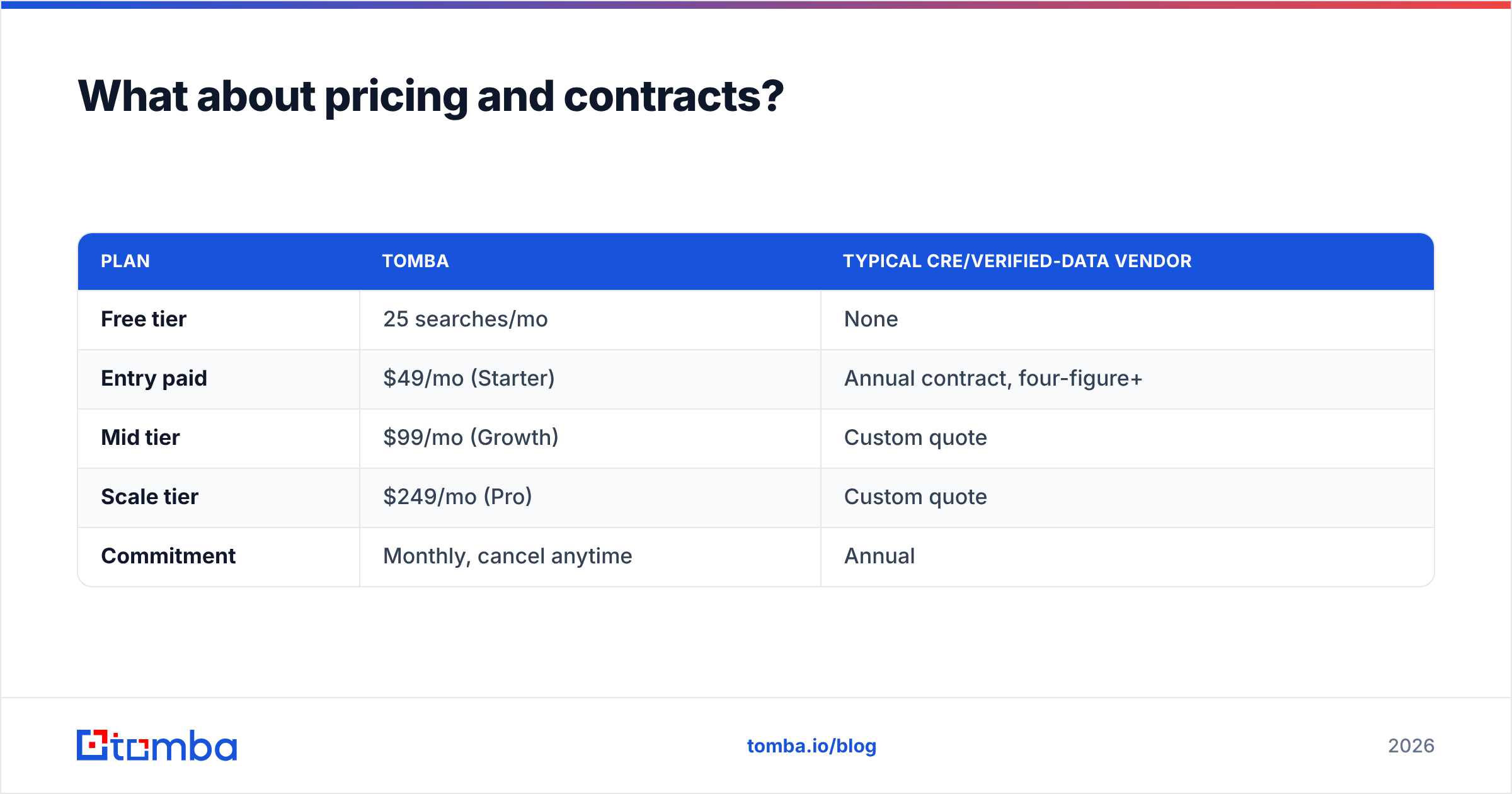
Both Biscred and SalesIntel use quote-based annual pricing with no public self-serve tier. You'll talk to sales, get a custom number, and commit for a year. That's standard for vertical and verification-heavy data providers, but it raises the stakes — you're betting a year's budget before you've stress-tested the data against your own list.
That contract friction is the single biggest reason smaller teams look elsewhere. Compare that with transparent, usage-based tooling:
| Plan | Tomba | Typical CRE/verified-data vendor |
|---|---|---|
| Free tier | 25 searches/mo | None |
| Entry paid | $49/mo (Starter) | Annual contract, four-figure+ |
| Mid tier | $99/mo (Growth) | Custom quote |
| Scale tier | $249/mo (Pro) | Custom quote |
| Commitment | Monthly, cancel anytime | Annual |
You can see the full breakdown on the Tomba pricing page. The point isn't that Tomba replaces a CRE database — it's that you don't need a five-figure annual contract to start finding and verifying business emails.
Where does an email finder fit alongside these tools?#
Most go-to-market stacks aren't one tool — they're layers. A horizontal database gives you the account list, an intent source tells you who's in-market, and an email finder fills the gaps the database missed and verifies what it returned.
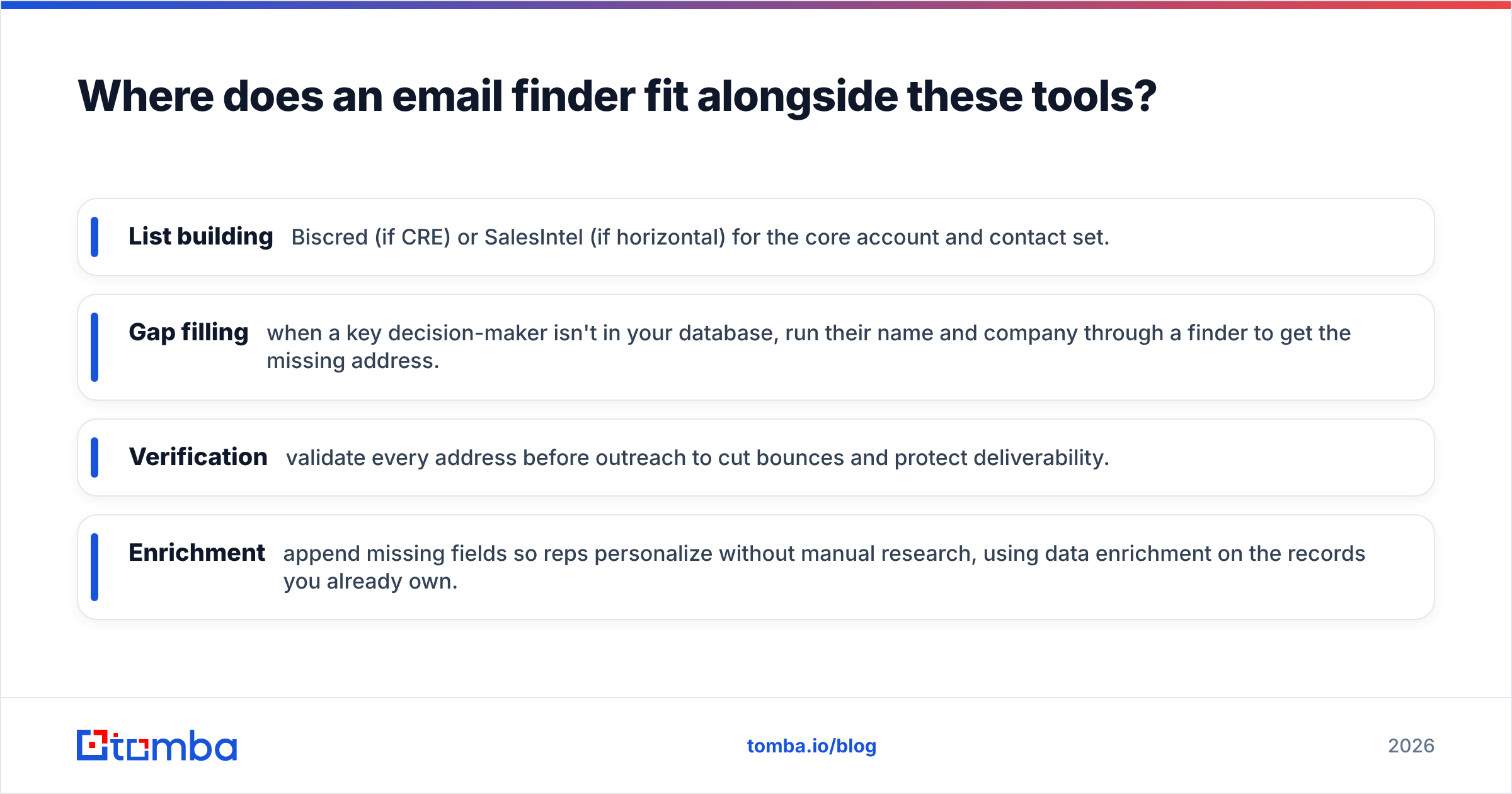
Here's a clean way to think about the layers:
- List building — Biscred (if CRE) or SalesIntel (if horizontal) for the core account and contact set.
- Gap filling — when a key decision-maker isn't in your database, run their name and company through a finder to get the missing address.
- Verification — validate every address before outreach to cut bounces and protect deliverability.
- Enrichment — append missing fields so reps personalize without manual research, using data enrichment on the records you already own.
That layered approach is why teams rarely treat "Biscred vs SalesIntel" as a winner-take-all decision. The database is the foundation; the finder and verifier are the cheap insurance that keep your campaigns landing.
Which should you choose in 2026?#
Decide by ICP first, budget second.
- You sell into commercial real estate: Biscred is the obvious primary. Its vertical depth pays for itself when CRE is your entire market. Add a flexible finder for non-CRE contacts and to verify before send.
- You sell broadly across B2B: Biscred can't serve you. Put SalesIntel on the shortlist against other horizontal providers, and prioritize human verification if direct-dial accuracy is critical to your motion.
- You're budget-conscious or still validating channels: Skip the annual contract for now. Start with transparent, usage-based email tooling, prove the channel, then graduate to a heavyweight database once the ROI is obvious.
Neither Biscred nor SalesIntel is "the best B2B data tool." They're sharp instruments for different jobs. The mistake is paying for the wrong one — a horizontal contract when you needed CRE depth, or a CRE specialist when your market is everywhere.
Start with flexible, verified email data#
Before you sign a five-figure annual contract, prove the channel with tooling you can turn on today. Tomba's email finder locates professional addresses by name, company, or domain, and its built-in verification keeps your bounce rate low and your sender reputation intact — on a free tier and monthly plans, not a yearly lock-in.
Use it as your gap-filler alongside Biscred or SalesIntel, or as your starting point while you decide which database your team actually needs. Either way, you'll send to addresses that land. Try Tomba free and find your first 25 contacts this month at no cost.
Ready to find emails that actually work?
Join 150,000+ professionals who stopped guessing and started sending. Free credits on signup — no credit card required.
Get the Tomba newsletter
Practical outbound tactics and product updates — once every two weeks.
About the author