Bizkonnect vs Apollo.io (2026): Which B2B Data Tool Wins?
A neutral, side-by-side breakdown of Bizkonnect vs Apollo.io in 2026 — org charts, data accuracy, pricing, and where a focused email finder beats both.
You are picking between two very different bets. Bizkonnect sells visual org charts and account intelligence built around mapping who reports to whom. Apollo.io sells a giant contact database bolted to a sequencing engine. They get lumped together because both promise "better B2B data," but they solve different problems — and neither is the cheapest way to just find a verified email.
This is a neutral teardown. Where Apollo wins, we say so. Where Bizkonnect wins, we say so. And where a dedicated email finder beats paying for a bloated suite, we say that too.
TL;DR — Bizkonnect vs Apollo.io in one screen#
- Bizkonnect is strongest at account mapping: actionable org charts, cleansed account lists, and event-triggered prospecting. It's a research layer, not an outbound engine.
- Apollo.io is strongest at scale and workflow: 270M+ contacts, built-in sequences, a dialer, and a CRM-lite in one tab. Breadth over precision.
- Pricing logic differs: Apollo is self-serve and credit-based ($0 free tier up to custom). Bizkonnect leans toward managed, quote-based data services.
- Data accuracy is the real battleground — both rely on aggregation, and emails still need independent verification before you send.
- If your core need is verified emails by domain or name, a focused tool like Tomba costs less and verifies in-line, instead of paying suite pricing for features you won't touch.
What is Bizkonnect?#
Bizkonnect is a sales intelligence provider that built its reputation on actionable org charts. Instead of handing you a flat CSV of names, it visualizes reporting structures inside a target account so reps can see decision-makers, influencers, and the path between them.
Its other pillars are account-list cleansing (deduping and enriching the accounts you already track) and trigger-based prospecting — surfacing companies showing buying signals like leadership changes, expansions, or tech adoption. The pitch is depth on a defined set of accounts, which suits ABM teams chasing 200 named logos rather than spraying 50,000 cold contacts.
The trade-off: Bizkonnect is closer to a managed data service than a self-serve SaaS. You often talk to a person, scope a project, and get a quote. That's great for enterprise ABM and miserable for a solo founder who wants 500 emails by Friday.
What is Apollo.io?#
Apollo.io is an all-in-one prospecting and engagement platform. At its center is a contact database the company reports at 270M+ contacts and 70M+ companies, wrapped in filters, a Chrome extension, email sequences, a dialer, and lightweight deal tracking.
The appeal is the single tab: find a lead, verify-ish the email, drop it into a sequence, and track replies without leaving Apollo. For a small team that doesn't want to stitch six tools together, that consolidation is the entire value proposition.
The catch is the catch with every mega-database — breadth costs precision. Apollo's data is crowd-aggregated and user-contributed, so freshness varies wildly by region and seniority. Credits also disappear faster than people expect once you turn on enrichment and exports. If you want a leaner stack, see how teams scope an Apollo alternative around just the data layer.

Bizkonnect vs Apollo.io: the core comparison#
Here is the honest side-by-side. Treat database sizes as vendor-reported, not audited.
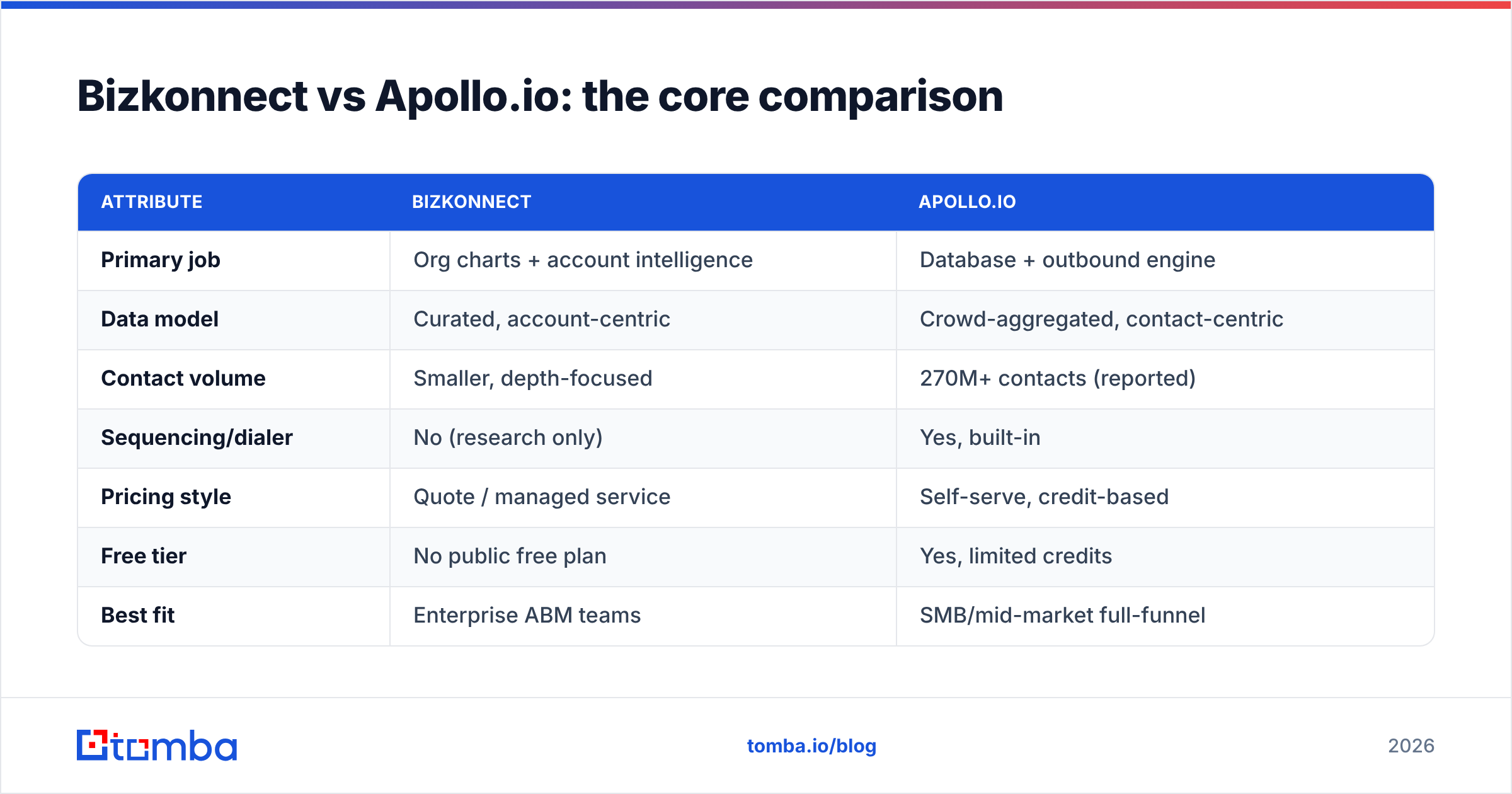
| Attribute | Bizkonnect | Apollo.io |
|---|---|---|
| Primary job | Org charts + account intelligence | Database + outbound engine |
| Data model | Curated, account-centric | Crowd-aggregated, contact-centric |
| Contact volume | Smaller, depth-focused | 270M+ contacts (reported) |
| Sequencing/dialer | No (research only) | Yes, built-in |
| Pricing style | Quote / managed service | Self-serve, credit-based |
| Free tier | No public free plan | Yes, limited credits |
| Best fit | Enterprise ABM teams | SMB/mid-market full-funnel |
| Weak spot | Not built for volume outreach | Variable data freshness |
The pattern is clear: Bizkonnect is a scalpel for named accounts; Apollo is a Swiss Army knife for whole-funnel motion. Choosing between them is really choosing your go-to-market shape, not picking a "better tool."
Which has better data accuracy?#
Neither vendor can promise accuracy you don't verify yourself — and that's the most important sentence in this article.
Both platforms assemble data from public sources, partnerships, and user activity. That means every record has a shelf life. People change jobs roughly every 2–3 years, and B2B contact data decays by an estimated 30% per year (a figure echoed by analyst firms like Gartner). Bizkonnect's curated, account-scoped model tends to be tighter on the accounts it actively maintains. Apollo's scale means more coverage but more stale or guessed rows, especially outside North America.
The practical fix is the same regardless of which you buy: treat every exported email as a hypothesis and verify it before sending. Bounces above 2–3% drag your domain reputation and hurt email deliverability for every future campaign. Running exports through a dedicated email verifier — including a catch-all verifier for tricky domains — is non-negotiable whether your raw data came from Bizkonnect, Apollo, or anywhere else.
A quick framework for judging any provider's data:
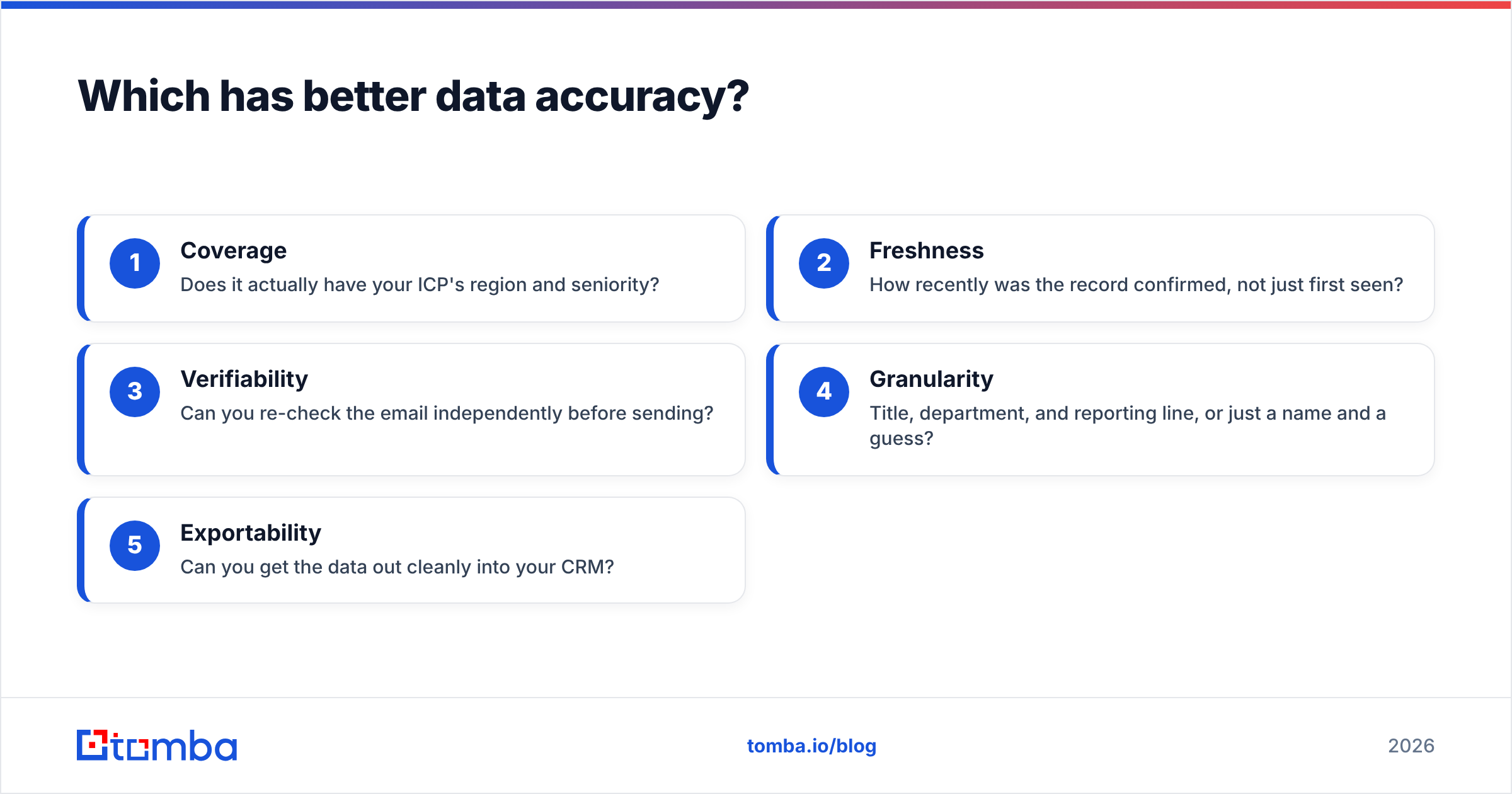
- Coverage — Does it actually have your ICP's region and seniority?
- Freshness — How recently was the record confirmed, not just first seen?
- Verifiability — Can you re-check the email independently before sending?
- Granularity — Title, department, and reporting line, or just a name and a guess?
- Exportability — Can you get the data out cleanly into your CRM?
How do pricing models compare?#
The pricing philosophies are almost opposites, which makes a raw dollar comparison misleading.
Apollo.io is transparent and self-serve: a free tier, then paid plans that scale by credits and seats. It's friendly to start and easy to overspend once enrichment, mobile numbers, and exports eat credits. Budget for more than the sticker plan implies.
Bizkonnect is quote-driven. You scope the accounts and deliverables, and pricing reflects a managed engagement. That's reasonable for a 12-month ABM program and overkill for a one-off list pull.
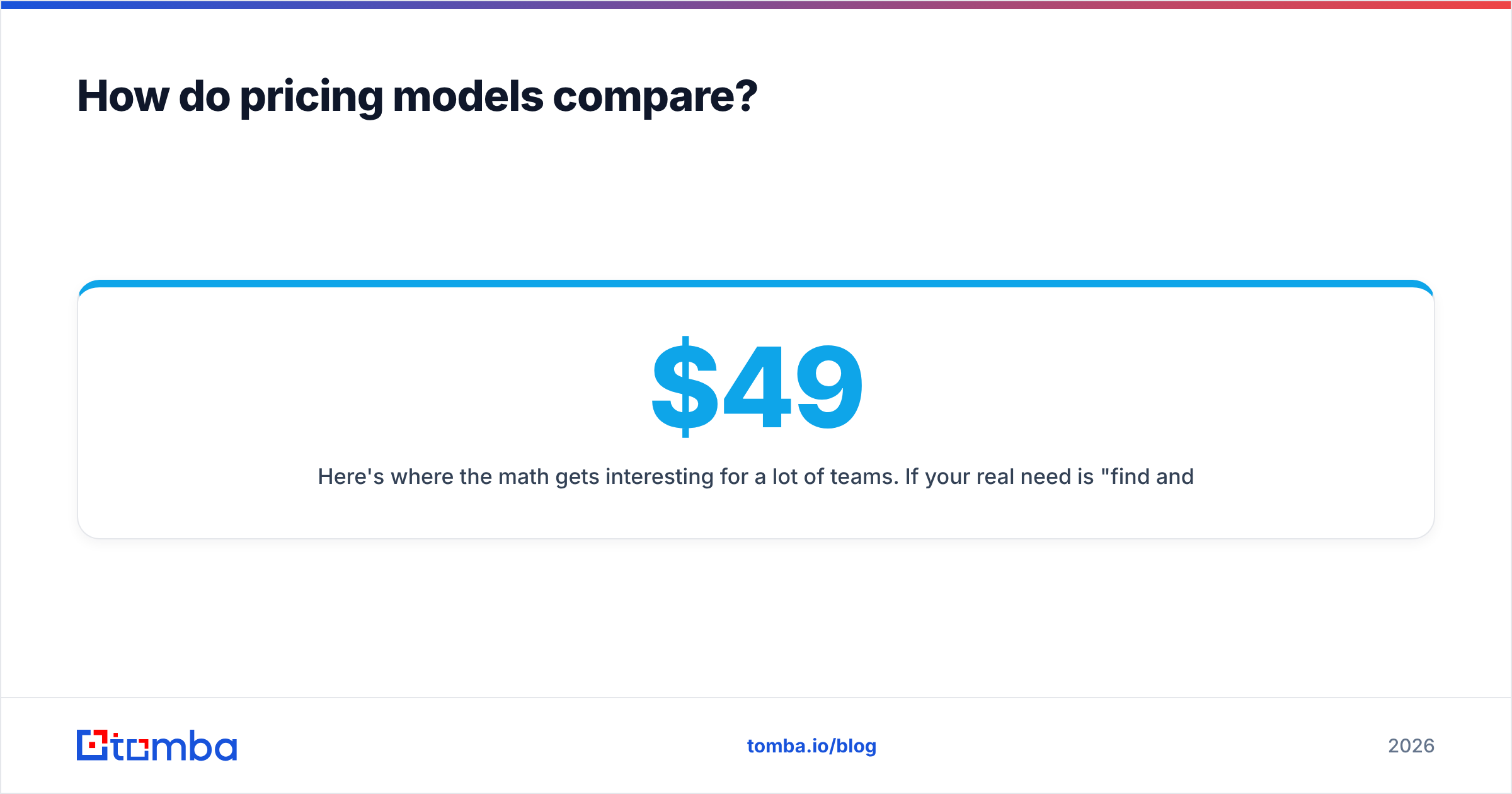
Here's where the math gets interesting for a lot of teams. If your real need is "find and verify professional emails by domain or name," you're often paying suite pricing for one feature. A focused finder is dramatically cheaper. Tomba's plans run a Free tier (25 searches/mo), Starter at $49/mo, Growth at $99/mo, and Pro at $249/mo — see full Tomba pricing. For pure email discovery, that beats both platforms on cost-per-verified-contact.

When should you choose Bizkonnect?#
Pick Bizkonnect when the account, not the contact, is the unit of work.
- You run named-account ABM and need to map buying committees, not dump leads.
- You sell into large, complex orgs where the reporting line determines the play.
- You want trigger alerts (leadership changes, expansions) on a curated target list.
- You have budget and a deal cycle long enough to justify a managed data engagement.
If that's you, Bizkonnect's org charts genuinely shorten the "who do I actually call?" research that reps otherwise do by hand in LinkedIn for hours. For finding the right email once you've identified the person, pair it with a domain search to pull verified company addresses fast.
When should you choose Apollo.io?#
Pick Apollo when you want one tool to find, sequence, and track without assembling a stack.
- You're an SMB or mid-market team running high-volume outbound.
- You'd rather have everything in one tab than integrate five point tools.
- You need a starting database and don't yet have a CRM workflow nailed down.
- Your motion is broad ICP, not 50 hand-picked logos.
The honest caveat: as you scale, many teams outgrow the all-in-one and split it apart — using a dedicated finder for data, a dedicated platform for sending, and a real CRM for tracking. That's also when a leaner Apollo alternative for the data layer starts to pencil out.
Where does a dedicated email finder beat both?#
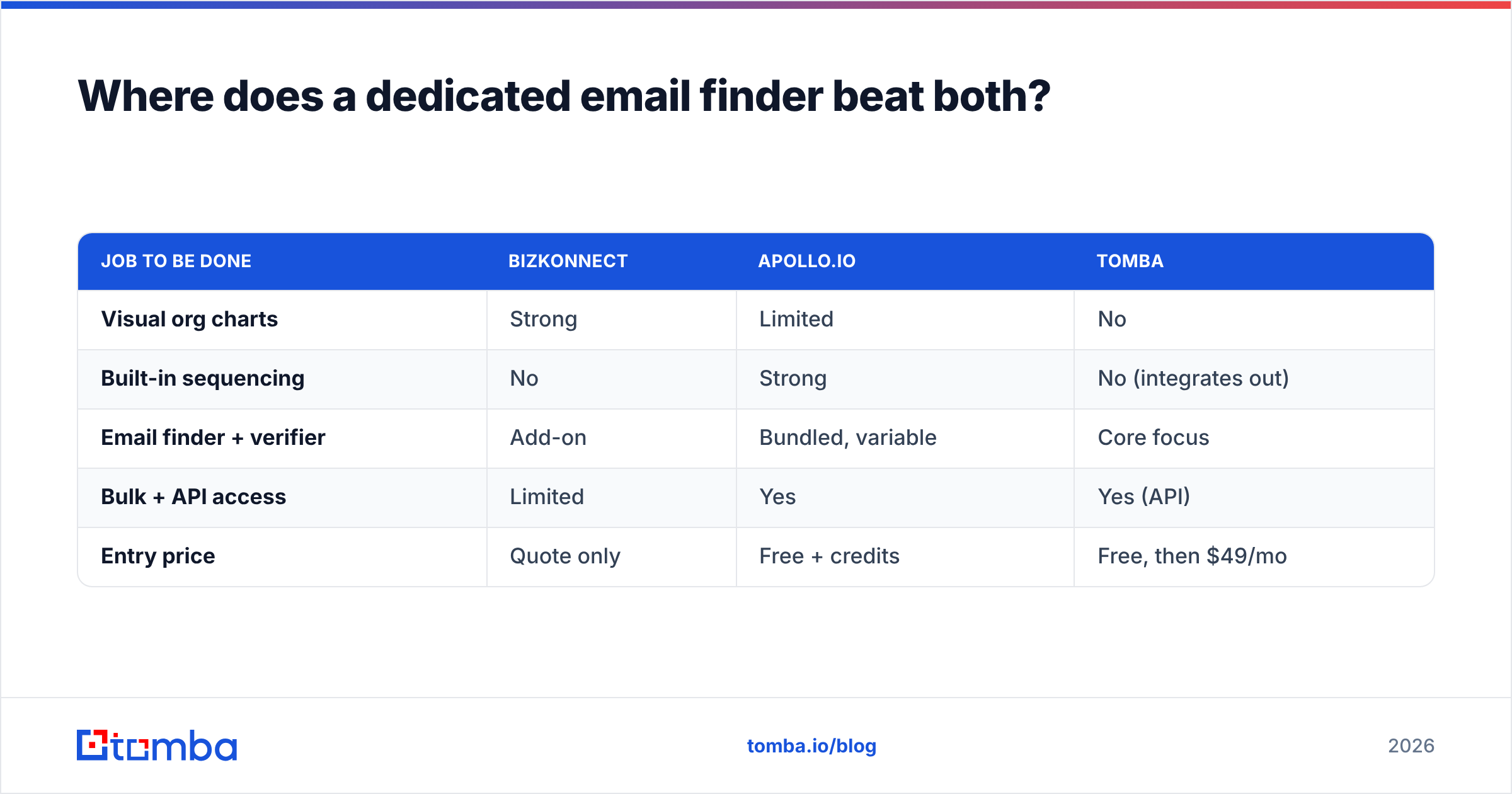
When your bottleneck is accurate, verified contact emails — not org charts and not a built-in dialer — a specialized finder wins on focus and price.
Generalist suites spread engineering across dozens of features. A focused tool puts all of it into one job: turning a name and a company into a deliverable, verified email. That shows up as higher match rates and lower bounce rates on the exact task you care about.
| Job to be done | Bizkonnect | Apollo.io | Tomba |
|---|---|---|---|
| Visual org charts | Strong | Limited | No |
| Built-in sequencing | No | Strong | No (integrates out) |
| Email finder + verifier | Add-on | Bundled, variable | Core focus |
| Bulk + API access | Limited | Yes | Yes (API) |
| Entry price | Quote only | Free + credits | Free, then $49/mo |
Tomba's stack is built around this single competency: the email finder, an email verifier, domain search, bulk lead generation, and data enrichment — all reachable from a Chrome extension, Google Sheets, or the API. You don't pay for a dialer you won't use. For independent benchmarks of finders generally, third-party review sites like G2 and Capterra are a sane place to sanity-check claims.
Can you use them together?#
Yes, and for many teams that's the smartest answer.
A clean division of labor looks like this: use Bizkonnect or Apollo for discovery — figuring out which accounts and people matter — then route the resulting list through a dedicated finder and verifier before anything hits a send tool. You get the suite's targeting plus a finder's accuracy, without trusting unverified rows to your sender reputation.
A typical stitched workflow:
- Identify target accounts and decision-makers in Bizkonnect (org charts) or Apollo (filters).
- Find the verified email with a dedicated finder by name + domain.
- Verify at the catch-all and SMTP level to strip risky addresses.
- Enrich with phone and firmographics where you need them.
- Sequence in your sending tool of choice with a clean, low-bounce list.
This is also how you keep response rates healthy: clean data in, fewer bounces, better inbox placement, more replies.
The verdict#
There's no universal winner — there's a winner for your motion.
- Choose Bizkonnect if you're an enterprise ABM team and org-chart depth on named accounts is the job.
- Choose Apollo.io if you're an SMB/mid-market team that values one-tab consolidation over precision.
- Choose a dedicated finder if the real bottleneck is accurate, verified emails — and you'd rather not pay suite pricing for features you'll ignore.
Most growing teams end up running discovery in a suite and trusting verification to a focused tool, because deliverability is where revenue actually leaks.
If finding and verifying professional emails is the part you want to nail, start free with the Tomba Email Finder. Find addresses by domain, name, or company, verify them in-line, and export clean lists to your CRM — no dialer tax, no credit roulette. The free tier gives you 25 searches a month to test match rates against your own ICP before you spend a dollar, and plans start at $49/mo when you're ready to scale.
Ready to find emails that actually work?
Join 150,000+ professionals who stopped guessing and started sending. Free credits on signup — no credit card required.
Get the Tomba newsletter
Practical outbound tactics and product updates — once every two weeks.
About the author