Bizkonnect vs Cufinder: B2B Data Tools Compared (2026)
Bizkonnect vs Cufinder, broken down by data coverage, org-chart depth, enrichment, pricing model, and which one actually fits your outbound motion in 2026.
You are choosing between two B2B data platforms that look similar on a feature grid but solve different problems. This breakdown shows where each one wins, where each one frustrates teams, and how to fill the gaps both leave behind.
TL;DR#
- Bizkonnect is built around actionable org charts and account intelligence — its strength is mapping who reports to whom inside a target account, not raw contact volume.
- Cufinder is a broader lead-generation and enrichment engine — company search, contact data, and email finding at list-building scale, with published self-serve plans.
- Pricing models differ sharply: Cufinder leans toward transparent tiered plans (including a free entry point), while Bizkonnect is quote-driven and sold as a sales-intelligence service.
- Neither is a dedicated email verifier. If deliverability matters, you still need a verification layer before you load addresses into a sequencer.
- Best move for most teams: pick the platform that matches your motion (account mapping vs. volume prospecting), then run every address through a real verifier like Tomba's email verifier before sending.
What is Bizkonnect?#
Bizkonnect is a sales-intelligence platform whose signature feature is actionable org charts. Instead of handing you a flat list of contacts, it tries to reconstruct the reporting structure inside a target company — who sits where, who reports to whom, and which roles influence a deal. Think of it less like a phone book and more like the seating chart at a wedding: knowing the names is useful, but knowing who is married to whom changes how you work the room.
That positioning makes Bizkonnect attractive to account-based teams selling complex, multi-stakeholder deals. You start from a named account, map the buying committee, and personalize outreach by role. Bizkonnect also bundles campaign tooling for sending personalized email to those mapped contacts. You can read more about its positioning on the official Bizkonnect site.
The trade-off: org-chart depth is hard to maintain at scale, so coverage is strongest for mid-to-large enterprises and thinner for small businesses. Pricing is not published as simple self-serve tiers — it is sold as a service with a quote.
What is Cufinder?#
Cufinder is a lead-generation and data-enrichment platform aimed at volume. Its core jobs are company search, contact discovery, email finding, and bulk enrichment — turning a domain or company name into usable contact records. It exposes both a web app and an API, and it publishes self-serve plans including a free entry tier, which lowers the barrier for solo founders and small teams. The official details live at cufinder.io.
Where Bizkonnect optimizes for depth inside one account, Cufinder optimizes for breadth across many accounts. If your motion is "build a list of 2,000 SaaS marketing managers in North America and enrich them," Cufinder's model fits more naturally than Bizkonnect's org-chart-first approach.

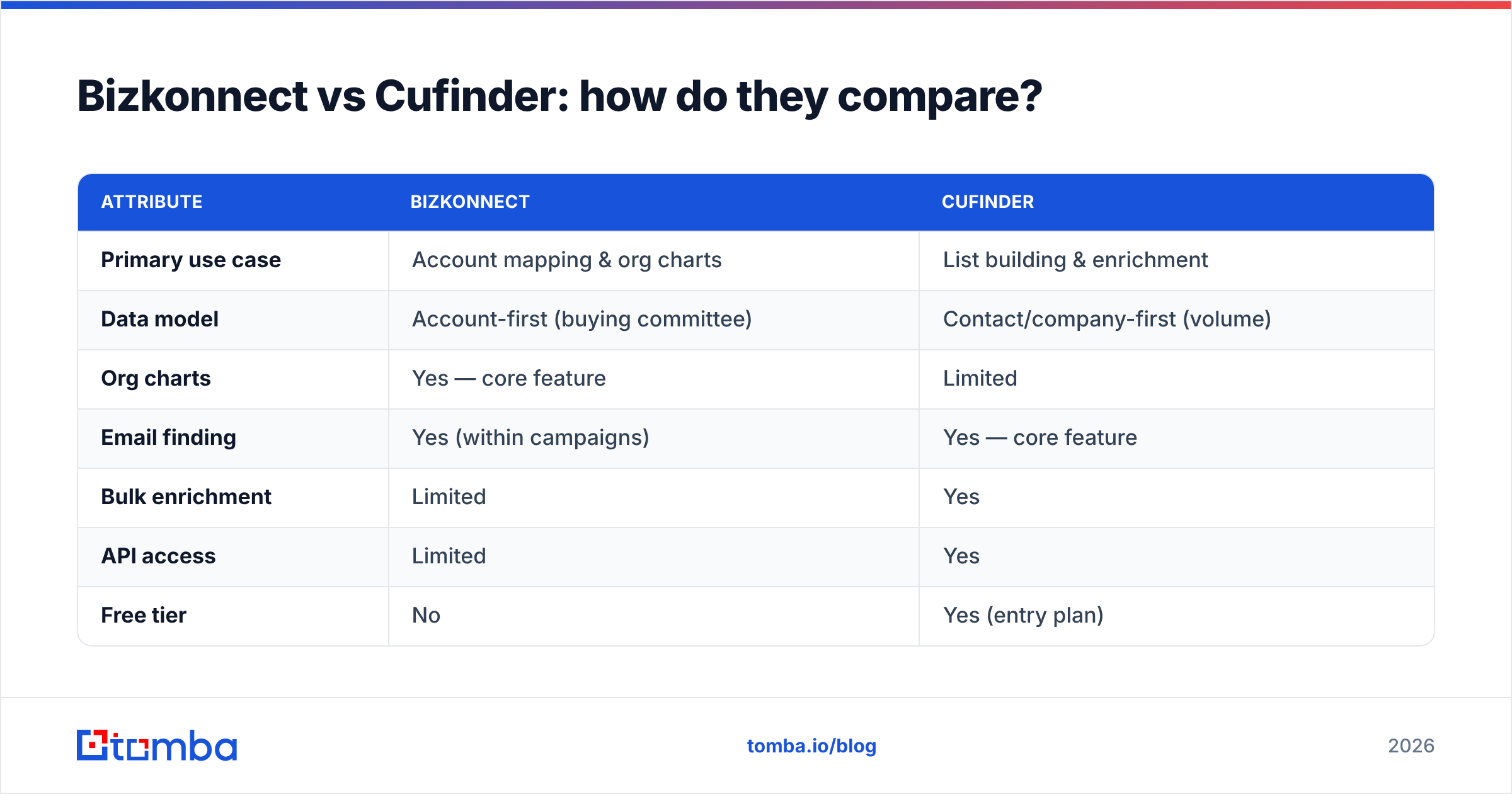
Bizkonnect vs Cufinder: how do they compare?#
Here is the head-to-head on the attributes that actually change your workflow. Treat the pricing rows as directional — Bizkonnect is quote-based and Cufinder adjusts tiers over time, so confirm current numbers on each vendor's site before you buy.
| Attribute | Bizkonnect | Cufinder |
|---|---|---|
| Primary use case | Account mapping & org charts | List building & enrichment |
| Data model | Account-first (buying committee) | Contact/company-first (volume) |
| Org charts | Yes — core feature | Limited |
| Email finding | Yes (within campaigns) | Yes — core feature |
| Bulk enrichment | Limited | Yes |
| API access | Limited | Yes |
| Free tier | No | Yes (entry plan) |
| Pricing model | Quote / custom | Published self-serve tiers |
| Best fit | Enterprise ABM teams | SMB & high-volume outbound |
The pattern is clear: these tools are not really substitutes. They are two different answers to two different questions. Choosing well starts with naming your own motion before you compare logos.
Which one fits your sales motion?#
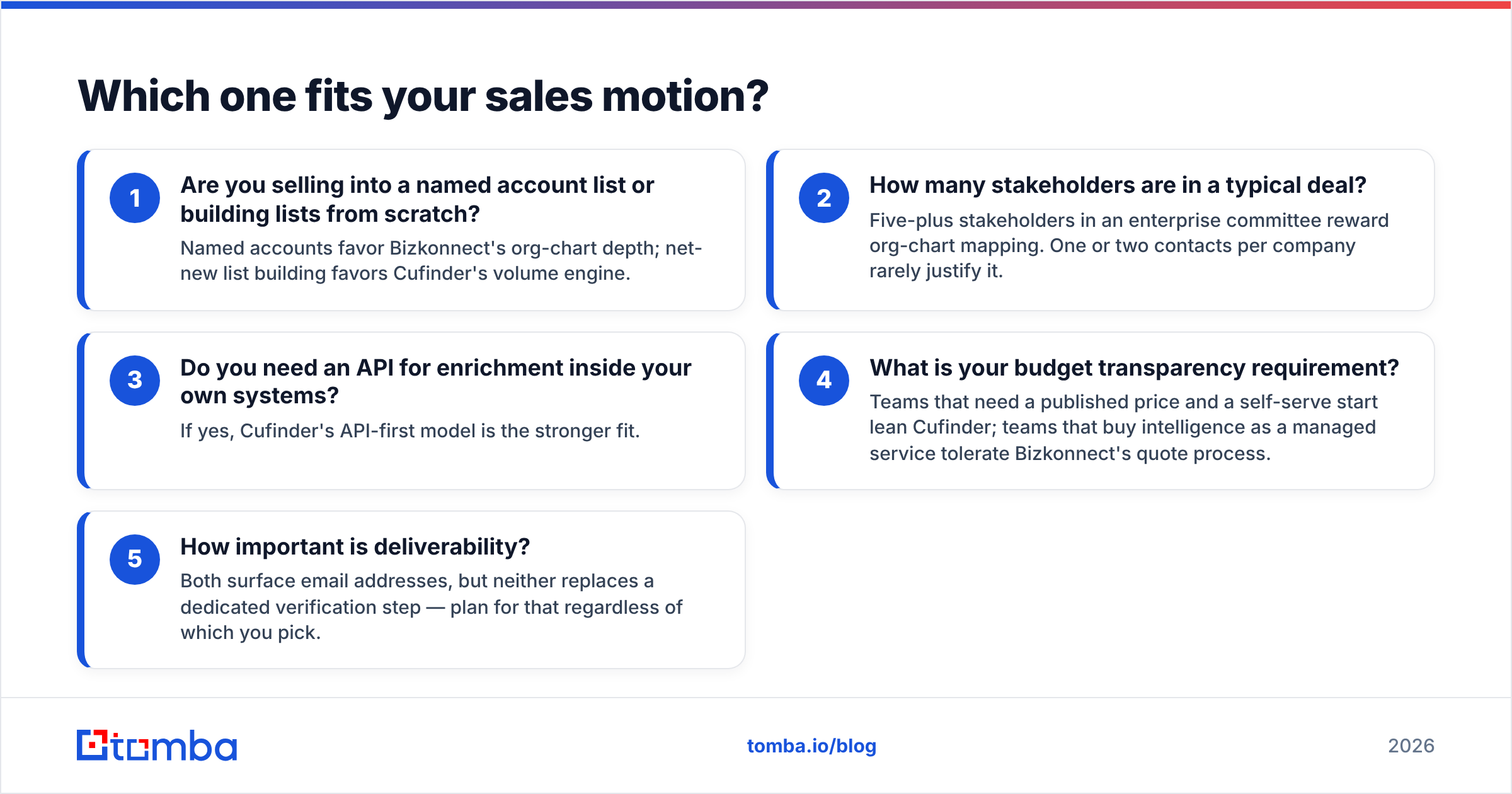
Use these five questions to decide quickly. Each one points you toward the platform whose design philosophy matches your reality.
- Are you selling into a named account list or building lists from scratch? Named accounts favor Bizkonnect's org-chart depth; net-new list building favors Cufinder's volume engine.
- How many stakeholders are in a typical deal? Five-plus stakeholders in an enterprise committee reward org-chart mapping. One or two contacts per company rarely justify it.
- Do you need an API for enrichment inside your own systems? If yes, Cufinder's API-first model is the stronger fit.
- What is your budget transparency requirement? Teams that need a published price and a self-serve start lean Cufinder; teams that buy intelligence as a managed service tolerate Bizkonnect's quote process.
- How important is deliverability? Both surface email addresses, but neither replaces a dedicated verification step — plan for that regardless of which you pick.
If you answered "named accounts, many stakeholders, managed service," Bizkonnect is your platform. If you answered "net-new lists, API, transparent pricing," Cufinder wins. Most teams running modern outbound land closer to the Cufinder side — but they still hit the same wall on data freshness.
How accurate and fresh is the data?#
This is where both tools get judged in the real world, and where buyers should be skeptical of any vendor's headline accuracy claim. B2B contact data decays fast — people change jobs constantly, and an org chart that was correct last quarter can be 20-30% wrong today. Bizkonnect's org-chart model is especially exposed to this, because a reporting structure is harder to keep current than a single email field.
Independent reviews are the sanity check here. Cross-reference each vendor's self-reported numbers against user reviews on G2 before you trust a coverage or accuracy figure in a sales deck. Pay attention to comments about bounce rates and stale titles, not just star ratings.
The practical implication: whatever address either platform hands you, verify it before you send. A finder's job is to surface a likely address; a verifier's job is to confirm it resolves to a real, accepting mailbox. Skipping the second step is how sender reputation quietly erodes. If you want the mechanics, our guide on email deliverability walks through why unverified lists tank inbox placement.
Where do both tools leave gaps?#
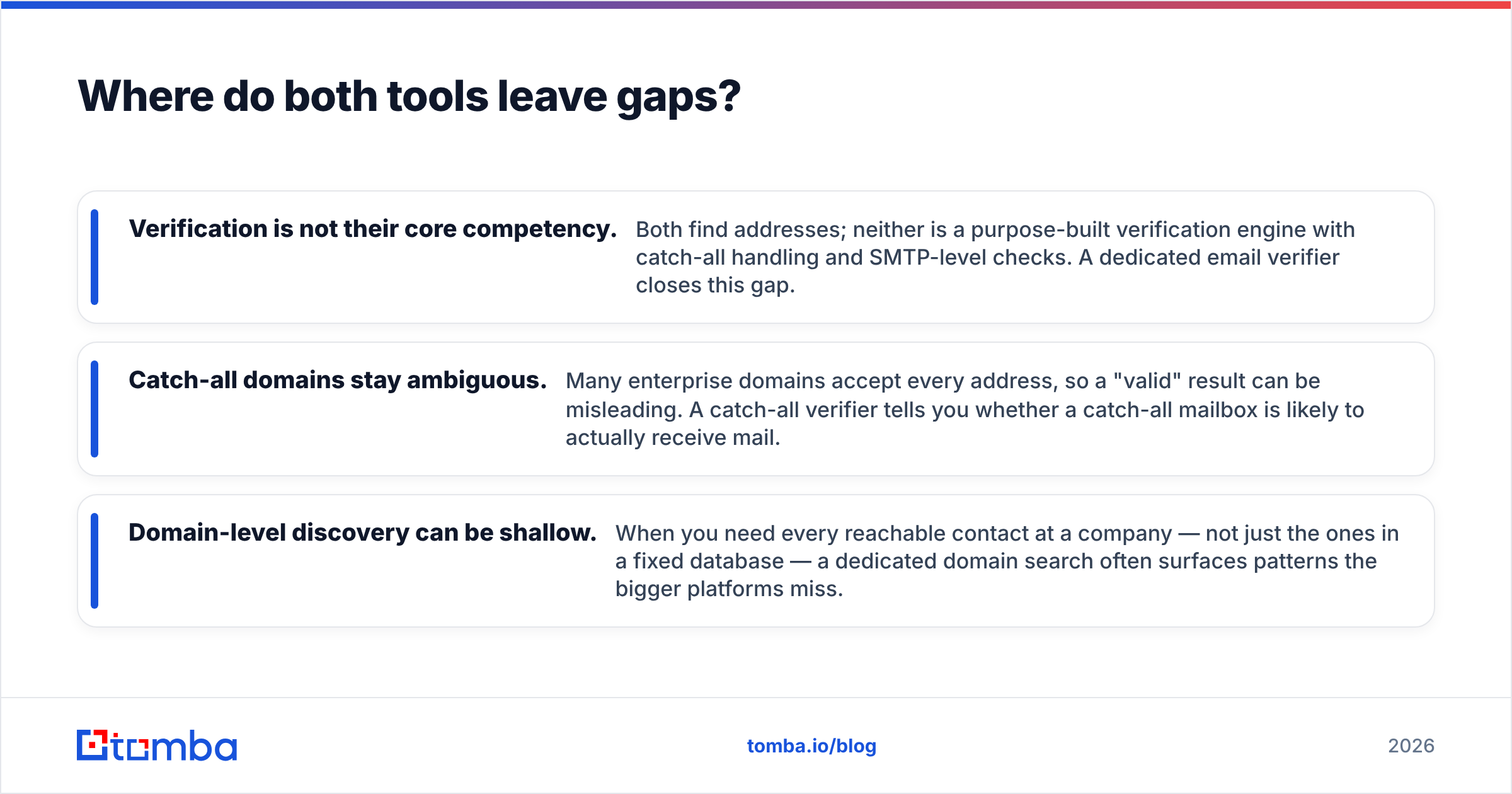
Even if you pick the right platform, three gaps tend to remain — and they are the same three gaps regardless of which logo you choose.
- Verification is not their core competency. Both find addresses; neither is a purpose-built verification engine with catch-all handling and SMTP-level checks. A dedicated email verifier closes this gap.
- Catch-all domains stay ambiguous. Many enterprise domains accept every address, so a "valid" result can be misleading. A catch-all verifier tells you whether a catch-all mailbox is likely to actually receive mail.
- Domain-level discovery can be shallow. When you need every reachable contact at a company — not just the ones in a fixed database — a dedicated domain search often surfaces patterns the bigger platforms miss.
None of these are reasons to avoid Bizkonnect or Cufinder. They are reasons to pair whichever you choose with a focused data-quality layer so the addresses you pay to find actually convert into delivered, opened email.
How does pricing really compare?#
Pricing is the cleanest dividing line between these two. Cufinder publishes self-serve plans and a free tier, so you can start small and scale credits as you grow — predictable for finance and easy to pilot. Bizkonnect is sold as a quote-based sales-intelligence engagement, which suits enterprises with procurement processes but frustrates teams that want to swipe a card and start today.
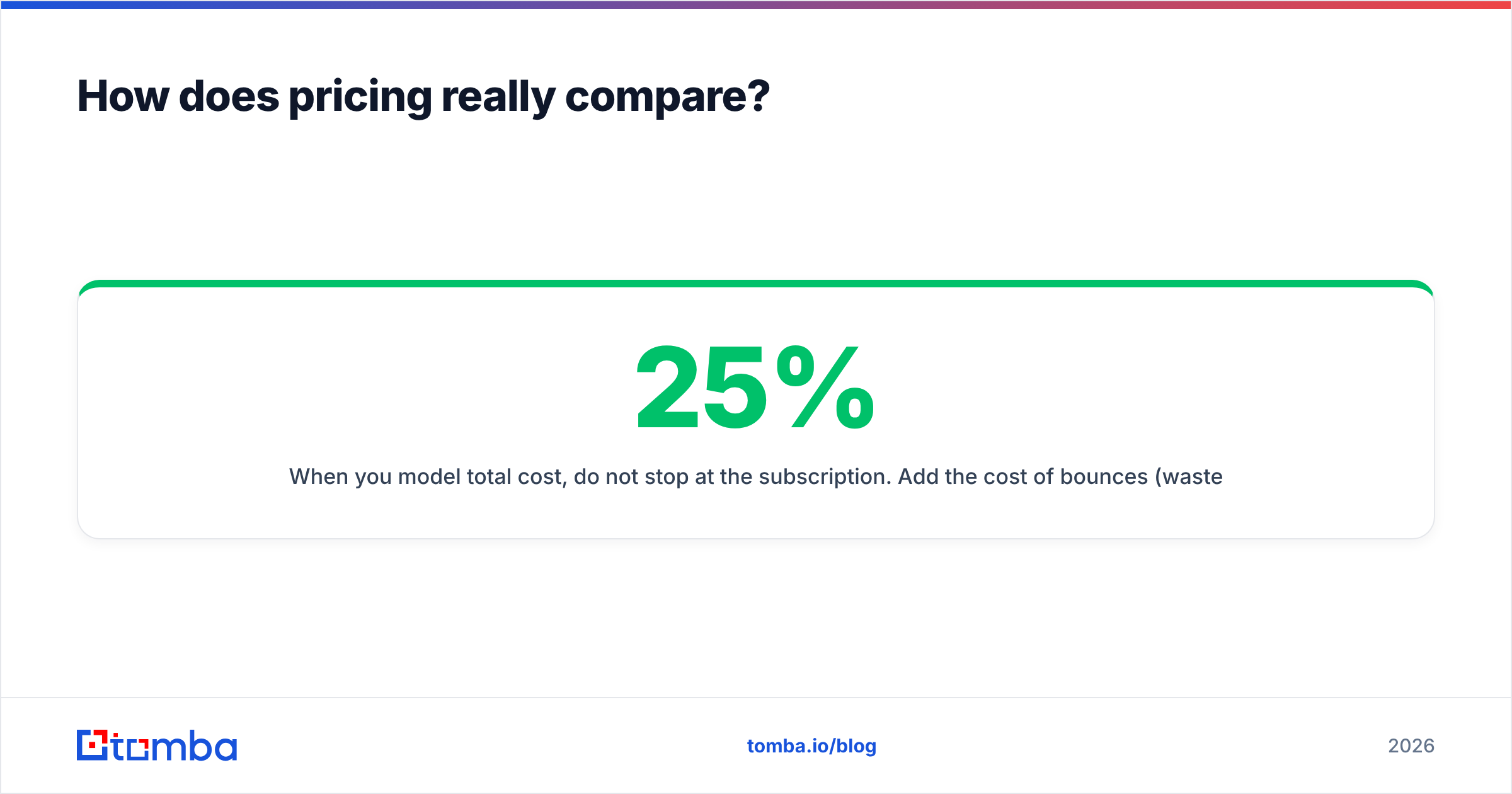
When you model total cost, do not stop at the subscription. Add the cost of bounces (wasted sequencer slots, domain reputation damage) and the cost of verification you will need either way. A platform that looks cheaper per contact gets expensive fast if 25% of its addresses bounce. For a clean comparison point on credit-based pricing, see Tomba pricing, which runs from a free tier at 25 searches per month up to a $49/mo Starter plan, $99/mo Growth, and $249/mo Pro.
Is there a simpler alternative for email data?#
Yes — if your real need is finding and verifying professional email addresses rather than mapping enterprise org charts, a focused tool is faster and cheaper than either platform. Both Bizkonnect and Cufinder bundle email finding inside larger suites; that breadth is valuable when you need it and overhead when you do not.
Tomba is built specifically for the find-and-verify job. The Tomba Email Finder locates professional addresses by name, domain, or company, and every result can be checked against the verifier and catch-all tools in the same workflow. You can also enrich records through data enrichment and pull whole companies at once with the B2B database. For teams that just want clean, deliverable contacts without a quote call or a sprawling seat-based contract, that focus is the point.
The bottom line#
Pick Bizkonnect if you run enterprise ABM and live or die by knowing the buying committee — its org charts are the reason to buy it, and no amount of raw volume replaces them. Pick Cufinder if you build net-new lists at volume, want API access, and need transparent, self-serve pricing. They are not competitors so much as tools for two different jobs.
But settle the data-quality question separately from the platform question. Whatever you choose, the addresses are only worth what they deliver — and that depends on verification, not on which vendor's database they came from.
Ready to stop guessing whether your contacts are real? Start with the Tomba Email Finder and run a free batch of searches today — find professional emails by domain or name, verify them in the same pass, and load only deliverable addresses into your sequencer. It is the data-quality layer that makes the rest of your stack worth paying for.
Ready to find emails that actually work?
Join 150,000+ professionals who stopped guessing and started sending. Free credits on signup — no credit card required.
Get the Tomba newsletter
Practical outbound tactics and product updates — once every two weeks.
About the author