Bizkonnect vs Generect 2026: Which B2B Data Tool Wins?
Bizkonnect vs Generect compared head-to-head for 2026 — org charts vs real-time leads, pricing, accuracy, integrations, and where each one actually fits your GTM stack.
Bizkonnect vs Generect: The 2026 B2B Data Showdown
Choosing between Bizkonnect and Generect comes down to one question: do you need to map an account or fill a pipeline? They look similar on a feature grid, but they solve different problems — and neither is a drop-in replacement for a dedicated email finder.
TL;DR#
- Bizkonnect is an account-intelligence tool built around org charts, decision-maker mapping, and "actionable" company signals. Best for ABM teams selling into large, complex orgs.
- Generect is a real-time lead-generation engine that pulls fresh contacts and emails on demand, with a heavy LinkedIn and API focus. Best for high-volume outbound teams.
- Pricing and data freshness are the real dividing lines: Bizkonnect leans toward curated, human-verified org data; Generect leans toward live, automated extraction.
- Email accuracy is a weak spot for both — if verified, deliverable email is your bottleneck, a specialist like Tomba Email Finder outperforms either as the dedicated layer.
- Most mature GTM stacks end up using an intelligence tool plus a verification layer, not one tool pretending to be both.
What is Bizkonnect?#
Bizkonnect is a sales-intelligence platform whose signature feature is the org chart. Instead of handing you a flat list of contacts, it tries to show you how a company is structured — who reports to whom, which division owns the budget, and which "actionable" triggers (leadership changes, expansions, tech adoption) are worth a touch this quarter.
That makes it an account-based-marketing tool at heart. If you sell six-figure deals into enterprises where seven people sign off, knowing the reporting lines is genuinely valuable. Bizkonnect's pitch is that mapping the buying committee up front shortens the deal cycle.
The tradeoff: org-chart data is expensive to maintain, so coverage is deepest on large, well-documented companies and thinnest on SMBs and fast-moving startups. You're paying for curation, not raw volume.
What is Generect?#
Generect comes at the market from the opposite direction. It's a real-time lead-generation engine: you define a target (filters, a LinkedIn search, a company list) and it returns fresh contacts — names, titles, companies, and emails — pulled and enriched on demand rather than from a static, aging database.
Its strength is freshness and automation. Because data is generated at query time, you're less likely to hit the "this person left 14 months ago" problem that plagues stale databases. Generect also leans hard into API and LinkedIn workflows, which appeals to teams running automated outbound at scale.
The tradeoff is the inverse of Bizkonnect's: you get breadth and recency, but far less of the structured "who-reports-to-whom" context that complex enterprise selling needs.

How do Bizkonnect and Generect compare on features and pricing?#
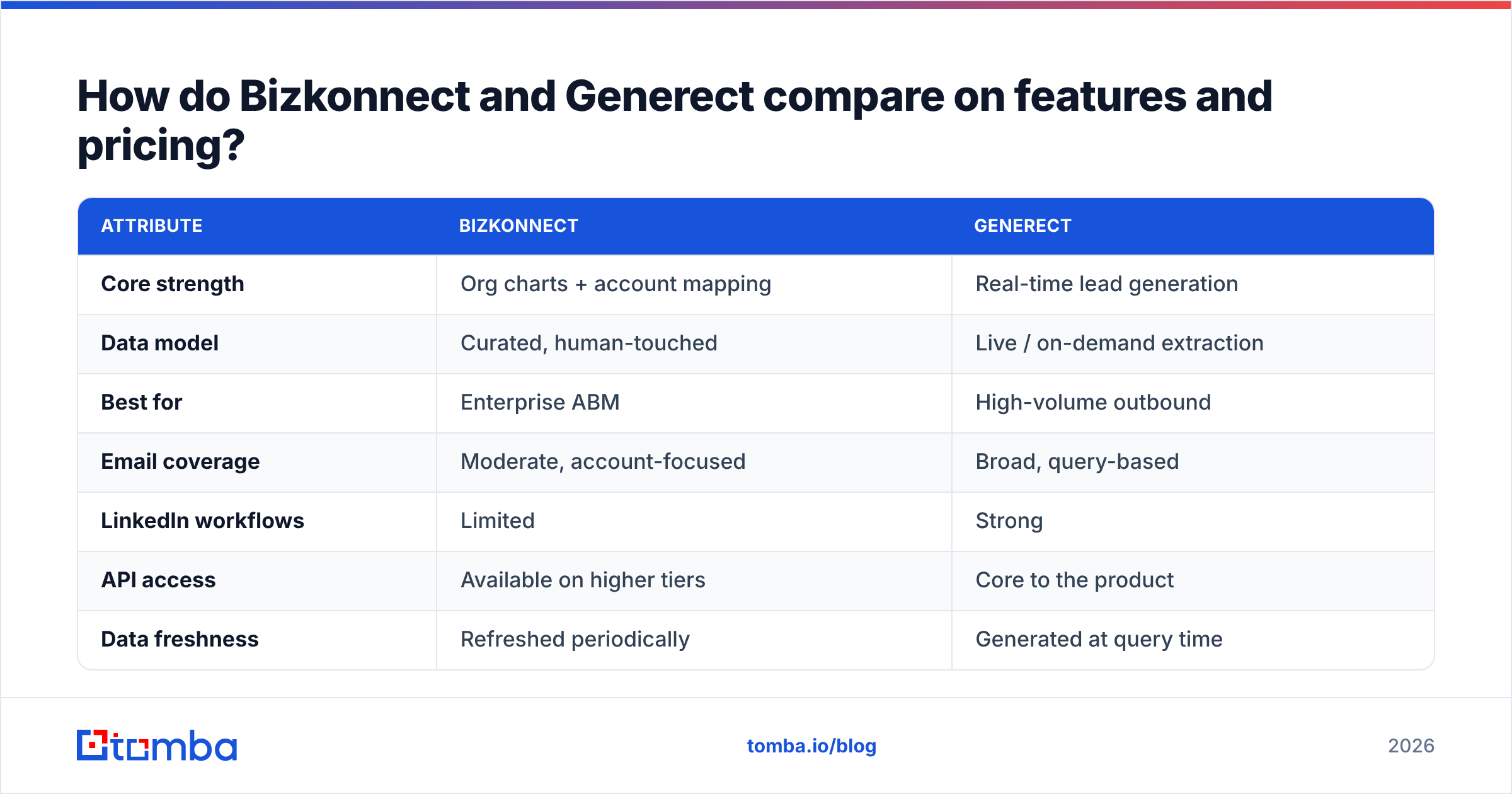
Here's the head-to-head on the attributes that actually change a buying decision. (Both vendors keep pricing partly gated, so treat dollar figures as indicative starting points and confirm on their sites.)
| Attribute | Bizkonnect | Generect |
|---|---|---|
| Core strength | Org charts + account mapping | Real-time lead generation |
| Data model | Curated, human-touched | Live / on-demand extraction |
| Best for | Enterprise ABM | High-volume outbound |
| Email coverage | Moderate, account-focused | Broad, query-based |
| LinkedIn workflows | Limited | Strong |
| API access | Available on higher tiers | Core to the product |
| Data freshness | Refreshed periodically | Generated at query time |
| Entry pricing | Custom / quote-based | Lower, usage-based tiers |
| Free trial | Demo-gated | Limited free credits |
A simpler way to read that table: Bizkonnect optimizes for depth on a few accounts; Generect optimizes for breadth across many. Neither ranking is "better" in the abstract — it depends on your motion.
Which one fits your go-to-market motion?#
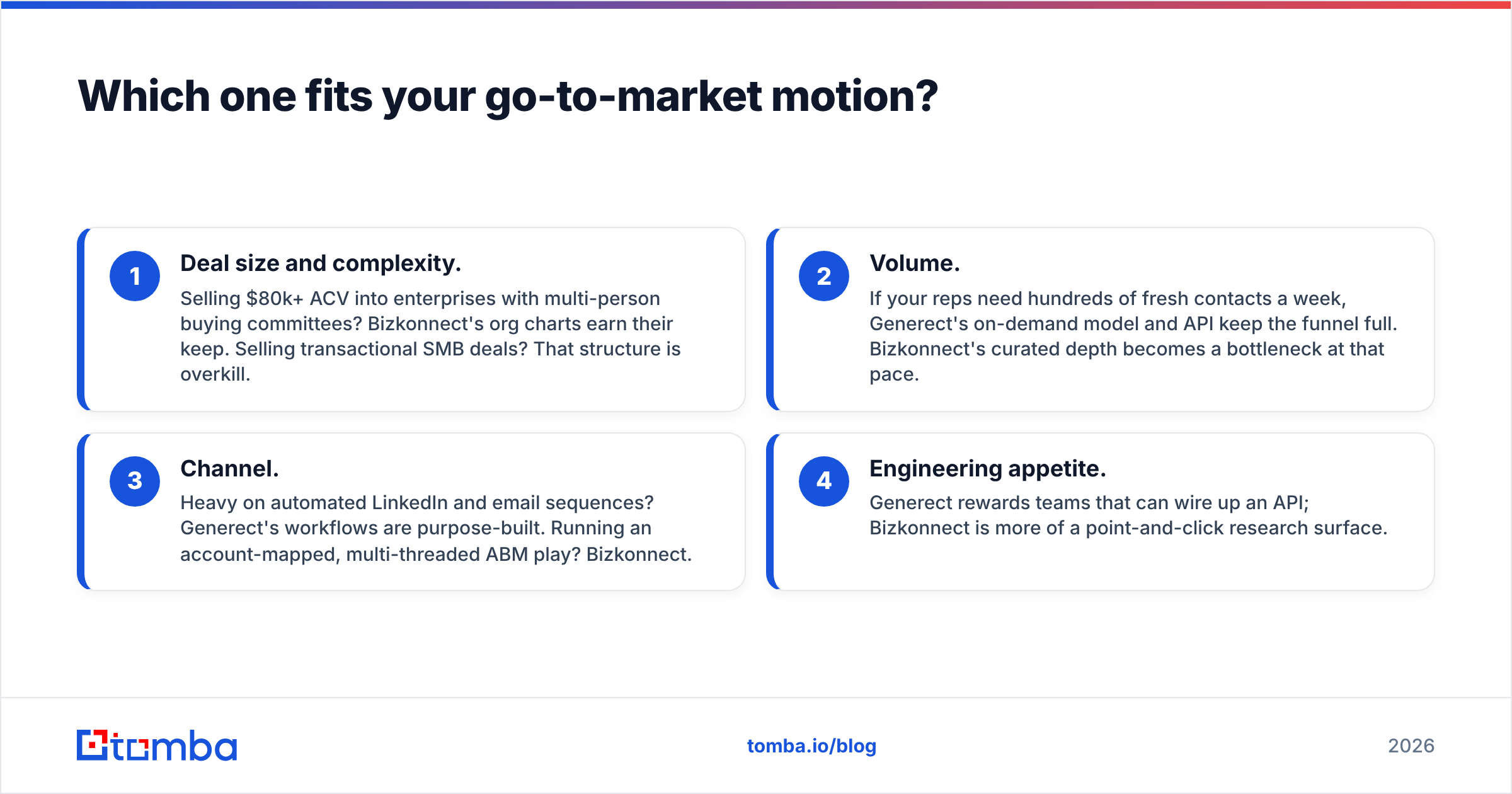
Pick based on how you actually sell, not on the longer feature list. Use these four checks:
- Deal size and complexity. Selling $80k+ ACV into enterprises with multi-person buying committees? Bizkonnect's org charts earn their keep. Selling transactional SMB deals? That structure is overkill.
- Volume. If your reps need hundreds of fresh contacts a week, Generect's on-demand model and API keep the funnel full. Bizkonnect's curated depth becomes a bottleneck at that pace.
- Channel. Heavy on automated LinkedIn and email sequences? Generect's workflows are purpose-built. Running an account-mapped, multi-threaded ABM play? Bizkonnect.
- Engineering appetite. Generect rewards teams that can wire up an API; Bizkonnect is more of a point-and-click research surface.
If you map your answers and they split across both columns, that's a strong signal you actually need a layered stack — an intelligence source plus a separate verification and enrichment layer. That's where most teams land, and it's worth understanding where each vendor gets its data before you commit budget.
Is either tool good enough for email accuracy?#
Short answer: both are "fine," neither is great, and that gap quietly tanks your campaigns.
Here's the mechanism. Outbound performance is gated by email deliverability, and deliverability collapses when your bounce rate climbs. Mailbox providers read a high bounce rate as a spam signal and throttle your whole domain — so 200 bad addresses don't just waste 200 sends, they degrade the next 2,000. An intelligence tool that's 88% accurate on email looks acceptable on a slide and is painful in a real send.
Bizkonnect's email data is a byproduct of its account focus; Generect's is broader but generated automatically, which means catch-all and role-based addresses slip through. Neither runs the multi-step SMTP and catch-all validation that a dedicated verifier does as its entire job.
The fix isn't to abandon your intelligence tool — it's to verify before you send. Run any list, regardless of source, through a dedicated email verifier so unknowns and catch-alls get flagged before they hit your sequencer. This is exactly the layered approach G2's category data shows mature teams adopting: best-of-breed sourcing plus best-of-breed verification, per G2's email-finder category.

Where does Tomba fit against Bizkonnect and Generect?#
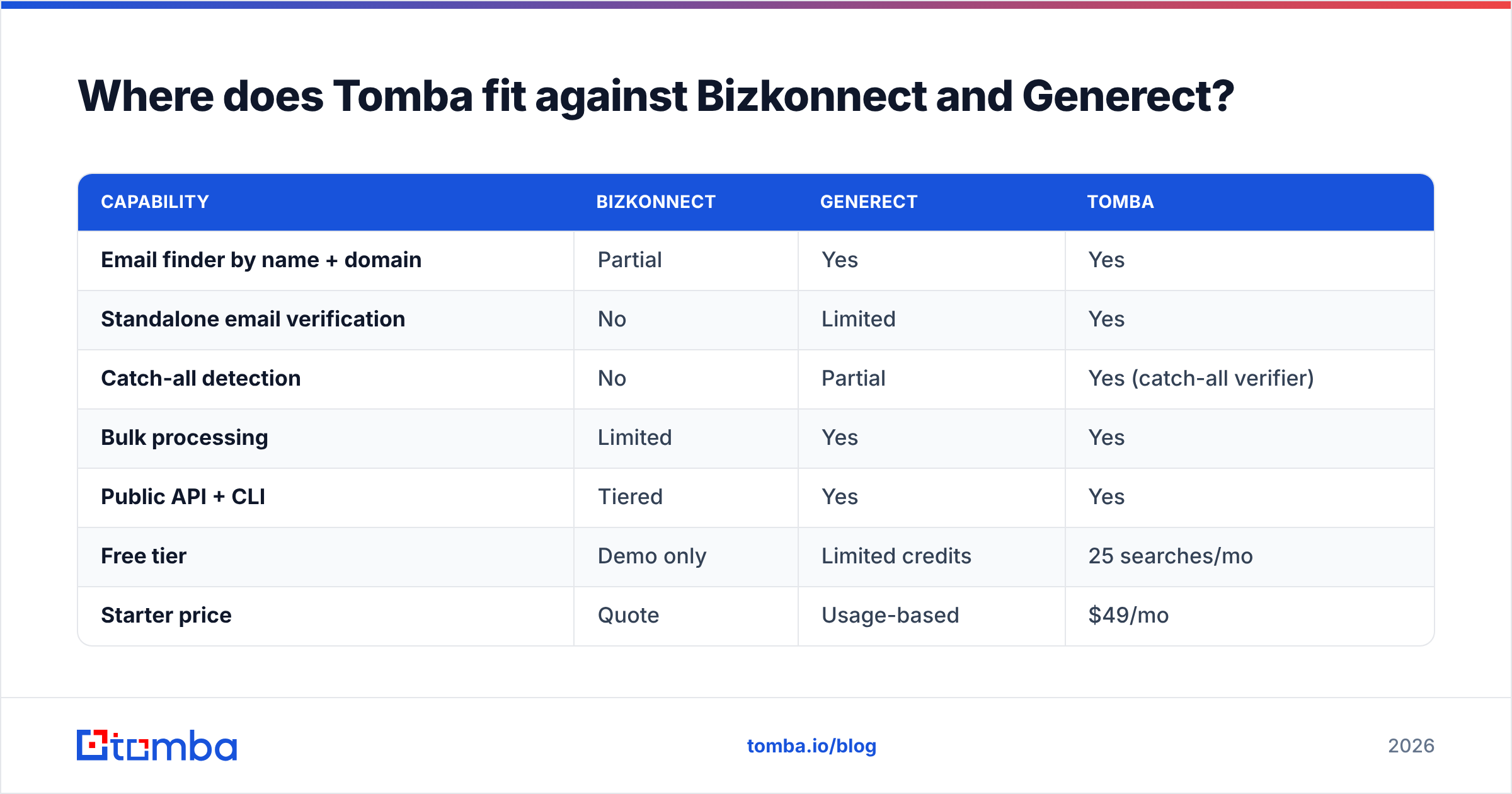
Tomba isn't trying to be an org-chart tool or a LinkedIn-scraping engine — it's the verified-email layer that makes whatever you source from either platform actually deliverable. That's a deliberately narrower job, and the focus shows up in accuracy.
| Capability | Bizkonnect | Generect | Tomba |
|---|---|---|---|
| Email finder by name + domain | Partial | Yes | Yes |
| Standalone email verification | No | Limited | Yes |
| Catch-all detection | No | Partial | Yes (catch-all verifier) |
| Bulk processing | Limited | Yes | Yes |
| Public API + CLI | Tiered | Yes | Yes |
| Free tier | Demo only | Limited credits | 25 searches/mo |
| Starter price | Quote | Usage-based | $49/mo |
A practical pipeline looks like this: use Bizkonnect to map the committee or Generect to source volume, then push every address through Tomba's email finder and verifier to strip the bounces before your outbound platform ever sees the list. You can run it by hand, through the Tomba API, or inside HubSpot — and full Tomba pricing starts at a flat $49/mo for the Starter plan, which keeps the verification layer cheap relative to wasted sends.
What do real buyers say to watch out for?#
A few recurring themes from category reviews and buyer chatter (cross-check current reviews on G2 and each vendor's own site, bizkonnect.com and generect.com, before you buy):
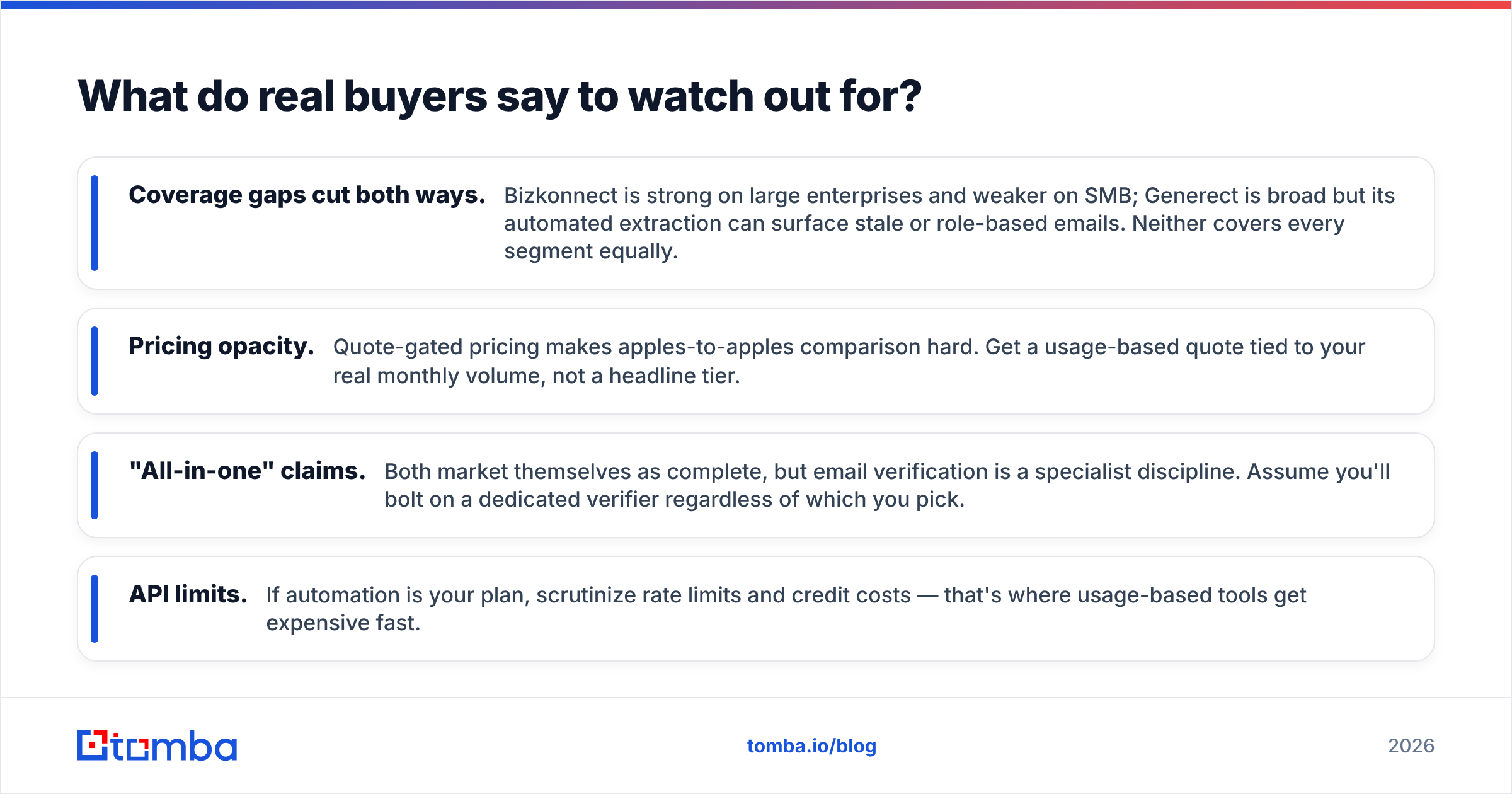
- Coverage gaps cut both ways. Bizkonnect is strong on large enterprises and weaker on SMB; Generect is broad but its automated extraction can surface stale or role-based emails. Neither covers every segment equally.
- Pricing opacity. Quote-gated pricing makes apples-to-apples comparison hard. Get a usage-based quote tied to your real monthly volume, not a headline tier.
- "All-in-one" claims. Both market themselves as complete, but email verification is a specialist discipline. Assume you'll bolt on a dedicated verifier regardless of which you pick.
- API limits. If automation is your plan, scrutinize rate limits and credit costs — that's where usage-based tools get expensive fast.
Bizkonnect vs Generect: the verdict#
Choose Bizkonnect if your world is enterprise ABM and the hardest part of your job is figuring out who the seven decision-makers are inside a sprawling org. Choose Generect if you live in high-volume, API-driven outbound and need fresh contacts faster than a static database can refresh.
But don't expect either to solve deliverability — that's a separate layer, and treating it as one is what separates teams with 2% bounce rates from teams that get their domain throttled. Source with the tool that fits your motion, then verify with a specialist.
Get verified emails into your pipeline#
Whichever intelligence platform you pick, the addresses still have to land. Tomba's Email Finder and verifier give you SMTP-checked, catch-all-aware, deliverable emails at a flat $49/mo Starter price — with a free tier of 25 searches so you can test it against your current Bizkonnect or Generect lists before paying a cent. Find the contact, verify the address, protect your sender reputation, and let your outbound numbers reflect the quality of your data instead of the gaps in it. Start free at tomba.io/email-finder.
Ready to find emails that actually work?
Join 150,000+ professionals who stopped guessing and started sending. Free credits on signup — no credit card required.
Get the Tomba newsletter
Practical outbound tactics and product updates — once every two weeks.
About the author