Bizkonnect vs Quickenrich: B2B Data Tools Compared 2026
Bizkonnect vs Quickenrich, broken down by data type, accuracy, pricing, and fit — plus where a dedicated email finder beats both for outbound.
Choosing between Bizkonnect and Quickenrich usually means choosing between two very different jobs: mapping who reports to whom inside a target account, or filling in the missing fields on a list you already have. They get lumped together because both promise "better B2B data," but they solve different problems — and neither is a true email-finding engine.
This guide breaks down what each tool actually does, where they overlap, what they cost, and when a dedicated email finder is the smarter buy.
TL;DR — Bizkonnect vs Quickenrich at a glance#
- Bizkonnect is a sales-intelligence and org-chart platform. Its edge is account mapping: visual hierarchies, decision-maker trees, and trigger-based account lists.
- Quickenrich is a data-enrichment tool. Its edge is taking a partial record (name, domain, LinkedIn URL) and returning emails, phones, and firmographics.
- Neither is built first as an email finder. If your core need is verified, deliverable email addresses at scale, both leave gaps you'll pay for in bounces.
- Pricing favors Quickenrich for credit-based enrichment; Bizkonnect is seat-and-data-package oriented and quote-driven.
- Best combined play: use an org-chart tool for targeting, then a purpose-built email finder with built-in verification for the actual contact data.
What is Bizkonnect?#
Bizkonnect is a B2B sales intelligence platform focused on account mapping and org charts. Instead of handing you a flat list of contacts, it visualizes the reporting structure inside a company — who sits above whom, which department a prospect belongs to, and how a buying committee is likely shaped.
That matters for complex, multi-threaded deals. If you're selling a six-figure platform into an enterprise, knowing that your champion reports to a VP who reports to the economic buyer is more useful than a raw email dump. Bizkonnect leans into "actionable sales plays" — trigger events, org changes, and curated account lists meant to start conversations.
The trade-off: org-chart data is inferred and curated, so freshness and coverage vary by company size. Smaller firms and fast-moving startups are harder to map accurately than Fortune 1000 accounts.
What is Quickenrich?#
Quickenrich is a data-enrichment service. You feed it what you have — a name plus a company, a domain, or a LinkedIn profile — and it returns the missing pieces: work email, phone number, job title, company size, industry, and other firmographic fields.
Enrichment is a fill-in-the-blanks job. It shines when you already have a list (form fills, CRM records, event scans) and need to make it usable. It's a poor fit when you're starting from zero and need to discover contacts inside an account you've never touched.
Like most enrichment tools, Quickenrich's value rises and falls on two things: how broad its underlying data is, and whether the emails it returns are actually deliverable. Enrichment that hands back a plausible-looking but dead address is worse than no data, because it inflates your list and tanks your sender reputation.
Bizkonnect vs Quickenrich: how do they compare?#
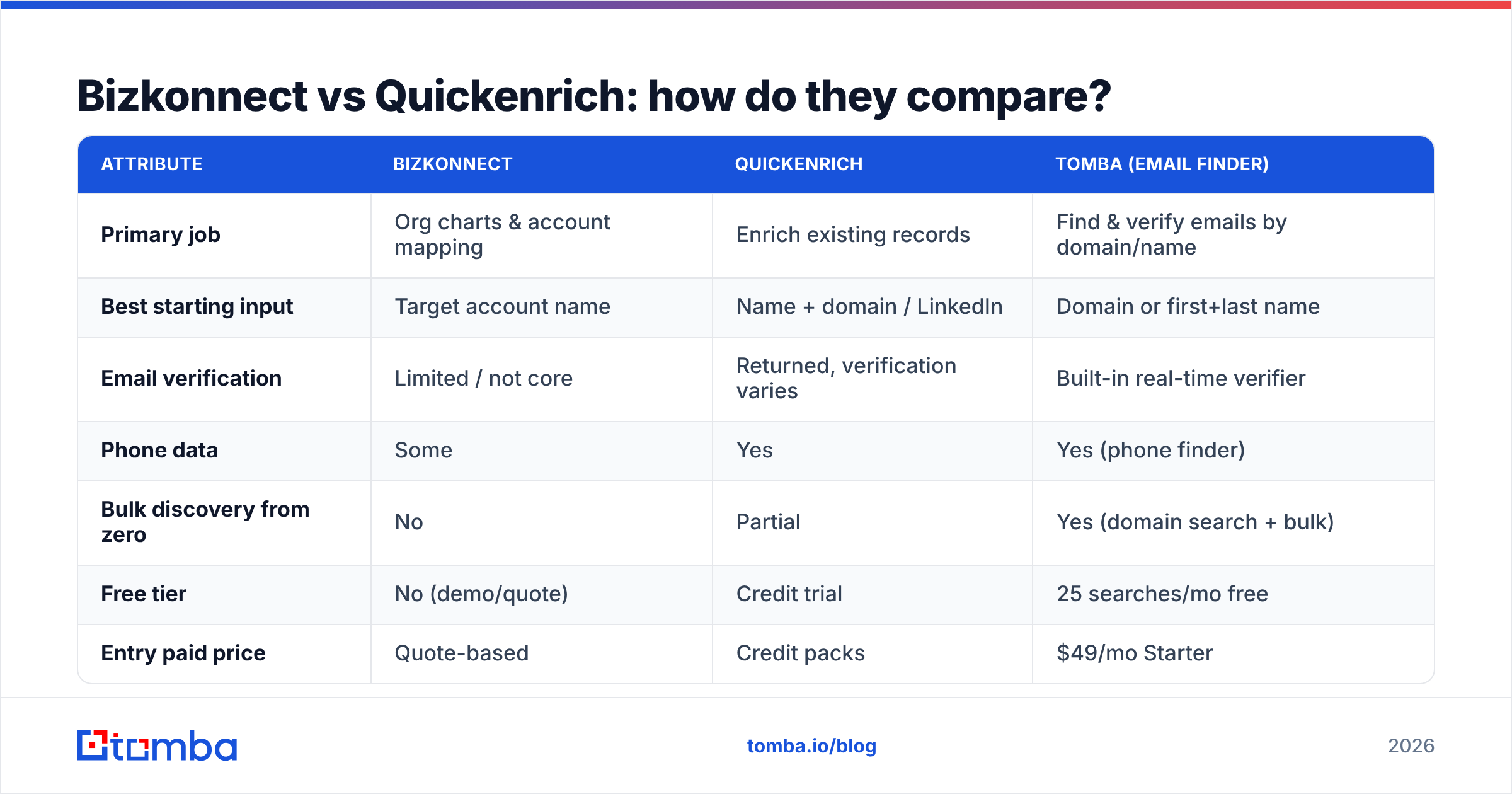
Here's the side-by-side. The third column shows where a dedicated email-finding platform like Tomba fits, because for most outbound teams the real decision isn't "A or B" — it's "which combination."
| Attribute | Bizkonnect | Quickenrich | Tomba (email finder) |
|---|---|---|---|
| Primary job | Org charts & account mapping | Enrich existing records | Find & verify emails by domain/name |
| Best starting input | Target account name | Name + domain / LinkedIn | Domain or first+last name |
| Email verification | Limited / not core | Returned, verification varies | Built-in real-time verifier |
| Phone data | Some | Yes | Yes (phone finder) |
| Bulk discovery from zero | No | Partial | Yes (domain search + bulk) |
| Free tier | No (demo/quote) | Credit trial | 25 searches/mo free |
| Entry paid price | Quote-based | Credit packs | $49/mo Starter |
| API access | Limited | Yes | Full REST API |
| Ideal user | Enterprise AE / account-based teams | RevOps cleaning CRM data | SDRs & marketers building lists |
Which one fits your use case?#
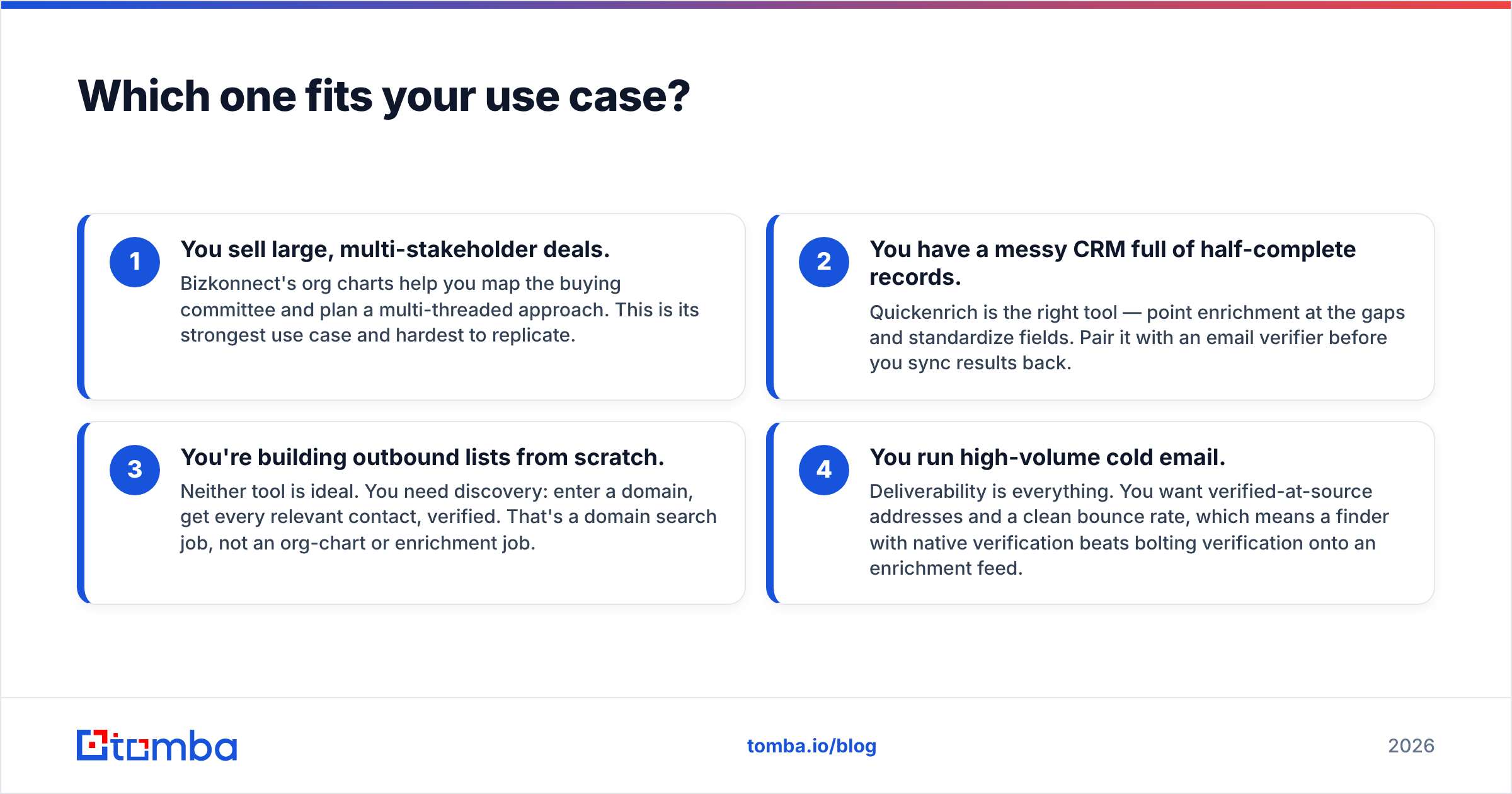
Pick based on the job you're actually doing, not the feature list. Use these four scenarios as a shortcut:
- You sell large, multi-stakeholder deals. Bizkonnect's org charts help you map the buying committee and plan a multi-threaded approach. This is its strongest use case and hardest to replicate.
- You have a messy CRM full of half-complete records. Quickenrich is the right tool — point enrichment at the gaps and standardize fields. Pair it with an email verifier before you sync results back.
- You're building outbound lists from scratch. Neither tool is ideal. You need discovery: enter a domain, get every relevant contact, verified. That's a domain search job, not an org-chart or enrichment job.
- You run high-volume cold email. Deliverability is everything. You want verified-at-source addresses and a clean bounce rate, which means a finder with native verification beats bolting verification onto an enrichment feed.
The honest read: Bizkonnect and Quickenrich are complementary to outbound, not the engine of it. They help you target and clean. They don't reliably supply fresh, deliverable contacts at SDR volume.
How accurate is the data from each?#
Accuracy splits into two questions: coverage (do they have a record for your prospect?) and validity (is the email actually live?).
- Bizkonnect optimizes for structural accuracy — the shape of the org. Contact-level email validity is secondary, so treat any addresses as candidates to verify, not facts.
- Quickenrich optimizes for fill rate. The risk with any enrichment vendor is "match-and-hope": it returns the most statistically likely email for a name+domain without confirming the mailbox exists. Independent reviews on G2 consistently show enrichment fill rate and verified accuracy are different numbers — vendors quote the first and bury the second.
This is exactly why a standalone verification step matters regardless of which tool you choose. If you want to understand where contact data actually comes from and how it's validated, Tomba documents its data sources openly, and runs every result through a verification layer rather than guessing a pattern and shipping it.
What about pricing — Bizkonnect vs Quickenrich?#
Pricing models differ enough that a flat "which is cheaper" misses the point.
- Bizkonnect is quote-driven, sold around seats plus data packages and account-list volume. Expect an enterprise-style sales motion and annual commitment. There's no public self-serve free tier.
- Quickenrich uses credit-based enrichment — you buy a pool of credits and spend them per enriched record. This is friendlier for trial and for variable volume, but costs scale with list size and re-enrichment cycles.
For comparison, a dedicated finder is usually the most predictable line item. Tomba's pricing is transparent and self-serve: a Free tier with 25 searches per month, Starter at $49/mo, Growth at $99/mo, Pro at $249/mo, and custom Enterprise. You can validate the data quality before you ever talk to sales — something neither quote-driven nor pure-credit models make easy.
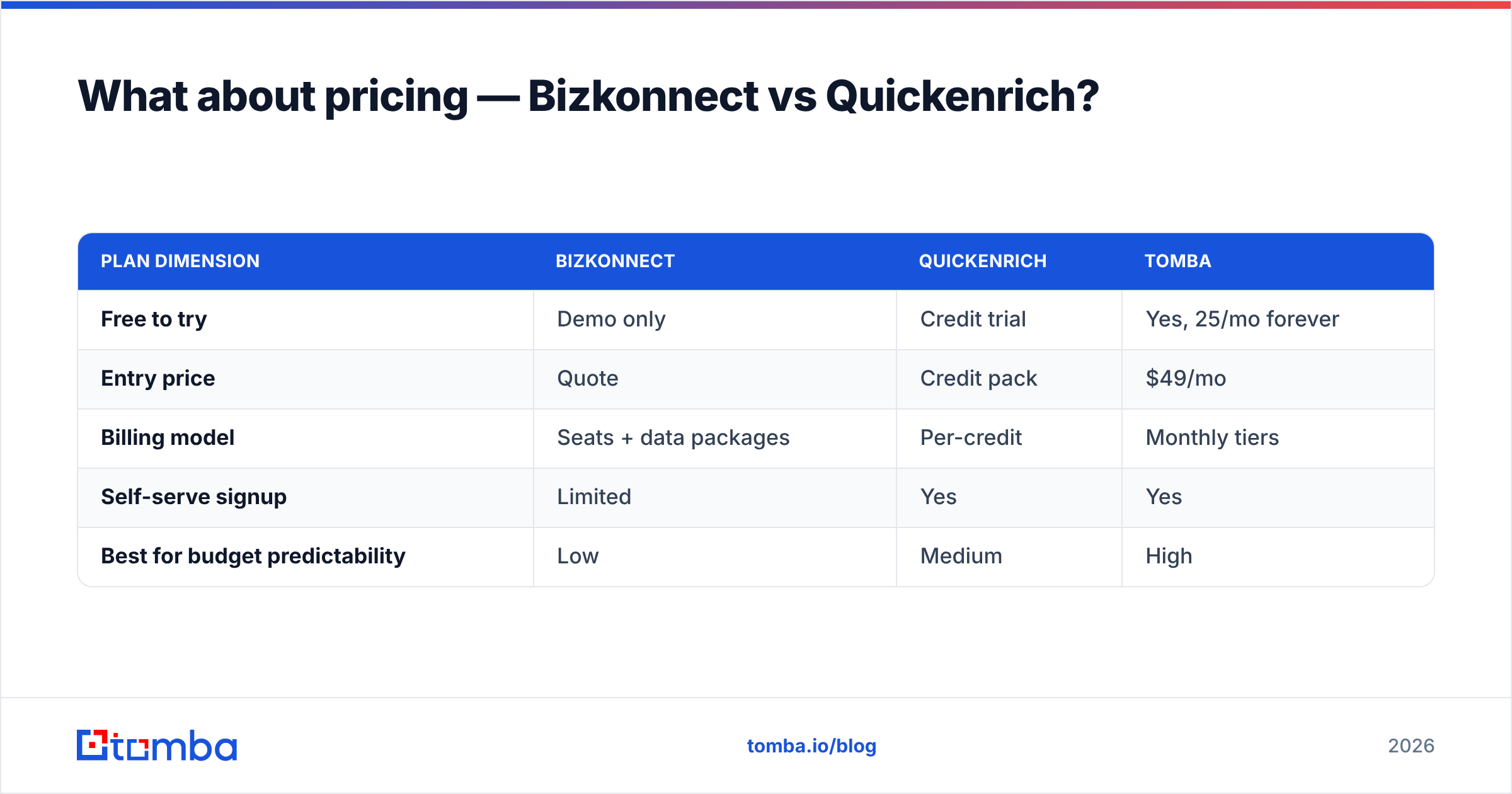
| Plan dimension | Bizkonnect | Quickenrich | Tomba |
|---|---|---|---|
| Free to try | Demo only | Credit trial | Yes, 25/mo forever |
| Entry price | Quote | Credit pack | $49/mo |
| Billing model | Seats + data packages | Per-credit | Monthly tiers |
| Self-serve signup | Limited | Yes | Yes |
| Best for budget predictability | Low | Medium | High |
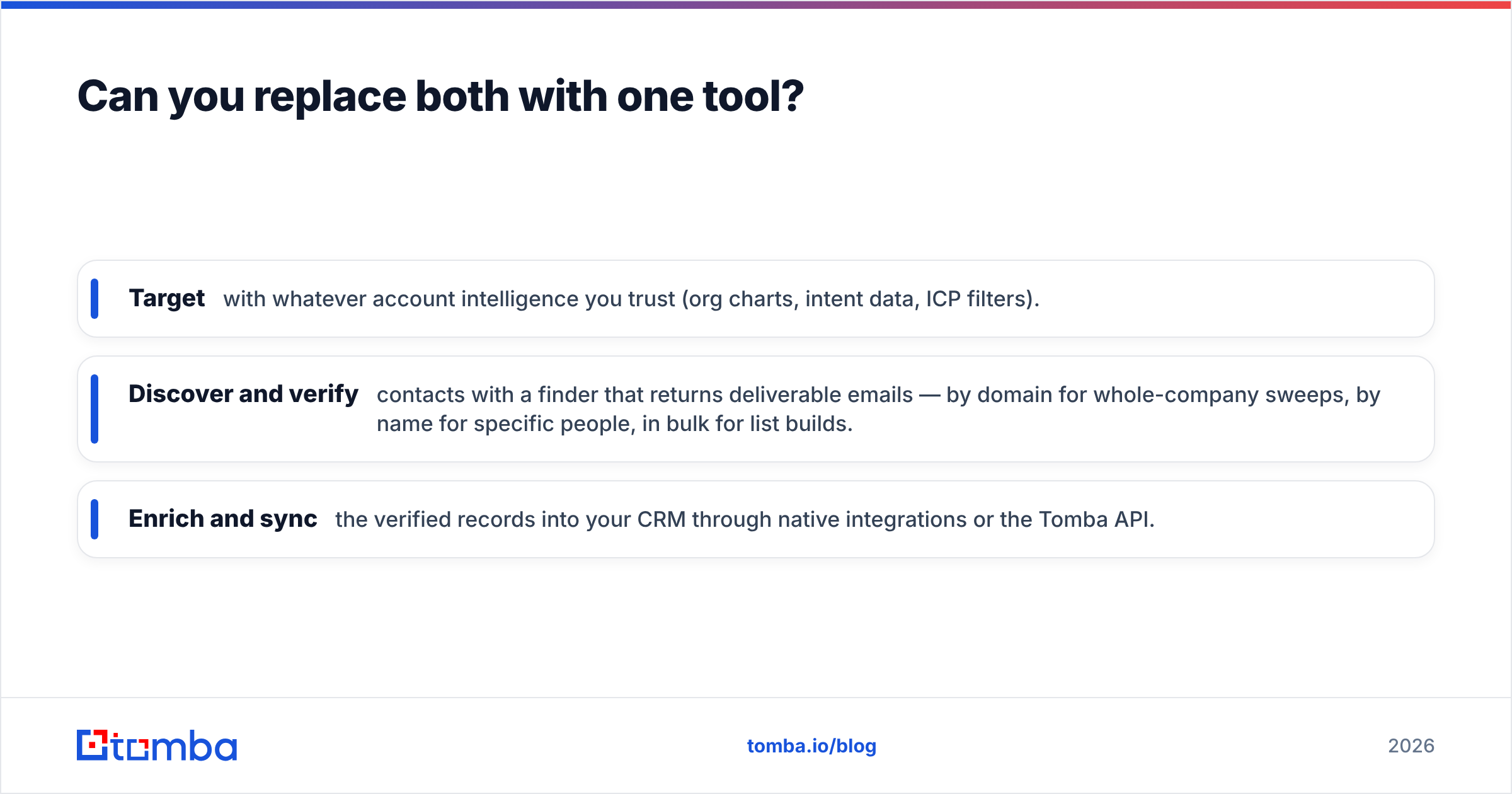
Can you replace both with one tool?#
Partly — and it depends on your motion. You can't fully replicate Bizkonnect's curated org charts with a finder; visual buying-committee mapping is a genuine specialty. But for the contact-data half of the job that both tools touch, a single email-finding platform usually does it better and cheaper.
Here's the practical stack most outbound teams land on:
- Target with whatever account intelligence you trust (org charts, intent data, ICP filters).
- Discover and verify contacts with a finder that returns deliverable emails — by domain for whole-company sweeps, by name for specific people, in bulk for list builds.
- Enrich and sync the verified records into your CRM through native integrations or the Tomba API.
That sequence keeps your bounce rate low because verification happens before the address ever hits your sequencer — not after a campaign already burned your domain. It also collapses two subscriptions (intelligence + enrichment) into a cleaner spend when your primary need is volume of clean contacts rather than enterprise account mapping.
Bizkonnect vs Quickenrich: the verdict#
Choose Bizkonnect if account mapping and org charts are central to how you sell — enterprise, committee-driven deals where knowing the hierarchy changes your strategy.
Choose Quickenrich if you mostly need to clean and complete data you already own, and a credit-based enrichment model fits your variable volume.
But if your real bottleneck is finding verified emails to actually run outbound — the job both tools only partly cover — neither is the right primary tool. You want a finder built for discovery and verification from day one.
Start with verified contact data, not guesswork#
If your goal is to reach decision-makers, the data layer is where deals are won or lost. Tomba's Email Finder lets you find professional email addresses by domain, name, or company — every result run through real-time verification so your bounce rate stays low and your sender reputation stays intact. Start free with 25 searches a month, scale to Starter at $49/mo when you're ready, and skip the quote calls and dead-address roulette entirely. Pair it with data enrichment and the domain search when you need whole-account coverage, and you've replaced the messy parts of both tools with one accurate, predictable source of truth.
Ready to find emails that actually work?
Join 150,000+ professionals who stopped guessing and started sending. Free credits on signup — no credit card required.
Get the Tomba newsletter
Practical outbound tactics and product updates — once every two weeks.
About the author