Bizkonnect vs SalesIntel: Which B2B Data Tool Wins in 2026?
Bizkonnect sells org charts and contextual targeting; SalesIntel sells human-verified contacts. Here's which B2B data tool fits your 2026 pipeline — and where a leaner finder beats both.
Choosing between Bizkonnect and SalesIntel comes down to one question: do you need a map of who reports to whom, or a list of contacts you can actually email today? Both call themselves B2B data intelligence platforms, but they solve different halves of the prospecting problem — and neither is the cheapest way to get a verified email into your sequence.
TL;DR — Bizkonnect vs SalesIntel at a glance#
- Bizkonnect is built around org charts, account mapping, and contextual "trigger" targeting — strongest when you sell complex deals into large enterprises and need to navigate buying committees.
- SalesIntel leans on human-verified contact data, intent signals (via Bombora), and technographics — strongest when you want accurate direct dials and emails at scale in North America.
- Pricing is opaque on both (annual contracts, quote-based), so expect four- to five-figure yearly commitments before you've sent a single email.
- Coverage is regional: SalesIntel is US-heavy; Bizkonnect skews toward enterprise org data over SMB breadth.
- If your real need is just finding and verifying email addresses without an annual seat license, a focused tool like the Tomba Email Finder does that job for a fraction of the cost.
What is Bizkonnect?#
Bizkonnect is a sales intelligence provider whose signature feature is actionable org charts — visual maps of a company's reporting structure, decision-makers, and influencers. The pitch is that knowing the hierarchy lets you target the economic buyer and the champion at the same time, instead of cold-emailing whoever you happened to find on LinkedIn.
On top of org charts, Bizkonnect layers "Solution Maps" and contextual triggers: news, initiatives, and account-level signals that give reps a reason to reach out. It's a fit for account-based selling (ABM) motions where each target account is researched deliberately rather than blasted.
The trade-off: org-chart data is expensive to maintain and goes stale fast. People change roles constantly, so a chart that was accurate last quarter may quietly mislead you this quarter. You're paying for depth on a relatively narrow set of enterprise accounts, not broad coverage.
What is SalesIntel?#
SalesIntel is a B2B contact and company data platform that markets human-verified data — a research team re-verifies records on a cycle — alongside machine-processed data for breadth. Its core selling points are direct-dial phone numbers, verified emails, firmographics, technographics, and buyer intent powered by a Bombora partnership.
If your motion is high-volume outbound into US mid-market and enterprise accounts, SalesIntel's database and its "RevDriver" Chrome extension are designed to feed your CRM and sequences quickly. Intent data helps you prioritize accounts that are already researching your category, which can lift reply rates when used well.
The trade-offs are familiar for this category: coverage is strongest in North America and thins out internationally, "human-verified" doesn't mean every record is fresh, and pricing is annual and quote-based. You can read independent user reviews on G2 to gauge how teams rate accuracy and support before committing.
Bizkonnect vs SalesIntel: how do they compare?#
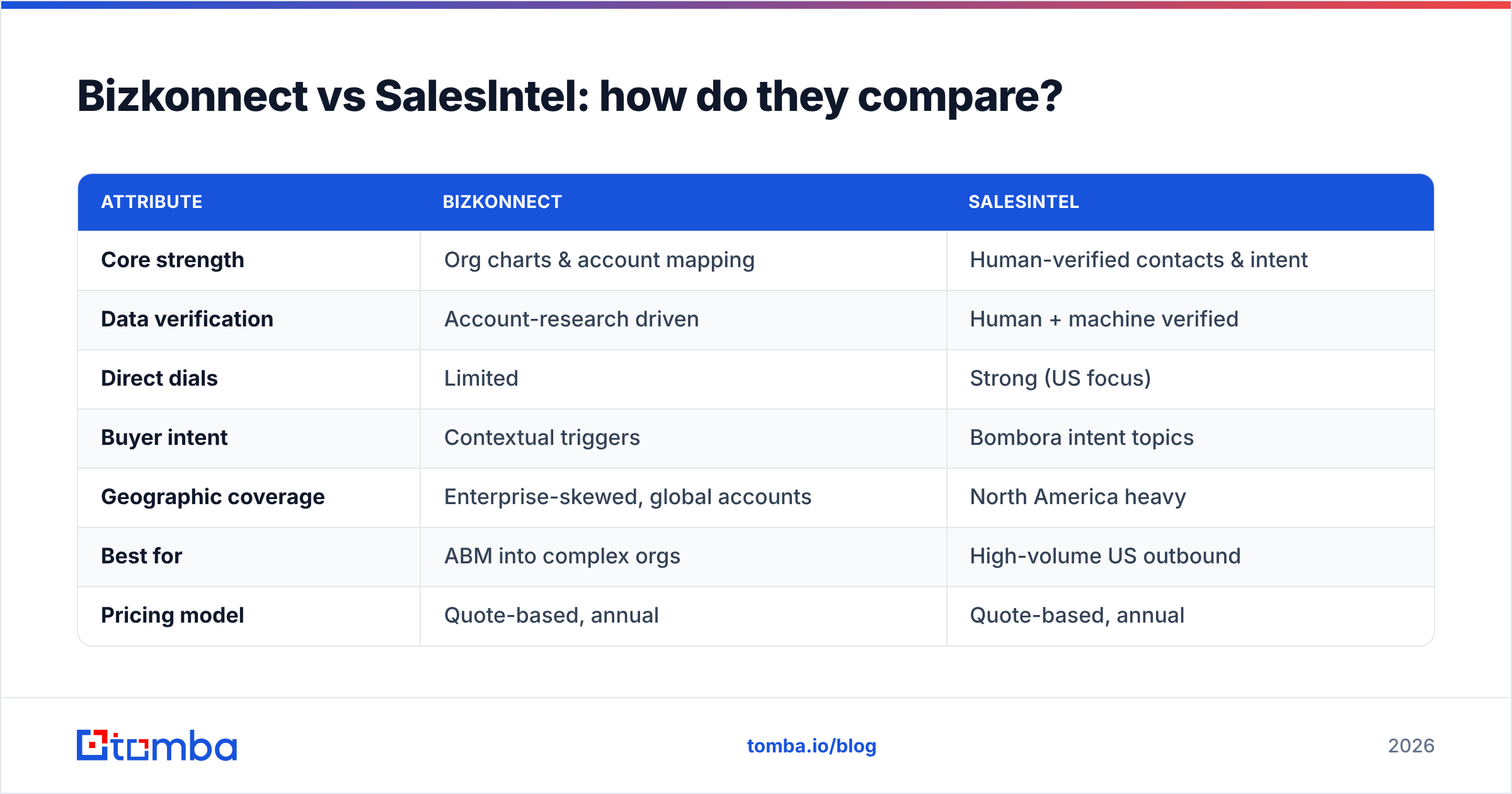
Here's the head-to-head on the attributes that actually change your day-to-day workflow.
| Attribute | Bizkonnect | SalesIntel |
|---|---|---|
| Core strength | Org charts & account mapping | Human-verified contacts & intent |
| Data verification | Account-research driven | Human + machine verified |
| Direct dials | Limited | Strong (US focus) |
| Buyer intent | Contextual triggers | Bombora intent topics |
| Geographic coverage | Enterprise-skewed, global accounts | North America heavy |
| Best for | ABM into complex orgs | High-volume US outbound |
| Pricing model | Quote-based, annual | Quote-based, annual |
| Chrome extension | Limited | RevDriver |
| Free self-serve tier | No | No |
The pattern: Bizkonnect optimizes for navigating a single complex account; SalesIntel optimizes for volume and contactability across many accounts. Few teams need both at full price, and most teams overpay for whichever one they pick because they only use a slice of the platform.
Which one is more accurate?#
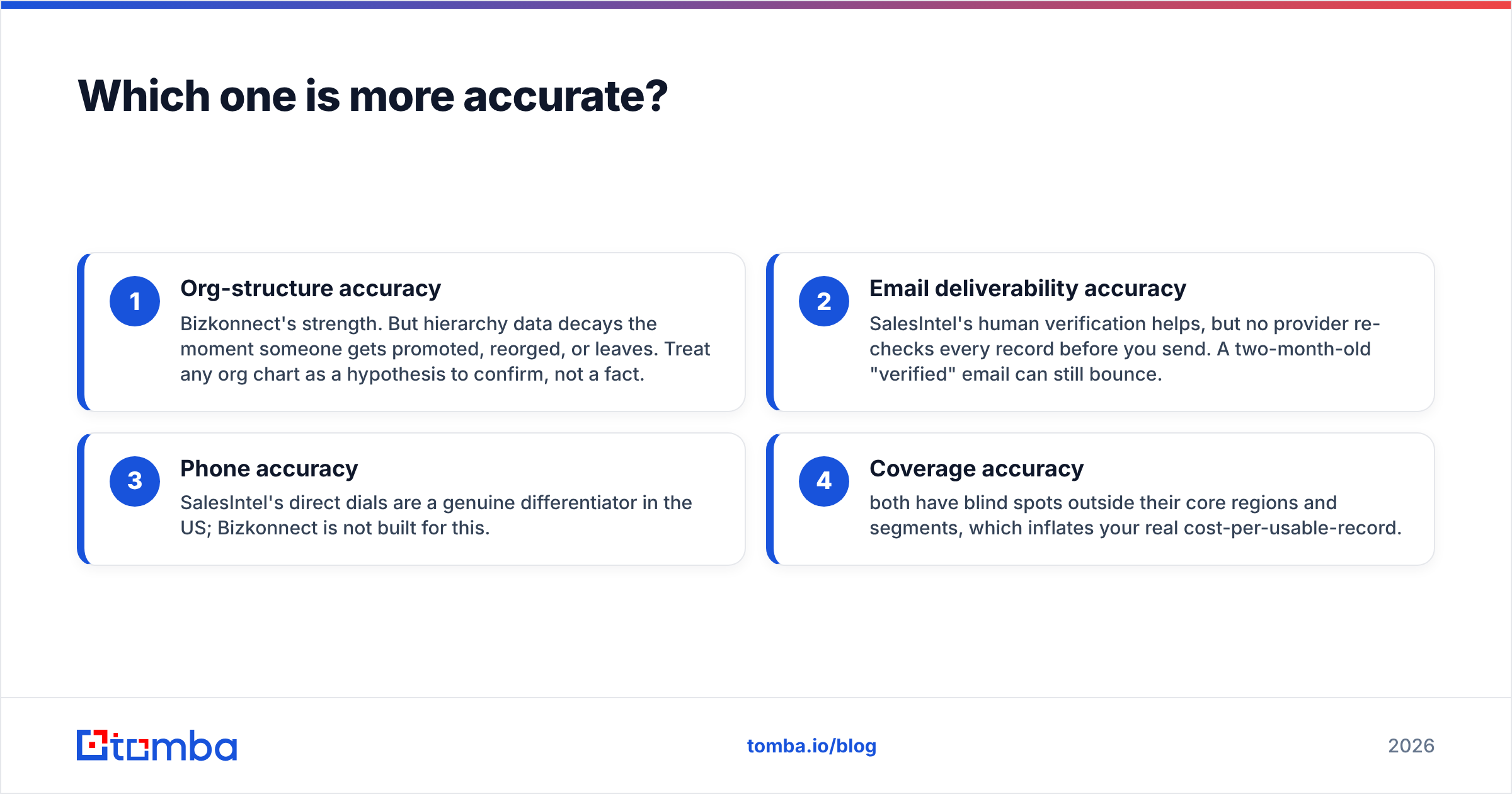
Accuracy depends on what kind of accuracy you mean. Org-structure accuracy and contact-deliverability accuracy are different problems.
- Org-structure accuracy — Bizkonnect's strength. But hierarchy data decays the moment someone gets promoted, reorged, or leaves. Treat any org chart as a hypothesis to confirm, not a fact.
- Email deliverability accuracy — SalesIntel's human verification helps, but no provider re-checks every record before you send. A two-month-old "verified" email can still bounce.
- Phone accuracy — SalesIntel's direct dials are a genuine differentiator in the US; Bizkonnect is not built for this.
- Coverage accuracy — both have blind spots outside their core regions and segments, which inflates your real cost-per-usable-record.
The honest takeaway: regardless of which platform you license, you should re-verify contact data at send time. That's exactly the gap a dedicated email verifier fills — it checks the mailbox right before you load a sequence, so platform staleness doesn't tank your sender reputation. Protecting your email deliverability is cheaper than recovering from a blacklist.
What do they cost — and is it worth it?#
Both Bizkonnect and SalesIntel run on annual, quote-based contracts. Neither publishes a transparent self-serve price, which usually signals deals in the low- to mid-five figures per year once you add seats, credits, and intent modules. That's defensible if you're a funded sales org running ABM at scale. It's overkill if you mainly need verified emails to fuel cold outreach.
For comparison, transparent per-seat tooling looks like this:
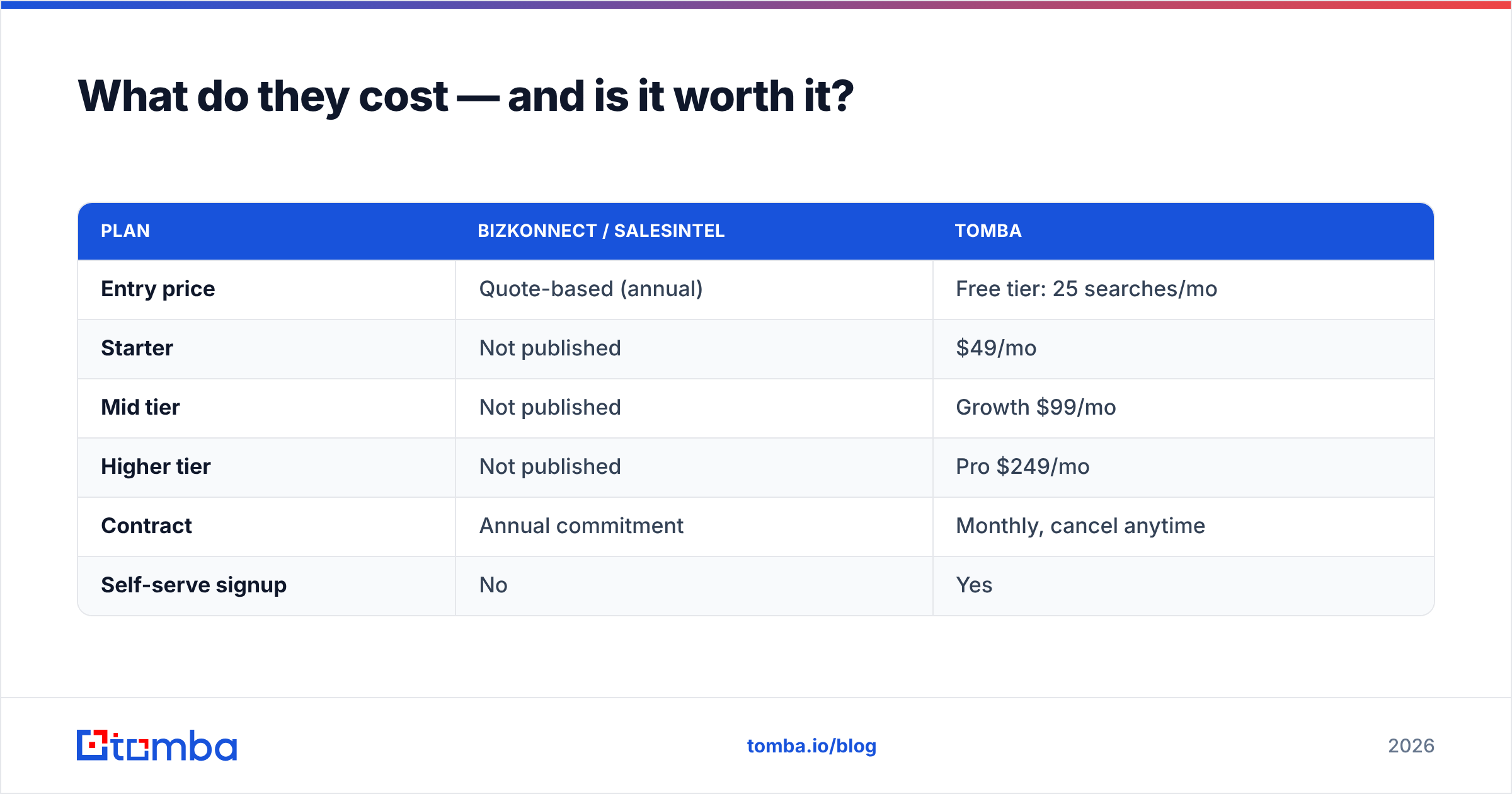
| Plan | Bizkonnect / SalesIntel | Tomba |
|---|---|---|
| Entry price | Quote-based (annual) | Free tier: 25 searches/mo |
| Starter | Not published | $49/mo |
| Mid tier | Not published | Growth $99/mo |
| Higher tier | Not published | Pro $249/mo |
| Contract | Annual commitment | Monthly, cancel anytime |
| Self-serve signup | No | Yes |
You can see the full breakdown on Tomba pricing. The point isn't that Tomba replaces an enterprise intelligence suite feature-for-feature — it doesn't ship org charts. The point is that most teams buy a $30k platform to do a $49/mo job: find an email, verify it, push it to the CRM.
When should you pick Bizkonnect?#
Pick Bizkonnect when the account, not the contact, is the hard part. Signs this is you:
- You sell six-figure deals into enterprises with large buying committees.
- Your reps lose deals because they engaged the wrong stakeholder or missed an influencer.
- You run a deliberate, low-volume ABM motion where research time per account is justified.
- You already have a reliable source of verified emails and phones, and what you lack is organizational context.
If two or more of those are true, Bizkonnect's org charts can shorten your path to the real decision-maker. Just budget for the annual commitment and plan to verify contact details separately.
When should you pick SalesIntel?#
Pick SalesIntel when contactability and volume in North America drive your pipeline. Signs this is you:
- Your SDR team needs direct dials and verified emails by the thousand.
- You want intent data to prioritize accounts already in-market.
- Your ICP is concentrated in US mid-market and enterprise.
- You can absorb an annual contract and will actually use the seats.
SalesIntel's combination of human verification, technographics, and Bombora intent is a coherent package for a funded outbound team. Outside the US, or on a tight budget, the value proposition weakens fast.
Is there a leaner alternative to both?#
Yes — if your bottleneck is getting accurate, send-ready contact data rather than full-blown account intelligence. Plenty of teams license SalesIntel or Bizkonnect, then discover that 80% of their actual usage is "find this person's email and confirm it's valid." That slice can run on a focused stack:
- Find the address — find email addresses by name and company domain, or run a domain search to pull every public mailbox at a target account.
- Verify before you send — an email verifier plus a catch-all verifier for tricky domains keeps bounce rates low.
- Enrich and scale — data enrichment fills firmographic gaps, and the bulk email finder handles lists without a per-seat platform fee.
- Wire it into your CRM — native HubSpot and Salesforce integrations push verified records straight into your pipeline.
This won't draw you an org chart. But for the majority of outbound teams whose real KPI is verified contacts in sequence per week, it does the job at a transparent monthly price instead of an opaque annual one. For the enterprise-data philosophy behind both incumbents, vendors like HubSpot and analysts at Gartner frame the broader market — worth reading before you sign anything.
How do you actually decide?#
Run this in order, and don't skip step one:
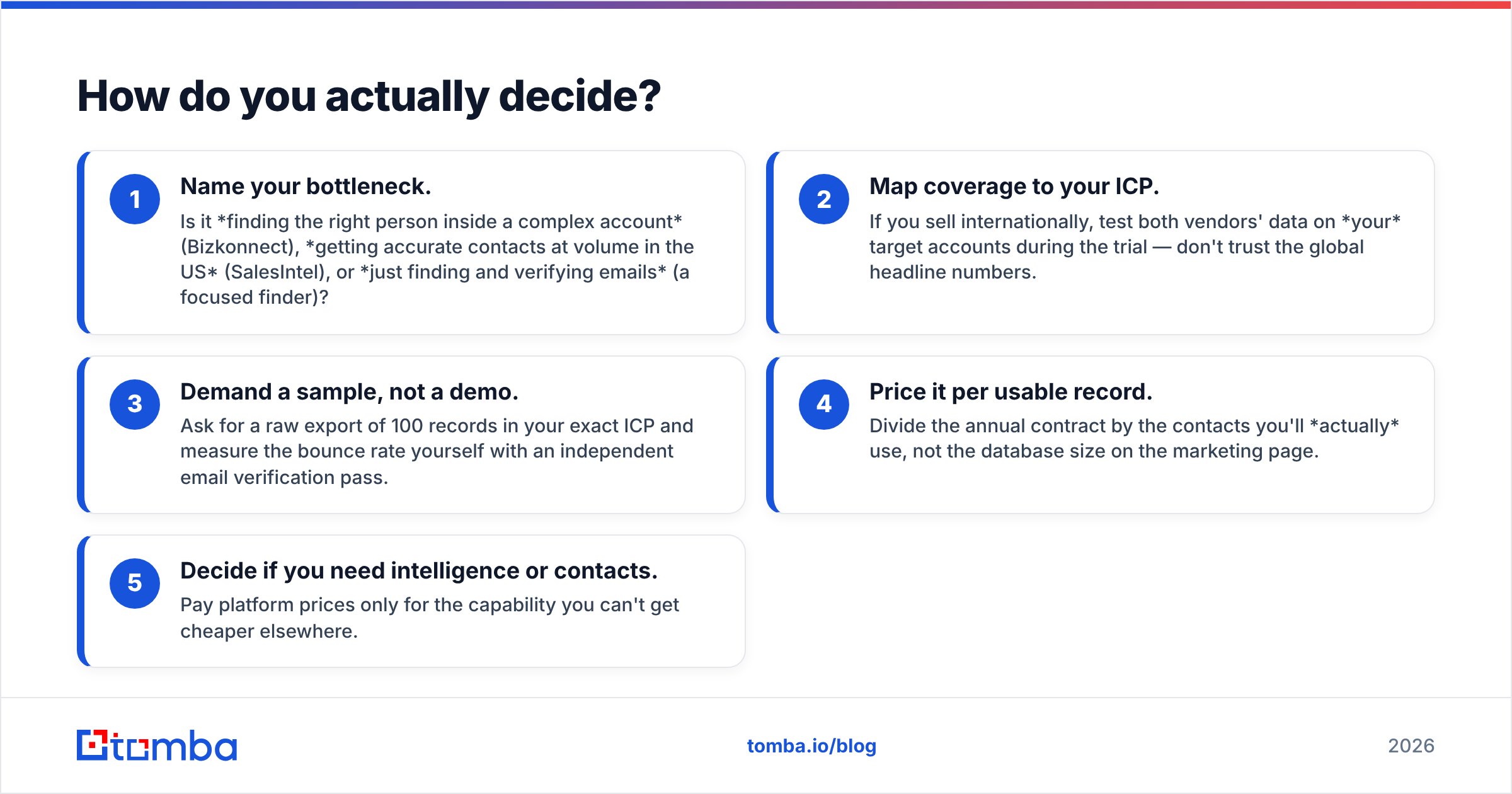
- Name your bottleneck. Is it finding the right person inside a complex account (Bizkonnect), getting accurate contacts at volume in the US (SalesIntel), or just finding and verifying emails (a focused finder)?
- Map coverage to your ICP. If you sell internationally, test both vendors' data on your target accounts during the trial — don't trust the global headline numbers.
- Demand a sample, not a demo. Ask for a raw export of 100 records in your exact ICP and measure the bounce rate yourself with an independent email verification pass.
- Price it per usable record. Divide the annual contract by the contacts you'll actually use, not the database size on the marketing page.
- Decide if you need intelligence or contacts. Pay platform prices only for the capability you can't get cheaper elsewhere.
Most teams that run this exercise discover they were about to buy a suite to solve a finder-and-verifier problem.
The verdict#
Bizkonnect wins on org-chart depth; SalesIntel wins on US contactability and intent — but both are heavyweight, annual-contract platforms that most teams underuse. Choose Bizkonnect for deliberate ABM into complex enterprises. Choose SalesIntel for high-volume US outbound that benefits from direct dials and intent. And before you commit to either, be honest about whether your actual job is account intelligence or simply getting verified emails into a sequence.
If it's the latter, start with the Tomba Email Finder: find professional emails by name, company, or domain, verify them in the same workflow, and push clean records to your CRM — on a free tier to test and a $49/mo plan to scale, no annual contract required. Prove the data quality on your own ICP first, then decide whether you still need a five-figure platform on top.
// get started
Find, verify and enrich your first contacts today
Start on the free plan with 25 searches a month, then scale when your team is ready.
Free plan · No credit card required · GDPR & CCPA
// about the author