Bizkonnect vs Sendflock 2026: Which B2B Sales Tool Wins?
Bizkonnect maps org charts and sales intelligence; Sendflock automates cold email at scale. Here's an honest, side-by-side 2026 breakdown to help you pick.
TL;DR
- Bizkonnect is a sales-intelligence platform built around dynamic org charts, account mapping, and actionable contact data for account-based selling.
- Sendflock is a cold-email automation tool — it sends, sequences, and tracks outbound campaigns, but it does not build the org-level intelligence Bizkonnect specializes in.
- They solve different halves of the same funnel: Bizkonnect tells you who to target inside an account; Sendflock helps you reach them at volume.
- Neither is primarily an email-finder, so accuracy of the underlying contact data is where most teams get burned — verify before you send.
- Best pairing for most teams: a focused data source plus a sending tool. We close with where Tomba fits and how to avoid bouncing your domain.
What are Bizkonnect and Sendflock?#
Short answer: they are not direct competitors — they overlap at the edges. Bizkonnect is a sales-intelligence product. Sendflock is a cold-email engine. Teams compare them because both promise "more pipeline," but they attack the problem from opposite ends.
Think of it like building a house. Bizkonnect is the architect's blueprint — it shows you the structure of an account, who reports to whom, and where the decision power sits. Sendflock is the delivery truck — it moves your message to the door, repeatedly and on schedule. You need both, but buying a delivery truck does not give you a blueprint.
Bizkonnect focuses on:
- Dynamic org charts — visual maps of reporting lines inside target accounts.
- Account intelligence — company-level signals, departmental structure, and role mapping.
- Actionable contact data — named contacts tied to their position in the hierarchy.
- ABM enablement — feeding account-based marketing plays with structure, not just a flat list.
Sendflock focuses on:
- Email sequencing — multi-step drip campaigns with conditional logic.
- Inbox rotation and sending — distributing volume across mailboxes.
- Open, click, and reply tracking — campaign analytics.
- List upload and personalization — you bring the contacts, it does the outreach.
The gap is obvious once you name it: Sendflock assumes you already have clean, verified contacts. Bizkonnect helps you decide who those contacts should be, but you still need accurate email addresses to act on the map.
Is Bizkonnect better than Sendflock?#
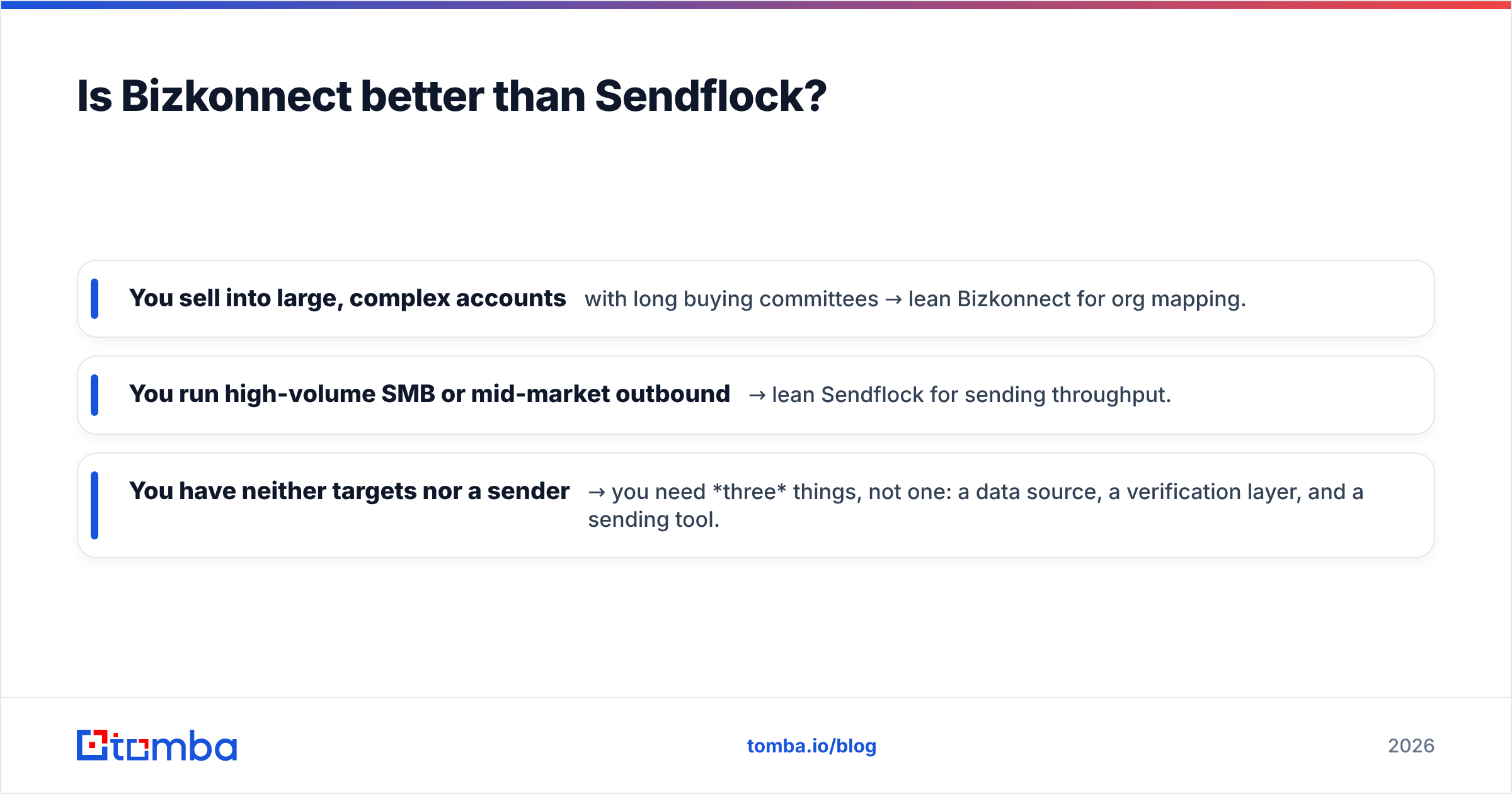
Conclusion first: neither is "better" — they sit at different stages, so the right question is which gap you have. If you cannot figure out who the buying committee is inside a 5,000-person enterprise, Bizkonnect earns its seat. If you already know your targets and need to send 2,000 personalized emails a week without torching your domain, Sendflock is the tool you are shopping for.
Here is the practical decision tree most revenue teams follow:
- You sell into large, complex accounts with long buying committees → lean Bizkonnect for org mapping.
- You run high-volume SMB or mid-market outbound → lean Sendflock for sending throughput.
- You have neither targets nor a sender → you need three things, not one: a data source, a verification layer, and a sending tool.
That third scenario is where most comparison shoppers actually live, and it is why picking "Bizkonnect vs Sendflock" as a binary usually leads to a half-solved funnel.
How do Bizkonnect and Sendflock compare on features?#
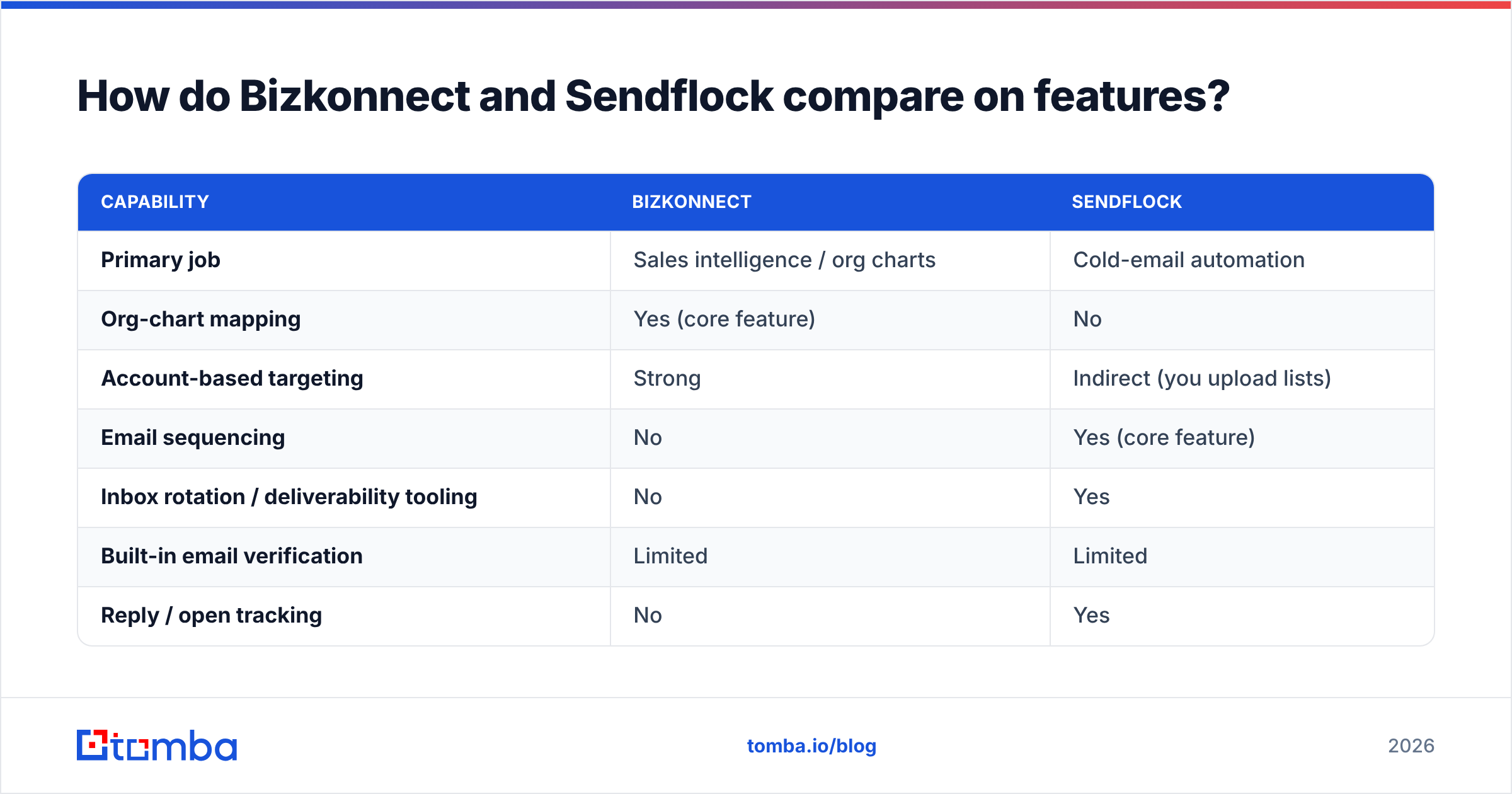
The table below maps the two tools against the jobs a B2B outbound motion actually needs. Treat empty cells as "not the product's core job," not necessarily a hard limitation.
| Capability | Bizkonnect | Sendflock |
|---|---|---|
| Primary job | Sales intelligence / org charts | Cold-email automation |
| Org-chart mapping | Yes (core feature) | No |
| Account-based targeting | Strong | Indirect (you upload lists) |
| Email sequencing | No | Yes (core feature) |
| Inbox rotation / deliverability tooling | No | Yes |
| Built-in email verification | Limited | Limited |
| Reply / open tracking | No | Yes |
| Best for | ABM, enterprise account planning | SMB/mid-market volume outbound |
| Data freshness risk | Medium (org data ages fast) | High (depends on your uploaded list) |
The pattern: Bizkonnect owns the "who and where," Sendflock owns the "send and track." Neither one fully owns the "is this email address real and safe to mail?" question — and that is the silent killer of cold-email programs. A beautiful org chart and a slick sequence both collapse if 18% of your addresses bounce.
For a deeper primer on why that middle layer matters, see the glossary entry on email deliverability and the concept of sender reputation — both are decided long before your first email lands.
What about pricing for Bizkonnect vs Sendflock?#
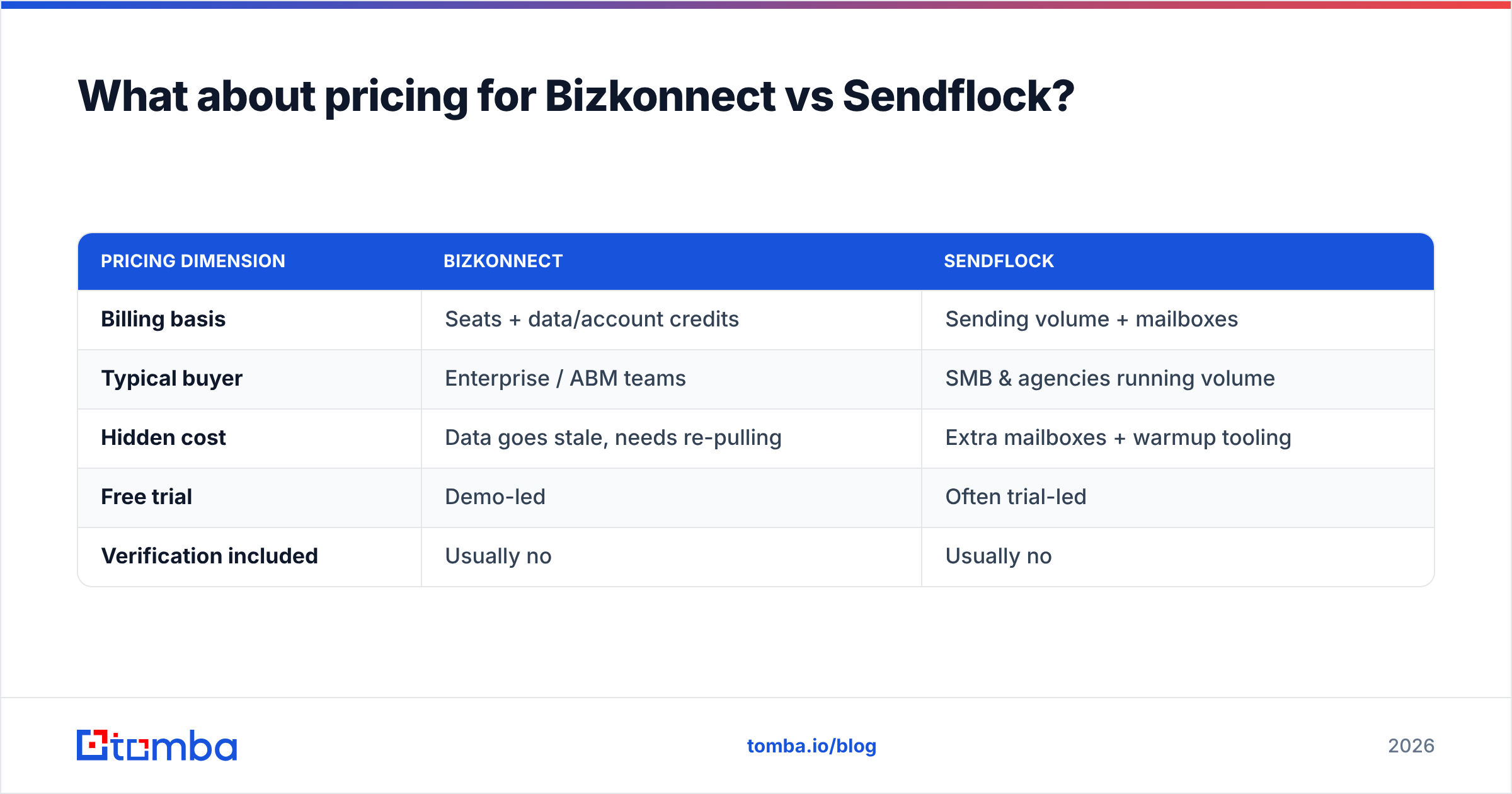
Both vendors gate pricing behind sales conversations and tier by seats, credits, or sending volume, so treat any published figure as directional. The more useful exercise is understanding what you pay for in each model, because the cost structures are not comparable line for line.
| Pricing dimension | Bizkonnect | Sendflock |
|---|---|---|
| Billing basis | Seats + data/account credits | Sending volume + mailboxes |
| Typical buyer | Enterprise / ABM teams | SMB & agencies running volume |
| Hidden cost | Data goes stale, needs re-pulling | Extra mailboxes + warmup tooling |
| Free trial | Demo-led | Often trial-led |
| Verification included | Usually no | Usually no |
The "hidden cost" row is the one to internalize. With an intelligence tool, you pay again every time the org data ages — people change jobs constantly, and an org chart from nine months ago is partly fiction. With a sending tool, your real cost creeps up as you add mailboxes and warmup services to chase deliverability. In both cases, a separate verification step is the cheapest insurance you can buy — bounces cost you reputation, which is far more expensive than credits.
If you want a transparent, published model to benchmark against, compare them to Tomba pricing: a free tier at 25 searches per month, Starter at $49/mo, Growth at $99/mo, and Pro at $249/mo. That kind of flat, public pricing makes it easier to budget the data-and-verification layer that both Bizkonnect and Sendflock assume you handle elsewhere.
Which tool wins for cold email accuracy and deliverability?#
Direct answer: neither tool will save a dirty list, and this is where most teams lose the game before kickoff. Sendflock can rotate inboxes and warm them up, but if you feed it unverified addresses, the bounces still register against your sending domain. Bizkonnect can hand you a perfectly mapped buying committee, but a name-and-title is not a deliverable email address.
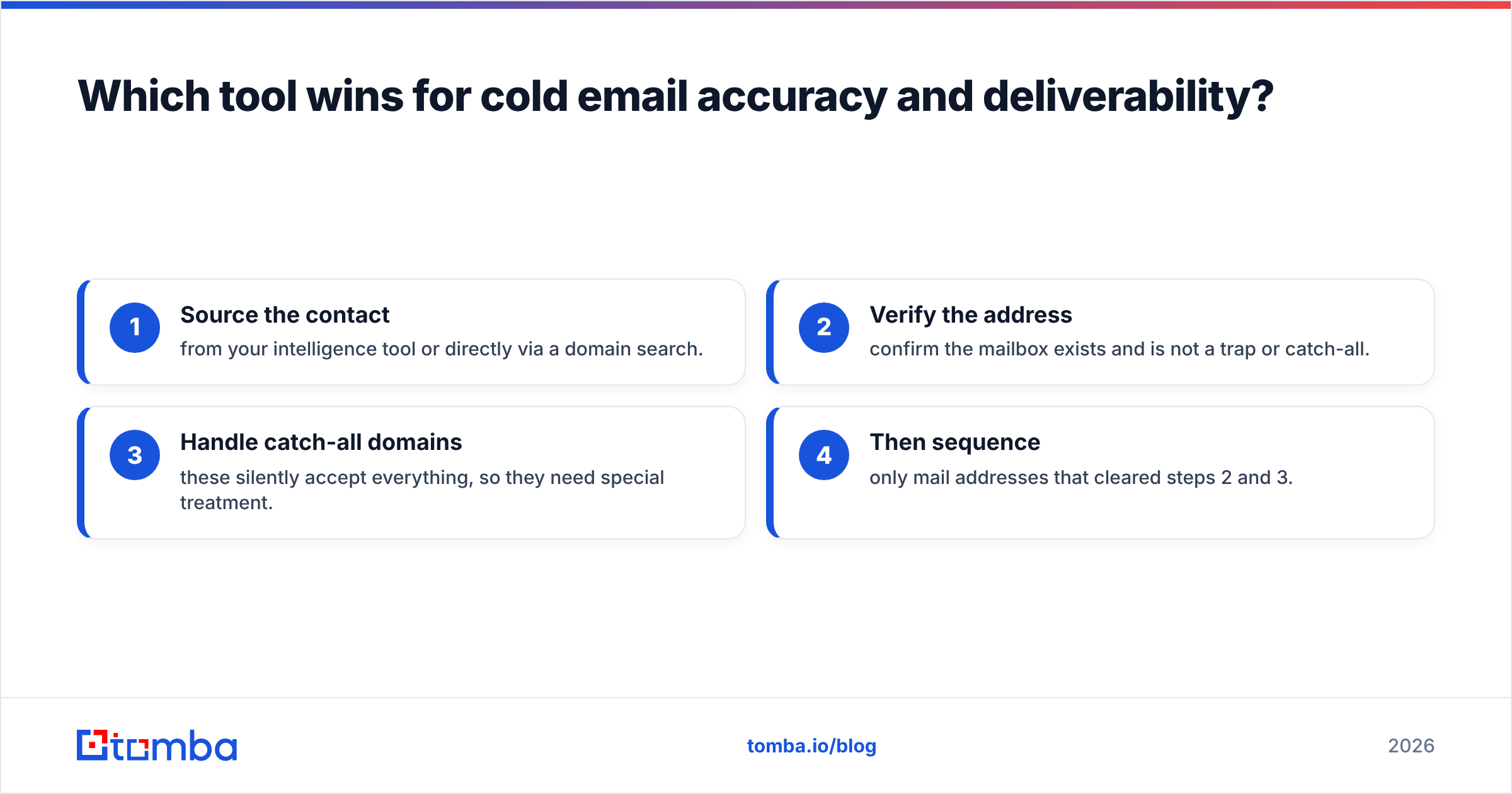
The fix is a verification gate between "who" and "send":
- Source the contact — from your intelligence tool or directly via a domain search.
- Verify the address — confirm the mailbox exists and is not a trap or catch-all.
- Handle catch-all domains — these silently accept everything, so they need special treatment.
- Then sequence — only mail addresses that cleared steps 2 and 3.
This is exactly the workflow Tomba's email verifier is built for, and the catch-all verifier handles the trickiest case — domains that accept every address and lie to your sending tool about validity. Pair that with the domain search when you know the company but not the person, and you have filled the gap both Bizkonnect and Sendflock leave open.

According to HubSpot's research on email marketing, list quality and segmentation drive far more of your results than send volume — which reinforces the point: the tool that sends is less important than the data it sends to. Industry review sites like G2 are useful for reading unfiltered user feedback on both Bizkonnect and Sendflock before you commit budget.
When should you choose Bizkonnect?#
Choose Bizkonnect when your problem is structural complexity inside accounts. Specific signals:
- You sell six-figure deals into enterprises with 8–15 person buying committees.
- Your reps waste hours guessing who actually signs off.
- Your ABM program needs department-level maps, not flat contact dumps.
- You already have a sending tool and a verification process, and the missing piece is intelligence.
Bizkonnect's org charts genuinely shorten the "who do I even talk to?" phase in big accounts. That is a real, defensible value — just remember the maps age, and a title is not an email.
When should you choose Sendflock?#
Choose Sendflock when your problem is outbound throughput. Specific signals:
- You run high-volume SMB or mid-market campaigns where targets are easy to identify.
- You need multi-inbox rotation, warmup, and sequence logic in one place.
- Your team is comfortable bringing its own verified list.
- You measure success in replies-per-week, not account-map depth.
Sendflock does the unglamorous sending work well. Its blind spot is the same as every sending tool: it trusts the list you upload. Garbage in, bounces out. If you want to understand the upstream discipline, the Instantly alternative breakdown covers how sending-tool buyers should think about data hygiene before scaling volume.
Can you use both together?#
Yes — and for enterprise ABM teams, the combination is logical: Bizkonnect builds the account map, Sendflock executes the outreach. But there is a missing third leg, and ignoring it is the most common mistake we see.
The complete stack looks like this:
- Intelligence layer (Bizkonnect or similar) → tells you who.
- Data + verification layer (an email finder plus verification) → turns names into deliverable, confirmed addresses.
- Sending layer (Sendflock or similar) → delivers and tracks at volume.
Skip the middle layer and you are pouring unverified data into a sending machine — which is how good domains end up on blocklists. You can sanity-check your own setup with a free SPF checker and blacklist checker before you scale.
Frequently asked questions#
Is Bizkonnect a cold-email tool? No. Bizkonnect is a sales-intelligence platform focused on org charts and account mapping. It is not designed to send sequences — pair it with a sending tool.
Is Sendflock an email finder? No. Sendflock automates sending and sequencing. It expects you to supply verified contacts, which means you still need a dedicated data and verification source.
Which is cheaper, Bizkonnect or Sendflock? They price on different bases (seats/credits vs sending volume), so there is no clean apples-to-apples answer. Factor in the hidden costs: stale-data re-pulls for Bizkonnect, extra mailboxes for Sendflock.
Do I still need a separate email verifier? Yes. Neither tool makes verification its core job, and unverified addresses are the fastest way to damage sender reputation. A dedicated email verifier is non-negotiable.
The bottom line#
Bizkonnect and Sendflock are not really rivals — they are two pieces of one funnel. Bizkonnect answers who to target; Sendflock answers how to reach them at scale. The piece both leave to you is the one that decides whether your campaign succeeds: accurate, verified contact data.
That is where Tomba slots in. Use the Tomba Email Finder to turn the names on your org chart into real, deliverable addresses, run them through verification before they ever hit your sequencer, and protect the sender reputation you have spent months building. Start free with 25 searches a month, and only feed your sending tool data you can actually trust.
// get started
Find, verify and enrich your first contacts today
Start on the free plan with 25 searches a month, then scale when your team is ready.
Free plan · No credit card required · GDPR & CCPA
// about the author